

Market Summary and Growth Forecast
The global Chemical Plant Ventilation Market will witness a robust CAGR of 5.9%, valued at $5.80 billion in 2026, expected to appreciate and reach $9.70 billion by 2035.
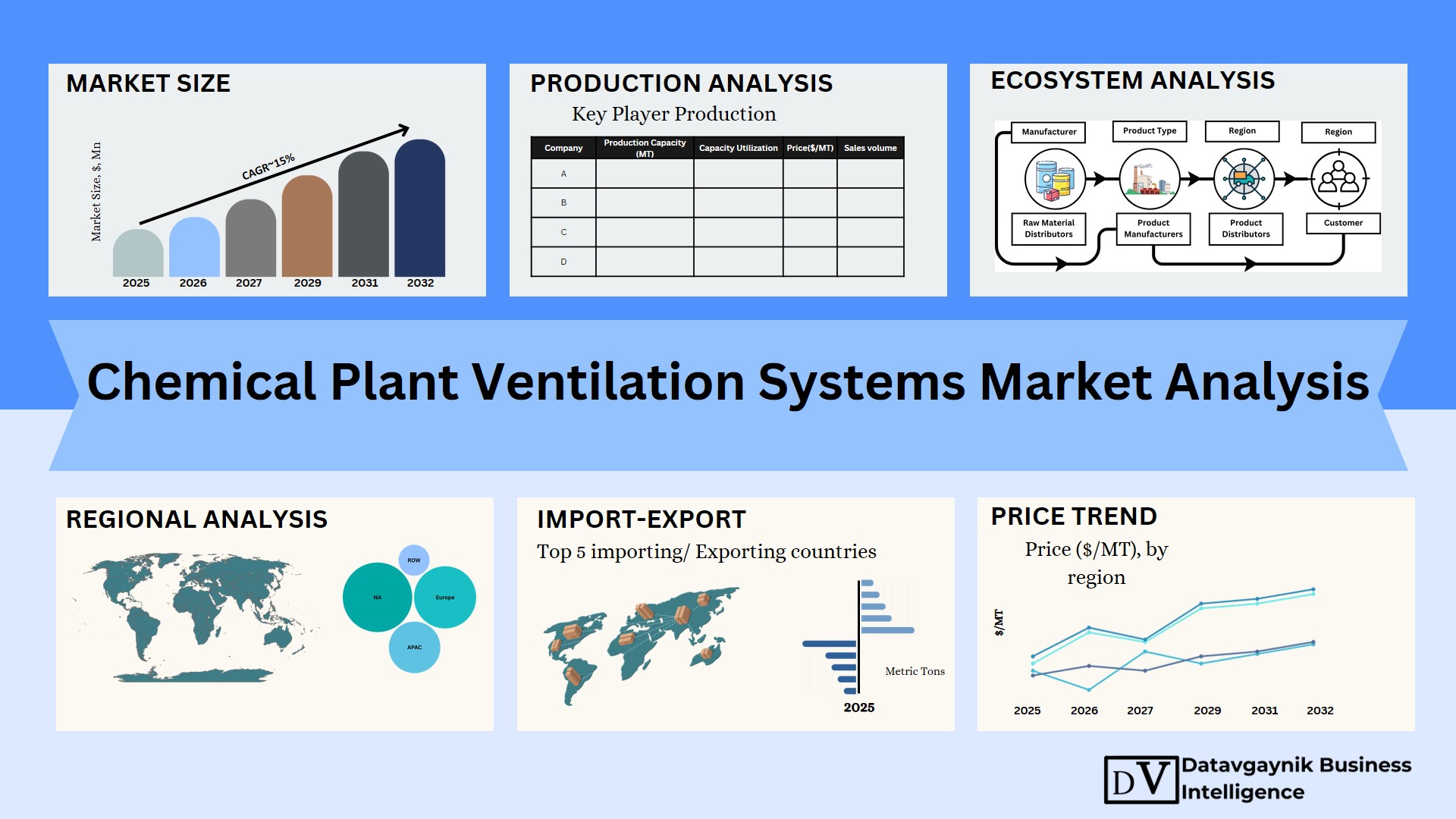
The Chemical Plant Ventilation Market covers engineered air movement, air treatment, fume capture, hazardous vapor control, make-up air, exhaust, explosion-proof ventilation, filtration, and connected monitoring systems used across chemical manufacturing sites. This is not ordinary factory ventilation. In chemical plants, ventilation is tied directly to worker safety, fire risk reduction, process continuity, emission control, and regulatory compliance. One weak air-handling zone can expose operators to vapors, create corrosive build-up, or increase the probability of an ignition event.
Datavagyanik also covers related markets such as the Wastewater Treatment Plant Ventilation Systems Market. They offer supporting insights that clarify downstream implications and strategic challenges in the context of the main topic.
The market’s strategic relevance in 2026–2035 is rising because chemical producers are being pushed to operate cleaner, safer, and more energy-efficient plants. Older facilities are also being retrofitted rather than fully rebuilt. That creates steady demand for modular ventilation upgrades, local exhaust ventilation, scrubber-linked exhaust systems, and digital airflow monitoring.
| Market Indicator | Estimate / Outlook |
| Global Market Size, 2026 | $5.80 billion |
| Projected Market Size, 2035 | $9.70 billion |
| CAGR, 2026–2035 | 5.9% |
| Primary Demand Base | Chemical, petrochemical, specialty chemical, agrochemical, and fine chemical plants |
| Core Growth Theme | Safety-led retrofits plus emission-control-linked ventilation upgrades |
| Most Attractive Investment Window | 2027–2032, as brownfield upgrades accelerate |
Several macro forces are shaping the market. First, chemical production is moving further toward Asia, especially China, India, Southeast Asia, and the Middle East. These regions are expanding basic chemicals, specialty chemicals, fertilizers, battery materials, and polymer capacity. New plants need full ventilation packages from the design stage. Older plants need safety modernization.
Second, regulation is becoming less forgiving. Authorities are not only looking at outdoor emissions. They are paying closer attention to indoor exposure, combustible vapors, toxic fumes, dust, corrosive mist, and emergency purge systems. This pushes companies to treat ventilation as a risk-control asset, not just a utilities line item.
Third, energy efficiency is now part of the buying decision. Ventilation can be power-intensive, especially in large chemical complexes running 24/7. So, buyers are asking for variable-speed drives, demand-based ventilation, better fan efficiency, corrosion-resistant ducting, and intelligent controls. The practical goal is simple: move enough air to keep people and assets safe without wasting energy every hour of the year.
Fourth, plant design is changing. More chemical facilities now include enclosed processing zones, high-containment production rooms, solvent handling areas, and automated packaging sections. These areas need targeted extraction rather than generic dilution ventilation. That is why local exhaust ventilation and zone-based control will gain share.
The Chemical Plant Ventilation Market is also becoming more service-heavy. Equipment sales remain important, but lifecycle value is shifting toward inspection, filter replacement, duct cleaning, airflow balancing, ATEX-rated upgrades, and predictive maintenance. This creates stronger aftermarket revenue for OEMs and engineering firms.
Key stakeholders include industrial ventilation OEMs, fan and blower manufacturers, air filtration companies, industrial HVAC contractors, EPC firms, chemical plant operators, process safety consultants, environmental engineering companies, worker safety regulators, fire safety authorities, industry associations, governments, private equity investors, and infrastructure-focused strategic investors.
Expert insight: the next decade will reward suppliers that can combine safety compliance, corrosion resistance, energy savings, and plant-level monitoring. Chemical companies don’t want fragmented vendors anymore. They want one accountable ventilation partner for design, installation, compliance, and service.
Market Segmentation and Forecast Scope
Segmentation for the Chemical Plant Ventilation Market should be built around how chemical plants actually buy and use these systems. Procurement teams usually do not think in one single bucket called “ventilation.” They split demand by equipment type, hazard zone, production area, end-use plant category, and region. This gives a clearer view of where value is created.
By Product Type
The market can be segmented into general exhaust and make-up air systems, local exhaust ventilation systems, explosion-proof fans and motors, air filtration and dust/fume collectors, corrosion-resistant ducting and dampers, scrubber-linked ventilation systems, and airflow monitoring and control systems.
Local exhaust ventilation systems are one of the most strategic categories because they capture fumes, vapors, and mist close to the source. This reduces operator exposure and limits contamination across the plant. This sub-segment is estimated to account for 31% of global revenue in 2026. Demand is especially strong in solvent handling, reaction vessels, formulation rooms, charging points, drum filling, and laboratory-scale production areas.
Explosion-proof fans and motors also remain critical. These are used in hazardous zones where flammable vapors, gases, or dust may be present. The segment benefits from upgrades in petrochemical plants, resin plants, coatings facilities, and agrochemical units.
Air filtration and dust/fume collectors are growing due to tighter worker exposure limits and the need to protect downstream equipment. Chemical dust can be toxic, combustible, sticky, or corrosive. So, filtration systems often require customized media, safe change-out designs, and compatibility with plant-specific compounds.
Scrubber-linked ventilation systems connect exhaust capture with treatment equipment. These systems are common in acid gas, ammonia, chlorine, solvent, and VOC-prone areas. They will gain importance where indoor air quality and external emission limits overlap.
By Application
By application, the market includes hazardous vapor control, toxic fume extraction, VOC management, combustible dust control, solvent room ventilation, temperature and humidity management, corrosive gas removal, emergency purge ventilation, and general plant air exchange.
Hazardous vapor control is the most safety-sensitive application. It supports flammable liquid handling, storage rooms, reaction zones, and enclosed process modules. This category is not driven only by comfort. It is driven by risk reduction.
VOC management is becoming more important as chemical companies face tighter scrutiny on solvent use and air emissions. Ventilation systems are increasingly integrated with carbon adsorption, wet scrubbers, condensers, or thermal treatment systems.
Emergency purge ventilation is a smaller but high-value segment. It is used where accidental vapor release or gas build-up could create immediate risk. These systems need fast response, reliable controls, and clear integration with plant alarms.
By End User
By end user, demand is divided into basic chemical producers, petrochemical plants, specialty chemical manufacturers, agrochemical plants, paint and coating producers, pharmaceutical and fine chemical plants, battery chemical producers, and industrial gas and reagent facilities.
Specialty chemical manufacturers are among the strongest adopters because they often handle multiple compounds in smaller batches. Their ventilation needs change by process, solvent, toxicity profile, and containment level. This creates demand for flexible and modular systems.
Battery chemical producers are emerging as a high-growth end-user group. Cathode materials, electrolyte solvents, lithium salts, and related intermediates require cleaner, safer, and more controlled production environments. This is a growth pocket to watch through 2035.
Petrochemical plants remain large-volume buyers due to the scale of their facilities. However, growth is more retrofit-led in mature regions and newbuild-led in Asia and the Middle East.
By Region
By region, the market is segmented into North America, Europe, Asia Pacific, and LAMEA.
Asia Pacific is the largest regional market and is estimated to hold 45% of global revenue in 2026. China remains the anchor market due to its chemical production scale. India is gaining momentum from specialty chemicals, agrochemicals, intermediates, and import-substitution manufacturing. Southeast Asia is also seeing selective investment in petrochemicals and downstream chemical processing.
North America is a strong retrofit and compliance market. Demand is supported by chemical plant modernization, worker safety investments, and replacement of older industrial ventilation systems.
Europe is more regulation-led. Energy efficiency, emission control, and plant safety upgrades are key demand triggers. However, slower chemical capacity expansion can limit volume growth compared with Asia.
LAMEA is uneven but attractive. The Middle East is expanding petrochemical and downstream chemical capacity, while Latin America and Africa show selective demand in fertilizers, mining chemicals, agrochemicals, and industrial chemicals.
| Segmentation Dimension | Core Sub-Segments | Strategic Outlook |
| By Product Type | Local exhaust ventilation, explosion-proof fans, filtration units, ducting, scrubber-linked systems, controls | Local exhaust and connected controls will outpace basic exhaust systems |
| By Application | Vapor control, VOC management, fume extraction, dust control, emergency purge, temperature management | Safety-critical and emission-linked applications will attract higher budgets |
| By End User | Petrochemicals, specialty chemicals, agrochemicals, fine chemicals, battery chemicals, coatings | Specialty chemicals and battery chemicals will offer stronger growth intensity |
| By Region | North America, Europe, Asia Pacific, LAMEA | Asia Pacific leads on new capacity; North America and Europe lead on retrofits |
Expert insight: the most attractive opportunity is not in basic exhaust fans. It sits in engineered packages that combine capture, treatment, monitoring, and compliance documentation. That is where buyers are willing to pay a premium.
Market Trends and Innovation Landscape
The innovation story in the Chemical Plant Ventilation Market is moving from “more airflow” to “smarter airflow.” For years, chemical plants used high-capacity ventilation as a blunt safety tool. That worked, but it wasted energy and often failed to solve localized exposure problems. The new approach is more precise. Capture contaminants near the source. Monitor airflow in real time. Adjust fan speed based on risk. Treat exhaust before discharge. Then document the system’s performance.
R&D Evolution
R&D is focused on four areas: hazard-specific ventilation design, energy-efficient airflow management, corrosion-resistant materials, and connected monitoring.
Chemical plants handle acids, solvents, alkalis, powders, monomers, intermediates, and reactive compounds. So, ventilation suppliers are moving toward application-specific engineering. A solvent charging area does not need the same system as a fertilizer dust zone. A chlorine handling room does not behave like a resin blending area. This is pushing vendors to develop more customized fan, duct, hood, damper, and filtration designs.
Energy use is another R&D priority. Large ventilation systems can run continuously. Even small efficiency gains can reduce operating costs over the equipment life. That is why variable frequency drives, high-efficiency impellers, aerodynamic duct layouts, and demand-controlled ventilation are gaining more attention.
Technology Evolution
The market is shifting toward sensor-led ventilation control. Plants are adding sensors for airflow, pressure differential, VOC concentration, temperature, humidity, and filter condition. These sensors help maintenance teams detect system underperformance before it becomes a safety issue.
This matters because many ventilation failures are not dramatic. A blocked filter, damaged duct, underperforming fan, or poorly balanced hood can slowly increase exposure risk. Digital monitoring helps plant teams catch these changes earlier.
AI integration is relevant but still selective. It is not yet universal across chemical ventilation systems. The strongest use cases are predictive maintenance, abnormal airflow detection, energy optimization, and alarm prioritization. For example, a system can learn normal pressure and airflow patterns across a solvent handling room. When readings drift, it can alert the maintenance team before production is affected.
Expert commentary: AI will not replace process safety engineering in this market. It will support it. The real value is earlier warning, better maintenance planning, and fewer blind spots inside complex plants.
Material Science and System Design
Material selection is central to chemical plant ventilation. Standard steel ducting may not survive in corrosive environments. So, vendors are using stainless steel, FRP, PVC, polypropylene, coated metals, and specialty elastomers depending on the gas stream and temperature.
Corrosion-resistant fans and ductwork are especially important in acid handling, chlor-alkali, fertilizer, pigment, and specialty chemical units. Poor material selection can lead to leakage, contamination, maintenance shutdowns, and unsafe working conditions.
Filtration media is also evolving. Chemical dust and fume control often requires media that can handle moisture, sticky particles, fine powders, or reactive dust. Safe-change filters, cartridge designs, anti-static media, and high-temperature options are becoming more common in specialized areas.
Partnerships, M&A, and Industry Announcements
Recent industry activity shows a wider shift toward clean air, filtration, and smarter industrial HVAC platforms.
Camfil has expanded its air filtration footprint through acquisitions and local-market strengthening, supporting broader access to industrial filtration and clean-air solutions. This matters for chemical users because local service presence is often as important as equipment selection.
Johnson Controls has been reshaping its HVAC and building technology portfolio, including divestments in residential and light commercial HVAC. For industrial users, the broader signal is clear: large building technology firms are focusing more on intelligent controls, energy performance, and integrated safety environments.
Donaldson continues to push connected monitoring in dust, fume, and mist collection. This aligns well with chemical plant needs where filter condition, airflow reliability, and maintenance timing influence safety and uptime.
Howden, under Chart Industries, remains relevant in mission-critical air and gas handling. Its position in industrial fans and engineered airflow systems links directly to heavy process industries, including chemicals and petrochemicals.
Nederman remains active in industrial air filtration and fume extraction, with a portfolio positioned around worker protection and clean production environments. Its relevance is strongest in localized capture, extraction, and air pollution control.
Future Impact
The next wave of innovation will be shaped by three buyer priorities: compliance confidence, energy reduction, and operational visibility. Plants will not buy ventilation only when something breaks. They will upgrade because insurers, regulators, internal EHS teams, and production leaders need proof that risk is being managed.
By 2035, the Chemical Plant Ventilation Market will likely look more integrated, with ventilation systems connected to plant safety dashboards, emission controls, and predictive maintenance platforms. That may quietly change the buying center too. EHS, operations, maintenance, engineering, and finance will all have a stronger say in vendor selection.
Competitive Intelligence and Benchmarking
The competitive landscape in the Chemical Plant Ventilation Market is fragmented but technically demanding. No single company controls the full market because customer needs vary by plant type, chemical hazard, airflow requirement, ducting material, and regulatory exposure. The strongest suppliers are those that can serve more than one layer of the system: fans, filtration, exhaust capture, controls, monitoring, service, and compliance support.
Key Company Benchmarking
| Company | Portfolio Positioning | Market Position and Strategic Relevance |
| Camfil | Air filtration, molecular filtration, clean-air systems, gas-phase filtration, and filtration packages for corrosive or contaminant-heavy environments | Camfil is positioned as a premium filtration and clean-air specialist. Its strength is not basic ventilation hardware. It sits closer to air quality, gas-phase contaminant control, and high-performance filtration. This is valuable for chemical plants dealing with VOCs, corrosive gases, odor control, and clean production environments. |
| Donaldson | Dust, fume, mist, cartridge collection, replacement filters, industrial filtration service, and connected filtration monitoring | Donaldson is strong in industrial dust and fume collection. Its fit is especially clear in dry chemical powders, bulk solids handling, fine chemical processing, and plants where filter performance affects worker exposure and uptime. The company also benefits from recurring aftermarket demand. |
| Nederman | Source capture, fume extraction, dust collection, industrial filtration systems, ducting, and airflow optimization solutions | Nederman has a strong position in extraction-led clean air systems. It is relevant where the customer needs localized capture rather than broad air exchange. Its value is strongest in fume-prone process areas, combustible dust environments, and brownfield plants seeking lower energy use. |
| Howden / Chart Industries | Heavy-duty fans, blowers, air and gas handling equipment, process fans, and engineered airflow systems | Howden is better aligned with heavy process applications. It has strength in large-scale chemical, petrochemical, refining, and gas-handling environments. Its position is more engineering-led than catalog-led. That matters in high-pressure, high-volume, corrosive, or mission-critical ventilation zones. |
| Greenheck | Commercial and industrial fans, process exhaust fans, fume exhaust systems, make-up air systems, and air movement equipment | Greenheck is highly visible in engineered fan and air movement applications. It is particularly relevant in North America where specification channels, contractors, and plant engineers need reliable exhaust and make-up air solutions. Its strength is breadth and application flexibility. |
| Johnson Controls | HVAC systems, automation, controls, fire safety, industrial refrigeration, building management, and critical environment integration | Johnson Controls is not a pure chemical ventilation supplier. Its role is stronger in controls, monitoring, plant infrastructure, safety systems, and integrated facility management. It can participate where chemical facilities want HVAC, fire safety, and digital building systems connected into one operating layer. |
| Twin City Fan & Blower | Custom, semi-custom, and standard industrial fans for heavy-duty process, exhaust, and OEM applications | Twin City Fan & Blower serves the engineered fan segment with customization depth. It is relevant for chemical plants that need application-specific fan designs for process exhaust, fumes, corrosive air streams, or demanding duty cycles. |
Competitive Positioning View
The market can be viewed across three supplier groups.
First, filtration-led companies such as Camfil, Donaldson, and Nederman capture value where contaminant control is the main need. These firms benefit from filter replacement cycles, service contracts, and safety-led upgrades.
Second, fan and air-movement specialists such as Howden, Greenheck, and Twin City Fan & Blower compete in engineered airflow, exhaust, make-up air, and severe-duty applications. Their advantage comes from reliability, technical selection, and customization.
Third, integration-led players such as Johnson Controls participate where chemical plants need ventilation tied to broader safety, automation, alarms, and building management systems.
In the Chemical Plant Ventilation Market, differentiation is moving away from equipment alone. Buyers now ask sharper questions. Can the system reduce energy use? Can it prove airflow performance? Can it manage corrosive gases? Can it support audits? Can it be serviced locally?
Expert insight: the strongest vendors will be those that sell “controlled air risk,” not just fans and filters. Chemical plants are moving toward accountable systems. That means design, installation, monitoring, documentation, and maintenance will increasingly be bundled.
Regional Landscape and Adoption Outlook
Regional adoption in the Chemical Plant Ventilation Market follows the geography of chemical manufacturing, regulation, and brownfield modernization. Asia leads in new capacity. North America and Europe remain strong retrofit markets. Japan and South Korea are mature but technically demanding. The Rest of the World offers pockets of growth where petrochemicals, fertilizers, and industrial chemicals are expanding.
| Region | 2026 Market Estimate | 2035 Market Estimate | Adoption Outlook |
| North America | $1.16 billion | $1.76 billion | Retrofit-led, compliance-heavy, strong in petrochemicals and specialty chemicals |
| Europe | $1.04 billion | $1.52 billion | Regulation-led, energy-efficiency driven, slower capacity expansion |
| China | $1.62 billion | $2.78 billion | Largest demand base, supported by chemical scale and plant modernization |
| India | $0.41 billion | $0.82 billion | Fast-growth market led by specialty chemicals, agrochemicals, and intermediates |
| Japan | $0.29 billion | $0.41 billion | Mature, quality-driven, retrofit and safety-focused |
| South Korea | $0.23 billion | $0.33 billion | Petrochemical restructuring plus selective upgrades in high-value chemicals |
| Rest of the World | $1.05 billion | $2.08 billion | Middle East, Southeast Asia, Latin America, and Africa offer uneven but rising demand |
North America
North America remains a high-value market because plants often operate under strict worker safety, fire protection, environmental, and insurance requirements. The United States leads regional demand due to its petrochemical base on the Gulf Coast, specialty chemical clusters, battery material investments, and ongoing plant modernization. Canada contributes through industrial chemicals, fertilizers, mining chemicals, and process manufacturing.
Adoption is mostly retrofit-driven. Plants are replacing old fans, improving local exhaust capture, adding VOC control, and integrating ventilation alarms into facility systems. Funding is available, but buyers are disciplined. They want projects with safety justification, energy savings, and limited downtime.
White space exists in aging mid-sized chemical plants where ventilation systems were designed for older production layouts and now struggle with modern EHS expectations.
Europe
Europe is shaped by regulation, energy cost pressure, and industrial decarbonization. Germany, France, Belgium, the Netherlands, Italy, Spain, and the Nordic countries are the key demand centers. Europe has some of the world’s most advanced chemical facilities, but the region also faces high energy costs and weaker commodity chemical economics.
This creates a mixed outlook. Newbuild demand is slower than Asia. However, retrofit demand remains meaningful because plants need safer, cleaner, and more energy-efficient ventilation. Demand-controlled ventilation, high-efficiency fans, and emission-control-linked exhaust systems should gain traction.
The strongest white space is in chemical plants that must comply with tighter industrial emission rules but cannot justify full facility rebuilds. These sites will prefer targeted ventilation upgrades.
China
China is the largest national market. It has the biggest chemical manufacturing base and a wide spread of petrochemical, fine chemical, battery chemical, polymer, fertilizer, and specialty chemical plants. Demand is supported by new capacity, relocation of hazardous chemical plants into industrial parks, stricter safety oversight, and rising automation.
China’s adoption curve is moving from basic ventilation toward engineered systems. Large producers are investing in better process safety, VOC control, explosion-proof equipment, and digital plant monitoring. Local suppliers compete aggressively on price. International suppliers still hold advantage in complex filtration, critical process fans, and high-spec systems.
China is not just a volume market. It is becoming a technical market for high-risk chemical production zones.
India
India is one of the fastest-growing markets through 2035. Growth is supported by specialty chemicals, agrochemicals, dyes and pigments, pharmaceutical intermediates, battery materials, and import-substitution manufacturing. Gujarat, Maharashtra, Andhra Pradesh, Telangana, Tamil Nadu, and parts of northern India are important demand centers.
Adoption is still uneven. Large export-oriented chemical companies invest in strong ventilation and EHS systems. Smaller plants often operate with older exhaust setups or low-cost ducting. That gap creates a large retrofit opportunity.
Regulation, customer audits, insurer pressure, and global supply-chain qualification will push Indian plants toward better local exhaust ventilation, scrubber-linked exhaust, and hazardous vapor control.
Japan
Japan is mature but technically advanced. The market is led by specialty chemicals, electronics chemicals, polymers, fine chemicals, and high-purity manufacturing environments. Buyers place strong emphasis on reliability, material compatibility, energy efficiency, and low downtime.
Growth is modest in absolute terms, but replacement quality is high. Japanese buyers are more likely to specify corrosion-resistant materials, precision airflow, and quieter operation. The strongest demand is in semiconductor chemicals, battery materials, fine chemicals, and specialty resins.
South Korea
South Korea has a large petrochemical base and a strong position in battery materials, electronic chemicals, polymers, and specialty materials. Ulsan, Yeosu, Daesan, and other industrial clusters drive demand. However, parts of the petrochemical sector are facing overcapacity and margin pressure.
That said, restructuring does not eliminate ventilation demand. It changes the type of demand. Instead of broad newbuild expansion, more spending shifts toward safety upgrades, modernization, energy reduction, and process consolidation.
The strongest white space is in high-value chemical and battery material plants where worker safety, solvent control, and clean production standards are tightening.
Rest of the World
Rest of the World includes Southeast Asia, the Middle East, Latin America, Africa, Australia, and selected Eastern European markets. The Middle East is the strongest sub-region due to petrochemical and downstream chemical expansion in Saudi Arabia, the UAE, Qatar, and Oman. Southeast Asia is gaining traction in chemicals, polymers, coatings, and specialty processing. Brazil and Mexico lead Latin American demand, while Africa is more selective and tied to fertilizers, mining chemicals, and industrial chemicals.
The biggest white space is in mid-tier industrial parks where chemical production is expanding faster than safety infrastructure. Buyers often start with basic exhaust systems. Over time, they need hazardous fume capture, dust collection, VOC management, and emergency purge systems.
End-User Dynamics and Use Case
End-user adoption depends on the hazard profile of the plant. A petrochemical complex, an agrochemical formulation unit, and a battery electrolyte facility may all buy ventilation systems, but their operating logic is different.
Petrochemical and Basic Chemical Plants
Petrochemical and basic chemical plants use ventilation for hazardous vapor dilution, process exhaust, pump-room ventilation, compressor areas, tank farm support buildings, and emergency purge systems. Explosion-proof fans, robust motors, gas detection integration, and high-reliability exhaust systems are critical.
These users usually have larger budgets and formal engineering standards. However, buying decisions can be slow because systems must pass safety review, process hazard analysis, and operational approval.
Specialty Chemical Manufacturers
Specialty chemical manufacturers are among the most attractive customers. They often operate batch processes with frequent changeovers. This creates variable fume loads and different solvent, vapor, and dust profiles. Modular local exhaust systems, flexible ducting, scrubber-linked exhaust, and airflow monitoring are highly relevant.
These plants also face customer audits, especially when supplying global pharmaceutical, electronics, automotive, and consumer goods companies.
Agrochemical and Fertilizer Producers
Agrochemical and fertilizer producers need ventilation for powder handling, toxic vapor control, reaction areas, granulation, drying, packaging, and corrosive gas management. Dust collection and scrubber-connected exhaust are important. Some facilities also need combustible dust risk management.
Adoption in this segment is rising because many agrochemical plants are expanding exports and must meet stricter safety expectations from global buyers.
Fine Chemical and Pharmaceutical Intermediate Plants
Fine chemical and pharmaceutical intermediate plants use ventilation as part of containment, solvent control, odor reduction, and operator protection. These facilities typically need tighter zoning, pressure control, and high-quality extraction near reactors, centrifuges, dryers, and charging points.
This segment is less about large airflow volume and more about controlled capture. That makes engineering quality more important than basic fan capacity.
Battery Chemical Plants
Battery chemical plants are an emerging end-user group. Electrolytes, cathode precursors, lithium salts, solvents, and specialty additives require controlled environments. Ventilation systems must handle solvent vapors, corrosive fumes, humidity control, and safety risks linked to reactive materials.
This segment should outpace the broader market because battery material capacity is expanding across China, South Korea, Japan, Europe, India, and North America.
Use Case Scenario
An export-oriented specialty chemical producer in Gujarat upgraded its solvent charging and reactor hall ventilation after customer audits flagged inconsistent vapor capture near manual charging points. The plant installed localized extraction hoods, corrosion-resistant ducting, VOC sensors, variable-speed exhaust fans, and a scrubber-linked exhaust line. The change reduced odor complaints inside the production block, improved operator comfort, and helped the company document airflow performance during audits. The bigger benefit was operational confidence. The plant could run higher-value products without relying on temporary exhaust fixes or manual workarounds.
This use case reflects a common pattern in the market. Ventilation upgrades are often triggered by audits, safety incidents, capacity expansion, or export qualification. Once installed, the system supports compliance and production continuity.
Expert insight: end users are no longer treating ventilation as a one-time mechanical purchase. For higher-risk chemical plants, it is becoming part of the plant’s operating license, audit readiness, and customer credibility.
Recent Developments + Opportunities & Restraints
Recent Developments
| Year / Month | Event | Impact on the Industry |
| August 2024 | The EU’s revised Industrial Emissions Directive entered into force. | This strengthens the regulatory backdrop for industrial emission management. Chemical plants in Europe will face stronger pressure to document and reduce emissions. Ventilation systems tied to VOC capture, scrubbers, and process exhaust upgrades should benefit. |
| September 2024 | Nederman highlighted intelligent airflow control for fume and dust extraction systems. | This supports the shift from constant-flow extraction to demand-based airflow. Chemical plants can use similar logic to reduce energy waste while maintaining safe capture at active process points. |
| February 2025 | Camfil launched a new energy-efficient compact filter solution for HVAC and air filtration applications. | Energy-efficient filtration is becoming more relevant as industrial users look for lower pressure drop, longer filter life, and reduced system operating cost. |
| August 2025 | Johnson Controls completed the sale of its residential and light commercial HVAC business to Bosch. | The transaction sharpened Johnson Controls’ focus on commercial building solutions, controls, safety, and performance platforms. This supports a broader market shift toward integrated facility systems. |
| December 2025 | Camfil acquired F.C.R. in Italy to expand local air filtration expertise. | The deal strengthens Camfil’s European filtration footprint and local service capability. For chemical plants, local engineering support and replacement filter availability are important buying factors. |
Opportunities
Emerging chemical manufacturing hubs offer the largest demand upside. India, Southeast Asia, the Middle East, and selected Latin American markets are expanding chemical output. Many plants are still under-equipped on engineered ventilation. This gives suppliers room to sell upgrades beyond basic fans.
Automation and remote monitoring are becoming stronger value drivers. Demand-controlled ventilation, airflow sensors, filter condition monitoring, and connected dashboards can reduce energy use while improving audit readiness. This is especially relevant for multi-zone plants.
Brownfield retrofit demand is another major opportunity. Many chemical plants were built before current expectations on VOC control, worker exposure, and combustible dust risk. Retrofitting is often cheaper and faster than rebuilding, so targeted ventilation projects will keep moving.
Restraints
High upfront cost remains a barrier. Full ventilation upgrades can require fans, ducting, controls, civil work, power connections, scrubbers, sensors, and shutdown planning. Smaller chemical plants may delay investment unless pushed by regulators or customers.
Customization slows project execution. Chemical ventilation is rarely plug-and-play. Material compatibility, vapor profile, dust behavior, airflow balance, and hazardous-area classification must be checked before installation.
Chemical industry cyclicality can delay capex. When commodity chemical margins weaken, plant owners often prioritize maintenance over major upgrades. This affects large ventilation projects, especially in regions facing overcapacity or high energy costs.
Expert insight: the opportunity is real, but suppliers need to sell measurable outcomes. Energy savings, exposure reduction, downtime control, and audit documentation will matter more than equipment brochures.


