

Market Summary and Growth Forecast
The global Climate-Controlled Ventilation Systems Market will witness a robust CAGR of 7.1%, valued at USD 18.6 billion in 2026, expected to appreciate and reach USD 34.4 billion by 2035. The market covers ventilation platforms that regulate airflow, temperature, humidity, filtration, air exchange, pressure balance, and indoor air quality across commercial, residential, healthcare, industrial, institutional, transport, and controlled-environment facilities.
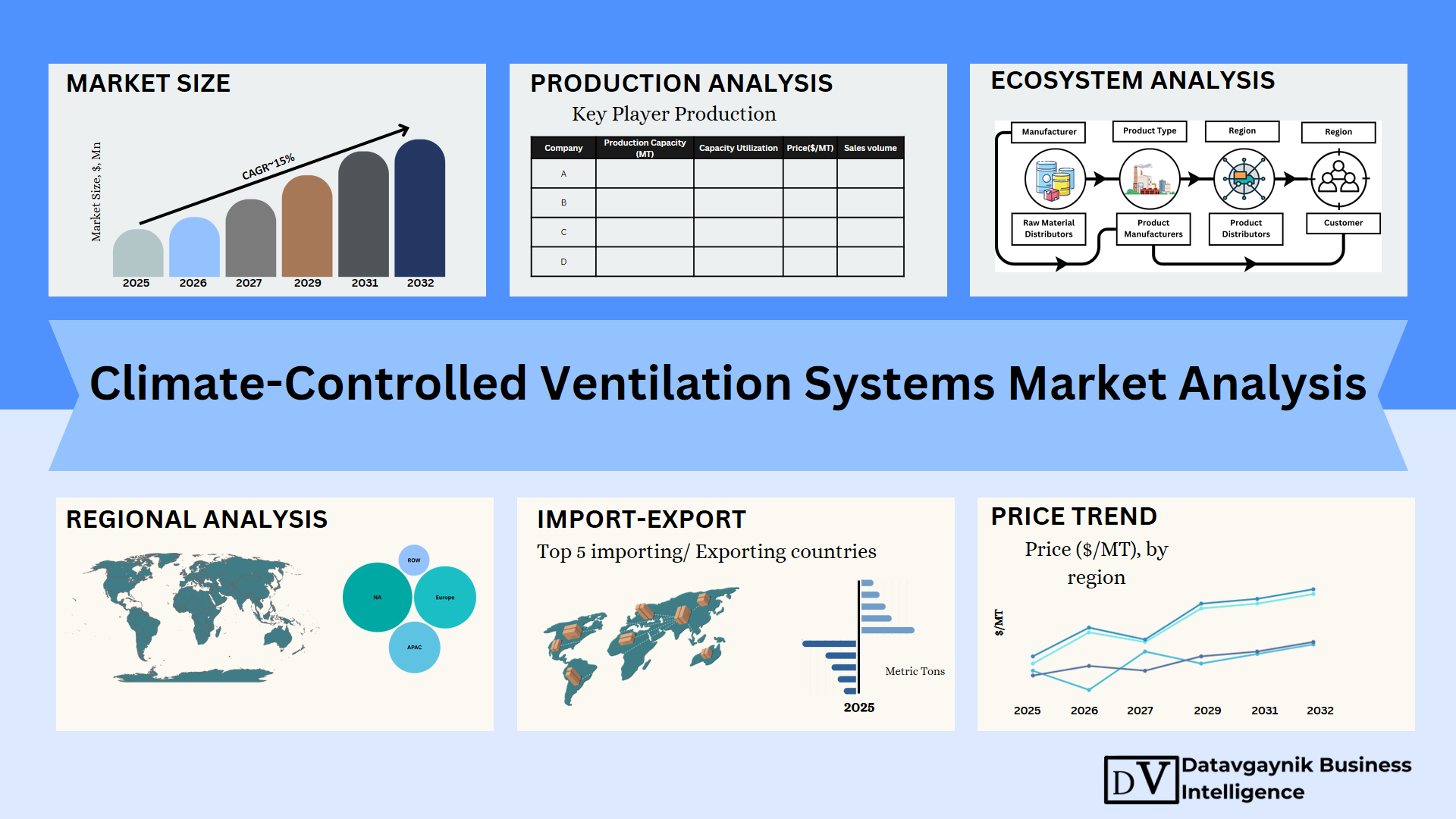
This is no longer a conventional ventilation equipment market. By 2026, demand is shifting toward intelligent systems that can adjust fresh air intake based on occupancy, CO₂ levels, particulate load, external weather, humidity, energy pricing, and building automation signals. That changes the buying logic. Customers are not only purchasing fans, ducts, dampers, air handling units, heat recovery ventilators, or control panels. They are buying operating efficiency, regulatory comfort, infection-risk reduction, and better indoor environmental control.
The strategic relevance of this market during 2026–2035 comes from one simple pressure point: buildings need more air quality control without allowing energy bills to move out of control. Ventilation increases safety and comfort, but unmanaged ventilation wastes energy. So, the strongest demand is coming from systems that combine climate control with energy recovery, demand-controlled ventilation, smart sensors, air quality monitoring, and integration with building management systems.
The Climate-Controlled Ventilation Systems Market is also being shaped by tougher building efficiency targets, indoor air quality standards, green building certification, hospital-grade ventilation expectations, and rising retrofits in older commercial properties. Europe is pushing hard through building energy performance rules. North America is seeing stronger replacement demand in schools, hospitals, offices, laboratories, and public buildings. Asia Pacific is adding volume through new construction, high-rise commercial buildings, electronics manufacturing, data centers, airports, and healthcare infrastructure.
Production dynamics are also changing. OEMs are redesigning systems around modular air handling units, variable-speed fans, energy recovery cores, low-noise ventilation, electronically controlled dampers, smart thermostats, connected sensors, and cloud-based monitoring. For industrial and mission-critical users, the value is even more direct. Semiconductor fabs, pharmaceutical cleanrooms, food processing units, indoor agriculture facilities, data centers, and precision manufacturing sites need stable temperature and humidity bands. A small airflow imbalance can affect yield, compliance, worker safety, or equipment reliability.
Expert insight: The market’s growth will not come only from new buildings. Retrofit will become the real volume engine. Older offices, schools, hospitals, hotels, factories, and public buildings are being forced to improve ventilation performance while cutting energy intensity. That combination creates a strong replacement cycle for smart and climate-responsive ventilation systems.
A practical way to view the opportunity is by system maturity. Basic ventilation systems will continue to sell in cost-sensitive projects, but the revenue premium is moving toward connected and sensor-led platforms. In 2026, smart and demand-controlled systems are estimated to represent around 31% of global revenue. By 2035, this share could move closer to 43%, as building owners seek lower operating costs and better compliance documentation. Energy recovery ventilation is another high-value area, especially in regions with extreme heat, cold, or humidity.
Commercial buildings will remain the largest demand pool in 2026, supported by offices, retail, hospitality, airports, education, and healthcare facilities. Industrial and controlled-environment applications will grow faster, though from a smaller base. The reason is clear. These users treat ventilation as a productivity and compliance system, not just a comfort system.
Key stakeholders in this market include ventilation system OEMs, HVAC equipment manufacturers, building automation companies, sensor suppliers, energy service companies, mechanical contractors, engineering consultants, real estate developers, hospitals, data center operators, pharmaceutical manufacturers, food processors, indoor farming operators, government agencies, building code authorities, green building councils, utilities, institutional investors, and infrastructure funds.
From an investment standpoint, the market is attractive because it sits at the intersection of decarbonization, health, automation, and infrastructure modernization. The winners will not necessarily be the lowest-cost equipment suppliers. They will be companies that can combine equipment reliability, controls intelligence, service coverage, retrofit capability, and lifecycle energy savings into one practical offering.
So, the 2035 outlook is positive but selective. Demand will rise across regions, but margin expansion will favor systems with measurable energy savings, indoor air quality reporting, remote diagnostics, and integration with broader building platforms. In short, the market is moving from air movement to controlled indoor climate performance.
Market Segmentation and Forecast Scope
The Climate-Controlled Ventilation Systems Market is best segmented by system type, control technology, application, end user, and region. This structure keeps the market clean and avoids overlap between equipment form, operating logic, and customer environment. It also helps separate volume-heavy conventional systems from higher-value intelligent ventilation platforms.
| Segmentation Dimension | Coverage Scope | Strategic Relevance |
| By Product Type | HVAC-integrated ventilation systems, energy recovery ventilation systems, heat recovery ventilation systems, demand-controlled ventilation systems, cleanroom and controlled-environment ventilation systems, industrial climate ventilation units | Shows how revenue moves from standard air movement toward energy-efficient and sensor-led systems |
| By Control Technology | Manual control, programmable control, sensor-based control, IoT-enabled control, AI-assisted optimization | Captures the shift from fixed ventilation settings to adaptive air management |
| By Application | Temperature control, humidity control, air filtration, fresh air exchange, pressure balancing, contamination control, indoor air quality management | Explains why systems are selected across buildings, process environments, and regulated facilities |
| By End User | Commercial buildings, residential buildings, healthcare facilities, industrial plants, data centers, laboratories, indoor agriculture, public infrastructure | Separates comfort-led demand from compliance-led and process-critical demand |
| By Region | North America, Europe, Asia Pacific, LAMEA | Tracks regulatory pressure, construction intensity, retrofit demand, and industrial expansion |
By product type, HVAC-integrated ventilation systems represent the broadest installed base because they are used across offices, retail properties, hotels, schools, airports, hospitals, and residential complexes. These systems are usually bundled into wider heating, cooling, and air handling packages. In 2026, HVAC-integrated ventilation systems are estimated to account for around 38% of global revenue, making them the largest product category. Their share is high because replacement cycles in commercial buildings remain steady and new construction still relies heavily on centralized HVAC design.
Energy recovery and heat recovery ventilation systems form the most strategically important segment. They reduce the energy penalty linked with fresh air exchange, especially in cold, hot, or humid climates. This makes them highly relevant in Europe, North America, Japan, South Korea, and premium commercial projects in China and the Gulf. Their adoption is also rising in schools, hospitals, laboratories, hotels, and high-performance residential buildings. The segment is expected to grow faster than conventional ventilation because it solves a practical problem: more fresh air without a sharp increase in heating or cooling load.
Demand-controlled ventilation is the fastest-moving technology layer within the market. These systems use occupancy, CO₂, humidity, particulate, temperature, and sometimes VOC sensors to adjust airflow in real time. The logic is simple. Empty rooms do not need the same ventilation rate as crowded rooms. So, demand-controlled systems help reduce energy waste while maintaining indoor air quality. In 2026, sensor-based and IoT-enabled ventilation controls are estimated to represent about 29% of total market revenue. This share should rise steadily as building operators look for measurable energy savings and better indoor air documentation.
By application, indoor air quality management remains the central demand driver across commercial and institutional buildings. That said, humidity control and pressure balancing are more important in healthcare, laboratories, electronics manufacturing, food processing, and pharmaceutical facilities. Temperature control is the baseline need, but it rarely operates alone. In higher-value installations, temperature, humidity, filtration, and air exchange are managed together as one controlled environment.
By end user, commercial buildings hold the largest revenue base in 2026, supported by offices, retail chains, hospitality assets, educational campuses, airports, and mixed-use properties. Healthcare and laboratories generate smaller volumes but higher specification value. These facilities need filtration, directional airflow, infection control, humidity stability, and regulatory-grade documentation. Industrial users also represent an important growth pocket, especially where ventilation affects worker safety, product quality, emissions control, or process stability.
Data centers are emerging as a specialized demand area. Their ventilation requirement is not the same as traditional comfort ventilation. Operators need thermal stability, airflow control, redundancy, and energy efficiency. This creates demand for advanced air handling, economizer-based ventilation, heat rejection integration, and remote system monitoring.
Indoor agriculture is another smaller but fast-growing segment. Controlled-environment farms need stable temperature, humidity, CO₂ balance, airflow distribution, and disease prevention. These systems are often designed around crop productivity rather than occupant comfort. That creates a different buying logic and higher customization potential.
Regionally, Asia Pacific is expected to remain the largest and fastest-expanding demand pool through 2035, backed by construction growth, industrial expansion, healthcare investment, electronics manufacturing, and urban infrastructure. North America will be led by retrofit demand, school ventilation upgrades, healthcare replacement cycles, and demand-controlled systems. Europe will continue to favor energy recovery and low-carbon building upgrades because regulation is sharper and energy prices remain a serious operating concern. LAMEA will expand from a smaller base, with the Gulf countries, Brazil, Mexico, and South Africa creating selective demand in hospitals, airports, malls, hotels, food processing, and industrial facilities.
Expert commentary: The segmentation story is moving from equipment categories to performance outcomes. Customers are no longer asking only what system moves air. They are asking how much energy it saves, whether it supports compliance, how well it manages indoor air quality, and whether it can be monitored remotely.
For the forecast period 2026–2035, the highest-growth sub-segments are expected to be demand-controlled ventilation, energy recovery ventilation, smart building-integrated systems, healthcare-grade ventilation, data center ventilation, and controlled-environment systems for industrial and agricultural applications. Conventional ventilation will still generate large volumes, especially in price-sensitive markets, but value growth will sit in intelligent, efficient, and application-specific platforms.


