

Market Summary and Growth Forecast
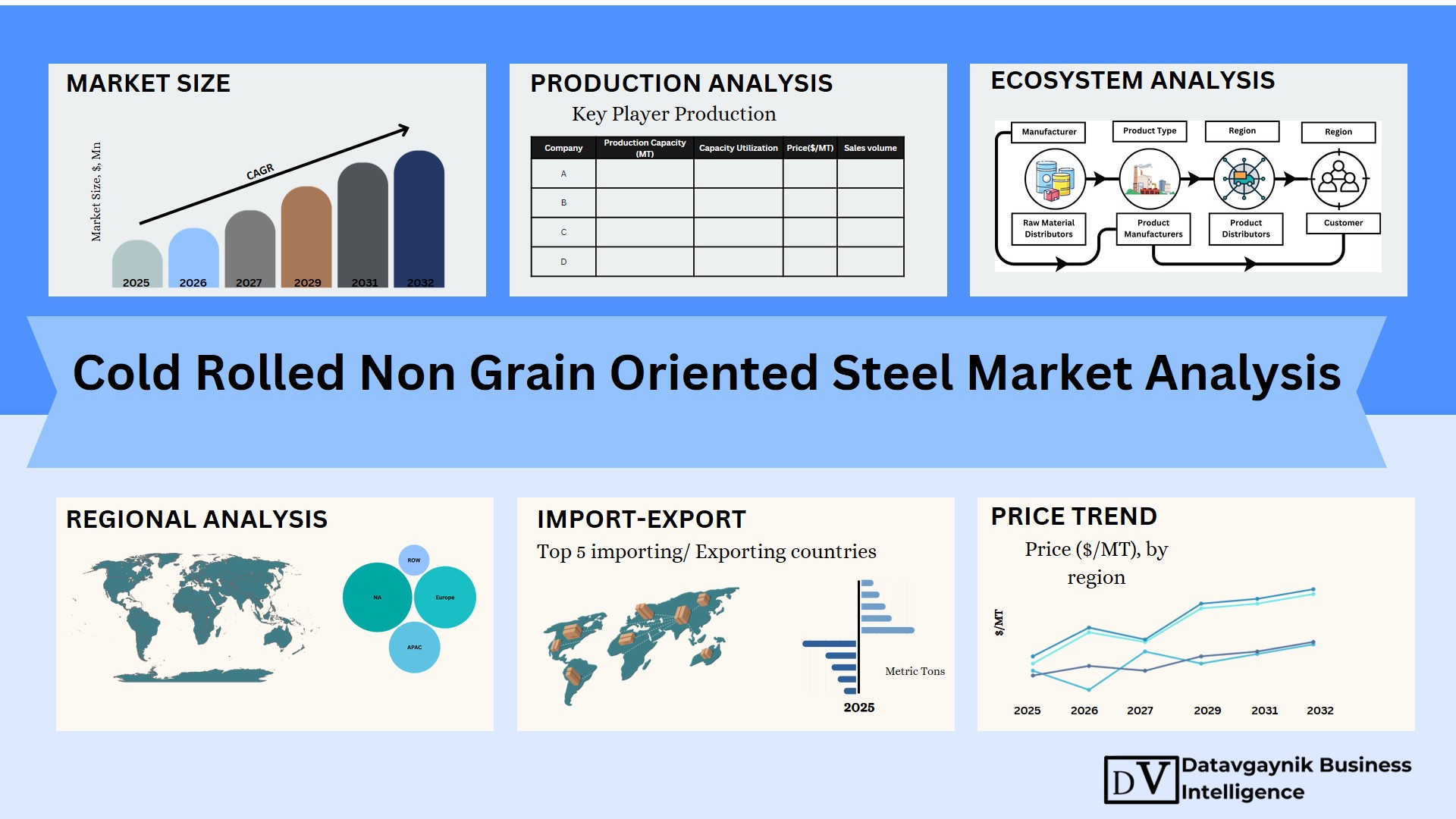
The global Cold Rolled Non Grain Oriented Steel Market will witness a robust CAGR of 5.3%, valued at $19.6 billion in 2026, expected to appreciate and reach $31.1 billion by 2035.
Cold rolled non grain oriented steel is a specialized electrical steel used mainly in rotating electrical machines where magnetic performance is required in multiple directions. Unlike grain oriented steel, which is optimized for transformer cores, non grain oriented steel supports motors, generators, compressors, pumps, alternators, appliances, industrial drives, and electric vehicle traction systems. Its value sits in a simple but critical point: it helps reduce core losses, improve magnetic permeability, and raise motor efficiency without changing the entire machine architecture.
The Cold Rolled Non Grain Oriented Steel Market is entering a strategically important period during 2026–2035 because motor efficiency is no longer a narrow engineering topic. It is now tied to electrification, power cost, climate regulation, industrial automation, and grid-connected equipment demand. Every additional efficiency gain in a motor or generator can reduce lifetime energy consumption. That makes this steel category more important than its share of the wider flat steel industry would suggest.
Demand in 2026 is estimated at nearly 7.8 million metric tons, with revenue reaching $19.6 billion. By 2035, volume demand is projected to move toward 11.3 million metric tons, while value reaches $31.1 billion. The value growth will remain slightly stronger than volume growth because demand is shifting toward thinner gauges, higher silicon grades, lower-loss grades, and high-purity electrical steel designed for compact motors and high-speed applications.
| Metric | 2026 Estimate | 2035 Forecast | Market Direction |
| Global Market Size | $19.6 billion | $31.1 billion | Premiumization-led growth |
| Global Volume Demand | 7.8 million metric tons | 11.3 million metric tons | EVs and industrial motors add scale |
| CAGR | 5.3% | 2026–2035 | Above conventional flat steel growth |
| Average Realization | $2,510 per metric ton | $2,750 per metric ton | Mix shift toward high-efficiency grades |
The market is being shaped by three macro forces. First, electrification is pushing motor content higher across vehicles, factories, buildings, HVAC systems, home appliances, and renewable power equipment. Second, energy-efficiency regulations are forcing motor producers to move toward better magnetic materials. Third, steelmakers are investing in tighter process control because electrical steel performance depends on chemistry, annealing, coating, gauge uniformity, and texture management.
Production is still concentrated around integrated steelmakers with advanced cold rolling and annealing capabilities. China, Japan, South Korea, Germany, India, and the United States are the main production and consumption nodes. Asia Pacific carries the largest demand pool because it combines electric vehicle manufacturing, appliance exports, industrial motor production, and large-scale steelmaking capacity. Europe and North America remain smaller in volume but important in high-grade demand because of strict efficiency norms and automotive electrification programs.
The stakeholder map is broad. Steel producers, motor OEMs, EV manufacturers, compressor manufacturers, industrial automation companies, appliance brands, power equipment makers, automotive Tier-1 suppliers, governments, energy-efficiency regulators, industry bodies, investors, and electrical steel processors all influence demand. For investors, the key question is not whether demand will rise. It is where the premium pool will sit. The answer is increasingly clear: low-loss material for EV traction motors, industrial IE4 and IE5 motors, high-speed compressors, and compact generator systems.
Expert commentary: This market will not behave like a plain commodity steel category. Margins will separate sharply between standard motor laminations and high-efficiency electrical steel. Producers with clean steel chemistry, thin-gauge capability, and reliable magnetic property control will capture a larger share of value than volume alone suggests.
Market Segmentation and Forecast Scope
The Cold Rolled Non Grain Oriented Steel Market can be segmented by product type, thickness range, application, end user, and region. This segmentation is important because demand does not move uniformly. Appliance motors, EV traction motors, industrial drives, and generator systems all use non grain oriented steel, but their grade requirements, loss tolerance, and price sensitivity are very different.
By Product Type
The market is primarily split into fully processed cold rolled non grain oriented steel and semi-processed cold rolled non grain oriented steel. Fully processed grades are supplied with final magnetic properties already developed through annealing and insulation coating. These grades are preferred by motor manufacturers that need predictable performance and tight loss limits. Semi-processed grades require further heat treatment by downstream users and are generally used where cost control or process customization matters more.
In 2026, fully processed grades account for an estimated 71% of global revenue. This share is rising because EV motors, high-efficiency industrial motors, premium appliances, and compressor applications need controlled magnetic behavior. Semi-processed grades remain relevant in cost-sensitive regional supply chains, particularly where downstream lamination and annealing ecosystems are mature.
By Thickness Range
Thickness is one of the most important technical dimensions in this market. Standard gauges such as 0.50 mm and 0.65 mm are widely used in general motors, home appliances, pumps, and small machinery. Thinner gauges such as 0.35 mm, 0.30 mm, and below are gaining share in EV traction motors and high-frequency applications because thinner sheets help reduce eddy current losses.
The fastest-growing thickness group through 2035 will be 0.35 mm and below. It will benefit from high-speed motor design, compact powertrain architecture, and premium compressor demand. That said, standard gauges will remain the volume base because industrial motors and appliance motors still dominate total usage.
By Application
Key applications include electric vehicles, industrial motors, home appliances, HVAC compressors, generators, pumps, fans, power tools, and small rotating machines. Industrial motors remain the largest consumption category because of their huge installed base across manufacturing, water systems, mining, chemicals, oil and gas, building systems, and process industries.
In 2026, industrial motors represent around 34% of global revenue. EV traction motors are smaller in absolute demand but carry the strongest growth profile. The reason is straightforward: EV platforms require high-efficiency, compact, high-speed motors where electrical steel loss performance directly affects range, thermal behavior, and motor size.
By End User
The main end users include automotive OEMs, motor and generator manufacturers, home appliance producers, HVAC equipment manufacturers, industrial equipment companies, and electrical steel service centers. Automotive OEMs and Tier-1 motor suppliers will become more influential buyers because EV motors require tighter supplier qualification and long-term grade consistency.
Motor manufacturers remain the technical center of demand. They decide grade selection based on core loss, magnetic induction, punching performance, coating quality, stacking factor, and supply reliability. Service centers also matter because they process coils into laminations, blanks, and slit materials for smaller motor producers that do not buy directly from steel mills.
By Region
The regional scope includes North America, Europe, Asia Pacific, and LAMEA. Asia Pacific leads by a wide margin because China, Japan, South Korea, and India sit at the center of motor manufacturing, EV production, appliance exports, and electrical steel capacity. Europe is more regulation-led, with demand tied to high-efficiency motors, premium industrial equipment, and electric mobility. North America is gaining relevance due to reshoring interest, motor efficiency standards, EV manufacturing investments, and grid equipment demand. LAMEA remains smaller but offers long-term upside through industrialization, HVAC demand, and infrastructure-linked motor consumption.
| Segmentation Dimension | Key Sub-Segments | Strategic Outlook Through 2035 |
| By Product Type | Fully processed, semi-processed | Fully processed grades gain share due to tighter magnetic performance needs |
| By Thickness | 0.65 mm, 0.50 mm, 0.35 mm, below 0.35 mm | Thin gauges grow faster in EV and high-speed motor designs |
| By Application | Industrial motors, EV traction motors, appliances, HVAC compressors, generators | EV traction motors deliver the highest value growth |
| By End User | Automotive OEMs, motor OEMs, appliance makers, HVAC firms, service centers | Automotive and motor OEMs become more specification-driven buyers |
| By Region | North America, Europe, Asia Pacific, LAMEA | Asia Pacific leads volume while Europe and North America drive premium-grade adoption |
Expert commentary: The most attractive sub-segments are not always the biggest. Industrial motors will keep the demand base stable, but EV traction motors and high-efficiency compressors will shape pricing power. That is where steelmakers can defend premiums if they can meet loss, gauge, and coating consistency requirements.
Market Trends and Innovation Landscape
Innovation in the Cold Rolled Non Grain Oriented Steel Market is moving around one core objective: reducing electrical losses without compromising manufacturability. The market is no longer only about producing electrical steel at scale. It is about producing grades that let OEMs design smaller, lighter, cooler, and more efficient motors.
R&D activity is concentrated in five areas: lower core loss, higher magnetic induction, thinner gauges, better insulation coatings, and improved punchability. These may sound technical, but they directly affect commercial outcomes. A lower-loss grade can support better motor efficiency. A thinner sheet can improve high-frequency performance. A better coating can reduce interlaminar losses and improve stacking quality. Improved punchability reduces tool wear and scrap during lamination production.
Material science is especially relevant here. Non grain oriented electrical steel performance is shaped by silicon and aluminum content, impurity control, grain size, crystallographic texture, surface roughness, coating quality, and annealing conditions. Producers are tuning these variables more precisely because motor designers want predictable performance across large coil batches. This is important for EV traction motors, where small variation in magnetic loss can affect thermal management and energy consumption.
Technology evolution is also visible in downstream processing. Laser scribing is more common in grain oriented steel, but for non grain oriented steel the focus is on precision rolling, controlled annealing, better coating systems, advanced inspection, and digital quality control. Steelmakers are using process data to monitor gauge consistency, surface defects, magnetic property variation, and coating uniformity. AI is not a headline driver of demand, but it is becoming useful inside production quality systems. It helps identify defects earlier, reduce property variation, and improve yield in premium electrical steel lines.
EV demand is one of the clearest innovation triggers. Global electric car sales crossed 20 million units in 2025, equal to roughly one-fourth of new car sales worldwide. This has raised demand for traction motor materials that can support high rpm, compact designs, and better energy efficiency. Motor-efficiency regulation is also pushing the market. In the European Union, certain motor categories from 75 kW to 200 kW are required to meet IE4 efficiency levels, while the United States has also moved toward tighter electric motor conservation standards with compliance impact from the second half of the decade.
Recent corporate activity shows how electrical steel is becoming a strategic asset. JSW Steel and JFE Steel have been expanding their electrical steel position in India through acquisition and fresh investment. In October 2024, their joint venture agreed to acquire thyssenkrupp Electrical Steel India, a business with cold rolled grain oriented and cold rolled non grain oriented electrical steel capability. In August 2025, JFE Steel said its total electrical steel investment linked to India would reach about ¥290 billion, including prior investment and acquisition activity. This matters because India is moving from import dependency toward localized electrical steel production for power equipment, motors, and mobility applications.
At the product level, the next wave of competition will be around high-efficiency grades for EVs and premium motors. Standard grades will remain important, but they will face pricing pressure when supply expands. Premium low-loss grades will be harder to commoditize because they require tighter metallurgical control and long qualification cycles with OEMs.
Partnerships between steelmakers, motor producers, and automotive companies are also becoming more important. EV programs need material validation early in the design cycle. Once a motor platform is qualified, switching suppliers is not easy because steel grade behavior influences lamination design, thermal performance, noise, vibration, and efficiency. This creates a sticky demand base for approved suppliers.
Expert commentary: By 2035, the winners will not be defined only by tonnage. They will be defined by grade depth, OEM qualification, and the ability to provide repeatable magnetic performance at industrial scale. Cold rolled non grain oriented steel is becoming a design material, not just an input material.
Competitive Intelligence and Benchmarking
Competition in the Cold Rolled Non Grain Oriented Steel Market is concentrated around integrated steelmakers with deep control over steel chemistry, cold rolling, annealing, coating, and magnetic property testing. This is not a market where any flat steel producer can quickly enter and compete at the premium end. Qualification takes time. Motor OEMs test loss values, magnetic induction, coating strength, lamination behavior, punchability, and batch consistency before approving a supplier.
The competitive field can be divided into three groups. The first includes global technology leaders with high-grade electrical steel portfolios. The second includes regional scale producers serving appliance and industrial motor demand. The third includes emerging suppliers trying to localize electrical steel capacity in fast-growing markets such as India and Southeast Asia.
China Baowu Steel Group holds one of the strongest volume positions globally. Its advantage comes from China’s large domestic ecosystem for EVs, industrial motors, appliances, compressors, and electrical equipment. The company serves a wide band of non-oriented electrical steel demand, from general motor grades to higher-grade material used in mobility and industrial applications. Its market position is strongest in Asia Pacific where domestic motor manufacturing depth supports large-scale offtake.
Nippon Steel remains one of the technology benchmarks in electrical steel. Its strength lies in high-quality magnetic sheet production, process know-how, and long-standing relationships with automotive and industrial customers. The company has been investing to expand high-grade non-oriented electrical steel capacity for eco-friendly vehicles, with its earlier announced investment program targeting stronger output capability by the first half of fiscal 2027. This places Nippon Steel in the premium-grade segment rather than just volume-led competition.
JFE Steel is positioned as a strong Japanese supplier with capability across electrical steel and advanced flat steel grades. Its role has become more strategic through its India partnership with JSW Steel. The joint platform gives JFE Steel exposure to a fast-growing local market where power equipment, motors, EVs, and manufacturing expansion are raising demand for electrical steel. The company’s competitive edge sits in technology transfer, quality systems, and premium-grade development.
POSCO benefits from South Korea’s dense automotive, electronics, shipbuilding, industrial machinery, and appliance base. Its position is supported by domestic demand from Korean motor, compressor, and mobility supply chains. POSCO is not only a steel supplier. It sits inside a broader Korean industrial ecosystem where electrical steel demand is linked to EV platforms, premium home appliances, industrial equipment, and energy infrastructure.
ArcelorMittal is becoming more important in North America. Its planned facility in Calvert, Alabama is designed to produce up to 150,000 metric tons of non-grain-oriented electrical steel annually, supporting automotive, mobility, renewable electricity, and industrial motor applications. This investment directly addresses the limited domestic supply of advanced NOES in the United States. It also gives the company a stronger position with North American automotive and industrial customers seeking regional sourcing.
thyssenkrupp Electrical Steel has historically held a strong position in electrical steel through specialized production know-how and established customer relationships. Its India business became strategically important after the JSW-JFE acquisition agreement in October 2024, because the asset included both grain-oriented and non-grain-oriented electrical steel capability. This makes the business relevant not only as a producer but also as a bridge between mature European process experience and high-growth Indian demand.
JSW JFE Electrical Steel is a rising competitive force in India. Its position is not yet equivalent to the large Japanese, Chinese, or European incumbents, but its strategic relevance is high. India is trying to reduce import dependence in electrical steel. Local motor manufacturing, power equipment, rail electrification, EVs, and industrial automation all support a stronger domestic business case. The JSW-JFE platform gives India a credible route to build local capability in advanced electrical steel.
| Company | Portfolio Position | Market Strength | Strategic Relevance |
| China Baowu Steel Group | Broad non-oriented electrical steel grades | Scale and China demand access | Strongest in Asia Pacific volume pools |
| Nippon Steel | High-grade magnetic steel sheets | Technology depth and quality consistency | Premium EV and industrial motor exposure |
| JFE Steel | Advanced electrical steel capability | Japanese process know-how | India growth access through JSW partnership |
| POSCO | Electrical steel for industrial and mobility demand | Korean automotive and appliance ecosystem | Strong regional supplier for premium customers |
| ArcelorMittal | New NOES capacity planned in the U.S. | North American localization | Strategic for automotive and domestic supply security |
| thyssenkrupp Electrical Steel | Specialized electrical steel production | European process heritage | Relevant through India asset transfer |
| JSW JFE Electrical Steel | Localizing electrical steel capacity in India | Domestic growth platform | High long-term importance in import substitution |
Expert commentary: Competitive advantage is moving from “who can make electrical steel” to “who can repeatedly make the right grade at the right loss level for a qualified motor platform.” That difference will matter more as EV and high-efficiency motor customers become less tolerant of property variation.
Regional Landscape and Adoption Outlook
The regional demand structure of the Cold Rolled Non Grain Oriented Steel Market is highly uneven. Asia holds the strongest manufacturing base. Europe leads on efficiency regulation. North America is rebuilding local supply chains. India is emerging as a structural growth market. Japan and South Korea remain technology-heavy suppliers, even as domestic demographic and industrial growth is slower than in China or India.
North America
North America is moving from import-reliant demand toward selective localization. The United States has strong demand from automotive motors, hybrid vehicles, industrial drives, HVAC systems, compressors, generators, and grid-linked equipment. Historically, advanced electrical steel supply has been tighter in the region, especially for premium NOES grades used in higher-efficiency mobility and industrial applications.
The region’s growth is supported by reshoring, EV assembly investments, motor efficiency regulation, and demand from industrial automation. The U.S. Department of Energy has moved ahead with updated electric motor conservation standards, which indirectly supports demand for better magnetic materials because motor producers need every efficiency lever available.
White space exists in domestic premium-grade supply, downstream lamination capacity, and qualified material availability for automotive platforms. ArcelorMittal’s Alabama investment directly targets this gap.
Europe
Europe is a regulation-led premium market. The region does not always lead in volume growth, but it remains important for high-efficiency motors, industrial automation, automotive electrification, compressors, and renewable power systems. EU ecodesign rules require certain electric motors to meet high efficiency levels, including IE4 for motors between 75 kW and 200 kW from July 2023. This pushes OEMs toward lower-loss electrical steel.
Germany, Italy, France, and Central Europe are the key demand clusters. Germany leads through automotive and industrial equipment. Italy has a strong motor and machinery base. Eastern Europe benefits from manufacturing relocation and appliance production. The underserved area is not demand creation but supply-chain resilience. Europe needs more secure access to premium electrical steel as EV and industrial efficiency requirements rise.
China
China is the largest demand center and the most important production base. It combines EV manufacturing, appliance exports, industrial motor production, renewable equipment, pumps, compressors, and general machinery. The country’s scale advantage is difficult to match. Chinese producers also benefit from domestic offtake across thousands of motor and equipment manufacturers.
China’s adoption is moving in two directions at once. Standard grades remain large because appliance and general motor demand is huge. At the same time, high-grade non-oriented electrical steel is rising because EV traction motors and premium industrial equipment need lower losses. China Baowu Steel Group and other domestic producers are positioned to serve both ends of the market.
India
India is the most important emerging growth market through 2035. Demand is supported by industrial motor consumption, rail electrification, power equipment, appliances, HVAC expansion, EV localization, and manufacturing policy. India’s challenge is not demand visibility. It is domestic capability in higher-grade electrical steel and stable supply of qualified material.
The JSW-JFE platform and acquisition of thyssenkrupp Electrical Steel India signal a shift from import dependence toward local production. This is strategically important because Indian motor OEMs, power equipment manufacturers, and mobility suppliers need shorter supply chains and more reliable grade availability.
White space is visible in EV traction motor grades, high-efficiency industrial motor laminations, and localized service-center processing. India can become a major regional demand pool if capacity, quality, and OEM qualification improve together.
Japan
Japan is a mature but technically advanced market. Domestic growth is modest, but Japanese steelmakers remain central to high-grade electrical steel technology. Demand comes from automotive motors, industrial machinery, robotics, compressors, precision appliances, and export-linked motor supply chains.
Japan’s strength is process control and long-term customer qualification. Nippon Steel and JFE Steel are more influential than local demand size alone suggests. Their overseas partnerships also extend Japanese technology into India, Southeast Asia, and North America.
South Korea
South Korea has a compact but high-value demand structure. EVs, batteries, premium appliances, compressors, shipbuilding equipment, industrial motors, and electronics-linked manufacturing support electrical steel consumption. POSCO benefits from proximity to Korean automotive and appliance champions.
The country’s adoption will be led by higher-efficiency motor platforms rather than broad volume expansion. The white space lies in ultra-thin and lower-loss grades for high-speed motors, premium compressor systems, and export-oriented mobility components.
Rest of the World
The Rest of the World includes Southeast Asia, Latin America, the Middle East, and Africa. Southeast Asia has the strongest near-term potential because appliance manufacturing, motor assembly, and electronics supply chains continue to expand in countries such as Vietnam, Thailand, Indonesia, and Malaysia. Latin America demand is linked to industrial motors, HVAC, mining, pumps, and consumer appliances. The Middle East is smaller but can grow through industrial infrastructure, cooling systems, and energy projects.
Africa remains underpenetrated. Demand is limited by industrial base depth, but long-term opportunity exists in power infrastructure, water pumping, cooling, mining, and localized manufacturing. The main constraint is not end-use relevance. It is processing capacity, inventory access, and cost-effective supply.
| Region | Adoption Pattern | High-Growth Areas | White Space |
| North America | Localization and premium supply rebuild | Automotive, HVAC, industrial motors | Domestic NOES capacity and lamination ecosystem |
| Europe | Regulation-led premium demand | IE4 motors, automation, EVs | Supply-chain resilience |
| China | Largest production and demand base | EV traction motors, appliances, industrial drives | Premium-grade consistency at scale |
| India | Import substitution and industrial growth | Power equipment, EVs, motors, rail | Local high-grade electrical steel |
| Japan | Technology-led mature demand | Precision motors, eco-cars, robotics | Overseas growth leverage |
| South Korea | Premium industrial ecosystem | EVs, compressors, appliances | Ultra-thin high-efficiency grades |
| Rest of World | Emerging motor and appliance demand | Southeast Asia, Latin America | Processing and distribution infrastructure |
Expert commentary: Asia will keep the volume lead, but North America and India may deliver the most visible strategic change. One is rebuilding domestic capacity. The other is building capability from a lower base. Both shifts can reshape regional sourcing decisions by 2035.
End-User Dynamics and Use Case
End-user demand in the Cold Rolled Non Grain Oriented Steel Market is driven by how each customer group balances cost, efficiency, size, thermal performance, and reliability. The same steel category serves many industries, but the buying logic changes sharply by application.
Automotive OEMs and EV motor suppliers are the most specification-driven buyers. They need low-loss grades, tight thickness tolerance, high magnetic induction, stable coating performance, and strong batch repeatability. For EV traction motors, the steel grade affects range, heat generation, motor size, and acoustic behavior. Supplier approval can take years because the material must be validated through lamination production, motor testing, durability cycles, and platform-level performance checks.
Industrial motor manufacturers remain the largest end-user group by volume. Their demand spans low-voltage motors, medium-voltage motors, pumps, fans, compressors, conveyors, machine tools, and process equipment. Adoption is increasingly tied to IE3, IE4, and IE5 efficiency targets. These customers do not always need the most premium grade, but they need consistent steel that helps hit energy efficiency targets without making the motor too expensive.
Home appliance manufacturers use non-oriented electrical steel in washing machines, refrigerators, air conditioners, fans, small compressors, and kitchen appliances. Their focus is cost, noise reduction, efficiency, and high-volume supply stability. Premium appliance brands are shifting toward better motor systems because energy labels and consumer power consumption matter more than before.
HVAC and compressor manufacturers are becoming more important. Demand for air conditioning, refrigeration, heat pumps, and commercial cooling is expanding globally. Compressors need efficient motors that can operate reliably under thermal stress. Thin-gauge and lower-loss electrical steel can help reduce power consumption in high-duty-cycle systems.
Generator and power equipment manufacturers use these grades in rotating machines where magnetic performance and reliability are critical. Renewable power, backup power, distributed generation, and industrial power systems support this demand. The category is smaller than industrial motors but offers stable technical demand.
Electrical steel service centers and lamination specialists act as an important bridge between steel mills and smaller OEMs. They slit coils, cut blanks, produce laminations, manage inventory, and support regional motor makers. Their role is especially important in emerging markets where many motor manufacturers do not have direct purchasing relationships with global steel producers.
Use case: An electric two-wheeler motor manufacturer in India upgraded from a standard non-oriented electrical steel grade to a thinner low-loss grade for its traction motor laminations. The company did not redesign the full drivetrain. It adjusted lamination geometry and supplier qualification around the improved steel grade. The result was lower heat build-up during city-driving cycles and more stable motor efficiency under frequent acceleration. For the OEM, the benefit was not only range improvement. It also reduced thermal stress on the motor housing and helped simplify cooling requirements.
The adoption pattern is clear. High-volume users still buy on cost and availability. Premium users buy on measurable efficiency gains. This creates a two-speed market. Standard grades will compete on scale, logistics, and price. Advanced grades will compete on magnetic performance, qualification depth, and supply reliability.
Recent Developments + Opportunities & Restraints
Recent Developments
February 2025 – ArcelorMittal announced a new NOES facility in Alabama.
ArcelorMittal confirmed plans to build an advanced non-grain-oriented electrical steel manufacturing facility at Calvert, Alabama. The plant is designed for up to 150,000 metric tons of annual NOES capacity, depending on product mix, and will serve automotive, mobility, renewable electricity, industrial, and commercial applications. This is a direct response to limited domestic premium NOES supply in the United States.
March 2025 – ANDRITZ selected for ArcelorMittal’s electrical steel line.
ANDRITZ said it was selected as a supplier for the new ArcelorMittal electrical steel facility. The announcement confirms the technical buildout behind the Alabama project and reinforces the move toward localized advanced NOES production for automotive and industrial applications.
October 2024 – JSW-JFE joint venture agreed to acquire thyssenkrupp Electrical Steel India.
The JSW Steel and JFE Steel joint venture agreed to acquire thyssenkrupp Electrical Steel India for about $482.1 million. The acquired business includes cold rolled grain-oriented and cold rolled non-grain-oriented electrical steel capability. This gives India a stronger domestic platform for electrical steel production.
August 2025 – JSW and JFE announced additional electrical steel investment in India.
JSW Steel and JFE Steel announced a $669 million investment to expand electrical steel output in India. While the announcement centered on grain-oriented electrical steel capacity, it strengthens the broader electrical steel ecosystem, supplier base, processing capability, and technical collaboration between the two companies.
January 2025 – U.S. DOE expanded motor efficiency standards.
The U.S. Department of Energy adopted amended standards for expanded-scope electric motors. This is important for the electrical steel ecosystem because tighter motor efficiency requirements increase pressure on OEMs to use better magnetic materials, improved lamination designs, and more efficient production systems.
Opportunities
Emerging market localization is the strongest opportunity. India, Southeast Asia, and parts of Latin America need more localized electrical steel supply, processing, and lamination capacity. This is especially relevant as motor production expands outside traditional hubs.
EV traction motors and high-efficiency industrial motors create a premium-grade opportunity. These applications need thinner gauges, lower core losses, and stronger quality consistency. Suppliers that can meet qualification requirements will have pricing power.
Automation and quality-control systems can improve yield and consistency. Electrical steel production is sensitive to small process variations. Digital inspection, advanced process control, and predictive quality analytics can reduce defects and support premium-grade repeatability.
Restraints
High technical entry barriers limit new supply. Producing reliable non-oriented electrical steel requires precise chemistry, rolling, annealing, coating, and testing capability. This reduces the speed at which new entrants can compete in premium grades.
Raw material and energy cost volatility can pressure margins. Electrical steel production is energy-intensive and quality-sensitive. Sudden changes in power, alloying inputs, and logistics costs can affect pricing and supply stability.
OEM qualification cycles are slow. Even when new capacity comes online, motor and automotive customers may take years to approve suppliers. That can delay revenue conversion for new electrical steel investments.
Expert commentary: The best opportunity is not only new capacity. It is qualified capacity. Mills that can secure OEM approvals before supply tightens will be better positioned than producers that simply add tonnage and wait for demand to arrive.


