

AI Cluster Spending and HBM-Led Compute Density Push Datacenter GPU Market Growth
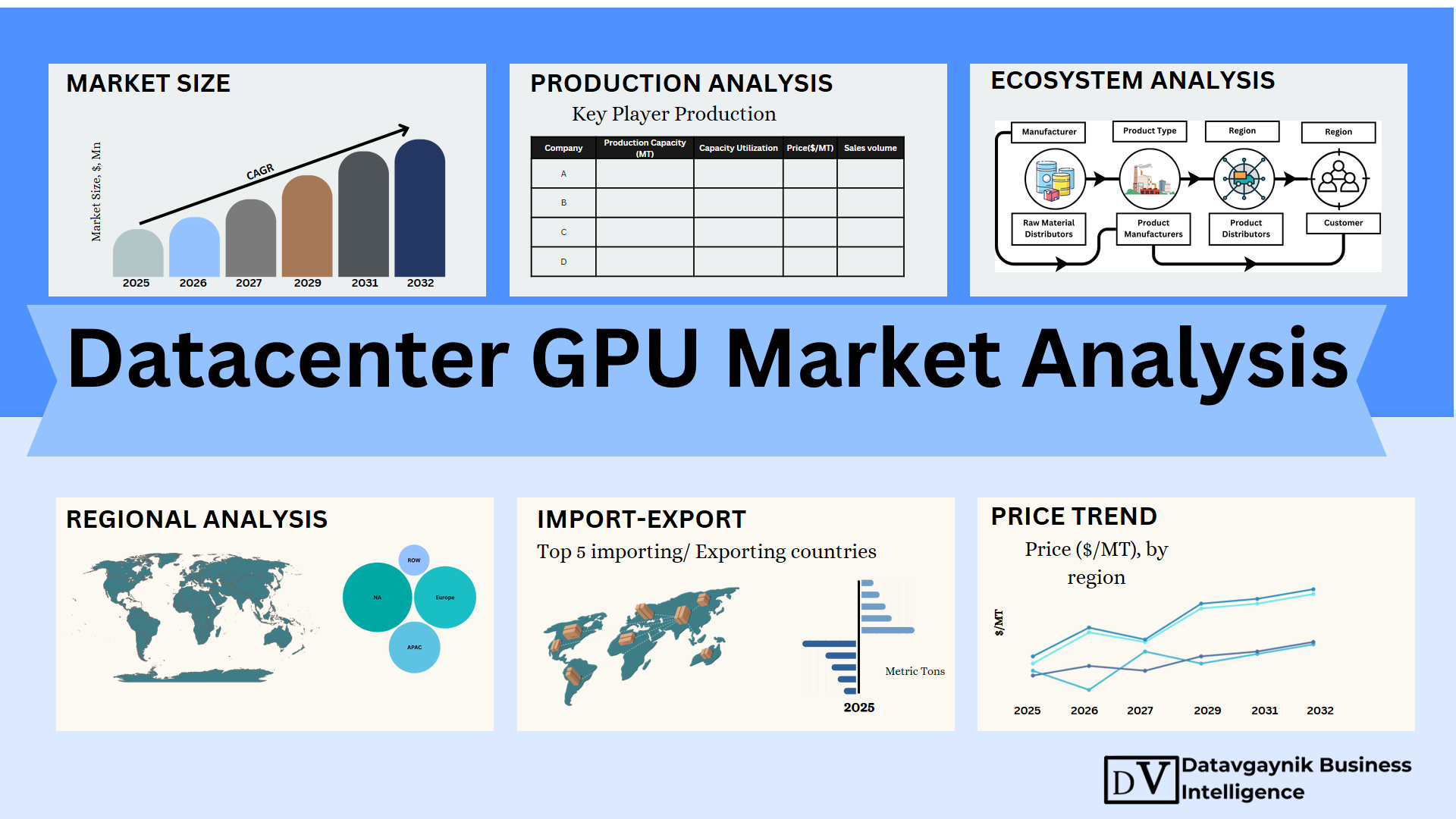
AI training clusters, hyperscale inference farms, sovereign AI programs, and high-performance computing upgrades are shifting GPU procurement from server-level purchases to rack-scale compute commitments. The Datacenter GPU Market is estimated at USD 218.4 billion in 2026 and is projected to reach USD 612.7 billion by 2032, advancing at a CAGR of 18.8%, as accelerator demand moves from experimental AI deployment to recurring infrastructure procurement. NVIDIA reported USD 62.3 billion in quarterly data center revenue for Q4 FY2026 and USD 193.7 billion in annual data center revenue, showing how AI accelerators have become the revenue center of compute infrastructure rather than an adjacent semiconductor category.
Datacenter GPU Demand is concentrated around three workload groups: frontier AI training, large-scale inference, and HPC simulation. Training clusters require high-end GPUs with HBM, high-speed interconnect, liquid-cooling readiness, and large memory bandwidth. Inference demand is broader because cloud providers, enterprise AI platforms, search engines, coding assistants, recommendation systems, and multimodal applications need lower latency and better cost per token. This changes the buying pattern from one-time accelerator installation to continuous GPU fleet expansion.
The strongest Datacenter GPU Trends are visible in rack-scale architecture. Individual PCIe accelerators are still used in enterprise and HPC systems, but hyperscalers are shifting toward integrated GPU platforms where accelerators, CPUs, networking, memory, power delivery, and cooling are sold as validated systems. NVIDIA’s Blackwell platform and GB200/NVL72-class systems illustrate this shift because performance depends on the full rack fabric, not only the GPU silicon. AMD also expanded its Instinct roadmap in June 2025 with MI350 series GPUs and open rack-scale AI infrastructure targeted at hyperscaler deployments including Oracle Cloud Infrastructure, adding competitive pressure in high-memory AI acceleration.
Supply constraints are no longer limited to front-end wafer fabrication. Advanced packaging, HBM availability, substrate capacity, and power-dense server integration now determine shipment timing. TSMC’s CoWoS platform supports large interposer integration for GPU-HBM packages, with CoWoS-S handling interposers up to about 2,700 mm², while larger designs require CoWoS-L or CoWoS-R. This packaging intensity explains why Datacenter GPU Growth is tied to foundry packaging capacity and HBM allocation rather than GPU design wins alone.
Memory bandwidth is becoming a stronger technical differentiator than peak compute alone. A 2026 technical study of NVIDIA datacenter GPUs found that FP16 and FP32 compute improved faster than off-chip memory size and bandwidth, with memory-related metrics doubling roughly every 3.32 to 3.53 years. This gap supports demand for HBM-rich accelerators, larger GPU memory pools, and higher-bandwidth interconnects because large language models, recommender systems, and simulation workloads frequently face memory and data-movement limits before theoretical compute limits.
Power is becoming a procurement filter. A 2025 NVIDIA Blackwell power-profile study reported up to 15% energy savings while maintaining more than 97% performance for selected HPC and AI workloads, enabling up to 13% higher throughput in power-constrained facilities. For hyperscale buyers, that translates into direct economic value because power availability, cooling design, rack density, and utility interconnection timelines increasingly determine how many GPUs can be deployed inside a campus.
AI Compute Demand Is Turning Datacenter GPU Production into a Packaging, Memory, and Power-Supply Constraint
Datacenter GPU production is now being pulled by AI model training, cloud inference, sovereign AI infrastructure, and HPC modernization at the same time. This demand-sector pressure has shifted the Datacenter GPU Market from a silicon-design race to a supply-chain execution race, where wafer allocation, advanced packaging slots, HBM supply, substrates, board assembly, liquid-cooling readiness, and power modules decide shipment volume.
The first production bottleneck is advanced-node wafer supply. NVIDIA, AMD, and cloud-custom accelerator programs depend heavily on TSMC’s 4nm, 5nm, and advanced packaging infrastructure. TSMC stated in June 2026 that AI chip demand would take a long time to fully satisfy, even with Arizona and Taiwan capacity expansion, while its Arizona output for advanced nodes is effectively committed through 2027. That keeps Datacenter GPU Demand tied to foundry prioritization rather than only end-customer orders.
The second bottleneck is CoWoS and other advanced packaging capacity. A datacenter GPU is not shipped as a simple die; high-end AI accelerators require GPU logic, multiple HBM stacks, large interposers, dense substrates, and strict thermal design. Industry estimates indicate global CoWoS demand rising from about 370,000 wafers in 2024 to nearly 1 million wafers in 2026, driven mainly by AI accelerators. That expansion still leaves allocation pressure because one rack-scale AI system consumes packaging capacity at a much higher rate than conventional server CPUs.
HBM supply is equally decisive. SK hynix said in June 2026 that it plans to double memory wafer capacity within five years, after spending about KRW 30.2 trillion in 2025 and preparing higher 2026 investment. The company also indicated that AI-related memory tightness could extend toward 2030. For the Datacenter GPU Market, this means GPU shipment growth depends on HBM3E and HBM4 availability, not just front-end GPU wafer starts.
Regional production remains concentrated across East Asia and the U.S.-linked design base. Taiwan controls the most important foundry and advanced packaging layer through TSMC. South Korea supplies a large portion of HBM through SK hynix and Samsung. Japan remains important for semiconductor materials, substrates, process chemicals, and equipment inputs. The U.S. controls core GPU design, software stacks, hyperscale procurement, and a growing share of AI infrastructure investment, but physical manufacturing remains distributed across foundry, OSAT, memory, PCB, and server assembly partners.
Server assembly adds another constraint. Datacenter GPUs must be integrated into HGX, OAM, PCIe, or rack-scale systems with high-current power delivery, retimers, networking, liquid-cooling components, and validation cycles. Foxconn, Quanta, Wistron, Wiwynn, Supermicro, Dell, HPE, and Lenovo play a larger role because GPU demand converts into complete AI server and rack demand. A single high-density AI rack can require tens of kilowatts of power, making power shelves, cooling loops, cables, and facility readiness part of the production equation.
Datacenter GPU Trends also show a shift from component shipment to platform shipment. Blackwell-class and MI350-class systems require coordinated supply across GPU die, HBM, CoWoS, substrates, NICs, switches, CPUs, firmware, and thermal hardware. This favors suppliers with pre-qualified platforms, long-term capacity reservations, and direct hyperscaler relationships.
AI Training, Inference, and HPC Workloads Are Splitting Datacenter GPU Market Segmentation by Memory Bandwidth and Deployment Scale
The Datacenter GPU Market is segmented less by basic chip type and more by workload intensity, memory configuration, server form factor, and buyer category. Demand is moving toward accelerators that combine high HBM capacity, fast interconnect, dense rack integration, and optimized power profiles because AI workloads are no longer served efficiently by isolated accelerator cards.
Key segmentation structure includes:
- By GPU form factor: PCIe GPUs, SXM/OAM accelerators, rack-scale GPU systems
• By workload: AI training, AI inference, HPC simulation, graphics/visualization, data analytics
• By memory configuration: HBM2E, HBM3, HBM3E, HBM4-ready platforms
• By deployment type: hyperscale cloud, colocation AI cloud, enterprise private AI, national supercomputing, research clusters
• By buyer group: hyperscalers, AI model developers, sovereign AI programs, enterprises, HPC labs, managed GPU cloud providers
AI training remains the highest-value segment because large model pre-training and fine-tuning require dense GPU clusters with high-bandwidth interconnect. NVIDIA’s GB200 NVL72 architecture, with 72 Blackwell GPUs and 36 Grace CPUs inside one liquid-cooled rack-scale system, reflects how the premium segment is shifting from accelerator cards to full compute domains. This segment carries higher system value because buyers purchase GPUs, CPUs, NVLink fabric, networking, cooling, and rack infrastructure as one integrated platform.
AI inference is becoming the fastest-expanding volume segment. Enterprises that do not train frontier models still need GPU capacity for search, code generation, customer-service assistants, retrieval-augmented generation, recommendation engines, fraud detection, and multimodal processing. In June 2026, Megaport secured four AI infrastructure contracts worth A$458.9 million and planned a US$594 million capital raise to build distributed inference cloud capacity, mainly around NVIDIA GPUs and related infrastructure. That shows Datacenter GPU Demand is spreading beyond hyperscalers into latency-sensitive regional inference clouds.
By product tier, the premium segment is dominated by high-HBM accelerators such as NVIDIA Blackwell-class systems and AMD Instinct MI350-series platforms. AMD’s June 2025 MI350 launch positioned the MI350X and MI355X for generative AI and HPC, with up to 3.9x generation-on-generation AI compute improvement and up to 35x inferencing uplift, indicating why buyers are segmenting GPU procurement by workload efficiency rather than only peak FLOPS.
Memory-led segmentation is also becoming stronger. AMD’s MI350X platform configuration includes 8 GPUs with 2.3 TB of HBM3E and 8 TB/s memory bandwidth per OAM, making it relevant for model sizes and simulation workloads where data movement limits performance. Datacenter GPU Trends therefore favor platforms with larger memory pools, faster HBM, and better inter-GPU bandwidth because inference and training workloads frequently hit memory bottlenecks before compute saturation.
Deployment segmentation shows hyperscale cloud as the largest revenue contributor, but colocation GPU clouds and enterprise private AI are growing as secondary clusters. Hyperscalers buy at rack and campus scale, often securing allocation years ahead. Enterprise buyers usually procure smaller clusters, but they pay higher integration premiums for validated servers, managed software, support, and power-efficient configurations.
HPC and scientific computing remain smaller than AI in revenue growth but important for specification development. Workloads such as climate modeling, molecular simulation, defense computing, nuclear research, and engineering simulation require FP64 performance, large memory, and stable software stacks. This segment supports Datacenter GPU Growth because government labs and research institutions refresh accelerator clusters in multi-year cycles, often prioritizing reliability and memory coherence over lowest acquisition cost.
HBM, Advanced Packaging, and Rack-Level Integration Are Resetting Datacenter GPU Price Economics
Datacenter GPU pricing is no longer shaped only by GPU silicon performance. The price-performance trade-off now depends on HBM capacity, advanced packaging yield, interconnect density, power efficiency, cooling requirement, software maturity, and the number of usable AI tokens or training steps generated per watt. This is why the Datacenter GPU Market carries a much higher average selling value than conventional server accelerator cycles.
Premium GPU platforms command the highest pricing because they combine advanced-node logic dies with HBM3E or HBM4-ready memory, large interposers, high-layer substrates, high-current power delivery, and dense server integration. A high-end AI accelerator is priced not only as a chip but as a constrained compute resource. Buyers pay for guaranteed allocation, tested compatibility, software support, and faster deployment inside AI clusters.
The main pricing layers are:
- GPU silicon cost: advanced-node wafer pricing, die size, yield, and binning
• Memory cost: HBM stack count, HBM generation, bandwidth, and supplier allocation
• Packaging cost: CoWoS, interposer size, substrate complexity, and yield loss
• System cost: server board, power delivery, networking, cooling, and validation
• Deployment cost: rack integration, facility power, liquid cooling, software, and support
HBM is the strongest price multiplier. A training-class GPU with large HBM capacity costs significantly more than a lower-memory accelerator because memory bandwidth directly affects model size, batch size, and inference throughput. Datacenter GPU Demand is therefore shifting toward higher-memory configurations even when the upfront price is higher, because under-sized memory forces more GPUs, longer training time, or higher latency.
Advanced packaging adds another pricing floor. CoWoS and similar packaging routes require expensive capacity, strict alignment, large interposers, and lower tolerance for defects. When packaging slots are tight, GPU suppliers with reserved capacity gain pricing power. This also explains why Datacenter GPU Trends favor long-term purchase commitments from hyperscalers; early allocation can reduce delivery risk even if unit pricing remains elevated.
Price variation is also visible by deployment format. PCIe GPUs are more flexible for enterprise servers and smaller AI clusters, but SXM, OAM, and rack-scale systems carry higher platform premiums. A rack-scale platform can cost several times more than a standalone server because it includes GPU trays, CPUs, NVLink or equivalent interconnect, high-speed networking, cooling loops, rack power distribution, and factory validation.
Buyer economics differ by workload. Frontier AI labs prioritize time-to-train and cluster scale, so price per GPU is less important than performance per cluster. Cloud providers focus on utilization, rental pricing, failure rate, and power-adjusted return per rack. Enterprise buyers evaluate total cost of ownership because a smaller private AI cluster must justify software, integration, maintenance, and energy cost across fewer workloads.
Power is becoming a direct pricing factor. A GPU that delivers better throughput within the same rack power limit can justify a higher acquisition price because many data centers face power constraints before floor-space constraints. In power-limited campuses, performance per watt can decide whether a buyer deploys 20,000 GPUs or must delay expansion until grid interconnection or cooling capacity improves.
Customer Concentration Gives Datacenter GPU Leaders Stronger Control Over Allocation, Software, and Platform Strategy
Datacenter GPU competition is concentrated because the largest buyers are also the most technically demanding customers. Hyperscale cloud providers, AI model developers, national AI programs, supercomputing centers, and managed GPU cloud operators account for the majority of premium accelerator purchases. This customer concentration gives leading GPU suppliers more pricing visibility, stronger order-book planning, and better control over allocation of HBM, packaging, boards, networking, and rack-scale systems.
NVIDIA remains the dominant company in the Datacenter GPU Market because its advantage is not limited to accelerator silicon. The company controls a broader compute platform covering GPUs, NVLink, InfiniBand and Ethernet networking, CUDA software, AI libraries, reference server designs, and rack-scale systems. This full-stack position raises switching cost because customers that train or deploy models on NVIDIA infrastructure also build workflows around CUDA, cuDNN, TensorRT, NCCL, NeMo, and related software layers.
AMD is the strongest direct challenger in high-performance AI acceleration. Its Instinct MI300 and MI350 platforms compete where buyers want high HBM capacity, open software direction, and supplier diversification. AMD has gained relevance among hyperscalers and AI infrastructure buyers that do not want complete dependence on one GPU vendor. The company’s competitive position is strongest in memory-heavy AI, HPC, and cloud deployments where procurement teams compare cost per training run, memory bandwidth, and platform availability.
Intel has a weaker position in premium datacenter GPUs but remains relevant through Gaudi accelerators, Xeon-based AI infrastructure, networking, and enterprise server relationships. Intel’s challenge is execution speed, software depth, and hyperscaler confidence at scale. Its opportunity is stronger in enterprise AI, price-sensitive inference, and integrated CPU-accelerator deployments rather than the highest-end frontier training cluster segment.
The competitive structure can be summarized as:
| Company group | Market role | Competitive strength | Main limitation |
| NVIDIA | Clear leader in premium AI GPUs | Software stack, networking, rack-scale platforms, allocation power | High price, supply dependence on packaging and HBM |
| AMD | Main challenger | HBM-rich accelerators, hyperscaler diversification, HPC credibility | Smaller software ecosystem and lower installed base |
| Intel | Selective competitor | CPU relationships, enterprise reach, Gaudi positioning | Weaker premium GPU momentum |
| Cloud custom silicon teams | Internal alternatives | Workload-specific optimization, captive demand | Limited external merchant market |
| AI server OEMs/ODMs | System enablers | Rack integration, validation, deployment scale | Dependent on GPU allocation |
Cloud providers are also reshaping competition through internal accelerators. Google TPU, AWS Trainium and Inferentia, Microsoft Maia, and Meta’s in-house AI silicon do not eliminate Datacenter GPU Demand, but they reduce dependence on merchant GPUs for selected workloads. These chips are strongest where the cloud operator controls the software stack, workload pattern, and data center architecture. Merchant GPUs still dominate where customers need flexible model development, broad framework support, third-party access, and rapid deployment.
Server OEMs and ODMs have become strategic competitors around integration rather than GPU design. Foxconn, Quanta, Wistron, Wiwynn, Supermicro, Dell Technologies, HPE, Lenovo, Gigabyte, and Inventec compete on rack validation, cooling design, power distribution, motherboard layout, firmware, service availability, and deployment speed. Their role is expanding because Datacenter GPU Growth increasingly depends on complete AI server and rack delivery, not only chip shipment.
Supplier qualification is a major entry barrier. A new accelerator vendor must qualify not only the chip but also memory, packaging, board design, drivers, compilers, frameworks, system thermals, firmware, security, failure diagnostics, and long-term support. Hyperscale customers typically require multi-quarter validation before large deployment, while enterprise buyers rely on OEM-certified configurations.
Other recently published reports:


