

Downhole Packers for High-Temperature Wells Market Demand Linked to HPHT Completions and Zonal Isolation Needs
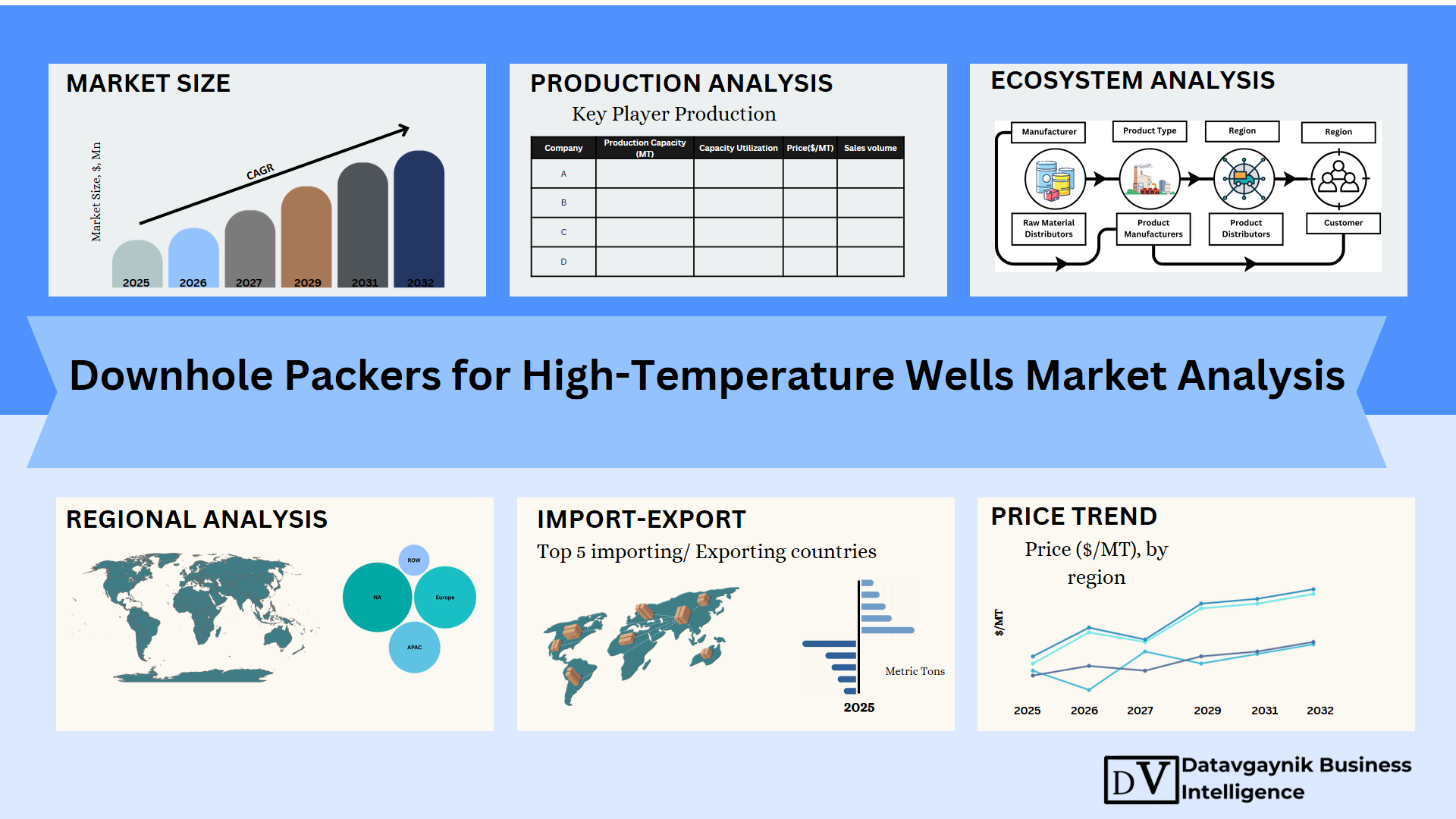
Downhole packers for high-temperature wells are completion tools used to seal the annular space between tubing and casing or open hole sections where reservoir temperature, pressure, fluid chemistry, and thermal cycling exceed the tolerance of conventional packer systems. The global Downhole Packers for High-Temperature Wells market is estimated at about USD 620 million in 2026 and is projected to reach nearly USD 1.03 billion by 2035, expanding at a CAGR of around 5.8% during the forecast period. Demand is concentrated in HPHT oil and gas wells, geothermal wells, deepwater completions, steam-assisted production, sour gas reservoirs, and unconventional gas projects where elastomer degradation, metal expansion, setting reliability, and long-term seal integrity directly affect well productivity and intervention cost.
The market is mainly segmented by packer type, temperature rating, setting mechanism, well type, application, and end user. Permanent packers account for stronger demand in high-temperature production wells because they provide long-duration isolation and lower leak risk in deep or sour environments. Retrievable packers remain relevant in testing, stimulation, temporary isolation, and workover programs where operators need flexibility. By material and design, high-temperature elastomer packers, metal-to-metal seal packers, expandable packers, and swellable packers serve different operating windows. Applications include production isolation, injection control, stimulation, zonal isolation, well testing, artificial lift support, and geothermal fluid management.
High-temperature well activity is shifting packer demand toward durability rather than basic completion volume
Growth in this market is not simply linked to the number of wells drilled. It is more closely tied to the share of wells operating in harsh reservoirs, deeper formations, higher bottomhole temperatures, corrosive fluids, and multi-zone completions. Conventional packers used in moderate-temperature wells can fail when exposed to sustained temperatures above 150°C, pressure cycling, CO₂, H₂S, brines, and thermal expansion. For HPHT wells, operators therefore prioritize premium sealing elements, nickel-alloy components, controlled extrusion gaps, advanced slips, and validated qualification testing.
Upstream spending supports this selective demand base. Global well completion equipment and services are projected to remain above USD 26 billion in 2026, while upstream oil and gas investment continues to run in the hundreds of billions of dollars as operators replace declining production and maintain output from mature fields. This supports demand for completion hardware even when drilling activity is uneven. A large share of upstream capital is used to offset natural field decline, which keeps workover, recompletion, and production-integrity spending active in older reservoirs where packers are replaced or upgraded during intervention campaigns.
Recent field activity also shows why high-temperature packers are becoming more specification-driven. In December 2025, Saudi Aramco started production from the first phase of Jafurah, with initial capacity around 450 million cubic feet per day and a long-term target of about 2 billion cubic feet per day by 2030. The project is tied to a broader USD 100 billion unconventional gas development and large-scale horizontal drilling, stimulation, and completion activity. For packer suppliers, this type of basin requires reliable isolation tools that can handle gas pressure, fracturing loads, long laterals, and reservoir-specific chemical exposure.
Brazil is another demand center because offshore pre-salt wells require high-reliability completions and extended service life. Petrobras reported production of about 2.5 million barrels per day in the fourth quarter of 2025, up around 20%, while full-year investment reached USD 20.3 billion and roughly 84% was directed toward exploration and production. These spending patterns support demand for premium packers used in deepwater production, injection, and intelligent completions where failure can lead to costly rig-based intervention.
Product segmentation favors permanent and metal-seal packers in severe-temperature wells
Permanent downhole packers hold a stronger position in HPHT production wells because operators value anchoring stability and long-term annular isolation more than retrieval convenience. In deep gas, pre-salt, sour reservoirs, and geothermal wells, pulling a failed completion can be expensive, so tool qualification and material compatibility often outweigh initial purchase price. Metal-to-metal seal and hybrid seal packers are gaining acceptance where elastomer-only systems face creep, extrusion, or chemical swelling risk.
Retrievable high-temperature packers are used more often in drill stem testing, temporary abandonment, acid stimulation, pressure testing, and selective injection. Their share is supported by service companies and operators that need reusable tools, faster deployment, and lower intervention cost. However, retrievable systems face more design constraints in extreme wells because slips, seals, and release mechanisms must work reliably after thermal exposure and pressure cycling.
Swellable packers are used in horizontal and open-hole completions where passive zonal isolation is preferred, especially in unconventional and carbonate reservoirs. Their adoption depends on fluid compatibility because swelling behavior changes with oil, water, salinity, temperature, and exposure time. In high-temperature wells, their position is strongest where predictable swelling and long sealing contact are validated before deployment.
Pricing is influenced by metallurgy, elastomer qualification, testing, and service risk
High-temperature packers are priced well above standard completion packers because cost is driven by alloy selection, elastomer formulation, machining tolerance, testing documentation, and field service support. Tools designed for HPHT wells often require Inconel or corrosion-resistant alloy components, premium backup systems, anti-extrusion devices, and high-temperature sealing compounds. Qualification testing can include pressure cycling, temperature soak, axial load, chemical exposure, and setting-force verification.
Price sensitivity varies by customer. National oil companies and supermajors typically accept higher tool prices when failure could delay production from offshore or deep gas wells. Independent shale operators are more cost-sensitive and may standardize packer designs across pads to reduce procurement complexity. Geothermal developers are also cost-conscious, but they increasingly require high-temperature packers for testing, stimulation, injection management, and well integrity in reservoirs where bottomhole temperature may exceed conventional oilfield limits.
U.S. drilling activity shows both the opportunity and the restraint. In May 2026, Baker Hughes reported that U.S. oil rigs rose to about 415, the highest level since November 2025, while the total oil and gas rig count remained lower than earlier cycle peaks after declines in 2023, 2024, and 2025. This indicates that packer demand is recovering selectively rather than broadly. The low inventory of drilled-but-uncompleted wells in U.S. shale also increases the need for new completions, but operators continue to control spending and focus on tools that lower failure risk and reduce intervention frequency.
Main challenges remain tool failure risk, qualification lead time, and uneven drilling cycles
The strongest challenge for suppliers is not basic manufacturing capacity; it is qualification consistency across different reservoir conditions. A packer that performs in one high-temperature oil well may not perform the same way in sour gas, steam injection, geothermal brine, or CO₂-rich environments. Operators therefore require application engineering, material traceability, pre-job simulation, and field-proven performance data.
Supply availability is also affected by long lead times for corrosion-resistant alloys, precision-machined components, and specialized elastomers. Smaller manufacturers can compete in standard packer categories, but HPHT wells favor companies with testing infrastructure, global service crews, and field failure databases. This keeps competition concentrated among oilfield service companies and specialized completion-tool suppliers with established qualification records.
Market growth will remain tied to high-value wells rather than total well count. Deepwater Brazil, Saudi unconventional gas, U.S. shale recompletions, Middle East sour gas, and geothermal development are the most relevant demand sources because they require packers that tolerate higher temperature, pressure, fluid aggression, and long service exposure. As operators push more wells into harsh reservoirs while controlling intervention budgets, the market will favor downhole packers that combine seal reliability, material compatibility, and documented HPHT performance over low-cost commodity designs.
Regional Market Behavior Shows Stronger Demand in Harsh-Reservoir Oil, Gas, and Geothermal Basins
The regional market for high-temperature downhole packers is led by countries where operators are developing HPHT gas, deepwater reservoirs, sour fields, steam injection assets, or geothermal wells. Demand is strongest where packer failure leads to high intervention cost, delayed production, or loss of zonal control. This makes the market more concentrated than standard completion equipment because high-temperature packers are not bought in large volumes for every well; they are selected for wells with severe temperature, pressure, corrosion, and completion-integrity risk.
Middle East Demand Is Driven by Sour Gas, Unconventional Gas, and Long-Life Production Wells
Saudi Arabia is one of the most important demand countries because Aramco’s gas expansion requires high-reliability completions across unconventional and high-pressure reservoirs. In June 2024, Aramco awarded around USD 25 billion in contracts connected to Jafurah phase two, Master Gas System expansion, unconventional gas rig contracts, directional drilling, and well tie-ins. The package included 23 unconventional gas rig contracts valued at about USD 2.4 billion and 13 Jafurah well tie-in contracts worth nearly USD 1.63 billion awarded between December 2022 and May 2024. This directly supports demand for packers used in production isolation, stimulation, testing, and tubing-casing annular sealing.
Saudi Arabia’s Jafurah field started first unconventional shale gas production in December 2025, with initial capacity around 450 million cubic feet per day and a target of about 2 billion cubic feet per day by 2030. The field holds an estimated 229 trillion standard cubic feet of raw gas and is linked to a broader USD 100 billion development program. This creates a high-specification market for permanent and retrievable packers that can withstand gas pressure, fracturing loads, corrosive fluids, and long production exposure.
The UAE, Qatar, Oman, and Kuwait also contribute through sour gas, mature-field redevelopment, and thermal production requirements. Middle Eastern procurement is typically contract-led, with national oil companies requiring prequalified suppliers, field-proven designs, and local service support. Local manufacturing of highly specialized HPHT packers remains limited, so the region depends on multinational service companies, regional assembly bases, certified repair shops, and imported alloy components.
North America Has a Larger Installed Base but More Cyclical Procurement
The United States is a major consumption market because of shale gas, tight oil, Gulf of Mexico deepwater wells, CO₂ exposure, and recompletion activity. In May 2026, Baker Hughes reported U.S. oil rigs at about 415, the highest level since November 2025, while the total U.S. rig count was around 551. The U.S. also had a record-low inventory of drilled-but-uncompleted wells in April 2026, with around 4,972 DUCs by EIA count and 3,866 by Enverus adjustment. This matters for packers because operators have less ready-to-complete inventory and must drill new wells to sustain output, supporting fresh completion-tool demand.
North American buying behavior is more price-sensitive than Middle East or deepwater Brazil. Shale operators typically standardize packer sizes, pressure ratings, and setting systems across pads to reduce tool complexity and logistics cost. Demand is strongest for retrievable, open-hole, hydraulic-set, and multistage isolation packers used in horizontal completions, stimulation, and recompletion. HPHT packer demand is smaller than total U.S. completion-tool demand but technically important in Haynesville gas, deep Permian intervals, Gulf of Mexico, and selected high-pressure unconventional plays.
Canada contributes through thermal oil sands, steam injection, and heavy-oil operations. High-temperature packers used in steam-assisted gravity drainage and cyclic steam stimulation face thermal cycling, elastomer fatigue, and casing expansion, making replacement demand a recurring feature. Canadian demand is therefore linked more to field maintenance and thermal recovery programs than to broad exploration growth.
Brazil and Latin America Favor Premium Packers for Deepwater and Pre-Salt Wells
Brazil is the leading Latin American demand country because pre-salt wells require high-reliability downhole completions in ultra-deepwater reservoirs. Petrobras reported fourth-quarter 2025 production of about 2.5 million barrels per day, up around 20%, while full-year investment reached USD 20.3 billion, with approximately 84% directed to exploration and production. Rising pre-salt output supports demand for permanent production packers, liner-top packers, feedthrough packers, injection packers, and intelligent-completion isolation tools.
Brazil’s procurement structure favors suppliers with offshore service crews, tool-testing capability, local content alignment, and repair facilities. Imports remain important because premium packers require advanced metallurgy, precision machining, and validated elastomer or metal-seal systems. Regional service delivery is concentrated around Rio de Janeiro, Macaé, and offshore logistics hubs that support Petrobras and international operators.
Mexico, Argentina, and Colombia represent smaller but relevant demand pockets. Mexico uses HPHT packers in Gulf of Mexico and mature-field remediation. Argentina’s Vaca Muerta shale development supports open-hole and stimulation packer demand, although pricing pressure is stronger because operators focus on drilling efficiency and completion cost per lateral.
Asia Pacific Demand Is Split Between China, Indonesia, Australia, and Geothermal Markets
China is a major demand and supply country. Its domestic oilfield equipment industry can manufacture standard and mid-range packers, while premium HPHT tools still depend partly on imported designs, licensed technology, or multinational suppliers for extreme wells. China’s demand comes from tight gas, deep shale gas in Sichuan, mature-field enhanced recovery, and geothermal exploration. Domestic suppliers compete on cost and availability, but international suppliers retain advantages in high-end qualification, metal-to-metal sealing, and offshore completions.
Indonesia and the Philippines support geothermal-related demand. Geothermal wells expose packers to high temperature, corrosive brines, scaling, and repeated injection-production cycles. The segment is smaller than oil and gas but important because conventional elastomer systems often face accelerated degradation. Australia contributes through LNG-linked gas, offshore projects, and high-pressure reservoirs where completion reliability has a direct effect on project economics.
Segmentation Highlights by Regional Fit
- Permanent production packers dominate deepwater Brazil, Middle East gas, Gulf of Mexico HPHT wells, and long-life offshore production.
- Retrievable packers are stronger in North America, Canada, workover-heavy mature fields, testing, temporary isolation, and stimulation jobs.
- Metal-seal and hybrid-seal packers gain preference in sour gas, high-pressure gas, geothermal, and wells above conventional elastomer temperature limits.
- Hydraulic-set and feedthrough packers are stronger in intelligent completions, offshore wells, and applications requiring control lines or monitoring equipment.
- Open-hole isolation packers are mainly linked to horizontal shale, carbonate reservoirs, and multistage stimulation systems.
Supply-demand balance remains tightest for premium HPHT designs because qualification cycles, alloy sourcing, elastomer testing, and service-crew availability limit fast substitution. Pricing is stable to firm in high-specification wells because operators treat packer failure as a production-risk issue, not only a tool-cost issue. Standard packers remain more competitive, especially in land markets where regional suppliers can offer shorter lead times and lower prices.
Competitive Landscape Led by Integrated Oilfield Service Companies and Specialized Completion Tool Suppliers
The high-temperature downhole packers market is supplied by a mix of global oilfield service companies, completion-tool specialists, regional manufacturers, and aftermarket service providers. Exact market share by company is not consistently disclosed because packers are reported inside broader completion equipment, well construction, or production systems revenue. Competitive position is therefore better assessed through product breadth, HPHT qualification, service footprint, offshore execution capability, customer approvals, and ability to support field installation.
SLB, Halliburton, Baker Hughes, Weatherford, NOV, TAM International, Peak Completion Technologies, Innovex, Rubicon Oilfield International, Packers Plus, and regional oilfield-tool manufacturers are among the visible participants in packers and completion isolation systems. The top-tier group has the strongest position in HPHT and deepwater wells because operators require engineering support, field-proven performance, global service availability, and tool traceability. Smaller suppliers compete in standard retrievable packers, thermal packers, accessories, replacement parts, and regional service work.
Baker Hughes has a broad packer portfolio covering production packers, retrievable and feedthrough packers, liner packers, open-hole packers, intelligent-completion packers, and high-pressure/high-temperature applications. Its packer systems are positioned around high-quality metallurgies, elastomer materials, and testing for downhole conditions. This makes the company stronger in premium production wells, offshore completions, and wells requiring qualified annular isolation rather than commodity sealing tools.
Weatherford is active in production packers, sealbore packers, hydrostatic packers, service tools, and open-hole isolation packers. Its ZoneSelect system includes hydraulic open-hole packers such as ARES II and APOLLO, with differential-pressure ratings up to 10,000 psi. Weatherford’s competitive advantage is strongest in zonal isolation, multistage stimulation, production packers, sand-face completions, and field-service execution. Its permanent and retrievable packer offerings are relevant for operators looking for pressure-tight sealing across a range of wellbore loads.
Halliburton competes through its broader completion, production, stimulation, and well-construction platform. Its advantage comes from integration: packers are supplied alongside completion design, stimulation services, sand control, digital wellsite execution, and field crews. In May 2026, Halliburton’s technology showcase in Houston emphasized real-time execution, automation, and digital workflow integration across the well lifecycle. For high-temperature packers, this type of capability matters because operators increasingly want pre-job modeling, deployment assurance, and intervention planning rather than standalone tool supply.
SLB’s position is supported by its global footprint across more than 100 countries and its broader completion and production technology portfolio. Its strength is tied to multinational operator relationships, offshore execution, qualification systems, and the ability to integrate packers into intelligent completions, flow-control systems, and production-monitoring architectures. In premium wells, this integration gives large suppliers an advantage because packers must be compatible with tubing, safety valves, gauges, control lines, and reservoir-management systems.
Manufacturing Economics and Cost Pressure
Manufacturing economics in this market are shaped by precision machining, alloy cost, elastomer chemistry, pressure testing, documentation, and low-volume customization. HPHT packers often use corrosion-resistant alloy parts, high-grade mandrels, slips, cones, backup rings, seal elements, and setting mechanisms that must be validated under temperature and pressure cycling. Compared with standard packers, production batches are smaller and engineering content is higher, which limits low-cost mass manufacturing.
Input-cost pressure comes from specialty steel, nickel alloys, elastomers, machining time, and testing capacity. Suppliers with established machining networks, in-house testing, and regional assembly hubs can protect margins better than small manufacturers that outsource critical processes. Distribution cost is also meaningful because packers must often be staged near basins, inspected before running, and supported by field specialists during installation.
Replacement economics favor premium suppliers in offshore and HPHT wells. A high-temperature packer may cost more upfront, but a failure can require rig intervention, production shut-in, tubing retrieval, or wellbore remediation. For deepwater and sour gas wells, operators therefore use total well-risk economics rather than simple purchase-price comparison. In shale and mature land markets, however, procurement teams still pressure suppliers on price, lead time, and standardization.
Recent Developments Affecting Demand and Competition
- June 2024, Saudi Arabia: Aramco awarded around USD 25 billion in contracts linked to Jafurah gas development, Master Gas System expansion, unconventional rig work, directional drilling, and well tie-ins. This supports demand for high-temperature packers used in unconventional gas completions, stimulation, and production isolation.
- December 2025, Saudi Arabia: Jafurah started first-phase output at about 450 million cubic feet per day, with a planned increase toward 2 billion cubic feet per day by 2030. The project raises demand for high-pressure gas completion tools, including permanent and retrievable packers.
- Fourth quarter 2025, Brazil: Petrobras reported oil production of about 2.5 million barrels per day and full-year investment of USD 20.3 billion, with about 84% directed to exploration and production. This supports premium offshore packer demand in pre-salt production and injection wells.
- May 2026, United States: Baker Hughes reported U.S. oil rigs at about 415 and total U.S. rigs around 551. A low drilled-but-uncompleted well inventory increases reliance on new drilling and fresh completions, supporting selective demand for packers in high-pressure shale and deep intervals.
- May 2026, United States: Shale DUC inventory fell to around 4,972 by EIA count and 3,866 by Enverus adjustment after 14 consecutive months of decline. This restricts quick production additions and increases the importance of reliable completion hardware when new wells are brought online.


