

Electric Car Coil Springs Demand Is Concentrated Around EV Manufacturing Hubs, Not Generic Aftermarket Channels
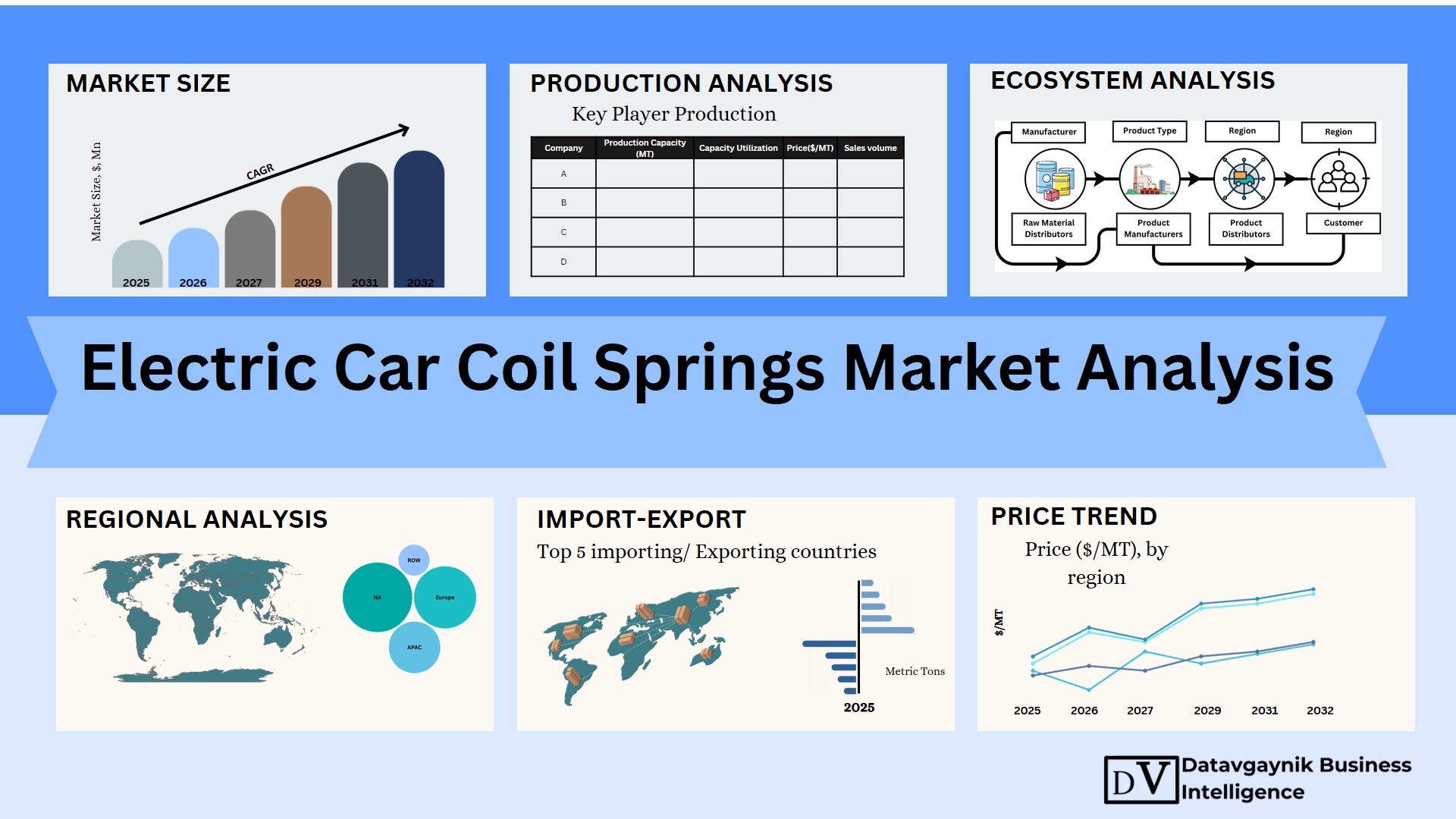
China, Germany, the United States, Japan, South Korea, the United Kingdom, France, and India account for the strongest demand base for Electric Car Coil Springs because these markets combine electric car production, EV registrations, suspension component sourcing, and regional aftermarket availability. DataVagyanik estimates the Electric Car Coil Springs market at USD 3.1 billion in 2026, with a CAGR of 11.4% through 2033, taking the market to USD 6.6 billion by the forecast year. The market is not broad-based in the same way as conventional passenger car coil springs; demand is concentrated around battery electric SUVs, crossovers, premium sedans, and high-volume compact EV platforms where battery-pack weight, ride height control, durability, and cabin comfort directly affect spring design.
China Holds the Highest Demand Intensity for Electric Car Coil Springs
China is the largest consumption cluster because EV volume is high enough to influence suspension component specifications rather than merely add incremental demand. In 2025, China produced 16.626 million new energy vehicles and sold 16.49 million units, with NEV sales rising 28.2% year on year. That scale makes China the most important country for Electric Car Coil Springs, especially for compact SUVs, extended-range EVs, plug-in hybrids, ride-hailing fleets, and high-volume urban passenger vehicles.
The demand pattern in China is OEM-led. Springs are sourced through Tier-1 and Tier-2 supplier networks located near vehicle assembly clusters in Guangdong, Shanghai, Jiangsu, Zhejiang, Chongqing, and Anhui. BYD, Tesla Shanghai, Geely, SAIC, Chery, NIO, Li Auto, and Xpeng create a wide range of suspension requirements, from cost-optimized compact EV springs to high-load coil springs for large electric SUVs. In May 2026, Tesla’s Chinese-made Model 3 and Model Y deliveries reached 85,982 units, up 39.4% year on year, reinforcing Shanghai’s role as both domestic supply hub and export-linked suspension sourcing base.
Chinese demand also differs from Europe because local EV platforms often carry heavier battery packs while still competing aggressively on price. This pushes suppliers toward higher tensile-strength steel, tighter fatigue control, and compact spring geometry rather than expensive fully active suspension systems in mass models. Coil springs remain important because they provide load-bearing performance at a lower cost than air suspension, particularly in vehicles priced for large-volume domestic sales.
Europe Is Stronger in Specification-Driven Demand Than Volume Alone
Europe is the second major regional cluster, led by Germany, France, the United Kingdom, the Netherlands, Belgium, Sweden, and Norway. In 2025, the European Union registered 1.88 million battery-electric cars, equal to 17.4% of the EU car market. Germany, the Netherlands, Belgium, and France together accounted for 62% of EU BEV registrations, making these countries the most relevant demand centers for Electric Car Coil Springs in Europe.
European demand is more specification-driven than China’s. German OEMs and suppliers prioritize ride comfort, safety validation, corrosion resistance, NVH performance, and compatibility with multi-link suspension systems. Electric SUVs from Volkswagen, Mercedes-Benz, BMW, Audi, Volvo, Polestar, and Hyundai-Kia’s European operations require springs that handle higher axle loads without compromising handling. The heavy battery floor of EVs changes the spring load case, especially in rear suspension systems, where additional curb weight and cargo loading can accelerate sagging or fatigue if the spring is not designed for EV-specific duty cycles.
The United Kingdom adds a different demand layer. In 2025, UK BEV registrations reached about 473,000 units, with fully electric cars taking 23.4% share of new car registrations. The UK market has a large independent repair and aftermarket network, so replacement Electric Car Coil Springs demand is growing through garages, parts distributors, and online catalog channels. However, the market remains application-specific: EV coil springs need correct load rating, model-year fitment, and corrosion protection because heavier electric cars place higher stress on suspension parts than similarly sized combustion-engine cars.
North America Demand Is Heavier, SUV-Led, and More Sensitive to Platform Mix
The United States is a high-value market even when EV penetration fluctuates. Demand is concentrated in electric SUVs, pickups, and crossovers rather than small electric hatchbacks. Tesla Model Y, Ford Mustang Mach-E, Rivian R1S, Hyundai Ioniq 5, Kia EV9, Chevrolet Equinox EV, and electric pickup platforms create a stronger requirement for high-load springs than smaller European city EVs.
North American Electric Car Coil Springs demand is influenced by vehicle size and road-use profile. Higher curb weights, larger wheel packages, towing expectations, and long-distance highway use increase the importance of fatigue resistance and ride-height stability. The customer base includes OEMs, suspension module suppliers, EV repair chains, fleet service operators, and replacement part distributors. The aftermarket is still smaller than the combustion vehicle spring replacement base because many EVs are relatively new, but early fleet use, ride-hailing mileage, and regional corrosion exposure in northern states are beginning to create replacement demand.
A constraint in North America is uneven EV adoption. The U.S. EV share softened in early 2026 after the late-2025 pull-forward effect from federal tax credit changes. This does not remove the demand base, but it changes procurement behavior: suppliers serving EV coil springs need flexible production planning rather than assuming a straight-line volume increase across every vehicle segment.
India Is Small in Value Today but Shows Fast Adoption in Passenger EV Springs
India’s Electric Car Coil Springs market is still emerging because passenger EV penetration is low compared with China and Europe. However, the growth rate is high. Passenger electric vehicle retail volumes in India reached 176,817 units in 2025, up 77.04% from 99,975 units in 2024, while penetration rose to around 4.0% of passenger vehicle sales. This creates early demand for EV-specific springs in compact SUVs and urban passenger cars, especially from Tata Motors, JSW MG Motor, Mahindra Electric, Hyundai, BYD, and newer entrants.
India’s demand is concentrated in Maharashtra, Karnataka, Delhi NCR, Tamil Nadu, Gujarat, and Telangana because these states combine EV registrations, urban use, charging infrastructure, and dealer access. The aftermarket is not yet strongly replacement-led because the electric passenger car fleet is young. OEM production and localized sourcing matter more. Spring suppliers serving India must compete on cost, durability on rough roads, and compatibility with compact EV platforms that carry battery weight while operating across potholes, speed breakers, high temperatures, and mixed-load urban driving.
Supplier Availability Is Strongest Where EV Platforms Are Built
Supply availability is not uniform. China has the broadest local manufacturing base for springs and suspension assemblies. Europe has stronger engineering depth, validation capability, corrosion testing, and aftermarket catalog coverage. Japan and South Korea remain important because NHK Spring, Hyundai Mobis-linked suppliers, and Japanese steel spring specialists support OEMs that export EV platforms globally. North America has strong suspension module integration, but some spring sourcing remains tied to global supplier networks.
Supplier examples show why EV springs are not simply carried over from combustion-engine cars. Mubea has highlighted that BEVs and plug-in hybrids require higher spring loads and rates because of vehicle weight, while its lightweight coil spring systems can reduce weight by up to 15% versus standard applications. NHK Spring displayed an EV-compatible thick-wire coil spring at Japan Mobility Show 2025, designed to withstand heavier vehicle weight while saving package space. Lesjöfors remains relevant on the European replacement side because it offers one of the broadest aftermarket coil spring ranges for passenger cars and light commercial vehicles.
Main Regional Constraints Are Weight, Cost, Validation, and Fitment Accuracy
The biggest constraint is technical rather than demand visibility. Electric cars are heavier, quieter, and more sensitive to ride quality complaints. A spring failure, sagging issue, incorrect ride height, or poor corrosion resistance becomes more noticeable because EV cabins generate less engine noise and buyers expect premium comfort. This raises validation requirements for load cycles, coating, fatigue life, and fitment accuracy.
Cost is the second constraint. In mass-market EVs, OEMs are under pressure to reduce battery, electronics, and chassis cost simultaneously. That limits the adoption of expensive suspension solutions in entry and mid-range EVs, leaving coil springs as a practical high-volume component but forcing suppliers to deliver better performance without sharp price increases.
The third constraint is regional fragmentation in the aftermarket. Europe has mature catalog coverage, but India and parts of Southeast Asia still have limited EV-specific replacement availability. North America has strong distribution, but fitment complexity is rising because EV trims differ by battery size, motor layout, wheel size, and performance package. As the EV fleet ages, the strongest replacement demand will come from high-mileage urban fleets, cold-weather countries with road salt exposure, and heavier electric SUVs where spring fatigue is more likely to appear earlier than in low-mileage private cars.
Overall, Electric Car Coil Springs demand is strongest where EV manufacturing, registration density, supplier engineering, and replacement access overlap. China leads by production volume, Europe leads in specification intensity and aftermarket maturity, North America leads in heavy EV applications, and India is moving from low-base adoption to localized OEM demand.
Country-Level Segmentation Shows Why Electric Car Coil Springs Are Bought Differently Across EV Markets
Electric Car Coil Springs are not distributed through one uniform global channel. The country-level structure is shaped by whether the market is OEM-heavy, aftermarket-heavy, export-linked, fleet-driven, or still in early adoption. China and Germany are stronger on OEM sourcing, the United Kingdom and Nordic Europe have visible replacement potential, the United States is skewed toward heavy EV platforms, Japan and South Korea remain supplier-led engineering markets, and India is moving from low-volume fitment to localized EV platform demand.
By product type, the market is led by compression coil springs for passenger EV suspension systems. Rear axle springs are gaining more technical attention because EV battery mass, boot loading, and SUV body structures increase load concentration. Front springs remain important, but rear suspension tuning has become more sensitive in compact crossovers and long-range variants. Progressive-rate coil springs have stronger adoption in premium EVs and heavier SUVs, while linear-rate springs remain common in mass-market compact EVs where cost control is central.
The strongest segmentation logic is as follows:
- By product type: standard coil springs, high-load EV coil springs, progressive-rate coil springs, lightweight high-tensile steel springs, corrosion-resistant coated springs, and performance/tuning springs.
- By customer type: EV OEMs, Tier-1 suspension module suppliers, authorized service networks, independent garages, fleet maintenance operators, and online aftermarket distributors.
- By application: compact electric cars, electric SUVs, premium sedans, ride-hailing EVs, electric vans, and performance EV variants.
- By channel: direct OEM procurement, Tier-1 integration, authorized replacement, independent aftermarket, e-commerce spare parts, and performance suspension specialists.
- By region: China-led volume sourcing, Europe-led specification and replacement demand, North America-led heavy vehicle applications, Japan/South Korea-led engineering supply, and India-led emerging localization.
China’s Distribution Structure Is Built Around OEM Procurement and Local Platform Speed
China’s Electric Car Coil Springs channel is heavily tied to OEM procurement because the country’s NEV production scale creates large-volume direct sourcing. Vehicle manufacturers and chassis integrators usually approve springs through platform-level testing, fatigue validation, coating performance, and supplier quality audits. Once approved, suppliers are locked into the model cycle, making direct OEM access more important than retail channel visibility.
The supply chain is clustered around major EV assembly belts. Guangdong supports BYD and other southern EV platforms, Shanghai supports Tesla and SAIC-linked ecosystems, Anhui and Zhejiang support fast-growing domestic brands, and Chongqing adds extended-range EV and SUV demand. This regional structure reduces logistics cost because coil springs are bulky relative to their unit value. Suppliers prefer plant-adjacent warehouses and just-in-time delivery schedules rather than long-distance replacement inventory models.
Chinese replacement demand is still developing. The first large EV cohorts from 2020–2022 are now entering higher-mileage usage, especially ride-hailing and commercial urban fleets. These users create earlier suspension replacement than low-mileage private EV owners. For mass EV models, buyer preference is not for premium branded springs but for correct fitment, fast availability, and low installed cost.
Europe Splits Between OEM Quality Approval and Mature Aftermarket Access
Europe has a more layered market. Germany, France, the UK, Netherlands, Sweden, and Norway each show different buying behavior. Germany is supplier-quality led because BMW, Mercedes-Benz, Volkswagen, Audi, Porsche, and Tesla’s Berlin-linked production environment require approved suspension components with stable metallurgy, fatigue performance, and corrosion protection. France is more compact-EV oriented, with demand tied to Renault, Peugeot, Citroën, Dacia-linked platforms, and urban fleet use. The Netherlands, Sweden, and Norway are important because high EV penetration increases the visible replacement base faster than in low-penetration countries.
The UK is one of the most important aftermarket countries. High BEV registrations, a large independent garage base, and mature online parts distribution give the UK a stronger replacement channel than most European markets. Coil spring replacement is usually driven by corrosion, ride-height loss, MOT inspection failures, accident repair, and suspension noise. Electric cars add a new fitment issue: a spring listed for a similar body shell may not always match the load rating of the BEV version. This increases the importance of catalog accuracy and VIN-based selection.
European distribution has three layers: OEM/Tier-1 supply, motor-factor distribution, and online aftermarket. Lesjöfors, KYB, Sachs, Monroe, febi, and other suspension brands compete through catalog depth and availability rather than only price. In colder countries, coated springs and corrosion resistance are more important because road salt shortens suspension component life.
North America Is Shaped by Heavier EVs and Fewer Small-Car Platforms
The United States and Canada have a different product mix. Electric pickups, three-row SUVs, large crossovers, and premium EV sedans create stronger demand for high-load suspension springs. The replacement cycle is not yet as mature as Europe because much of the EV fleet is young, but the load profile is more severe. A Rivian, Ford, Tesla, Hyundai, Kia, GM, or premium German EV used in suburban commuting, towing, snowbelt driving, or long highway use places different stress on springs than a compact European city EV.
The distribution structure is split between OEM service channels and independent aftermarket networks. Tesla service, franchised dealers, regional repair chains, and parts e-commerce all influence access. However, aftermarket catalog depth is still uneven because EV trims vary by battery pack, dual-motor configuration, wheel size, ride height, and performance package. This makes inventory risk higher for distributors: stocking one wrong spring can mean poor sell-through because fitment compatibility is narrower than conventional combustion models.
Canada adds a corrosion-driven replacement angle. Provinces using road salt create stronger long-term demand for coated springs and complete suspension repair kits. The aftermarket value per vehicle can be higher in these regions because springs are often replaced alongside dampers, mounts, and alignment services.
India’s Demand Is Localized Around OEM Fitment, Not Replacement Yet
India’s Electric Car Coil Springs market is primarily an OEM and authorized-service opportunity. Tata Motors, Mahindra, JSW MG Motor India, Hyundai, BYD, and Citroën-linked EV platforms are expanding the addressable base, but the installed fleet is still young. Replacement demand will build after 2027–2028 as early high-mileage urban EVs accumulate suspension wear.
India has specific operating requirements. Springs must handle bad roads, overloaded cabins, speed breakers, high ambient temperatures, and uneven service conditions. Compact electric SUVs require adequate ground clearance without making the ride too stiff. This makes India more demanding than its current market size suggests. A spring designed mainly for smooth-road European operation may not match Indian duty cycles unless revalidated.
Distribution is concentrated around OEM-authorized workshops, tier suppliers around Pune, Chennai, Sanand, NCR, and Bengaluru, and regional parts distributors. The independent EV suspension aftermarket remains thin. Customer buying is price-sensitive, but service reliability matters because EV owners are more likely to return to authorized service centers during the early ownership period.
Regional Adoption and Replacement Behavior Follow EV Fleet Age
Replacement demand for Electric Car Coil Springs follows EV fleet age, mileage, road condition, and service-channel maturity. China has the largest near-term replacement pool because its EV fleet expanded early and rapidly. Europe has the strongest catalog-led replacement ecosystem. North America will generate higher-value replacement per vehicle due to heavier EV formats. India, Southeast Asia, and Latin America remain OEM-driven until the electric car parc becomes older and more distributed across independent garages.
The buying pattern is shifting from “same platform, same spring” to EV-specific selection. Vehicle weight, battery placement, axle load, ride height, and damper matching now influence spring choice. This is why EV coil spring demand is increasingly segmented by vehicle architecture rather than only by model name.
Regional Supplier Ecosystem and Competitive Positioning in Electric Car Coil Springs
The supplier ecosystem is led by automotive spring specialists, suspension system manufacturers, aftermarket brands, and regional metal-forming companies. Competition is not defined only by production scale. Buyer trust depends on fatigue testing, steel quality, coating consistency, OEM approval, catalog accuracy, delivery reliability, and the ability to match spring rate to EV-specific axle loads.
Mubea is one of the most relevant global suppliers because of its long-standing position in high-strength spring components and lightweight automotive products. Its advantage is strongest in OEM-facing programs where chassis parts require validation, high-volume consistency, and platform-level approval. For EVs, the company’s positioning around lightweight and high-strength spring components is important because manufacturers are trying to offset battery weight without sacrificing ride comfort or load-bearing performance.
NHK Spring is significant in Japan and global Japanese OEM supply chains. Its 2025 Japan Mobility Show display included EV-compatible thick-diameter wire coil springs, end-turn coating, and XT coil spring products. This is relevant because Japanese suppliers are increasingly treating EV suspension springs as a specific engineering category. NHK Spring’s advantage comes from product validation, relationships with Japanese automakers, and the ability to support compact, light-car, passenger-car, and truck suspension requirements.
Lesjöfors has a different advantage: aftermarket availability. The company’s automotive aftermarket spring range covers a large share of the European vehicle parc and is backed by CNC coiling, precision presetting, tempering, shot peening, zinc phosphate, and epoxy coating processes. This makes Lesjöfors especially relevant in Europe and the UK, where independent garages and parts distributors need fitment depth, corrosion resistance, and quick delivery. In Electric Car Coil Springs, aftermarket catalogue coverage will become more valuable as early BEV fleets move into second and third ownership.
thyssenkrupp BILSTEIN is more visible in dampers and complete suspension tuning than standalone coil spring supply, but its EV and hybrid replacement positioning matters because dampers must be adjusted to the spring characteristics of heavier electric vehicles. The company has noted that EV springs are designed for higher vehicle weight and have different vibration behavior compared with combustion-engine models. This makes damper-spring compatibility a buying issue, especially for premium EVs and performance applications.
Other competitive participants include KYB, Sachs/ZF aftermarket channels, Monroe, febi Bilstein, Eibach, H&R, and regional spring manufacturers in China, India, South Korea, Turkey, Poland, and Mexico. Eibach and H&R are stronger in performance and tuning applications, where EV owners want ride-height changes or handling upgrades. KYB, Sachs, Monroe, and febi are stronger in broader suspension replacement ecosystems through distributors and garage networks.
Pricing and Margin Behavior Is Pressured by Steel, Fitment Complexity, and Inventory Risk
Electric Car Coil Springs do not carry the same pricing structure across all channels. OEM prices are volume-negotiated and tightly controlled, while aftermarket prices vary by brand, coating, vehicle model, fitment complexity, and regional availability. EV-specific springs can carry a premium over conventional springs when they require higher load rating, improved coating, or lower-volume catalog production. However, mass-market EV OEMs resist price increases because chassis components are part of aggressive cost-reduction programs.
Inventory is a hidden margin issue. In Europe and North America, a distributor may need to stock separate springs for standard-range, long-range, dual-motor, performance, and SUV variants. Wrong inventory ties up working capital. This favors brands with strong digital catalogues and VIN-level fitment accuracy. In India and Southeast Asia, the bigger constraint is not inventory depth but limited EV-specific independent service coverage.
Recent Developments Affecting Electric Car Coil Springs
- January 2026, China: The State Council Information Office reported 16.626 million NEVs produced and 16.49 million sold in 2025, creating the world’s largest OEM demand base for EV suspension components.
- January 2026, European Union: ACEA-linked data showed 1,880,370 BEV registrations in 2025 and 17.4% BEV market share, supporting specification-led coil spring demand across Germany, France, the Netherlands, Belgium, and Sweden.
- January 2026, United Kingdom: SMMT reported the UK new car market crossed 2.02 million units in 2025, with almost half a million BEVs added to the road, strengthening the future replacement pool for EV suspension springs.
- January 2026, India: FADA-based retail data showed India’s passenger EV sales rose 77.04% in 2025, indicating early but fast-growing localized demand for EV-specific springs in compact electric SUVs.
- October 2025, Japan: NHK Spring announced Japan Mobility Show 2025 exhibits including EV-compatible thick-diameter wire coil springs and end-turn coating, showing supplier-level product development for heavier electric vehicles.
- April 2024, Germany: BILSTEIN highlighted EV and hybrid OE replacement suspension requirements, noting that heavier electric vehicles use springs with different vibration behavior, which affects damper matching and replacement specification.


