

Rising Construction Activities Drive the Emulsion Polymer Market Market
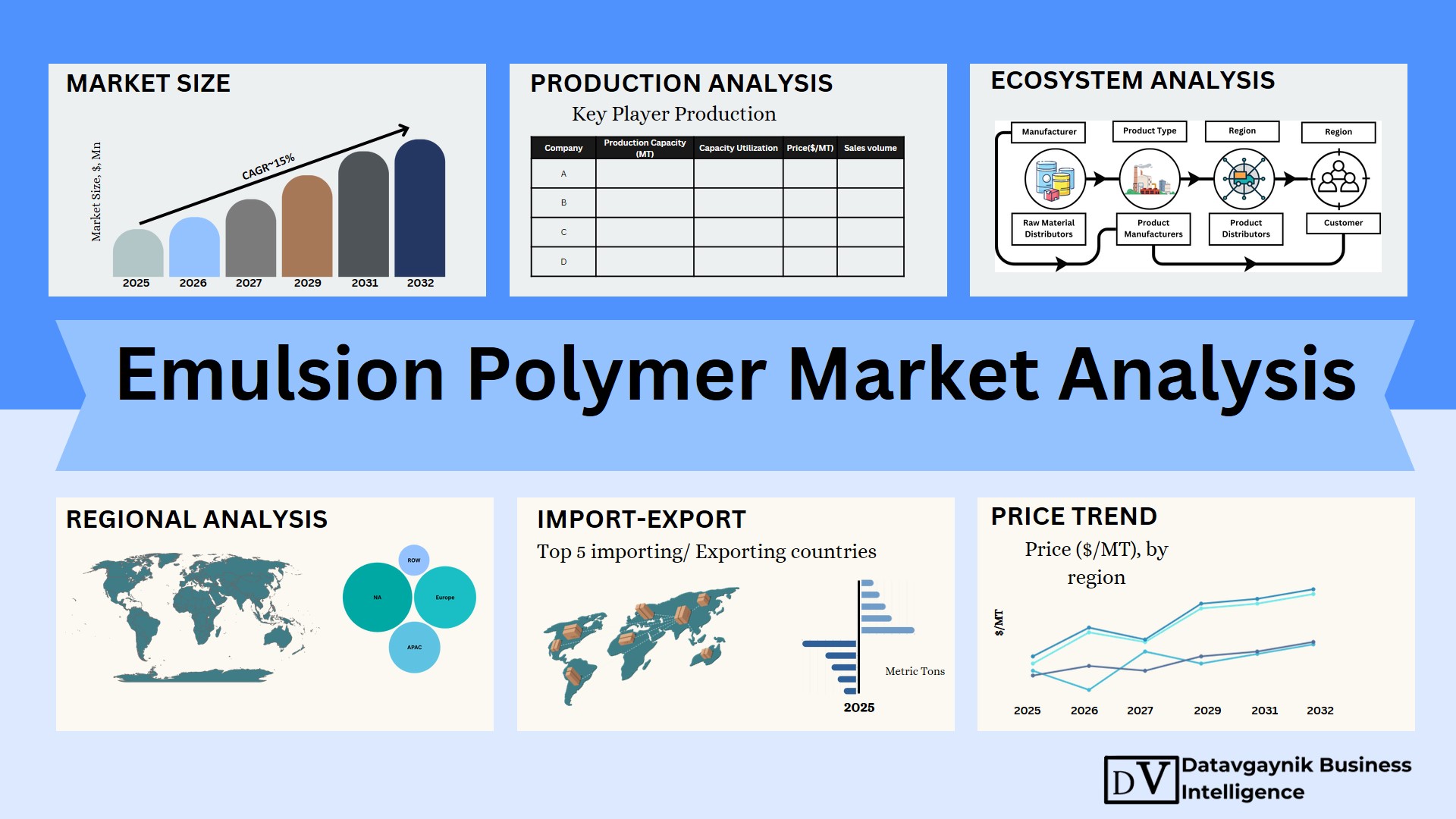
A surge in global construction expenditure is powering the growth trajectory of the Emulsion Polymer Market Market. For instance, in the United States, non-residential construction spending has grown steadily, surpassing $1.2 trillion annually. Similar trends are visible in Asia Pacific, where countries like India and China are investing heavily in infrastructure. India’s Smart Cities Mission and China’s Belt and Road Initiative are catalyzing demand for durable, high-performance coatings—most of which are based on emulsion polymers due to their weather resistance, adhesion, and eco-friendly profile.
In emerging markets, urban population growth is also creating consistent demand for residential and commercial structures. As a result, the Emulsion Polymer Market Market Size is expected to scale significantly, especially in regions where cement-based construction and insulation materials require robust waterproofing and finishing systems. These applications increasingly depend on emulsion polymers, known for their durability, flexibility, and low environmental impact.
Paints and Coatings Sector Underpins Emulsion Polymer Market Market Growth
The paints and coatings industry remains the largest consumer of emulsion polymers, contributing more than 35% to the Emulsion Polymer Market Market revenue in 2024. Emulsion polymers are vital in manufacturing decorative paints, industrial coatings, and architectural finishes. The demand for these products is being driven by expanding automotive, construction, and do-it-yourself (DIY) markets across North America and Asia.
For example, the global paints and coatings market is projected to exceed $250 billion by 2030, growing at 5.6% annually. Within this, the water-based coatings segment—predominantly dependent on emulsion polymers—is growing even faster due to rising regulatory restrictions on solvent-based alternatives. This has significantly elevated the demand for acrylic, vinyl acetate, and styrene-butadiene emulsion polymers, which form the backbone of water-based paint formulations.
Datavagyanik also covers related markets such as the Water-based acrylic emulsion Market, the Acrylic Copolymer Emulsion Market, and the Natural Wax Market Market. Each of these markets adds unique insights into end-user applications, regulatory influences, and competitive developments.
Eco-Friendly Formulations and Low VOC Requirements Push the Emulsion Polymer Market Market Forward
The shift toward low-VOC and eco-friendly chemicals is not a trend—it is now a regulatory imperative. Countries across Europe, North America, and Asia are implementing aggressive environmental standards, such as the European Union’s REACH regulations and the U.S. EPA’s VOC restrictions. These mandates are directly benefitting the Emulsion Polymer Market Market, which offers inherently water-based and low-VOC polymer alternatives.
Manufacturers are increasingly replacing solvent-based resins with waterborne emulsion polymer systems to comply with these norms. For instance, the demand for water-based adhesives, sealants, and paints has risen by over 20% in the last three years, accelerating the Emulsion Polymer Market Market Size in both developed and emerging economies. This transition is especially visible in consumer goods, furniture, and automotive refinishing sectors, where regulatory scrutiny is the most stringent.
Emulsion Polymer Market Market Benefits from the Rise in Sustainable Packaging
With e-commerce booming and sustainability becoming a corporate mandate, the global packaging industry is undergoing a transformation. Demand for recyclable, compostable, and low-carbon packaging materials is at an all-time high. This has created a sharp uptick in the use of emulsion polymers, particularly in pressure-sensitive adhesives and paper coatings that are both biodegradable and high-performing.
In 2023, the global sustainable packaging market was valued at approximately $285 billion and is forecasted to exceed $470 billion by 2030. The Emulsion Polymer Market Market is capturing a significant share of this value, particularly through vinyl acetate-based adhesives and styrene-butadiene latexes used in paperboard laminates, food packaging films, and label coatings. These polymers not only enhance printability and shelf appeal but also ensure compliance with food safety and recyclability standards.
Growing Adhesives and Sealants Demand Accelerates Emulsion Polymer Market Market Expansion
Emulsion polymers are increasingly vital to the adhesives and sealants industry, which is expected to grow at a CAGR of 5.2% through 2030. From construction to automotive assembly and electronics, emulsion polymer-based adhesives provide exceptional bonding, flexibility, and moisture resistance.
In packaging applications, where speed, safety, and sustainability are key, water-based emulsion adhesives are replacing solvent-based formulations. Additionally, in the woodworking sector, vinyl acetate ethylene (VAE) emulsions are gaining ground due to their excellent wood adhesion, fast setting time, and low formaldehyde emissions. These technical benefits are boosting the Emulsion Polymer Market Market share within the global adhesives industry, which is estimated to be worth $80 billion by 2027.
Textile Industry Innovations Reinforce the Emulsion Polymer Market Market
Technical textiles, performance apparel, and nonwoven fabrics are creating new growth avenues for the Emulsion Polymer Market Market. Emulsion polymers are used in textile coatings, backings, waterproofing, and print pastes, offering a combination of durability, softness, and chemical resistance.
In particular, the Asia Pacific textile industry—valued at more than $1.4 trillion—is witnessing exponential growth in demand for coated and treated fabrics used in outdoor apparel, medical textiles, and home furnishings. As consumers demand more breathable, antimicrobial, and waterproof garments, manufacturers are turning to polyurethane dispersions and acrylic emulsions to deliver these features sustainably. This evolution has fueled a 9% annual growth rate in the consumption of emulsion polymers across the textile industry over the last five years.
Technological Advancements Shape the Emulsion Polymer Market Market Landscape
The Emulsion Polymer Market Market is benefiting from significant advancements in polymer science. Modern emulsion polymerization techniques, such as mini-emulsion and controlled/living radical polymerization (CLRP), have enabled manufacturers to tailor molecular weights, glass transition temperatures, and particle sizes for highly specific performance outcomes.
For instance, in automotive coatings, the demand for chip-resistant, UV-stable, and fuel-resistant formulations has prompted the development of hybrid acrylic-styrene emulsions. In industrial sealants, high-tack, self-crosslinking emulsions have reduced the need for external plasticizers and crosslinkers, lowering both cost and environmental footprint.
Furthermore, bio-based emulsion polymers—derived from renewable feedstocks like soybean oil, starch, and lignin—are gaining commercial traction. These next-generation materials are expected to represent over 10% of the total Emulsion Polymer Market Market by 2030, driven by growing corporate ESG commitments and circular economy initiatives.
Emulsion Polymer Market Market Growth Correlates with the Lightweight Automotive Trend
The global shift toward electric and fuel-efficient vehicles has added another layer of momentum to the Emulsion Polymer Market Market. Lightweighting, essential for improving vehicle range and performance, requires alternative materials like composites and specialty coatings—most of which depend on emulsion polymer chemistry.
Waterborne emulsion polymers are being increasingly used in underbody coatings, anti-chip paints, interior adhesives, and thermal insulation layers. The automotive coatings market, valued at over $25 billion, is growing steadily with a noticeable tilt toward eco-compliant materials. This has led to a 6.8% CAGR in the use of emulsion polymers in automotive applications over the past three years.
Expanding End-User Base Propels Emulsion Polymer Market Market Size
The Emulsion Polymer Market Market is seeing expanded utilization across end-user industries such as electronics, consumer goods, personal care, and construction. In electronics, for example, emulsion polymers are used in conductive adhesives and encapsulants, supporting the demand for flexible displays and miniaturized components.
In the consumer goods segment, polymers play a vital role in protective coatings for appliances, waterproof packaging, and cosmetic formulations. As these industries push for low-VOC, high-durability materials, the Emulsion Polymer Market Market continues to evolve in response.
Track Country-wise Emulsion Polymer Production and Demand through our Emulsion Polymer Production Database
-
-
- Emulsion Polymer production database for 30+ countries worldwide
- Emulsion Polymer sales volume for 31+ countries
- Country-wise Emulsion Polymer production capacity, production plant mapping, production capacity utilization for 30+ manufacturers
- Emulsion Polymer production plants and production plant capacity analysis by top manufacturers
-
Track real-time Emulsion Polymer Prices, Emulsion Polymer price charts for 30+ countries, Emulsion Polymer weekly price tracker and Emulsion Polymer monthly price tracker
-
-
- Track real-time Emulsion Polymer prices and Emulsion Polymer price trend in 30+ countries though our excel-based Emulsion Polymer price charts
- Real-time Emulsion Polymer price tracker dashboard with 30+ countries
- Complete transparency on Emulsion Polymer price trend through our Emulsion Polymer monthly price tracker, Emulsion Polymer weekly price tracker
-
Asia Pacific Leads Geographical Demand in Emulsion Polymer Market Market
Asia Pacific remains the global leader in the Emulsion Polymer Market Market, contributing more than 40% of total volume demand. This dominance stems from a combination of rapid industrialization, urbanization, and manufacturing scale. China, for instance, produces and consumes the highest volume of emulsion polymers globally, with the construction sector alone accounting for more than 30% of its domestic consumption. Industrial coatings, architectural paints, adhesives, and waterproofing compounds continue to be the primary application areas.
India is emerging as a strong secondary market in the region. With an average annual infrastructure growth rate of 8.5%, India’s urban expansion and rising investment in commercial real estate are significantly boosting demand for styrene-butadiene and acrylic emulsion polymers. Similarly, countries like Vietnam, Thailand, and Indonesia are experiencing infrastructure booms, each growing at a rate of 7–10% annually, which fuels increasing demand for emulsion polymers in coatings, textiles, and packaging adhesives.
North America’s Advanced Manufacturing Strengthens Emulsion Polymer Market Market Position
In North America, the United States continues to dominate regional demand and production in the Emulsion Polymer Market Market. With over 2 million metric tons of annual output, U.S. manufacturers focus on acrylic emulsions and polyurethane dispersions tailored to construction, automotive, and high-performance coatings. The adoption of sustainable, water-based, and bio-derived polymers has accelerated due to strict environmental regulations.
Canada complements this demand with a smaller but highly specialized production landscape. Manufacturers in Canada are focusing on high-solid, low-VOC systems targeted at weather-resistant adhesives and energy-efficient building materials. Emulsion polymers made in North America are increasingly designed for value-added applications such as specialty paints, hybrid composites, and impact-resistant automotive coatings.
Europe’s Green Innovation Drives Emulsion Polymer Market Market Differentiation
Europe’s Emulsion Polymer Market Market is characterized by high environmental standards and strong innovation in green chemistry. Germany, France, Italy, and the UK collectively contribute to more than 30% of Europe’s total emulsion polymer output. Germany, in particular, is home to advanced manufacturing hubs that specialize in bio-based emulsions derived from natural feedstocks like vegetable oils, cellulose, and recycled carbon compounds.
The emphasis on low-carbon construction, circular packaging, and low-VOC formulations is pushing European producers to invest heavily in R&D. Acrylic and vinyl acetate-based emulsions dominate the market, primarily used in green building paints, automotive sealants, and high-performance packaging adhesives. European demand is also supported by the retrofitting and renovation sectors, which saw over 10% growth in 2024, contributing to rising consumption of emulsion polymer coatings and membranes.
Latin America and Middle East/Africa: Emerging Demand in Emulsion Polymer Market Market
Latin America and the Middle East/Africa (MEA) regions are emerging as promising markets in the Emulsion Polymer Market Market due to rising construction and infrastructure development. Brazil and Mexico are leading demand in Latin America, with a combined annual growth rate of over 6% in sectors such as residential housing, road construction, and water-proofing systems. These developments have spurred increased use of styrene-acrylic emulsions and VAE copolymers.
In the Middle East and Africa, the expansion of smart cities, hospitality infrastructure, and energy-efficient buildings—especially in UAE, Saudi Arabia, and South Africa—is increasing demand for emulsion polymer coatings. Waterproofing membranes, reflective paints, and adhesive technologies form the bulk of the application base. While production in these regions is currently limited, investments in polymer plants and import channels are rising sharply to meet future demand.
Segmentation by Product Type in Emulsion Polymer Market Market
Product segmentation plays a critical role in the structure of the Emulsion Polymer Market Market. Acrylics hold the largest share, accounting for more than 45% of total market consumption. These emulsions are widely used in paints, coatings, adhesives, and textiles due to their excellent UV resistance, water repellence, and durability. Demand for acrylic emulsions is increasing at a CAGR of 6.5%, driven by expanding construction and packaging industries.
Styrene-butadiene latex is the second largest product type, especially dominant in carpet backing, paper coatings, and construction sealants. The superior film-forming capability and cost-effectiveness of SB latex make it particularly attractive in high-volume applications.
Vinyl acetate polymers are gaining traction in woodworking adhesives, decorative paints, and architectural applications. With cost-efficiency and good adhesion as key strengths, this segment is expanding steadily, especially in Southeast Asia and Latin America.
Polyurethane dispersions are making notable inroads in specialty sectors such as automotive interiors, textiles, and electronic components. Though currently a smaller segment, polyurethane emulsions are projected to grow by 8% annually due to rising demand for high-performance and eco-friendly materials.
Application Segmentation Drives Customization in Emulsion Polymer Market Market
Paints and coatings account for over 35% of total application demand in the Emulsion Polymer Market Market. Water-based paints, driven by low-VOC and non-toxic requirements, are now standard across developed markets. Emulsion polymers are used not only for exterior and interior coatings but also for specialty formulations such as anti-fungal, anti-corrosive, and self-cleaning paints.
Adhesives and sealants follow closely behind, especially in packaging and construction industries. As the global packaging market approaches $1 trillion in size, water-based adhesives using emulsion polymers are projected to increase at a CAGR of 6.2%. Their use in flexible packaging, laminates, and pressure-sensitive labels is particularly significant.
Textile applications are experiencing renewed demand, especially in performance apparel, nonwovens, and industrial textiles. Emulsion polymers help in imparting water resistance, dye affinity, softness, and chemical resistance.
Construction applications are among the fastest-growing segments. Emulsion polymers are now integral to cement modifiers, tile adhesives, waterproofing membranes, and insulation coatings, especially in green building designs. Specialty emulsions designed to resist cracking, aging, and chemical degradation are gaining adoption in this vertical.
Price Volatility in Emulsion Polymer Market Price Trend
Datavagyanik identifies the Emulsion Polymer Market Price Trend as moderately volatile over the last five years. Prices of emulsion polymers are directly influenced by raw material costs—primarily butadiene, styrene, acrylate monomers, and vinyl acetate—which are derived from petrochemical streams. In periods of crude oil volatility, emulsion polymer prices typically see corresponding shifts.
For instance, average Emulsion Polymer Market Price per metric ton ranged from $1,350 to $1,650 in 2023, depending on grade and region. Acrylic emulsions saw higher price points due to tighter supply of acrylic acid. Styrene-butadiene latex prices remained more stable due to broader feedstock availability. Polyurethane dispersions continue to command premium pricing, typically 25–30% higher than acrylics, due to their performance characteristics.
Since 2022, the Emulsion Polymer Market Price Trend has reflected a gradual stabilization due to better raw material integration and diversified sourcing, although energy costs in Europe and geopolitical disruptions have continued to apply upward pressure.
Forecast Outlook on Emulsion Polymer Market Price and Production Strategy
Looking forward, the Emulsion Polymer Market Price is expected to witness moderate growth, staying within the $1,500–$1,800 per metric ton range for most standard emulsions by 2026. The increasing shift toward bio-based monomers and renewable feedstocks is likely to raise the average production cost by 8–12%, which will be gradually passed on to end-users.
Producers are responding by investing in efficiency improvements, automation, and localized feedstock sourcing to stabilize costs. Additionally, companies are entering long-term supply agreements with petrochemical majors to reduce Emulsion Polymer Market Price fluctuation risk.
Meanwhile, production strategies are evolving. Tier-1 manufacturers are expanding hybrid emulsions—combining multiple monomer types—to offer tailored solutions for niche markets like fire-retardant textiles, UV-cured adhesives, and antimicrobial coatings. This innovation-led approach is expected to help offset the pricing pressures through value differentiation.
Emulsion Polymer Manufacturing Database, Emulsion Polymer Manufacturing Capacity
-
-
- Emulsion Polymer top manufacturers market share for 30+ manufacturers
- Top 11 manufacturers and top 18 manufacturers of Emulsion Polymer in North America, Europe, Asia Pacific
- Emulsion Polymer production plant capacity by manufacturers and Emulsion Polymer production data for 30+ market players
- Emulsion Polymer production dashboard, Emulsion Polymer production data in excel format
-
Emulsion Polymer price charts, Emulsion Polymer weekly price tracker and Emulsion Polymer monthly price tracker
-
-
- Factors impacting real-time Emulsion Polymer prices in 30+ countries worldwide
- Emulsion Polymer monthly price tracker, Emulsion Polymer weekly price tracker
- Real-time Emulsion Polymer price trend, Emulsion Polymer price charts, news and updates
- Tracking Emulsion Polymer price fluctuations
-
Leading Global Players in the Emulsion Polymer Market Market
The Emulsion Polymer Market Market is consolidated among a group of key multinational players who collectively account for over 60% of the total global market share. These manufacturers have established dominance through vertically integrated operations, expansive distribution networks, and a continuous pipeline of innovation in emulsion technologies.
Dow – Innovation Leader in Emulsion Polymer Market Market
Dow is a leading name in the Emulsion Polymer Market Market, holding an estimated global share of 12–14%. The company’s product line is anchored by RHOPLEX™, a high-performance acrylic emulsion family used in architectural paints, traffic markings, and sealants. Dow also offers the PRIMAL™ line of waterborne dispersions targeted at the industrial coatings and adhesives segment.
Dow’s market advantage lies in its technical leadership and global presence, with major production plants in North America, Europe, and Asia. The company’s focus on low-VOC, APEO-free formulations has helped it stay aligned with sustainability trends and regulatory standards. Its continuous R&D investment has resulted in hybrid and nano-emulsion innovations that are increasingly adopted in high-end coatings and paper coatings.
BASF – Diversified Portfolio in Emulsion Polymer Market Market
BASF ranks among the top three players, with an estimated 10–12% share of the Emulsion Polymer Market Market. Its core offering includes the ACRONAL® and STYRONAL® ranges, which span across construction chemicals, adhesives, textile finishes, and architectural coatings. The company has invested heavily in environmentally friendly products, including bio-based emulsions designed for zero-VOC coatings.
BASF’s market strength is augmented by its comprehensive supply chain and advanced chemical integration. Its recent expansion of water-based dispersions capacity in Asia is targeted toward meeting rising demand in packaging and construction industries. BASF’s ability to cater to both commodity and specialty-grade emulsion polymers provides a strong competitive edge.
Celanese Corporation – Specialist in Vinyl-Based Emulsions
Celanese holds a 7–8% global share and has firmly positioned itself as a leader in vinyl-based products within the Emulsion Polymer Market Market. Its key emulsion brands include VINAMUL®, ECOVIN™, and TYCEL®, catering to the adhesives, paints, and paper industries. The company’s emulsions are widely used in construction adhesives, carpet backing, and barrier coatings for flexible packaging.
Celanese benefits from vertical integration in vinyl acetate monomer (VAM) production, allowing it to maintain cost control and stable supply. Its emulsion polymer production capacity exceeds 500,000 metric tons globally, with major facilities in North America, Europe, and China. Celanese’s focus on high-solid and formaldehyde-free technologies resonates strongly with eco-conscious manufacturers.
Synthomer – Niche Focus in High-Performance Applications
Synthomer commands about 5–6% of the global Emulsion Polymer Market Market, with a strong presence in specialty applications. Its product portfolio includes REVACRYL™, PLIOLITE™, and LIPATON™ emulsions designed for high-durability coatings, construction materials, and advanced adhesives. The company’s acquisition of OMNOVA Solutions further expanded its footprint in specialty latexes and reinforced its North American presence.
Synthomer’s core strategy revolves around value-added markets such as barrier packaging, automotive undercoats, and breathable membrane systems. With manufacturing plants in Europe, Asia, and the Americas, it is well-positioned to serve diverse industrial and consumer sectors with tailored emulsion systems.
Wacker Chemie – Leading Supplier of VAE Emulsions
Wacker Chemie holds a strong 5–7% share in the Emulsion Polymer Market Market, primarily driven by its VINNAPAS® line of vinyl acetate-ethylene (VAE) emulsions. These products are extensively used in adhesives, paints, and construction materials, particularly in Europe and Asia Pacific. Wacker has also expanded into bio-based and biodegradable emulsions, aligning with green building and packaging trends.
The company operates dedicated VAE plants in Germany, China, and the United States, and is among the few producers globally capable of producing large-scale specialty VAE dispersions. Wacker’s customer base spans from tile adhesives and insulation boards to baby diaper coatings and breathable films.
Arkema – Expanding Presence in Sustainable Emulsions
Arkema has grown its Emulsion Polymer Market Market presence significantly in recent years, now accounting for approximately 4–5% of global market share. The company’s core brand, ENCOR®, includes a broad range of waterborne emulsions for decorative paints, industrial coatings, and PSA adhesives. Arkema is also focused on developing renewable-based solutions through its SYNAQUA® range, targeting zero-VOC performance coatings.
Recent investments in Asia and Europe have expanded Arkema’s production capabilities, particularly in the high-growth packaging and construction segments. Its partnership strategy with regional distributors allows it to rapidly penetrate emerging markets with tailored, sustainable products.
Asian Paints, DIC Corporation, and LG Chem – Regional Powerhouses
In Asia, regional leaders like Asian Paints (India), DIC Corporation (Japan), and LG Chem (South Korea) are notable contributors to the Emulsion Polymer Market Market. Asian Paints integrates emulsion polymer production into its coatings business, ensuring control over cost and performance across product lines. DIC Corporation focuses on emulsion polymers for printing inks and coatings, while LG Chem emphasizes polyvinyl acetate emulsions for electronics, textiles, and furniture.
These companies hold cumulative regional shares of 5–7%, catering primarily to local markets but increasingly investing in capacity expansions and exports.
Emulsion Polymer Market Market Share by Manufacturer
As of the latest full-year estimates, the Emulsion Polymer Market Market share by manufacturer is distributed as follows:
- Dow: 12–14%
- BASF: 10–12%
- Celanese: 7–8%
- Synthomer: 5–6%
- Wacker Chemie: 5–7%
- Arkema: 4–5%
- Others (regional/local): 40–45%
The top six manufacturers collectively control over half of the global market. This concentration allows them to dictate pricing trends, influence supply chains, and lead innovation. Smaller players continue to exist in niche applications or operate regionally in low-cost economies.
Recent Developments and News in the Emulsion Polymer Market Market
The Emulsion Polymer Market Market has witnessed a wave of strategic developments aimed at expanding production, reducing environmental impact, and strengthening regional supply chains.
- In March 2024, Dow announced a $150 million investment in a new acrylic emulsion facility in Texas, aimed at serving North America’s coatings and sealants markets. The plant is expected to be operational by late 2025.
- In September 2023, BASF launched a new ACRONAL® bio-based emulsion platform in Europe, targeting zero-VOC construction applications. This launch supports the company’s commitment to increasing the share of sustainable products to 50% by 2030.
- In January 2024, Wacker Chemie expanded its VAE production capacity in Nanjing, China by 60,000 metric tons annually to meet growing regional demand for green adhesives and insulation systems.
- Synthomer, in February 2024, unveiled a new PLIOLITE™ formulation designed specifically for high-humidity waterproofing in tropical construction markets.
- Celanese completed the expansion of its VAM supply chain in Q4 2023 to support its VINAMUL® line, reducing lead times for emulsion polymer delivery in Asia Pacific.
These initiatives collectively reflect the competitive intensity and innovation-driven nature of the Emulsion Polymer Market Market. The emphasis remains on sustainable chemistry, regional self-reliance, and application-specific performance.
Emulsion Polymer Production Data and Emulsion Polymer Production Trend, Emulsion Polymer Production Database and forecast
-
-
- Emulsion Polymer production database for historical years, 11 years historical data
- Emulsion Polymer production data and forecast for next 11 years
- Emulsion Polymer sales volume by manufacturers
-
Track Real-time Emulsion Polymer Prices for purchase and sales contracts, Emulsion Polymer price charts, Emulsion Polymer weekly price tracker and Emulsion Polymer monthly price tracker
-
-
- Gain control on your purchase and sales contracts through our real-time Emulsion Polymer price tracker and Emulsion Polymer price trend analysis
- Emulsion Polymer weekly price tracker and forecast for next four weeks
- Emulsion Polymer monthly price tracker and forecast for next two months
-
Market Scenario, Demand vs Supply, Average Product Price, Import vs Export, till 2035
- Global Emulsion Polymer Market Market revenue and demand by region
- Global Emulsion Polymer Market Market production and sales volume
- United States Emulsion Polymer Market Market revenue size and demand by country
- Europe Emulsion Polymer Market Market revenue size and demand by country
- Asia Pacific Emulsion Polymer Market Market revenue size and demand by country
- Middle East & Africa Emulsion Polymer Market Market revenue size and demand by country
- Latin America Emulsion Polymer Market Market revenue size and demand by
- Import-export scenario – United States, Europe, APAC, Latin America, Middle East & Africa
- Average product price – United States, Europe, APAC, Latin America, Middle East & Africa
- Market player analysis, competitive scenario, market share analysis
- Business opportunity analysis
Key questions answered in the Global Emulsion Polymer Market Market Analysis Report:
- What is the market size for Emulsion Polymer Market in United States, Europe, APAC, Middle East & Africa, Latin America?
- What is the yearly sales volume of Emulsion Polymer Market and how is the demand rising?
- Who are the top market players by market share, in each product segment?
- Which is the fastest growing business/ product segment?
- What should be the business strategies and Go to Market strategies?
The report covers Emulsion Polymer Market Market revenue, Production, Sales volume, by regions, (further split into countries):
- Asia Pacific (China, Japan, South Korea, India, Indonesia, Vietnam, Rest of APAC)
- Europe (UK, Germany, France, Italy, Spain, Benelux, Poland, Rest of Europe)
- North America (United States, Canada, Mexico)
- Latin America (Brazil, Argentina, Rest of Latin America)
- Middle East & Africa
Table of Contents:
Emulsion Polymer Market
- Introduction to Emulsion Polymers
-
- Definition and Characteristics of Emulsion Polymers
- Evolution of Emulsion Polymerization Technology
- Key Properties of Emulsion Polymers
-
- Stability and Film-Forming Abilities
- Adhesion, Durability, and Water Resistance
- Types of Emulsion Polymers
-
- Acrylics
- Styrene-Butadiene (SB) Latex
- Vinyl Acetate Polymers
- Others (Hybrid and Specialty Polymers)
- Applications in Paints and Coatings
-
- Role in Architectural and Industrial Coatings
- Trends in Low-VOC and Eco-Friendly Formulations
- Applications in Adhesives and Sealants
-
- Use in Pressure-Sensitive and Structural Adhesives
- Innovations in High-Performance Adhesion
- Emulsion Polymers in Paper and Packaging
-
- Role in Coatings for Paper Products
- Use in Flexible and Sustainable Packaging
- Applications in Construction Materials
-
- Use in Cement Modifiers and Waterproofing Agents
- Enhancing Durability in Construction Products
- Market Overview and Dynamics
-
- Global Market Trends and Key Growth Drivers
- Opportunities in Emerging Industries
- Segmentation by Application
-
- Paints and Coatings
- Adhesives and Sealants
- Textiles, Paper, and Packaging
- Construction and Other Industries
- Regional Insights: North America Emulsion Polymer Market
-
- Growth in Coatings and Adhesives Sectors
- Regional Trends and Key Players
- Regional Insights: Europe Emulsion Polymer Market
-
- Demand for Sustainable and Green Products
- Innovations in Low-VOC Technologies
- Regional Insights: Asia Pacific Emulsion Polymer Market
-
- Expanding Manufacturing and Industrial Applications
- Regional Growth Drivers and Challenges
- Regional Insights: Latin America Emulsion Polymer Market
-
- Market Penetration in Packaging and Construction Sectors
- Opportunities for Regional Growth
- Regional Insights: Middle East & Africa Emulsion Polymer Market
-
- Use in Infrastructure Development Projects
- Market Challenges and Emerging Opportunities
- Manufacturing and Production Processes
-
- Techniques for Emulsion Polymerization
- Advances in High-Efficiency Processes
- Raw Materials for Emulsion Polymer Production
-
- Key Monomers and Additives
- Impact of Raw Material Pricing on Market Dynamics
- Technological Innovations in Emulsion Polymers
-
- Development of Hybrid and Specialty Polymers
- Trends in Enhanced Performance Products
- Environmental and Sustainability Considerations
-
- Biodegradable and Eco-Friendly Emulsion Polymers
- Role in Reducing Environmental Impact
- Competitive Landscape of the Emulsion Polymer Market
-
- Major Players and Market Share Analysis
- Strategies for Market Leadership
- Market Size and Growth Forecasts (2020–2035)
-
- Global Revenue Trends and Growth Projections
- Regional and Application-Specific Insights
- Consumer Insights and Market Adoption
-
- Preferences for Sustainable and High-Performance Polymers
- Barriers to Adoption in Emerging Applications
- Emulsion Polymers in Emerging Technologies
-
- Role in 3D Printing and Advanced Manufacturing
- Applications in Smart and Functional Materials
- Research and Development Initiatives
-
- Innovations in Polymerization Techniques
- Collaboration Between Industry and Academia
- Regulatory and Compliance Landscape
-
- Standards for Low-VOC and Sustainable Products
- Compliance Challenges Across Regions
- Economic Analysis of Emulsion Polymer Market
-
- Cost Structures and Profitability Analysis
- Pricing Trends in Global and Regional Markets
- Challenges and Risks in the Emulsion Polymer Market
-
- Addressing Scalability and Environmental Concerns
- Overcoming Market and Regulatory Barriers
- Future Outlook and Strategic Recommendations
-
- Growth Opportunities in Untapped Markets
- Strategic Insights for Investors and Stakeholders

