

Market Summary and Growth Forecast
The global Engine Coolant Temperature Sensor (ECT) Market is estimated at $920 million in 2026 and is expected to reach $1,260 million by 2035, growing at a CAGR of 3.6%.
The market covers temperature sensors used to monitor coolant conditions in internal combustion engines, hybrid powertrains, commercial engines, off-highway equipment, and related thermal-management systems. These sensors feed real-time temperature data to the engine control unit. That data supports fuel injection timing, ignition control, fan operation, emission control, cold-start performance, and overheating protection.
For 2026–2035, the Engine Coolant Temperature Sensor (ECT) Market sits in a mature but still relevant part of the automotive electronics stack. It is not a high-glamour sensor category like LiDAR or radar. But it remains mission-critical. A faulty coolant temperature signal can affect fuel economy, emissions, engine life, and drivability. That makes ECT sensors a low-cost component with high operational importance.
The growth outlook is shaped by three forces.
First, the global vehicle parc continues to age. Older passenger cars, light commercial vehicles, trucks, buses, tractors, and generators require replacement sensors. This gives the aftermarket a steady demand base, even where new ICE vehicle sales are softening.
Second, emission regulations keep pushing better thermal control. Engines must reach optimal operating temperature quickly and stay within a tighter band. That improves combustion efficiency and reduces cold-start emissions. So, even a simple coolant temperature sensor now sits inside a more controlled engine-management environment.
Third, hybrid vehicles extend the relevance of coolant temperature sensing. Hybrids still use engines. They also carry more complex cooling loops for engines, inverters, battery interfaces, and power electronics. Not all of these fall strictly under “engine coolant temperature,” but they increase the design importance of temperature sensing across the powertrain.
That said, battery-electric vehicle adoption creates a ceiling. Pure EVs do not use engine coolant temperature sensors in the traditional sense. They use coolant and thermal sensors, yes. But the demand shifts away from engine-specific sensing. So, the market grows, but not aggressively.
| Metric | Estimate |
| Global Market Size, 2026 | $920 million |
| Projected Market Size, 2035 | $1,260 million |
| Forecast CAGR, 2026–2035 | 3.6% |
| Core Demand Base | Passenger cars, LCVs, heavy trucks, buses, two-wheelers, off-highway equipment, industrial engines |
| Main Revenue Channels | OEM fitment, replacement aftermarket, fleet maintenance, engine system suppliers |
| Market Maturity | Mature component market with steady replacement demand |
| Strategic Growth Pockets | Hybrid powertrains, commercial vehicles, aftermarket replacement, high-temperature engine platforms |
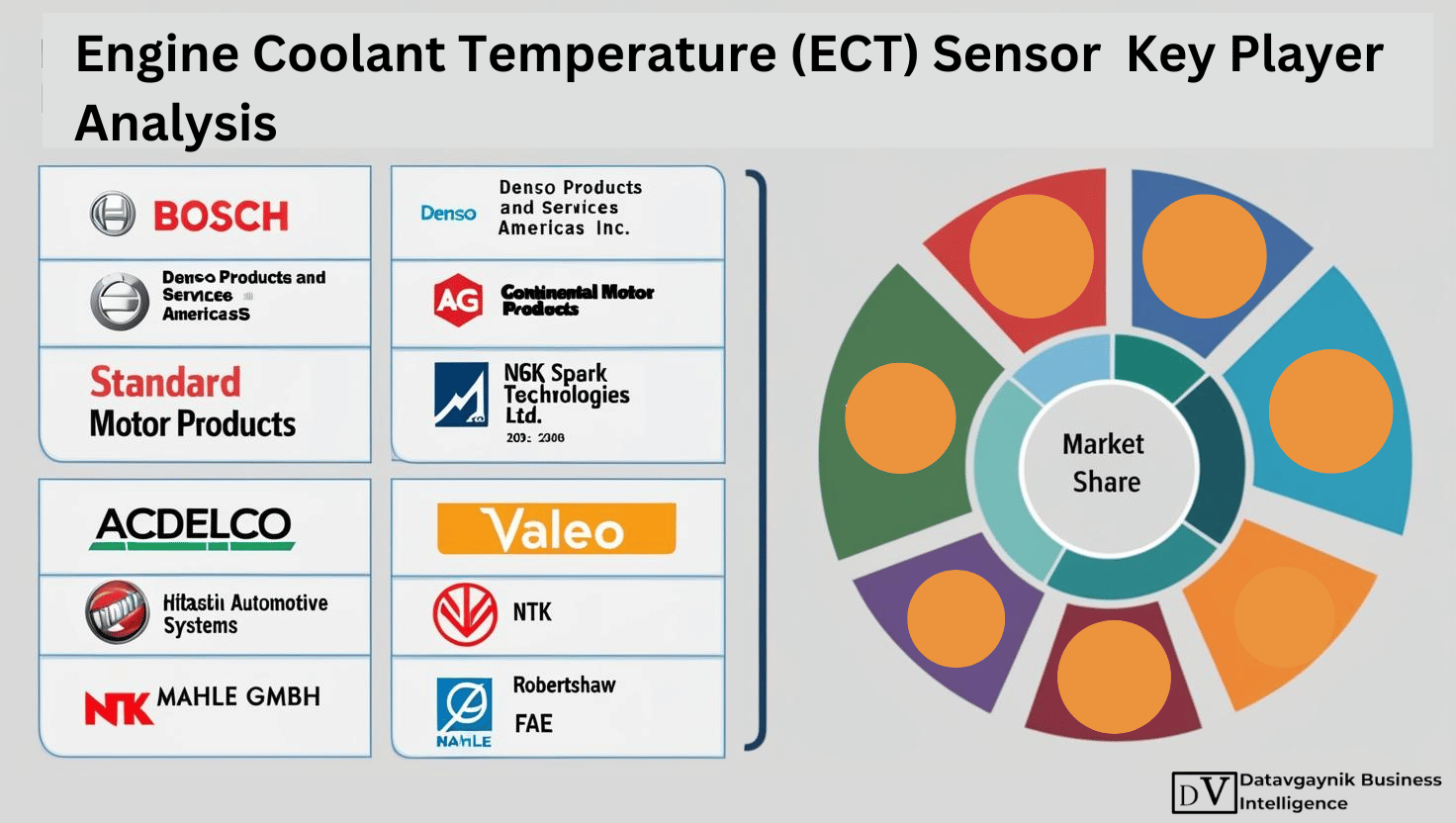
The key consumers and clients include vehicle OEMs, Tier-1 powertrain suppliers, engine manufacturers, aftermarket distributors, repair chains, fleet operators, commercial vehicle service networks, and industrial equipment manufacturers. Large suppliers such as Bosch, Denso, Continental, TE Connectivity, HELLA, Standard Motor Products, and Niterra remain important in this ecosystem through direct OEM supply, aftermarket coverage, or sensor component portfolios.
Expert view: The Engine Coolant Temperature Sensor (ECT) Market will not be driven by unit-price expansion alone. The real value sits in reliability, wider vehicle coverage, faster fault diagnosis, and compatibility with more complex engine-control architectures.
Market Segmentation and Forecast Scope
The Engine Coolant Temperature Sensor (ECT) Market can be segmented by product type, application, end user, and region. The segmentation needs to stay close to actual buying behavior. This is a component market, so demand is shaped by vehicle production, engine population, replacement cycles, sensor compatibility, and regional service depth.
Segmentation by Product Type
The largest product category is NTC thermistor-based ECT sensors. These sensors dominate because they are low-cost, reliable, easy to calibrate, and already embedded in most engine platforms. In 2026, NTC thermistor-based sensors account for around 78% of global demand by value. Their share remains high through 2035, though digital and integrated sensor formats gain selective ground.
Digital-output and smart temperature sensors are the more strategic sub-segment. They are still smaller in volume. But they fit better with advanced engine control units, onboard diagnostics, and thermal modules where signal quality and fault detection matter more.
PTC and RTD-based sensors remain relevant in specialized use cases, especially where stability, temperature range, or platform-specific engineering requirements justify the cost.
Segmentation by Application
By application, the market includes passenger vehicles, light commercial vehicles, heavy commercial vehicles, two-wheelers, off-highway equipment, marine engines, generators, and industrial engines.
Passenger vehicles remain the largest application base due to global production scale and large replacement demand. However, the most resilient growth is coming from commercial vehicles and off-highway engines. These platforms run longer duty cycles. They also face stricter uptime expectations. A small sensor failure can create costly downtime, so replacement quality matters.
Example: In a delivery fleet, a faulty ECT sensor may trigger poor cold-start behavior, fan mismanagement, higher fuel consumption, or engine warning lights. The part is inexpensive, but the downtime is not.
Segmentation by End User
The market is split between OEM demand and aftermarket demand. OEM demand is tied to new vehicle and engine production. Aftermarket demand is tied to the installed base and replacement cycles.
In 2026, the aftermarket accounts for about 34% of global value. This share is important because aftermarket pricing is usually higher than OEM supply pricing. Also, older vehicles often need sensor replacement due to connector corrosion, coolant contamination, thermal fatigue, or signal drift.
OEMs remain volume anchors. But aftermarket distributors and repair networks create a stronger margin pool.
Segmentation by Region
Regionally, the market is divided into North America, Europe, Asia Pacific, and LAMEA.
Asia Pacific is the largest production-linked region. China, India, Japan, South Korea, Thailand, and Indonesia together create a large base for passenger vehicles, two-wheelers, commercial vehicles, and engine production. India and Southeast Asia also support aftermarket growth because of rising vehicle ownership and longer vehicle life.
North America is strong in pickups, SUVs, commercial vehicles, and aftermarket replacement. The region also has a large do-it-for-me repair ecosystem.
Europe has slower ICE growth but higher technical requirements. Euro emission standards, hybrid adoption, and advanced diagnostics support demand for higher-quality sensors.
LAMEA is smaller but structurally relevant. Used vehicle imports, aging fleets, mining equipment, buses, and agricultural engines support replacement demand.
| Segmentation Dimension | Main Categories | Strategic Note |
| By Product Type | NTC thermistor, PTC sensor, RTD sensor, digital/smart sensor | NTC thermistor-based sensors hold around 78% share in 2026 |
| By Application | Passenger vehicles, LCVs, heavy trucks, two-wheelers, off-highway, industrial engines | Commercial and off-highway engines show better resilience |
| By End User | OEMs, aftermarket, fleet service, engine manufacturers | Aftermarket holds around 34% value share in 2026 |
| By Region | North America, Europe, Asia Pacific, LAMEA | Asia Pacific leads in production scale; North America leads in repair intensity |
The Engine Coolant Temperature Sensor (ECT) Market will see the fastest strategic movement in hybrid powertrains, aftermarket replacement, and heavy-duty engine platforms. These areas offer better durability requirements and more stable demand than low-cost entry-level passenger vehicle applications.
Market Trends and Innovation Landscape
Innovation in the Engine Coolant Temperature Sensor (ECT) Market is practical rather than dramatic. Buyers are not asking for a completely new component. They want better accuracy, tighter tolerances, longer life, cleaner signals, stronger connectors, and faster fault detection.
R&D Evolution
R&D is moving toward improved response time, better calibration stability, and stronger resistance to coolant chemistry. Modern coolants contain additives that can affect seals, metals, and plastics over long periods. Sensors need to survive heat cycles, vibration, fluid exposure, and connector stress for many years.
Suppliers are also improving sensor encapsulation and connector design. This matters in commercial vehicles and off-highway equipment where mud, vibration, moisture, and thermal shock are common. In mature markets, the difference between a premium sensor and a low-cost sensor often shows up after years of operation, not at installation.
Expert view: The next phase of ECT sensor development will focus less on headline innovation and more on durability engineering. Warranty reduction is a strong commercial argument here.
Technology Evolution
The core technology is still thermistor-led. That will not change quickly. NTC sensors are cheap, proven, compact, and compatible with existing ECU architectures. But design improvements are happening around the sensor rather than inside the sensing principle alone.
The most relevant technology shifts include:
- tighter signal tolerance for better engine calibration
- faster thermal response for cold-start optimization
- improved onboard diagnostics compatibility
- stronger connector sealing
- higher resistance to vibration and coolant contamination
- integration into thermostat housings and thermal-management modules
A key trend is component integration. Instead of treating the ECT sensor as a standalone part, some OEMs now integrate it into cooling assemblies, thermostat modules, or engine-management packages. This reduces assembly complexity and improves system-level performance.
Material and Design Improvements
Material science matters in this market, but in a very specific way. The focus is not exotic materials. It is practical durability.
Sensor housings use brass, stainless steel, engineered plastics, and high-temperature polymers depending on platform needs and cost targets. Sealing materials must resist coolant additives, pressure changes, and thermal cycling. Connector plastics must remain stable near hot engine bays.
For high-duty platforms, suppliers are improving corrosion resistance and thread integrity. A weak housing or poor seal can cause coolant leaks, inaccurate readings, or sensor failure. That creates service cost and warranty exposure.
AI and Software Relevance
AI is not a major direct driver for ECT sensor hardware. This should not be overstated. However, sensor data is becoming more useful inside vehicle diagnostics, fleet analytics, and predictive maintenance systems. ECT sensor readings can help identify thermostat issues, cooling-system degradation, fan problems, abnormal warm-up cycles, and possible engine stress.
So, AI does not change the sensor itself in a major way. It changes how the data may be interpreted in fleet platforms and connected diagnostics.
Expert view: The value of ECT data will rise as fleets use thermal patterns to predict failures. The sensor remains simple. The analytics layer becomes smarter.
Mergers, Partnerships, and Supplier Activity
There has not been a major ECT-only merger wave. This is too narrow a component category for that. Instead, supplier activity is happening at the broader automotive sensor and thermal-management level.
Large suppliers such as Bosch, Denso, Continental, TE Connectivity, HELLA, Sensata Technologies, and Standard Motor Products continue to expand sensor coverage across OEM and aftermarket channels. Partnerships are generally focused on platform supply, electronic control integration, aftermarket catalog expansion, and regional distribution.
Aftermarket players are also widening part-number coverage. This is important because vehicle parc fragmentation is increasing. Repair networks want faster availability across older models, imported vehicles, commercial fleets, and regional engine platforms.
The Engine Coolant Temperature Sensor (ECT) Market will therefore remain a steady engineering-led market. It is not built on hype. It is built on installed base, replacement discipline, thermal efficiency, and emission compliance.
Competitive Intelligence and Benchmarking
Competition in this market is split across two layers. The first layer is the OEM and Tier-1 supply chain, where qualification, platform history, quality systems, and engineering support matter most. The second layer is the aftermarket, where catalogue breadth, fitment accuracy, distribution reach, and brand trust shape demand.
The market is not dominated by one supplier. It is a wide field with global electronics groups, engine-management specialists, aftermarket brands, and regional sensor makers. The companies below represent the most relevant competitive benchmarks.
| Company | Portfolio Position | Market Role | Competitive Edge |
| Bosch | Automotive temperature sensors for water, oil, fuel, and engine-control systems | Strong OEM and aftermarket presence | Deep engine-management integration and global brand pull |
| Denso | Coolant temperature sensors and broader engine-management sensors | Strong in Japanese OEM platforms and replacement channels | OE-grade fitment credibility and strong Asian vehicle coverage |
| Continental | Coolant, oil, and fluid temperature sensors for passenger cars, trucks, buses, motorcycles, and generators | Strong Tier-1 and specialty vehicle supplier | Wider thermal-sensing range and robust powertrain electronics position |
| HELLA | Coolant temperature sensors and electronic sensor systems | Strong aftermarket and commercial vehicle exposure | Fitment coverage across vehicle-specific and universal spare parts |
| TE Connectivity | NTC, RTD, thermocouple, and digital temperature sensor platforms | Strong component-level and customized sensor supplier | Custom engineering, harsh-environment packaging, and connector expertise |
| Standard Motor Products | Temperature sensors for air, water, oil, gasoline, diesel, biodiesel, and exhaust gases | Strong aftermarket and engineered solutions position | Broad mounting options, connector flexibility, and replacement-part reach |
| Niterra / NTK | Engine coolant, air charge, ambient air, exhaust gas, battery, and intake temperature sensors | Strong aftermarket sensor brand | Established ignition and sensor identity with OE-style replacement positioning |
Bosch is one of the strongest benchmarks because its sensor portfolio sits close to engine-management architecture. Its temperature sensors use NTC elements and support cold-start control, warm-operation management, and fan actuation. Bosch also benefits from trust among OEMs and repair networks, which helps in both original fitment and replacement sales.
Denso has a strong position in coolant temperature sensing through its linkage with Japanese OEM platforms and its broad aftermarket presence. Its sensor positioning is practical: coolant data helps the ECU manage fuel injection, ignition timing, transmission shifting, and warning functions. That makes Denso a reference supplier where accuracy and OE fitment matter.
Continental is positioned more broadly in fluid-temperature sensing. Its coolant and oil temperature sensors cover engine coolant, engine oil, diesel fuel, trucks, buses, passenger cars, motorcycles, and stationary generators. This gives it a stronger angle in mixed powertrain and commercial-duty applications.
HELLA is particularly relevant in the replacement and commercial vehicle ecosystem. Its coolant temperature sensor range is tied to cooling-circuit monitoring and warning functions. The company also serves trucks, trailers, agricultural vehicles, construction equipment, buses, and caravans through universal and vehicle-specific parts channels.
TE Connectivity competes more as a sensor technology and integration partner than as a simple replacement-part brand. Its temperature sensor portfolio includes NTC thermistors, RTDs, thermocouples, and digital sensors. Its edge is customization, harsh-environment packaging, and connector-level reliability. That matters when sensor design must fit tight engine-bay, thermal, vibration, or chemical-exposure requirements.
Standard Motor Products is stronger in aftermarket and custom automotive sensor solutions. Its portfolio spans thermistors, RTDs, thermocouples, and silicon-based sensors. The company’s practical strength is product variation: different materials, mounting formats, connector options, and media compatibility.
Niterra / NTK has a credible aftermarket sensor identity. Its temperature sensor range includes engine coolant sensors along with air charge, ambient air, cylinder head, exhaust gas, fuel, HVAC, battery, and intake temperature sensors. Its positioning works well where repair shops want a known ignition and sensor brand rather than a low-cost private label.
Expert view: The winning suppliers will not be the cheapest ones alone. They will be the suppliers that can reduce diagnostic errors, improve fitment confidence, and keep availability strong across older ICE and hybrid platforms.
Regional Landscape and Adoption Outlook
Regional demand is tied to two different engines of growth. One is new vehicle production. The other is the aging installed base. The first supports OEM sensor demand. The second supports aftermarket replacement. Both matter, but they do not move at the same speed.
United States
The United States is a high-value aftermarket market. The reason is simple: vehicles stay on the road longer. In 2025, the average age of US light vehicles rose to 12.8 years, while the vehicle fleet reached about 289 million light vehicles in operation. That creates steady replacement demand for engine-management parts, including coolant temperature sensors.
The US also has strong demand from pickups, SUVs, commercial vans, fleet vehicles, and light trucks. These vehicles tend to carry higher repair spending than compact passenger cars. Repair chains, parts retailers, warehouse distributors, and e-commerce platforms all support wider aftermarket movement.
Regulation is also relevant. Emission compliance and onboard diagnostics keep engine sensors important. A poor temperature signal can affect fuel trim, cold-start behavior, emissions readiness, and warning-light triggers. So, even a low-cost part can become a compliance-related repair item.
Europe
Europe is slower in ICE growth but stronger in regulatory pressure. Euro standards, emissions testing, onboard diagnostics, and vehicle durability expectations keep sensor quality high. The EU vehicle fleet is also aging. In 2024, there were 256 million cars on EU roads, and commercial fleets remained large, including roughly 31.1 million vans and 6.2 million trucks. Trucks averaged 14 years in age, which supports replacement demand for engine and cooling-system components.
Germany, France, Italy, Spain, Poland, and the UK are the most relevant European demand centers. Germany remains the engineering and premium vehicle anchor. Italy, Spain, and Eastern Europe support aftermarket replacement because of older vehicle fleets and repair-driven parts demand.
The region’s adoption outlook is mixed. EV penetration limits long-term ICE sensor volume. But hybrids, vans, trucks, buses, and older vehicles keep demand alive. So, Europe becomes less about volume expansion and more about quality, diagnostics, and compliance-grade sensing.
China
China is the largest production-linked opportunity. Its automotive ecosystem is deep, fast-moving, and increasingly export-oriented. The cooling-sensor opportunity here is not limited to domestic sales. Chinese OEMs are expanding overseas, and that can pull local sensor suppliers into global platforms.
That said, China is also the strongest electrification disruptor. The rapid shift toward new-energy vehicles reduces traditional engine sensor intensity over time. The practical market view is more balanced: ICE and hybrid vehicles still carry large volumes, but pure EV growth caps the long-term upside for engine-specific sensors.
Cost pressure is intense. Local sensor makers compete aggressively on price. Global suppliers retain advantage in premium platforms, export programs, and high-quality aftermarket channels.
India
India is one of the most attractive growth markets. The country has a large two-wheeler base, rising passenger vehicle ownership, growing utility vehicle demand, and a large commercial transport network. SIAM data for April–December 2025 showed total production across passenger vehicles, commercial vehicles, three-wheelers, two-wheelers, and quadricycles at 25.37 million units, giving India a very large base for thermal and engine sensors.
The important point is not only production. It is vehicle usage. Indian vehicles often operate in high heat, stop-start traffic, dusty conditions, and mixed maintenance environments. That makes cooling-system reliability more important. Replacement demand is also supported by independent garages, parts distributors, and multi-brand service networks.
Localization will matter. Suppliers that can deliver reliable sensors at controlled cost will do better than premium-only suppliers.
Japan
Japan is a mature but technically demanding market. Vehicle production is not growing aggressively, but OEM standards are high. Japanese automakers value reliability, calibration discipline, warranty control, and long supplier relationships.
ECT demand in Japan is closely linked to hybrid platforms, compact cars, kei vehicles, commercial mini-trucks, and export production. Japanese OEMs also influence sensor demand outside Japan through production bases in Thailand, India, Indonesia, Mexico, and the US.
Japan will not be the fastest-growing region. But it will remain an important technology and quality benchmark.
South Korea
South Korea is relevant through Hyundai, Kia, and export-oriented vehicle platforms. The country has strong electronics capability, disciplined automotive manufacturing, and growing hybrid and electrified vehicle production.
Demand for traditional engine coolant temperature sensors will remain stable in hybrids and ICE exports. Korean suppliers may also gain from thermal-management modules as vehicle electronics content rises. Like Japan, South Korea’s real influence is larger than its domestic vehicle demand because its OEM platforms sell globally.
Middle East
The Middle East is relevant mainly as an aftermarket and fleet replacement market. It is not a major ECT sensor manufacturing hub. But it has harsh operating conditions, high ambient temperatures, SUVs, commercial fleets, taxis, buses, and imported used vehicles. These factors increase stress on cooling systems.
Saudi Arabia, the UAE, and Turkey are the most relevant markets. Turkey also has a manufacturing and supplier base, while GCC countries are stronger in replacement demand. In the Middle East, the value proposition is simple: heat tolerance, corrosion resistance, and dependable fitment.
| Region | Adoption Driver | Growth Outlook | Strategic Read |
| United States | Aging vehicle fleet and strong aftermarket | Moderate | High-value replacement market |
| Europe | Regulation, diagnostics, aging commercial fleet | Low to moderate | Quality-led demand, not volume-led |
| China | Large production base and export expansion | Moderate | High volume, high price pressure |
| India | Vehicle production growth and harsh-duty usage | High | Best emerging-market upside |
| Japan | Hybrid platforms and quality-driven OEMs | Low to moderate | Technical benchmark market |
| South Korea | Export OEM platforms and electronics capability | Moderate | Stable ICE/hybrid export linkage |
| Middle East | Heat exposure and fleet replacement | Moderate | Aftermarket-led opportunity |
Expert view: The best regional strategy is not one global pricing model. The US and Europe need fitment confidence. India needs cost-localized durability. China needs price competitiveness. The Middle East needs heat-resistant replacement coverage.
Recent Developments + Opportunities & Restraints
Recent Developments
March 2025 – TDK launched a new family of immersion temperature sensors for EV powertrain cooling. The first product is a fully sealed NTC thermistor designed for fast temperature control in oil-cooled electric drivetrain systems. This is not a traditional ECT sensor launch, but it shows where thermal sensing is moving: faster response, sealed construction, and cooling-fluid compatibility.
May 2025 – S&P Global Mobility reported that the average age of US light vehicles reached 12.8 years in 2025. This directly supports aftermarket demand for engine-management replacement parts, including ECT sensors, especially as high-volume 2015–2019 vehicles move deeper into the repair cycle.
July 2025 – Honeywell highlighted its battery electrolyte safety sensor after winning a 2025 Best of Sensors award. The relevance here is adjacent but important. Automotive sensing is moving from basic measurement toward safety-critical thermal monitoring across electrified platforms.
September 2025 – The European Union published Euro 7 implementing technical rules covering type approval, onboard diagnostics, onboard fuel and energy monitoring, anti-tampering, cybersecurity, and sensor-data integrity. This raises the importance of reliable vehicle sensor data in the next phase of emissions compliance.
April 2026 – OICA reported that global vehicle production rose from 92.7 million units in 2024 to 96.4 million units in 2025, with Asia-Pacific production rising to around 59.2 million vehicles and accounting for more than 61% of global output. This reinforces Asia’s role as the main production-linked demand base for automotive sensors.
Opportunities and Business Insights
Emerging markets offer the clearest volume upside. India, Southeast Asia, Latin America, and parts of the Middle East still have large ICE and hybrid vehicle populations. Many vehicles operate in hot, dusty, stop-start conditions. That raises cooling-system stress and replacement need.
Aftermarket digitization is another opening. Better e-catalogues, VIN-based fitment, QR-based authentication, and faster distributor availability can reduce wrong-part returns. For a low-ticket sensor, logistics and fitment accuracy can matter as much as the part itself.
Remote diagnostics and fleet monitoring can also lift value. ECT data can help fleets detect thermostat failure, cooling-system inefficiency, abnormal warm-up time, fan issues, or early overheating risk. The sensor stays simple, but the service model becomes smarter.
Restraints
The biggest restraint is pure EV penetration. Battery-electric vehicles use thermal sensors, but they do not use engine coolant temperature sensors in the traditional ICE sense. So, electrification slowly shifts demand away from engine-specific sensing.
Price pressure is another issue. ECT sensors are often treated as commodity replacement parts. Low-cost imports can compress margins, especially in independent aftermarket channels.
The third restraint is platform integration. When sensors are bundled inside thermostat housings or thermal modules, standalone replacement volumes may narrow in some newer vehicle platforms.


