

Market Summary and Growth Forecast
The global Epoxy Polymers Market will witness a robust CAGR of 5.8%, valued at $15.4 billion in 2026, expected to appreciate and reach $25.6 billion by 2035. The market sits at the center of several industrial value chains where adhesion, corrosion resistance, electrical insulation, chemical durability, and structural strength matter more than basic material cost.
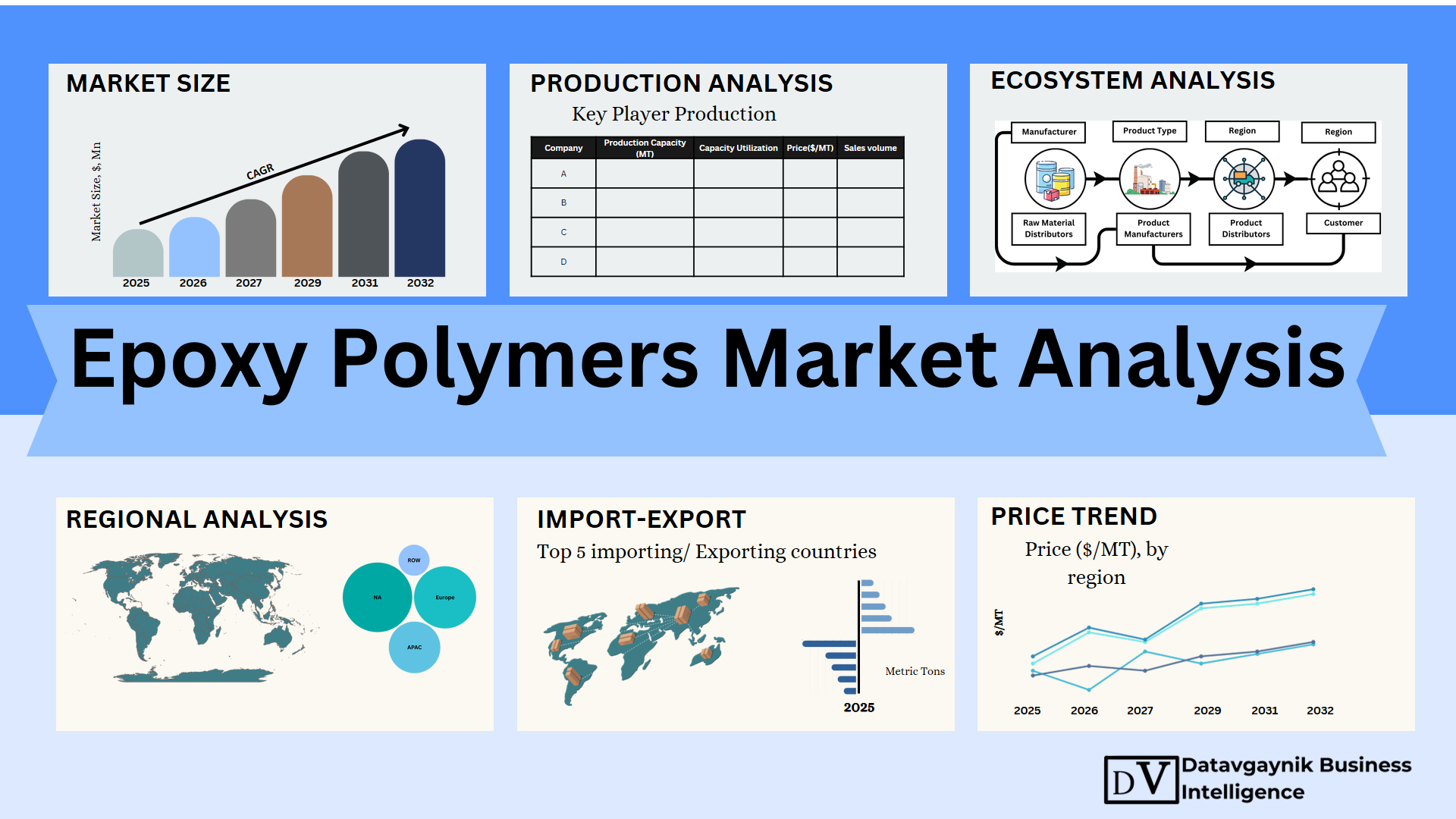
Epoxy polymers are thermosetting resin systems formed mainly through the reaction of epoxy resins with curing agents, hardeners, modifiers, and fillers. Once cured, they create a tightly cross-linked structure that performs well under mechanical, thermal, and chemical stress. This makes them important in coatings, adhesives, composites, electronics, construction materials, wind blades, automotive parts, marine protection systems, and industrial tooling.
The strategic relevance of epoxy polymers during 2026–2035 is not just about volume growth. It is about where the material is being used. Demand is shifting toward high-performance applications where standard polymers or solvent-heavy coating systems often fall short. Offshore wind installations need durable blade composites and protective coatings. Electric vehicles need electronic encapsulation, battery pack adhesives, lightweight composites, and heat-resistant insulation systems. Semiconductor and electronics manufacturers need precise potting compounds, laminates, and encapsulants. Infrastructure owners need longer-lasting flooring, primers, repair mortars, and anti-corrosion systems.
So, the growth story is tied to industrial upgrading rather than simple commodity resin consumption. China, India, Southeast Asia, the United States, Germany, South Korea, and Japan will remain major demand centers. Production will still be influenced by availability and price movements of bisphenol-A, epichlorohydrin, phenols, solvents, amines, and specialty hardeners. Any volatility in these feedstocks can affect margins quickly because epoxy value chains are chemically integrated and energy-sensitive.
Regulation will also shape the market. Lower-VOC coatings, worker-safety norms, stricter chemical exposure rules, and sustainability expectations from OEMs are pushing formulators toward waterborne epoxy, powder epoxy, high-solids systems, bio-based epoxy, and low-emission curing chemistries. This does not mean conventional systems will disappear. They won’t. But premium demand will move toward cleaner and more application-specific formulations.
Expert insight: The next phase of the Epoxy Polymers Market will be less about “more resin” and more about “better resin systems.” Customers are asking for durability, processability, compliance, and lifecycle performance in the same formulation. That changes how suppliers compete.
Global Epoxy Polymers Market Snapshot
| Metric | Estimate |
| Market Size, 2026 | $15.4 billion |
| Market Size, 2035 | $25.6 billion |
| CAGR, 2026–2035 | 5.8% |
| Estimated Volume, 2026 | 4.9 million tons |
| Estimated Volume, 2035 | 7.1 million tons |
| Largest Regional Market, 2026 | Asia Pacific |
| Fastest-Growing Regional Market, 2026–2035 | Asia Pacific |
| Most Strategic Demand Areas | Protective coatings, electronics, wind energy, EVs, construction chemicals |
Key stakeholders in this market include epoxy resin producers, specialty chemical formulators, coating manufacturers, adhesive companies, composite fabricators, electronics OEMs, automotive and EV manufacturers, wind turbine producers, marine and infrastructure operators, construction contractors, distributors, governments, industry associations, investors, and sustainability-focused procurement teams.
Large companies such as Westlake, Olin, Kukdo Chemical, Hexion, Huntsman, Nan Ya Plastics, Aditya Birla Chemicals, DIC Corporation, Sika, 3M, BASF, and Evonik will continue influencing product development, supply security, and formulation standards. Still, regional formulators will remain important because epoxy systems are often customized close to the customer.
The Epoxy Polymers Market will therefore remain a high-value industrial materials market. It is not the largest polymer category by volume. But in many applications, it carries disproportionate technical importance.
Market Segmentation and Forecast Scope
The Epoxy Polymers Market can be segmented by product type, formulation system, application, end user, and region. The segmentation needs to reflect how epoxy is actually bought and used. Customers rarely purchase “epoxy polymer” in isolation. They buy coatings, adhesives, encapsulants, laminates, composite systems, flooring materials, casting compounds, repair mortars, or specialty resins designed for a process window.
By Product Type
The market includes bisphenol-A epoxy resins, bisphenol-F epoxy resins, novolac epoxy resins, glycidyl amine epoxy resins, aliphatic and cycloaliphatic epoxy resins, brominated epoxy resins, and modified epoxy systems. Bisphenol-A based epoxy remains the workhorse because it balances cost, performance, availability, and compatibility with a wide range of curing agents.
In 2026, bisphenol-A epoxy systems are estimated to account for nearly 46% of global revenue. Their position is strongest in coatings, adhesives, civil engineering products, laminates, and general industrial uses. That said, specialty epoxy types will gain faster traction where heat resistance, electrical performance, optical clarity, flame retardancy, or low viscosity matters.
Novolac epoxy systems will remain important in high-temperature and chemical-resistant environments. Cycloaliphatic epoxy will see selective growth in electrical insulation, UV-resistant coatings, and electronics. Glycidyl amine epoxy systems will be more relevant in aerospace, advanced composites, and demanding structural applications.
By Formulation System
The market can also be viewed through solvent-borne epoxy, waterborne epoxy, powder epoxy, high-solids epoxy, and 100% solids epoxy systems. This segmentation is highly relevant because regulations and customer requirements are changing buying behavior.
Solvent-borne systems still have a strong base in heavy-duty coatings and industrial maintenance. However, waterborne, high-solids, and powder epoxy systems will grow faster due to lower emissions and improved workplace compliance. Powder epoxy will remain attractive in pipe coatings, rebar coatings, appliances, electrical components, and metal protection. 100% solids systems will continue gaining attention in flooring, tank linings, marine coatings, and construction repair applications.
By Application
Major application segments include protective coatings, adhesives and sealants, composites, electronics and electrical systems, construction materials, powder coatings, marine coatings, automotive components, wind turbine blades, and industrial tooling.
Protective coatings are expected to remain the largest application area. In 2026, coatings are estimated to hold around 39% of market revenue, supported by demand from infrastructure, marine assets, oil and gas facilities, bridges, industrial plants, flooring, and metal protection. The reason is simple: corrosion costs money. Epoxy coatings help delay asset failure and reduce maintenance cycles.
Composites will be one of the most strategic growth areas. Wind blades, lightweight vehicles, aerospace structures, sporting goods, pressure vessels, and industrial parts increasingly require resin systems that can deliver mechanical strength without excess weight. Electronics will also expand steadily as epoxy encapsulants, underfills, laminates, and potting systems become more critical in dense and heat-sensitive devices.
By End User
The core end-user groups include construction and infrastructure, automotive and transportation, electronics and electrical equipment, wind energy, aerospace and defense, marine, oil and gas, industrial manufacturing, and consumer goods.
Construction and infrastructure will remain a broad demand base. It uses epoxy in flooring, structural adhesives, concrete repair, anchors, primers, waterproofing systems, and protective coatings. Automotive and EV applications will create higher-value demand in adhesives, composites, coatings, electronics, and battery systems. Electronics and electrical users will prioritize quality consistency, dielectric strength, low ionic contamination, and thermal stability.
Wind energy deserves special attention. Epoxy is deeply embedded in blade manufacturing and protective systems. As turbine blades become longer, resin performance becomes more critical. Small formulation errors can create big downstream risks.
By Region
The regional scope includes North America, Europe, Asia Pacific, and LAMEA.
Asia Pacific will lead both revenue and volume. China will remain the largest single demand base due to coatings, electronics, construction, wind energy, and industrial production. India will grow faster from a smaller base due to infrastructure spending, manufacturing expansion, rail, renewables, and automotive activity. South Korea, Japan, and Taiwan will remain important in electronics-grade epoxy systems.
North America will be shaped by industrial refurbishment, aerospace, defense, EV investments, wind energy, data centers, electronics packaging, and protective coatings. Europe will grow at a more moderate pace but will lead in regulatory-driven product upgrades, waterborne systems, powder coatings, circularity expectations, and low-emission formulations. LAMEA will see demand from construction, oil and gas maintenance, marine coatings, and infrastructure development, with the Gulf countries and Brazil acting as key demand pockets.
Forecast Scope Summary
| Segmentation Dimension | Coverage Included | Strategic Notes |
| By Product Type | BPA epoxy, BPF epoxy, novolac, glycidyl amine, cycloaliphatic, brominated, modified epoxy | BPA systems lead, specialty systems grow faster |
| By Formulation System | Solvent-borne, waterborne, powder, high-solids, 100% solids | Low-VOC and high-solids systems gain share |
| By Application | Coatings, adhesives, composites, electronics, construction, marine, automotive, wind energy | Coatings lead; composites and electronics remain strategic |
| By End User | Construction, automotive, electronics, energy, aerospace, marine, oil and gas, industrial manufacturing | EVs, wind, electronics, and infrastructure create premium demand |
| By Region | North America, Europe, Asia Pacific, LAMEA | Asia Pacific leads; Europe drives cleaner chemistries |
The Epoxy Polymers Market will reward suppliers that can serve both ends of the demand curve: cost-efficient standard resin systems for broad industrial use and high-spec formulations for electronics, EVs, wind, aerospace, and advanced coatings.
Market Trends and Innovation Landscape
The innovation landscape in epoxy polymers is moving in three clear directions: cleaner chemistry, higher performance, and better process control. The material has been around for decades, but the requirements around it are changing quickly. Customers now want epoxy systems that cure faster, emit less, bond better, survive harsher environments, and fit automated production lines.
Shift Toward Low-VOC and Cleaner Epoxy Systems
Regulation is one of the strongest forces shaping formulation strategy. Solvent-heavy epoxy systems still have a place, especially in demanding industrial and marine environments. But the direction is clear. Waterborne epoxy, high-solids epoxy, powder epoxy, and solvent-free systems are gaining relevance as governments, contractors, and OEMs tighten emission requirements.
This trend is visible in coatings, flooring, infrastructure repair, electronics, and consumer-facing industrial products. For large infrastructure owners, low-VOC systems are no longer only about compliance. They also support safer application conditions and shorter downtime.
Expert commentary: Cleaner epoxy chemistry will not replace conventional systems overnight. The market is too application-specific for that. But every major supplier now needs a credible low-emission portfolio because procurement teams are asking for it upfront.
Bio-Based and Partially Renewable Epoxy Development
Bio-based epoxy polymers are gaining attention as customers look for lower-carbon alternatives. The focus is mainly on partially bio-based epoxy resins, bio-derived curing agents, lignin-based epoxy concepts, plant-oil-modified epoxy systems, and renewable carbon inputs. These products are still a smaller part of the market, but they are strategically important.
Adoption will be strongest where sustainability claims matter and performance requirements are manageable. Examples include coatings, adhesives, construction products, consumer goods, and selected composite applications. In highly demanding aerospace, electronics, and heavy-duty corrosion environments, bio-based systems must prove long-term reliability before broad use.
The commercial question is not whether bio-based epoxy can be made. It can. The harder question is whether it can match curing behavior, chemical resistance, thermal stability, supply consistency, and cost expectations at scale.
High-Performance Epoxy for EVs, Electronics, and Energy Systems
Electrification is creating a more technical demand profile for epoxy polymers. EV battery packs, power electronics, motors, sensors, charging systems, busbars, and control units require materials that can bond, protect, insulate, seal, and sometimes manage heat. Epoxy adhesives and encapsulants are used because they offer dimensional stability, dielectric performance, and chemical resistance.
Electronics manufacturers are also using epoxy systems in printed circuit boards, semiconductor packaging materials, underfills, potting compounds, and electronic laminates. As devices become smaller and more powerful, epoxy formulations must handle heat, moisture, vibration, and electrical stress.
Wind energy is another major innovation area. Longer blades need resin systems with strong fatigue performance, controlled cure profiles, good fiber wet-out, and reliable processing. This is pushing resin producers and composite specialists to improve infusion-grade epoxy systems.
Faster Cure and Process-Friendly Systems
Manufacturers want materials that fit production speed. That is pushing demand for faster-curing epoxy systems, snap-cure adhesives, one-component epoxy systems, latent curing agents, low-temperature curing systems, and formulations designed for automated dispensing.
This matters in automotive assembly, electronics, appliances, composite molding, construction chemicals, and industrial repair. A resin that performs well but slows down the line can lose out to a slightly lower-performing system that fits the process better.
That said, fast cure brings trade-offs. Pot life, storage stability, heat generation, shrinkage, and final mechanical performance must be balanced carefully. This is where formulation expertise becomes a serious differentiator.
Toughened, Flexible, and Hybrid Epoxy Systems
Traditional epoxy systems can be brittle. That is a known limitation. To solve this, suppliers are improving rubber-toughened epoxy, core-shell particle toughening, thermoplastic-modified epoxy, urethane-modified epoxy, silicone-modified epoxy, and epoxy-acrylate hybrid systems.
These modified systems are important in structural adhesives, composites, automotive parts, electronic protection, and impact-resistant coatings. Customers want toughness without losing adhesion, corrosion resistance, or thermal stability. That balance is not easy. It requires careful chemistry and application testing.
Mergers, Partnerships, and Capacity Strategy
The competitive landscape is also evolving through capacity expansion, portfolio repositioning, and partnerships with downstream formulators. Large epoxy resin producers are investing in supply reliability, specialty resin grades, and integration with feedstock chains. Specialty chemical companies are focusing more on curing agents, additives, modifiers, and application-specific systems.
Partnerships between resin suppliers, OEMs, wind blade manufacturers, electronics companies, and coating formulators will become more important through 2035. Why? Because epoxy performance is rarely decided by resin alone. It depends on the full system: resin, hardener, accelerator, filler, modifier, substrate, process, cure schedule, and operating environment.
The Epoxy Polymers Market is therefore becoming more formulation-led. Suppliers that only compete on base resin price will remain exposed to margin pressure. Those that can support customers with testing, regulatory documentation, technical service, and customized performance packages will command stronger positions.
Innovation Outlook, 2026–2035
| Innovation Area | Market Direction | Likely Impact by 2035 |
| Low-VOC epoxy systems | Waterborne, high-solids, powder, and solvent-free systems expand | Stronger adoption in coatings, flooring, and infrastructure |
| Bio-based epoxy | Selective commercialization grows | Premium niche adoption before broad industrial scaling |
| EV and electronics epoxy | Encapsulants, adhesives, potting compounds, and insulation materials advance | Higher value per kilogram than standard coating-grade systems |
| Fast-cure systems | More one-component and automated-process-compatible epoxy products | Better fit with automotive, electronics, and industrial lines |
| Toughened epoxy | Hybrid and particle-modified systems gain use | Improved structural bonding and composite durability |
| Wind blade resin systems | Infusion-grade and fatigue-resistant epoxy systems improve | Support longer blade designs and offshore wind expansion |
Expert commentary: By 2035, the winners won’t simply be the largest resin producers. The stronger players will be those that understand the customer’s process, not just the customer’s purchase order. In epoxy, formulation knowledge is often where the real margin sits.
The Epoxy Polymers Market will keep its industrial base, but its innovation premium will come from cleaner coatings, energy transition applications, electronics reliability, lightweight composites, and process-ready resin systems.
Competitive Intelligence and Benchmarking
Competition in epoxy polymers is layered. At the top are integrated resin producers with access to upstream feedstocks and global supply chains. Below them are specialty formulators that convert base resins into coatings, adhesives, flooring systems, encapsulants, composite systems, and construction chemicals. The strongest companies usually do both: produce core epoxy chemistry and support customers with application-specific formulation work.
| Company | Portfolio Position | Market Position |
| Olin | Liquid and solid epoxy resins, specialty epoxy systems, materials for electronics, coatings, composites, and industrial uses | One of the most integrated global epoxy producers, with a strong position in North America and Europe |
| Westlake | Epoxy resins, modifiers, curing agents, waterborne systems, coating and composite-focused thermoset materials | A major global supplier strengthened by the acquisition of Hexion’s epoxy business |
| Kukdo Chemical | Epoxy resins, curing agents, reactive diluents, electronic materials, composite-related systems, and specialty resin grades | A leading Asian epoxy producer with strong relevance in Korea, China, India, and export markets |
| Huntsman | Epoxy resins, curing agents, accelerators, adhesives, composite systems, coatings materials, and advanced materials formulations | Strong in specialty and performance-driven applications, especially composites, adhesives, electronics, and transportation |
| Nan Ya Plastics | Liquid, solid, diluted, and solution epoxy resins used in coatings, electronics, construction, motors, adhesives, and anti-corrosion systems | A major Asian producer with strong linkage to electronics, chemical materials, and regional resin supply |
| Aditya Birla Chemicals | Liquid epoxy resins, solid epoxy resins, blends, multifunctional resins, reactive diluents, curing agents, and formulated systems | A fast-rising global player with manufacturing depth across Asia and a growing footprint in the United States |
| DIC Corporation | Epoxy resins for coatings, electronics, civil engineering, construction, infrastructure, functional materials, and adhesives | A Japan-based specialty materials player with strong relevance in higher-value functional and electronics-linked demand |
Olin remains one of the most important global suppliers because of its integrated epoxy chain. Its strength is not only resin production. It also serves advanced electronics, liquid resin markets, coatings, composites, and performance systems. The company is well positioned where customers want scale, technical reliability, and long-term supply discipline.
Westlake has a broad epoxy platform across coatings and composites. Its position improved after adding Hexion’s epoxy business, which gave it deeper coverage in specialty epoxy resins, modifiers, and curing agents. Westlake is particularly relevant in protective coatings, construction systems, composite materials, and lower-emission formulation upgrades.
Kukdo Chemical is one of the strongest Asian epoxy producers. Its portfolio cuts across basic epoxy resins, novolac grades, curing agents, reactive diluents, electronics materials, and composite-related applications. The company benefits from proximity to electronics, coatings, shipbuilding, infrastructure, and industrial manufacturing demand in Asia.
Huntsman competes more on formulation depth and specialty performance than pure commodity volume. Its advanced materials business is tied to adhesives, coatings, composites, electrical insulation, transportation, and aerospace-linked systems. The company’s market position is stronger where customers need technical service, controlled curing behavior, and tailored resin-hardener packages.
Nan Ya Plastics has a strong Asian manufacturing base and broad chemical integration. Its epoxy materials serve coatings, electrical and electronic materials, construction repair, motors, adhesives, and anti-corrosion uses. The company is strategically relevant because Asian demand still drives the largest volume base of the global market.
Aditya Birla Chemicals is expanding from an Asian epoxy producer into a broader global advanced materials player. Its product range includes base epoxy resins, blends, multifunctional materials, reactive diluents, and formulated systems. Its recent U.S. expansion also gives it better access to coatings, flooring, marine, and industrial customers in North America.
DIC Corporation occupies a more specialty-oriented position. Its epoxy resin business is connected to coatings, electronics, construction, civil engineering, adhesives, and functional materials. DIC’s strength is strongest in quality-sensitive applications where performance consistency matters more than bulk resin pricing.
Expert commentary: The competitive split is becoming clearer. Commodity resin producers need cost control and feedstock access. Specialty players need formulation intelligence. The best-positioned suppliers are those that can do both without losing speed.
Regional Landscape and Adoption Outlook
Regional adoption is not uniform. Epoxy polymers follow industrial structure. Where there is construction, electronics, marine activity, wind energy, automotive production, coatings demand, and infrastructure repair, epoxy demand becomes more stable and higher-value.
North America
North America is a mature but technically important market. The United States leads regional demand due to protective coatings, aerospace, defense, industrial flooring, construction repair, electrical systems, EV manufacturing, wind energy, and electronics packaging. Canada contributes through infrastructure, marine, energy, and industrial maintenance. Mexico is gaining relevance through automotive assembly and nearshoring-led manufacturing.
Growth in North America will be supported by refurbishment of aging infrastructure, reshoring of manufacturing, semiconductor investments, EV battery plants, and demand for durable industrial coatings. The region is also sensitive to import trade actions, local supply security, and feedstock economics.
The white space is in localized specialty formulation. Many customers do not only need resin supply. They need faster cure, lower odor, lower VOC, better thermal behavior, and field-tested systems that meet contractor or OEM process conditions.
Europe
Europe will grow slower in volume but stronger in product sophistication. Germany, France, Italy, the United Kingdom, Spain, the Benelux region, and the Nordics are key demand pockets. Germany leads in industrial coatings, automotive, machinery, electrical systems, and specialty chemicals. Italy and Spain remain important for construction chemicals, coatings, marine, and infrastructure activity. The Nordics are more relevant for wind, marine, and sustainability-driven materials.
Regulation is the main regional force. Europe pushes the market toward low-VOC coatings, waterborne epoxy, powder systems, safer curing agents, and better chemical documentation. The region also has strong demand from wind energy, rail, marine assets, industrial refurbishment, and high-performance coatings.
That said, Europe’s cost base is high. Energy prices, compliance costs, and import competition have put pressure on local producers. Anti-dumping measures may help stabilize parts of the regional supply chain, but customers will still demand competitive pricing.
China
China is the largest demand and production center. It has deep epoxy consumption across coatings, electronics, electrical laminates, construction, shipbuilding, wind turbine blades, industrial machinery, adhesives, and automotive parts. Local producers also have strong feedstock integration and capacity depth.
Growth will be supported by renewable energy, electronics manufacturing, EV production, industrial coatings, marine applications, and infrastructure maintenance. However, overcapacity can pressure pricing. China will likely remain strong in volume, but margins may be uneven unless producers move toward higher-performance grades.
The most strategic sub-segments in China are electronics-grade epoxy, wind blade resin systems, powder coating materials, EV adhesives, and anti-corrosion systems for industrial assets.
India
India is one of the fastest-growing markets. Demand is supported by infrastructure, metro rail, roads, bridges, power projects, renewable energy, industrial flooring, automotive, electrical equipment, and domestic manufacturing. Construction chemicals and protective coatings are especially important because epoxy is used in repair, anchoring, flooring, primers, waterproofing support systems, and industrial maintenance.
India’s epoxy ecosystem is also becoming more policy-sensitive. Anti-dumping duties and local manufacturing priorities may support domestic resin producers and formulators. Still, India remains dependent on selected imported inputs and specialty grades. This creates opportunity for local capacity, technical service, and regional distribution.
The white space is large in mid-tier industrial customers. Many smaller manufacturers and contractors still use basic systems. As quality standards improve, demand will shift toward better-formulated epoxy products.
Japan
Japan is a high-value epoxy market rather than a high-volume growth market. Demand is linked to electronics, automotive components, electrical insulation, precision manufacturing, coatings, adhesives, and infrastructure maintenance. Japanese customers often require tight quality control, technical documentation, and stable long-term performance.
Growth will be moderate, but specialty value will remain strong. Electronics and advanced materials will drive demand for cleaner, more reliable epoxy systems. Japan also remains important for R&D in functional resins, semiconductor-linked materials, and high-purity applications.
South Korea
South Korea is strategically important because of electronics, semiconductors, shipbuilding, batteries, automotive, coatings, and industrial manufacturing. Epoxy demand is deeply connected to high-spec applications, especially electronic materials, marine coatings, adhesives, and composite systems.
Korean suppliers and users are technically advanced, but the region also faces global trade scrutiny around epoxy exports. Domestic demand will stay resilient because Korea’s electronics and shipbuilding base requires performance materials at scale.
The strongest growth pockets will be EV batteries, semiconductor packaging materials, anti-corrosion marine coatings, electronics encapsulation, and high-performance adhesives.
Rest of the World
The Rest of the World includes Southeast Asia, the Middle East, Africa, Latin America, and Oceania. Southeast Asia will see strong demand from electronics assembly, construction, coatings, automotive parts, and industrial manufacturing. Vietnam, Thailand, Malaysia, and Indonesia are important growth markets.
The Middle East will remain relevant for oil and gas maintenance, marine coatings, desalination infrastructure, industrial flooring, and construction. Brazil and Mexico will drive Latin American demand through construction, automotive, wind energy, and industrial coatings. Africa remains underserved but offers long-term potential in infrastructure repair, power, mining, ports, and industrial facilities.
White space is largest where industrial assets are expanding but formulation quality remains uneven. This creates room for regional distributors, contractor training, pre-formulated systems, and application support.
Regional Adoption Outlook
| Region/Country | Adoption Level | Growth Character | Strategic Demand Pockets |
| North America | High | Stable, premium-led | Industrial coatings, EVs, aerospace, infrastructure repair, electronics |
| Europe | High | Regulation-led | Low-VOC systems, wind, powder coatings, specialty adhesives |
| China | Very high | Volume-led with specialty shift | Electronics, wind blades, EVs, coatings, construction |
| India | Medium-high | Fast-growing | Infrastructure, construction chemicals, coatings, electrical equipment |
| Japan | High | Specialty-led | Electronics, automotive, precision materials, functional resins |
| South Korea | High | Technology-led | Semiconductors, batteries, marine, electronics materials |
| Rest of the World | Mixed | Emerging and project-led | Oil and gas, ports, construction, industrial flooring, coatings |
Expert commentary: Asia will remain the center of gravity. But Europe and North America will shape the quality curve. That means the market’s volume story and value story will not always move in the same geography.
End-User Dynamics and Use Case
End-user demand is shaped by performance risk. Epoxy polymers are rarely selected only because they are available. They are selected because failure is expensive. A coating failure can shut down an asset. A weak adhesive can affect vehicle safety. A poor encapsulant can damage electronics. A resin defect in a wind blade can create major warranty exposure.
Construction and Infrastructure
Construction users adopt epoxy through flooring systems, concrete repair, primers, structural bonding, anchoring, grouts, coatings, and waterproofing support applications. Demand is strong in industrial buildings, warehouses, airports, hospitals, metro stations, bridges, ports, parking structures, and power plants.
The buying decision is practical. Contractors want systems that cure predictably, bond well to concrete or steel, handle abrasion, and reduce rework. In emerging markets, adoption rises when project owners shift from low-cost repair products to lifecycle-based maintenance planning.
Protective Coatings and Industrial Maintenance
This is one of the most stable demand pools. Epoxy coatings are used on steel structures, pipelines, tanks, ships, bridges, chemical plants, offshore assets, refineries, water systems, and industrial floors. The market is driven by corrosion protection, chemical resistance, abrasion resistance, and asset-life extension.
Users in this segment care about surface preparation tolerance, cure speed, application temperature range, salt-spray performance, and long-term durability. Lower-VOC systems are becoming more relevant, but heavy-duty environments still need proven performance.
Automotive and Electric Vehicles
Automotive users adopt epoxy in structural adhesives, coatings, composites, electronic modules, battery packs, sensors, insulation systems, and lightweight parts. EVs are lifting the value intensity because batteries and power electronics need bonding, sealing, vibration protection, and electrical insulation.
OEMs are also moving toward automated dispensing and faster curing systems. That makes process compatibility just as important as material strength.
Electronics and Electrical Equipment
Electronics users adopt epoxy in printed circuit boards, semiconductor packaging, potting compounds, underfills, encapsulants, electrical laminates, transformers, motors, switchgear, and sensors. The quality bar is high because epoxy systems must protect components from heat, moisture, vibration, chemicals, and electrical stress.
This segment uses smaller volumes compared with coatings or construction, but value per kilogram can be much higher. Demand will remain strong in South Korea, Japan, Taiwan, China, the United States, and parts of Southeast Asia.
Wind Energy and Composites
Wind blade manufacturers rely on epoxy systems for blade structures, especially where fatigue resistance, fiber wet-out, controlled curing, and mechanical strength are critical. Longer blades increase the pressure on resin performance. Composite fabricators also use epoxy in aerospace, pressure vessels, sports equipment, marine parts, and industrial components.
The main buyer concern is reliability at scale. A resin system must perform not only in a lab but also across large parts, long production cycles, and variable manufacturing conditions.
Realistic Use Case
Scenario: A wind blade manufacturer in coastal China upgraded from a standard infusion resin to a tougher epoxy system for longer offshore blade sections. The company needed better fatigue performance, more predictable cure behavior, and fewer void-related quality issues during large-part processing. The switch increased resin cost per kilogram, but it reduced rework risk and improved confidence in blade durability. For the buyer, the decision was not about resin price. It was about protecting the economics of a high-value turbine asset over decades of operation.
This use case reflects how epoxy adoption often works in high-risk applications. The material is evaluated against downtime, warranty exposure, maintenance cost, and lifecycle reliability.
Expert commentary: In end-use markets, epoxy is not always the cheapest material. But when the cost of failure is high, buyers are willing to pay for chemistry that reduces risk.
Recent Developments + Opportunities & Restraints
Recent Developments
| Year/Month | Event | Market Impact |
| 2025, July | The European Commission imposed definitive anti-dumping measures on epoxy resin imports from China, Taiwan, and Thailand. | This supports regional producers and may improve price stability in Europe, while making import sourcing more complex for downstream formulators. |
| 2025, June | Aditya Birla Advanced Materials acquired Cargill’s 17-acre specialty chemical manufacturing facility in Dalton, Georgia. | The move strengthens its U.S. position in formulated resins, curing agents, reactive diluents, marine coatings, industrial coatings, and flooring-linked systems. |
| 2025, May | The U.S. International Trade Commission found that epoxy resin imports from South Korea, Taiwan, and Thailand injured the U.S. industry. | This reinforced the trade-protection theme in epoxy resins and may encourage more regional sourcing in North America. |
| 2025, August | DIC resolved to build new epoxy resin production equipment for semiconductor encapsulation materials in Japan. | This points to rising demand for higher-purity, electronics-grade epoxy materials linked to semiconductors and advanced packaging. |
| 2024, April | Westlake introduced lower-yellowing epoxy systems for coatings and decorative applications at the American Coatings Show. | This supports demand for epoxy formulations with better visual stability, especially in applications where clarity and appearance matter. |
Opportunities
Emerging market infrastructure demand: India, Southeast Asia, the Middle East, and parts of Latin America will require more epoxy-based coatings, repair systems, industrial flooring, adhesives, and construction chemicals as infrastructure spending increases.
Electronics and EV material demand: Higher use of encapsulants, underfills, potting materials, adhesives, and insulation systems creates a premium growth pocket. This is especially relevant in China, South Korea, Japan, Taiwan, the United States, and Southeast Asia.
Cleaner and process-ready formulations: Waterborne epoxy, high-solids systems, powder epoxy, fast-cure adhesives, and automated dispensing-compatible epoxy systems can help suppliers move away from purely price-led competition.
Restraints
Feedstock volatility: Epichlorohydrin, bisphenol-A, phenols, solvents, amines, and energy costs can move sharply. This creates margin pressure for both resin producers and formulators.
Regulatory and health scrutiny: Chemical exposure rules, VOC limits, and sustainability demands can increase compliance costs and slow approvals for certain formulations.
Overcapacity and trade disruption: Asia-led capacity additions, dumping concerns, and anti-dumping duties can create unstable pricing, supply uncertainty, and sourcing complexity for multinational buyers.
Expert commentary: The opportunity is real, but not evenly distributed. Standard epoxy resin will remain price-sensitive. The stronger margin pool will sit in specialty systems, electronics materials, EV adhesives, low-emission coatings, and technically supported formulations.


