

Ethyl Hexanoate Market Fueled by Expanding Food and Beverage Sector
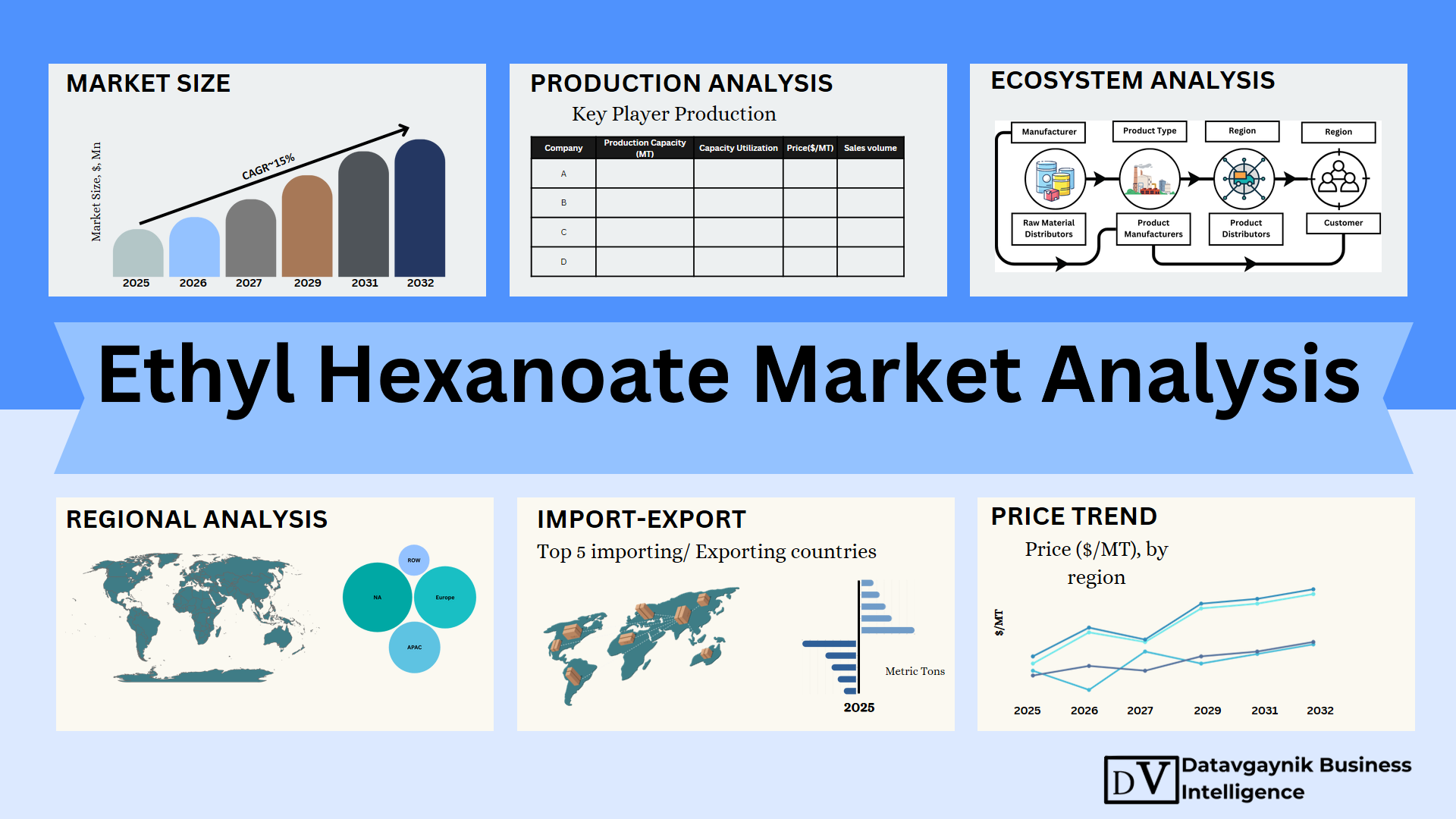
The Ethyl Hexanoate Market is witnessing a substantial surge in demand, primarily driven by its broadening applications across the global food and beverage industry. Ethyl hexanoate, known for its strong fruity aroma reminiscent of apple, pineapple, and pear, has become a cornerstone ingredient in flavor enhancement. For instance, in 2023 alone, the global fruit-flavored beverage market surpassed USD 98 billion, and with a projected CAGR of over 5.8% until 2030, the use of natural flavor compounds like ethyl hexanoate is expected to rise in parallel.
The growth trajectory of the Ethyl Hexanoate Market is directly tied to consumer trends favoring natural and clean-label food products. With more than 65% of global consumers showing preference for natural flavoring agents over synthetic ones, manufacturers in the food sector are increasingly shifting towards ethyl hexanoate for its natural derivation and low toxicity profile. As the processed food industry scales up—particularly in Asia-Pacific and Latin America—ethyl hexanoate is solidifying its role as a key additive in candies, dairy products, baked goods, and ready-to-drink beverages.
Rising Demand for Premium Alcoholic Beverages Boosts Ethyl Hexanoate Market
The Ethyl Hexanoate Market is also being significantly driven by the escalating global consumption of premium and craft alcoholic beverages. Ethyl hexanoate is a crucial ester in enhancing the fruity aroma of wines, whiskies, and brandies. As of 2024, the global wine market alone is valued at over USD 340 billion, with fruit-forward flavor profiles increasingly preferred by millennial and Gen Z consumers.
For example, in European markets like France and Italy, ethyl hexanoate is extensively used in the formulation of premium wines to replicate or amplify natural fermentation aromas. Similarly, in the U.S., the rise of craft distilleries—growing at over 10% annually—has resulted in increased adoption of ethyl hexanoate for tailoring unique aromatic signatures. This surge in demand across alcoholic beverage categories is significantly expanding the overall Ethyl Hexanoate Market Size.
Datavagyanik also covers related markets such as the Cetyl ethyl hexanoate Market, the Butyl hexanoate Market, and the Ethyl Acetate Market. Understanding these markets sheds light on emerging innovations and industry crossovers that impact the main topic.
Fragrance and Personal Care Sector Unlocks New Ethyl Hexanoate Market Opportunities
The fragrance and personal care industry has emerged as another critical driver propelling the Ethyl Hexanoate Market. Known for its fruity and floral olfactory profile, ethyl hexanoate is widely utilized in perfumes, lotions, shampoos, and deodorants. With the global personal care market poised to reach over USD 730 billion by 2027, growing at a CAGR of 7.5%, the demand for naturally derived aroma compounds like ethyl hexanoate is rapidly escalating.
For instance, leading cosmetics producers are incorporating ethyl hexanoate in formulations to align with consumer demand for botanically inspired scents and clean-label products. The clean beauty trend, which accounted for over 23% of all cosmetic launches in 2023, increasingly favors naturally derived esters, thereby fueling consistent growth in the Ethyl Hexanoate Market.
Industrial Applications Add a New Dimension to Ethyl Hexanoate Market Expansion
Beyond its use in food and fragrances, the Ethyl Hexanoate Market is expanding due to growing adoption in industrial applications. Ethyl hexanoate serves as an effective solvent in paints, coatings, and adhesives due to its volatility and solvency strength. The global paints and coatings market, which crossed USD 185 billion in 2023, is growing at a CAGR of 5.3%, driven by demand in construction and automotive sectors. Ethyl hexanoate’s chemical properties make it a preferred choice for formulations that require fast-drying and low-viscosity solvents.
Additionally, its use in the production of plasticizers is on the rise, supporting the manufacturing of flexible plastics used in consumer electronics, automotive interiors, and medical devices. These applications are significantly contributing to the diversification and resilience of the Ethyl Hexanoate Market.
Ethyl Hexanoate Market Benefits from Pharmaceutical and Chemical Synthesis Growth
In the pharmaceutical and specialty chemical industries, ethyl hexanoate is gaining attention as a useful intermediate. It is used in the synthesis of specialty esters and as a flavor masking agent in oral pharmaceuticals. For instance, with the global pharmaceutical sector projected to exceed USD 1.6 trillion by 2027, even niche applications such as excipients present considerable opportunities for the Ethyl Hexanoate Market.
In chemical synthesis, ethyl hexanoate is valued for its compatibility with organic compounds and its ability to act as a precursor for creating more complex molecules. The rising need for specialty chemicals in agriculture, textiles, and electronics is pushing manufacturers to adopt ethyl hexanoate in their intermediate formulations. As a result, the compound’s versatility is positioning it as a high-potential asset in the broader chemical value chain.
Shift Towards Bio-Based Products Strengthens Ethyl Hexanoate Market Growth
The global shift towards sustainability is having a transformative impact on the Ethyl Hexanoate Market. Bio-based and renewable production of ethyl hexanoate is gaining traction as industries move away from petrochemical-derived esters. In 2024, more than 30% of all new flavor and fragrance chemical launches were bio-based. This transition is largely consumer-driven, with over 70% of Gen Z consumers expressing a willingness to pay more for sustainable products.
For example, leading producers are increasingly investing in fermentation-based production techniques, using natural feedstocks such as sugarcane and cornstarch. These innovations not only align with regulatory mandates in Europe and North America but also position ethyl hexanoate as a preferred ingredient in eco-conscious formulations. The growth of the bio-based chemicals sector, expected to reach USD 97 billion by 2028, further supports the expansion of the Ethyl Hexanoate Market in this direction.
Global Processed Food Industry Catalyzes Ethyl Hexanoate Market Demand
The rapid urbanization and modernization of diets, particularly in Asia-Pacific and Africa, are significantly boosting the global processed food industry, which in turn is propelling the Ethyl Hexanoate Market. For instance, countries like India, Indonesia, and Vietnam are witnessing double-digit growth in packaged food consumption, driven by rising incomes and changing lifestyles.
Ethyl hexanoate is extensively used in fruit-flavored yogurts, beverages, bakery products, and desserts, enhancing sensory appeal and shelf stability. As urban populations grow—expected to reach 68% globally by 2050—the demand for convenient, flavorful, and shelf-stable food products is accelerating. This trend is directly linked to a sustained increase in ethyl hexanoate consumption, thereby positively impacting the Ethyl Hexanoate Market Size.
Consumer Preferences for Natural Scents Continue to Shape Ethyl Hexanoate Market
Changing consumer preferences are reshaping the Ethyl Hexanoate Market, particularly in terms of demand for naturally inspired scents and flavors. Ethyl hexanoate, which can be derived from fruits or produced through bio-based processes, is perfectly aligned with this shift. For example, global natural fragrance ingredient sales grew by over 9% in 2023, a pace much faster than synthetic counterparts.
As health-conscious consumers scrutinize product labels more closely, ingredients like ethyl hexanoate gain favor due to their recognition as safe, naturally occurring compounds. This clean-label movement is especially prominent in North America and Europe, where regulatory frameworks support natural ingredient claims. Consequently, the alignment of ethyl hexanoate with these trends is boosting its uptake in multiple end-use sectors, further fueling the Ethyl Hexanoate Market.
“Track Country-wise Ethyl Hexanoate Production and Demand through our Ethyl Hexanoate Production Database”
-
-
- Ethyl Hexanoate production database for 27+ countries worldwide
- Ethyl Hexanoate sales volume for 31+ countries
- Country-wise Ethyl Hexanoate production capacity, production plant mapping, production capacity utilization for 27+ manufacturers
- Ethyl Hexanoate production plants and production plant capacity analysis by top manufacturers
-
“Track real-time Ethyl Hexanoate Prices, Ethyl Hexanoate price charts for 27+ countries, Ethyl Hexanoate weekly price tracker and Ethyl Hexanoate monthly price tracker”
-
-
- Track real-time Ethyl Hexanoate prices and Ethyl Hexanoate price trend in 27+ countries though our excel-based Ethyl Hexanoate price charts
- Real-time Ethyl Hexanoate price tracker dashboard with 27+ countries
- Complete transparency on Ethyl Hexanoate price trend through our Ethyl Hexanoate monthly price tracker, Ethyl Hexanoate weekly price tracker
-
North America Leads High-Value Applications in the Ethyl Hexanoate Market
The Ethyl Hexanoate Market in North America has established a robust foundation, driven by its dynamic food, beverage, and personal care industries. The United States, accounting for a major share of regional demand, has seen steady growth in natural flavor and fragrance consumption. For example, the U.S. processed food industry exceeded USD 950 billion in 2023, with fruit-based beverages and confections forming a significant portion. Ethyl hexanoate is used extensively in these products to deliver authentic fruity aromas, contributing directly to the compound’s rising consumption.
In the fragrance segment, American consumers increasingly demand clean-label and botanical scents in skincare and haircare. With over 50% of new personal care launches in North America now emphasizing “natural” ingredients, ethyl hexanoate is well-positioned as a favored ester. Furthermore, the rise of premium, artisanal alcoholic beverages—where ethyl hexanoate enhances aromatic complexity—continues to support growth across distilleries and wineries in states like California and Oregon.
Europe Drives Sustainable Production in the Ethyl Hexanoate Market
The Ethyl Hexanoate Market in Europe is closely aligned with the continent’s commitment to sustainability and clean chemistry. Countries such as Germany, France, and the Netherlands are at the forefront of producing bio-based ethyl hexanoate using fermentation and green chemistry techniques. For instance, Germany’s chemical sector, valued at over USD 260 billion, continues to invest heavily in renewable chemical production, with ethyl hexanoate among the priority esters.
France, home to one of the world’s largest fragrance hubs, has witnessed increasing demand for high-purity ethyl hexanoate, particularly in perfume blending and gourmet flavors. French wine producers also utilize the compound to enhance fruity profiles in high-value wine exports such as Bordeaux and Champagne. Meanwhile, the Netherlands plays a crucial role as a logistics hub, re-exporting ethyl hexanoate across Europe, the Middle East, and Africa, thanks to its efficient distribution infrastructure.
Asia-Pacific Emerges as the Fastest-Growing Ethyl Hexanoate Market
Asia-Pacific is the most rapidly expanding region in the Ethyl Hexanoate Market, fueled by population growth, urbanization, and the evolution of consumer tastes. China dominates regional production with large-scale chemical manufacturing hubs and growing demand from the food processing sector. For example, China’s flavored beverage market alone surpassed USD 65 billion in 2023, with ethyl hexanoate being a critical flavoring component.
India is also becoming a strategic player, with its food and beverage industry growing at over 10% annually. In addition, the “Make in India” initiative has resulted in new ethyl hexanoate production facilities focused on low-cost, high-quality outputs for both domestic and export markets. Japan and South Korea, with their mature cosmetics and personal care markets, have increased imports of ethyl hexanoate to support product innovation in skincare, perfumes, and wellness applications.
Latin America and Middle East Expand Ethyl Hexanoate Market Through Alcohol and Fragrance Sectors
The Ethyl Hexanoate Market in Latin America is driven by Brazil, Mexico, and Argentina, where growing wine and spirit industries are boosting demand. In Brazil, which produces more than 3.6 million liters of wine annually, ethyl hexanoate is integral to aroma development in both domestic and export-bound bottles. Similarly, Mexico’s tequila and craft beer sectors are leveraging ethyl hexanoate to differentiate sensory profiles and improve consumer appeal.
The Middle East, while nascent, is showing consistent growth. With a strong emphasis on luxury personal care products and niche perfumery, countries like the UAE and Saudi Arabia are importing high-quality ethyl hexanoate for use in localized formulations that cater to premium consumers. The rise of food processing clusters in the region is also beginning to create new demand for the compound in flavoring applications.
Africa’s Ethyl Hexanoate Market Anchored in Growing Food and Fragrance Adoption
Africa represents an emerging frontier for the Ethyl Hexanoate Market, driven by increasing urbanization and a shift toward packaged and processed foods. In nations like South Africa, Kenya, and Nigeria, consumer preferences are evolving toward flavored beverages and confectionery, where ethyl hexanoate serves as a natural and cost-effective flavoring agent.
Simultaneously, the continent’s growing cosmetics industry, particularly in North Africa, is contributing to demand. With the rise of local beauty brands and expanding awareness of product quality, ethyl hexanoate’s application in fragrance manufacturing is gaining traction. The opportunity lies in creating regionally tailored formulations using ethyl hexanoate to meet unique cultural preferences in aroma and taste.
Production Hubs Define Ethyl Hexanoate Market Supply Chain Dynamics
The supply side of the Ethyl Hexanoate Market is currently led by China, the United States, Germany, and India. These nations not only dominate production volumes but also define global pricing and trade flows. China, with its large-scale industrial zones and low production costs, is a leading exporter of synthetic and bio-based ethyl hexanoate, supplying Southeast Asia, Europe, and Africa.
The United States, with its focus on high-purity, food-grade esters, maintains leadership in premium applications. Germany is focused on sustainable, REACH-compliant formulations, while India is emerging as a low-cost, versatile producer capable of supplying both pharma-grade and industrial-grade ethyl hexanoate. These production hubs shape the flow of raw materials and determine regional availability and Ethyl Hexanoate Price stability.
Application-Based Segmentation Continues to Diversify Ethyl Hexanoate Market
The Ethyl Hexanoate Market is segmented by application into five major categories: food and beverage, fragrance and personal care, industrial solvents, pharmaceutical intermediates, and agricultural applications. Food and beverage remains the dominant segment, representing nearly 40% of global ethyl hexanoate consumption due to its use in fruit flavors, soft drinks, and confectionery.
The fragrance and personal care segment is expanding steadily, projected to grow at over 6% annually due to increased global spending on wellness and grooming. Industrial applications, including coatings and adhesives, hold around 15% of market share. Pharmaceuticals and agriculture, though currently smaller, are witnessing rapid innovation, particularly in the use of ethyl hexanoate as an environmentally friendly excipient or pheromone.
Ethyl Hexanoate Price Trend Reflects Feedstock Costs and Regulatory Changes
The Ethyl Hexanoate Price Trend is largely dictated by the cost of raw materials such as ethanol and hexanoic acid, both of which are influenced by global petrochemical and agricultural commodity cycles. In 2023, ethyl hexanoate prices ranged between USD 4,200 and USD 5,100 per metric ton depending on purity and source. Bio-based variants, which are increasingly favored, command a premium of 10–15% over synthetic alternatives.
For instance, in Europe, stricter chemical safety regulations have shifted demand toward REACH-compliant, naturally derived ethyl hexanoate, contributing to a higher average price. In contrast, Asian manufacturers—particularly in China and India—offer competitively priced volumes due to localized raw material sourcing and scale efficiencies.
The Ethyl Hexanoate Price Trend is expected to remain moderately inflationary through 2025, with price increases averaging 2–3% annually. This is due to rising demand in food and personal care, combined with tighter regulatory oversight and sustainability requirements in key export markets.
Import-Export Dynamics Influence Ethyl Hexanoate Market Competitiveness
Trade activity plays a crucial role in the global Ethyl Hexanoate Market. China remains the largest exporter, supplying over 40% of global traded volume. India follows with rising exports to Southeast Asia, the Middle East, and parts of Africa. Europe, especially Germany and France, primarily exports high-purity and fragrance-grade ethyl hexanoate to North America and neighboring EU nations.
Import-dependent regions such as Africa, the Middle East, and parts of Latin America are exposed to price fluctuations tied to shipping costs, currency movements, and raw material availability. The growing trend of regional manufacturing is gradually reducing reliance on imports in some areas, but global trade will continue to shape the Ethyl Hexanoate Price Trend and supply chain resilience.
Outlook: Regional and Segmental Shifts to Reshape Ethyl Hexanoate Market
As per Datavagyanik, the global Ethyl Hexanoate Market is poised for structural transformation driven by consumer behavior, regulatory frameworks, and industrial innovations. Demand from the food and beverage sector will remain the primary growth pillar, while personal care and specialty chemical applications will gain incremental momentum. The Ethyl Hexanoate Price will reflect a blend of cost pressures and premiumization due to sustainable sourcing.
Key producing countries will continue to expand their capacity, and emerging economies will accelerate adoption across end-use industries. The regional diversification of production and demand will not only ensure stability in supply but also open doors for localized innovation in application-specific formulations.
“Ethyl Hexanoate Manufacturing Database, Ethyl Hexanoate Manufacturing Capacity”
-
-
- Ethyl Hexanoate top manufacturers market share for 27+ manufacturers
- Top 9 manufacturers and top 16 manufacturers of Ethyl Hexanoate in North America, Europe, Asia Pacific
- Ethyl Hexanoate production plant capacity by manufacturers and Ethyl Hexanoate production data for 27+ market players
- Ethyl Hexanoate production dashboard, Ethyl Hexanoate production data in excel format
-
“Ethyl Hexanoate price charts, Ethyl Hexanoate weekly price tracker and Ethyl Hexanoate monthly price tracker”
-
-
- Factors impacting real-time Ethyl Hexanoate prices in 21+ countries worldwide
- Ethyl Hexanoate monthly price tracker, Ethyl Hexanoate weekly price tracker
- Real-time Ethyl Hexanoate price trend, Ethyl Hexanoate price charts, news and updates
- Tracking Ethyl Hexanoate price fluctuations
-
Leading Manufacturers Shape the Competitive Ethyl Hexanoate Market Landscape
The Ethyl Hexanoate Market is dominated by a select group of global manufacturers who control a significant portion of both the production volume and technological innovation. These players are not only major producers but also key influencers in terms of product quality, pricing trends, and supply chain strategies. As per Datavagyanik, more than 70% of the global market volume is controlled by the top ten manufacturers, indicating a moderately consolidated market structure.
Top Global Manufacturers in the Ethyl Hexanoate Market
Several industry leaders have emerged as dominant forces in the Ethyl Hexanoate Market, driven by their scale of operations, investment in sustainable technologies, and diversified product portfolios. Below are some of the most influential manufacturers:
- Sigma-Aldrich (a subsidiary of Merck Group)
Sigma-Aldrich has positioned itself as a high-purity ethyl hexanoate producer, targeting laboratories, specialty chemical applications, and pharma-grade formulations. Its product line includes Ethyl Hexanoate ≥ 99.5% GC for analytical and research use. The brand is well-established in North America and Europe, with consistent market share in the pharmaceutical and R&D sectors. - Solvay S.A.
Solvay is one of the top chemical producers in Europe and a strong player in the bio-based Ethyl Hexanoate Market. The company is known for its green chemistry initiatives and has a robust portfolio of esters used in food and fragrance applications. Solvay’s presence in France and Belgium gives it a strategic edge in servicing the wine and perfume industries. - Tokyo Chemical Industry Co., Ltd. (TCI)
TCI is a leading Japanese manufacturer known for producing high-quality, lab-grade ethyl hexanoate used in research and niche flavor applications. The company has a strong market share in Japan, South Korea, and the U.S., offering a product line including Ethyl Hexanoate, Reagent Grade (99%+) aimed at pharmaceutical synthesis and fine chemical development. - Ernesto Ventós S.A.
Based in Spain, Ernesto Ventós specializes in aromatic compounds for the flavor and fragrance industries. Their natural and synthetic ethyl hexanoate variants are used widely in gourmet foods, fine perfumes, and alcoholic beverages. Their product offerings are tailored to meet the needs of the European Union’s strict flavoring regulations. - Aurochemicals
Headquartered in the U.S., Aurochemicals is known for its natural aroma ingredients and essential oils. The company focuses on producing Natural Ethyl Hexanoate derived from fermentation and renewable sources. Aurochemicals maintains a strong position in clean-label food and beverage applications across North America. - Penta Manufacturing Company
Penta is another U.S.-based manufacturer offering industrial and food-grade ethyl hexanoate. Their extensive distribution network supports demand from large-scale food processing companies and industrial solvent producers. Their ethyl hexanoate line is available in multiple grades, allowing flexibility in end-use customization. - Haihang Industry Co., Ltd.
China-based Haihang Industry is a prominent exporter of flavor and fragrance chemicals, including Ethyl Hexanoate 99% Food Grade. With large-scale manufacturing capacity and access to low-cost raw materials, Haihang has strengthened its presence in Southeast Asia, Africa, and the Middle East. - Vigon International (a subsidiary of Azelis Group)
Vigon International provides ingredients for cosmetics and personal care, including ethyl hexanoate used in bath and body care products. The company’s global network and parent company’s distribution power support its growth in the premium fragrance and wellness segment.
Ethyl Hexanoate Market Share by Manufacturers
In terms of global Ethyl Hexanoate Market share, Sigma-Aldrich, Solvay, and Haihang Industry are currently leading with a combined market share exceeding 35%. Sigma-Aldrich dominates the lab and pharma-grade segment, while Solvay has a stronghold in Europe’s food and fragrance markets. Haihang Industry’s aggressive pricing and export model give it leverage in emerging markets, especially in Asia-Pacific and Africa.
Ernesto Ventós and Aurochemicals hold a significant share in the high-purity and natural product segment, which is witnessing double-digit growth due to increasing sustainability preferences. Tokyo Chemical Industry and Penta Manufacturing cater largely to the industrial and research chemicals segments, holding around 10% combined share in those verticals.
As the demand for bio-based and clean-label ethyl hexanoate increases, the market share is expected to gradually shift toward companies investing in green chemistry and fermentation-based production, such as Aurochemicals and Solvay.
Manufacturer Strategy and Differentiation in the Ethyl Hexanoate Market
Differentiation in the Ethyl Hexanoate Market is largely based on product purity, source (natural vs. synthetic), and regional compliance. For example, manufacturers like Solvay and Ernesto Ventós emphasize EU regulatory compliance, including REACH standards, positioning their products as preferred choices in regulated markets.
Meanwhile, U.S.-based producers such as Aurochemicals differentiate by offering USDA-certified natural ethyl hexanoate, aligning with North American clean-label trends. Asian producers like Haihang focus on cost-efficiency, supplying large volumes to budget-sensitive buyers in developing economies.
The diversification of applications—from high-end perfumes to industrial solvents—has pushed manufacturers to offer multiple grades of ethyl hexanoate, each catering to different end-use specifications.
Recent News and Industry Developments in the Ethyl Hexanoate Market
The Ethyl Hexanoate Market has experienced several notable developments over the past 12 to 18 months, with manufacturers responding to evolving consumer preferences and regulatory pressures:
- Q1 2024 – Aurochemicals announced the expansion of its fermentation-based ethyl hexanoate line, aimed at doubling its production capacity for natural esters by early 2025. This move aligns with rising demand in the organic food and beverage segment.
- Q2 2023 – Haihang Industry launched a new ethyl hexanoate production facility in Eastern China, increasing output capacity by 30%. The expansion supports rising export demand from Southeast Asia and the Middle East.
- Q3 2023 – Solvay introduced a new bio-based ester platform under its Green Aroma product range, incorporating ethyl hexanoate as a central component for sustainable perfumery applications in Europe.
- Q4 2023 – Vigon International partnered with regional distributors in the UAE and Saudi Arabia to expand its footprint in the Middle Eastern fragrance and personal care market, leveraging demand for imported aromatic ingredients.
- Q1 2025 – Penta Manufacturing updated its industrial ethyl hexanoate formulations to include lower-VOC alternatives for use in eco-compliant coatings and adhesives, targeting regulatory changes in North America.
These developments reflect how the Ethyl Hexanoate Market is evolving—not just in terms of volume but also in quality, sustainability, and strategic alignment with end-user expectations.
“Ethyl Hexanoate Production Data and Ethyl Hexanoate Production Trend, Ethyl Hexanoate Production Database and forecast”
-
-
- Ethyl Hexanoate production database for historical years, 10 years historical data
- Ethyl Hexanoate production data and forecast for next 9 years
- Ethyl Hexanoate sales volume by manufacturers
-
“Track Real-time Ethyl Hexanoate Prices for purchase and sales contracts, Ethyl Hexanoate price charts, Ethyl Hexanoate weekly price tracker and Ethyl Hexanoate monthly price tracker”
-
-
- Gain control on your purchase and sales contracts through our real-time Ethyl Hexanoate price tracker and Ethyl Hexanoate price trend analysis
- Ethyl Hexanoate weekly price tracker and forecast for next four weeks
- Ethyl Hexanoate monthly price tracker and forecast for next two months
-
Market Scenario, Demand vs Supply, Average Product Price, Import vs Export, till 2035
- Global Ethyl Hexanoate Market revenue and demand by region
- Global Ethyl Hexanoate Market production and sales volume
- United States Ethyl Hexanoate Market revenue size and demand by country
- Europe Ethyl Hexanoate Market revenue size and demand by country
- Asia Pacific Ethyl Hexanoate Market revenue size and demand by country
- Middle East & Africa Ethyl Hexanoate Market revenue size and demand by country
- Latin America Ethyl Hexanoate Market revenue size and demand by
- Import-export scenario – United States, Europe, APAC, Latin America, Middle East & Africa
- Average product price – United States, Europe, APAC, Latin America, Middle East & Africa
- Market player analysis, competitive scenario, market share analysis
- Business opportunity analysis
Key questions answered in the Global Ethyl Hexanoate Market Analysis Report:
- What is the market size for Ethyl Hexanoate in United States, Europe, APAC, Middle East & Africa, Latin America?
- What is the yearly sales volume of Ethyl Hexanoate and how is the demand rising?
- Who are the top market players by market share, in each product segment?
- Which is the fastest growing business/ product segment?
- What should be the business strategies and Go to Market strategies?
The report covers Ethyl Hexanoate Market revenue, Production, Sales volume, by regions, (further split into countries):
- Asia Pacific (China, Japan, South Korea, India, Indonesia, Vietnam, Rest of APAC)
- Europe (UK, Germany, France, Italy, Spain, Benelux, Poland, Rest of Europe)
- North America (United States, Canada, Mexico)
- Latin America (Brazil, Argentina, Rest of Latin America)
- Middle East & Africa
Table of Contents:
- Introduction to the Ethyl Hexanoate Market
- Definition and Applications of Ethyl Hexanoate
- Role in the Flavor and Fragrance Industry
- Market Overview: Ethyl Hexanoate Demand and Growth
- Current Market Landscape
- Market Growth Factors and Challenges
- Key Drivers and Restraints
- Ethyl Hexanoate Market Segmentation
- By Application: Food & Beverages, Fragrances, Pharmaceuticals, Others
- By End-User Industry: Cosmetics, Household Products, and More
- Regional Market Dynamics
- North America: Market Growth and Opportunities
- Europe: Consumption and Industry Trends
- Asia Pacific: Demand Drivers and Key Players
- Latin America: Market Outlook and Consumer Trends
- Middle East & Africa: Market Developments
- Ethyl Hexanoate Production and Supply Chain
- Key Manufacturers and Production Techniques
- Overview of Raw Materials and Sourcing
- Supply Chain Dynamics and Distribution Channels
- Pricing Trends and Forecast
- Historical Pricing Trends
- Price Drivers and Forecast for the Next Decade
- Ethyl Hexanoate Market Competition and Key Players
- Leading Companies in the Ethyl Hexanoate Market
- Market Share Analysis by Major Players
- Competitive Landscape and Strategic Insights
- Consumer Trends and Preferences
- Ethyl Hexanoate in Consumer Goods: Popularity and Usage
- Impact of Consumer Preferences on Market Trends
- Technological Innovations and Developments
- Advancements in the Production of Ethyl Hexanoate
- New Applications and Product Innovations
- Ethyl Hexanoate in the Food & Beverage Industry
- Role in Flavor Enhancement
- Market Size and Growth in the Food Sector
- Regulatory Considerations and Safety Standards
- Ethyl Hexanoate in Fragrance and Cosmetics
- Use in Perfumes and Personal Care Products
- Growth and Trends in the Cosmetic Industry
- Environmental Impact and Sustainability
- Eco-friendly Production Practices
- Sustainability Initiatives in Ethyl Hexanoate Manufacturing
- Regulatory Landscape
- Regulatory Compliance for Ethyl Hexanoate in Different Regions
- Safety Guidelines and Industry Standards
- Market Challenges and Risk Factors
- Market Volatility and External Factors
- Supply Chain Disruptions and Risk Management
- Ethyl Hexanoate Consumption and Demand Analysis
- Regional Consumption Patterns
- Market Demand Drivers and Consumption Behavior
- Ethyl Hexanoate Market Trends in Pharmaceuticals
- Usage in Medicinal and Pharmaceutical Applications
- Growth Prospects in the Pharmaceutical Industry
- Global Trade and Export-Import Analysis
- Leading Exporters and Importers of Ethyl Hexanoate
- Trade Regulations and Market Access
- Key Raw Materials and Supply Sources
- Overview of Raw Materials Used in Ethyl Hexanoate Production
- Sourcing Trends and Key Suppliers
- Ethyl Hexanoate Market Investment Insights
- Investment Opportunities and Market Entry Strategies
- Profitability Outlook for Stakeholders
- Future Outlook and Emerging Trends
- Predictions for the Ethyl Hexanoate Market (2025-2035)
- Future Opportunities in Untapped Regions and Applications
- Case Studies in the Ethyl Hexanoate Market
- Successful Business Models and Strategies in Production
- Case Study 1: Leading Producers and Their Market Strategies
- Case Study 2: Innovations in Production and Application
- Conclusion and Key Market Insights
- Recap of Market Dynamics and Growth Forecast
- Future Market Opportunities and Strategic Takeaways

