

Market Summary and Growth Forecast
The global Eucalyptus-Based Tencel Fabric Market will witness a robust CAGR of 8.7%, valued at $2.4 billion in 2026, expected to appreciate and reach $5.1 billion by 2035.
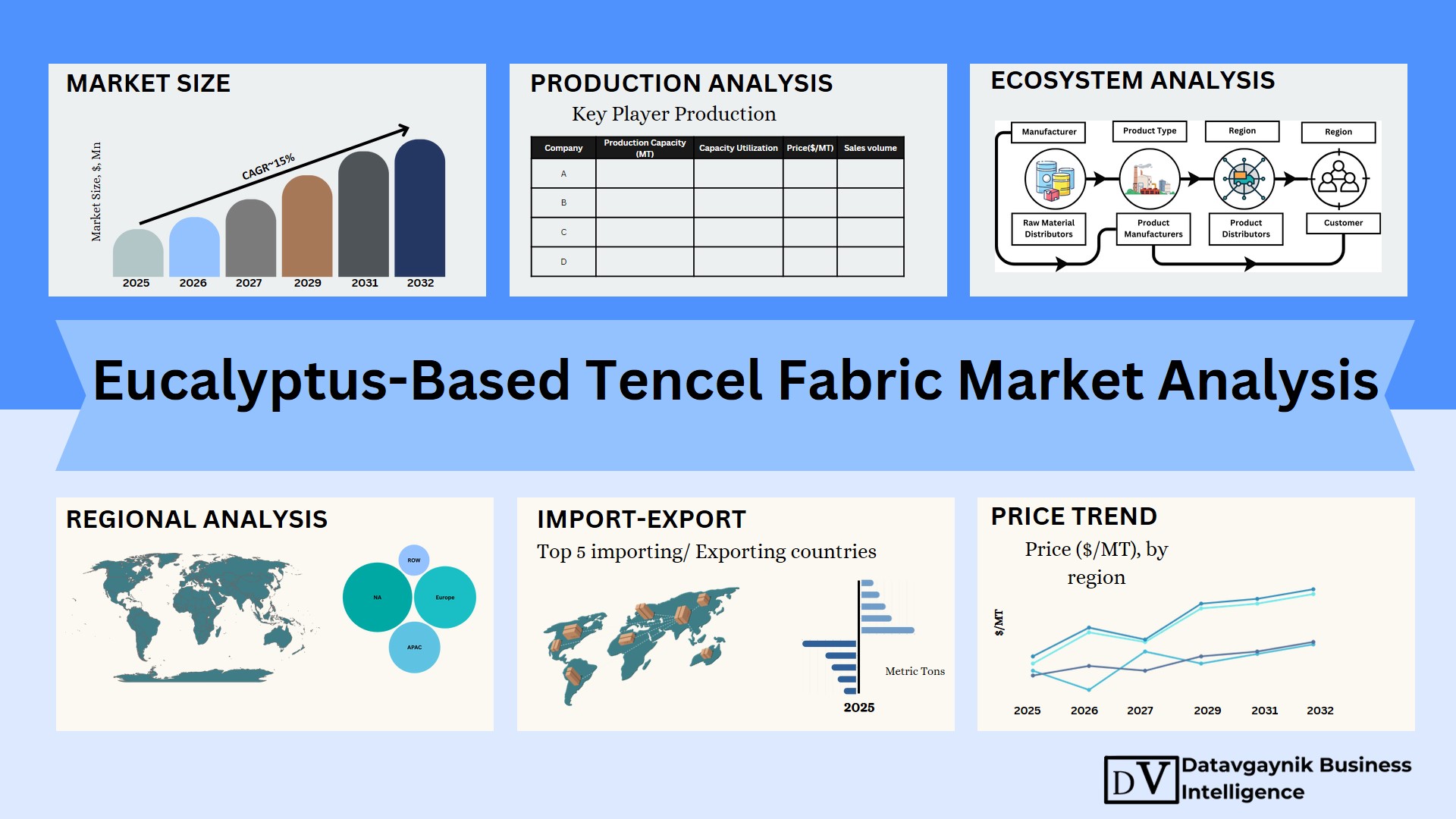
The market covers woven, knitted, blended, and finished fabrics made using eucalyptus-derived lyocell fibers sold under the TENCEL™ ecosystem or equivalent eucalyptus-based cellulosic fiber platforms. In simple terms, this is the fabric market sitting downstream of lyocell fiber production. It includes apparel fabrics, home textile fabrics, intimatewear materials, activewear blends, premium shirting, denim blends, bedding fabrics, and selected hygiene-adjacent textile applications where softness, moisture control, breathability, and lower environmental footprint matter.
Its relevance in 2026–2035 is not just about “sustainable fashion.” That phrase is too broad now. The stronger point is that brands are under pressure to reduce dependence on fossil-based synthetics while still offering comfort, drape, durability, and scalable sourcing. Cotton has water and land-use constraints. Polyester faces scrutiny around fossil feedstock and microplastic shedding. Eucalyptus-based Tencel fabric sits in the middle: more premium than basic viscose, more breathable than polyester, and easier for brands to position as a responsible material without fully redesigning product lines.
The Eucalyptus-Based Tencel Fabric Market is also benefiting from a shift in procurement behavior. Earlier, lyocell-based fabrics were mostly used by premium labels, eco-focused brands, and selected innerwear or bedding companies. By 2026, the buyer base has widened. Mid-market fashion brands, D2C apparel labels, luxury bedding companies, sports-lifestyle brands, and denim mills are using eucalyptus-based lyocell blends to improve hand feel and sustainability claims at the same time. This widens the addressable base beyond niche “green apparel.”
From a production standpoint, the market is tied closely to manmade cellulosic fiber capacity, certified wood pulp supply, solvent recovery processes, spinning efficiency, dyeing performance, and fabric finishing capability. The closed-loop lyocell process is strategically important because it improves solvent recovery and reduces process waste compared with older regenerated cellulosic routes. That said, fabric makers still face real constraints. Eucalyptus-based Tencel fabric remains costlier than polyester and standard cotton blends. Availability can also tighten when pulp prices rise or when fiber producers prioritize higher-margin customers.
Regulation will act as a structural demand shaper during 2026–2035. Europe is the clearest example. Textile policy is moving toward durability, recyclability, environmental claims control, and circular product design. This does not automatically guarantee growth for every cellulosic fabric. But it does make traceable, certified, lower-impact materials more attractive in sourcing discussions. Large brands will increasingly ask: Can the material support product passports? Can origin be verified? Can the sustainability claim survive compliance review? Eucalyptus-based Tencel fabric is well placed in that conversation, especially when suppliers can document fiber origin, processing route, chemical recovery, and certification status.
The market’s growth will be strongest where sustainability and comfort overlap with repeat-purchase categories. Innerwear, sleepwear, athleisure, premium casualwear, women’s dresses, shirts, bedding, and baby textiles will remain the most commercially attractive areas. These categories reward softness and moisture management. They also give brands a visible consumer-facing story. A T-shirt or bedsheet made with eucalyptus-based lyocell is easier to explain than a complex industrial textile.
Global Eucalyptus-Based Tencel Fabric Market Forecast, 2026–2035
| Metric | Estimate |
| Global market size, 2026 | $2.4 billion |
| Projected market size, 2035 | $5.1 billion |
| CAGR, 2026–2035 | 8.7% |
| Estimated volume, 2026 | 540 kilotons of fabric equivalent |
| Projected volume, 2035 | 1,020 kilotons of fabric equivalent |
| Average value realization, 2026 | $4.4/kg fabric equivalent |
| Core demand base | Apparel, home textiles, innerwear, bedding, premium casualwear |
Expert insight: The real opportunity is not in replacing cotton or polyester entirely. That’s unlikely. The more realistic growth case is blend substitution. Mills and brands will use eucalyptus-based Tencel fabric where it improves softness, breathability, sustainability positioning, and product premiumization without forcing a complete sourcing reset.
Key macro forces shaping the Eucalyptus-Based Tencel Fabric Market include material substitution, sustainability-led sourcing, growth of premium comfort textiles, mill-level innovation in blended yarns, and retailer pressure for cleaner material claims. Technology will also support growth, though mostly through fiber processing, fabric finishing, dye optimization, traceability systems, and lifecycle data integration. AI is not a major demand driver in this market at the material level. Its role is indirect, mainly in demand forecasting, inventory planning, digital sampling, and supplier compliance tracking.
The stakeholder ecosystem is broad. Fiber producers supply eucalyptus-based lyocell inputs. Yarn spinners convert fiber into ring-spun, open-end, compact, or blended yarns. Fabric mills develop woven, knitted, denim, jersey, twill, satin, and bedding-grade fabrics. Dyeing and finishing houses influence shrinkage control, color fastness, surface feel, and performance finishes. Apparel and home textile brands drive commercial adoption. Retailers and e-commerce platforms shape consumer visibility. Certification bodies and industry associations influence trust. Governments and regulators shape environmental labeling and textile waste rules. Investors monitor capacity expansion, premium material adoption, and circular textile infrastructure.
By 2035, the market will likely look more mainstream than niche. Growth will not come only from luxury or eco-brands. It will come from practical fabric economics: better blends, better finishing, more stable supply, and clearer compliance value. The winners will be suppliers that can connect fiber traceability with fabric performance and help brands make claims that are specific, defensible, and easy for consumers to understand.
Competitive Intelligence and Benchmarking
Competition in the Eucalyptus-Based Tencel Fabric Market is shaped by fiber control, pulp sourcing credibility, downstream mill relationships, and brand-facing sustainability proof. It is not a typical fabric market where hundreds of mills compete only on price. The upstream fiber layer matters heavily because fabric buyers want traceability, certified wood sourcing, stable quality, and reliable sustainability documentation.
Lenzing AG remains the reference player in this space. Its position is built around branded lyocell and modal fibers used in apparel, home textiles, denim, intimates, activewear, and premium lifestyle fabrics. The company’s advantage is not just fiber capacity. It is brand recognition among mills, retailers, and consumers. Its TENCEL™ portfolio includes lyocell fibers and lyocell filament yarns, with claims around certified or controlled wood sourcing and high solvent recovery in lyocell production. This gives Lenzing a premium position in fabrics where hand feel, transparency, and consumer-facing labeling matter.
Birla Cellulose / Grasim Industries is a major cellulosic fiber supplier with strong relevance in India, Southeast Asia, and global textile export chains. The company is positioned as a scale player rather than a narrow premium-only supplier. Its strength lies in man-made cellulosic fiber production, partnerships with mills, and growing investment in lyocell capacity. Grasim’s FY 2024–25 reporting identifies its cellulosic fiber business as a core textile segment, while its recent Harihar lyocell expansion approval signals a stronger push into sustainable fiber supply from India.
Sateri is a strong Asia-based cellulosic fiber producer with meaningful exposure to lyocell. Its proposition is based on wood-pulp-based lyocell, closed-loop manufacturing, and supply into high-quality textile applications. The company’s China manufacturing base gives it strong proximity to spinning, knitting, weaving, dyeing, and garmenting ecosystems. This matters because many global apparel and home textile brands still depend on China-linked textile conversion networks. Sateri’s lyocell fiber is marketed as biodegradable and produced with solvent recovery of around 99.7%, which supports sustainability-led fabric sourcing.
Tangshan Sanyou Group is relevant as a large Chinese regenerated cellulose fiber producer with lyocell capability. Its Tangcell™ lyocell platform is positioned around sustainable forest-based raw materials and closed-loop solvent processing. The company benefits from China’s scale advantage in textile conversion, especially where brands need volume, blending flexibility, and faster sampling cycles. It is also active in next-generation cellulosic work, including recycled-content MMCF development, which could influence future fabric economics.
Acelon Chemicals & Fiber Corporation plays more on the yarn and fabric-development side than as a pure eucalyptus lyocell fiber producer. Its relevance is in functional, eco-friendly, and specialty yarn development, including POY, FDY, DTY, ATY, and bi-component yarn capabilities. For the Eucalyptus-Based Tencel Fabric Market, such players matter because fabric innovation often happens at the yarn and blend stage, not only at fiber production. Moisture management, drape, stretch recovery, cooling touch, and surface texture are created through yarn engineering and finishing.
Xinxiang Chemical Fiber / Bailu Group is more strongly associated with viscose filament and next-generation cellulosic alternatives than branded eucalyptus lyocell fabric. Still, it is worth tracking because China’s cellulosic filament and recycled-content fiber ecosystem increasingly overlaps with lyocell and sustainable fabric innovation. Canopy notes Xinxiang’s next-gen product activity around recycled cotton and alternative cellulose inputs. This makes the company relevant for future circular cellulosic fabric development.
Expert insight: The strongest companies will not be those selling fiber alone. The winners will be suppliers that can help mills deliver consistent fabric behavior, documented sustainability claims, and commercial-scale blends at acceptable cost.
Regional Landscape and Adoption Outlook
North America
North America is a high-value consumption region rather than a large-scale fiber production hub for eucalyptus-based lyocell fabrics. Demand is led by the U.S., especially in premium bedding, athleisure, casualwear, D2C basics, baby textiles, and innerwear. Brands in the region use eucalyptus-based fabrics to support comfort-led and sustainability-led product positioning. The adoption curve is strong in online-first brands because product storytelling is easier: softness, breathability, moisture control, and lower-impact sourcing can be explained directly to consumers. Canada remains smaller but aligned with similar sustainability and premium home textile demand.
Europe
Europe is one of the most strategically important regions for the Eucalyptus-Based Tencel Fabric Market. The region combines premium consumer demand, regulatory pressure, and brand-level sustainability commitments. Germany, France, Italy, Spain, the Netherlands, and the Nordic countries are key demand centers. The EU’s Strategy for Sustainable and Circular Textiles aims to create a greener and more resilient textile sector by 2030, while the Ecodesign for Sustainable Products Regulation entered into force in July 2024 and is expected to influence product durability, circularity, and sustainability information requirements. This improves the relevance of traceable cellulosic fabrics.
China
China is both a production engine and an adoption market. It has deep spinning, weaving, knitting, dyeing, finishing, and garmenting infrastructure. Local players such as Sateri and Tangshan Sanyou Group strengthen China’s position in regenerated cellulosic fibers. Demand is supported by export-oriented apparel mills as well as domestic premium fashion and lifestyle brands. China’s biggest advantage is conversion speed. Mills can move from fiber trial to yarn, fabric, dyeing, garmenting, and commercial sampling faster than many other regions. That gives China a strong role in blended fabrics, jersey, denim blends, shirting, and home textile formats.
India
India is moving from being mainly a cotton and viscose textile base toward a broader man-made cellulosic fiber ecosystem. The country has strong spinning, garmenting, home textile, and export capacity. Birla Cellulose / Grasim Industries gives India a strategic upstream anchor. The approved ₹3,094 crore lyocell expansion at Harihar strengthens India’s long-term role in sustainable fiber supply and may help domestic mills reduce dependence on imported specialty cellulosic inputs.
Japan
Japan is a quality-sensitive market. Adoption is concentrated in premium apparel, innerwear, loungewear, and high-comfort lifestyle textiles. Japanese buyers usually prioritize consistency, fabric hand, color stability, shrinkage control, and long-wear performance. Growth is moderate in volume but strong in value terms. The market is attractive for premium eucalyptus-based Tencel fabric blends where the buyer is willing to pay for softness and product integrity.
South Korea
South Korea is a design-led and brand-driven textile market. Adoption is shaped by fashion labels, cosmetics-adjacent lifestyle brands, premium home textile companies, and activewear players. The country’s strength lies in product development and trend translation rather than upstream fiber scale. Eucalyptus-based lyocell fabrics are attractive in women’s wear, base layers, soft-touch casualwear, and bedding. Korean brands also respond quickly to sustainability narratives when they can be tied to visible product benefits.
Rest of the World
The Rest of the World includes Southeast Asia, Turkey, Latin America, the Middle East, and Africa. Southeast Asia is the strongest manufacturing opportunity because Vietnam, Indonesia, Bangladesh, and Thailand already serve global apparel supply chains. Turkey is important for Europe-linked apparel production and faster lead times. Latin America and the Middle East remain consumption-led opportunities, mostly in premium apparel and bedding. Africa is still underserved due to limited specialty fabric conversion infrastructure, but long-term potential exists as apparel manufacturing clusters mature.
Expert insight: The white space is not only in rich consumer markets. It is in manufacturing regions that can process eucalyptus-based lyocell blends reliably. Mills that master dyeing, shrinkage control, pilling resistance, and finishing will capture more value than commodity converters.
End-User Dynamics and Use Case
End-user adoption in the Eucalyptus-Based Tencel Fabric Market is led by apparel brands, home textile manufacturers, innerwear companies, premium bedding brands, denim mills, and lifestyle retailers. Each group uses the material differently.
Apparel brands use eucalyptus-based lyocell fabrics to upgrade comfort and sustainability positioning. The strongest use is in dresses, shirts, tops, relaxed trousers, loungewear, and premium basics. These are categories where drape and softness matter.
Innerwear and sleepwear brands value the fabric because moisture regulation and smooth hand feel are directly felt by the consumer. This creates repeat purchase potential.
Home textile brands use it in bedsheets, pillowcases, duvet covers, and premium bedding sets. Here, softness and breathability are easier to market than technical sustainability language.
Denim and casualwear mills use lyocell blends to soften fabric, improve drape, and reduce the stiff feel of conventional cotton-heavy denim.
Retailers and e-commerce platforms act as demand amplifiers. They influence which sustainability claims get consumer visibility and which materials receive premium shelf space.
Use case: A premium bedding brand in the U.S. introduced eucalyptus-based lyocell-cotton blended bedsheets for customers who wanted a softer and cooler sleep surface without moving to synthetic microfiber. The brand positioned the product around breathability, smooth feel, and responsibly sourced cellulose. The key commercial benefit was not only sustainability. It was a higher average selling price and stronger differentiation from standard cotton bedding.
The adoption logic is clear. End users do not buy eucalyptus-based Tencel fabric only because it is “green.” They buy it when it improves product feel, creates a premium story, and supports compliance-ready sourcing claims.
Recent Developments + Opportunities & Restraints
Recent Developments
| Year / Month | Event | Industry Impact |
| 2024 / January | Lenzing introduced work around using TENCEL™ Lyocell fibers as an alternative material route for stretch fabrics. | Supports reduced dependence on conventional synthetic stretch components in selected apparel categories. |
| 2024 / July | The EU’s Ecodesign for Sustainable Products Regulation entered into force. | Strengthens the long-term case for traceable, durable, and lower-impact textile materials sold into Europe. |
| 2024 / December | Birla Cellulose received the top ranking in Canopy’s 2024 Hot Button Report for responsible MMCF sourcing. | Improves buyer confidence in forest-risk management and responsible cellulosic fiber sourcing. |
| 2025 / May | Tangshan Sanyou opened a 10 metric ton pilot line to advance recycled-content MMCF production. | Signals stronger movement toward circular cellulosic fibers that may later influence lyocell and fabric blends. |
| 2026 / June | Grasim Industries approved a ₹3,094 crore second-phase expansion of its lyocell plant in Harihar, Karnataka. | Strengthens India’s future lyocell supply base and improves regional availability for textile mills. |
Opportunities
Emerging market sourcing expansion
India, Vietnam, Bangladesh, Indonesia, and Turkey can become stronger downstream conversion hubs if yarn availability and finishing know-how improve. This creates room for regional fabric mills to serve export brands looking beyond China-only sourcing.
Premium home textile growth
Bedding and sleep products offer a clear value proposition. Consumers can feel the softness and cooling effect immediately. That makes eucalyptus-based lyocell easier to commercialize than sustainability claims in low-cost apparel.
Circular cellulosic innovation
Recycled cotton pulp, textile-to-textile recycling, and next-gen MMCF partnerships can reduce dependence on virgin wood pulp over time. This is still early but strategically important for brand sourcing teams.
Restraints
Higher cost versus cotton and polyester
Eucalyptus-based lyocell fabrics remain more expensive than commodity cotton, viscose, and polyester blends. This limits adoption in mass basic apparel.
Supply concentration
The market depends heavily on a limited number of upstream fiber producers. Any disruption in pulp sourcing, solvent recovery operations, freight, or capacity allocation can affect fabric availability.
Performance variability in blends
Fabric behavior depends on yarn structure, blend ratio, finishing, dyeing, and garment construction. Poorly developed blends can shrink, pill, or lose surface quality. So adoption requires technical competence at mill level.


