

Market Summary and Growth Forecast
The global Explosives Coating Wax Market is estimated at $68 million in 2026 and is expected to reach $98 million by 2035, growing at a CAGR of 4.1%.
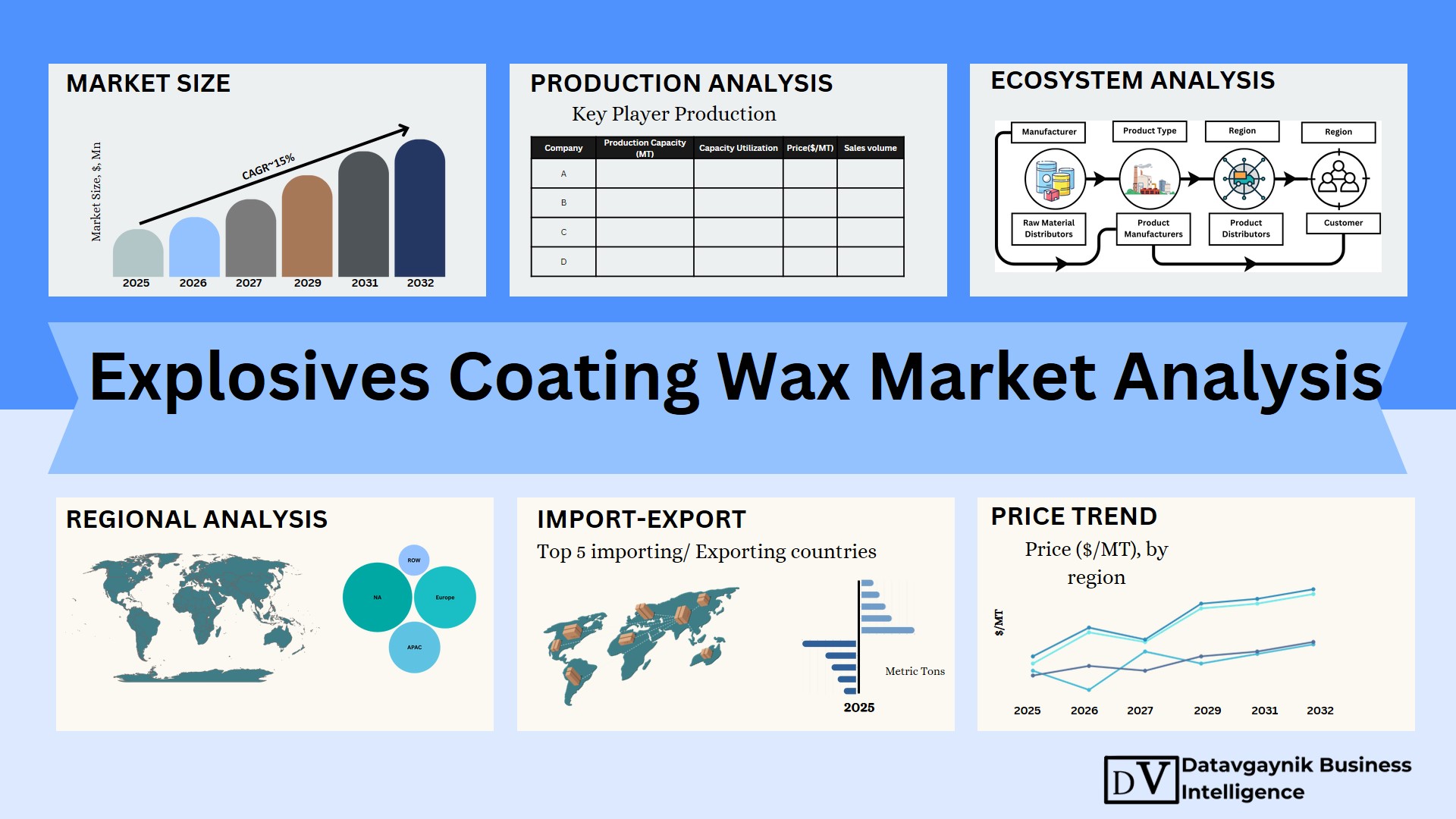
For this report, the Explosives Coating Wax Market includes specialty paraffin, slack, microcrystalline, synthetic hydrocarbon and formulated wax grades used in the manufacture or protection of energetic materials. Their main functions include:
- Coating porous ammonium nitrate prills
- Reducing moisture absorption and caking
- Limiting dust and fines during storage or transport
- Desensitizing energetic crystals
- Binding and lubricating pressed or cast explosive compositions
- Waterproofing explosive wrappers, detonating cords and fuses
General-purpose candle wax, packaging wax and fertilizer coatings that aren’t linked to explosive-grade materials are excluded.
Datavagyanik also covers related markets such as the Emulsifier for Explosives Market and the Polyethylene Wax (PE Wax) Market. These markets reflect the interconnectedness of industrial forces that define the growth and direction of the primary topic.
Ammonium nitrate prills used in industrial explosives are commonly treated with a small quantity of waxy anti-caking material. This keeps the prills free-flowing without blocking the porosity needed for fuel-oil absorption. Patent examples indicate coating addition rates of around 0.06% to 0.10% by weight, depending on the formulation and required performance. The same technical literature shows that hydrophobic coatings can lower caking, abrasion and fines during temperature cycling and storage.
Market-estimation framework
The published industry does not report explosives coating wax as a separate global revenue category. So, the market value has been developed through a bottom-up model covering wax consumption in explosive-grade ammonium nitrate, detonating systems, packaged explosives, cast-loaded materials and selected military energetic compositions.
| Market indicator | 2026 | 2035 | Analytical basis |
| Estimated market revenue | $68 million | $98 million | Wax demand multiplied by weighted specialty-grade pricing |
| Estimated demand volume | 24.7 thousand tonnes | 32.4 thousand tonnes | Coated explosive material output and formulation-level wax consumption |
| Average realized value | $2,750 per tonne | $3,025 per tonne | Mix of commodity paraffin grades and higher-value microcrystalline or formulated products |
| Revenue CAGR | — | 4.1% | Volume growth plus gradual movement toward qualified specialty grades |
This estimate is supported by visible industry capacity. Dyno Nobel reports more than 1.2 million tonnes of ammonium nitrate capacity and 32 manufacturing facilities. Enaex reports ammonium nitrate production capacity of approximately 850,000 tonnes per year. These figures cover only two large producers. They indicate the scale of the technical-ammonium-nitrate ecosystem served by coating and formulation suppliers.
Why the market matters
The business relevance of the Explosives Coating Wax Market comes from its effect on a much larger value chain. Wax represents a minor portion of an explosive’s total cost. Yet an unsuitable coating can create caking, excess dust, poor prill flow, inconsistent oil absorption or unstable processing. A low-cost input can therefore influence plant productivity, storage life and final blasting performance.
Demand through 2035 will be shaped by four main forces.
Mining and mineral extraction: Copper, iron ore, coal, gold, aggregates and critical-mineral projects remain the largest volume base. Open-pit mines use large quantities of ammonium-nitrate-based blasting agents. More mining activity means higher demand for coated prills, detonating cord and packaged energetic materials.
Infrastructure construction: Roads, tunnels, dams, rail corridors and large excavation projects support demand beyond conventional mining. This creates opportunities for coating wax suppliers that can serve regional explosive plants rather than only large integrated producers.
Defense and munitions production: Microcrystalline and high-melting-point waxes are used for desensitization, binding and lubrication in certain press-loaded or cast-loaded explosives. These applications carry lower volumes than mining explosives but generally require tighter thermal, purity and consistency specifications. IGI identifies wax use in detonating fuses, explosive desensitization, binding and lubrication, including grades conforming to military specifications.
Production and regulatory control: Explosive materials move through tightly controlled manufacturing and logistics systems. This increases the value of consistent batches, documented feedstock origins and repeatable melting behavior. A wax may be chemically simple. Qualification isn’t. Once approved for a production line, suppliers can benefit from long commercial relationships because reformulation requires additional safety and performance testing.
Key consumers and clients
Direct buyers include:
- Integrated commercial explosive manufacturers such as Orica, Dyno Nobel, Enaex and Austin Powder
- Ammonium nitrate producers supplying porous explosive-grade prills
- Manufacturers of detonating cord, safety fuse and initiation systems
- Packaged emulsion and dynamite producers
- Defense ammunition and energetic-material manufacturers
- Contract formulators serving mining, quarrying and construction markets
- Government-qualified suppliers of military-grade wax products
The market remains small in value but technically sticky. Buyers care less about a wax supplier’s total refining capacity and more about batch consistency, approved formulation performance and supply reliability.
Expert view: The strongest suppliers won’t sell explosives coating wax as a generic refinery by-product. They’ll sell a controlled performance package built around melting range, viscosity, adhesion, oil content and compatibility with the customer’s energetic formulation.
Market Segmentation and Forecast Scope
The Explosives Coating Wax Market is segmented by dominant wax chemistry, application, end user and region. Products containing multiple waxes are classified according to the dominant base material. This avoids counting the same formulated blend under several product categories.
By Product Type
Paraffin and Slack-Wax-Dominant Grades
This category includes refined paraffin, semi-refined wax and slack-wax-rich formulations. It is estimated to account for 48.5% of market revenue in 2026.
These grades are widely used where cost, hydrophobicity and easy melt application are the main purchasing criteria. Typical uses include ammonium nitrate prill coatings, moisture barriers and certain packaged explosive components.
Slack wax can also function as the diluent portion of more complex anti-caking formulations. Historical ammonium nitrate coating formulations combined wax with fatty amides, stearates, mineral oils or related additives to improve prill handling without affecting downstream explosive performance.
This segment will remain the largest by volume. Its revenue growth will be slower because of pricing pressure and competition from mineral-oil-based anti-caking systems.
Microcrystalline-Wax-Dominant Grades
Microcrystalline wax offers stronger adhesion, greater flexibility and higher viscosity than conventional paraffin wax. It is suited to detonating cord, fuse manufacture, desensitization and press-loaded or cast-loaded energetic compositions.
The category captures a higher average selling price because customers often specify narrow melting ranges, controlled penetration values and thermal stability. High-melt microcrystalline grades will remain particularly important where explosive materials must tolerate elevated storage or processing temperatures.
Synthetic Hydrocarbon Wax Grades
This segment covers Fischer–Tropsch wax, polyethylene wax and other synthetic hydrocarbon grades formulated for controlled hardness, molecular-weight distribution or thermal performance.
It is expected to be the fastest-growing product segment through 2035. Growth will come from applications requiring:
- More precise melting profiles
- Lower oil content
- Reduced batch variability
- Improved abrasion resistance
- Compatibility with automated coating equipment
- Greater control over finished explosive density and handling
Synthetic wax won’t replace paraffin across standard ammonium nitrate coating. Its economics are better suited to demanding formulations where process stability outweighs raw-material cost.
Natural and Bio-Derived Specialty Waxes
This segment includes plant-based and other renewable waxes used alone or in formulated systems. Commercial use remains limited because energetic materials require extensive compatibility and ageing tests.
The opportunity is therefore selective. Bio-derived waxes are more likely to enter moisture-barrier and non-critical binding applications before being accepted in sensitive military or initiating formulations.
By Application
Ammonium Nitrate Prill Coating and Anti-Caking
Wax-based coatings protect porous prills from humidity, friction and mechanical degradation. The application must preserve the open pore structure needed for fuel-oil uptake in ANFO.
This is the largest-volume application. Demand is concentrated near ammonium nitrate plants and integrated mining-explosive manufacturing clusters.
Desensitization and Phlegmatization
Wax surrounds or partially coats energetic crystals to reduce sensitivity to impact, friction or handling. Paraffin and microcrystalline waxes have both been used as phlegmatizing agents, while the exact choice depends on explosive chemistry, processing temperature and final mechanical properties.
This application carries stricter qualification requirements. It also generates higher value per tonne than standard prill coating.
Binding and Lubrication
Wax can help bind energetic particles during pressing or casting. It can also reduce tooling friction and improve the release of finished components.
Demand is driven by military energetic materials, boosters and selected commercial explosive products. Product consistency is critical because small formulation changes can alter density, mechanical strength or initiation behavior.
Moisture Barriers for Wrappers, Cords and Fuses
Paraffin wax is used as a moisture barrier in dynamite wrappers. Microcrystalline wax is used in certain detonating-fuse systems. Wax suppliers serving this category compete on penetration, flexibility, adhesion and resistance to cracking during storage or field handling.
By End User
Commercial Mining and Quarrying Explosive Manufacturers
This segment represents approximately 61.0% of market revenue in 2026.
It includes producers of ANFO, heavy ANFO, bulk emulsions, packaged emulsions, boosters and related blasting materials. Volume is linked to mine output, overburden removal, quarry production and infrastructure excavation.
Growth will be strongest in copper, gold, iron ore and critical-mineral regions where new projects require large-scale drill-and-blast operations.
Defense and Munitions Manufacturers
Defense buyers use qualified waxes in selected high-explosive formulations, ammunition components and insensitive energetic systems. Volumes are comparatively small. Technical value is high.
Supply contracts normally require detailed quality documentation, stable feedstock sources and repeatability across production batches.
Initiation-System and Detonating-Cord Manufacturers
These companies consume wax in fuse, cord and related initiating products. The segment benefits from expanding electronic blasting systems because electronic initiation doesn’t fully remove the need for energetic transmission components and associated moisture protection.
Independent Ammonium Nitrate and Energetic-Material Producers
These producers buy coating materials directly for integration at prilling, granulation or formulation plants. They represent an attractive customer group for regional wax formulators able to provide onsite testing and application support.
By Region
North America
Demand is supported by quarrying, coal, metals mining, civil construction and defense manufacturing. The region favors qualified suppliers with stable domestic logistics and military-grade capabilities.
Europe
The regional market is more specification-led. Environmental documentation, worker-safety requirements and product traceability carry greater commercial weight. Growth is moderate but value per tonne is relatively high.
Asia Pacific
Asia Pacific is the largest strategic demand region. China, India, Australia and Indonesia combine large mining, quarrying, infrastructure and explosive-manufacturing bases.
Australia is especially important due to its high-intensity open-pit mining sector. India offers faster long-term growth through coal production, metal mining, highways, tunnels and domestic technical-ammonium-nitrate capacity.
Latin America, Middle East and Africa
Latin America is led by copper and iron ore operations in Chile, Peru and Brazil. The Middle East contributes through quarrying, cement production and infrastructure. African demand comes from gold, copper, coal, diamonds and construction materials.
The region has strong volume potential but remains exposed to currency movements, imported wax costs and uneven local formulation capabilities.
Use case: A porous ammonium nitrate producer may select a lower-cost paraffin-dominant coating for standard dry-climate deliveries. The same producer could need a higher-adhesion microcrystalline blend for long-distance shipments exposed to humidity and repeated temperature cycling.
Market Trends and Innovation Landscape
Innovation in the Explosives Coating Wax Market is moving away from basic wax selection and toward formulation engineering. Buyers increasingly assess how the complete coating behaves during melting, spraying, cooling, storage and final explosive preparation.
R&D Evolution: Lower Addition Rates, Better Surface Performance
One important R&D direction is obtaining better anti-caking and moisture resistance with less coating material.
This matters because excessive coating can obstruct ammonium nitrate porosity and reduce fuel-oil absorption. Too little coating can lead to fines, dust and caking. The target is therefore not the thickest barrier. It’s the smallest stable dose that delivers consistent surface coverage.
Earlier technical examples demonstrated effective coating rates near 0.06% by weight, compared with competing systems applied at around 0.08% to 0.10%. This illustrates the value of surface chemistry and additive selection rather than simply increasing wax dosage.
Future development will focus on:
- Finer wax dispersion
- More uniform spray patterns
- Faster surface wetting
- Reduced migration into prill pores
- Better performance under humidity cycling
- Lower dust generation during pneumatic loading
Shift Toward Formulated Wax Systems
Standard paraffin wax remains commercially important. Still, many applications now use wax as one element in a larger coating package.
Formulations may contain fatty amides, stearates, mineral oils, synthetic wax fractions or anti-static additives. Each component has a job. Wax provides hydrophobicity and structure. Oils improve application. Amides and stearates influence lubrication, surface attachment and anti-caking performance.
So, competition is gradually shifting from selling a wax grade to delivering a validated formulation.
Suppliers with pilot coating equipment, thermal analysis and explosive-material compatibility testing will have an advantage. Smaller traders may remain active in price-sensitive markets but will struggle in qualified military and multinational manufacturing accounts.
High-Melt and Narrow-Specification Grades
High-temperature storage, warm-climate logistics and energetic-material processing create demand for waxes that don’t soften prematurely.
Microcrystalline and synthetic waxes can provide:
- Higher melting points
- Better adhesion
- Lower brittleness
- Controlled penetration
- Improved mechanical strength
- More stable molecular-weight profiles
IGI markets high-melt microcrystalline products for explosive desensitization and supplies grades designed for specific thermal and molecular-weight requirements. This reflects the broader movement toward application-specific wax rather than interchangeable commodity material.
Automation of Coating Application
Explosive-grade ammonium nitrate is generally coated through heated spraying and controlled cooling. The process depends on wax temperature, viscosity, nozzle condition, prill feed rate and drum residence time.
Modern plants are moving toward tighter inline control of these variables. Practical improvements include:
- Automated wax metering
- Heated and insulated delivery lines
- Nozzle-pressure monitoring
- Real-time prill-temperature measurement
- Closed-loop adjustment of coating rate
- Automated sampling for caking and oil-absorption tests
The benefit is straightforward: less batch variation and lower coating consumption.
Substitution Risk from Polymer and Hybrid Coatings
Wax faces competition from polymeric surface treatments, mineral coatings, fatty-amine systems and hybrid anti-caking agents.
Polymer systems can offer stronger moisture resistance in harsh conditions. Yet they may cost more, alter porosity or require different processing equipment. Wax retains an advantage where manufacturers need low cost, easy melting, established explosive compatibility and straightforward plant integration.
The likely outcome is not full displacement. Hybrid formulations will expand, combining wax with polymers, oils or surface-active materials.
Decarbonization Extends Into Explosive Inputs
The carbon footprint of an explosive historically received less attention than blast performance and safety. That’s changing.
In June 2024, Orica and Fertiberia completed an industrial-scale blast in Spain using low-carbon technical ammonium nitrate made with renewable hydrogen. The project showed that mining companies are beginning to assess emissions embedded in explosive raw materials.
In April 2024, Dyno Nobel opened a $20 million nitrous-oxide-abatement project at its Moranbah plant. In January 2025, the company opened a further $8 million abatement project at its Louisiana, Missouri facility. Both projects target emissions generated during nitric acid and ammonium-nitrate-based explosive production.
In July 2025, Orica received conditional approval for A$432 million in funding for the Hunter Valley Hydrogen Hub, which is intended to replace part of the natural-gas feedstock used in ammonia and ammonium nitrate production.
These projects don’t directly change wax consumption. They do change supplier expectations. Large explosive companies are likely to request product carbon data, energy-use information and traceable feedstock documentation from specialty wax suppliers.
Investment and Consolidation
The customer base is also consolidating.
In July 2024, Austin Powder announced a strategic investment from American Industrial Partners to support its global growth plan.
In March 2026, Orica reached an agreement to acquire the remaining explosives business of Nelson Brothers in North America for $25 million, alongside the retirement of $48 million in related debt, subject to final conditions. The transaction is intended to strengthen Orica’s position in US quarrying and construction explosives.
For coating-wax suppliers, this can work both ways. Larger customers offer broader volumes and multinational qualification opportunities. They also hold more purchasing power and may reduce the number of approved suppliers.
Innovation outlook to 2035
| Innovation area | Commercial impact through 2035 |
| Low-dose hydrophobic formulations | Lower wax consumption per tonne but higher value for validated performance |
| Synthetic and high-melt waxes | Faster revenue growth in defense and technically demanding applications |
| Hybrid wax-polymer systems | Better moisture resistance in tropical and long-storage conditions |
| Automated coating control | Reduced waste, improved consistency and stronger demand for narrow-specification wax |
| Low-carbon feedstock documentation | New qualification requirement for multinational explosives producers |
| Regional formulation centers | Faster customer trials and lower dependence on long-distance finished-product shipments |
Expert view: By 2035, the Explosives Coating Wax Market will still be volume-led by paraffin-based products. The profit pool, though, will increasingly sit in qualified blends, high-melt grades and formulations that solve a specific processing problem. Commodity supply alone won’t be enough.
Competitive Intelligence and Benchmarking
Competition in the Explosives Coating Wax Market is fragmented. There is no single supplier that controls the category globally. The competitive base includes specialty wax formulators, integrated refinery-backed producers, synthetic wax specialists and regional paraffin manufacturers.
Direct market-share data isn’t publicly disclosed. So, companies are benchmarked by product fit, formulation capability, manufacturing reach, technical support and proximity to major explosives-producing regions.
| Company | Relevant portfolio | Competitive position and market relevance |
| Sonneborn | High-purity microcrystalline waxes, wax blends, petrolatum-based materials and specialty hydrocarbons | Sonneborn has one of the clearest direct links to the sector. Its product-selection system specifically identifies explosives as an end-use application. The company is well positioned in high-melt, flexible and consistent microcrystalline grades used where binding, desensitization or moisture resistance is important. Its manufacturing footprint in North America and Europe supports multinational qualification programs. |
| Sasol | Petroleum-derived paraffin, microcrystalline wax, Fischer–Tropsch synthetic wax, oxidized grades and formulated blends | Sasol is the strongest technology-led competitor in synthetic wax. Its advantage comes from control over Fischer–Tropsch chemistry, which offers narrow molecular distribution, low viscosity and stable thermal performance. These properties fit automated coating, high-temperature storage and tightly specified energetic formulations. The company is less dependent on conventional refinery slack-wax availability than many competitors. |
| The International Group – IGI | Paraffin wax, slack wax, microcrystalline wax, synthetic wax, emulsions and customized formulations | IGI combines feedstock access with refining, terminal, blending and contract-manufacturing capabilities. It operates six North American wax-blending locations and can supply products as slabs, pellets, bulk liquids, drums or granules. This flexibility is useful for explosive manufacturers requiring application-specific melting point, hardness, oil content or viscosity. Its strongest position is in North American custom-qualified supply. |
| H&R Group | Fully refined paraffin, microcrystalline wax, technical wax, formulated waxes and wax-oil emulsions | H&R Group competes through formulation depth and its global refinery and specialty-production network. The company produces multiple paraffin qualities and develops tailored waxes for specific industrial functions. Its European manufacturing base supports customers seeking narrow specifications, documentation and consistent regulatory compliance. H&R also maintains production or commercial operations across China, India, Southeast Asia, Australia and the Americas. |
| Paramelt | Pure and blended microcrystalline waxes, formulated base waxes, coating compounds and specialty wax systems | Paramelt is positioned as a flexible formulation partner rather than a high-volume commodity wax producer. It operates eight production facilities and supplies more than 80 countries. Its strength lies in developing customer-specific blends where adhesion, flexibility, melting profile and processing behavior must be balanced. This makes it relevant for smaller qualified explosive applications and regional formulation projects. |
| Sinopec | Fully refined paraffin, microcrystalline wax, refinery-derived wax feedstocks and fine-wax products | Sinopec holds a scale and cost advantage in China. Its Jingmen operation is described as a major petroleum-wax production base, while other Sinopec facilities manufacture fully refined paraffin and microcrystalline grades. The company is strongest in upstream supply and domestic availability. It has less visible explosives-specific formulation support than specialty wax companies. |
| Chennai Petroleum Corporation Limited – CPCL | Paraffin wax, microcrystalline wax and refinery-derived specialty products | CPCL is a regional upstream contender in India. Its importance comes from domestic production and the ability to reduce dependence on imported microcrystalline and paraffin waxes. It doesn’t compete with global formulation specialists across every geography. That said, it can support Indian explosive manufacturers that prioritize local sourcing, shorter lead times and rupee-based procurement. |
Competitive positioning summary
| Competitive requirement | Best-positioned companies |
| Direct explosives-application visibility | Sonneborn |
| Synthetic and high-melt wax technology | Sasol |
| Customized North American blending | IGI |
| European technical and regulatory support | H&R Group, Paramelt |
| Large-scale Chinese paraffin supply | Sinopec |
| Domestic Indian wax availability | CPCL |
| Global custom-formulation flexibility | IGI, H&R Group, Paramelt |
The market’s entry barrier isn’t wax production alone. Qualification is the real barrier. Explosive manufacturers must confirm compatibility with ammonium nitrate, energetic crystals, binders, wrappers or initiation components. Once a wax is approved, changing the supplier can require plant trials, storage testing and safety validation.
That creates relatively stable customer relationships. It also means a smaller specialty formulator can defend an account against a much larger refinery if its product has already been qualified.
Expert view: Competitive advantage will increasingly come from formulation ownership and application support. A supplier that can reduce coating dosage, preserve ammonium nitrate porosity and maintain performance under humidity cycling will be harder to replace than one selling a standard wax specification.
Regional Landscape and Adoption Outlook
Regional demand depends on two separate ecosystems. The first is high-volume commercial blasting for mining, quarrying and infrastructure. The second is lower-volume but higher-value defense and energetic-material manufacturing.
China, the United States and India form the main volume markets. Europe, Japan and South Korea are more attractive for qualified specialty waxes. Saudi Arabia represents an emerging mining-led opportunity.
| Region | Current demand profile | Growth outlook through 2035 | Primary demand source |
| United States | High | Moderate | Mining, aggregates, construction and defense |
| Europe | Medium to high value | Moderate | Quarrying, Nordic mining and defense manufacturing |
| China | Very high volume | Moderate to high | Coal, metals, infrastructure and domestic explosives production |
| India | High and expanding | Fast | Coal, metal mining, tunnels, roads and defense |
| Japan | Low volume, high specification | Moderate | Defense, initiation systems and specialty energetic materials |
| South Korea | Medium, defense-led | Moderate to fast | Ammunition, propellants and defense exports |
| Middle East | Emerging | Fast from a smaller base | Mining, quarrying, cement and infrastructure |
United States
The United States is a large and mature market for commercial explosives. Demand comes from metal mining, coal, crushed stone, cement, roadbuilding and defense production. The country had 8,955 federal explosives licensees and permittees as of June 2026, showing the breadth of its regulated commercial base.
Dyno Nobel, Austin Powder and Orica are major explosive-industry buyers or channels. Sonneborn, IGI, H&R Group and imported Sasol materials form part of the addressable wax-supply ecosystem.
Federal regulation is strict. The Bureau of Alcohol, Tobacco, Firearms and Explosives controls licensing, manufacturing, distribution and storage under 27 CFR Part 555. Explosive materials generally must be held in approved locked magazines when they aren’t being manufactured, handled or transported.
The United States offers stable demand rather than the fastest volume growth. The best opportunities are high-melt grades, military-qualified waxes, custom blends and locally available alternatives to imported materials.
Europe
Europe is a specification-driven market. Commercial demand is supported by quarrying, infrastructure and mining in Sweden, Finland, Poland, Spain and parts of Central and Eastern Europe. Defense demand is becoming more important.
EU member-state defense expenditure reached €343 billion in 2024 and was estimated at €381 billion in 2025. Increased ammunition and defense-equipment investment supports upstream demand for qualified binders, desensitizers and processing materials, including selected microcrystalline waxes.
Civil explosives placed on the EU market fall under Directive 2014/28/EU. Equipment operating in potentially explosive atmospheres must also comply with the ATEX Directive 2014/34/EU where applicable. These rules favor suppliers with detailed technical documentation and strong batch traceability.
Germany and the Netherlands are important wax formulation and distribution centers through companies such as H&R Group and Paramelt. Nordic countries offer the strongest mining-linked growth. Poland and other eastern EU states offer rising defense-related potential.
China
China is the largest volume opportunity among the assessed countries. Its demand base includes coal mining, metal mining, quarrying, infrastructure construction and a large domestic explosives industry.
China produced approximately 4.83 billion tonnes of raw coal in 2025. Mining investment increased by 3.7% during the first nine months of 2025, supporting continued demand for blasting agents and coated explosive-grade ammonium nitrate.
The country also has a substantial local wax supply base. Sinopec’s operations produce fully refined paraffin, microcrystalline wax and related fine-wax products. This gives Chinese buyers a strong domestic cost position.
Local suppliers dominate standard paraffin applications. Imported European, North American or South African waxes are more likely to be used where a multinational specification, synthetic chemistry or tight thermal profile is required.
China’s challenge is price competition. Suppliers must usually demonstrate a measurable production benefit. Examples include reduced coating consumption, better prill flow or lower storage losses.
India
India is expected to be one of the fastest-growing markets through 2035. The country produced approximately 1.048 billion tonnes of coal during FY 2024–25, up by almost 5% from the previous year. Government targets and commercial-mine development continue to expand the blasting base.
Demand also comes from iron ore, limestone, aggregates, road tunnels, metro construction, hydropower and defense manufacturing. Solar Industries India is a major domestic explosives producer, while CPCL provides local paraffin and microcrystalline wax availability.
The Petroleum and Explosives Safety Organisation regulates authorization, manufacture, import, export, storage, transport and packaging. The relevant framework includes the Explosives Rules, 2008 and the Ammonium Nitrate Rules, 2012.
India offers three clear opportunities:
- Replacement of imported specialty waxes
- Local blending close to explosive plants
- Technical grades designed for high humidity and elevated storage temperatures
Domestic price sensitivity remains high. A premium wax must therefore lower total processing cost or solve a documented performance problem.
Japan
Japan has limited mining-driven demand. Its market is led by defense, ammunition, initiation components and tightly controlled industrial explosive applications.
The country’s purchasing criteria emphasize purity, consistency and documentation. Japan’s Ministry of Economy, Trade and Industry administers the Explosives Control Act, while the Ministry of Defense is expanding national defense capabilities. The government brought forward its objective of reaching a defense-budget level equivalent to 2% of GDP in FY 2025 when initial and supplementary budgets are combined.
Demand volume will remain below China, India or the United States. However, the average value per tonne can be higher due to narrow specifications and lengthy qualification requirements.
Imported microcrystalline and synthetic grades will remain relevant. Local buyers are unlikely to switch materials purely for a small price reduction.
South Korea
South Korea is a defense-led opportunity with a growing export-oriented ammunition and weapons industry. Mining and quarrying create a base level of commercial demand, but the more strategic opportunity comes from propellants, fuses, ammunition and high-explosive materials.
Hanwha Aerospace reports domestic facilities engaged in propellant compounding and filling, ammunition and fuse production, as well as the manufacture of high explosives and related raw materials. This confirms the existence of an integrated energetic-material production base.
Suppliers entering South Korea will face strict customer approval procedures. High-melt microcrystalline wax, consistent synthetic wax and specialized binding materials have better prospects than undifferentiated paraffin.
Growth will track defense exports and domestic ammunition-capacity investment rather than conventional mining alone.
Middle East
The Middle East is relevant but still emerging. Saudi Arabia offers the clearest long-term potential. The United Arab Emirates and Oman contribute through quarrying, cement, infrastructure and mineral-development projects.
Saudi Arabia’s mining strategy is a central part of Vision 2030. The government places the estimated value of its mineral resources above $2.5 trillion and is working to accelerate licensing, exploration and downstream processing.
Ma’aden is the leading regional mining group. Its phosphate, gold, aluminum and base-metal operations require drilling and blasting across multiple sites.
Most specialty waxes are currently imported or supplied through regional distributors. This creates room for:
- Local bulk storage and remelting
- Regional wax blending
- High-temperature grades for desert logistics
- Partnerships with ammonium nitrate and explosives manufacturers
Saudi Arabia is the highest-growth Middle Eastern market. Oman and the UAE offer smaller but commercially accessible opportunities. Political risk, project delays and fragmented national regulations remain constraints elsewhere in the region.
Expert view: India and Saudi Arabia offer the clearest new-supplier opportunities. China offers larger volume but tougher pricing. Japan and South Korea offer smaller volumes but better margins for products that pass demanding technical qualification.
Recent Developments, Opportunities and Restraints
Recent Developments
- July 2024 – Austin Powder received a strategic investment from American Industrial Partners. The funding is intended to support geographic expansion, innovation and operating growth. A wider manufacturing footprint may create additional qualification opportunities for regional wax and additive suppliers.
- January 2025 – Dyno Nobel opened an $8 million nitrous-oxide abatement system at its Louisiana, Missouri plant. The project removes more than 95% of nitrous oxide generated during nitric-acid and ammonium-nitrate production. It signals stronger carbon-accounting expectations across the explosives supply chain.
- July 2025 – Orica was conditionally awarded A$432 million for the Hunter Valley Hydrogen Hub. The project will integrate renewable hydrogen into ammonia production used within the ammonium-nitrate value chain. Wax suppliers serving large explosive companies may increasingly need feedstock traceability and product-carbon information.
- March 2026 – Orica agreed to acquire the remaining Nelson Brothers explosives operations in the United States. The transaction includes a US$25 million purchase payment and retirement of approximately US$48 million in debt. It expands Orica’s exposure to US quarrying and construction through emulsion plants, storage and mobile delivery assets.
- July 2026 – Orica reached final investment decision on the Hunter Valley Hydrogen Hub. The facility is designed to produce around 4,700 tonnes of renewable hydrogen and approximately 26,600 tonnes of low-carbon ammonia annually, with first production targeted for 2029.
No major public product launch focused exclusively on explosives coating wax was identified. Innovation in this category is usually handled through confidential customer formulations and qualification trials rather than widely promoted commercial launches.
Opportunities and Business Insights
Regionalized Formulation and Supply
Explosives plants want dependable supply close to production sites. Regional blending in India, China, Australia, Saudi Arabia and Latin America can reduce freight costs, shorten lead times and limit exposure to refinery disruptions.
Automated Application and Quality Control
AI isn’t yet a central demand driver for coating wax. Automation is more relevant. Suppliers can differentiate through waxes compatible with automated dosing, heated transfer systems, inline viscosity measurement and digital batch tracking.
Low-Carbon and Traceable Wax Grades
Large explosives companies are reducing emissions from ammonia and ammonium nitrate. Similar requirements may move upstream into wax procurement. Suppliers offering carbon data, renewable content or lower-emission synthetic pathways may gain preferred-supplier status.
Market Restraints
- Wax is used at low dosage rates, limiting total addressable volume.
- Qualification cycles are long due to safety and formulation risks.
- Standard paraffin grades face intense price competition.
- Polymer, fatty-amine and mineral anti-caking treatments can replace wax in some applications.
- Refinery closures and declining Group I base-oil production can tighten traditional wax feedstock supply.
- Buyers may resist reformulation unless the new grade delivers a clear operating or cost advantage.
Expert view: The best opportunity isn’t selling more tonnes of basic paraffin. It’s earning more value per tonne through qualified blends, local technical service and measurable improvements in storage, dosing or explosive-manufacturing consistency.


