

Market Summary and Growth Forecast
The global Floating Production Storage and Offloading (FPSO) Systems Market is estimated at $21,400 million in 2026 and is expected to reach $38,000 million by 2035, growing at a CAGR of 6.6%.
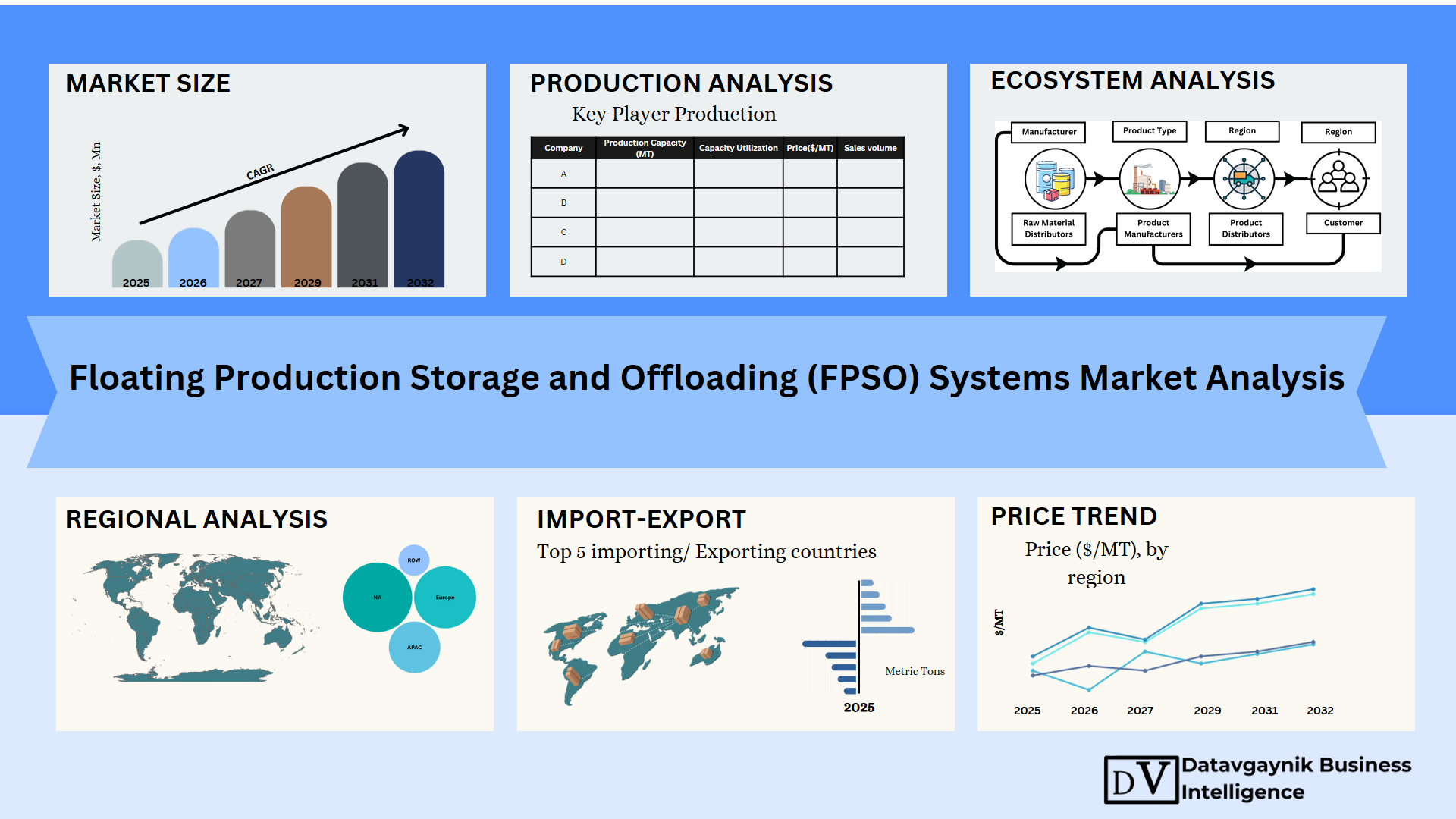
The market covers integrated offshore production systems that process hydrocarbons at sea, store produced crude, and offload it to shuttle tankers or export routes. In practical business terms, this includes FPSO hulls, topside process modules, mooring systems, turret systems, storage infrastructure, marine systems, process automation, safety systems, operations support, and major lifecycle upgrades. It does not include crude oil sales, subsea wells, drilling rigs, fixed platforms, or downstream refining assets.
Datavagyanik also covers related markets such as the Floating LNG Storage Units Market. Such interlinked markets help paint a fuller story of the supply chain, influencing the primary topic’s trajectory.
The business relevance of FPSOs is becoming sharper in 2026–2035 because offshore production is moving toward deeper water, remote basins, and fields where fixed platforms are either too expensive or technically unsuitable. Brazil’s pre-salt fields, Guyana’s Stabroek block, Angola’s deepwater blocks, Suriname’s offshore discoveries, and selective Southeast Asian developments are all pointing in the same direction: operators want production capacity that can be deployed without building a full fixed platform network.
For this analysis, the Floating Production Storage and Offloading (FPSO) Systems Market is treated as a capital-intensive offshore infrastructure market with two revenue engines. The first is new FPSO development, where EPC, integration, conversion, and installation contracts create large one-time revenue pools. The second is long-term leasing, operations, maintenance, and asset integrity services, where contractors earn revenue over 10–25 years. That mix gives the market a more stable profile than pure offshore construction, but project timing still creates lumpiness.
A typical FPSO project can involve several billion dollars of field development spending when subsea systems, wells, pipelines, and logistics are included. The FPSO system itself usually represents one of the largest single infrastructure packages in the development plan. This is why procurement cycles are long, financing structures are complex, and contractor balance sheets matter almost as much as engineering capability.
Market size and forecast snapshot
| Metric | Estimate |
| Global market size, 2026 | $21,400 million |
| Projected market size, 2035 | $38,000 million |
| CAGR, 2026–2035 | 6.6% |
| Base demand theme | Deepwater and ultra-deepwater oil and gas production |
| Most active demand basins | Brazil, Guyana, Suriname, Angola, Nigeria, Southeast Asia, Gulf of Mexico |
| Revenue boundary | FPSO system EPC, newbuilds, conversions, leasing, O&M, asset integrity, major upgrades |
The revenue boundary for the Floating Production Storage and Offloading (FPSO) Systems Market is shaped by offshore project sanctioning rather than simple vessel demand. When oil companies approve deepwater developments, FPSO awards usually follow. When oil price uncertainty, cost inflation, local content rules, or regulatory reviews delay final investment decisions, FPSO demand can shift by one or two years. So, the forecast should be read as a project-cycle view rather than a smooth manufacturing curve.
Three forces matter most.
First, deepwater production economics are improving in selected basins. New discoveries in Guyana and Suriname, high-flow reservoirs in Brazil, and Angola’s integrated offshore projects create a strong case for large-capacity floating production. These basins can support high-spec units with larger topsides, higher gas processing capacity, and longer operating lives.
Second, regulation is pushing system design toward lower routine flaring, higher gas utilization, stronger methane control, and better safety assurance. FPSOs are no longer judged only on production capacity. Operators now ask how much gas can be compressed, reinjected, exported, or treated onboard. That adds engineering cost, but it also creates new value for contractors with gas handling and emissions-reduction capability.
Third, execution risk has become a board-level issue. Cost overruns, shipyard congestion, delayed modules, and specialized equipment bottlenecks can change project economics. This is pushing the industry toward standardized hulls, repeatable topside designs, integrated digital monitoring, and earlier supplier involvement.
The key consumers and clients are upstream oil and gas operators. These include national oil companies, international oil companies, and deepwater-focused joint ventures. Petrobras, ExxonMobil, Shell, TotalEnergies, bp, Eni, Equinor, CNOOC, ONGC, Petronas, Chevron, and African national oil companies are among the most relevant buyer groups. FPSO contractors such as SBM Offshore, MODEC, Yinson Production, BW Offshore, MISC, Bluewater, and Bumi Armada compete by combining engineering delivery, project finance, fleet operations, and lifecycle reliability.
Expert view: The next phase of FPSO growth won’t be led by “more vessels” alone. It will be led by larger, more complex, data-enabled production systems that can handle oil, gas, water, emissions, and uptime risk in one offshore asset.
Market Segmentation and Forecast Scope
The Floating Production Storage and Offloading (FPSO) Systems Market can be segmented across five practical dimensions: system type, water depth and field complexity, ownership model, production profile, and region. This segmentation avoids overlap because each dimension answers a different commercial question. What is being built? Where will it operate? Who owns it? What production stream does it handle? Which region creates demand?
Segmentation framework
| Segmentation dimension | Sub-segments | Why it matters |
| By System Type | Newbuild FPSOs, converted FPSOs, redeployed or life-extended FPSOs | Defines engineering scope, cost base, delivery timeline, and asset life |
| By Water Depth / Field Complexity | Shallow water, deepwater, ultra-deepwater | Determines mooring design, riser complexity, topside specification, and safety systems |
| By Ownership / Contract Model | EPC sale, lease-and-operate, build-own-operate-transfer, O&M contracts | Shapes revenue recognition, financing structure, contractor risk, and recurring income |
| By Production Profile | Oil-focused FPSOs, oil-and-gas FPSOs, gas-condensate FPSOs, heavy-oil FPSOs | Drives topside design, compression, separation, storage, offloading, and emissions systems |
| By End User | National oil companies, international oil companies, independents, joint ventures | Defines procurement behavior, local content requirements, and contract duration |
| By Region | North America, Europe, Asia Pacific, LAMEA | Captures basin maturity, regulatory differences, reserves quality, and project pipeline |
By System Type, newbuild FPSOs are the most strategic category because high-capacity deepwater fields increasingly need purpose-built hulls and large topside modules. Newbuild FPSOs account for an estimated 58% of 2026 market revenue. Their share is high because Brazil, Guyana, Suriname, and Angola are demanding larger production units with stronger gas handling, longer field lives, and higher reliability standards. Converted FPSOs still matter, especially for smaller fields or faster-track developments, but they are less suited for some of the highest-spec ultra-deepwater projects.
By Water Depth / Field Complexity, deepwater and ultra-deepwater applications are the center of gravity. This is where FPSOs make the strongest economic case. Fixed platforms become difficult to justify when water depth, distance from shore, or reservoir layout increases. Ultra-deepwater units need advanced mooring systems, high-pressure processing equipment, stronger subsea integration, and more robust safety systems. This segment also carries the highest technical barrier for new entrants.
By Ownership / Contract Model, lease-and-operate models remain attractive because they reduce upfront capital pressure for operators. Contractors finance, own, and operate the FPSO while the oil company pays through long-term charter or service payments. EPC sale models are also important, especially where national oil companies prefer ownership of the production asset. The choice depends on balance sheet strategy, local content rules, tax treatment, project risk, and the operator’s internal operating capability.
By Production Profile, oil-focused FPSOs remain the largest demand pool, but oil-and-gas FPSOs are becoming more important. Offshore projects now need better gas monetization and lower routine flaring. This changes the topside design. Gas compression, dehydration, reinjection, export readiness, power generation efficiency, and carbon management are becoming part of the commercial discussion much earlier in project planning.
By End User, national oil companies and state-linked operators are central to demand. Petrobras is a clear anchor client because Brazil’s pre-salt fields need multiple large FPSOs over a long development cycle. ExxonMobil and partners are driving high-speed FPSO deployment in Guyana. Shell, TotalEnergies, bp, Eni, and Equinor continue to shape demand through technically complex deepwater projects. Independents and joint ventures matter as well, especially in Africa and emerging Atlantic Margin basins.
By Region, LAMEA is the most important growth zone because it includes Latin America and West Africa. Latin America alone is estimated to represent about 37% of 2026 global FPSO systems revenue, driven mainly by Brazil and Guyana. Suriname is moving from discovery story to development opportunity. Angola is also regaining attention as operators approve integrated offshore developments. Asia Pacific remains active in Malaysia, China, Indonesia, Australia, and India, though project sizes are more mixed. Europe is mature but still relevant for North Sea redevelopment, harsh-environment capability, and engineering services. North America is selective, with demand tied mainly to the Gulf of Mexico.
For the Floating Production Storage and Offloading (FPSO) Systems Market forecast, the fastest-growing sub-segments are expected to be ultra-deepwater FPSOs, high-gas-handling FPSOs, lease-and-operate contracts, and digital lifecycle management services. These areas align with where operators are spending: large reservoirs, long field lives, stricter emissions expectations, and fewer tolerance levels for downtime.
Expert view: Segmentation should not be built around vessel labels alone. The better lens is field complexity. A basic FPSO and a high-gas ultra-deepwater FPSO may share the same acronym, but commercially they behave like different asset classes.
Market Trends and Innovation Landscape
In the Floating Production Storage and Offloading (FPSO) Systems Market, innovation is moving in three directions: execution efficiency, emissions control, and lifecycle intelligence. The industry is not chasing novelty for its own sake. It is solving hard commercial problems: long delivery cycles, cost escalation, methane and flaring scrutiny, aging asset risk, and the need to keep offshore production online with limited intervention.
The first major trend is standardization. FPSO contractors are trying to reduce project risk by using repeatable hull designs, modular topsides, pre-qualified equipment packages, and earlier engineering freeze points. This is most visible in high-spec projects where schedule discipline matters. A standardized hull does not mean every project looks the same. It means the base platform is more predictable, while the topsides are customized around reservoir fluids, gas volumes, water handling, and export strategy.
This trend is reshaping competition. Contractors with proven execution platforms can bid with more confidence. Shipyards benefit from repeat work. Operators gain better schedule visibility. Smaller contractors may find it harder to compete unless they specialize in conversions, redeployments, niche geographies, or O&M-led models.
The second trend is the rise of gas-handling complexity. New FPSOs are being asked to process more associated gas, support reinjection, reduce flaring, and prepare for future gas export options. This has a direct impact on compression trains, separation systems, dehydration units, power generation, flare systems, and emissions monitoring. In Brazil and Guyana, the scale of gas processing requirements is becoming a major differentiator between ordinary FPSO capability and premium FPSO capability.
The third trend is digital integration. This is one area where AI is actually relevant. FPSOs generate large operating datasets across rotating equipment, process systems, marine systems, power generation, hull integrity, and safety barriers. AI-supported analytics, digital twins, predictive maintenance, and integrated data platforms are now being used to improve uptime and detect operational issues earlier. The business case is simple: a single unplanned shutdown on a large FPSO can carry very high opportunity cost.
Expert view: AI in FPSOs will not replace offshore engineers. Its near-term value is sharper condition monitoring, better anomaly detection, fewer maintenance surprises, and smarter asset integrity planning.
The fourth trend is decarbonization engineering. This is still early, but it is no longer theoretical. Contractors are testing onboard carbon capture concepts, more efficient power systems, solid oxide fuel cell pilots, flare reduction packages, and energy optimization software. These solutions are not yet standard on every project because offshore space, weight, safety, and cost constraints are strict. Still, they are likely to influence project specifications between 2026 and 2035, especially where operators face stronger emissions reporting obligations.
Material science also plays a role, but it is not the headline story. The relevant areas are corrosion-resistant alloys, advanced coatings, fatigue-resistant mooring components, composite materials in selected applications, and improved insulation or fire protection materials. FPSOs operate in saltwater, high humidity, high pressure, and sometimes sour service conditions. Any material improvement that extends inspection intervals or reduces maintenance workload can influence lifecycle economics.
Recent announcements show where the market is heading. SBM Offshore has continued to promote standardized FPSO delivery through its Fast4Ward approach and new FEED activity in Guyana. SBM Offshore has also moved deeper into digital performance through partnerships with SLB and Cognite. MODEC has secured major FPSO work linked to Guyana and Brazil while also investing in lower-emission offshore power and onboard carbon capture concepts. Petrobras remains one of the most important demand anchors through Brazil’s pre-salt and Sergipe-Alagoas developments. Angola’s new offshore investment approvals also reinforce West Africa’s position in the next FPSO cycle.
Innovation and news-led trend map
| Trend area | What is changing | Commercial impact |
| Standardized FPSO platforms | Repeat hull designs, modular topsides, pre-planned procurement | Better cost control and shorter delivery risk windows |
| High-gas-processing FPSOs | Larger compression, reinjection, dehydration, and gas treatment systems | Higher project value and stronger differentiation for premium contractors |
| Digital twins and AI analytics | Integrated data platforms, predictive maintenance, asset performance tools | Improved uptime, lower maintenance uncertainty, better lifecycle planning |
| Decarbonized onboard power | Fuel cells, carbon capture pilots, energy optimization systems | Early-stage but strategically important for future tenders |
| Asset integrity upgrades | Hull life extension, corrosion control, mooring inspection, process reliability | Expands aftermarket and long-term service revenue |
| Local content engineering | Regional execution centers, local fabrication, domestic workforce development | Improves bid competitiveness in Brazil, Guyana, Angola, Malaysia, and India |
Mergers and partnerships are becoming more targeted. The industry is not seeing broad consolidation at the same speed as some manufacturing markets. Instead, companies are forming technical alliances around digital operations, mooring integration, carbon capture, and offshore power. This is a practical route because FPSO projects depend on ecosystems. No single contractor controls the full technology stack.
The strategic implication is clear. By 2035, FPSO competition will be less about who can deliver a vessel and more about who can deliver production assurance. Buyers will compare contractors on schedule performance, gas-handling capability, emissions readiness, digital operations, financing strength, and long-term uptime. That changes the market from a project EPC contest into an infrastructure performance market.
Use case/example: A deepwater operator in Guyana or Brazil may select a higher-cost FPSO contractor if the contractor can reduce schedule risk, offer stronger gas compression experience, integrate AI-based maintenance, and support local execution. The upfront bid may not be the lowest, but the lifecycle risk profile may be better.
Competitive Intelligence and Benchmarking
Competition in the Floating Production Storage and Offloading (FPSO) Systems Market is concentrated among contractors that can combine engineering delivery, marine operations, project financing, and long-term asset management. This is not a simple vessel supply market. Winning players need balance sheet depth, yard coordination capability, subsea interface experience, process engineering strength, and a track record of operating offshore assets safely for decades.
The competitive field can be grouped into three layers. The first layer includes global FPSO specialists that design, build, lease, and operate large production units. The second layer includes regional floating production companies with strength in conversion, redeployment, and long-term operations. The third layer includes shipyards, topside contractors, turret specialists, and engineering firms that support FPSO delivery without always owning the final asset.
Competitive benchmark table
| Company | Portfolio focus | Market position | Strategic strength |
| SBM Offshore | Large FPSOs, standardized hulls, lease-and-operate contracts, O&M, lifecycle services | Global leader in high-capacity FPSO systems | Strong execution record in Brazil, Guyana, and Suriname |
| MODEC | FPSO/FSO EPCI, ownership, leasing, and operations | Top-tier Japanese FPSO contractor | Strong Brazil and Guyana exposure with deepwater engineering depth |
| Yinson Production | FPSO ownership, conversion, newbuild delivery, long-term charters | Fast-rising independent operator | Competitive in emerging deepwater markets and emissions-focused designs |
| BW Offshore | FPSO engineering, operations, redeployment, field-specific solutions | Established operator with selective growth strategy | Strong operating discipline and flexible project models |
| MISC Group | Floating production solutions, EPCIC, O&M, repair, life extension, redeployment | Malaysia-based offshore player with global ambitions | Strong Asia-Pacific base and Petrobras-linked project experience |
| Bumi Armada | FPSO operations, floating gas solutions, offshore services | Mid-sized FPSO and offshore services contractor | Useful exposure to Asia, Africa, and Indian offshore production |
| Bluewater Energy Services | Harsh-environment FPSOs, turret/mooring systems, floating production operations | Specialist operator with strong North Sea and Atlantic experience | Strong in harsh conditions, mooring technology, and asset redeployment |
SBM Offshore remains the most strategically important company in the market. Its position is built on large FPSO delivery, standardized execution platforms, leasing models, and long-term operations. The company’s standardized hull strategy gives it a practical edge when operators want repeatability, schedule control, and lower design risk. Its strength is most visible in Brazil, Guyana, and now Suriname. The company is not just selling a unit. It is selling production certainty over a multi-decade asset life.
MODEC is another top-tier FPSO specialist. The company has deep experience in EPCI, leasing, ownership, and operations. Its portfolio is particularly relevant for large deepwater units with complex topsides. Brazil and Guyana are important markets for the company, and its Japanese engineering base supports credibility in technically demanding projects. MODEC competes strongly where process complexity, schedule discipline, and long-term operations matter more than lowest upfront cost.
Yinson Production has become more visible in the FPSO space because it combines an independent ownership model with aggressive execution in emerging offshore basins. The company’s portfolio includes FPSO conversion, project delivery, operations, and long-term charter structures. Its Angola activity shows its ability to compete in markets where emissions performance, delivery speed, and contractor financing matter. The company is not yet as large as SBM Offshore or MODEC, but its strategic profile has improved.
BW Offshore has a more selective market posture. It is not chasing every mega-project. Instead, it focuses on tailored floating production solutions, operations, redeployments, and disciplined asset management. This gives the company a useful role in mid-sized fields, brownfield extensions, and offshore developments where a flexible commercial model is needed. Its long operating history supports client confidence, especially where uptime and asset reliability drive economics.
MISC Group is a serious Asian offshore player with growing relevance in FPSO systems. Its offshore business covers design engineering, project execution, repair, life extension, redeployment, and O&M. The company’s exposure to large Brazilian FPSO projects has strengthened its global credentials. It also benefits from Malaysia’s offshore ecosystem and can support projects across Southeast Asia and other emerging basins.
Bumi Armada competes as a mid-sized FPSO and offshore services contractor. It has worked across Asia, Africa, and the Indian offshore market. Its role is especially relevant where operators need floating production experience but may not require the largest standardized newbuild FPSO. The company’s position is more niche than the leading global contractors, but it remains relevant in conversion-led and regionally anchored projects.
Bluewater Energy Services is best viewed as a specialist rather than a scale leader. Its strength sits in harsh-environment FPSOs, turret and mooring capability, and operating assets under demanding offshore conditions. That makes the company relevant for North Sea-style environments, Atlantic redeployments, and projects where mooring performance and environmental resilience matter. It is not the largest competitor, but it carries strong technical credibility.
Expert view: The competitive gap is widening. Contractors with standardized FPSO platforms, access to capital, and long operating records are gaining power. Smaller players can still win, but usually through redeployment, niche geography, harsh-environment expertise, or cost-efficient conversion models.
Regional Landscape and Adoption Outlook
The regional outlook for FPSO systems is uneven. Demand is not spread evenly across the world. It follows deepwater reserves, offshore licensing, operator capital budgets, yard availability, and political willingness to approve long-cycle oil and gas projects. The strongest demand momentum remains outside the traditional North American and European centers. Brazil, Guyana, Suriname, Angola, and parts of Southeast Asia are driving the next project wave.
Regional outlook snapshot
| Region / Country | Adoption status | Demand outlook | Main role in ecosystem |
| United States | Mature offshore oil and gas market | Selective growth | Deepwater production, Gulf of Mexico technology base, subsea tiebacks |
| Europe | Mature and regulated | Low to moderate growth | North Sea redevelopment, harsh-environment engineering, O&M, decommissioning |
| China | Expanding offshore production base | Moderate to strong growth | Domestic FPSO deployment, shipbuilding, offshore engineering |
| India | Early-stage FPSO adoption | Selective growth | East coast deepwater development, ONGC-led demand |
| Japan | Limited domestic deployment | Stable as supply-side hub | FPSO engineering and contractor base through MODEC |
| South Korea | Limited domestic deployment | Stable as shipbuilding hub | Large hulls, offshore modules, global FPSO fabrication |
| Middle East | Limited FPSO need | Low direct adoption | Offshore capital strength, fixed-platform dominance, selective floating opportunities |
United States
The United States is a mature offshore production market, led by the Gulf of Mexico. It has strong deepwater infrastructure, experienced operators, advanced subsea capability, and a mature offshore regulatory system. That said, FPSO adoption is not as broad as in Brazil or Guyana because the Gulf already has a deep network of fixed and floating production hubs, pipelines, and subsea tieback options. Many new fields can be tied back to existing host facilities instead of requiring a standalone FPSO.
So, the U.S. opportunity is selective. It is more likely to appear in technically complex fields, remote deepwater blocks, or situations where existing infrastructure cannot support the production profile. Regulatory oversight is strict, project timelines are long, and operators are careful about capital discipline. The U.S. remains important for technology, subsea integration, safety standards, and project engineering, but it is not the largest FPSO growth engine.
Europe
Europe’s FPSO demand is centered on the North Sea and nearby offshore areas. The region has mature fields, aging assets, harsh weather, high safety requirements, and strong environmental regulation. This creates demand for life extension, brownfield redevelopment, asset integrity, and decommissioning-linked services rather than a large wave of new FPSO deployments.
The United Kingdom and Norway are the most relevant European offshore markets. The UK has historically used FPSOs in the North Sea and West of Shetland. Norway’s offshore ecosystem is highly advanced, but fixed platforms and subsea-to-shore models are often preferred where infrastructure supports them. Europe is also a knowledge hub for turret systems, mooring engineering, marine assurance, remote monitoring, and harsh-environment operations.
Funding in Europe is more selective. Banks and export credit agencies are scrutinizing oil and gas exposure more closely. Operators must show lower emissions intensity, strong safety performance, and clear field economics. This may slow some projects, but it also creates room for higher-value engineering and lower-emission FPSO upgrades.
China
China is becoming more important in both FPSO deployment and construction. On the demand side, CNOOC is pushing offshore output from the South China Sea and Bohai Bay. On the supply side, Chinese yards are now central to global FPSO hull and module fabrication. China’s FPSO ecosystem benefits from industrial scale, state-backed offshore strategy, and strong domestic shipbuilding capacity.
The country’s adoption outlook is moderate to strong. China is not only importing FPSO know-how; it is building domestic capability. Its recent use of cylindrical FPSO design in South China Sea projects signals a willingness to adapt floating production architecture to local field conditions. Regulation is state-led and development-focused, which can speed execution once projects are approved. Funding is also supported by national energy security priorities.
India
India is still an emerging FPSO market. The main demand comes from deepwater development on the east coast, especially projects linked to ONGC. The country has offshore reserves, but project execution has faced delays due to technical complexity, monsoon and cyclone conditions, contractor coordination, and cost control. FPSO adoption is therefore selective rather than broad.
The long-term case is still positive. India wants to reduce import dependency and improve domestic oil and gas output. FPSOs can support this objective where offshore fields are too remote or complex for fixed platforms. However, India will need stronger domestic offshore project management, clearer procurement timelines, and more predictable contract structures to attract global FPSO contractors at scale.
Japan
Japan is not a major domestic FPSO deployment market. Its importance comes from engineering, project management, and corporate ownership through MODEC. Japanese contractors bring strong process discipline, safety culture, and technical credibility to deepwater FPSO projects worldwide. Japan also plays a role in financing, marine equipment, automation, and high-specification components.
The outlook is stable. Japan’s domestic offshore oil production base is limited, so growth will come from export-oriented FPSO services. In this market, Japan is a supply-side country rather than a demand-side country.
South Korea
South Korea’s role is also supply-side. It is one of the world’s major offshore shipbuilding and fabrication centers. Korean yards have experience in large hulls, offshore structures, LNG carriers, and complex marine engineering. While domestic FPSO deployment is limited, South Korea remains critical to global project execution because FPSO hulls and modules require advanced yard capacity.
The country’s challenge is cost competitiveness. Chinese yards have become more aggressive in FPSO hull work, while Singapore remains important for integration and repairs. South Korean yards remain attractive for technically demanding offshore structures, but they must balance price, schedule, and yard capacity.
Middle East
The Middle East is not a core FPSO adoption region. Most Gulf offshore production uses fixed platforms, artificial islands, pipelines, and established export infrastructure. Water depths are generally shallower than Brazil or Guyana, and existing infrastructure reduces the need for FPSOs.
That said, the region remains relevant because of capital availability, offshore service capability, and national oil company investment power. Selective FPSO opportunities may emerge outside the core Gulf shelf or in projects requiring early production, remote field monetization, or floating storage flexibility. Still, compared with Latin America and West Africa, the Middle East is a secondary demand market.
Expert view: The strongest FPSO adoption story is not in every offshore country. It is concentrated in places where deepwater reserves, weak export infrastructure, and large production targets overlap. That is why Brazil, Guyana, Suriname, and Angola matter more than many larger oil-producing countries.
Recent Developments + Opportunities & Restraints
Recent Developments
| Year / Month | Event | Market relevance |
| 2024, October | TotalEnergies announced the final investment decision for the GranMorgu development on Block 58 in Suriname. | This moved Suriname from offshore discovery status to a real FPSO demand market. It also reinforced the Atlantic Margin as a major FPSO growth corridor. |
| 2024, November | SBM Offshore and Technip Energies were awarded contracts for the GranMorgu FPSO in Suriname. | The award confirmed the role of standardized hulls and modular topsides in reducing schedule and execution risk. |
| 2025, May | SBM Offshore announced that FPSO Alexandre de Gusmão was producing and formally on hire after first oil and acceptance testing. | This strengthened Brazil’s role as the largest long-cycle FPSO market and showed continued demand from Petrobras pre-salt developments. |
| 2025, August | Yinson Production announced that the Agogo FPSO achieved first oil ahead of schedule and began its 15-year firm charter. | The event improved Yinson’s competitive position and highlighted demand for lower-emission FPSO designs in West Africa. |
| 2026, June | Azule Energy, ANPG, and partners reached final investment decision on the $5.1 billion Greater PAJ offshore project in Angola. | This supports Angola’s deepwater revival and adds another long-cycle FPSO opportunity in West Africa. |
Opportunities & Business Insights
Opportunity 1: Emerging deepwater basins
The strongest opportunity sits in frontier and fast-scaling offshore basins. Guyana is already in rapid deployment mode. Suriname is entering its first major offshore development cycle. Angola is rebuilding momentum through integrated projects. Brazil remains the anchor market because of pre-salt depth, reservoir quality, and continued Petrobras investment. Contractors with capital access and proven delivery capacity will have the advantage.
Opportunity 2: AI, automation, and remote monitoring
Digital operations are becoming a real differentiator. FPSO operators can use predictive analytics, digital twins, remote equipment monitoring, and anomaly detection to reduce unplanned downtime. The value is not abstract. On a large offshore asset, even a short production outage can have a major revenue impact. Contractors that offer data-enabled lifecycle services can move beyond construction revenue into higher-margin operating support.
Opportunity 3: Cost-saving standardized platforms
Standardized hulls, modular topsides, and repeatable procurement models can reduce delivery uncertainty. This is attractive for operators that need multiple FPSOs across similar reservoirs. Brazil, Guyana, and Suriname are the clearest examples. The more repeatable the design, the easier it becomes to control engineering hours, yard learning curves, spare parts, and inspection routines.
Restraints
Restraint 1: High upfront capital and financing pressure
FPSOs require large upfront capital. Lease-and-operate models help operators reduce direct capex, but contractors then carry financing risk. Higher interest rates, tighter lender scrutiny, and ESG-linked financing limits can raise project costs.
Restraint 2: Shipyard congestion and supply chain bottlenecks
Large FPSO projects need hull capacity, topside modules, rotating equipment, control systems, marine systems, and specialist integration yards. Delays in any major package can push first oil into a later year. This directly affects operator economics.
Restraint 3: Regulatory and emissions compliance
FPSO projects must now address flaring, methane control, produced water, spill prevention, gas handling, and worker safety. These requirements improve long-term project quality, but they also raise design complexity and approval timelines.
Expert view: The market is not short of demand. The harder question is execution. Contractors that can deliver large FPSOs on time, with lower emissions and predictable uptime, will capture the best contracts through 2035.


