

Surging Demand for High-Octane Fuels Boosts Fluid Catalytic Cracker (FCC) Additives Market
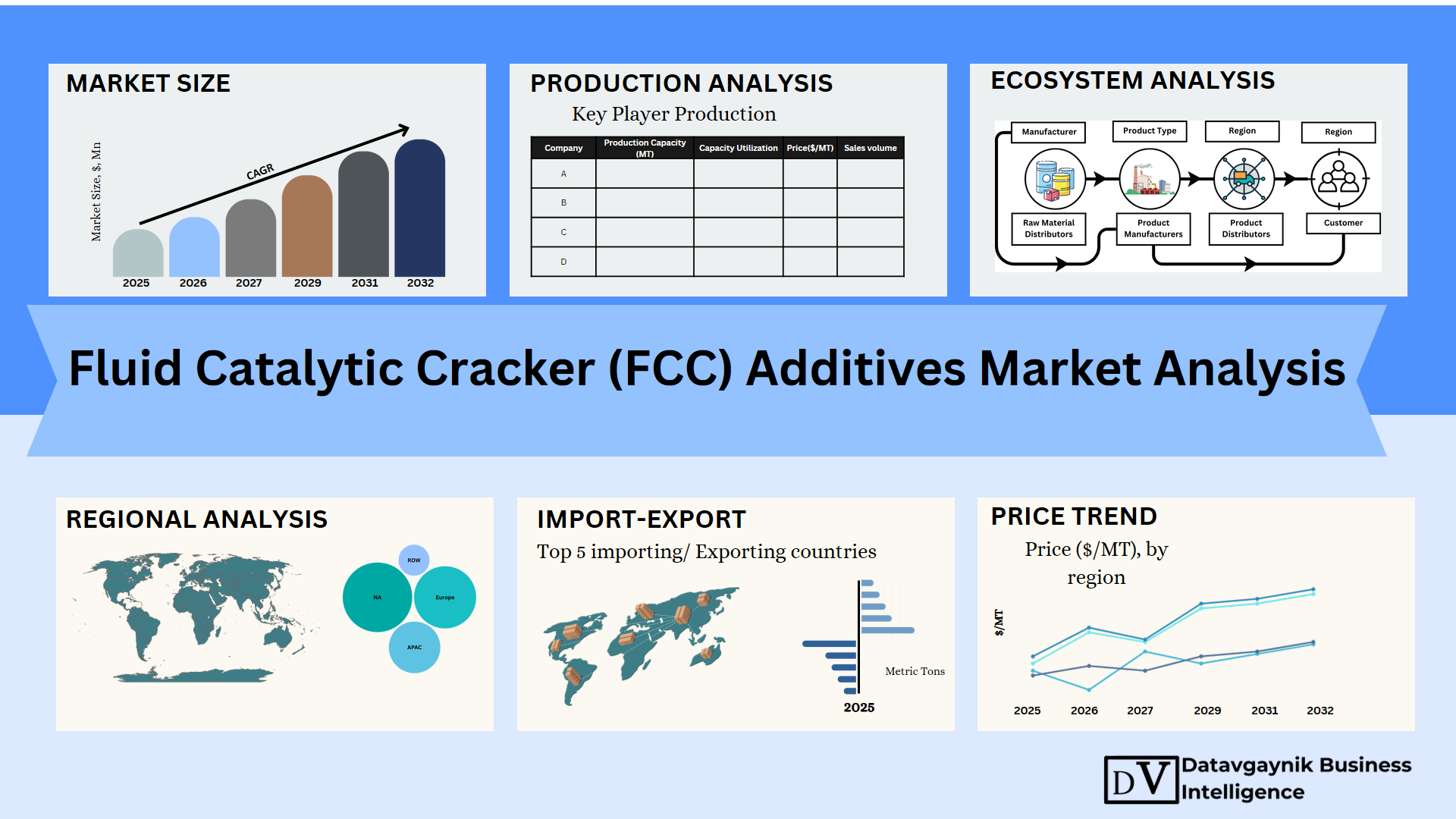
The Fluid Catalytic Cracker (FCC) Additives Market is witnessing a robust surge driven by the expanding global appetite for high-octane, cleaner-burning fuels. As gasoline engines become more advanced, especially with the proliferation of turbocharged and downsized engines, the demand for high-octane fuel has increased significantly. For instance, in the last five years, the share of high-octane gasoline sales in developing countries has grown by over 15%, prompting refiners to upgrade their FCC operations. FCC additives that enhance octane levels without compromising yield are becoming essential tools in helping refineries meet this demand. This trend directly supports the Fluid Catalytic Cracker (FCC) Additives Market Size, which is projected to expand steadily as refiners prioritize premium gasoline production.
Environmental Regulations Drive Innovation in the Fluid Catalytic Cracker (FCC) Additives Market
Governments across the globe are tightening emissions regulations, compelling refineries to adopt advanced technologies that reduce pollutants like sulfur oxides (SOx), nitrogen oxides (NOx), and particulate matter. In regions such as the European Union and the United States, emission caps have become more stringent under frameworks like the Euro 6 standards and EPA Tier 3 regulations. As a result, there has been a notable increase in the deployment of FCC additives that trap SOx or modify the catalyst surface to lower NOx emissions.
For instance, refiners in Europe have reported over 30% reductions in SOx emissions through the application of specialized FCC additives. This regulatory pressure is not just reactive; it is catalyzing R&D in the Fluid Catalytic Cracker (FCC) Additives Market, fueling the development of next-generation solutions.
Petrochemical Demand Fuels Propylene-Enhancing Additive Consumption
The booming petrochemical industry, particularly the growing consumption of propylene, is creating unprecedented opportunities within the Fluid Catalytic Cracker (FCC) Additives Market. Propylene is a vital feedstock for manufacturing polypropylene, which is used in packaging, automotive, textiles, and construction. Global propylene demand is expected to exceed 150 million metric tons by 2030, growing at a CAGR of over 4.5%.
Refineries are optimizing their FCC units to maximize propylene yields by using ZSM-5-based additives, which shift the hydrocarbon product slate toward light olefins. For example, refiners using propylene-maximizing additives have reported up to a 60% increase in olefin output. This surge directly correlates with the expansion in the Fluid Catalytic Cracker (FCC) Additives Market Size, as refiners across Asia-Pacific, North America, and the Middle East intensify efforts to meet the rising demand from petrochemical sectors.
Complex Crude Feedstocks Escalate Demand for Metal Passivation and Coke Reduction Additives
The increasing processing of heavy, sour, and unconventional crude oil feedstocks is introducing higher levels of contaminants like vanadium, nickel, and sulfur into FCC units. These impurities lead to rapid catalyst deactivation, reduced yields, and excessive coke formation. Refineries are therefore turning to specialized FCC additives that passivate metals and minimize coke deposits. For instance, metal passivation additives have been shown to extend catalyst life by up to 25% and reduce regeneration frequency.
In Latin America and parts of the Middle East, where heavy crudes dominate, such additives have become standard practice. The evolving complexity of crude oil directly influences the strategic direction of the Fluid Catalytic Cracker (FCC) Additives Market, as additive formulations are increasingly tailored to refinery-specific challenges.
Biofuel Integration into Refining Spurs Innovation in the Fluid Catalytic Cracker (FCC) Additives Market
With global mandates pushing for cleaner energy sources, the integration of renewable feedstocks such as bio-oils and waste-derived materials into FCC units is accelerating. These feedstocks introduce new challenges, such as higher oxygen content and unpredictable contaminant profiles. In response, the Fluid Catalytic Cracker (FCC) Additives Market is evolving rapidly, with refiners seeking additives that can stabilize operations, manage variability, and maintain product quality. For example, FCC units processing bio-based feeds report up to 20% variability in catalyst performance, which can be mitigated through specialized additives. As more nations commit to net-zero targets, the demand for biofuel-compatible additives is expected to contribute substantially to market growth.
Operational Efficiency and Catalyst Longevity Drive Additive Adoption
Refineries are under continuous pressure to reduce downtime, lower energy costs, and increase throughput. Additives that enhance catalyst activity, selectivity, and thermal stability are critical in this regard. For instance, coke reduction additives can lower regeneration temperatures by 10–15%, leading to energy savings and prolonged catalyst life. In the Asia-Pacific region, where many refineries are upgrading to modern configurations, such performance-enhancing additives are seeing accelerated adoption. This operational imperative is further cementing the central role of advanced formulations in the Fluid Catalytic Cracker (FCC) Additives Market.
Refinery Upgrades Across Emerging Economies Expand Fluid Catalytic Cracker (FCC) Additives Market
Emerging economies such as India, China, and Vietnam are witnessing large-scale investments in refining capacity to meet domestic fuel demand and boost exports. India alone plans to expand refining capacity by over 100 million metric tons per year by 2030. These expansions, often involving residue fluid catalytic cracking (RFCC) units, necessitate advanced FCC additives that enhance heavy feedstock conversion, improve propylene yields, and reduce emissions. For instance, China’s state-owned refiners have adopted new-generation FCC additives to process heavier feedstocks with greater efficiency, reporting up to 35% better conversion rates. These dynamics are reshaping the landscape of the Fluid Catalytic Cracker (FCC) Additives Market, positioning emerging markets as key growth engines.
Circular Economy and Sustainability Goals Reinforce Additive Demand
Sustainability has become a cornerstone of strategic planning in the refining industry. Governments and corporations alike are adopting circular economy principles, emphasizing waste reduction, recycling, and low-carbon processing. This shift is directly benefiting the Fluid Catalytic Cracker (FCC) Additives Market, especially additives that support waste-to-fuel technologies or enhance the performance of recycled feedstocks. For example, additives capable of stabilizing performance during the processing of plastic-derived oils are gaining traction in Europe and Japan. As decarbonization targets become more aggressive, the alignment of FCC additives with green refining objectives is becoming a major market differentiator.
Technological Advancements Elevate Performance Standards in the Fluid Catalytic Cracker (FCC) Additives Market
Rapid innovation in materials science and nanotechnology is pushing the boundaries of what FCC additives can achieve. Advances such as nanoscale catalyst coatings, multifunctional additive systems, and real-time feedstock adaptability are driving the evolution of the Fluid Catalytic Cracker (FCC) Additives Market. For instance, recent developments in surface modification have enabled the creation of additives that enhance both octane levels and propylene yields simultaneously—an advancement that was difficult to achieve with older formulations. As global competition intensifies, refiners are increasingly seeking additive solutions that offer integrated benefits, such as yield improvement, emission control, and catalyst longevity in a single formulation.
Strategic Focus on Petrochemical Feedstock Optimization Amplifies FCC Additive Use
With the petrochemical sector projected to account for over one-third of the global oil demand growth through 2030, refiners are shifting their focus from traditional fuel production to high-value petrochemical feedstocks. This pivot has led to the growing use of additives that maximize light olefin yields, particularly in FCC units. For example, South Korean refiners have retrofitted their FCC systems to boost propylene output, supported by tailored additive strategies. This transformation has pushed the Fluid Catalytic Cracker (FCC) Additives Market to the forefront of petrochemical value chain optimization, making it a vital tool in maximizing downstream profitability.
“Track Country-wise Fluid Catalytic Cracker (FCC) Additives Production and Demand through our Fluid Catalytic Cracker (FCC) Additives Production Database”
-
-
- Fluid Catalytic Cracker (FCC) Additives production database for 30+ countries worldwide
- Fluid Catalytic Cracker (FCC) Additives Powder sales volume for 31+ countries
- Country-wise Fluid Catalytic Cracker (FCC) Additives production capacity and production plant mapping, production capacity utilization for 30+ manufacturers
- Fluid Catalytic Cracker (FCC) Additives production plants and production plant capacity analysis for top manufacturers
-
North America Leads in Advanced Production and Demand in the Fluid Catalytic Cracker (FCC) Additives Market
The Fluid Catalytic Cracker (FCC) Additives Market in North America is driven by advanced refining infrastructure and the constant push for cleaner fuels and greater process efficiency. The United States, home to one of the largest refining capacities globally, plays a pivotal role in both the production and consumption of FCC additives. Refineries across the U.S. are increasingly adopting additives that support propylene maximization and compliance with Tier 3 gasoline sulfur limits. These regulations have significantly influenced demand for SOx and NOx reduction additives, which now constitute a growing share of additive consumption in the region.
For instance, refineries processing shale-derived light crudes require tailored FCC additives to manage metal contaminants and coke formation. This has accelerated innovation and deployment of multi-functional products that simultaneously enhance octane levels, reduce emissions, and extend catalyst life. The region is also a major exporter of FCC additives, with North American manufacturers supplying advanced formulations to Asia Pacific, Latin America, and the Middle East. As refiners continue to invest in decarbonization strategies, the North American Fluid Catalytic Cracker (FCC) Additives Market is expected to witness consistent growth, with a sharp focus on high-performance and environmentally compliant solutions.
Europe Prioritizes Emission Control and Biofuel Compatibility in the Fluid Catalytic Cracker (FCC) Additives Market
The Fluid Catalytic Cracker (FCC) Additives Market in Europe is defined by stringent environmental policies and a proactive stance on sustainable refining. Countries such as Germany, France, and the Netherlands are heavily investing in cleaner fuel technologies, leading to widespread adoption of FCC additives designed for SOx, NOx, and CO2 emission reduction. Refineries in this region are also at the forefront of processing renewable and recycled feedstocks, such as used cooking oils and waste plastics, further boosting the need for specialized additives.
For example, refineries integrating bio-oils into their FCC units experience greater oxygen content and feed variability, which requires additives with strong contaminant resistance and selectivity control. This shift has created opportunities for additive manufacturers offering custom solutions for bio-feedstock applications. European refiners are also emphasizing circular economy goals, where additive efficiency plays a key role in minimizing energy use and maximizing feedstock flexibility. As the region tightens its carbon neutrality goals for 2030 and beyond, the Fluid Catalytic Cracker (FCC) Additives Market is aligning more closely with green refining mandates, driving innovation and creating demand for advanced formulations.
Asia Pacific Emerges as the Fastest-Growing Fluid Catalytic Cracker (FCC) Additives Market
Asia Pacific represents the most dynamic growth frontier for the Fluid Catalytic Cracker (FCC) Additives Market, driven by surging refining capacity and rising domestic fuel demand. Countries like China and India are rapidly scaling up their FCC units, both in new installations and in modernization of existing facilities. China alone accounts for a significant share of global refining output and is heavily focused on maximizing petrochemical production, particularly propylene and butylene. This has led to widespread adoption of ZSM-5-based olefin-enhancing additives.
In India, the drive toward Bharat Stage VI fuel standards has led to a spike in demand for SOx and NOx reduction additives. The region is also experiencing a notable shift in crude quality, with more refineries processing heavier and sourer crude oils. This has accelerated the use of metal passivation and coke reduction additives. Additionally, the increasing integration of bio-derived and waste-based feedstocks in refining operations across Asia Pacific is further expanding the demand for customized FCC additive solutions. With refinery expansions in Southeast Asia and consistent economic growth, the Fluid Catalytic Cracker (FCC) Additives Market in Asia Pacific is expected to grow at a CAGR exceeding 6% over the next five years.
Middle East Strengthens Production Capabilities in the Fluid Catalytic Cracker (FCC) Additives Market
The Middle East is traditionally known for its large-scale refining operations, and its role in the Fluid Catalytic Cracker (FCC) Additives Market is becoming increasingly significant. Countries such as Saudi Arabia, the UAE, and Kuwait are undertaking massive investments in refining capacity and integration with petrochemical complexes. These projects are not only increasing demand for FCC additives but also encouraging the development of localized production capabilities through joint ventures and partnerships.
Refineries in the Middle East, often processing heavy sour crude, face challenges in residue conversion, contaminant management, and coke control. As a result, additive consumption in the region is focused on metal passivation and coke reduction products. Additionally, with the growing emphasis on fuel quality improvement for export competitiveness, octane enhancement additives are witnessing higher uptake. As downstream integration deepens in the region, the Fluid Catalytic Cracker (FCC) Additives Market is transitioning from a predominantly import-reliant model to one with emerging domestic manufacturing strength.
Latin America Sees Moderate Growth Driven by Refinery Modernization
In Latin America, the Fluid Catalytic Cracker (FCC) Additives Market is experiencing moderate yet steady growth, primarily supported by ongoing refinery upgrades and a stronger regulatory push toward cleaner fuels. Countries such as Brazil and Mexico are investing in improving FCC unit efficiency and emission control. These upgrades are translating into increased demand for SOx traps, NOx reduction additives, and multifunctional solutions that enhance both performance and environmental compliance.
For instance, Brazil’s focus on increasing octane ratings and reducing sulfur content in gasoline has led to greater utilization of octane-boosting and desulfurization additives. Meanwhile, Mexico’s refinery modernization programs are incorporating FCC additives aimed at maximizing propylene and middle distillate yields. Although the region faces budgetary and logistical challenges, its commitment to improving refining efficiency ensures a positive trajectory for the Fluid Catalytic Cracker (FCC) Additives Market.
Segment-Wise Analysis of the Fluid Catalytic Cracker (FCC) Additives Market
The Fluid Catalytic Cracker (FCC) Additives Market is segmented across additive types, application areas, feedstock type, and end-user industries, each shaping demand patterns uniquely.
Additive type segmentation reveals that octane-enhancing and olefin-enhancing additives dominate in value, given the global push for high-performance fuels and petrochemical feedstocks. ZSM-5 additives, for example, have become essential in FCC units aiming to boost propylene output without sacrificing gasoline quality.
Sulfur and nitrogen oxide reduction additives are becoming increasingly indispensable, particularly in Europe, North America, and parts of Asia, where fuel sulfur limits are reaching single-digit ppm levels. Metal passivation additives remain critical in units processing heavy or unconventional crudes, accounting for a growing share in Latin America and the Middle East.
Application-wise, gasoline production remains the largest segment, but propylene production is growing at a faster pace, driven by global plastic and polymer demand. Emission control, as an application segment, is growing rapidly in response to tightening environmental regulations.
By feedstock type, the demand for FCC additives is highest in units processing heavy crudes, which require a complex blend of additives for stability and performance. Unconventional feedstocks like bio-oils and waste-derived materials are introducing niche demand for custom-formulated additives, especially in Europe and Asia Pacific.
In terms of end-user industries, oil refineries continue to account for the bulk of consumption. However, the petrochemical sector is emerging as a powerful demand driver, as refiners increasingly align operations with downstream polymer production. The biofuel industry is also rising in influence, particularly in markets with aggressive renewable integration targets.
Fluid Catalytic Cracker (FCC) Additives Price Trend Reflects Supply Chain and Feedstock Dynamics
The Fluid Catalytic Cracker (FCC) Additives Price is influenced by several interconnected variables, including raw material costs, refining activity levels, and technological sophistication of the additive formulation. Over the past two years, the Fluid Catalytic Cracker (FCC) Additives Price Trend has shown moderate inflation, driven by global disruptions in chemical supply chains and increased demand for high-performance products.
For instance, ZSM-5-based additives have experienced a price rise of nearly 8% due to rising demand from propylene-maximizing operations and tightening supplies of key precursor materials. Similarly, metal passivation additives have seen upward price adjustments in regions where heavy crude processing is intensifying.
Regional pricing trends also vary significantly. In North America and Europe, where additive technology is more advanced, prices reflect the premium value of multifunctional and sustainable formulations. In contrast, in Asia Pacific and the Middle East, price competitiveness is high due to greater focus on volume and cost-efficiency.
The Fluid Catalytic Cracker (FCC) Additives Price Trend is also shaped by refinery maintenance cycles. During planned shutdowns, demand dips slightly, leading to short-term price corrections. However, during peak refining seasons or periods of regulatory enforcement, demand spikes create upward pressure on prices. Furthermore, with environmental compliance becoming non-negotiable, the willingness of refiners to pay a premium for additives that ensure regulatory alignment has increased.
Looking ahead, the Fluid Catalytic Cracker (FCC) Additives Price is expected to remain firm due to sustained global refining activity, increasing feedstock complexity, and expanding biofuel integration. However, advances in local manufacturing and raw material substitution could stabilize the Fluid Catalytic Cracker (FCC) Additives Price Trend in emerging markets over the medium term.
“Fluid Catalytic Cracker (FCC) Additives Manufacturing Database, Fluid Catalytic Cracker (FCC) Additives Manufacturing Capacity”
-
-
- Fluid Catalytic Cracker (FCC) Additives top manufacturers market share for 30+ manufacturers
- Top 9 manufacturers and top 19 manufacturers of Fluid Catalytic Cracker (FCC) Additives in North America, Europe, Asia Pacific
- Production plant capacity by manufacturers and Fluid Catalytic Cracker (FCC) Additives production data for 30+ market players
- Fluid Catalytic Cracker (FCC) Additives production dashboard, Fluid Catalytic Cracker (FCC) Additives production data in excel format
-
Leading Manufacturers Shaping the Fluid Catalytic Cracker (FCC) Additives Market
The Fluid Catalytic Cracker (FCC) Additives Market is dominated by a handful of global chemical and catalyst manufacturers that have established deep expertise and extensive product portfolios tailored to the refining industry’s evolving needs. These manufacturers drive innovation, improve additive performance, and strategically expand their global footprint to meet rising demand fueled by stricter environmental regulations and petrochemical sector growth.
R. Grace & Co. – Market Leader with Advanced Additive Technologies
R. Grace & Co. holds a commanding presence in the Fluid Catalytic Cracker (FCC) Additives Market, capturing approximately one-third of the global market share. Its product suite includes the highly regarded ACE™ additive, designed to enhance gasoline yield and reduce coke formation, and the Access™ line that offers enhanced catalyst protection and improved contaminant management. These technologies have allowed Grace to maintain strong partnerships with major refiners globally, especially in North America and Asia-Pacific, where FCC units are upgraded to meet ultra-low sulfur fuel standards. Their joint venture with Chevron, Advanced Refining Technologies (ART), further solidifies their position by delivering custom solutions aimed at maximizing propylene production and fuel quality, crucial for refiners adapting to evolving petrochemical feedstock demands.
Johnson Matthey – Pioneer in Emission Control and Additive Innovation
Johnson Matthey is another dominant force within the Fluid Catalytic Cracker (FCC) Additives Market, with a notable share around 20%. The company’s emphasis on emission control technologies has led to the development of proprietary additives such as SUPER SOXGETTER™ and LO-SOX™PB, which effectively reduce sulfur oxide emissions during FCC processing. Their NONOX™ additive line targets nitrogen oxide reduction, addressing one of the most challenging refinery emissions issues.
Johnson Matthey’s commitment to sustainability and regulatory compliance positions them favorably in regions like Europe and the United States, where environmental mandates are increasingly stringent. Their continuous investment in R&D also produces additive formulations that prolong catalyst life and improve FCC unit reliability, factors that translate into operational cost savings and enhanced refinery margins.
BASF SE – Innovator of High-Performance Olefin Maximizers
BASF SE plays a critical role in advancing the Fluid Catalytic Cracker (FCC) Additives Market by focusing on boosting olefin yields to meet petrochemical industry needs. Their Fourtitude™ additive is engineered to maximize butylene output, an important building block for synthetic rubber and plastics. Meanwhile, the ZEAL™ catalyst additive optimizes propylene production without sacrificing gasoline quality. Leveraging their Multiple Frameworks Topology (MFT) technology, BASF provides solutions that offer superior selectivity and catalyst longevity. BASF’s influence is particularly strong in Asia-Pacific and Europe, where petrochemical demand is rapidly growing and refineries are actively reconfiguring FCC units to increase light olefin production.
Albemarle Corporation – Expanding Footprint with Multifunctional Additives
Albemarle Corporation is a key competitor in the Fluid Catalytic Cracker (FCC) Additives Market, offering a broad portfolio that includes octane enhancers and sulfur reduction additives. Their products are designed for refineries seeking to balance product yield, environmental compliance, and operational efficiency. Albemarle has capitalized on growing demand in emerging markets such as India and Latin America by customizing additives to address specific regional feedstock challenges like heavy crude and biofeedstock integration. The company’s strategic investments in regional production facilities and technical support centers underpin their expanding market share, currently estimated in the mid-single digits globally, with strong growth potential.
Axens – Specialist in Olefin Production and Refining Optimization
Axens is recognized for its specialized additive solutions that target enhanced propylene and light olefin production, critical for refiners focused on petrochemical feedstocks. Their FCC additive portfolio supports high selectivity processes while improving gasoline quality and controlling coke formation. Axens’ expertise in integrated refining and petrochemical solutions makes them a preferred partner in regions undergoing refinery modernization, including the Middle East and Asia. Although their global market share is smaller relative to industry giants, Axens is carving a niche by offering tailor-made formulations that align with refinery-specific feedstock and product slate requirements.
Market Share Breakdown in the Fluid Catalytic Cracker (FCC) Additives Market
The Fluid Catalytic Cracker (FCC) Additives Market is highly concentrated, with the top five manufacturers commanding over 70% of the market. W. R. Grace & Co. leads with approximately 30-35%, leveraging its strong innovation pipeline and global reach. Johnson Matthey follows with roughly 20%, driven by its focus on emission control and catalyst life extension technologies. BASF SE holds around 15-18%, benefitting from its olefin maximization technologies aligned with petrochemical industry demands.
Albemarle Corporation and Axens round out the leading group with combined shares close to 15%, supported by their regional penetration and specialized product offerings. The remaining market is fragmented among smaller regional producers and emerging local players, especially in Asia-Pacific and the Middle East, where refinery capacity is expanding rapidly.
This market share distribution reflects the importance of technological innovation, regional presence, and the ability to provide integrated service and technical support, which are key differentiators for fluid catalytic cracker additive suppliers.
Recent Industry Developments and Market Dynamics
- Q1 2025: W. R. Grace & Co. announced the launch of ACE 2.0, an upgraded FCC additive designed to further enhance propylene yields by up to 10% while reducing coke formation, responding to increased petrochemical demand in Asia-Pacific. This launch strengthens their competitive edge in rapidly growing markets.
- Late 2024: Johnson Matthey expanded its FCC additive production facility in Europe, aiming to meet the rising demand for SOx and NOx reduction additives driven by tightening EU fuel quality standards. The expansion includes advanced manufacturing lines capable of producing next-generation environmentally compliant additives.
- Mid 2024: BASF SE secured several long-term supply agreements with refineries in China and India, focused on its Fourtitude™ and ZEAL™ additives. These agreements underscore BASF’s strategic focus on petrochemical feedstock optimization amid surging regional demand for light olefins.
- 2023-2024: Albemarle Corporation made strategic acquisitions of local additive producers in India and Latin America, enhancing their regional manufacturing capabilities and technical support. These moves aim to address regional feedstock challenges such as heavier crudes and biofeedstock integration, expected to fuel market share gains.
- Ongoing: Axens is actively collaborating with refiners in the Middle East to implement FCC additive solutions tailored for heavy sour crudes, enhancing propylene yields and operational efficiency. This partnership model is becoming a template for addressing complex feedstock processing challenges globally.
The Fluid Catalytic Cracker (FCC) Additives Market remains fiercely competitive, driven by innovation, regional expansion, and stringent environmental mandates. Leading manufacturers continue to invest heavily in R&D and localized production to capture market opportunities presented by shifting crude qualities, rising petrochemical feedstock demand, and the integration of renewable feedstocks. As refinery operators navigate complex regulatory landscapes and seek to maximize profitability, the role of advanced FCC additives will only become more critical, ensuring sustained growth and dynamic competition in this vital sector.
“Fluid Catalytic Cracker (FCC) Additives Production Data and Fluid Catalytic Cracker (FCC) Additives Production Trend, Fluid Catalytic Cracker (FCC) Additives Production Database and forecast”
-
-
- Fluid Catalytic Cracker (FCC) Additives production database for historical years, 10 years historical data
- Fluid Catalytic Cracker (FCC) Additives production data and forecast for next 9 years
-
Market Scenario, Demand vs Supply, Average Product Price, Import vs Export, till 2035
- Global Fluid Catalytic Cracker (FCC) Additives Market revenue and demand by region
- Global Fluid Catalytic Cracker (FCC) Additives Market production and sales volume
- United States Fluid Catalytic Cracker (FCC) Additives Market revenue size and demand by country
- Europe Fluid Catalytic Cracker (FCC) Additives Market revenue size and demand by country
- Asia Pacific Fluid Catalytic Cracker (FCC) Additives Market revenue size and demand by country
- Middle East & Africa Fluid Catalytic Cracker (FCC) Additives Market revenue size and demand by country
- Latin America Fluid Catalytic Cracker (FCC) Additives Market revenue size and demand by
- Import-export scenario – United States, Europe, APAC, Latin America, Middle East & Africa
- Average product price – United States, Europe, APAC, Latin America, Middle East & Africa
- Market player analysis, competitive scenario, market share analysis
- Business opportunity analysis
Key questions answered in the Global Fluid Catalytic Cracker (FCC) Additives Market Analysis Report:
- What is the market size for Fluid Catalytic Cracker (FCC) Additives in United States, Europe, APAC, Middle East & Africa, Latin America?
- What is the yearly sales volume of Fluid Catalytic Cracker (FCC) Additives and how is the demand rising?
- Who are the top market players by market share, in each product segment?
- Which is the fastest growing business/ product segment?
- What should be the business strategies and Go to Market strategies?
The report covers Fluid Catalytic Cracker (FCC) Additives Market revenue, Production, Sales volume, by regions, (further split into countries):
- Asia Pacific (China, Japan, South Korea, India, Indonesia, Vietnam, Rest of APAC)
- Europe (UK, Germany, France, Italy, Spain, Benelux, Poland, Rest of Europe)
- North America (United States, Canada, Mexico)
- Latin America (Brazil, Argentina, Rest of Latin America)
- Middle East & Africa
Table of Contents:
Fluid Catalytic Cracker (FCC) Additives Market:
- Executive Summary
- Key Highlights and Market Overview
- Strategic Insights for Industry Stakeholders
- Summary of Market Growth Drivers and Opportunities
- Introduction to Fluid Catalytic Cracker (FCC) Additives
- Definition and Functional Importance in Refining Processes
- Role of FCC Additives in Enhancing Catalyst Performance
- Overview of the FCC Process in Petroleum Refineries
- Historical Development and Market Evolution
- Evolution of FCC Additive Technologies
- Milestones in Catalyst Chemistry and Process Improvements
- Changing Trends in Global Refining Practices
- Classification of FCC Additives
- By Product Type: Octane Enhancers, SOx Reduction Additives, NOx Reduction Additives, Metals Passivation Additives, Others
- By Composition: Zeolite-Based, Non-Zeolite Additives
- Performance Metrics and Functional Comparison
- Global FCC Additives Market Overview (2020–2040)
- Market Size and Revenue Projections
- Key Market Dynamics: Drivers, Challenges, and Opportunities
- Emerging Trends in Additive Technologies
- Key Market Drivers and Restraints
- Growing Demand for High-Quality Fuel and Clean Energy
- Impact of Stringent Environmental Regulations
- Challenges in Refinery Upgrades and Operational Costs
- Technological Innovations in FCC Additives
- Advances in Catalyst Formulations and Additive Efficiency
- Development of Eco-Friendly Additives for Emission Reduction
- Integration of Nanotechnology in FCC Additive Development
- Global Market Segmentation
- By Additive Type: Performance Enhancers, Environmental Additives, Metals Management Additives
- By Application: Gasoline Production, Diesel Production, Emission Control, Others
- By End-Use Industry: Petroleum Refineries, Chemical Plants, Others
- Regional Market Analysis
- North America: Refinery Modernization and Additive Demand
- Europe: Regulatory Landscape and Technological Advancements
- Asia-Pacific: Growing Refining Capacity and Emerging Markets
- Latin America: Refining Sector Developments and Market Opportunities
- Middle East & Africa: Refinery Expansion Projects and Additive Demand
- Competitive Landscape and Market Share Analysis
- Global Market Share of Leading FCC Additive Manufacturers
- Company Profiles, Product Portfolios, and Strategic Initiatives
- Competitive Strategies: Collaborations, Mergers, and Acquisitions
- FCC Additives Production and Manufacturing Analysis
- Overview of Additive Production Processes
- Global Production Capacity and Facility Distribution
- Cost Structure Analysis and Process Optimization Techniques
- Supply Chain Dynamics and Value Chain Analysis
- Raw Material Sourcing and Supplier Ecosystem
- Logistics, Distribution Channels, and Market Accessibility
- Supply Chain Challenges and Risk Mitigation Strategies
- Pricing Analysis and Market Profitability
- Historical and Current Pricing Trends
- Factors Affecting FCC Additive Pricing Across Regions
- Profitability Analysis by Product Type and Application
- Global Trade and Export-Import Dynamics
- Major Exporting and Importing Countries for FCC Additives
- Trade Regulations and Their Impact on Market Growth
- Analysis of International Trade Flows and Trends
- Market Demand and Consumption Patterns
- Sector-Wise Demand Analysis Across Refining Industries
- Consumption Trends in Emerging and Established Markets
- Growth Drivers in Gasoline and Diesel Production
- End-Use Industry Insights
- Role of FCC Additives in Enhancing Refinery Efficiency
- Applications in Emission Control and Regulatory Compliance
- Use in Petrochemical Feedstock Optimization
- Environmental Impact and Sustainability Considerations
- Development of Low-Emission Additive Technologies
- Sustainability Practices in Additive Production
- Lifecycle Assessment and Environmental Impact Reduction
- Challenges and Risk Factors in the Market
- Technological Barriers and Performance Limitations
- Raw Material Supply Constraints and Price Volatility
- Regulatory Challenges and Market Entry Barriers
- Investment Landscape and Strategic Opportunities
- Key Investment Trends in FCC Additive Technologies
- Regional Investment Hotspots and Emerging Markets
- Strategic Recommendations for Investors and Market Players
- Impact of Global Events on Market Dynamics
- Impact of COVID-19 on Refining Operations and Additive Demand
- Geopolitical Factors Affecting Global Supply Chains
- Economic Trends Influencing Market Growth and Development
- Future Outlook and Market Forecast (2025–2040)
- Long-Term Growth Projections and Key Trends
- Innovations Shaping the Future of FCC Additive Technologies
- Strategic Roadmap for Sustainable Market Growth
- Research and Development Landscape
- R&D Investments and Technological Advancements
- Recent Breakthroughs in Additive Chemistry and Process Improvement
- Role of Academic and Industry Collaborations in Innovation
- Case Studies and Industry Best Practices
- Successful Implementation of FCC Additive Technologies
- Lessons from Global Leaders in Refining and Additive Development
- Innovative Business Models Driving Market Growth
- Appendices
- Glossary of Technical Terms and Abbreviations
- Research Methodology and Data Sources
- List of Tables, Figures, and Charts
Other recently published reports:

