

Fluoropolymer Films Market Demand Is Being Reset by Replacement Cycles, Solar Durability Standards, and High-Purity Electronics Use
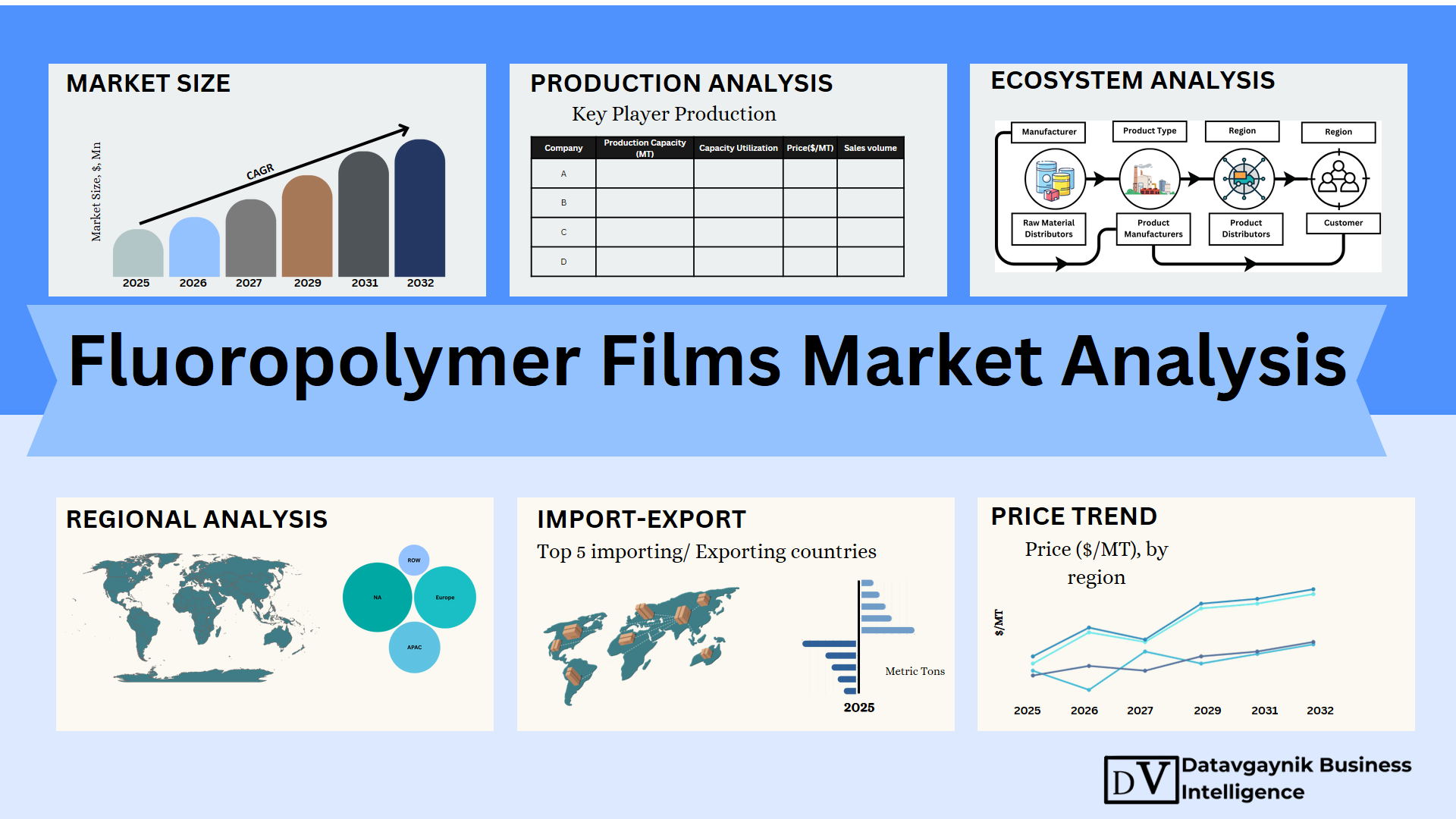
Fluoropolymer Films are increasingly purchased as replacement-sensitive performance materials rather than ordinary plastic films, especially where 10–25 year weatherability, chemical resistance, dielectric stability, and low surface energy are required. On this application base, the Fluoropolymer Films Market is estimated at USD 2.15 billion in 2026 and is projected to reach nearly USD 3.20 billion by 2032, advancing at a CAGR of about 6.8%. Demand is concentrated in PV backsheets, semiconductor processing, aerospace insulation, medical packaging, release liners, architectural membranes, wire insulation, and chemically resistant industrial barriers.
The strongest sales logic comes from applications where film failure leads to expensive system-level replacement. In solar modules, PVDF, ETFE, and other fluorinated films protect backsheets from UV exposure, moisture ingress, thermal cycling, and electrical degradation. India’s solar manufacturing push added a visible 2025–2026 demand signal: by October 2025, the country’s PLI-linked high-efficiency module program had targeted 48.3 GW of domestic module capacity, creating downstream pull for durable encapsulation and backsheet materials, even as local upstream film supply remained limited.
Fluoropolymer Films demand is also rising in electronics because thinner devices require insulation films with stable dielectric strength, chemical inertness, and clean-room compatibility. PTFE, FEP, PFA, and ETFE films are used in flexible circuits, high-frequency cables, semiconductor equipment linings, release sheets, and clean chemical-contact surfaces. In November 2025, advanced semiconductor research demonstrated freestanding fluoropolymer insulating films with breakdown fields above 7 MV/cm and roughness near 0.45 nm, reinforcing the material’s relevance for next-generation dielectric interfaces rather than only conventional insulation.
Product grade directly controls market scenario and pricing. PTFE films dominate where high temperature resistance and non-stick performance matter; PVDF films are preferred in solar backsheets, battery-related barriers, and chemical-resistant layers; FEP and PFA films serve high-purity and heat-sealable applications; ETFE films gain demand in architecture, greenhouses, aerospace, and lightweight membranes. Thickness usually ranges from below 25 microns for electronics and release applications to above 100 microns for construction, solar, and industrial lining uses.
Production remains technically controlled because fluoropolymer resin quality, melt processability, skiving, extrusion, calendaring, stretching, surface treatment, and contamination control determine usable film yield. Producers with resin integration and film-conversion capability have stronger pricing power because customers require consistent thickness, tensile strength, dielectric performance, surface finish, and traceable documentation. In high-specification applications, qualification can take 6–18 months, limiting supplier switching and protecting margins.
Fluoropolymer Films Production Is Controlled by Resin Integration, Thin-Gauge Conversion Yield, and Qualified Processing Capacity
Fluoropolymer Films production begins with fluorinated monomers and specialty resins, but market availability is decided by the conversion stage. PTFE film is commonly produced through skiving, calendaring, or paste extrusion, while FEP, PFA, ETFE, and PVDF films are more dependent on melt extrusion, casting, orientation, and multilayer lamination capability. Film quality is measured less by bulk resin volume and more by thickness tolerance, pinhole control, tensile balance, dielectric strength, surface smoothness, and contamination limits.
The installed production base is concentrated among suppliers that can manage both fluoropolymer chemistry and precision film conversion. Resin producers with downstream film capability have better control over melt flow, molecular weight distribution, additive selection, and batch consistency. Independent converters remain important, but they often depend on qualified resin supply from global producers, creating cost exposure when fluoropolymer resin prices move or when export availability tightens.
PTFE film production has a different cost and yield profile from melt-processable Fluoropolymer Films. Skived PTFE films require billet molding, sintering, and precision slicing; yield losses rise when customers demand ultra-thin gauges, low curl, narrow thickness variation, or clean surface finish. Melt-processable FEP and PFA films need high-temperature extrusion lines, corrosion-resistant equipment, and controlled cooling because even small defects can weaken heat-sealability or dielectric performance.
PVDF films are increasingly tied to energy and industrial applications. Solar backsheets, battery-related barriers, chemical-resistant liners, and architectural coatings require PVDF film grades with UV resistance, adhesion compatibility, and stable mechanical performance. In March 2026, China’s photovoltaic manufacturing chain continued to operate above 600 GW of annual module capacity, keeping pressure on backsheet, encapsulation, and barrier-film suppliers even as pricing remained competitive across the solar materials chain. This capacity scale supports higher volume for PVDF and ETFE films but forces producers to defend margins through quality, localization, and supply reliability.
ETFE film production is more specialized because applications in architecture, stadium roofing, greenhouses, aerospace insulation, and lightweight membranes demand transparency, tear resistance, flame performance, and long outdoor service life. The product is often sold in project-specific thicknesses, surface finishes, or widths, making capacity planning less standardized than commodity film production. Large architectural projects may consume tens of thousands of square meters of ETFE film, but each project requires engineering approval, warranty support, and fabrication compatibility.
Regional production is led by China, Japan, the United States, Germany, South Korea, and selected European converters. China has expanded resin and film conversion capacity at the fastest pace, especially for PVDF, PTFE, and solar-linked materials. Japan and the United States remain stronger in high-purity, electronics-grade, aerospace-grade, and medical-grade Fluoropolymer Films where documentation, qualification, and consistency carry higher value than volume alone.
Fluoropolymer Films Market Segmentation Is Led by Solar Protection, Electronics Insulation, and High-Specification Industrial Barriers
Fluoropolymer Films segmentation is shaped by lifecycle cost, qualification intensity, and the level of performance risk in the end-use application. Buyers rarely select these films only on price per kg; they evaluate service temperature, dielectric stability, chemical resistance, UV durability, film thickness, weldability, surface energy, and replacement cost. This makes the Fluoropolymer Films Market more grade-sensitive than volume-sensitive.
Key market segments include:
- By Product Type
PTFE films
PVDF films
FEP films
PFA films
ETFE films
ECTFE and specialty fluoropolymer films - By Application
Solar backsheets and renewable energy protection
Electronics and electrical insulation
Industrial chemical barriers and linings
Aerospace wire, cable, and insulation films
Medical and pharmaceutical packaging
Release films and non-stick processing liners
Architectural membranes and greenhouse films - By Thickness
Below 25 microns for electronics, release films, and precision insulation
25–100 microns for electrical, packaging, and industrial lamination
Above 100 microns for solar, construction, chemical lining, and architectural use - By End-Use Industry
Solar and renewable energy
Semiconductor and electronics
Chemical processing
Aerospace and defense
Medical devices and pharma packaging
Construction and architecture
Automotive and high-performance industrial equipment
PVDF and ETFE films are gaining higher visibility because solar, construction, and battery-linked applications require long outdoor exposure resistance. PVDF films are widely used in backsheet structures, barrier layers, and chemical-resistant surfaces because they balance weatherability, adhesion compatibility, and processability. ETFE films hold a premium position in architectural membranes and lightweight roofing because they offer high light transmission, low weight, and service lives often exceeding 20 years in outdoor applications.
PTFE films remain the leading technical segment where high-temperature resistance, low friction, and chemical inertness are non-negotiable. These films are used in release liners, gaskets, sealing surfaces, high-frequency cables, chemical-contact layers, and non-stick industrial processing. Their share is supported by replacement demand because worn release surfaces or insulation layers are often changed on fixed maintenance cycles rather than after complete failure.
Electronics and electrical insulation form one of the highest-value demand clusters. FEP, PFA, PTFE, and ETFE films are used in cables, flexible circuits, semiconductor tools, sensors, connectors, and dielectric insulation systems. Film thickness below 50 microns is common where device miniaturization, signal integrity, and thermal stability are more important than bulk mechanical strength. In January 2026, semiconductor fabrication investment continued to expand in the United States, Japan, Taiwan, and South Korea, with several announced fabs exceeding USD 10 billion each; this directly increases demand for high-purity insulation, release, and chemical-contact fluoropolymer film grades.
Solar backsheets and renewable energy protection represent the largest volume-sensitive segment. A single utility-scale solar project can consume millions of square meters of backsheet and encapsulation-related film materials, depending on module design. Fluoropolymer Films gain preference where modules face high UV exposure, desert heat, coastal humidity, or long warranty requirements of 25–30 years.
Medical and pharmaceutical packaging demand is smaller in volume but stronger in qualification value. Films used in sterile barriers, diagnostic devices, tubing protection, and drug-contact packaging require traceability, low extractables, and consistent surface properties. Supplier switching is slower because validation cycles can run 12 months or longer.
Fluoropolymer Films Pricing Is Driven by Qualification Cost, Purity Control, and Application-Specific Documentation
Fluoropolymer Films pricing does not follow ordinary plastic film economics because buyers pay for reliability, qualification history, and application safety margins. Standard industrial-grade films compete on thickness, resin type, and roll width, while electronics, aerospace, medical, and solar-certified films carry higher premiums because each batch must meet tighter limits for surface defects, contamination, dielectric performance, and long-term ageing behavior.
The first cost layer comes from fluoropolymer resin. PTFE, FEP, PFA, ETFE, and PVDF resins require fluorinated feedstocks, controlled polymerization, corrosion-resistant equipment, and strict environmental management. Resin cost normally represents the largest share of finished film cost, especially for high-purity PFA and FEP grades used in semiconductor and electrical applications. When resin availability tightens, film converters face immediate margin pressure because customer-approved grades cannot be easily substituted with lower-cost polymers.
Processing cost forms the second major price component. PTFE skived films need billet forming, sintering, and precision slicing, which adds yield loss when customers require narrow tolerance, low curl, or ultra-thin gauges. Melt-extruded Fluoropolymer Films require high-temperature lines, specialized dies, careful cooling, and defect inspection. A small defect rate can reduce saleable output sharply in applications where pinholes, gels, scratches, or thickness variation are unacceptable.
Qualification and documentation create a separate premium. Films used in aerospace wire insulation, semiconductor process equipment, medical packaging, and long-life solar backsheets may need certificates of analysis, traceability, lot control, regulatory statements, flame performance data, dielectric testing, or ageing-test records. This adds cost even when the polymer chemistry is similar to a lower-priced industrial grade. In qualified applications, switching a supplier can require 6–18 months of testing, so buyers often accept a price premium to avoid revalidation risk.
Price bands vary strongly by film type and specification. PTFE skived films generally command higher pricing than commodity thermoplastic films because of sintering and skiving losses. PFA and FEP films carry premium pricing where heat sealability, chemical purity, and dielectric stability are required. PVDF films are more exposed to solar and industrial pricing pressure, especially when Asian supply expands. ETFE films are priced on project specifications, width, transparency, coating, warranty, and fabrication suitability rather than resin cost alone.
Energy and environmental compliance also affect production economics. Fluorochemical manufacturing uses energy-intensive reactions, emission-control systems, waste-treatment infrastructure, and specialized handling. In 2025–2026, tighter scrutiny of fluorinated chemical production and PFAS-related restrictions in the United States and Europe increased compliance pressure across the broader fluoropolymer chain, raising the value of suppliers with cleaner process controls, documented emissions management, and stable regulatory files.
Regional price gaps remain visible. China supplies larger volumes of PVDF, PTFE, and industrial fluoropolymer films at competitive pricing, while Japan, the United States, and Western Europe retain premiums in electronics, aerospace, medical, and high-purity films. Freight cost also matters because wide rolls, protective packaging, clean handling, and temperature-controlled storage for sensitive grades raise delivered cost.
Contract pricing is common in qualified applications, while spot buying is more visible in industrial release films, protective liners, and general-purpose chemical barriers. Large solar and electronics buyers negotiate annual or semi-annual supply contracts to stabilize cost, but smaller converters often face resin-linked price adjustments. The Fluoropolymer Films Market therefore rewards suppliers that combine resin security, film-yield efficiency, documentation depth, and approved-customer access.
Fluoropolymer Films Market Competition Is Shaped by Long-Term Supply Approvals, Resin Control, and Specialty Film Conversion Strength
Long-term supply approvals define competition in the Fluoropolymer Films Market because buyers in electronics, aerospace, solar, medical, and chemical processing do not switch suppliers only for a 3–5% price saving. Approved films must match thickness tolerance, dielectric strength, surface finish, thermal ageing, chemical resistance, lot traceability, and documentation requirements. This gives established producers stronger retention in high-value applications.
The leading competitive group includes Chemours, Daikin Industries, AGC, Arkema, Saint-Gobain, 3M, Solvay/Syensqo, Gujarat Fluorochemicals, Rogers Corporation, Nitto Denko, Guarniflon, Chukoh Chemical Industries, and several China-based PTFE, PVDF, ETFE, and FEP film suppliers. Daikin’s fluoropolymer portfolio serves automotive, aerospace, semiconductor, electronics, and industrial uses, while Arkema’s Kynar PVDF family is positioned around durability, chemical resistance, weatherability, and regional supply coverage across North America, Europe, and Asia.
Competition differs by product family. PTFE film supply is more fragmented because many converters can skive, laminate, or slit PTFE billets, but premium demand still favors suppliers that control resin consistency and precision slicing. FEP and PFA films are more concentrated because melt extrusion requires high-temperature equipment, cleaner processing, and stronger resin-process know-how. ETFE films are concentrated in fewer project-qualified suppliers because architectural, aerospace, and greenhouse applications need width control, transparency, tear strength, flame behavior, and warranty support.
PVDF films are becoming more strategically contested because solar backsheets, chemical barriers, battery-related interfaces, and industrial protection use PVDF for UV resistance and chemical durability. Arkema’s March 2026 announcement of a 20% expansion of Kynar PVDF production capacity at Changshu, China, scheduled for start-up in 2028, shows how suppliers are positioning capacity closer to Asian solar, battery, and industrial customers.
Competitive strength can be viewed across four capability bands:
| Supplier capability band | Competitive advantage | Typical buyer pull |
| Resin-integrated global producers | Monomer/resin control, grade consistency, documentation | Electronics, aerospace, solar, medical |
| Specialty film converters | Thin-gauge conversion, slitting, lamination, custom rolls | Release liners, insulation, industrial barriers |
| Project-focused ETFE/PVDF suppliers | Width, transparency, fabrication support, warranties | Architecture, greenhouses, roofing |
| Regional low-cost converters | Price flexibility and shorter delivery cycles | General industrial films and liners |
Supplier switching cost remains high where films are part of validated assemblies. Aerospace wire insulation, semiconductor process films, medical packaging, and PV module backsheets often require 6–18 months of testing, customer approval, or field validation. This protects incumbent suppliers and allows premium pricing for companies with proven records, clean documentation, and multi-region delivery.
The market is moderately consolidated at the resin and high-purity film level, but more fragmented in industrial PTFE skived films, release sheets, and standard protective liners. China-based suppliers are increasing volume competition in PTFE, PVDF, and solar-linked Fluoropolymer Films, while Japanese, American, and European suppliers retain stronger positions in ultra-clean electronics, aerospace, medical, and high-warranty applications.
Other recently published reports:


