

Foam Board Insulation Competition Is Led by Specification Depth, Contractor Access, and Regional Building-Code Demand
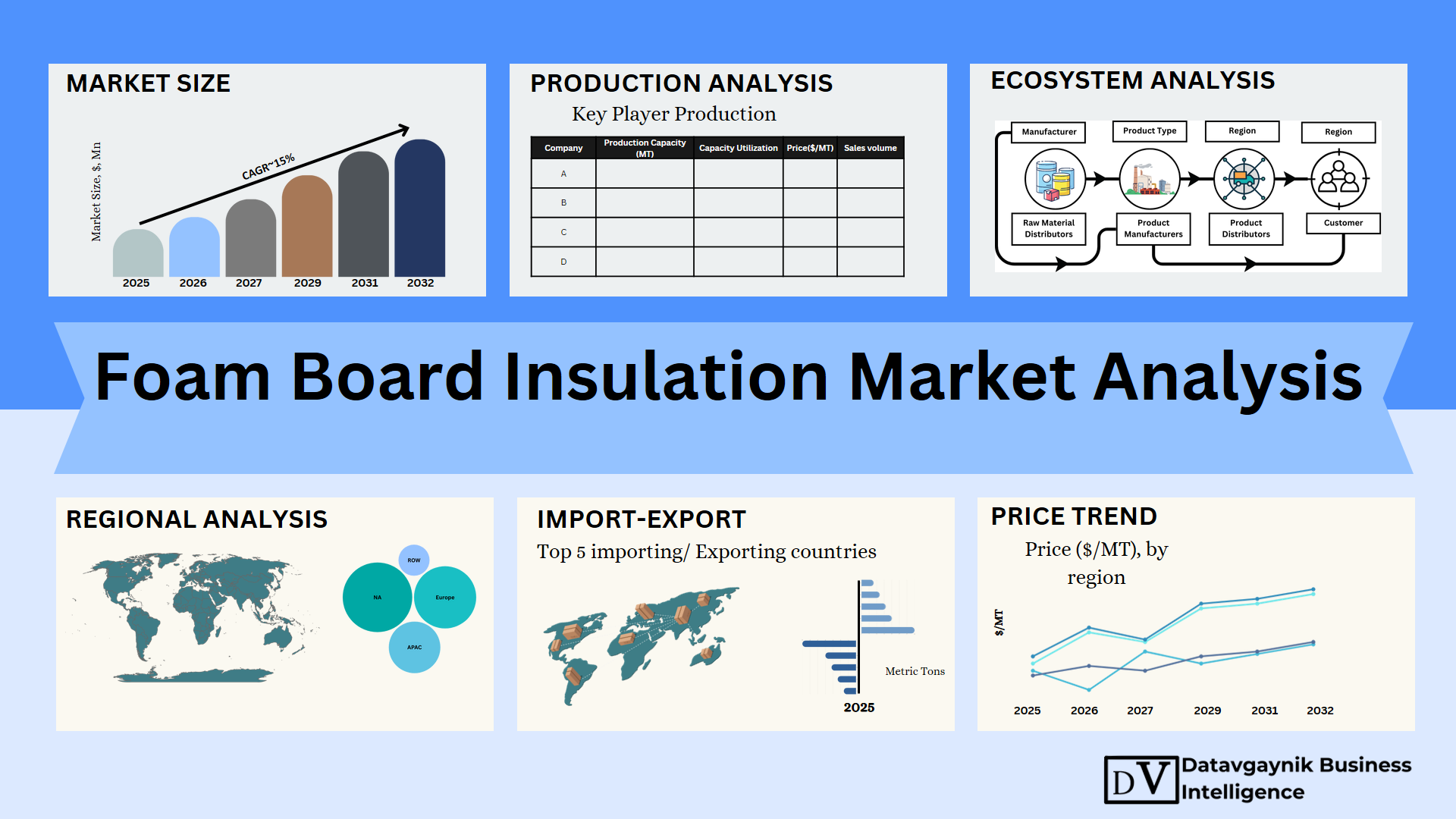
Foam Board Insulation is a specification-driven building materials market where competition is shaped by rigid board chemistry, code compliance, contractor familiarity, distribution reach, and roof-wall-foundation application coverage rather than only price. The global Foam Board Insulation market is estimated at about USD 24.8 billion in 2026, supported by a mid-single-digit CAGR of nearly 5.1%, and is projected to reach roughly USD 35.4 billion by 2033, with demand linked to energy-efficient envelopes, commercial reroofing, cold-chain facilities, residential retrofits, and below-grade moisture control. The wider foam insulation market is placed at USD 31.81 billion in 2026 and forecast at USD 40.39 billion by 2031, while building thermal insulation is projected at USD 37.12 billion in 2026, showing that rigid board insulation remains one of the higher-value product clusters within the broader envelope-efficiency segment.
Foam Board Insulation Supplier Ecosystem Remains Concentrated at the Brand Level but Fragmented at the Channel Level
The competitive structure is split between global insulation manufacturers, regional foam-board producers, roofing-system companies, building-material distributors, and contractor-linked dealers. Owens Corning, Kingspan, Carlisle, Saint-Gobain, DuPont, BASF-linked insulation systems, SOPREMA, Atlas Roofing, Johns Manville, Ravago, and several EPS/XPS regional producers compete across product type, compressive strength, thermal resistance, fire performance, facing material, panel dimension, and jobsite availability.
Large suppliers hold stronger positions where projects require tested assemblies, code documentation, environmental declarations, warranty-backed roofing systems, or national distribution. Smaller and regional suppliers remain relevant in EPS boards, commodity wall sheathing, packaging-adjacent insulation, cold storage, and price-sensitive residential applications. The result is not a single-leader market; it is a layered ecosystem where polyiso roofing boards, XPS foundation boards, EPS sheathing, and specialty PIR panels follow different procurement logic.
| Supplier category | Strongest product role | Competitive advantage | Main buyer group |
| Global insulation brands | Polyiso, XPS, PIR, specialty boards | Certification, R-value performance, national distribution | Commercial contractors, architects, building owners |
| Roofing-system companies | Faced polyiso boards, tapered insulation | Warranty tie-in with membranes and roof systems | Roofing contractors, facility owners |
| Regional EPS/XPS producers | Standard boards, foundation boards, sheathing | Local price, delivery speed, custom cutting | Residential builders, distributors |
| Building-material distributors | Multi-brand supply | Inventory access and contractor credit | Contractors, remodelers, dealers |
| System integrators and installers | Installed insulation packages | Labor availability and application know-how | Project developers, general contractors |
Company Positioning Depends on Product Range, Documentation, and Installed-Base Trust
Owens Corning has a strong position in North America because its insulation business connects FOAMULAR XPS, residential channel access, commercial building demand, and brand trust among contractors. The company reported USD 10.1 billion in continuing-operation net sales for 2025 and maintained a large building-materials platform after completing the USD 3.9 billion Masonite acquisition in May 2024, which strengthened its residential construction-materials reach even though Masonite is not an insulation producer.
Kingspan is stronger in high-performance insulation boards and insulated panels where PIR, phenolic, and premium envelope systems are specified for commercial buildings, cold stores, data centers, and industrial facilities. Its 2024 reporting highlighted that insulation systems sold in 2024 are expected to save 172 million tonnes of CO₂e over their lifetime, reinforcing why premium insulation suppliers increasingly compete through carbon payback, building-envelope performance, and whole-life efficiency rather than only board cost.
Carlisle competes heavily through commercial roofing and polyiso insulation, where insulation is purchased as part of a roof system rather than as a standalone board. Its 2024 annual report noted that adding one inch of polyiso insulation to a 50,000-square-foot roof can save building owners as much as USD 110,000 in avoided energy costs over the roof life. This gives polyiso suppliers a stronger argument in commercial reroofing, where owners evaluate lifecycle savings, membrane compatibility, drainage design, and warranty terms.
Product Differentiation Is Clearer in Application Than in Generic Material Labels
Polyiso boards lead in commercial roofing because they offer high R-value per inch, compatibility with single-ply membranes, and availability in tapered systems. XPS boards remain important for below-grade, foundation, plaza deck, and high-compressive-strength applications where moisture resistance and load tolerance matter. EPS boards are stronger in cost-sensitive wall sheathing, insulated concrete forms, packaging-linked construction uses, and lightweight fill applications. PIR and phenolic boards are more relevant where thermal performance, fire classification, and thinner profile requirements matter.
Foam Board Insulation buyers rarely compare all products equally. A roofing contractor may prioritize faced polyiso availability and warranty compatibility. A basement contractor may prefer XPS or EPS depending on moisture exposure, price, and local code. A cold-storage developer may select PIR or high-performance panels because temperature control, energy loss, and hygienic wall systems are more important than initial material cost.
Customer Access Is Controlled by Distribution Depth and Contractor Habit
Distribution remains one of the strongest competitive barriers. Foam Board Insulation is bulky, freight-sensitive, and jobsite-schedule dependent, so suppliers with nearby inventory, regional plants, roofing-distributor relationships, and contractor credit lines have an advantage. National brands win large projects through specifications and approved-submittal packages, while regional suppliers win when lead time, freight cost, and custom sizing influence purchasing.
The U.S. market illustrates this demand logic. In April 2026, U.S. private construction spending stood at an annualized USD 1.64 trillion, residential construction at USD 909.9 billion, and public construction at USD 532.7 billion. These numbers keep insulation demand tied to both new construction and retrofit activity, but uneven residential momentum means suppliers cannot depend only on housing starts; commercial reroofing, public buildings, schools, warehouses, and cold-chain assets remain important volume stabilizers.
Regional Competition Is Strongest Where Codes, Renovation Spending, and Energy Costs Intersect
North America is brand-led and channel-driven. Owens Corning, Carlisle, Johns Manville, Atlas Roofing, DuPont, and regional EPS/XPS producers compete through roofing distributors, home-center access, contractor networks, and code-compliant product documentation. Polyiso is especially strong in commercial roofing, while XPS and EPS compete across foundations, walls, and residential sheathing.
Europe is more regulation-led. The European Parliament approved building energy-efficiency legislation in March 2024 targeting renovation and efficiency improvement because buildings account for about 40% of EU energy consumption. This directly supports demand for Foam Board Insulation in renovation, façade upgrades, flat-roof retrofits, and public-building efficiency programs, while also increasing scrutiny of fire safety, product declarations, and installation quality.
Asia-Pacific is more construction-volume-led, with China, India, Southeast Asia, South Korea, and Japan showing different buyer behavior. Premium PIR and polyiso boards are stronger in cold-chain, industrial roofing, electronics facilities, and high-spec commercial buildings, while EPS and XPS boards remain more price-competitive in residential and basic commercial insulation.
Regulatory Scrutiny and Fire Performance Limit Simple Volume Expansion
The main constraint is not lack of demand; it is product acceptance under fire, smoke, blowing-agent, recyclability, and building-code requirements. Foam plastics need correct installation, protective barriers, compatible cladding systems, and tested assemblies. The September 2024 Grenfell Tower Inquiry reporting kept industry attention on insulation marketing, system testing, and high-rise façade risk, especially in Europe and the U.K., where contractors and specifiers now apply tighter scrutiny to documentation and application suitability.
Pricing is another constraint. Foam Board Insulation depends on petrochemical inputs, facers, blowing agents, energy costs, freight, and plant utilization. Because boards are low-density but bulky, freight can materially affect delivered cost. This supports regional producers in commodity grades but favors global brands in high-performance projects where certification, R-value stability, and warranty support justify premium pricing.
Foam Board Insulation Competition Favors Companies That Combine Board Performance With Project Access
The strongest suppliers are not simply those with the lowest production cost. They combine product breadth, code documentation, contractor familiarity, regional inventory, technical support, and application-specific performance. Polyiso roofing-board suppliers benefit from commercial reroofing and warranty-linked systems. XPS suppliers benefit from foundations, below-grade insulation, and moisture-sensitive applications. EPS suppliers retain share where price, local cutting, and lightweight board availability matter.
Foam Board Insulation Supplier Segmentation Is Shaped by Product Chemistry, Roofing Access, and Regional Code Pressure
Foam Board Insulation suppliers can be separated into four practical categories: high-performance insulation manufacturers, roofing-system companies, regional EPS/XPS board producers, and distributor-led building-material suppliers. The first group competes on R-value per inch, low-GWP compliance, fire-tested assemblies, environmental documentation, and architect acceptance. The second group sells insulation as part of roof-system procurement, where tapered design, membrane compatibility, warranty coverage, and jobsite sequencing are decisive. Regional board producers compete through lower freight cost, quick delivery, custom cutting, and price-sensitive builder relationships. Distributor-led suppliers hold buyer access where contractors need mixed loads, credit terms, same-week availability, and replacement boards during active projects.
Product Portfolio Comparison Shows Why Polyiso, XPS, EPS, and PIR Do Not Compete Equally
Polyiso dominates commercial roofing because it is lightweight, widely stocked by roofing distributors, and sold in flat or tapered systems. Tapered polyiso gives suppliers an additional service advantage because drainage design, shop drawings, and staged delivery are tied to contractor productivity. Atlas Roofing, for example, supports polyiso roofing projects through tapered design services and product lines such as ACFoam and EnergyShield, giving it stronger access to commercial roofing contractors than commodity board suppliers.
XPS suppliers are stronger in below-grade insulation, foundation walls, plaza decks, inverted roofs, and agricultural buildings because the material is selected for moisture resistance and compressive performance. DuPont’s Styrofoam XPS position is linked to closed-cell rigid foam-board performance across thermal, moisture, air, and vapor requirements. DuPont also moved Styrofoam Brand XPS to low-GWP grey XPS production from November 2023, which matters in U.S. states and institutional projects where blowing-agent compliance affects specification acceptance.
EPS is broader but more fragmented. It is used in wall sheathing, insulated concrete forms, geofoam, low-cost roof insulation layers, and residential boards. EPS suppliers are often regionally strong because logistics cost is high relative to product value. A local EPS producer can compete effectively against a national brand when the project requires short lead time, basic board dimensions, or custom-cut blocks rather than premium thermal performance.
| Segment | Strongest company type | Buyer reason for selection | Competitive pressure |
| Polyiso roofing board | Roofing-system and insulation brands | High R-value, tapered design, roof-system warranty | Facers, fire rating, membrane compatibility |
| XPS board | Branded insulation manufacturers | Moisture resistance, compressive strength, below-grade use | Low-GWP compliance, price, code acceptance |
| EPS board | Regional producers and distributors | Lower cost, availability, custom cutting | Freight cost, commodity pricing, local competition |
| PIR / premium rigid board | High-performance envelope suppliers | Thin profile, fire performance, industrial/cold-chain use | Certification, premium pricing, project approval |
| Tapered insulation systems | Roofing brands and design-service providers | Drainage, labor saving, engineered roof slope | Design support, delivery sequencing |
Customer Segmentation Is Split Between Contractors, Specifiers, Owners, and Retail Buyers
Commercial roofing contractors form the highest-value buyer group because insulation is purchased in large square-foot volumes and installed with roof membranes, cover boards, fasteners, adhesives, and warranty packages. The buying decision is partly technical and partly logistical. Contractors prefer suppliers that can deliver full roof assemblies, replacement panels, tapered layouts, and consistent board thickness across multiple shipments.
Residential builders buy Foam Board Insulation through lumberyards, pro dealers, home centers, and local distributors. Their purchasing logic is more price- and availability-driven. Code compliance still matters, but the supplier that has inventory near the jobsite often wins. Remodelers and retrofit contractors are less brand-loyal than commercial roofers because they buy smaller lots, often mixing rigid foam boards with batts, spray foam, housewrap, flashing, and sealants.
Industrial and cold-chain buyers select insulation through engineers, design-build contractors, panel suppliers, and facility owners. Cold stores, food-processing buildings, pharmaceutical warehouses, and data centers use insulation as part of thermal control and energy-loss management. In April 2026, U.S. private nonresidential construction spending stood near USD 729.8 billion annualized, while total nonresidential spending reached about USD 1.25 trillion; this supports rigid insulation demand in factories, logistics buildings, schools, healthcare facilities, and data centers rather than only residential construction.
Regional Company Presence Depends on Construction Mix and Distribution Density
North America is the most channel-sensitive region. Owens Corning, Carlisle, Johns Manville, DuPont, Atlas Roofing, SOPREMA, and regional EPS producers depend on roofing distributors, pro-dealer networks, and contractor relationships. U.S. construction spending reached USD 2.172 trillion annualized in April 2026, with private construction at USD 1.64 trillion and public construction at USD 532.7 billion. This keeps supplier access tied to both residential demand and public-sector building activity, especially schools and infrastructure-linked facilities.
Europe is more regulation- and renovation-led. Supplier positioning is influenced by building energy-performance rules, façade fire scrutiny, product declarations, and renovation funding. EU buildings account for around 40% of energy consumption and roughly half of gas consumption, making insulation suppliers important to renovation and energy-security policy. This gives larger European suppliers such as Kingspan, Saint-Gobain, Recticel, SOPREMA, and Ravago an advantage where documentation, multi-product envelope systems, and compliance support are required.
Asia-Pacific is more mixed. China and India generate volume through new construction, industrial buildings, cold-chain development, and cost-sensitive commercial projects. Japan and South Korea are more specification-led, with higher interest in fire performance, dimensional stability, and premium panels. Southeast Asian demand is concentrated in commercial buildings, factories, cold-chain warehouses, and food-processing facilities, but price sensitivity limits rapid substitution toward premium boards.
Channel Structure Gives Distributors Strong Control Over Buyer Access
Foam Board Insulation is rarely sold only through direct manufacturer relationships. Commercial roofing products move through roofing distributors, building-envelope specialists, and contractor supply houses. Residential boards move through lumberyards, pro dealers, builder merchants, and home centers. Industrial panels and premium rigid boards often move through project-based channels involving architects, EPC contractors, façade contractors, and cold-storage specialists.
Service coverage is not field repair in the same way as equipment markets. It is technical support, submittal documentation, tapered roof design, installation guidance, code documentation, inventory coordination, and warranty administration. Suppliers with stronger technical teams reduce approval delays for architects and contractors. This is why premium suppliers protect margin better than commodity board producers.
Replacement and Retrofit Behavior Strengthen Roofing and Renovation Channels
Replacement demand is strongest in commercial roofing because roof systems have defined service lives and reroofing projects often involve insulation upgrades. A building owner replacing a membrane may add insulation to improve thermal performance, meet code, improve drainage, or reduce operating cost. Carlisle’s roofing-materials disclosures show how polyiso is positioned around lifecycle economics, with the company citing energy-cost savings from added polyiso insulation on large commercial roofs.
Residential replacement is more irregular. Foam board is added during basement finishing, siding replacement, roofline changes, garage insulation, foundation repair, and energy retrofits. This demand depends on contractor awareness, local energy codes, utility incentives, and household renovation spending. In Europe, renovation policy gives retrofit demand a stronger structural base than in many emerging markets.
Section 3: Leading Companies Compete Through Portfolio Breadth, Board Chemistry, and Contractor Confidence
Owens Corning is one of the strongest North American insulation brands because it combines insulation, roofing, and building-materials channel access. Its FOAMULAR XPS line is positioned for foundations, below-grade walls, exterior sheathing, cavity walls, and commercial applications where moisture resistance and compressive strength matter. Owens Corning reported USD 10.1 billion in 2025 continuing-operation net sales and operates as a broad building-products supplier rather than a narrow foam-board producer. That breadth supports cross-selling through contractors, pro dealers, and commercial accounts.
Kingspan is stronger in premium building-envelope applications. Its insulation portfolio includes high-performance boards, insulated panels, flat-roof insulation, and controlled-environment envelope products. Kingspan’s 2025 results indicated that QuadCore accounted for 27% of global insulated panel revenue, showing how the company’s competitive advantage is tied to proprietary high-performance panel systems, not only commodity board supply. Kingspan also has a built-up roofing presence of around EUR 1 billion, where insulation is a major value component.
Carlisle is best positioned in commercial roofing-linked Foam Board Insulation. Its strength is not only polyiso board production but the ability to integrate insulation with roofing membranes, adhesives, cover boards, accessories, and warranty-backed systems. This gives Carlisle stronger contractor access in large commercial reroofing and new low-slope roof projects. Its 2025 annual-report publication in March 2026 highlighted continued focus on scalable innovation and Vision 2030 execution, reinforcing its position as a systems supplier in building products.
DuPont has a focused position in XPS through Styrofoam Brand insulation. Its advantage is brand legacy, technical documentation, closed-cell performance, and compliance transition toward low-GWP products. The move to low-GWP grey XPS is commercially important because state-level restrictions and public-sector procurement requirements increasingly affect which boards can be specified.
Saint-Gobain competes through broader construction-materials scale, insulation systems, distribution strength, and regional presence. Its 2025 results showed sales up 2.1% and operating income up 3.8% in local currencies, with strong growth in Asia and emerging countries. The company’s planned 2026–2030 strategy includes about EUR 12 billion for organic growth and acquisitions, with North America, Asia-Pacific, and emerging markets targeted as higher-growth regions.
Atlas Roofing holds a strong North American position in polyiso roof and wall insulation through ACFoam and EnergyShield products. Its eight polyiso insulation plants in the U.S. and Canada give it regional manufacturing reach, while tapered design services support contractors and specifiers on commercial roofing projects.
Johns Manville, SOPREMA, BASF-linked systems, Recticel, Ravago, and several regional EPS/XPS producers add competitive pressure through specific application niches. Johns Manville is relevant in roofing systems and insulation boards. SOPREMA participates through roofing, waterproofing, and insulation systems. Recticel has stronger European insulation-board relevance. Ravago and regional EPS producers remain important where cost, availability, and local conversion matter more than premium brand positioning.
Pricing, Distribution Cost, and Margin Pressure
Foam Board Insulation pricing is influenced by resin cost, blowing agents, facers, energy, freight, and plant utilization. Polyiso generally commands a stronger value position in roofing because it is linked to system performance and warranty coverage. XPS carries a premium where moisture resistance and compressive strength are required. EPS is usually more price-competitive but faces margin pressure because buyers can compare local suppliers more easily. Freight remains a major cost factor because boards are bulky, so regional production and distributor inventory can decide final delivered price.
Recent Developments Affecting Foam Board Insulation Competition
- February 2026, United States: Owens Corning reported 2025 continuing-operation net sales of USD 10.1 billion, supporting its role as a large-scale building-products supplier with insulation and roofing channel access.
- February 2026, Ireland/global: Kingspan reported that QuadCore represented 27% of global insulated panel revenue, strengthening its position in premium insulated envelopes.
- March 2026, United States: Carlisle published its 2025 annual report, reinforcing its commercial roofing-system strategy where polyiso insulation is tied to membrane systems and contractor procurement.
- April 2026, United States: Construction spending reached USD 2.172 trillion annualized, supporting insulation demand across residential, commercial, and public buildings.
- March 2024, European Union: The European Parliament approved stricter building energy-efficiency legislation, with buildings representing about 40% of EU energy use; this supports renovation-led demand for rigid insulation boards.


