

Market Summary and Growth Forecast
The global Foam Control Agents for Food Processing Market is estimated at $1,185 million in 2026 and is expected to reach $1,725 million by 2035, growing at a CAGR of 4.3%.
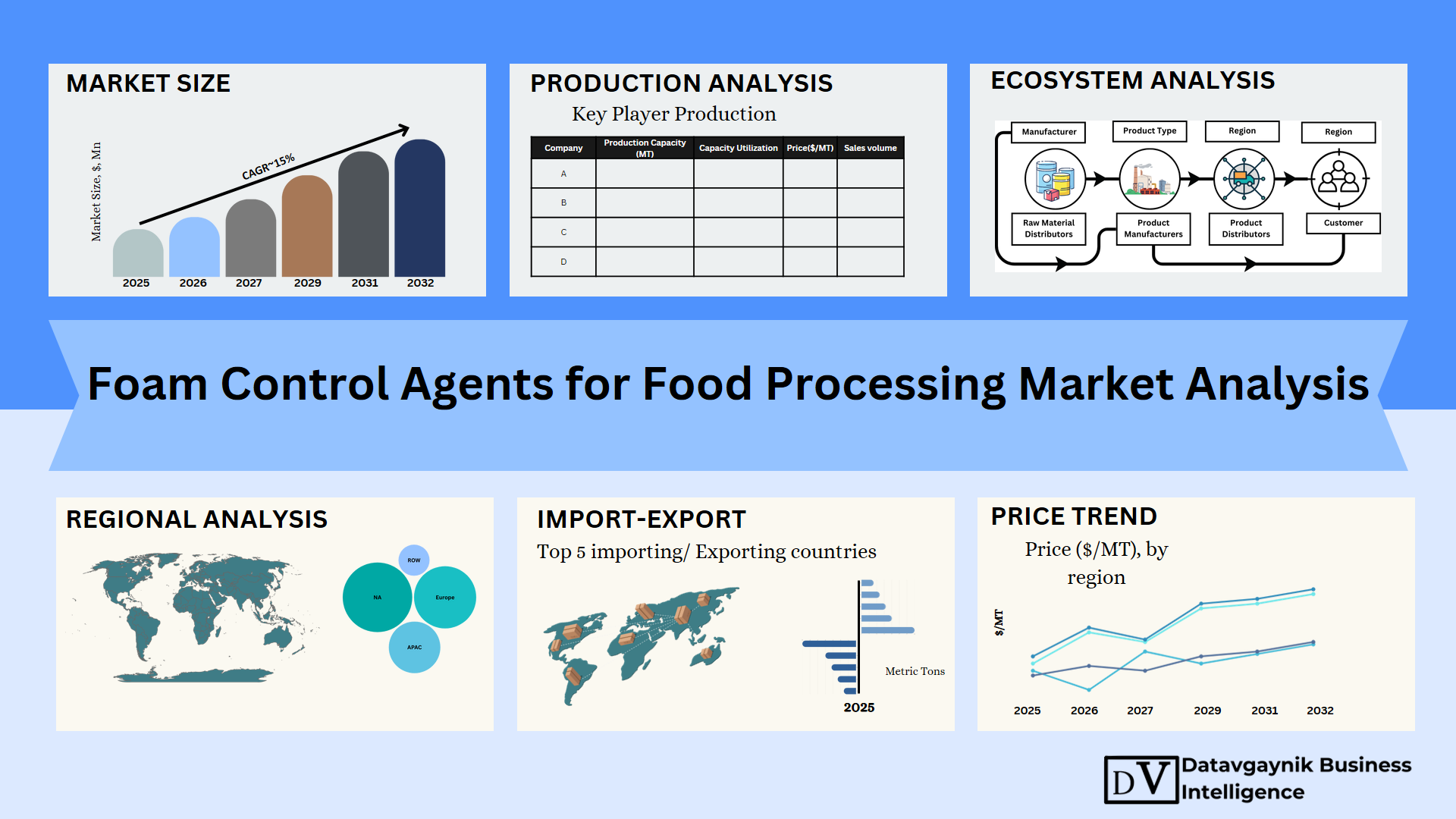
This market covers food-grade antifoams and defoamers used to prevent, reduce, or break foam during food and beverage manufacturing. It includes silicone emulsions, mineral-oil-free systems, vegetable oil-based defoamers, polyether-based materials, powder antifoams, and customized blends used in process tanks, fermentation vessels, evaporators, boiling systems, fryers, filling lines, CIP loops, and ingredient production.
Datavagyanik also covers related markets such as the Food Processing Facility Ventilation Systems Market, the Charge Control Agents Market, and the Insulation Foam Blowing Agents Market. Such interlinked markets help paint a fuller story of the supply chain, influencing the primary topic’s trajectory.
The business relevance is simple. Foam wastes capacity. It reduces tank throughput. It causes product loss. It slows filling speed. It can also create hygiene and cleaning problems in high-volume plants. In 2026, a beverage, dairy, sugar, or fermentation facility is not buying foam control agents as a “minor additive.” It is buying plant uptime.
A typical processor may dose only a few grams to a few hundred grams per metric ton of processed material. But the economic impact is much larger than the dosage cost. A 1%–2% improvement in tank utilization or filling-line stability can be worth more than the annual defoamer spend in medium and large plants. That is why the Foam Control Agents for Food Processing Market is tied more closely to processing intensity than to food volume alone.
The regulatory base is already established in major markets. In the U.S., defoaming agents for food processing are covered under 21 CFR 173.340, which allows certain defoaming substances under defined conditions. For dimethylpolysiloxane, the regulation generally limits use to 10 ppm in ready-to-consume food, with specific exceptions for products such as dry gelatin dessert mixes and cooking salt. In the EU, dimethyl polysiloxane is authorized as food additive E 900 under the food additive framework, and EFSA re-evaluated it in 2020.
The demand base is broad. The largest buyers are not retail food brands directly. They are processing plants. Key consuming groups include beverage producers, breweries, distilleries, dairy processors, edible oil refiners, sugar mills, starch processors, potato processors, jam and jelly producers, yeast and enzyme manufacturers, fermentation ingredient companies, meat and poultry processors, and large contract food manufacturers.
Production growth in processed food is the structural anchor. The U.S. food and beverage manufacturing industry accounted for 16.8% of manufacturing sales and 15.4% of manufacturing employment in 2021, showing why even small process additives have a large installed base in developed markets. Europe is also a deep consumption base, with the EU food and drink industry generating €1.2 trillion in turnover and employing 4.7 million people according to FoodDrinkEurope’s 2024 data. China adds scale from the production side. USDA FAS reported that China’s food processing sector reached $1.26 trillion in 2024, growing 2.2% year on year.
So, the Foam Control Agents for Food Processing Market grows through three linked forces.
First, food plants are running faster. Higher-speed filling, aseptic processing, membrane filtration, enzymatic conversion, and fermentation all raise foam risk. Second, food safety teams want cleaner, traceable, low-odor formulations. Third, processors are moving from generic defoamers to application-specific products. A sugar mill does not need the same performance profile as a dairy evaporator or fermentation tank.
By 2035, the market should look more specialized. Commodity silicone emulsions will still hold a strong position. But growth will move toward lower-dose blends, silicone-free options, high-temperature frying systems, fermentation-compatible defoamers, allergen-free vegetable-oil systems, and products with clear documentation for FDA, EU, Kosher, Halal, and non-GMO requirements.
Market sizing snapshot
| Metric | 2026 Estimate | 2035 Forecast | Analyst View |
| Global market size | $1,185 million | $1,725 million | Mid-single-digit growth, led by higher processing intensity |
| CAGR | — | 4.3% | Stable, not explosive |
| Estimated merchant volume | 360–390 kilotons | 500–535 kilotons | Volume growth trails value growth due to premium formulations |
| Blended ASP | $3.00–$3.30/kg | $3.20–$3.45/kg | Premium grades lift value, while oil-based systems cap pricing |
| Core demand clusters | Beverage, dairy, fermentation, sugar, edible oils | Same, with stronger bioingredient demand | Fermentation becomes more strategic |
Expert view: This is not a market where demand suddenly jumps because of one breakthrough. It compounds quietly as plants automate, batches become larger, and processors become less tolerant of downtime.
Market Segmentation and Forecast Scope
The Foam Control Agents for Food Processing Market should be segmented by formulation chemistry, processing application, end-user group, and region. This structure reflects how the product is actually bought. Food processors do not ask only for “antifoam.” They ask whether it works in hot syrup, acidic juice, protein-rich whey, vegetable blanching water, fermentation broth, fryer oil, or CIP discharge.
By Product Type
The main product groups include silicone-based antifoams, vegetable oil-based defoamers, polyether-based defoamers, water-based emulsions, powder antifoams, and specialty blends.
Silicone-based antifoams remain the workhorse. They offer strong knockdown, low dosage, thermal stability, and good performance in both hot and cold aqueous systems. Dow’s food-grade silicone antifoam portfolio, for example, includes water-dilutable emulsions and concentrated products used in fermentation, beverage, meat, dairy, fruit and vegetable processing, evaporation, and related operations.
2026 disclosed share: Silicone-based foam control agents account for an estimated 43% of global revenue.
That share is high because silicone products solve the most common problem: quick foam collapse at low use levels. But the segment is not free from pressure. Some processors want silicone-free labeling support. Others want vegetable-based systems for cleaner ingredient positioning.
Vegetable oil-based and ester-based defoamers are gaining attention in food applications where taste, odor, allergen status, and plant-origin claims matter. MÜNZING’s food processing portfolio includes vegetable-derived ester and silicone emulsion defoamers positioned for products such as brewing, syrups, jams, jellies, oils, ice cream, and food processing applications.
Polyether-based systems serve specific aqueous and fermentation settings where compatibility matters more than broad-spectrum performance. They are useful when formulators need a non-silicone route or when downstream separation sensitivity is important.
Powder antifoams are used where dry blending, powdered ingredients, instant mixes, or controlled release in dry systems is needed. Their share is smaller. Their value per kilogram is usually higher.
By Application
The application view is more useful than a simple chemistry view because foam behavior changes sharply by process.
Key application clusters include:
| Application Segment | Main Foam Trigger | Strategic Outlook |
| Fermentation and bioingredients | Proteins, sugars, agitation, aeration | Fastest strategic growth due to enzymes, yeast, cultures, organic acids |
| Beverage processing and bottling | Carbonation, filling speed, surfactants, fruit solids | Strong demand from high-speed filling lines |
| Dairy and whey processing | Proteins, heat, evaporation, spray drying | Premium-grade demand due to quality sensitivity |
| Sugar, syrup, jam, and confectionery | Boiling, viscosity, dissolved solids | Stable, high-volume consumption |
| Edible oils and frying systems | Heat, food residues, oxidation products | Specialized high-temperature demand |
| Starch, potato, and vegetable processing | Washing, blanching, starch release | Cost-sensitive but volume-heavy |
| Meat, poultry, and seafood processing | Protein foam, wash water, cooking systems | Moderate growth with hygiene-linked demand |
The fastest-growing application is expected to be fermentation and bioingredients. This includes yeast, enzymes, cultures, amino acids, organic acids, and adjacent food biotechnology processes. The reason is practical. Fermentation vessels need foam suppression without harming yield, oxygen transfer, or downstream purification. That requires more customized chemistry.
Example: A fermentation plant producing enzymes may spend a small amount on antifoam per batch. But poor foam control can reduce working volume, raise contamination risk, and complicate harvest. This makes the buying decision technical rather than purely price-led.
By End User
End users can be grouped into large food and beverage processors, ingredient and fermentation companies, dairy cooperatives and milk processors, sugar and starch processors, edible oil and frying operations, contract manufacturers, and regional food processors.
Large processors prefer documented, globally compliant products. They want the same formulation to work across plants in the U.S., Europe, China, India, and Southeast Asia. Smaller processors are more price-sensitive. They often buy through distributors and may switch suppliers if performance is comparable.
Ingredient producers are the most technical buyers. They test foam control agents for yield impact, residual behavior, filtration compatibility, odor, and downstream quality. This group will shape premium demand through 2035.
By Region
The regional scope covers North America, Europe, Asia Pacific, and LAMEA.
Asia Pacific is the largest and most dynamic region. It benefits from packaged food growth, beverage capacity expansion, dairy processing, sugar production, starch processing, and rising fermentation-based ingredient manufacturing.
2026 disclosed share: Asia Pacific accounts for an estimated 41% of global revenue.
North America is a mature but high-value market. Demand is tied to beverages, meat processing, dairy, bioethanol-adjacent fermentation, food ingredients, and strict supplier qualification.
Europe is quality- and regulation-led. Buyers care about traceability, additive status, allergen position, sustainability documentation, and compatibility with EU food additive requirements.
LAMEA is smaller but still relevant. Brazil, Mexico, South Africa, Saudi Arabia, and the UAE show demand across sugar, beverages, dairy, edible oils, and packaged food manufacturing. Growth is often distributor-led rather than direct-supplier-led.
The segmentation logic shows one thing clearly. The Foam Control Agents for Food Processing Market is not a single-product market. It is a performance chemistry market split by process pain points.
Market Trends and Innovation Landscape
Innovation in the Foam Control Agents for Food Processing Market is moving in a practical direction. Processors are not asking for exotic chemistry. They want lower dosage, lower residue, better regulatory documentation, less odor, better thermal stability, and fewer surprises during audits.
R&D Evolution: From Generic Knockdown to Process-Specific Control
Older defoamers were often judged by one question: does the foam collapse? That is no longer enough. Food plants now evaluate foam control agents by their full process effect.
They check whether the product affects taste. They check whether it leaves deposits. They test filterability. They check if it creates issues in spray drying. They ask whether the same grade can be used in multiple plants. This is pushing suppliers toward tighter formulation design and better technical support.
Food-grade silicone emulsions are still being optimized around active content, dilution behavior, particle stability, and hot-cold performance. Dow’s food-grade antifoam portfolio shows how suppliers position products across fermentation, beverage, meat, dairy, fruit and vegetable processing, evaporation, and crystallization.
Material Science: Silicone Efficiency, Vegetable Base, and Silica-Boosted Formulations
Material science matters here. A defoamer is not just one active ingredient. It is a system. It may include silicone oil, hydrophobic silica, emulsifiers, carriers, vegetable oils, esters, polyethers, or powders.
Hydrophobic silica is especially important in oil-based and silicone-based systems. It helps rupture foam lamellae and can improve defoaming efficiency. Evonik describes hydrophobic silica as a performance booster for liquid defoamer formulations and notes that it can help reduce oil content while supporting economical dosing.
This points to a clear innovation route: more active performance per kilogram. Suppliers are trying to reduce dosage without making products harder to disperse. For food processors, this can reduce storage, handling, and residue concerns.
Vegetable oil-based and ester-based systems are also receiving more attention. MÜNZING’s food-grade defoamer range includes vegetable-source ester products and silicone emulsions for food processing applications. This reflects a broader customer pull toward plant-origin, allergen-aware, and low-odor materials.
Expert view: Silicone will not disappear from this market. It is too efficient. But silicone-free and vegetable-based systems will take share in applications where label comfort and customer perception matter more than the lowest dose cost.
Technology Evolution: Better Dosing, Cleaner Plants, Fewer Line Interruptions
The technology shift is not only in chemistry. It is also in dosing control.
Large food plants are moving from manual dosing to controlled feed systems connected to tanks, evaporators, fermentation vessels, and filling lines. This reduces overuse. It also avoids under-dosing during peak foam events. Over-dosing is costly and can create downstream residue. Under-dosing can stop production.
AI is not a major direct driver of this market today. It is not changing the chemistry of defoamers in a visible commercial way. The more realistic trend is automation. Foam sensors, level monitoring, PLC-based dosing, camera-assisted line checks, and batch data are helping plants use antifoam more precisely. So, AI should be viewed as an indirect process optimization tool, not as a core market engine.
Regulatory and Documentation Pressure
Food-grade qualification is becoming a commercial differentiator. Buyers want proof that products comply with the intended use. They also want documentation for FDA, EU, Kosher, Halal, non-GMO, allergen, and food contact requirements.
In the U.S., 21 CFR 173.340 remains a key reference point for defoaming agents used in food processing. In Europe, EFSA’s re-evaluation of dimethyl polysiloxane E 900 provides a regulatory anchor for silicone-based food antifoams.
This affects supplier selection. A lower-priced defoamer without clean documentation may work in a plant trial. But it may fail during supplier approval. That is why multinational processors prefer established suppliers with technical files and regional regulatory support.
Mergers, Partnerships, and Market Activity
The most relevant corporate movement is upstream silicone consolidation. In May 2024, KCC Corporation completed the acquisition of Momentive Performance Materials Group, strengthening its position in global silicones and specialty materials. In January 2025, KCC Silicone also completed its merger with Momentive Performance Materials Korea, which expanded its domestic and global silicone platform.
This matters for food-grade foam control even if the deal was not limited to food additives. Silicone feedstock, formulation know-how, application labs, and global distribution all influence competitive strength in food defoamers.
The market is also seeing steady product-level activity from suppliers such as Dow, MÜNZING, Evonik, Applied Material Solutions, Momentive, Shin-Etsu, Elkem, and regional formulators. Applied Material Solutions lists food-grade defoamers across enzyme, vinegar, ethanol, soy sauce, cheese vat, whey drying, yogurt, edible oil, wheat protein, starch, jam, and canning applications, showing how fragmented and application-specific the opportunity has become.
Expert view: The next phase of competition will not be won only by having a cheaper drum of antifoam. It will be won by application proof — lower dose, fewer defects, better audit files, and faster troubleshooting at the plant level.
The Foam Control Agents for Food Processing Market will therefore evolve as a technical service market wrapped around specialty chemistry. Suppliers that combine compliant formulations, local stock points, plant-level testing, and process-specific dosing guidance will have the strongest position through 2035.
Competitive Intelligence and Benchmarking
Competition in the Foam Control Agents for Food Processing Market is moderately fragmented. The top tier is built around silicone chemistry, food-grade documentation, global distribution, and plant-level technical service. The second tier is made up of regional formulators that compete on price, faster supply, and application customization.
The market does not behave like a classic bulk chemical category. A buyer may reject a cheaper product if it creates odor, residue, filtration issues, or audit risk. So, the competitive edge sits in three areas: formulation reliability, regulatory files, and process troubleshooting.
Competitive benchmark: leading companies
| Company | Core Portfolio Position | Estimated 2026 Market Position | Strength in Food Processing |
| Dow | Food-grade silicone emulsions, concentrates, fluids, powders, and foam-control systems | Leader / 12%–14% global share | Strong in beverage, fermentation, sugar, vegetable processing, and general aqueous systems |
| Momentive / KCC | Silicone and non-silicone antifoams, fermentation antifoams, food and beverage foam-control systems | Leader / 9%–11% global share | Strong in fermentation, frying, sauces, jams, food processing, and technical silicone applications |
| MÜNZING | Vegetable-derived ester defoamers, silicone emulsions, food additive and processing-aid grades | Specialist / 5%–7% global share | Strong in cleaner-label, allergen-aware, brewing, syrups, jams, jellies, oils, and liquid/powder recipes |
| Shin-Etsu Chemical | Silicone defoaming agents in oil, emulsion, powder, and related formats | Asia-led major / 4%–6% global share | Strong in Japan and Asia where food-grade silicone safety and heat resistance are important |
| Elkem | Silicone antifoam and defoamer systems for food processing and food packaging operations | Global challenger / 3%–5% global share | Strong in silicone foam control for direct and indirect food-contact use |
| Evonik | Hydrophobic silica and carrier silica used to improve defoamer performance | Upstream enabler / 3%–5% value influence | Strong in defoamer formulation efficiency, oil reduction, powder antifoam carriers, and silica technology |
| Applied Material Solutions | Food-processing defoamers and antifoams for meat, dairy, beverage, grain, produce, and fermentation operations | Regional specialist / 2%–4% global share | Strong in application-led U.S. food plant support and customized industrial food-processing systems |
Dow
Dow is one of the strongest global players in food-grade silicone antifoams. Its portfolio includes water-dilutable silicone emulsions, concentrates, fluids, compounds, and powder formats for food and beverage production. The company positions these materials for foam reduction during processing and packaging, with use cases across hot and cold aqueous systems. Its published food-grade antifoam line also points to fermentation, high-sugar systems, wastewater treatment, vegetable processing, and beverages.
Dow benefits from global customer qualification. Large food processors prefer suppliers that can support the same product family across North America, Europe, China, India, and Southeast Asia. This matters because food-grade defoamers are often locked into plant specifications after validation. Once approved, switching is slow.
Expert view: Dow’s strength is not only chemistry. It is risk reduction. For multinational food companies, supplier approval, documentation, and continuity can matter as much as dose efficiency.
Momentive / KCC
Momentive, now fully owned by KCC Corporation, is a major silicone and specialty-materials player with a visible position in food and beverage foam control. Its food and beverage antifoam portfolio includes high-active antifoam compounds and fermentation-focused concentrates. One listed food/feed processing antifoam is positioned for applications such as frying, jelly, jam, and sauce manufacturing. Another fermentation concentrate is described for aerobic bacterial and fungal fermentation, with low impact on oxygen transfer and product yield.
The May 2024 acquisition of Momentive by KCC Corporation strengthens KCC’s access to high-performance silicone platforms and global specialty-materials markets. This gives the combined group a deeper technical base in silicone intermediates, antifoam technologies, and cross-industry formulation knowledge.
Momentive / KCC is particularly relevant in fermentation, frying, sauces, jams, and high-performance food-processing systems where durability matters. Its position is stronger in technically demanding applications than in purely price-sensitive commodity defoamer accounts.
MÜNZING
MÜNZING holds a strong specialist position. It is not only a silicone defoamer player. Its food-processing portfolio includes vegetable-source ester defoamers and silicone emulsion defoamers. One food-grade ester product is derived from vegetable sources and positioned for brewing, syrups, jams, jellies, cooking oils, ice cream, cosmetics, pharmaceuticals, and other oil-in-water systems. The company also highlights Kosher Pareve, allergen-free, animal-derived-ingredient-free, and U.S. defoaming-agent compliance attributes for relevant food products.
This positioning is important. Many food companies are not trying to eliminate performance chemistry. They are trying to make it easier to defend in audits and customer questionnaires. MÜNZING benefits from this shift.
Its strongest opportunity is in premium niche accounts. Brewing, syrups, jams, jellies, oils, and specialty food formulations are areas where odor, origin, certification, and labeling comfort matter.
Shin-Etsu Chemical
Shin-Etsu Chemical is a strong silicone technology player with relevance in food manufacturing. Its silicone product information lists silicone defoaming agents for controlling foam during food product manufacturing. The company also describes silicone defoaming agents as available in oil, solution, powder, and emulsion formats, with high effectiveness at small addition levels. It highlights safety for food applications under Japan’s food additive standards.
Shin-Etsu Chemical is strongest in Japan and wider Asia. Its competitive base is heat resistance, chemical resistance, silicone know-how, and local credibility with Japanese food and industrial customers.
The company is less visible as a global food-processing defoamer brand than Dow or Momentive. Still, it remains important because Japan and South Korea have disciplined food-manufacturing environments, and buyers value quality consistency.
Elkem
Elkem provides silicone antifoam and defoamer solutions for food processing and food packaging applications. The company states that silicone antifoams and defoamers are used in direct and indirect food-contact applications and across food and beverage production to control unwanted foam.
Elkem sits in the global challenger category. It has a strong silicone materials base and can serve customers that need technical support across silicone foam control, food contact, packaging, and adjacent industrial uses.
Its market opportunity is strongest in Europe, Asia, and multinational accounts where customers want a credible alternative to the largest incumbents. It also benefits from the broader push to optimize process aids rather than simply buy the lowest-cost drum.
Evonik
Evonik is best viewed as an upstream technology enabler rather than a direct food-processing defoamer brand in every account. Its hydrophobic silica materials improve liquid defoamer performance. The company explains that adding hydrophobic silica particles can boost foam-fighting ability, reduce oil content in formulations, and support economical dosing. It also offers carrier silicas that help convert defoamer oils into powder forms for dry preparations.
This makes Evonik strategically important. Many defoamer suppliers depend on silica structure, surface treatment, dispersion behavior, and carrier performance to make products work at lower dosage.
In practical terms, Evonik influences the Foam Control Agents for Food Processing Market without always appearing as the label on the drum bought by the food plant.
Applied Material Solutions
Applied Material Solutions is a specialized U.S.-based player focused on foam control and related chemical products. Its food-processing positioning covers grain processing, fruit and vegetable washing, meat processing, dairy products, and fermentation. The company also describes food-processing and agribusiness defoamers as tools for preventing product defects, overflowing tanks, and slowed processing times.
Its advantage is application proximity. Regional processors often need quick sampling, practical troubleshooting, and flexible supply. That creates room for players that are smaller than Dow or Momentive but closer to the plant floor.
Expert view: The competitive map will stay split. Global suppliers will dominate multinational specifications. Regional specialists will win where speed, custom blending, and local technical service matter more than global brand weight.
Regional Landscape and Adoption Outlook
Regional demand follows food-processing capacity, regulatory strictness, fermentation intensity, beverage production, and the level of automation in plants. The highest-value markets are not always the highest-volume markets. A mature dairy or fermentation plant in the U.S., Japan, or Germany may buy lower volumes but higher-specification foam control agents. A sugar, starch, or vegetable-processing cluster in Asia may buy larger volumes at more competitive prices.
United States
The United States is a mature and high-value market. Demand is concentrated in beverage, dairy, meat and poultry, grain processing, fermentation, sauces, syrups, and food-ingredient manufacturing.
The U.S. food and beverage manufacturing sector is structurally large. USDA ERS reports that food and beverage manufacturing accounted for 16.8% of U.S. manufacturing sales and 15.4% of manufacturing employment in 2021. Meat processing alone accounted for 26.2% of food and beverage manufacturing sales in 2021, with dairy products at 12.8%, beverages at 11.3%, and grain and oilseed milling at 10.4%. These categories are foam-relevant. Meat wash systems, dairy evaporation, beverage filling, grain processing, starch systems, and fermentation all create recurring need for defoamers.
Estimated 2026 U.S. demand is $245 million–$265 million, equal to roughly 21%–22% of global revenue. Growth should remain in the 3.5%–4.0% range through 2035. The country is already highly penetrated, so growth comes less from first-time adoption and more from higher-speed processing, automated dosing, and premium food-grade documentation.
Regulation is a major buying filter. U.S. processors look closely at FDA-compliant use, supplier documentation, Kosher, Halal, allergen statements, non-GMO support where relevant, and plant audit readiness.
Europe
Europe is a premium market with high regulatory discipline. The EU food and drink industry generated €1.2 trillion in turnover and employed 4.7 million people according to FoodDrinkEurope’s 2024 data. This gives Europe a large base of processors across dairy, bakery, confectionery, brewing, vegetable processing, meat, sauces, and ingredients.
Estimated 2026 European demand is $255 million–$275 million, roughly 22%–23% of global revenue. Growth should track around 3.2%–3.8%. Western Europe is mature. Central and Eastern Europe add selective capacity growth in packaged food and beverage manufacturing.
Germany, France, Italy, the Netherlands, Spain, Poland, and the U.K. are the most relevant demand pockets. Germany and the Netherlands are strong in food technology, ingredients, dairy, and process engineering. Italy and Spain bring beverage, oils, sauces, tomato processing, and confectionery demand. Poland is increasingly relevant due to food manufacturing expansion and export-oriented production.
Europe’s buying behavior favors documentation-heavy suppliers. EU food additive status, E-number clarity, allergen positioning, sustainability claims, and traceability matter. This is why the region is attractive for silicone-free and vegetable-derived systems in selected applications.
China
China is one of the largest volume markets. Its demand base includes beverages, dairy, soy products, starch, sugar, condiments, fermentation ingredients, edible oils, and frozen foods.
USDA FAS reported that China’s food processing sector grew 2.2% in 2024 to $1.26 trillion. The scale is important. Even modest changes in processed food output can create significant incremental demand for process aids, including foam control agents.
Estimated 2026 China demand is $210 million–$230 million, or around 18%–19% of global revenue. Growth should remain above the global average at 4.7%–5.2% through 2035, assuming food safety enforcement, beverage capacity, dairy processing, and fermentation ingredient output continue to rise.
China also has a large domestic formulation base. Local suppliers compete aggressively in basic silicone emulsions and oil-based defoamers. Multinationals retain an edge in high-specification fermentation, export-oriented food plants, and multinational food company accounts.
India
India is a high-growth market, but still underpenetrated relative to its food production base. Demand comes from dairy, sugar, edible oils, starch, beverages, fruit processing, bakery, ready-to-eat foods, and informal-to-formal processing upgrades.
The policy backdrop is supportive. India’s Ministry of Food Processing Industries reported 165 approved applications, 274 project locations, ₹9,207 crore in beneficiary-reported investments, and ₹2,162.55 crore in incentives disbursed under the food-processing PLI scheme as of February 2026. This matters for foam control because new plants and upgraded lines tend to specify process aids more formally.
Estimated 2026 India demand is $70 million–$82 million, equal to 6%–7% of global revenue. Growth is likely to be 6.0%–7.0% through 2035, making India one of the fastest-growing national markets.
The country will remain price-sensitive. Still, premium pockets are expanding. Large dairy processors, beverage companies, edible oil refiners, export food manufacturers, and multinational contract manufacturers are increasingly willing to pay for stable, food-grade, documented defoamers.
Japan
Japan is a mature, high-specification market. Demand is driven by dairy, beverages, health foods, frozen foods, sauces, noodles, confectionery, fermentation, oils, and traditional processed foods.
USDA FAS reported that Japan’s food processing sector produced $174 billion of food in 2024, up 3.9% in value, with growth in dairy, alcoholic beverages, tea, coffee, cocoa, and health foods. The 2026 USDA update noted that the sector contracted 3% in 2025 to $174 billion, while soft drinks, health foods, frozen foods, and shelf-stable products continued to show growth areas.
Estimated 2026 Japan demand is $55 million–$65 million. Growth should stay modest at 2.0%–2.8%. The country is not a volume-growth story. It is a quality story.
Japanese processors value reliability, small-dose effectiveness, product safety, odor control, and regulatory compliance. Shin-Etsu Chemical has a strong home-market relevance because local users trust domestic silicone technology and documentation.
South Korea
South Korea is smaller than Japan and China but strategically relevant. It has strong packaged food, beverages, sauces, bakery, dairy, fermentation, and convenience-food production.
USDA FAS reported that Korea had more than 31,075 food processing companies in 2023, generating $65.0 billion in sales. It also noted that Korean processors rely heavily on imported commodities and ingredients, with basic and intermediate agricultural product imports totaling $16.9 billion in 2024. A later U.S. Embassy market overview cited 31,771 food processing companies and $66.6 billion in sales in 2024.
Estimated 2026 South Korea demand is $30 million–$38 million, with 3.5%–4.5% expected annual growth through 2035. Demand is strongest in high-quality processed food, sauces, beverages, fermentation, and export-oriented food manufacturers.
South Korea also benefits from the KCC-Momentive silicone platform. The January 2025 merger between KCC Silicone and Momentive Performance Materials Korea strengthens the local silicone ecosystem and could improve support for silicone-based foam-control applications.
Middle East
The Middle East is relevant because food security policies are pushing more local processing. The region is not yet a large foam-control market by global standards, but the growth rate is attractive.
The UAE is the clearest processing hub. USDA FAS reported that the UAE food processing industry was expected to generate $39.8 billion in 2025 and grow at 5.3% per year to 2030. The report also notes that around 90% of the UAE’s food is imported, making processing, logistics, and re-export infrastructure strategically important.
Saudi Arabia is building processing capacity through food security and localization. A 2025 Saudi Food Manufacturing update cited more than 1,900 food factories with investments exceeding SAR 88 billion. In January 2026, Reuters reported that JBS planned to double output at its new chicken processing plant in Jeddah by the end of 2026, supporting Saudi Arabia’s push to raise local food production.
Estimated 2026 Middle East demand is $42 million–$50 million, with growth of 5.5%–6.5% through 2035. Saudi Arabia, UAE, and Turkey are the most important markets. Demand will center on dairy, beverages, meat processing, edible oils, sauces, bakery, and institutional food production.
Expert view: Regional growth will not come from defoamer awareness alone. It will come from new processing assets. Every new dairy line, beverage plant, sauce factory, poultry processor, or edible oil operation adds another point where foam must be controlled.
Recent Developments + Opportunities & Restraints
Recent developments: last two years
| Year / Month | Event | Relevance to the Market |
| May 2024 | KCC Corporation completed the full acquisition of Momentive Performance Materials Group. | Strengthens KCC’s global silicone and specialty-materials platform. This has direct relevance for silicone antifoams used in food, beverage, fermentation, frying, sauces, and other processing systems. |
| January 2025 | KCC Silicone completed its merger with Momentive Performance Materials Korea. | Improves Korea-based silicone integration and application support. This is relevant for Asian food processors that require technical silicone foam-control systems. |
| June 2025 | USDA FAS reported that the UAE food processing industry was expected to reach $39.8 billion in 2025 and grow 5.3% annually to 2030. | Supports rising demand for processing aids in packaged foods, beverages, dairy, meat, edible oils, and re-export food manufacturing. |
| September 2025 | India’s World Food India 2025 was positioned by the Ministry of Food Processing Industries as its largest edition, with 90+ countries and 2,000+ exhibitors. | Shows India’s policy push to position itself as a global food-processing hub. This supports long-term demand for compliant food processing chemicals. |
| January 2026 | JBS announced plans to double output at its new chicken processing plant in Jeddah by the end of 2026. | Reinforces Saudi Arabia’s local food-processing capacity buildout. Meat and poultry processing are recurring users of defoamers in wash, cooking, protein-control, and wastewater-linked systems. |
| April 2026 | India’s food-processing PLI scheme reported ₹9,207 crore in beneficiary investments and ₹2,162.55 crore incentives disbursed as of February 2026. | New processing capacity and plant modernization increase the addressable base for food-grade antifoams and automated dosing systems. |
Opportunities and business insights
Opportunity 1: Emerging-market food-processing buildout
India, China, Southeast Asia, Saudi Arabia, and the UAE are the clearest expansion zones. These markets are adding packaged food, beverage, dairy, edible oil, poultry, and ingredient capacity. Foam-control suppliers can grow by targeting new plant commissioning rather than waiting for replacement demand.
The best entry points are line trials, distributor-led technical service, and documentation packs. Price matters in these markets. But once a product is approved in a plant, repeat demand can be stable.
Opportunity 2: Automated dosing and plant productivity
Manual dosing remains common in smaller and mid-sized plants. This creates waste. It also creates batch variation. Suppliers that pair defoamers with dosing guidance, sensor-based foam monitoring, or PLC-linked feed systems can move from commodity chemical selling to productivity selling.
This is especially relevant in fermentation, dairy evaporation, beverage filling, starch processing, and sugar systems. A small reduction in over-dosing can cut chemical use. A small reduction in under-dosing can avoid line stoppage.
Opportunity 3: Silicone-free and cleaner-label comfort
Silicone-based foam control will retain a major role because it performs well at low dose. That said, vegetable-derived and ester-based products will gain share where processors want a simpler customer story. Brewing, syrups, jams, jellies, oils, ice cream, and specialty formulations are attractive spaces.
This is not just about “natural” positioning. It is about easier supplier approval, fewer customer objections, and better alignment with premium food categories.
Restraints
Restraint 1: Regulatory and audit sensitivity
Food-grade foam control agents must be supported by correct use limits, safety documentation, and regional compliance files. This increases sales-cycle time. A plant may need lab trials, process trials, QA approval, procurement approval, and customer approval before switching.
Restraint 2: Formulation compatibility risk
A defoamer that works in one plant may fail in another. Protein levels, pH, temperature, solids, oil content, agitation, fermentation organisms, and downstream filtration all affect performance. This limits pure catalog selling.
Restraint 3: Price pressure from local formulators
Commodity silicone emulsions and oil-based defoamers face price competition, especially in Asia and Latin America. Global suppliers need to defend premium pricing through lower dosage, process reliability, audit support, and technical service.
Expert view: The strongest commercial opportunity is not “selling more antifoam.” It is selling fewer disruptions. Suppliers that can prove reduced overflow, faster filling, better batch yield, and cleaner audits will keep pricing power.


