

Market Summary and Growth Forecast
The global Frac Valves for Hydraulic Fracturing Market is estimated at $1,380 million in 2026 and is expected to reach $2,218 million by 2035, growing at a CAGR of 5.4%.
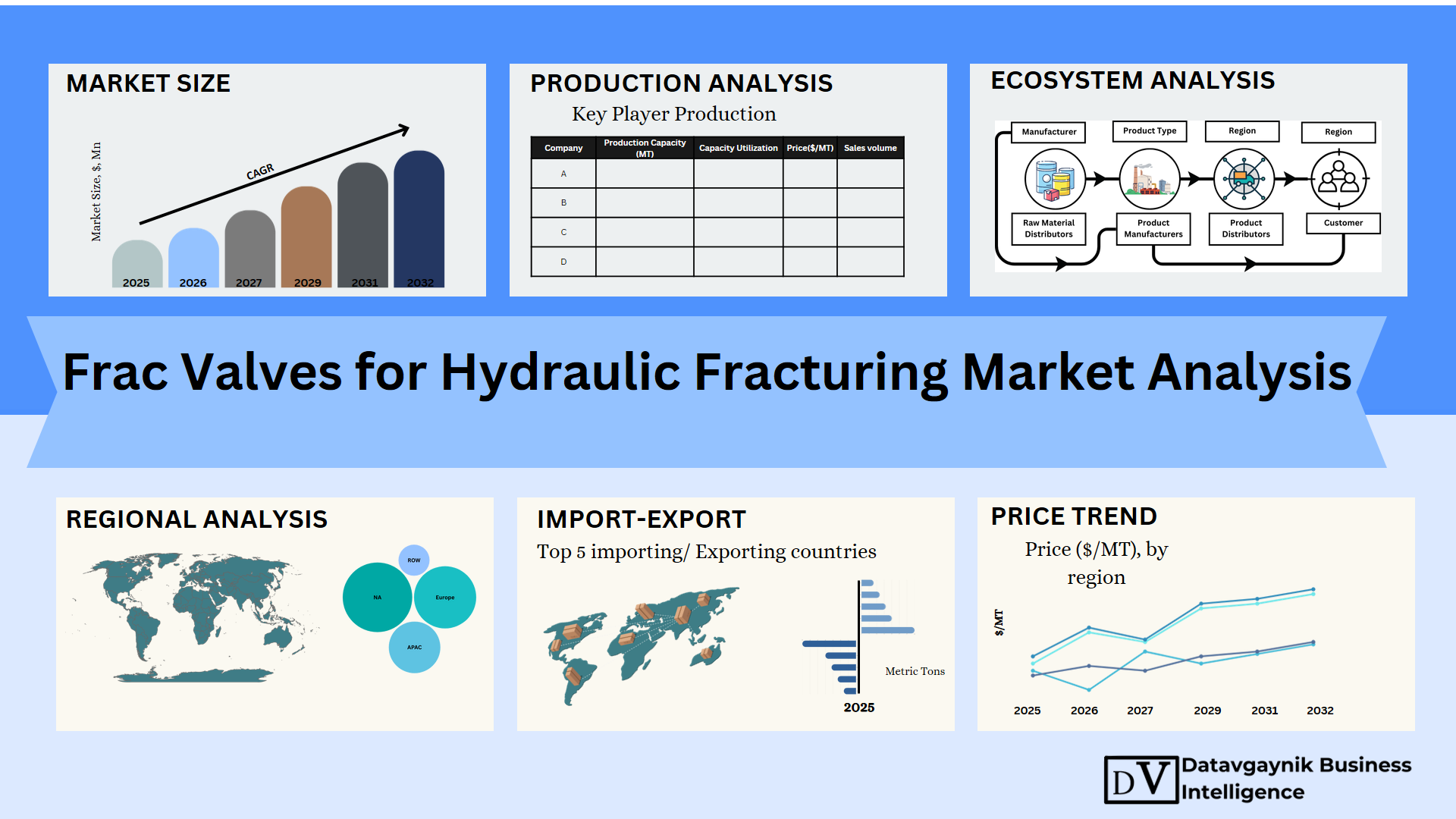
The market covers high-pressure valves used across hydraulic fracturing fleets, frac trees, zipper manifolds, flowback units, wellhead systems, and pressure-control assemblies. These valves are not generic industrial valves. They work in abrasive, high-pressure, high-cycle environments where sand, chemicals, water, and hydrocarbons move under severe operating stress. So, valve reliability directly affects pumping uptime, stage efficiency, field safety, and maintenance cost.
Datavagyanik also covers related markets such as the Frac Sand (Hydraulic Fracturing Sand) Market, the Hydraulic Fracturing Fluids Market, and the Hydraulic Fracturing Proppants Market. These related markets contribute valuable context to the primary topic by highlighting complementary trends and technologies.
The Frac Valves for Hydraulic Fracturing Market is tied closely to unconventional oil and gas activity. North American shale remains the demand anchor, but the market is no longer only a U.S. Permian Basin story. Tight gas development in China, unconventional resource testing in the Middle East, and shale activity in Argentina are widening the opportunity base. That said, demand still moves with drilling budgets, frac fleet utilization, pressure-pumping intensity, and well completion designs.
| Market Indicator | Estimate / View |
| Global Market Size, 2026 | $1,380 million |
| Projected Market Size, 2035 | $2,218 million |
| CAGR, 2026–2035 | 5.4% |
| Core Demand Base | Pressure-pumping fleets, frac service providers, oilfield service companies, E&P operators, rental companies |
| Primary Revenue Pool | New valves, replacement valves, valve assemblies, high-pressure frac-system components |
| Most Active Demand Region | North America |
| High-Growth Opportunity Zones | Argentina, China, Middle East, selected tight gas basins |
From 2026 to 2035, growth will come from three practical forces.
First, wells are becoming more completion-intensive. Longer laterals, tighter stage spacing, and high-volume pumping are increasing wear on valves. Operators are trying to move more fluid and proppant in shorter windows. This raises stress on gate valves, plug valves, check valves, and manifold valves. Replacement cycles are becoming more disciplined because downtime on a frac pad is expensive.
Second, the market is shifting toward higher-pressure and more abrasion-resistant designs. The move from traditional pressure classes toward 15,000 psi and selected 20,000 psi applications is changing supplier economics. Buyers are not only paying for a valve body. They are paying for endurance, seal integrity, low failure rates, and serviceability in harsh field conditions.
Third, capital discipline in oil and gas is reshaping buying behavior. E&P companies and service firms are not purchasing equipment just to expand fleets. They are buying to reduce non-productive time, improve asset utilization, and keep crews moving. That supports a steady replacement-driven market even when new frac fleet additions slow.
Regulation also plays a role, though indirectly. Emissions rules, water management requirements, and well-control standards are pushing operators toward safer and cleaner surface equipment. Valves that reduce leakage risk, improve containment, and support high-pressure control are getting more attention. This is especially relevant in North America and Europe, where site-level scrutiny is higher.
The Frac Valves for Hydraulic Fracturing Market also benefits from the growing preference for modular frac systems. Zipper manifolds, quick-connect assemblies, and multi-well pad operations need robust pressure-control components. As pad drilling becomes more standardized, valve suppliers that can support repeatable configurations and fast field maintenance will gain share.
Key consumers and clients include:
- Pressure-pumping contractors such as large frac fleet operators and regional service companies
- Oilfield service companies including Halliburton, SLB, Baker Hughes, and specialist pressure-control providers
- Exploration and production companies active in shale and tight gas basins
- Wellhead and frac tree manufacturers supplying integrated pressure-control packages
- Rental and refurbishment companies supporting high-pressure iron and valve replacement cycles
- National oil companies testing unconventional gas and liquids resources in emerging basins
Expert view: The market is not being pulled only by higher oil prices. The stronger signal is operating intensity. More stages per pad, more proppant, and shorter completion windows all increase valve fatigue. That creates a durable replacement cycle even in cautious capex years.
Market Segmentation and Forecast Scope
The Frac Valves for Hydraulic Fracturing Market is best understood through five segmentation lenses: product type, pressure rating, application, end user, and region. This structure reflects how buyers actually evaluate equipment. A pressure-pumping company may care first about operating pressure and replacement cost. A wellhead supplier may focus on integration. A shale operator may focus on safety, uptime, and pad-level efficiency.
Segmentation Framework
| Segmentation Dimension | Scope Included | Strategic Relevance |
| By Product Type | Gate valves, plug valves, check valves, ball valves, choke/control valves, relief/safety valves, other high-pressure valves | Defines revenue concentration and replacement frequency |
| By Pressure Rating | Up to 10,000 psi, 15,000 psi, 20,000 psi and above | Captures the shift toward high-pressure completions |
| By Application | Frac trees, zipper manifolds, pump discharge lines, flowback systems, pressure-control units, wellhead isolation | Shows where valves are exposed to the highest wear |
| By End User | Pressure-pumping contractors, oilfield service firms, E&P operators, rental companies, wellhead equipment suppliers | Tracks who controls purchasing and replacement decisions |
| By Region | North America, Europe, Asia Pacific, LAMEA | Reflects shale maturity, unconventional resource development, and service infrastructure |
By Product Type
Gate valves represent the most strategic product family because they sit close to the wellhead and frac tree environment. They must handle high pressure, frequent cycling, and abrasive flow exposure. In 2026, gate valves and frac-tree isolation valves account for about 42% of global revenue. This is the largest visible sub-segment because these valves are mission-critical and replacement-sensitive.
Plug valves remain important across high-pressure manifold and fluid control systems. They are valued for compact design and fast actuation, but they face heavy wear when exposed to sand-loaded fluids. Suppliers are working on improved seat materials, body coatings, and easier maintenance formats.
Check valves are used to prevent reverse flow in high-pressure lines. Their demand is steady because they protect pumps, manifolds, and downstream equipment. The replacement cycle is tied closely to fleet utilization.
Ball valves are used in selective frac and flow-control positions where reliable shutoff is required. Their role is more specific than gate or plug valves, but they remain relevant in engineered assemblies.
Choke, relief, and safety valves serve pressure regulation and protection functions. These are smaller in revenue share but important for well-control integrity.
By Pressure Rating
The market is shifting toward higher-pressure systems. 15,000 psi valves hold an estimated 46% revenue share in 2026, making this the most important pressure class by value. The reason is simple. Many operators want equipment that can handle more demanding completion designs without moving immediately to the highest-cost pressure tier.
10,000 psi valves still serve mature basins, lower-pressure completions, and cost-sensitive service fleets. They will remain relevant, but the growth profile is slower.
20,000 psi and above valves are the fastest-growing pressure class. The base is smaller, but adoption is rising in complex wells, high-intensity shale completions, and advanced pressure-control packages. These valves command premium pricing because design tolerances, material requirements, and testing standards are higher.
By Application
Frac trees and wellhead isolation remain the most critical application area. Valves used here face high pressure and must perform with very low failure tolerance. A field failure can stop the entire stage or create a safety issue.
Zipper manifolds are another strong demand pocket. Multi-well pad operations depend on efficient switching between wells. This creates strong demand for durable valves that can withstand repeated operations.
Pump discharge and high-pressure flowlines require valves that can survive continuous vibration, abrasive fluids, and intense pressure cycling. This application is strongly tied to pressure-pumping fleet activity.
Flowback and pressure-control systems use valves after stimulation to manage produced fluids, sand, and pressure transitions. Demand here grows as operators place greater focus on controlled flowback and site safety.
By End User
Pressure-pumping contractors are the most direct buyers. They manage equipment wear daily, so they are highly sensitive to valve life, spare availability, and service turnaround.
Oilfield service companies buy valves as part of integrated frac systems, surface pressure-control packages, and well intervention services. Their purchasing decisions often favor proven suppliers and standardized equipment platforms.
E&P operators influence the market even when they do not directly purchase every valve. They define completion designs, safety requirements, approved vendors, and field performance expectations.
Rental and refurbishment companies are becoming more important. Some operators prefer renting or refurbishing high-pressure components instead of purchasing new systems. This supports aftermarket demand.
Wellhead equipment suppliers buy valves for frac trees, pressure-control assemblies, and integrated packages. Their demand is tied to new well completions and replacement cycles.
By Region
North America remains the commercial center of the market. The U.S. shale ecosystem has the largest frac fleet base, deepest service infrastructure, and highest replacement velocity. Canada adds steady demand through tight oil and gas development.
Europe is smaller and more selective. Regulatory limits, public acceptance issues, and lower shale activity reduce market scale. Demand is mainly linked to conventional pressure-control work, specialty projects, and imported equipment supply.
Asia Pacific is led by China’s tight gas and shale gas programs. Australia and selected Southeast Asian markets add niche demand. Growth depends on domestic unconventional resource success and the ability to build local service ecosystems.
LAMEA is the most interesting long-term growth region. Argentina’s Vaca Muerta activity, Middle East unconventional gas programs, and selective African tight-resource projects create demand from a smaller base. Growth will not be linear, but the strategic upside is meaningful.
Expert view: The fastest growth will not always come from the largest basins. It will come from basins where unconventional activity is moving from pilot programs into repeatable development. Once that happens, valve demand moves from project-based purchasing to fleet-based replacement.
Market Trends and Innovation Landscape
The Frac Valves for Hydraulic Fracturing Market is evolving around durability, pressure capability, field service speed, and lifecycle economics. Buyers are less impressed by catalog claims now. They want field evidence. How long does the valve last? How fast can it be rebuilt? Can it handle sand-heavy operations? Does it reduce downtime during a multi-well pad campaign?
R&D Evolution: From Strength to Serviceability
Earlier product development was mostly about pressure containment. That remains essential, but R&D has moved further. Suppliers are now focused on wear management, sealing performance, and rebuild efficiency.
Valve makers are investing in better internal geometries, stronger sealing systems, and components that can be replaced faster in the field. This matters because service crews cannot afford long maintenance windows. A valve that can be rebuilt quickly may be more valuable than a slightly cheaper valve with longer downtime.
There is also more attention on lifecycle cost. Buyers increasingly compare valves based on cost per stage or cost per operating hour. This is pushing suppliers to provide more transparent performance data.
Expert view: The winning suppliers will not be the ones selling the cheapest valve. They will be the ones that help pressure-pumping customers reduce failure events across the pad. That is where procurement decisions are moving.
Technology Evolution: Higher Pressure and Modular Frac Systems
High-pressure design remains the main technology trend. 15,000 psi systems are now central to the market, while 20,000 psi and above valves are gaining attention in demanding applications. This shift supports premium pricing but also raises the technical bar for suppliers.
Another major trend is the move toward modular frac systems. Zipper manifolds, skid-mounted pressure-control packages, and quick-connect surface equipment need valves that fit standardized layouts. This supports demand for repeatable designs and interchangeable parts.
Automation is also entering the valve ecosystem, but unevenly. Fully automated frac valve systems are still limited by cost, site conditions, and safety requirements. However, hydraulic actuation, remote monitoring, and position indication are becoming more common in higher-value applications.
Material Science and Wear Resistance
Material performance is central to this market. Frac valves operate in abrasive service where proppant can damage seats, gates, stems, and internal surfaces. So, the innovation focus is practical: harder surfaces, better coatings, stronger elastomers, and improved corrosion resistance.
Suppliers are refining alloy selection, carbide overlays, thermal spray coatings, and non-metallic sealing materials. The goal is not just longer life. It is more predictable life. Predictability allows service companies to plan replacements before a failure shuts down the job.
This is especially relevant in basins using high sand concentrations or aggressive fluid systems. In those environments, low-grade valves wear quickly and can increase total operating cost.
Digital Monitoring and AI: Narrow but Useful
AI is not transforming the core valve market in the same way it is changing reservoir modeling or drilling analytics. Still, digital tools are becoming useful around maintenance planning. Sensors can track cycles, pressure exposure, temperature, and operating history. These data points can feed predictive maintenance models.
For large pressure-pumping fleets, this may lead to smarter replacement scheduling. Instead of replacing valves on fixed intervals, companies can service them based on actual usage patterns. That reduces both premature replacement and unexpected failure.
Expert view: AI will not sell frac valves by itself. But it can improve how fleets manage high-pressure assets. The real value is in fewer surprise failures, better inventory planning, and faster field decisions.
Mergers, Partnerships, and Industry Announcements
Industry consolidation is shaping the buyer landscape. Larger pressure-pumping platforms are gaining more purchasing power. This puts pressure on valve suppliers to offer consistent quality, national service coverage, and better aftermarket support.
Recent consolidation among pressure-pumping and oilfield service companies has also encouraged standardization. When fleets merge, they often rationalize equipment designs, approved supplier lists, and maintenance practices. This can benefit established valve suppliers with broad field support. It can also make market entry harder for smaller manufacturers.
Partnerships are becoming common between valve manufacturers, pressure-control specialists, and local service providers. In emerging regions, local repair capability matters almost as much as the original valve sale. A supplier without field support may win a first order but struggle to retain the account.
Large oilfield service companies such as Halliburton, SLB, Baker Hughes, and pressure-pumping operators such as Liberty Energy, ProFrac, and Calfrac Well Services influence equipment specifications through fleet purchasing and field performance standards. Their equipment choices affect what gets adopted across the wider service ecosystem.
Commercial Impact Through 2035
The next phase of the Frac Valves for Hydraulic Fracturing Market will be defined by four commercial shifts:
| Trend | Likely Market Impact by 2035 |
| Higher-pressure completions | Supports premium valve demand and stronger revenue per unit |
| More abrasive frac designs | Raises replacement frequency and demand for wear-resistant materials |
| Modular surface equipment | Favors standardized valve platforms and integrated suppliers |
| Predictive maintenance tools | Improves aftermarket planning and reduces unplanned downtime |
| Service network expansion | Helps suppliers win in Argentina, China, and Middle East projects |
The market will remain cyclical because hydraulic fracturing depends on upstream capital spending. Still, the structural demand case is stronger than a simple rig-count view suggests. Valves wear out. Fleets need replacement parts. Higher-pressure completions create higher-value demand. That is why the Frac Valves for Hydraulic Fracturing Market should remain a resilient niche within the broader oilfield equipment ecosystem.
Competitive Intelligence and Benchmarking
Competition is concentrated around companies that can combine high-pressure valve engineering, frac tree integration, surface pressure-control systems, and field service coverage. The buying decision is practical. Customers want fewer failures, fast rebuilds, spare availability, and proven performance under abrasive service.
| Company | Portfolio Focus | Market Position | Strategic Benchmark |
| SLB / Cameron | High-pressure frac valves, frac trees, fluid delivery systems, automated valve-control platforms | Global leader in pressure-control equipment and integrated completion systems | Strong in premium shale operations and automated frac-pad workflows |
| Halliburton | Fracturing equipment, completion systems, intelligent frac operations, well-control support equipment | Strong oilfield service leader with deep pressure-pumping and completion exposure | Benefits from direct contact with E&P operators and field-level completion programs |
| Cactus / Baker Hughes Surface Pressure Control JV | Wellheads, frac stacks, zipper manifolds, pressure-control packages, service and rental support | North America-focused pressure-control platform with expanding international reach | The 2025 JV strengthened scale in surface pressure control and aftermarket service |
| TechnipFMC | Surface wellheads, frac systems, check valves, automated frac transition systems, pressure-containment solutions | Technology-led supplier with strong surface and subsea pressure-control background | Differentiates through automation, large-bore systems, and integrated pad-level equipment |
| NOV | Well service valves, pump expendables, manifold-related systems, flow-control components | Broad oilfield equipment supplier with strong aftermarket and shale service exposure | Competitive in replacement-driven demand and service-linked components |
| SPM Oil & Gas / Caterpillar | Surface frac solutions, stimulation pumps, flow-control equipment, pressure-pumping components | Established supplier to pressure-pumping and oilfield service customers | Strong fit where buyers want bundled frac-site equipment and repair support |
| Worldwide Oilfield Machine | Frac gate valves, wellhead equipment, pressure-control systems, engineered surface solutions | Specialist manufacturer with differentiated high-pressure valve designs | Competes on valve reliability, compact footprint, and reduced field maintenance |
SLB / Cameron holds one of the strongest positions in the premium frac valve and pressure-control ecosystem. Its portfolio spans high-pressure frac valves, frac trees, frac-and-flowback equipment, electric valve control, and automated fluid delivery systems. SLB’s own frac equipment information highlights remote valve operation and automated control as part of its frac-and-flowback platform, while its Cameron frac valve page positions the offering for large-bore, high-pressure production, manifold, and fracturing applications.
Halliburton is not only an equipment supplier. It is also a major user and integrator of fracturing technologies through its completion and stimulation business. Its fracturing equipment portfolio is centered on improving uptime, stage execution, and field efficiency. This gives the company a strong indirect influence on valve specifications because it operates close to the customer’s completion design and field performance data.
Cactus / Baker Hughes Surface Pressure Control JV is now a more important competitive platform after the June 2025 agreement where Cactus became the majority owner and operator of Baker Hughes’ surface pressure control product line, while Baker Hughes retained a 35% stake. The combination brings together Cactus’ North American wellhead and frac equipment footprint with Baker Hughes’ pressure-control product heritage.
TechnipFMC competes through engineered surface pressure-control systems, wellheads, gate valves, check valves, and automated frac systems. Its wellhead technology page highlights core wellhead components such as seals and gate valves, while its unconventional frac case material shows a check-valve design engineered for high-intensity frac service. This positions the company well for complex pads and high-cycle operations.
NOV has a broad equipment base across well servicing, flow control, and shale applications. Its valve and seat offering is positioned for demanding shale plays, while its Anson brand includes plug valves used in compact flowline isolation and quick shutoff applications. The company’s strength is breadth rather than narrow specialization.
SPM Oil & Gas / Caterpillar serves the market through surface frac systems, stimulation equipment, flow-control products, replacement expendables, and repair services. Caterpillar describes SPM as a provider of pressure-pumping, well-service, stimulation pumps, flow-control products, and engineered repair services for oilfield service companies. This makes SPM important where customers prefer a combined product-and-service supply model.
Worldwide Oilfield Machine is a focused oilfield equipment manufacturer with frac valve and wellhead capabilities. Its frac valve offering is positioned around high-pressure fracturing and flowback operations, with emphasis on smooth operation, reduced maintenance, and modular design. For buyers, the company is more of a specialist challenger than a full-line oilfield services platform.
Expert view: The competitive gap is moving from “who can manufacture a valve” to “who can keep the pad running.” That favors companies with installed base, repair networks, field data, and integrated pressure-control packages.
Regional Landscape and Adoption Outlook
Regional adoption is shaped by one simple question: where is hydraulic fracturing moving from occasional activity to repeatable industrial activity? The United States remains the clear leader. China and the Middle East are building long-term unconventional gas programs. India, Japan, and South Korea are more selective and import-led.
Regional Adoption Matrix
| Region / Country | Adoption Level | Growth Outlook, 2026–2035 | Demand Character |
| United States | Very high | Moderate but durable | Replacement-heavy, high-pressure, pad-driven |
| Europe | Low | Limited | Regulatory-constrained, niche pressure-control demand |
| China | Medium and rising | High | Shale gas and tight gas development |
| India | Low | Selective | Exploration-linked, policy-dependent |
| Japan | Very low domestic demand | Low | Indirect demand through overseas shale investment and LNG security |
| South Korea | Very low domestic demand | Low | Import-led energy model, limited local fracturing activity |
| Middle East | Rising | High from a smaller base | Unconventional gas and large NOC-led projects |
United States
The United States is the demand anchor. Its shale ecosystem has the deepest pressure-pumping fleet base, the largest replacement cycle, and the strongest service infrastructure. The Permian Basin remains the most important demand center because high completion intensity drives heavy valve wear. EIA data showed Permian shale and tight formations produced 6.0 million barrels per day of crude oil and 22.2 Bcf/d of dry gas in December 2025, equal to 44% of U.S. oil production and 19% of marketed gas production.
Adoption is not only about new wells. It is also about maintenance. U.S. pressure-pumping companies run valves through repeated high-pressure cycles. This creates steady demand for gate valves, plug valves, check valves, seats, seals, and rebuild kits. The U.S. also leads in electric frac, automated valve control, and remote operating systems.
Regulation is strict but familiar. Operators already work under state-level water, chemical disclosure, emissions, and well-integrity rules. This supports demand for better pressure containment and safer remote operations rather than reducing the need for frac valves.
Europe
Europe remains a limited market. Public opposition, strict environmental permitting, and lower unconventional drilling activity restrict shale-related demand. The region still needs pressure-control equipment for selected oil and gas projects, well intervention, geothermal pilots, and offshore operations, but dedicated frac valve demand is modest.
Europe’s opportunity is more technology-led than volume-led. Suppliers with leak-reduction designs, automated actuation, and low-maintenance systems may find selective adoption. But broad shale-style growth is unlikely without a major policy shift.
China
China is the most important Asian growth market. The country is targeting deeper shale and tight gas resources to improve domestic energy security. Recent reporting shows Chinese state energy companies are advancing ultra-deep shale gas exploration in the Sichuan Basin, with targeted formations at 4,500–5,000 meters and shale gas output potentially rising toward 40 bcm by 2035.
This matters for valve demand because deeper resources usually require higher pressure, stronger surface equipment, and more technically demanding completion programs. China also has a domestic equipment-manufacturing base, so foreign suppliers may face price pressure. That said, premium high-pressure valves and advanced sealing systems still have room where reliability is critical.
India
India is a cautious, early-stage market. The government has opened policy routes for unconventional hydrocarbons, including shale oil and gas, but commercial fracturing activity is still limited compared with North America or China. India’s 2018 policy framework permits exploration and exploitation of unconventional hydrocarbons such as shale oil/gas and coal bed methane under existing contracts and nomination fields.
Demand for frac valves in India will likely come from pilot wells, CBM activity, tight reservoirs, and selective E&P programs. Large-scale demand requires stronger reservoir results, water-management confidence, and service-company investment. For now, India is a watchlist market rather than a near-term volume market.
Japan
Japan has very limited domestic hydraulic fracturing demand. Its relevance is indirect. Japanese energy companies invest in overseas gas and LNG supply chains to secure fuel access. In 2025, JERA was reported to be in advanced talks to buy U.S. shale gas assets worth about $1.7 billion, which shows Japan’s interest in upstream shale exposure rather than domestic frac equipment demand.
So, Japan influences the market through capital flows, LNG strategy, and overseas partnerships. It is not a major local buyer of frac valves.
South Korea
South Korea is similar to Japan in market structure. Domestic shale development is minimal. Demand comes mainly from Korean engineering firms, EPCs, offshore energy supply chains, and overseas project participation. Local valve and industrial equipment manufacturers may participate as suppliers, but the domestic frac valve consumption base is small.
The country’s role is strongest in manufacturing, engineering, and international energy procurement. Direct hydraulic fracturing adoption will remain limited through 2035.
Middle East
The Middle East is becoming more relevant. Saudi Arabia’s Jafurah program and the UAE’s unconventional gas ambitions are shifting the region from conventional oilfield demand toward more unconventional gas activity. Aramco says Jafurah production started in December 2025, with an ambition to reach 2 billion scfd of sales gas by 2030, plus ethane and liquids volumes.
ADNOC also describes unconventional gas as tight gas that requires advanced technologies such as hydraulic fracturing to extract it. This supports a long-term demand case for high-pressure surface equipment, including frac valves, frac trees, manifolds, and serviceable pressure-control packages.
Expert view: The Middle East will not copy the U.S. shale model exactly. National oil companies will move more slowly and with tighter procurement controls. But once projects scale, they can create large, repeatable equipment demand.
Recent Developments + Opportunities & Restraints
Recent Developments
| Year / Month | Event | Market Impact |
| 2026 – February | SLB launched a fully electric Cameron frac fluid delivery system with electric actuation and remote valve control features. | Supports the shift toward lower-maintenance frac valve systems, remote operations, and safer pad layouts. |
| 2025 – June | Baker Hughes and Cactus formed a surface pressure control joint venture, with Cactus as majority owner and operator. | Consolidates pressure-control capability and strengthens service coverage for wellhead and frac equipment customers. |
| 2025 – February | Halliburton and Coterra Energy launched autonomous hydraulic fracturing technology in the Permian Basin, with reported stage-efficiency improvement after rollout. | Reinforces the industry move toward automation, consistent execution, and digital control of frac operations. |
| 2025 – December | Saudi Aramco started production at the Jafurah gas plant, linked to one of the world’s largest unconventional gas developments outside the U.S. | Creates long-term upside for high-pressure frac equipment in the Middle East. |
| 2026 – May | YPF registered a $25 billion Vaca Muerta oil project under Argentina’s RIGI investment scheme. | Strengthens the long-term case for Latin American shale completions and related pressure-control equipment demand. |
Opportunities and Business Insights
Emerging unconventional basins create the clearest upside. Argentina, China, Saudi Arabia, and the UAE are not yet as mature as the U.S. shale market, but they are moving toward repeatable development. That shift matters. Once operators standardize pads and completion designs, valve purchases move from one-off procurement to recurring fleet demand.
Automation and remote valve control will create premium opportunities. Buyers want fewer workers in red zones. They also want faster well-to-well transitions. Electrically actuated and remotely controlled valve systems can improve safety and reduce non-productive time, especially on multi-well pads.
Aftermarket and refurbishment models are becoming more attractive. Frac valves face abrasive wear. That makes service, rebuild kits, field repair, and rental support a strong profit pool. Suppliers with regional service centers can defend margins better than suppliers that only ship new equipment.
Restraints
Oil and gas capex cyclicality remains the largest restraint. When crude or gas prices fall, operators delay completions, and pressure-pumping utilization weakens. Valve replacement demand continues, but new equipment demand can slow quickly.
Environmental and water-use concerns can limit adoption in sensitive regions. This affects Europe, India, and parts of Latin America more than the United States. Local permitting delays can postpone frac programs and reduce short-term equipment demand.
High-performance material costs also pressure margins. Premium alloys, coatings, sealing systems, and testing requirements raise production costs. Smaller manufacturers may struggle to compete if buyers demand both low prices and premium reliability.
Expert view: The best opportunity is not simply selling more valves. It is building a service-backed valve platform. In this market, uptime is the real product.


