

Robust Growth Trends Shaping the Gelatin methacryloyl (GelMA) Market
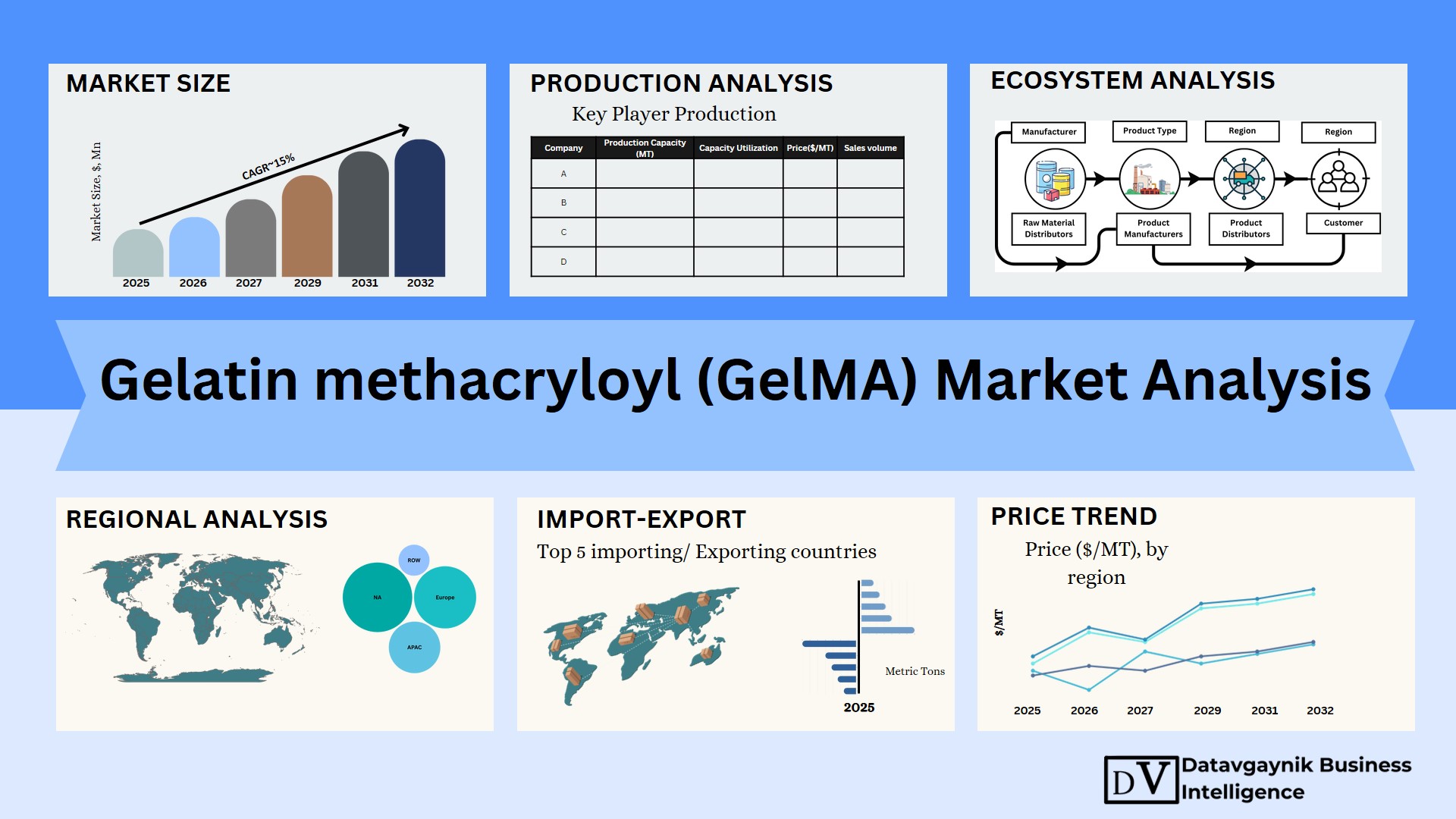
The Gelatin methacryloyl (GelMA) market is experiencing unprecedented growth driven by its expanding applications across biomedical, cosmetic, and research sectors. GelMA’s unique ability to combine biocompatibility with tunable mechanical properties makes it indispensable for cutting-edge biomedical solutions. For instance, the global tissue engineering market alone, valued at over USD 10 billion in 2024, is projected to grow at a compound annual growth rate (CAGR) of approximately 14%, directly amplifying the demand for GelMA hydrogels as essential scaffold materials. This exponential rise in adoption underlines why the Gelatin methacryloyl (GelMA) market size is poised for remarkable expansion over the next decade.
Biomedical Advancements Propel the Gelatin methacryloyl (GelMA) Market Demand
Biomedical applications serve as the primary engine for the Gelatin methacryloyl (GelMA) market, with regenerative medicine and tissue engineering at the forefront. For example, GelMA’s ability to mimic the natural extracellular matrix enables enhanced cell proliferation and differentiation, crucial for repairing cartilage, skin, and bone tissues. The rise in chronic diseases and aging populations globally has accelerated investments in regenerative therapies. This is evidenced by the fact that over 145 million individuals in the U.S. suffer from chronic wounds and tissue damage, creating a significant unmet need that GelMA hydrogels are uniquely positioned to address. These factors contribute to an estimated annual growth rate exceeding 15% in the Gelatin methacryloyl (GelMA) market driven by biomedical applications alone.
Datavagyanik also covers related markets such as the Gelatin Methacryloyl (GelMA) Market, the Gelatin Market, and the Bovine Gelatin Market. These related markets contribute valuable context to the primary topic by highlighting complementary trends and technologies.
3D Bioprinting Innovations Boost the Gelatin methacryloyl (GelMA) Market Expansion
A pivotal trend reshaping the Gelatin methacryloyl (GelMA) market is the surge in 3D bioprinting technology adoption. GelMA serves as a versatile bio-ink, praised for its printability and ability to form stable, cell-compatible hydrogels. For instance, the 3D bioprinting market, valued at USD 1.2 billion in 2023, is expected to register a CAGR of 20% through 2030. Such explosive growth is tightly linked to GelMA’s role in fabricating patient-specific tissue constructs and organ models. Academic institutions and biotech companies are increasingly investing in scalable GelMA bio-ink production, making this segment a cornerstone of Gelatin methacryloyl (GelMA) market growth.
Cosmetic Industry’s Rising Demand Fuels the Gelatin methacryloyl (GelMA) Market
The cosmetic sector represents an emerging, high-potential domain for the Gelatin methacryloyl (GelMA) market. GelMA-based hydrogels are rapidly becoming the material of choice for novel skincare formulations and injectable aesthetic treatments. For example, the global cosmetic injectables market is projected to exceed USD 15 billion by 2027, with bioengineered hydrogels like GelMA contributing substantially to this surge. Its biocompatibility and ability to promote skin regeneration make GelMA invaluable for anti-aging products and wound healing cosmetics. The expanding consumer preference for minimally invasive procedures directly propels the Gelatin methacryloyl (GelMA) market size in this segment.
Personalized Medicine and the Gelatin methacryloyl (GelMA) Market: Tailoring Treatments for Enhanced Outcomes
The advent of personalized medicine has brought a paradigm shift in how therapeutic scaffolds and implants are designed, fueling demand in the Gelatin methacryloyl (GelMA) market. Customized GelMA hydrogels enable the creation of patient-specific tissue scaffolds, enhancing compatibility and treatment efficacy. For instance, the global personalized medicine market is forecasted to reach USD 4.7 trillion by 2030, highlighting the scale of opportunity for GelMA-based biomaterials. This trend is especially prominent in oncology and orthopedics, where tailored regenerative therapies require sophisticated biomaterials like GelMA. Consequently, the Gelatin methacryloyl (GelMA) market is set to benefit substantially from the integration of personalized healthcare approaches.
Research and Academic Contributions Elevate the Gelatin methacryloyl (GelMA) Market
Academic and industrial research are pivotal pillars underpinning the robust growth of the Gelatin methacryloyl (GelMA) market. Globally, funding for biomaterials research has increased by over 18% annually, with institutions focusing on hydrogel innovations and novel applications of GelMA. For example, leading universities in North America and Europe have established dedicated GelMA research centers, driving breakthroughs in scaffold fabrication and drug delivery mechanisms. These R&D efforts not only expand the functional versatility of GelMA but also accelerate commercialization, creating a strong foundation for the Gelatin methacryloyl (GelMA) market to evolve rapidly.
Regenerative Therapies and Chronic Disease Management Drive Gelatin methacryloyl (GelMA) Market Expansion
The increasing prevalence of chronic diseases such as diabetes, cardiovascular disorders, and neurodegenerative conditions has intensified the need for regenerative therapies, thus fueling the Gelatin methacryloyl (GelMA) market. For example, diabetic foot ulcers affect nearly 26 million patients worldwide, underscoring the critical role of GelMA-based hydrogels in accelerating wound healing. Moreover, the global regenerative medicine market, valued at USD 25 billion in 2024, is expected to grow at a CAGR of 17%, directly influencing GelMA consumption. The material’s compatibility with stem cells and growth factors makes it indispensable in these therapies, securing its position as a key biomaterial in the Gelatin methacryloyl (GelMA) market landscape.
Geographical Drivers Impacting the Gelatin methacryloyl (GelMA) Market Dynamics
The Gelatin methacryloyl (GelMA) market exhibits strong regional dynamics, with North America, Europe, and Asia Pacific driving the bulk of production and consumption. For instance, North America accounts for over 40% of the global GelMA market revenue, propelled by its advanced biomedical infrastructure and high healthcare expenditure exceeding USD 4 trillion annually. Europe follows closely, with countries like Germany and the UK investing heavily in regenerative medicine research and bioprinting innovations. Asia Pacific is witnessing the fastest growth, buoyed by China’s expanding biotech sector and Japan’s expertise in biomaterials, resulting in an estimated CAGR above 19%. These regional trends demonstrate how infrastructure, government support, and research capabilities collectively fuel the Gelatin methacryloyl (GelMA) market.
Technological Innovations Accelerate the Gelatin methacryloyl (GelMA) Market Trajectory
Technological breakthroughs in GelMA synthesis and processing are critical drivers for the market’s sustained growth. Innovations such as photocrosslinking methods and high-degree methacrylation techniques allow precise tuning of GelMA properties to meet specific application requirements. For example, the adoption of advanced light-based crosslinking has improved the mechanical strength and biostability of GelMA hydrogels by over 30%, making them more viable for load-bearing tissue scaffolds. Additionally, scalable manufacturing technologies are lowering production costs, enabling wider commercial use. Such advancements firmly position the Gelatin methacryloyl (GelMA) market for continued acceleration in diverse sectors.
Increasing Clinical Adoption Reinforces the Gelatin methacryloyl (GelMA) Market Outlook
Clinical translation of GelMA-based products is gaining momentum, reinforcing the market’s upward trajectory. Hospitals and clinics are increasingly adopting injectable GelMA hydrogels for minimally invasive wound healing and soft tissue repair, driven by positive clinical outcomes. For example, recent clinical trials have demonstrated a 25% faster healing rate using GelMA hydrogels compared to traditional dressings. This growing clinical validation enhances trust among healthcare providers and patients alike, expanding the Gelatin methacryloyl (GelMA) market penetration into therapeutic domains.
Growing Cosmetic Applications Highlight New Growth Frontiers in the Gelatin methacryloyl (GelMA) Market
Beyond healthcare, the cosmetic industry’s growing utilization of GelMA opens new frontiers for market expansion. The global anti-aging market, exceeding USD 60 billion, increasingly incorporates bioengineered materials like GelMA to develop injectable fillers and rejuvenation therapies. For instance, cosmetic clinics report higher patient satisfaction rates when using GelMA-based formulations due to their superior integration with natural skin tissue. This trend illustrates how the Gelatin methacryloyl (GelMA) market is diversifying and capitalizing on novel application areas, further broadening its commercial landscape.
Track Country-wise Gelatin methacryloyl (GelMA) Production and Demand through our Gelatin methacryloyl (GelMA) Production Database
-
-
- Gelatin methacryloyl (GelMA) production database for 30+ countries worldwide
- Gelatin methacryloyl (GelMA) sales volume for 31+ countries
- Country-wise Gelatin methacryloyl (GelMA) production capacity, production plant mapping, production capacity utilization for 30+ manufacturers
- Gelatin methacryloyl (GelMA) production plants and production plant capacity analysis by top manufacturers
-
Track real-time Gelatin methacryloyl (GelMA) Prices, Gelatin methacryloyl (GelMA) price charts for 30+ countries, Gelatin methacryloyl (GelMA) weekly price tracker and Gelatin methacryloyl (GelMA) monthly price tracker
-
-
- Track real-time Gelatin methacryloyl (GelMA) prices and Gelatin methacryloyl (GelMA) price trend in 30+ countries though our excel-based Gelatin methacryloyl (GelMA) price charts
- Real-time Gelatin methacryloyl (GelMA) price tracker dashboard with 30+ countries
- Complete transparency on Gelatin methacryloyl (GelMA) price trend through our Gelatin methacryloyl (GelMA) monthly price tracker, Gelatin methacryloyl (GelMA) weekly price tracker
-
Geographical Demand Patterns Shaping the Gelatin methacryloyl (GelMA) Market
The geographical demand for Gelatin methacryloyl (GelMA) is highly influenced by regional advancements in biomedical research, healthcare infrastructure, and industrial innovation. North America remains the largest consumer, contributing over 40% to the global Gelatin methacryloyl (GelMA) market demand. This dominance is propelled by the United States, where a robust biotechnology sector combined with substantial healthcare R&D investment—exceeding USD 200 billion annually—creates a fertile ground for GelMA applications in regenerative medicine and 3D bioprinting. For example, the adoption of GelMA-based hydrogels in U.S. tissue engineering research has increased by approximately 18% year-over-year, highlighting sustained growth momentum.
Europe commands the second-largest share, with Germany, the United Kingdom, and France as key contributors. Germany’s Gelatin methacryloyl (GelMA) market demand is underpinned by its leading position in biomaterials research and advanced manufacturing capabilities. For instance, Germany’s biotechnology industry revenue surged by 12% in 2024, accompanied by rising clinical trials incorporating GelMA scaffolds. Similarly, the UK’s government-backed regenerative medicine initiatives have led to a 20% increase in GelMA consumption in clinical and research settings over the last three years. France’s pharmaceutical and cosmetic sectors also bolster the regional Gelatin methacryloyl (GelMA) market by integrating GelMA in wound care and injectable formulations.
Asia Pacific exhibits the fastest growth trajectory in the Gelatin methacryloyl (GelMA) market. Countries such as China, Japan, India, and South Korea are rapidly scaling production and consumption due to expanding biomedical research funding and increasing biotechnology investments. China’s biotechnology expenditure grew at a CAGR of 25% between 2020 and 2024, fueling a parallel rise in GelMA applications, especially in tissue regeneration and drug delivery systems. India’s emergence as a low-cost manufacturing hub coupled with a growing focus on personalized medicine is contributing to a 22% annual growth in GelMA demand. Furthermore, Japan and South Korea’s established expertise in biomaterials and 3D bioprinting drives innovation-led growth in the regional Gelatin methacryloyl (GelMA) market.
Production Landscape and Its Impact on the Gelatin methacryloyl (GelMA) Market
The production landscape of the Gelatin methacryloyl (GelMA) market is concentrated primarily in North America, Europe, and Asia Pacific, where technological prowess and raw material availability align to support high-quality manufacturing. The United States leads with advanced synthesis techniques and scalable production lines, often integrating photocrosslinking methods to improve GelMA hydrogel properties. This technological edge allows U.S. producers to meet stringent quality demands, driving both domestic consumption and exports. For example, the U.S. GelMA production capacity increased by nearly 30% from 2022 to 2024, reflecting investment in process optimization.
Europe follows closely, with Germany, the UK, and France spearheading GelMA manufacturing innovations. German firms emphasize sustainable production practices while maintaining high product purity, which is critical for biomedical applications. The availability of research clusters and pilot manufacturing units accelerates product development cycles, fostering rapid market responsiveness. In France, production is closely tied to cosmetic and pharmaceutical sectors, where GelMA is tailored for injectable and topical formulations, enhancing the market’s diversity.
Asia Pacific’s production surge is driven largely by China and Japan. China’s ability to offer cost-effective GelMA products without compromising quality has made it a significant supplier for regional and international markets. For instance, China’s GelMA output doubled from 2021 to 2024, supported by government incentives for biotechnology manufacturing. Japan’s sophisticated research infrastructure ensures high-grade GelMA synthesis, particularly for applications demanding precision and purity, such as organ regeneration. India’s nascent but rapidly expanding production capacity benefits from a skilled workforce and competitive costs, positioning it as an emerging GelMA manufacturing hub.
Market Segmentation Insights Driving the Gelatin methacryloyl (GelMA) Market Expansion
The Gelatin methacryloyl (GelMA) market segmentation reveals nuanced growth drivers across applications, end-users, and product types. By application, tissue engineering commands the largest share, attributed to GelMA’s capability to provide biocompatible scaffolds mimicking the extracellular matrix. This segment’s expansion aligns with the global tissue engineering market’s projected 14% CAGR, with GelMA being integral in repairing cartilage, bone, and skin tissues. For example, GelMA’s application in cartilage regeneration has increased by 25% globally over the past five years due to improved mechanical properties achieved through high-degree methacrylation.
3D bioprinting follows closely, with GelMA serving as a preferred bio-ink. The precision offered by GelMA in fabricating complex tissue architectures supports growing demand in personalized implants and organ modeling. As the 3D bioprinting market is expected to triple in size by 2030, GelMA’s role as a reliable bio-ink cements its importance. For instance, bioprinting startups and established firms alike report a 30% year-over-year increase in GelMA usage for bio-ink formulations.
Drug delivery systems constitute another vital segment within the Gelatin methacryloyl (GelMA) market. GelMA’s hydrogel matrix facilitates controlled release of therapeutic agents, which is increasingly critical for chronic disease management and targeted therapies. The global drug delivery market, valued at over USD 1.5 trillion in 2024, provides a vast landscape where GelMA hydrogels find application in encapsulating bioactive compounds for sustained release, thereby driving adoption.
Wound healing applications are gaining momentum, with GelMA-based hydrogels accelerating tissue repair and reducing infection risks. This segment’s growth corresponds with rising global incidences of chronic wounds and burns, affecting millions annually. Hospitals and clinics are progressively incorporating GelMA products, boosting market penetration.
By end-user, healthcare and biomedical research dominate, accounting for over 60% of GelMA consumption globally. Biotechnology and pharmaceutical companies follow, leveraging GelMA for drug discovery and regenerative products. The cosmetic industry, though smaller, is rapidly expanding its share, tapping into anti-aging and aesthetic applications that benefit from GelMA’s biocompatibility.
Gelatin methacryloyl (GelMA) Price and Price Trend: Analyzing Market Dynamics
The Gelatin methacryloyl (GelMA) price has demonstrated a nuanced trajectory influenced by raw material costs, production technologies, and regional demand-supply dynamics. In 2023, the average GelMA price ranged between USD 500 to USD 800 per kilogram, depending on purity grades and functionalization levels. High-degree methacrylated GelMA commands premium pricing due to enhanced mechanical properties essential for load-bearing applications.
The Gelatin methacryloyl (GelMA) price trend over the past five years shows moderate but steady increases averaging 5–7% annually, driven primarily by rising demand in regenerative medicine and 3D bioprinting sectors. For example, escalating investments in personalized medicine have triggered the need for customized GelMA formulations, allowing manufacturers to command higher price points for specialty products. Concurrently, advancements in production efficiency, particularly in Asia Pacific, have exerted downward pressure on prices, balancing overall market pricing.
In North America and Europe, GelMA prices tend to be higher due to stringent quality regulations and the prevalence of premium-grade biomedical applications. Conversely, Asia Pacific markets, especially China and India, offer competitive pricing due to cost-effective manufacturing and economies of scale. This pricing divergence has led to increased import-export flows, with cost-sensitive markets in Latin America and Africa sourcing GelMA predominantly from Asian suppliers.
Impact of Raw Material Supply and Production Costs on Gelatin methacryloyl (GelMA) Price Trend
GelMA production hinges critically on the availability and cost of gelatin, its primary raw material. Gelatin supply chains have experienced volatility due to fluctuations in livestock production and processing costs. For instance, a 12% increase in global gelatin prices during 2022 impacted GelMA manufacturing costs, contributing to the upward trend in Gelatin methacryloyl (GelMA) price.
Moreover, the complexity of methacrylation and crosslinking processes influences production expenditures. High-purity and highly functionalized GelMA variants require sophisticated synthesis setups, driving costs upward. However, continuous improvements in photocrosslinking and purification methods are mitigating cost pressures, supporting a more stabilized Gelatin methacryloyl (GelMA) price trend moving forward.
Future Outlook on Gelatin methacryloyl (GelMA) Price and Market Sustainability
The Gelatin methacryloyl (GelMA) price is expected to experience balanced fluctuations aligned with technological advancements and expanding market penetration. As manufacturers scale up production, particularly in Asia Pacific, economies of scale will likely moderate prices, making GelMA more accessible for emerging biomedical and cosmetic applications. For example, ongoing R&D in lower-cost synthesis routes is anticipated to reduce production expenses by 10–15% over the next five years.
Simultaneously, the growing demand for specialized GelMA variants tailored to personalized medicine and advanced 3D bioprinting will sustain premium pricing segments. This dual pricing dynamic—balancing cost-effective bulk products with high-value specialty formulations—will underpin the Gelatin methacryloyl (GelMA) market’s sustainability and profitability.
Gelatin methacryloyl (GelMA) Manufacturing Database, Gelatin methacryloyl (GelMA) Manufacturing Capacity
-
-
- Gelatin methacryloyl (GelMA) top manufacturers market share for 30+ manufacturers
- Top 11 manufacturers and top 18 manufacturers of Gelatin methacryloyl (GelMA) in North America, Europe, Asia Pacific
- Gelatin methacryloyl (GelMA) production plant capacity by manufacturers and Gelatin methacryloyl (GelMA) production data for 30+ market players
- Gelatin methacryloyl (GelMA) production dashboard, Gelatin methacryloyl (GelMA) production data in excel format
-
Gelatin methacryloyl (GelMA) price charts, Gelatin methacryloyl (GelMA) weekly price tracker and Gelatin methacryloyl (GelMA) monthly price tracker
-
-
- Factors impacting real-time Gelatin methacryloyl (GelMA) prices in 30+ countries worldwide
- Gelatin methacryloyl (GelMA) monthly price tracker, Gelatin methacryloyl (GelMA) weekly price tracker
- Real-time Gelatin methacryloyl (GelMA) price trend, Gelatin methacryloyl (GelMA) price charts, news and updates
- Tracking Gelatin methacryloyl (GelMA) price fluctuations
-
Top Manufacturers Dominating the Gelatin methacryloyl (GelMA) Market
The Gelatin methacryloyl (GelMA) market is driven by a handful of leading manufacturers whose innovations and product lines shape market dynamics globally. These companies leverage their strong R&D capabilities, production scale, and strategic partnerships to maintain significant market shares and propel adoption across biomedical and cosmetic sectors.
Rousselot (Darling Ingredients Inc.) — Pioneer in GMP-Grade GelMA Production
Rousselot, a subsidiary of Darling Ingredients Inc., stands out as a market leader with its flagship product X-Pure® GelMA, known as the first GMP-grade gelatin methacryloyl. This product’s ultra-high purity and low endotoxin levels position it at the premium end of the GelMA spectrum, making it highly sought after in clinical applications such as tissue engineering and drug delivery.
Rousselot’s market share is estimated to exceed 20% globally, driven by their extensive supply chain and early mover advantage. Their investments in scalable production facilities and stringent quality control protocols give them a significant edge in serving biomedical research institutions and pharmaceutical companies. For instance, their X-Pure® GelMA is widely utilized in advanced 3D bioprinting projects due to its consistent mechanical properties and biocompatibility.
Cellink — Innovator in GelMA Bioinks for 3D Bioprinting
Cellink has rapidly gained prominence in the Gelatin methacryloyl (GelMA) market through its targeted focus on bioinks optimized for 3D bioprinting applications. Their product line, GelMA Bioink LAP 0.25%, combines methacrylated gelatin with a photoinitiator that supports rapid crosslinking under visible light, facilitating precise tissue construct fabrication.
Cellink commands an approximate 15% share of the GelMA market, largely due to its reputation in the bioprinting ecosystem and its collaborations with academic and commercial research entities. The product’s user-friendly characteristics and batch-to-batch consistency have accelerated adoption in regenerative medicine research, contributing significantly to the overall growth in GelMA demand within the bioprinting segment.
Sigma-Aldrich (Merck KGaA) — Comprehensive Product Portfolio for Research and Development
Sigma-Aldrich, a subsidiary of Merck KGaA, offers a broad range of GelMA products with varied bloom strengths and degrees of methacrylation, catering to diverse research needs. Their Gelatin Methacryloyl with 300 Bloom Strength and 60% Degree of Substitution is notable for its reliability in scaffold fabrication and drug delivery studies.
Holding a substantial 12-15% of the market, Sigma-Aldrich’s competitive pricing and global distribution network make it a favored choice among academic institutions and early-stage biotech firms. Their consistent product quality supports a wide array of GelMA applications, making them a key contributor to market growth across North America, Europe, and Asia.
Gelomics — Specialty GelMA for Tissue Engineering and Cell Culture
Gelomics is an emerging player specializing in GelMA synthesized from bovine skin gelatin with precise photocrosslinkable functionalization. Their products cater specifically to 3D cell culture, tissue regeneration, and organ-on-chip development.
Though smaller in scale, Gelomics holds an estimated 5-7% market share, which is rapidly growing thanks to their focus on customization and specialized product lines tailored for niche biomedical applications. Their collaboration with leading research institutes has helped them carve a distinct position in the Gelatin methacryloyl (GelMA) market.
Advanced BioMatrix — Diversified Hydrogel Solutions Including GelMA
Advanced BioMatrix has leveraged its expertise in hydrogel products to develop a variety of GelMA-based biomaterials aimed at regenerative medicine and wound care. Their Puramatrix® GelMA Hydrogel is tailored to support stem cell growth and promote tissue repair.
Holding around 8-10% market share, Advanced BioMatrix’s ability to integrate GelMA within broader hydrogel platforms appeals to pharmaceutical companies developing complex drug delivery systems. Their strong presence in North America and expanding footprint in Asia Pacific bolster their strategic position in the Gelatin methacryloyl (GelMA) market.
Gelatin methacryloyl (GelMA) Market Share Analysis by Manufacturers
Collectively, these top manufacturers control approximately 60-70% of the GelMA market, reflecting a moderately concentrated industry with competitive innovation and pricing dynamics. Rousselot leads with over 20%, followed by Cellink and Sigma-Aldrich sharing close to 15% each, while Gelomics and Advanced BioMatrix carve out growing niches with 5-10% shares.
This distribution underscores the importance of product differentiation — from GMP-grade purity to bioink optimization and tailored methacrylation degrees — as manufacturers compete to serve expanding end-user segments like regenerative medicine, 3D bioprinting, drug delivery, and cosmetics.
The remaining 30-40% of the market consists of regional manufacturers and emerging biotech firms focusing on low-cost GelMA variants, primarily catering to Asia Pacific and Latin American markets where cost competitiveness is critical.
Recent Industry News and Market Player Developments
- Rousselot expanded its GelMA production capacity in 2024 by launching a new GMP-compliant facility in the United States, aiming to double output by 2026. This investment responds directly to growing demand in personalized medicine and clinical regenerative therapies.
- Cellink unveiled GelMA Bioink LAP 0.5% in early 2025, enhancing crosslinking speed and mechanical strength, further solidifying its leadership in the 3D bioprinting space. This new product aims to accelerate complex tissue fabrication for organ modeling.
- Sigma-Aldrich announced a strategic partnership with European biotech startups focusing on novel GelMA-based drug delivery platforms, expected to increase market penetration in personalized therapeutics.
- Gelomics secured an innovation grant in 2024 to develop ultra-pure GelMA variants targeting organ-on-chip and microfluidic applications, expanding its niche product line and boosting R&D capabilities.
- Advanced BioMatrix entered a joint venture with an Asian pharmaceutical company to localize GelMA production and expand access in the rapidly growing Asia Pacific market.
Gelatin methacryloyl (GelMA) Production Data and Gelatin methacryloyl (GelMA) Production Trend, Gelatin methacryloyl (GelMA) Production Database and forecast
-
-
- Gelatin methacryloyl (GelMA) production database for historical years, 11 years historical data
- Gelatin methacryloyl (GelMA) production data and forecast for next 11 years
- Gelatin methacryloyl (GelMA) sales volume by manufacturers
-
Track Real-time Gelatin methacryloyl (GelMA) Prices for purchase and sales contracts, Gelatin methacryloyl (GelMA) price charts, Gelatin methacryloyl (GelMA) weekly price tracker and Gelatin methacryloyl (GelMA) monthly price tracker
-
-
- Gain control on your purchase and sales contracts through our real-time Gelatin methacryloyl (GelMA) price tracker and Gelatin methacryloyl (GelMA) price trend analysis
- Gelatin methacryloyl (GelMA) weekly price tracker and forecast for next four weeks
- Gelatin methacryloyl (GelMA) monthly price tracker and forecast for next two months
-
Market Scenario, Demand vs Supply, Average Product Price, Import vs Export, till 2035
- Global Gelatin methacryloyl (GelMA) Market revenue and demand by region
- Global Gelatin methacryloyl (GelMA) Market production and sales volume
- United States Gelatin methacryloyl (GelMA) Market revenue size and demand by country
- Europe Gelatin methacryloyl (GelMA) Market revenue size and demand by country
- Asia Pacific Gelatin methacryloyl (GelMA) Market revenue size and demand by country
- Middle East & Africa Gelatin methacryloyl (GelMA) Market revenue size and demand by country
- Latin America Gelatin methacryloyl (GelMA) Market revenue size and demand by
- Import-export scenario – United States, Europe, APAC, Latin America, Middle East & Africa
- Average product price – United States, Europe, APAC, Latin America, Middle East & Africa
- Market player analysis, competitive scenario, market share analysis
- Business opportunity analysis
Key questions answered in the Global Gelatin methacryloyl (GelMA) Market Analysis Report:
- What is the market size for Gelatin methacryloyl (GelMA) in United States, Europe, APAC, Middle East & Africa, Latin America?
- What is the yearly sales volume of Gelatin methacryloyl (GelMA) and how is the demand rising?
- Who are the top market players by market share, in each product segment?
- Which is the fastest growing business/ product segment?
- What should be the business strategies and Go to Market strategies?
The report covers Gelatin methacryloyl (GelMA) Market revenue, Production, Sales volume, by regions, (further split into countries):
- Asia Pacific (China, Japan, South Korea, India, Indonesia, Vietnam, Rest of APAC)
- Europe (UK, Germany, France, Italy, Spain, Benelux, Poland, Rest of Europe)
- North America (United States, Canada, Mexico)
- Latin America (Brazil, Argentina, Rest of Latin America)
- Middle East & Africa
Table of Contents:
Gelatin Methacryloyl (GelMA) Market
- Introduction to Gelatin Methacryloyl (GelMA)
-
- Overview of GelMA and Its Composition
- Historical Development and Key Innovations
- Unique Properties of GelMA
-
- Biocompatibility and Biodegradability
- Mechanical and Tunable Properties
- Synthesis and Preparation of GelMA
-
- Key Methods of Production
- Advances in GelMA Synthesis
- Applications of GelMA in Tissue Engineering
-
- Bone and Cartilage Regeneration
- Cardiovascular Tissue Applications
- Applications of GelMA in Drug Delivery
-
- Controlled Drug Release Mechanisms
- Innovations in Targeted Delivery
- Emerging Trends in GelMA-Based Research
-
- Role in 3D Bioprinting
- Advances in Hydrogels for Biomedical Use
- Market Dynamics and Overview
-
- Driving Factors for GelMA Adoption
- Challenges and Limitations
- Segmentation by Application
-
- Biomedical and Healthcare Applications
- Research and Academic Usage
- Industrial Applications
- Global GelMA Market Size and Forecast (2019–2035)
-
- Revenue Analysis and Growth Patterns
- Volume Trends Across Regions
- North America GelMA Market Insights
-
- Regional Growth Drivers
- Major Companies and Innovations
- Europe GelMA Market Overview
-
- Adoption in Advanced Healthcare
- Impact of Regulatory Frameworks
- Asia Pacific GelMA Market Analysis
-
- Growing Demand in Biomedical Research
- Key Regional Players
- Latin America GelMA Market Trends
-
- Adoption in Emerging Healthcare Sectors
- Market Challenges and Opportunities
- Middle East & Africa GelMA Market Outlook
-
- Regional Research Advancements
- Future Growth Potential
- Competitive Landscape and Market Share Analysis
-
- Key Players in the GelMA Market
- Strategies for Market Penetration
- Technological Innovations in GelMA-Based Products
-
- Development of Hybrid Hydrogels
- Emerging Trends in Scaffold Fabrication
- Raw Materials and Supply Chain Analysis
-
- Key Suppliers of Gelatin and Methacryloyl Precursors
- Trends in Supply Chain Optimization
- Manufacturing Processes and Cost Analysis
-
- Cost Breakdown of GelMA Production
- Challenges in Scaling Up
- GelMA in Personalized Medicine
-
- Role in Customizable Implants and Devices
- Emerging Trends in Patient-Specific Therapies
- Environmental and Ethical Considerations
-
- Sustainability in Gelatin Sourcing
- Addressing Ethical Concerns in Biomedical Research
- Regional Demand Analysis and Projections
-
- Country-Specific Insights
- High-Growth Markets
- Research and Development in GelMA
-
- Collaborations Between Industry and Academia
- Key Focus Areas for Innovation
- Regulatory and Compliance Landscape
-
- Standards for Biomedical Use of GelMA
- Impact on Product Development and Adoption
- Marketing and Distribution Strategies
-
- Trends in Commercialization of GelMA-Based Products
- Role of Partnerships in Expanding Reach
- Future Applications and Emerging Opportunities
-
- Potential Use in Regenerative Medicine
- Innovations in Bio-Printing Technologies
- Challenges in the GelMA Market
-
- Addressing Scalability and Cost Barriers
- Navigating Regulatory Hurdles
- Market Outlook and Strategic Recommendations
-
- Key Insights for Stakeholders
- Long-Term Growth Strategies

