

Geothermal Ventilation Systems Demand Remains Concentrated in Cold-Climate Building Markets
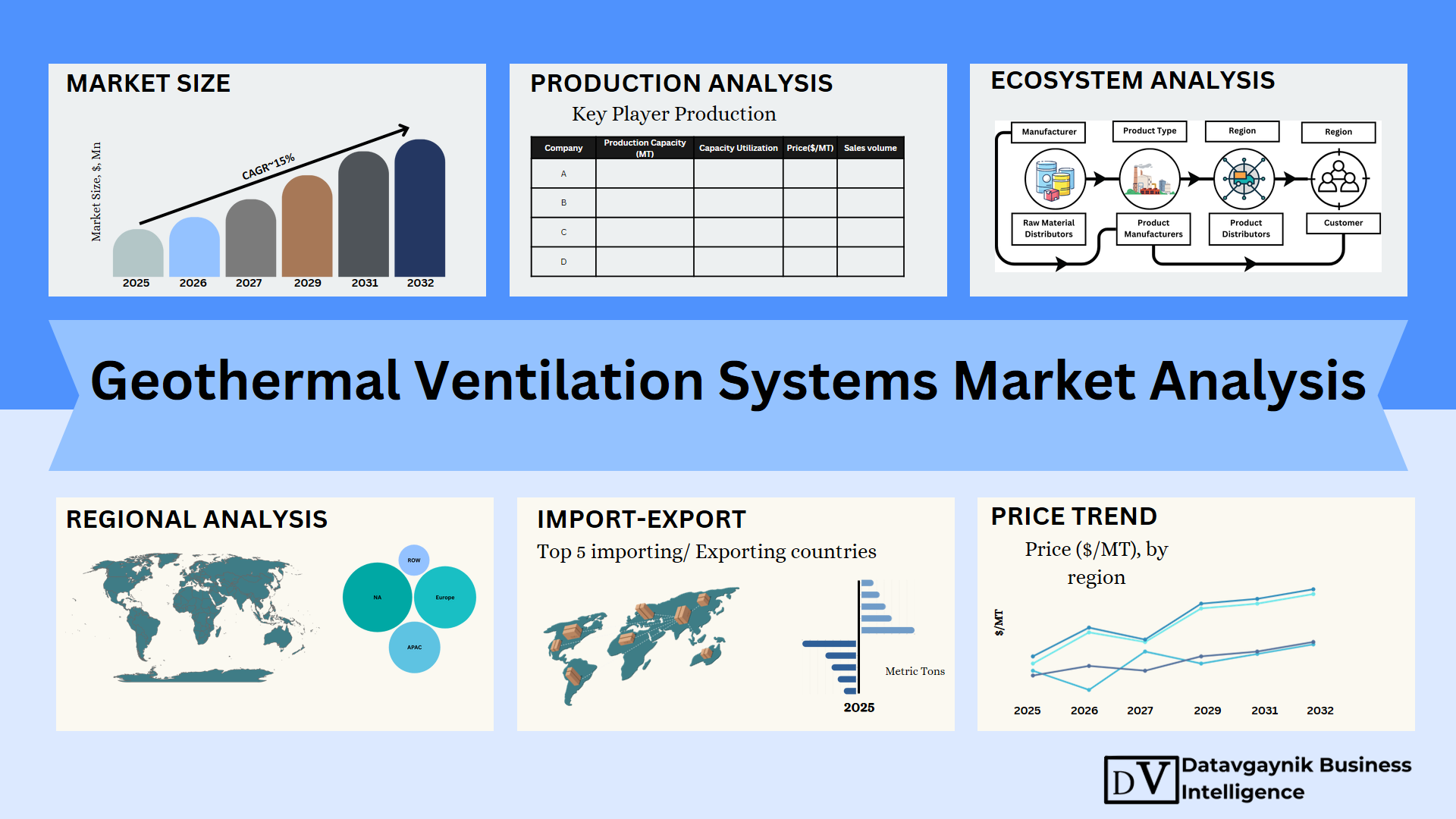
Northern Europe, the United States, Canada, Germany, Switzerland, and parts of China account for the strongest adoption base for Geothermal Ventilation Systems because these markets combine high heating-load buildings, established heat pump installers, and buyers willing to invest in ground-source infrastructure for long operating life. The global addressable market for geothermal heat pump-based ventilation and building conditioning systems is estimated at about USD 13.4 billion in 2026, expanding at a CAGR of nearly 9.4% through 2035, when the market is projected to reach about USD 30.1 billion. Demand is led by residential retrofits, schools, universities, healthcare buildings, public facilities, commercial offices, district-scale housing, and institutional campuses where geothermal ventilation is used to reduce heating and cooling energy intensity while maintaining controlled indoor air exchange.
Regional adoption is strongest where heating load, subsidy access, and installer depth overlap
Geothermal Ventilation Systems are not adopted evenly across regions. The market is strongest where buildings need long heating seasons, electricity grids can support heat pump operation, and local contractors have drilling, loop-field design, heat pump installation, and ventilation balancing capability. This explains why Sweden, Germany, Switzerland, the Netherlands, the United States, and Canada remain more relevant than warmer or low-income regions despite wider global interest in building decarbonization.
Europe is the most mature demand cluster in terms of policy-linked building heating transition. Across 16 European countries, residential heat pump sales reached about 2.62 million units in 2025, compared with 2.38 million in 2024, lifting the installed heat pump base in Europe to nearly 28 million units. This matters for geothermal ventilation because a larger heat pump service ecosystem improves buyer confidence, component availability, installer training, and after-sales support. However, the ground-source portion is more selective than air-source systems because it requires site suitability, drilling access, ground-loop design, and higher upfront capital.
Sweden is one of the clearest examples of geothermal adoption reaching a mature replacement and optimization phase. By the end of 2024, Sweden had approximately 690,000 ground-source heat pumps installed, with roughly four out of five systems using vertical closed-loop boreholes. This high installed base supports recurring demand for compressor replacements, controls upgrades, hydronic balancing, ventilation integration, and borehole-field optimization rather than only new installations. Swedish demand is therefore less about first-time awareness and more about improving seasonal performance in detached houses, multi-family housing, and public buildings.
Germany has a larger building stock but a more policy-sensitive adoption pattern. Heat pump sales weakened sharply in 2024 after a strong 2022–2023 cycle, with industry data showing a major drop linked to uncertainty around heating rules, municipal heat planning, subsidy awareness, and household investment caution. For Geothermal Ventilation Systems, this means demand remains concentrated in higher-income residential retrofits, public buildings, schools, commercial properties, and developers that can absorb design and drilling cost. Germany’s advantage is not low-cost adoption; it is engineering capacity, building renovation pressure, and a sizable base of HVAC contractors and energy consultants.
United States demand is strongest in institutional, residential retrofit, and campus-scale buildings
The United States has broad technical potential, but adoption is still fragmented by state incentives, electricity prices, drilling economics, and HVAC contractor availability. The strongest customer groups are universities, K-12 school districts, municipal buildings, military facilities, commercial campuses, and higher-income homeowners in regions with heating and cooling load balance. Geothermal Ventilation Systems are attractive in these settings because ventilation, heating, and cooling can be planned together at the building or campus level rather than as a simple furnace replacement.
In January 2024, U.S. national laboratory analysis indicated that installing geothermal heat pumps in about 70% of U.S. buildings could reduce the need for new long-distance transmission lines by 33%. This finding is important for market demand because geothermal ventilation is increasingly viewed not only as an HVAC efficiency measure but also as a grid-load management tool. Ground-source systems reduce peak heating and cooling demand compared with many conventional systems, which is relevant for utilities and public-sector buyers planning electrification without overloading local distribution networks.
U.S. adoption is still constrained by project complexity. A standard air-source heat pump can be sold through a conventional HVAC channel, while a geothermal system usually requires load calculation, ground-loop sizing, drilling or trenching, permitting, and long-term service planning. This makes the sales cycle longer and shifts demand toward buyers with a total-cost-of-ownership mindset. Public schools, hospitals, and campuses are stronger customers than price-sensitive single-family homeowners because they can evaluate lifecycle savings, maintenance stability, and utility-demand impacts over 20–30 years.
Public incentives improve buyer access, but service availability still decides conversion
The United Kingdom shows how incentive design can stimulate demand even from a low installed base. The Boiler Upgrade Scheme provides upfront grants for air-source and ground-source heat pumps in England and Wales, and official statistics track applications across air-source, ground-source, shared ground-loop, and biomass categories. In 2024, industry commentary around the scheme showed applications rising strongly after grant levels improved and eligibility barriers were reduced. For geothermal ventilation, this improves buyer access, but the UK remains more air-source-led because ground-source projects need outdoor space, drilling capacity, and higher installation budgets.
The difference between subsidy availability and actual geothermal adoption is important. Grants can reduce upfront cost, but they do not create drilling crews, experienced designers, or building-level ventilation expertise overnight. Countries with mature installer networks convert policy support into installations faster. Countries with weak service coverage see slower adoption, more project delays, and stronger dependence on specialist contractors.
Application use is concentrated in buildings where ventilation quality and energy savings are both measurable
Geothermal Ventilation Systems are used mainly in buildings where controlled air exchange, thermal comfort, and energy efficiency are measurable operating requirements. Residential demand is strongest in detached houses and high-performance homes where owners are replacing oil, LPG, electric resistance heating, or aging boilers. Commercial demand is more common in offices, schools, healthcare facilities, public buildings, hotels, and institutional campuses where year-round occupancy makes energy savings easier to justify.
Schools and universities are particularly strong applications because ventilation quality affects occupant comfort, while heating and cooling costs are recurring budget items. Ground-source systems also suit facilities with available land, sports fields, courtyards, parking areas, or campuses where boreholes or horizontal loops can be installed without disrupting dense urban infrastructure. Healthcare and senior-care buildings are relevant because they require stable indoor air quality, year-round comfort, and dependable mechanical systems, but procurement is more conservative because uptime, commissioning quality, and maintenance support are critical.
Regional constraints keep the market concentrated rather than mass-market
The main constraint is upfront cost. Geothermal ventilation linked with ground-source heat exchange requires higher initial spending than conventional HVAC or air-source systems. Drilling cost, loop-field design, site assessment, ground conditions, permitting, and labor availability determine whether a project is feasible. This naturally favors countries with high energy prices, strong policy support, and customers that understand lifecycle economics.
Urban density is another limitation. Dense cities may have high building energy demand, but limited land access can restrict loop-field installation. Shared ground loops, district-scale systems, and borehole fields under public land can address this, but they require coordination among developers, utilities, municipalities, and building owners. As a result, adoption is often faster in suburban institutional campuses, Nordic residential areas, and public-sector retrofit programs than in dense private apartment stock.
The market also depends heavily on service quality. Poorly sized systems, weak commissioning, or inadequate ventilation integration can reduce performance and damage buyer confidence. This makes certification, contractor training, and post-installation monitoring more important than simple product availability. Mature markets such as Sweden benefit from accumulated installation experience, while emerging markets need stronger design standards, installer training, and financing models before geothermal ventilation can move beyond premium or institutional projects.
Overall, regional demand for Geothermal Ventilation Systems remains concentrated in countries where high heating demand, decarbonization pressure, installer capability, and long-term building ownership overlap. Europe provides the strongest installed-base signal, Sweden shows the clearest ground-source maturity, Germany offers scale but policy-sensitive demand, and the United States provides large technical potential led by institutional and campus-scale buyers. The market is expanding, but it remains service-intensive, specification-driven, and constrained by site feasibility rather than being a simple plug-in HVAC replacement market.
Country-level segmentation shows why geothermal ventilation adoption is deeper in selected building markets
Geothermal Ventilation Systems are segmented less by simple equipment category and more by building condition, ground access, ownership model, and service availability. In mature countries, closed-loop systems dominate because they offer predictable operation, lower water-permitting exposure, and suitability for residential and institutional buildings. Open-loop systems are more selective because they depend on aquifer access, water quality, discharge rules, and local environmental approvals. Hybrid geothermal systems, where ground-source heat exchange is paired with auxiliary boilers, chillers, air handlers, heat recovery ventilation, or building automation, are more common in commercial and campus-scale projects.
The United States remains one of the most project-diverse markets. Residential demand is concentrated in the Northeast, Midwest, Pacific Northwest, and parts of the Mountain states where heating and cooling loads justify higher upfront system cost. Commercial demand is stronger in schools, colleges, municipal buildings, military facilities, and healthcare campuses. The U.S. channel is contractor-led rather than retail-led: manufacturers supply through distributors and certified geothermal installers, while drillers and mechanical contractors decide project feasibility. For large buildings, the buying process usually involves consulting engineers, energy service companies, utility incentives, and facilities managers.
Canada follows a similar cold-climate pattern but with stronger demand logic in detached housing, indigenous community infrastructure, public facilities, and provincial energy-efficiency programs. Demand is concentrated in Ontario, Quebec, British Columbia, and parts of Alberta where electricity access, heating costs, and building retrofit programs influence adoption. Canadian buyers also place higher value on winter reliability because air-source heat pump efficiency can fall during extreme cold. Ground-source systems remain more attractive where customers want stable performance below freezing and lower exposure to outdoor equipment icing.
Sweden is the benchmark country for high installed-base penetration. The market is not only driven by new system sales; it is also supported by replacement of older heat pump units, borehole reuse, compressor upgrades, control-system modernization, and ventilation balancing in existing homes. Swedish adoption is stronger than most European countries because detached houses often have suitable plots, electricity-based heating has long been accepted, and installer experience is deep. Vertical borehole systems dominate because they require less land than horizontal loops and are well suited to Sweden’s housing pattern and geology.
Germany has a more engineering-intensive buyer base. Adoption is strongest in new single-family homes, high-efficiency residential developments, public-sector buildings, and commercial projects where energy consultants can justify higher upfront spending. The German market is segmented by new-build versus retrofit. New-build applications are easier because underfloor heating, low-temperature distribution, and borehole planning can be designed from the start. Retrofit projects are slower because existing radiators, insulation levels, and permitting requirements affect final economics. German customers are also more sensitive to subsidy stability, installer availability, and heat planning rules.
Switzerland is a compact but high-value market. Buyer adoption is supported by high income levels, strict building efficiency norms, and strong engineering culture. Ground-source heat pumps are common in residential and multi-family buildings where long asset life and predictable performance matter. The country’s segmentation is strongly influenced by cantonal regulation, drilling approval, and building-specific energy planning. Service access is generally strong, but project approvals can be more complex than in less regulated markets.
The United Kingdom remains an underpenetrated market for geothermal ventilation compared with Nordic and Alpine countries. Ground-source installations are more common in rural homes, larger properties, estates, schools, and selected public buildings. The Boiler Upgrade Scheme improves customer affordability, but air-source heat pumps capture most grant-led residential demand because they are easier to install and require less ground work. Shared ground loops are an important UK segment because they can support terraces, apartments, and dense housing schemes, but they need developer or utility coordination rather than individual homeowner action.
China has a different market structure. Demand is more linked to district energy, public buildings, commercial complexes, government-supported clean heating, and urban infrastructure than to premium detached housing. Northern China’s heating demand creates strong potential, but projects vary widely by province, local policy, and groundwater rules. In China, system integrators and construction-linked engineering firms have a larger role than small residential installers. Ground-source ventilation and heat pump systems are more likely to be deployed as part of larger building energy systems, industrial parks, or municipal heating-cooling projects.
Japan and South Korea are smaller geothermal ventilation markets relative to their broader heat pump industries. Both countries have strong HVAC technology capability, but ground-source adoption is limited by urban density, high drilling cost, small plot sizes, and easier availability of air-source alternatives. Demand is concentrated in public buildings, demonstration projects, commercial properties, and specialized facilities requiring stable thermal performance. In these countries, geothermal ventilation competes with high-efficiency variable refrigerant flow systems, air-source heat pumps, and compact ventilation-recovery systems that fit dense urban building stock more easily.
Segmentation by product type and service model reflects site feasibility more than buyer preference
Closed-loop vertical borehole systems are the strongest product segment in mature countries because they suit limited land, offer stable seasonal performance, and reduce exposure to water withdrawal regulation. Horizontal closed-loop systems are cost-effective where land is available, especially in rural housing, schools, and low-density public buildings. Open-loop systems can deliver high efficiency but remain constrained by groundwater quality, environmental rules, and discharge requirements.
By building type, residential systems account for higher unit volume, while commercial and institutional systems generate higher project value per site. Residential customers usually buy packaged geothermal heat pumps with ducted air distribution, hydronic floor heating, domestic hot water support, or ventilation add-ons. Commercial customers buy engineered systems involving heat pumps, pumps, controls, air handlers, heat recovery, balancing, monitoring, and maintenance agreements.
By channel, the market divides into four practical routes:
- Installer-led residential sales: Dominant in the U.S., Canada, Sweden, Germany, Switzerland, and the UK. Buyer trust depends on local contractor reputation, design accuracy, and post-installation service.
- Engineering consultant and mechanical contractor route: Common in schools, healthcare buildings, offices, and campuses where design documentation and lifecycle cost analysis are required.
- Public procurement and retrofit program route: Important in municipal buildings, education estates, social housing, and government-funded decarbonization projects.
- Developer or utility-led shared loop model: Growing in dense housing and multi-building projects where one ground loop can support multiple buildings or dwellings.
Service coverage is the real separator between mature and emerging markets. A manufacturer can ship heat pump equipment into most countries, but geothermal ventilation requires site assessment, drilling, loop installation, pressure testing, antifreeze charging, commissioning, ventilation balancing, controls setup, and long-term diagnostics. Countries with trained installers and local drillers can scale projects faster. Countries without these skills experience higher project cost, delays, and lower buyer confidence.
Regional availability is shaped by drilling capacity, installer certification, and building ownership
Availability is strongest in markets where HVAC contractors, borehole drillers, energy consultants, and equipment distributors operate together. Sweden and Switzerland have strong ecosystem depth relative to population. The United States has strong supplier availability but uneven regional service depth because geothermal contractors are concentrated in specific states and utility territories. Germany has strong technical capacity, but household demand has been affected by policy uncertainty, financing conditions, and broader construction-market weakness.
Distribution is not comparable with mass HVAC products. Geothermal units may move through wholesalers, manufacturer representatives, or direct commercial channels, but the project is not complete without local installation capacity. Inventory behavior also differs. Air-source heat pumps can be stocked by distributors for high-volume replacement demand. Ground-source units are more often specified by capacity, loop configuration, building load, and application, so lead times depend on equipment configuration and contractor scheduling.
Replacement demand is emerging as a meaningful revenue source in mature countries. Ground loops can last several decades, so older systems can be upgraded by replacing indoor heat pump units, pumps, controls, and ventilation interfaces without rebuilding the entire underground infrastructure. This makes Sweden, parts of Canada, and mature U.S. geothermal states attractive for service revenue even when new construction slows.
Regional supplier ecosystem is split between equipment manufacturers and project delivery specialists
The supplier ecosystem for Geothermal Ventilation Systems is not limited to heat pump manufacturers. It includes ground-source heat pump brands, water-source HVAC manufacturers, drilling contractors, loop-field designers, pump suppliers, heat recovery ventilation vendors, building automation providers, mechanical contractors, energy service companies, and public-sector procurement consultants. Market access depends on how well these participants work together at local level.
In North America, WaterFurnace, ClimateMaster, Bosch Thermotechnology, Carrier, Trane, Enertech, and Modine-related water-source and geothermal offerings are widely recognized in residential and commercial ground-source systems. WaterFurnace has a strong residential and commercial geothermal identity, with systems such as its 7 Series residential product line positioned around forced-air heating, cooling, and domestic hot water contribution. ClimateMaster is prominent in water-source and geothermal heat pump technology, particularly across commercial and institutional applications. Bosch has a broader heating and building technology portfolio and offers ground-source equipment in selected markets.
North American competitive strength is strongly linked to dealer networks. Buyers rarely select geothermal systems purely by brand; they select the contractor who designs and installs the system. This gives established local dealers, geothermal-certified installers, and experienced drilling partners a strong influence on equipment selection. For commercial projects, mechanical engineers and energy consultants influence the approved vendor list, while public entities often specify efficiency, warranty, commissioning, and service requirements.
In Europe, NIBE, Bosch, Vaillant, Viessmann, Stiebel Eltron, OCHSNER, Danfoss-related components, Alpha Innotec, Thermia, and regional specialists have stronger visibility. NIBE has deep relevance in Nordic markets where ground-source systems are well established, and its product positioning is tied to heating, cooling, hot water, and indoor climate control. Bosch’s Compress ground-source heat pump range supports its position in Germany and wider European modernization projects. Vaillant, Viessmann, and Stiebel Eltron benefit from brand trust in hydronic heating markets, installer familiarity, and residential retrofit channels.
European competition is more fragmented than the largest brand lists suggest. In Sweden and Switzerland, local installers and established regional distributors can hold strong local influence even when equipment brands are multinational. In Germany, buyer confidence often depends on whether the installer can manage the full package: heat pump selection, borehole coordination, heating distribution adjustment, controls, and subsidy documentation.
China’s supplier ecosystem is more project-led. Large HVAC companies, building energy contractors, construction groups, and regional engineering firms participate in ground-source heat pump and ventilation projects. Procurement is often linked to public buildings, district heating and cooling, commercial complexes, and municipal clean-heating programs. The competitive advantage lies less in household dealer networks and more in project execution, local government access, engineering capability, and ability to integrate geothermal heat exchange with building systems.
Japan and South Korea have strong HVAC manufacturers, but geothermal ventilation remains a specialized segment. Mitsubishi Electric, Daikin, Panasonic-linked HVAC ecosystems, and local engineering firms have technical capability, but high-density urban construction often favors compact air-source and VRF systems. Geothermal suppliers must therefore compete on lifecycle efficiency, public-building credentials, and site-specific performance rather than broad residential channel reach.
Pricing and margin behavior reflects installation complexity rather than equipment alone
Price competition in Geothermal Ventilation Systems is not driven only by heat pump unit cost. Drilling, trenching, loop materials, pumps, manifolds, indoor distribution, ducting or hydronic upgrades, heat recovery ventilation, controls, commissioning, and permitting can account for a large part of the final installed price. This is why two systems with similar heat pump capacity can have very different installed costs across countries or even within the same city.
Manufacturers face margin pressure from compressors, refrigerants, electronic controls, logistics, and distributor inventory cycles. Installers face pressure from labor cost, drilling availability, permitting delays, and customer financing limits. Commercial projects can support higher engineering margins, but they also require more documentation, performance guarantees, and commissioning discipline. Residential projects are more volume-dependent and more sensitive to subsidy changes.
Replacement economics are more favorable in mature installed-base markets. Once a ground loop exists, replacing the indoor geothermal heat pump is usually less disruptive than the original installation. This supports recurring demand for indoor units, circulation pumps, expansion tanks, controls, sensors, and ventilation-system upgrades. Service providers with installed-base records have an advantage because they can target aging systems before failure.
Recent developments shaping geothermal ventilation demand and access
- January 2024, United States: ORNL and NREL analysis found that geothermal heat pumps installed in about 70% of U.S. buildings could reduce the need for new long-distance transmission lines by 33%. This strengthens the grid-planning argument for geothermal ventilation in public buildings, campuses, and utility-supported efficiency programs.
- February 2024, United States: Oak Ridge National Laboratory published further analysis on geothermal heat pump deployment through 2050, linking building electrification, grid reliability, and reduced energy-system cost. This supports institutional procurement where lifecycle energy impact is part of project evaluation.
- March 2025, Switzerland: The HEAPO dataset covering 1,408 Swiss households with heat pumps and 410 field inspection protocols highlighted the importance of optimization, commissioning, and skilled service. For geothermal ventilation, this reinforces the role of diagnostics and performance tuning after installation.
- October 2025, Europe: European Heat Pump Association data showed heat pump sales in 13 European countries increased by 9% in the first half of 2025 after a weak 2024. This improved distributor sentiment and helped reduce uncertainty in installer pipelines.
- March 2026, Europe: EHPA preliminary data showed 2.62 million residential heat pumps sold across 16 European countries in 2025, taking Europe’s installed heat pump base to around 28 million units. This broader heat pump recovery supports geothermal ventilation through contractor training, customer awareness, and component availability.
- March 2026, United Kingdom: UK heat pump deployment statistics continued to track Boiler Upgrade Scheme activity, with ground-source heat pumps included alongside air-source and shared ground-loop categories. The grant structure improves buyer access, but ground-source adoption remains dependent on property type, land access, and installer availability.


