

Expanding High-Tech Applications Driving Getter Adsorbents Market Demand
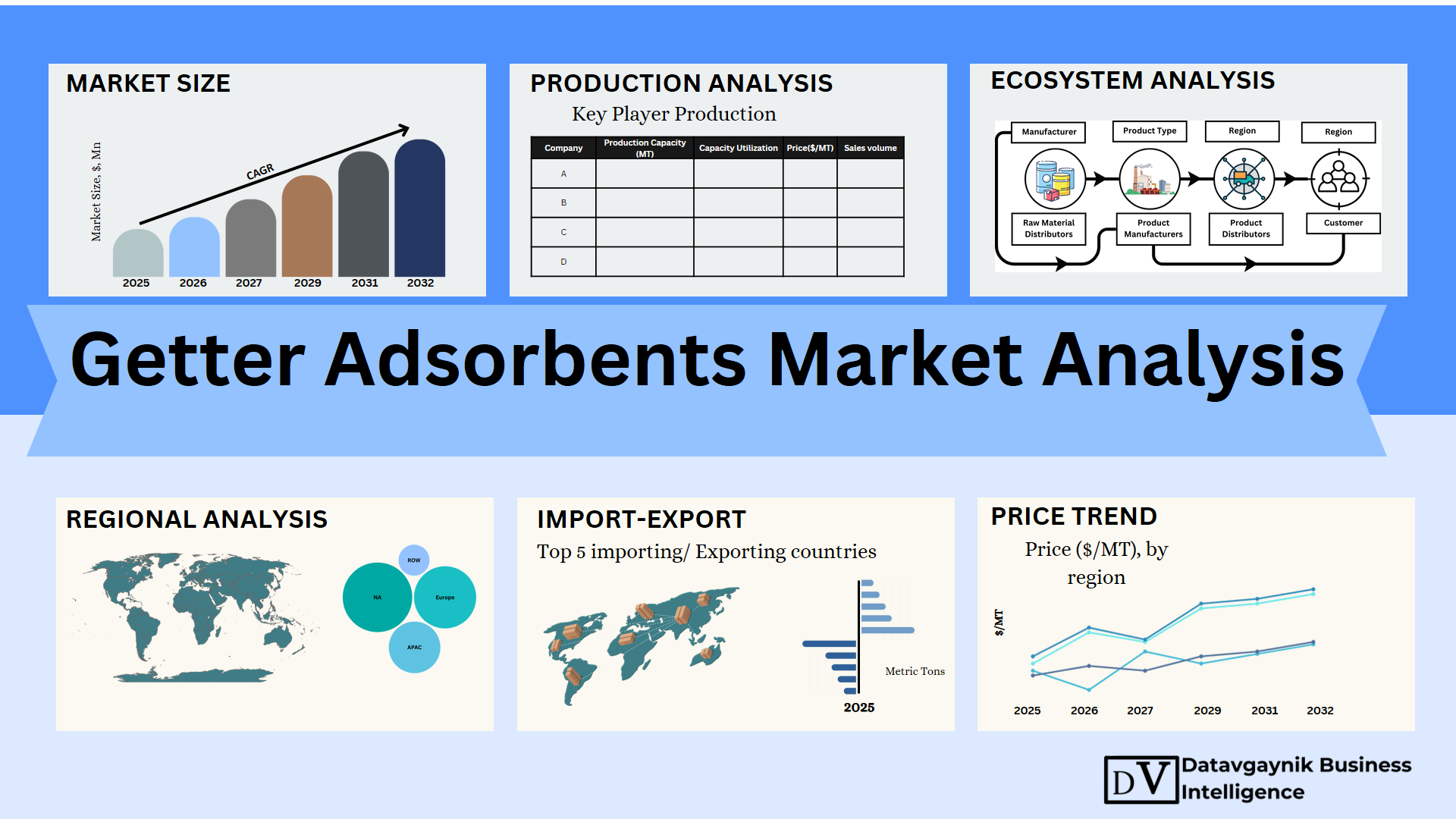
The Getter Adsorbents Market is undergoing a dynamic transformation, fueled by the exponential growth of industries demanding ultra-pure operational environments. For instance, the semiconductor and microelectronics sector, a cornerstone of the global digital economy, is expected to reach a market size of over $1 trillion by 2030. In such a precision-dependent industry, even trace amounts of gas or moisture can disrupt functionality. Getter adsorbents, which remove residual gases like oxygen, nitrogen, or water vapor, have become indispensable in fabrication facilities. As next-generation technologies like 3nm chips and quantum processors emerge, the application of getter adsorbents in ultra-clean chambers is expected to surge.
This trend is further accentuated by the rise of OLED technology, advanced photonics, and miniaturized sensors in consumer electronics, all of which require enhanced protection from atmospheric contaminants. In these environments, getter adsorbents are not optional—they are integral to device stability and yield optimization. As a result, the Getter Adsorbents Market Size is projected to grow consistently at a CAGR above 7% through the forecast period.
Surging Demand from the Electric Vehicle and Energy Storage Sector
The rapid electrification of transport and energy infrastructure is a fundamental catalyst for the Getter Adsorbents Market. The global electric vehicle stock exceeded 40 million units in 2024, up from 26 million in 2022, showcasing a double-digit annual growth rate. With each lithium-ion battery requiring stringent moisture and gas control mechanisms to prevent degradation and ensure longevity, getter adsorbents play a critical role.
For instance, the internal environment of EV battery packs must remain chemically stable for thousands of charge-discharge cycles. Getter adsorbents are deployed within battery modules to capture volatile gases, particularly hydrogen and water vapor, which are byproducts of electrochemical reactions. Additionally, utility-scale energy storage systems—expected to surpass 400 GWh in capacity by 2030—employ getter materials to preserve energy efficiency and operational safety over prolonged periods.
This strong momentum in the global energy transition directly translates to increased consumption of advanced getter materials, making energy storage one of the most robust verticals in the Getter Adsorbents Market.
Precision Requirements in Aerospace and Defense Strengthen Getter Adsorbents Market
High-reliability environments such as aerospace and defense demand materials that function flawlessly under extreme conditions. In satellites, for example, temperature fluctuations, vacuum conditions, and exposure to radiation can compromise sensitive instrumentation. Getter adsorbents are used to maintain internal vacuums and absorb any outgassing from onboard electronics or structural materials, ensuring mission-critical performance.
With over 3,500 active satellites in orbit and space launch activities increasing at a CAGR of 15%, the aerospace segment represents a consistent and expanding application area for getter technologies. Moreover, defense systems, particularly in missile guidance units, night vision optics, and advanced radar systems, require compact and ultra-reliable getter solutions to preserve operational accuracy. As global defense budgets expand, the Getter Adsorbents Market finds increasing demand for durable and high-performance materials across airborne and space-based platforms.
Rising Adoption in Medical Devices and Healthcare Infrastructure
The medical industry’s reliance on sterility, longevity, and precision creates fertile ground for getter adsorbent applications. In implantable devices such as pacemakers and cochlear implants, getter adsorbents are deployed to prevent internal condensation and gas accumulation, which could otherwise cause device failure. Similarly, advanced imaging equipment like MRI and CT scanners contain getter materials to maintain vacuum integrity in sensor units and protect sensitive components.
The global medical device market, valued at over $570 billion in 2024, is expanding rapidly with an increasing demand for home-based diagnostics and wearable health tech. Getter adsorbents are also vital in pharmaceutical packaging, where they help maintain drug efficacy by protecting contents from humidity and oxygen infiltration. The integration of getter adsorbents in moisture-sensitive biosensors and diagnostic cartridges further cements their position in next-gen medical applications, propelling the Getter Adsorbents Market forward.
Environmental Regulations and Compliance Fuel Industrial Demand
Industries across the board are under mounting pressure to reduce emissions, enhance process purity, and comply with stricter environmental standards. Getter adsorbents provide a clean, passive method to capture undesirable gases without introducing additional chemicals or emissions. For instance, in catalytic converters and industrial gas purification systems, getter materials are employed to remove reactive impurities before they can enter the environment or corrode equipment.
Countries in the EU and North America are tightening VOC and particulate emission guidelines across sectors, from automotive to pharmaceuticals. These regulatory shifts are creating a mandatory market for gas purification systems that often rely on getter-based materials. As a result, the Getter Adsorbents Market is increasingly seen as an enabler of green manufacturing and sustainable operations, especially where high-precision emissions control is required.
Technological Innovation Enhancing Getter Adsorbents Market Efficiency
Ongoing innovations in material science have elevated the performance capabilities of getter adsorbents. For example, hybrid getter materials—combining metallic and non-metallic compositions—offer enhanced specificity for targeted gases, longer operational life, and compatibility with advanced electronics. This evolution allows getter adsorbents to be tailored for niche applications, such as flexible electronics, quantum computing components, and next-generation biomedical devices.
Nanostructured getter coatings, which can be integrated as films directly onto device surfaces, are transforming the way moisture and gas control is managed in compact environments. These developments are reducing system weight and size, which is particularly important for aerospace and implantable medical devices. Such technological shifts are reinforcing the competitiveness and value proposition of the Getter Adsorbents Market in high-tech applications.
Emerging Markets Accelerating Regional Expansion in Getter Adsorbents Market
While developed economies in North America, Europe, and East Asia have historically led in getter adsorbent adoption, emerging markets are rapidly catching up. For instance, India’s semiconductor fabrication initiatives and EV manufacturing targets are drawing international investment, creating new demand centers for getter materials. Similarly, Southeast Asian countries such as Vietnam, Malaysia, and Thailand are strengthening their electronics manufacturing ecosystems, fueling regional market expansion.
These nations are investing in local production of electronics, medical devices, and energy storage technologies—all sectors heavily reliant on getter adsorbents. As production shifts eastward to take advantage of cost efficiencies and market proximity, the global Getter Adsorbents Market is seeing a redistribution of growth potential, prompting suppliers to diversify their operational footprints.
IoT, AI, and Sensor Proliferation Bolstering Long-Term Growth
The rise of connected ecosystems and artificial intelligence is giving rise to billions of smart sensors embedded in environments ranging from autonomous vehicles to precision agriculture systems. These sensors operate in sealed packages and harsh environments where gas buildup can impair accuracy. Getter adsorbents are used within sensor housings to control humidity, prevent corrosion, and extend operational life.
With the global sensor market expected to exceed $300 billion by 2030, the need for micro-scale gas control solutions is creating vast opportunities in the Getter Adsorbents Market. As more industries transition to data-driven and automated platforms, the integration of getter technology into IoT hardware becomes increasingly non-negotiable.
“Track Country-wise Getter Adsorbents Production and Demand through our Getter Adsorbents Production Database”
-
-
- Getter Adsorbents production database for 30+ countries worldwide
- Getter Adsorbents Powder sales volume for 31+ countries
- Country-wise Getter Adsorbents production capacity and production plant mapping, production capacity utilization for 30+ manufacturers
- Getter Adsorbents production plants and production plant capacity analysis for top manufacturers
-
North America: Advanced Industries Fueling Getter Adsorbents Market Growth
In North America, the Getter Adsorbents Market is experiencing substantial growth, driven by the region’s leadership in aerospace, semiconductor manufacturing, and life sciences. The United States accounts for the largest share in the regional market, supported by its expanding semiconductor fabrication capacity. For instance, U.S. chip production investments surged past $50 billion in 2024, and every new fabrication unit relies heavily on getter materials to maintain ultra-pure processing environments.
Additionally, the region’s robust aerospace sector, led by defense contractors and space exploration firms, incorporates getter adsorbents in satellites, aircraft avionics, and propulsion systems. As space launches increased by over 20% year-over-year, the demand for high-performance getter materials also rose. Medical device manufacturing in the U.S., particularly for implantables and diagnostics, further boosts regional consumption of getter adsorbents, solidifying North America’s strategic role in the global market.
Europe: Sustainability and Innovation Reinforcing Getter Adsorbents Market
Europe remains a pivotal region in the Getter Adsorbents Market, underpinned by its rigorous environmental regulations and advanced industrial base. Germany, France, and the United Kingdom lead in deploying getter technologies across automotive, renewable energy, and pharmaceutical sectors. For example, Germany’s electric vehicle production crossed 1.3 million units in 2024. Each EV battery system integrates getter adsorbents to extend cell life and enhance thermal stability.
France’s dominance in aerospace, especially through its space programs and aircraft manufacturing, contributes significantly to regional demand. Moreover, Europe’s focus on green hydrogen and fuel cell technologies increases the requirement for getter materials that support gas purification and system reliability. The region’s commitment to sustainability encourages R&D into recyclable and eco-efficient getter materials, strengthening long-term market dynamics.
Asia Pacific: Epicenter of Global Getter Adsorbents Market Expansion
Asia Pacific has emerged as the fastest-growing region in the Getter Adsorbents Market, driven by massive industrialization, technological upgrades, and domestic manufacturing capabilities. China leads with dominant shares, primarily due to its booming electronics and energy storage industries. With the country producing over 60% of the world’s lithium-ion batteries, the use of getter adsorbents in battery packs, modules, and related systems is extensive.
Japan and South Korea maintain strong positions due to their advanced semiconductor and precision electronics sectors. Japanese companies are also at the forefront of developing ultra-high-purity getter films and hybrid materials. In India, the growing focus on local electronics and EV manufacturing under national policies is accelerating the demand for getter technologies. Southeast Asia’s emergence as a global electronics assembly hub further boosts regional market opportunities, particularly for low-cost, high-efficiency getter solutions.
Latin America and Middle East: Emerging Frontiers for Getter Adsorbents Market
While relatively smaller in volume, Latin America and the Middle East are showing promising potential in the Getter Adsorbents Market. Brazil and Mexico are expanding their automotive and healthcare infrastructure, incorporating getter adsorbents in EV battery development and medical packaging. Meanwhile, the Middle East’s growing investment in aerospace, especially in satellite-based communications and defense, has created new market opportunities.
Countries like the UAE and Saudi Arabia are investing in space research and clean energy, fostering an ecosystem that demands advanced gas purification solutions. These emerging markets are also importing getter technologies for application in oil & gas processing systems, where gas control and purity are critical to safety and operational efficiency.
Getter Adsorbents Market Segmentation by Product Type and Form
The Getter Adsorbents Market can be segmented by type into metallic, non-metallic, and hybrid getters. Metallic getters, such as those made from zirconium or titanium alloys, dominate high-temperature and vacuum-intensive applications like aerospace and semiconductor fabs. Non-metallic variants, including zeolites and activated carbon, are primarily used in moisture-sensitive industries like pharmaceuticals and diagnostics.
Hybrid getters are witnessing rapid adoption, especially in environments that demand a combination of moisture absorption and reactive gas control. These are used in advanced lithium battery systems, space electronics, and flexible displays. In terms of form, pellet and granular forms dominate bulk industrial applications. Powdered getter adsorbents are preferred in high-surface-area use cases such as microelectronics. Films and coatings are growing in medical and defense sectors due to their minimal weight and space requirements.
Getter Adsorbents Market Segmentation by Application Area
Segmentation by application reveals a diversified Getter Adsorbents Market, with the semiconductor industry commanding the highest share due to the need for vacuum and contaminant-free environments in lithography and wafer processing. This is followed by energy storage systems—both grid and mobility-based—where getter adsorbents are essential for performance optimization.
In the healthcare sector, getter adsorbents are applied in MRI systems, implantable devices, and drug containers. Aerospace and defense represent a high-value segment where performance reliability justifies premium-grade getter products. Industrial applications, such as catalytic converters and vacuum pumps, continue to use getter materials for process stabilization and equipment protection.
Getter Adsorbents Price and Regional Production Dynamics
Getter Adsorbents Price varies considerably depending on type, form, and purity level. Metallic getter materials such as zirconium alloys can range between $200–$500 per kilogram, depending on the specific alloy composition and application requirements. Non-metallic options such as zeolites are significantly more cost-effective, with prices between $30–$80 per kilogram, primarily used in bulk desiccation processes.
Getter Adsorbents Price Trend shows a gradual upward movement over the past three years, primarily due to the rising cost of raw materials like rare earth metals and increased energy prices affecting production. Additionally, with demand accelerating from EV battery manufacturing and high-performance computing, manufacturers are facing supply constraints that are pushing prices upward, especially for high-purity variants.
China remains the largest producer, exporting large volumes of mid-range and premium getter materials. Japan and South Korea focus more on high-tech applications, producing niche formulations with stringent quality controls. In Europe, production emphasizes environmentally sustainable and REACH-compliant getter materials, while the U.S. caters predominantly to defense, aerospace, and biotech industries.
Supply Chain and Strategic Sourcing Trends in Getter Adsorbents Market
As the Getter Adsorbents Market matures, supply chain resilience is becoming a key concern. Geopolitical tensions, particularly between major trading partners, have led to procurement diversification. For instance, companies previously reliant on Chinese imports for getter powders are now sourcing from South Korea and establishing joint ventures in India to secure local production.
Vertical integration is gaining traction, with semiconductor and battery manufacturers either acquiring getter firms or forming exclusive partnerships. This not only secures supply but allows better customization of getter materials to match specific environmental and technical needs. Such strategic sourcing trends are influencing both Getter Adsorbents Price and long-term vendor relationships.
Technology Integration Creating Value in Getter Adsorbents Market
The Getter Adsorbents Market is being reshaped by technological advancements such as nanostructured materials and additive manufacturing. Companies are now producing micro-coatings that can be printed directly onto substrates, reducing waste and enhancing performance. These innovations are particularly impactful in miniaturized medical implants and wearable tech.
Getter sensors—integrated with digital feedback mechanisms—are also being explored to monitor saturation levels and predict maintenance needs. This is proving invaluable in defense and aerospace where preventive diagnostics are crucial. As such, the incorporation of smart technologies is adding a value-based pricing tier to the Getter Adsorbents Price Trend, pushing certain segments into premium pricing categories.
Conclusion: Strategic Outlook for Getter Adsorbents Market
In summary, the Getter Adsorbents Market is on an accelerated growth path, underpinned by technological innovation, geographic expansion, and rising demand across high-purity application sectors. Regional dynamics are shifting, with Asia Pacific setting the pace, while Europe and North America focus on quality and sustainability. Emerging markets are adding new layers of demand, especially in automotive and aerospace technologies.
Getter Adsorbents Price will continue to reflect pressures from raw material scarcity, application-specific customization, and premiumization through innovation. Firms that invest in R&D, secure raw material sources, and build resilient global supply chains will command a strategic advantage in this evolving market landscape.
“Getter Adsorbents Manufacturing Database, Getter Adsorbents Manufacturing Capacity”
-
-
- Getter Adsorbents top manufacturers market share for 30+ manufacturers
- Top 9 manufacturers and top 19 manufacturers of Getter Adsorbents in North America, Europe, Asia Pacific
- Production plant capacity by manufacturers and Getter Adsorbents production data for 30+ market players
- Getter Adsorbents production dashboard, Getter Adsorbents production data in excel format
-
Leading Manufacturers in the Global Getter Adsorbents Market
The Getter Adsorbents Market is shaped by a concentrated group of manufacturers that supply both standard and application-specific materials for global industries. These companies are differentiated not only by scale but also by the sophistication of their product portfolios, their focus on R&D, and their ability to support high-performance end-use sectors such as semiconductors, aerospace, and energy storage.
SAES Getters S.p.A., based in Italy, is widely recognized as one of the most influential players in the global getter adsorbents market. The company holds a strong presence in both metallic and hybrid getter technologies, supporting applications in medical devices, displays, vacuum systems, and advanced electronics. Its product line includes offerings such as St 707, a high-capacity alloy used extensively in vacuum tubes and cathode ray tubes, and the Gettersorb family, specifically developed for gas purification in lithium batteries and sensor modules.
Japan-based Mitsubishi Materials Corporation is another key player, especially known for its high-performance zirconium-based getter solutions. The company services semiconductor, optical, and hydrogen storage markets. Mitsubishi Materials offers specialized powder and pellet forms for ultra-high vacuum conditions and is steadily expanding its footprint in energy storage applications, including solid-state batteries and fuel cells.
Shenzhen Sinter Metal Co., Ltd. is a major Chinese manufacturer that has scaled up rapidly, primarily driven by strong domestic demand. The company focuses on sintered porous getter products, widely used in OLED displays and LED backlighting systems. Shenzhen Sinter has capitalized on China’s massive electronics production ecosystem and offers cost-effective yet high-efficiency getters for mass production environments.
VACUUMSCHMELZE GmbH, headquartered in Germany, contributes significantly to the European getter adsorbents market with specialized solutions for magnetic shielding and hermetically sealed electronic components. The company provides getter rings and strips designed for aerospace, defense, and high-end medical technologies where dimensional stability and long-term performance are paramount.
Advanced Technology & Materials Co., Ltd. (AT&M), a Chinese high-tech enterprise, produces a wide array of metallic getter products, including titanium and zirconium-based pellets and powders. AT&M serves key sectors such as renewable energy, petrochemicals, and high-purity gas applications. Its role in China’s Made in China 2025 initiative has further enhanced its position in the global supply chain for getter technologies.
Praxair Surface Technologies (now part of Linde Group) also contributes to the global market through advanced coating-based getter solutions. These are used in extreme vacuum applications such as X-ray tubes, electron beam welding systems, and analytical instrumentation. The company’s focus is on high-purity, surface-treated getter solutions customized for next-generation semiconductors and high-energy devices.
Getter Adsorbents Market Share by Manufacturer
The global Getter Adsorbents Market remains moderately consolidated, with the top five manufacturers accounting for approximately 55 to 60 percent of the total market share. SAES Getters alone controls nearly 20 percent of the global market, largely due to its first-mover advantage, extensive patent portfolio, and vertically integrated manufacturing operations across Europe and Asia.
Mitsubishi Materials Corporation commands an estimated 12 to 14 percent of the market, with a stronghold in high-purity and application-specific getters. The company’s emphasis on research-based development and supply chain reliability contributes to its global relevance, particularly in the semiconductor and energy sectors.
Chinese players like Shenzhen Sinter and AT&M collectively account for roughly 15 to 18 percent of the market share, benefiting from lower production costs and massive domestic demand. These companies have been expanding their export footprint, targeting Southeast Asia, the Middle East, and Africa.
VACUUMSCHMELZE maintains a 6 to 8 percent share, primarily in niche and customized product segments that demand European precision and reliability. The company’s focus on high-accuracy and stability-driven applications makes it a preferred partner in defense and aerospace markets.
Smaller manufacturers and regional players make up the remaining 40 percent, competing on specialization, pricing, and agility. Many of these companies focus on low-volume, high-customization applications, particularly for universities, research labs, and pilot-scale production facilities.
Notable Product Offerings in the Getter Adsorbents Market
SAES Getters’ St 707 and GPDC lines are widely adopted in consumer electronics, medical implants, and space-grade applications. These products are recognized for their long-term gas absorption efficiency, ease of integration, and minimal maintenance requirements.
Mitsubishi Materials’ zirconium-aluminum alloy getters are notable for their ultra-high purity, which is critical in lithography chambers and vacuum furnaces. Their getter pellets and strips are available in variable geometries and are often customized for OEM partners in the semiconductor supply chain.
AT&M’s high-capacity getter cartridges are used in vacuum interrupters, fuel cells, and hydrogen purification systems. These are particularly relevant in China’s push for green hydrogen and sustainable industrial infrastructure.
Shenzhen Sinter’s sintered disk getters are standard components in television backlights, OLED modules, and consumer sensor assemblies. Their high-volume production capability supports global electronics brands through third-party suppliers and OEMs.
Recent News and Developments in the Getter Adsorbents Market
In March 2024, SAES Getters announced the expansion of its manufacturing facility in Lainate, Italy, with a focus on hybrid getter materials. The facility is expected to be operational by late 2025 and will increase the company’s capacity for lithium battery and display applications by 30 percent.
In January 2025, Mitsubishi Materials signed a strategic partnership agreement with a South Korean EV battery manufacturer to co-develop getter materials optimized for solid-state battery cells. The collaboration includes joint R&D labs and plans to begin commercial production by mid-2026.
Shenzhen Sinter launched a new production line for compact sintered getter modules in September 2024, targeting high-density microelectronics. The line is capable of producing over 5 million units annually and supports advanced packaging solutions used in smartphones and wearables.
In November 2024, VACUUMSCHMELZE introduced a new series of getter rings designed specifically for low-orbit satellites. These are engineered to withstand harsh space environments and provide consistent vacuum sealing performance for over 15 years of orbital operation.
In April 2025, AT&M unveiled its titanium-based getter powders for hydrogen fuel stations in China. The products are aimed at extending the lifespan of hydrogen purification systems and improving system uptime in urban mobility hubs.
This strategic landscape underscores the evolving nature of the getter adsorbents market, where product innovation, vertical integration, and global reach determine leadership. The industry is moving toward increasingly specialized solutions aligned with the next generation of energy, healthcare, and electronics technologies. Manufacturers that invest in tailored product lines and forward-integrated collaborations are expected to retain competitive advantages in this rapidly advancing global market.
“Getter Adsorbents Production Data and Getter Adsorbents Production Trend, Getter Adsorbents Production Database and forecast”
-
-
- Getter Adsorbents production database for historical years, 10 years historical data
- Getter Adsorbents production data and forecast for next 9 years
-
Market Scenario, Demand vs Supply, Average Product Price, Import vs Export, till 2035
- Global Getter Adsorbents Market revenue and demand by region
- Global Getter Adsorbents Market production and sales volume
- United States Getter Adsorbents Market revenue size and demand by country
- Europe Getter Adsorbents Market revenue size and demand by country
- Asia Pacific Getter Adsorbents Market revenue size and demand by country
- Middle East & Africa Getter Adsorbents Market revenue size and demand by country
- Latin America Getter Adsorbents Market revenue size and demand by
- Import-export scenario – United States, Europe, APAC, Latin America, Middle East & Africa
- Average product price – United States, Europe, APAC, Latin America, Middle East & Africa
- Market player analysis, competitive scenario, market share analysis
- Business opportunity analysis
Key questions answered in the Global Getter Adsorbents Market Analysis Report:
- What is the market size for Getter Adsorbents in United States, Europe, APAC, Middle East & Africa, Latin America?
- What is the yearly sales volume of Getter Adsorbents and how is the demand rising?
- Who are the top market players by market share, in each product segment?
- Which is the fastest growing business/ product segment?
- What should be the business strategies and Go to Market strategies?
The report covers Getter Adsorbents Market revenue, Production, Sales volume, by regions, (further split into countries):
- Asia Pacific (China, Japan, South Korea, India, Indonesia, Vietnam, Rest of APAC)
- Europe (UK, Germany, France, Italy, Spain, Benelux, Poland, Rest of Europe)
- North America (United States, Canada, Mexico)
- Latin America (Brazil, Argentina, Rest of Latin America)
- Middle East & Africa
Table of Contents:
Getter Adsorbents Market:
- Executive Summary
- Key Highlights of the Getter Adsorbents Market
- Strategic Insights for Industry Stakeholders
- Summary of Market Trends and Future Prospects
- Introduction to Getter Adsorbents
- Definition and Functional Role in Industrial Applications
- Key Characteristics and Mechanisms of Action
- Importance of Getter Adsorbents in Modern Technologies
- Historical Development and Market Evolution
- Timeline of Getter Adsorbent Technology Development
- Milestones in Material Science and Innovation
- Evolution of Market Demand Across Industries
- Types of Getter Adsorbents
- Classification Based on Material Composition (Metal-Based, Non-Metallic, Hybrid)
- Product Variants by Application (Gas Purification, Electronics, Vacuum Systems)
- Comparative Analysis of Performance Metrics
- Global Getter Adsorbents Market Overview (2020–2040)
- Market Size, Revenue, and Growth Projections
- Key Market Dynamics: Drivers, Challenges, and Opportunities
- Emerging Trends and Technological Innovations
- Key Market Drivers and Restraints
- Industrial Demand in Semiconductor, Aerospace, and Healthcare Sectors
- Impact of Environmental and Safety Regulations
- Technological Advancements Boosting Market Growth
- Material Science Innovations in Getter Adsorbents
- Advanced Compositions for Enhanced Efficiency
- Nanotechnology Applications in Getter Materials
- Research & Development Trends and Breakthroughs
- Global Market Segmentation
- By Product Type: Metallic Getters, Non-Evaporable Getters (NEG), Chemical Getters
- By Application: Electronics, Energy Storage, Pharmaceuticals, Vacuum Systems
- By End-User Industry: Semiconductor, Healthcare, Industrial Manufacturing
- Regional Market Analysis
- North America: Market Dynamics, Key Players, and Growth Forecast
- Europe: Innovation Landscape and Regulatory Influence
- Asia-Pacific: Rapid Expansion in Electronics and Manufacturing Sectors
- Latin America: Emerging Markets and Growth Opportunities
- Middle East & Africa: Industrial Growth and Technological Adoption
- Competitive Landscape and Market Positioning
- Global Market Share Analysis of Leading Companies
- Company Profiles, Product Portfolios, and Strategic Initiatives
- Competitive Strategies: Mergers, Acquisitions, and Partnerships
- Production Analysis and Manufacturing Trends
- Overview of Production Processes and Technologies
- Global Production Capacities and Facility Distribution
- Cost Structure and Operational Efficiency Analysis
- Supply Chain Dynamics and Logistics
- Raw Material Sourcing and Supplier Landscape
- Distribution Channels and Supply Chain Challenges
- Risk Mitigation Strategies in Global Supply Chains
- Pricing Analysis and Market Profitability
- Historical and Current Pricing Trends
- Factors Influencing Price Fluctuations
- Regional Pricing Dynamics and Margin Analysis
- Trade and Global Export-Import Dynamics
- Key Exporting and Importing Countries
- Global Trade Policies Impacting the Market
- Analysis of Trade Flow and Market Accessibility
- Demand Analysis and Market Consumption Patterns
- Sector-Wise Demand Analysis
- Consumption Trends in High-Growth Industries
- Emerging Applications Driving Market Expansion
- End-Use Industry Insights
- Semiconductor Industry: Demand for Ultra-Pure Environments
- Healthcare and Pharmaceutical Applications
- Energy Sector: Role in Battery Technology and Fuel Cells
- Environmental Impact and Sustainability Trends
- Eco-Friendly Getter Adsorbent Technologies
- Sustainability Practices in Production and Usage
- Regulatory Compliance and Environmental Impact Assessments
- Market Risks and Challenges
- Supply Chain Vulnerabilities and Raw Material Shortages
- Technological Obsolescence and Competitive Pressures
- Regulatory Challenges in Global Markets
- Investment Landscape and Strategic Opportunities
- Emerging Investment Opportunities by Region
- Venture Capital and Private Equity Trends
- Strategic Recommendations for New Market Entrants
- Impact of Global Events on Getter Adsorbents Market
- Effects of Global Crises (e.g., COVID-19) on Production and Demand
- Geopolitical Events Influencing Supply Chains
- Economic Trends and Their Impact on Market Dynamics
- Future Outlook and Market Forecast (2025–2040)
- Long-Term Growth Projections and Trends
- Technological Innovations Shaping the Future
- Strategic Roadmap for Market Growth and Development
- Technological Advancements and R&D Landscape
- Key Research Areas and Innovations in Getter Technology
- Patent Analysis and Technological Roadmap
- Role of Academic and Industrial Collaborations in Innovation
- Case Studies and Success Stories
- Best Practices from Leading Companies
- Lessons Learned from Industry Pioneers
- Impact of Strategic Innovations on Market Leadership
- Appendices
- Glossary of Technical Terms
- Research Methodology and Data Sources
- List of Tables, Figures, and Graphs
Other recently published reports:

