

Surging Industrial Demand Propelling the Analcime Market
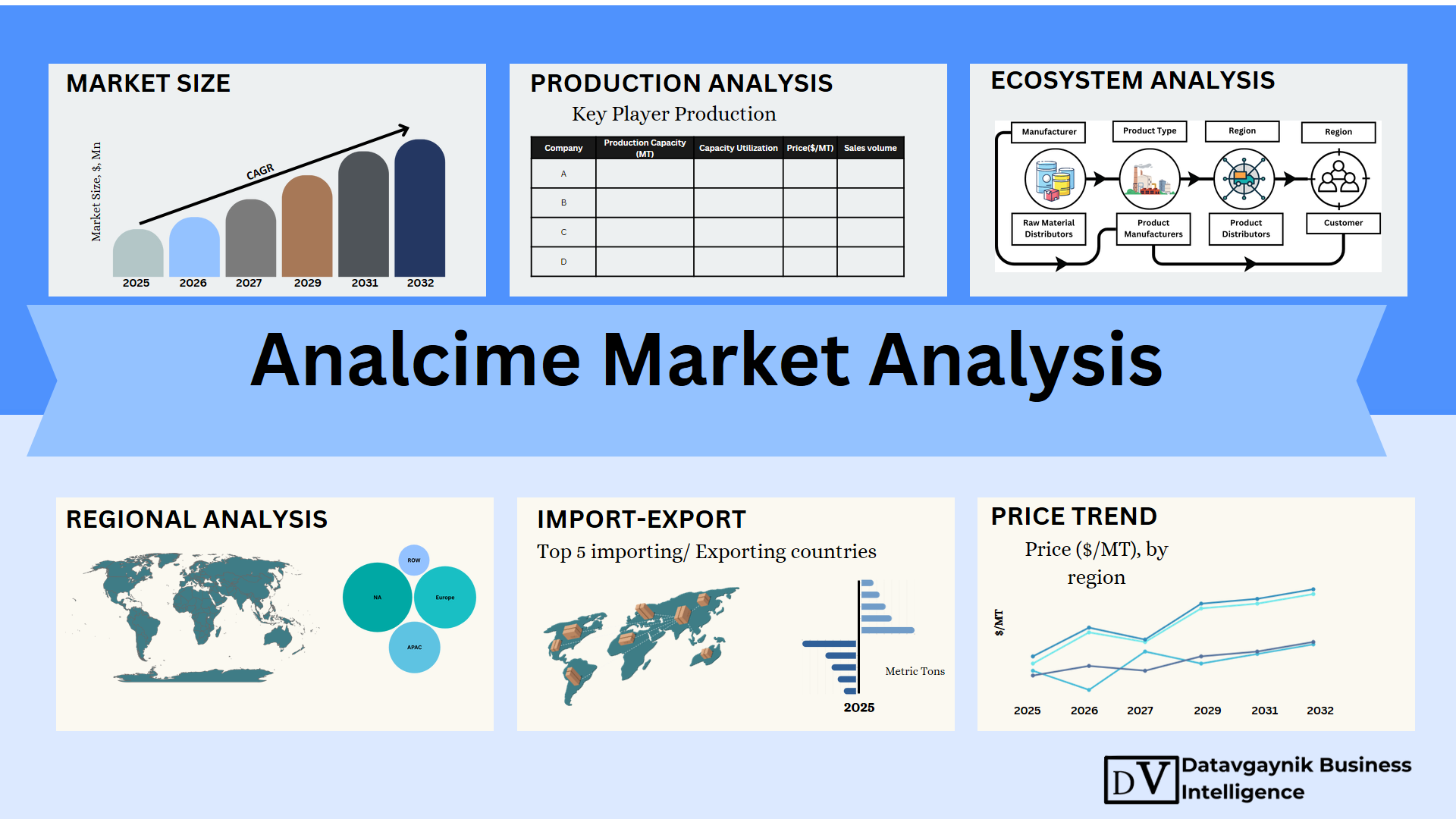
The analcime market is experiencing rapid expansion, propelled by global shifts toward sustainable materials, increased regulatory scrutiny on emissions, and a widespread demand for efficient industrial solutions. Datavagyanik reports that this naturally occurring zeolite mineral is gaining traction across sectors due to its superior ion-exchange, adsorption, and catalytic properties. These features are being leveraged in a growing number of applications such as water treatment, petrochemical refining, sustainable construction, and agriculture.
The analcime market size is projected to grow significantly between 2024 and 2032, underpinned by rising investments in green infrastructure and environmental technologies. For instance, global investment in water and wastewater treatment crossed 300 billion USD in 2023, and the increasing replacement of synthetic chemicals with natural alternatives such as analcime is contributing directly to this market’s growth trajectory.
Environmental Technologies Driving the Global Analcime Market
Environmental concerns are a primary driver for the analcime market. As governments and industries worldwide seek sustainable solutions for pollution and resource scarcity, analcime is emerging as a key material in water and air purification systems. For example, its ion-exchange capacity enables the removal of heavy metals, ammonium, and organic pollutants from contaminated water sources, making it ideal for municipal and industrial treatment plants.
In the United States, over 2 billion pounds of toxic waste are discharged into waterways annually, prompting stricter enforcement by the Environmental Protection Agency. These regulations are encouraging utilities and manufacturers to adopt natural zeolite-based technologies, directly contributing to demand in the analcime market. Similarly, in India and China, where water pollution and shortages are critical issues, local governments are promoting the use of natural minerals in decentralized filtration systems.
Petrochemical Sector Embracing Catalytic Applications in the Analcime Market
The petrochemical industry is another significant contributor to the analcime market, particularly through its use of analcime as a catalyst in refining operations. With its high thermal stability and reactivity, analcime is utilized in processes such as fluid catalytic cracking to boost output and lower emissions. For example, Saudi Arabia and the United Arab Emirates have implemented refinery upgrades aligned with sustainability goals, in which natural zeolites are being used to replace more toxic and less efficient synthetic catalysts.
The global refining catalyst market, valued at approximately 4.5 billion USD in 2023, is forecast to grow steadily through 2030. A rising share of this demand is being captured by eco-friendly, mineral-based alternatives like analcime. Datavagyanik notes that this shift is reshaping the competitive dynamics of the analcime market, especially in high-growth petrochemical regions such as the Middle East and Asia-Pacific.
Sustainable Construction Trends Catalyzing the Analcime Market
Construction is rapidly emerging as one of the most dynamic sectors within the analcime market. As countries implement stricter energy efficiency standards for buildings, there is increasing reliance on lightweight, thermally insulating materials. Analcime is being incorporated into concrete mixes and pozzolanic additives to enhance insulation, structural integrity, and environmental performance.
For instance, the European Union’s directive that all new buildings be nearly zero-energy by 2030 has fueled a spike in demand for advanced mineral-based building materials. In Western Europe alone, sustainable construction projects are increasing by over 15 percent annually. This trend is directly influencing growth in the analcime market as builders seek non-toxic, high-performance alternatives to traditional additives.
Agricultural Innovation Boosting the Analcime Market Globally
The agriculture sector is adopting analcime for its ability to improve soil moisture retention, nutrient availability, and crop yield. Particularly in regions facing climate stress, such as Sub-Saharan Africa and the Middle East, analcime is being deployed to improve the efficiency of irrigation and fertilization. In Morocco and Egypt, for example, government-supported pilot programs have shown that analcime-based soil treatments can increase crop yields by up to 20 percent in arid zones.
Livestock farming is also contributing to growth in the analcime market. Animal feed supplemented with analcime can reduce ammonia emissions by as much as 25 percent while improving nutrient absorption. With the global livestock industry valued at over 1.5 trillion USD and growing demand for sustainable practices, these benefits are positioning analcime as a key input in future farming systems.
Healthcare and Cosmetics Applications Expanding the Analcime Market
Healthcare and personal care represent emerging frontiers within the analcime market. The mineral’s non-toxic, antimicrobial, and absorptive properties are being evaluated for use in medical dressings, drug delivery platforms, and personal hygiene products. In Japan, research into analcime-based wound gels has demonstrated improved healing rates and lower infection risks compared to traditional treatments.
The global market for natural and mineral-based cosmetics is projected to surpass 79 billion USD by 2030. As consumers become increasingly wary of synthetic chemicals, brands in Europe and North America are introducing analcime-infused formulations in deodorants, face masks, and skincare creams. Datavagyanik notes that this trend is opening new revenue streams in the analcime market by connecting mineral performance with consumer wellness.
Energy and Gas Separation Technologies Supporting the Analcime Market
Clean energy and gas separation applications are also contributing to rising demand in the analcime market. The mineral’s capacity for gas adsorption makes it valuable in technologies related to hydrogen storage, carbon capture, and natural gas purification. For instance, in Qatar and South Korea, analcime is being used to filter carbon dioxide and sulfur compounds from natural gas pipelines, enhancing energy efficiency and reducing emissions.
As the global hydrogen economy grows—expected to surpass 210 billion USD by 2030—the need for safe and scalable storage materials is becoming critical. Analcime’s ability to store hydrogen at a molecular level is being explored in pilot projects across Europe and East Asia, positioning the mineral as a valuable asset in the transition toward green energy.
Analcime Market Size Poised for Strong Regional Growth
Datavagyanik identifies the Asia-Pacific region as the fastest-growing contributor to the global analcime market. China leads the way with large-scale deployment of analcime in water treatment, agriculture, and construction. India is also seeing rapid adoption, particularly in agriculture and rural water infrastructure. The region’s accelerating urbanization and industrial development are expected to drive double-digit growth in the analcime market over the next five years.
In North America, the United States is focusing on environmental remediation and sustainable construction, both of which support analcime usage. Meanwhile, Europe’s focus on clean energy, green buildings, and sustainable farming practices ensures continued demand. Countries such as Germany, France, and the Netherlands are advancing pilot programs for high-purity analcime applications in air purification and medical technologies, further expanding the market’s value.
“Track Country-wise Analcime Production and Demand through our Analcime Production Database”
-
-
- Analcime production database for 23+ countries worldwide
- Analcime sales volume for 28+ countries
- Country-wise Analcime production capacity, production plant mapping, production capacity utilization for 23+ manufacturers
- Analcime production plants and production plant capacity analysis by top manufacturers
-
“Track real-time Analcime Prices, Analcime price charts for 23+ countries, Analcime weekly price tracker and Analcime monthly price tracker”
-
-
- Track real-time Analcime prices and Analcime price trend in 23+ countries though our excel-based Analcime price charts
- Real-time Analcime price tracker dashboard with 23+ countries
- Complete transparency on Analcime price trend through our Analcime monthly price tracker, Analcime weekly price tracker
-
Asia-Pacific Leading the Global Analcime Market with Industrial Scale and Resource Depth
The Asia-Pacific region is currently the most dominant force in the analcime market, accounting for the largest share in both production and consumption. Datavagyanik highlights China as the world’s primary producer, leveraging vast natural zeolite reserves and an expansive industrial base. For instance, China’s rapid infrastructure development, valued at over 2.5 trillion USD annually, has driven high-volume use of analcime in green construction materials and wastewater treatment.
In India, the analcime market is expanding due to surging demand in agriculture, where the mineral is being integrated into soil conditioning practices to combat drought and salinity. India’s Ministry of Agriculture reported a 30 percent increase in adoption of mineral-based soil enhancers in 2023, a large portion of which includes natural zeolites like analcime. Additionally, the expansion of rural water treatment initiatives under India’s Jal Jeevan Mission has created new demand for analcime-based filtration technologies, particularly in states facing chronic groundwater contamination.
Japan and South Korea are also playing a key role in the high-purity synthetic analcime market. These countries are investing heavily in research and development for advanced energy systems, gas separation technologies, and healthcare applications. For example, South Korean companies are using high-grade analcime in carbon capture systems and clean hydrogen projects, which are projected to exceed 50 billion USD in cumulative investments by 2030. This wave of innovation is reinforcing Asia-Pacific’s leadership in the global analcime market.
North America’s Diversified Industrial Base Strengthening the Analcime Market
North America is a mature yet evolving market for analcime, with growing interest in sustainable industrial materials. The United States leads the regional analcime market due to its use in water treatment, construction, and petrochemicals. For instance, over 85 percent of municipal water systems in the western U.S. are seeking natural filtration alternatives due to concerns over chemical contamination and rising treatment costs. Analcime’s cost-effectiveness and safety profile make it a preferred choice.
In the refining sector, U.S.-based petrochemical giants are upgrading catalytic units to meet carbon reduction mandates, creating sustained demand for natural mineral catalysts. Datavagyanik estimates that the U.S. analcime market could grow at a CAGR of 6.2 percent through 2030, fueled by infrastructure modernization and regulatory incentives tied to green technologies.
Canada, meanwhile, is focusing on agricultural and environmental applications. Provinces such as Alberta and Saskatchewan are seeing increased deployment of analcime in livestock feed and soil management systems. Additionally, Canadian construction companies are incorporating analcime-based additives into energy-efficient building projects under the Green Building Strategy, supporting regional market growth.
Europe’s Regulatory and Sustainability Focus Driving the Analcime Market
Europe is emerging as a strategic region for high-value applications in the analcime market, particularly in sectors aligned with the EU’s Green Deal and climate action plans. Germany remains the regional leader, integrating analcime into advanced water treatment systems to remove nitrates, phosphates, and heavy metals. The German government has earmarked over 10 billion USD for municipal water infrastructure upgrades through 2027, creating robust demand for natural adsorbents like analcime.
France is focusing on agricultural innovation, especially in reducing fertilizer dependency. The analcime market in France is gaining ground as farmers adopt natural soil conditioners that enhance nutrient efficiency and water retention. In parallel, the cosmetics sector is introducing mineral-rich formulations using analcime, capitalizing on consumer demand for non-toxic and environmentally friendly products.
Italy and the Netherlands are key contributors to the construction segment within the European analcime market. These countries are pushing forward with sustainable building codes that mandate the use of low-carbon materials, giving analcime a strategic role as a lightweight, thermally efficient concrete additive. Eastern European nations such as Poland and Hungary are also expanding use in wastewater management and agro-industrial systems, supported by EU regional development funding.
Middle East Analcime Market Strengthened by Desalination and Energy Infrastructure
The Middle East presents unique conditions driving demand across the analcime market, particularly in water treatment and petrochemical industries. With countries like Saudi Arabia and the United Arab Emirates investing heavily in desalination and wastewater recycling, the need for natural, regenerable filtration media is rising sharply.
Saudi Arabia, for example, has committed more than 50 billion USD in water projects by 2030 under its Vision 2030 program. Analcime is being deployed in these systems for its ability to trap ammonia, nitrates, and heavy metals, outperforming traditional media in lifecycle cost and sustainability. At the same time, the region’s expanding refining sector is integrating analcime-based catalysts into hydrogen and low-emission fuel processes.
Qatar and Kuwait are focusing on gas separation and emissions reduction, especially in natural gas production. The analcime market in these countries is evolving in tandem with large-scale environmental engineering projects that rely on zeolite-type minerals to reduce flaring emissions and optimize gas quality.
Latin America’s Agricultural Focus Creating Opportunities in the Analcime Market
Latin America is a rapidly developing analcime market, with agriculture at the center of demand. Countries like Brazil, Argentina, and Chile are integrating analcime into soil fertility programs aimed at reducing chemical inputs and improving sustainability. Datavagyanik notes that mineral-based soil enhancers can cut water usage by up to 25 percent, a critical advantage in drought-prone areas of the continent.
In Brazil, large agri-businesses are piloting the use of analcime in sugarcane and soybean fields to optimize irrigation and nutrient delivery. The government’s low-carbon agriculture plan (ABC+) is incentivizing such transitions with tax credits and subsidies, creating an enabling environment for market growth. Additionally, Chile’s mining and construction sectors are using analcime-based materials in tailings management and green building projects, diversifying its application base.
Global Segmentation of the Analcime Market by Product and Application
The analcime market is segmented primarily into natural and synthetic types. Natural analcime, mined from zeolite-rich deposits, is used extensively in agriculture, water treatment, and construction due to its cost-effectiveness and wide availability. Synthetic analcime, produced under controlled conditions, caters to high-purity applications in petrochemicals, gas separation, and medical technologies.
By application, the market is further segmented into water treatment, petrochemical refining, construction materials, agriculture and livestock, healthcare, and energy systems. Datavagyanik identifies water treatment as the fastest-growing segment, followed closely by agriculture and petrochemical refining. The integration of analcime into environmental management technologies is transforming it from a niche mineral to a mainstream industrial input.
Analcime Price and Analcime Price Trend Influenced by Supply Chain Dynamics
The analcime price landscape is shaped by production method, purity level, transportation costs, and regional demand fluctuations. As of Q1 2025, natural analcime prices range between 200 and 350 USD per ton, depending on grade and supplier proximity. Synthetic analcime, due to higher production costs, commands prices ranging from 600 to 900 USD per ton for high-purity material used in catalysis and gas applications.
Analcime price trend data from Datavagyanik reveals a gradual increase of 4 to 6 percent annually over the past three years, driven by tight supply conditions in some regions and surging demand from green infrastructure projects. For instance, the analcime price in Europe rose by 7 percent in 2024 due to strong demand in the construction and personal care sectors coupled with elevated energy costs for synthetic production.
Asia-Pacific maintains the most competitive analcime price due to abundant reserves and lower labor costs. However, the analcime price trend in China is showing signs of upward pressure due to stricter environmental controls on mining operations. In North America, prices are relatively stable but expected to climb by 5 percent in 2025 as industrial applications expand and logistics costs remain volatile.
In the Middle East, the analcime price trend is heavily influenced by import dependencies. Saudi Arabia and the UAE, for example, import both raw and processed analcime, which has led to price variability depending on supplier country and freight routes. Latin America’s analcime price structure remains favorable, especially for bulk purchases tied to agricultural cooperatives and infrastructure initiatives.
Production and Export Dynamics Reshaping the Analcime Market
Global analcime production is concentrated in regions with significant natural deposits, particularly China, Turkey, the United States, and parts of Eastern Europe. Synthetic production is largely limited to industrialized nations like Japan, South Korea, and Germany due to the technology and capital requirements.
Datavagyanik reports that China leads global exports of natural analcime, supplying major markets in Europe, the Middle East, and Latin America. Japan and South Korea dominate exports of synthetic, high-purity analcime used in energy and healthcare applications. The United States is both a consumer and exporter, sending surplus material to Canada and Mexico while importing specialty grades from Asia.
Trade patterns in the analcime market are increasingly influenced by geopolitical considerations, trade tariffs, and environmental regulations. As countries prioritize domestic supply chains and sustainable sourcing, local production investments are expected to increase, particularly in Europe and North America. This shift could rebalance the global analcime price trend and create new competition in historically import-dependent markets.
“Analcime Manufacturing Database, Analcime Manufacturing Capacity”
-
-
- Analcime top manufacturers market share for 23+ manufacturers
- Top 6 manufacturers and top 13 manufacturers of Analcime in North America, Europe, Asia Pacific
- Analcime production plant capacity by manufacturers and Analcime production data for 23+ market players
- Analcime production dashboard, Analcime production data in excel format
-
“Analcime price charts, Analcime weekly price tracker and Analcime monthly price tracker”
-
-
- Factors impacting real-time Analcime prices in 18+ countries worldwide
- Analcime monthly price tracker, Analcime weekly price tracker
- Real-time Analcime price trend, Analcime price charts, news and updates
- Tracking Analcime price fluctuations
-
Top Manufacturers Driving the Analcime Market Expansion
The analcime market is witnessing robust involvement from a mix of global chemical giants and regional players specializing in zeolites and industrial minerals. These manufacturers are catering to the surging demand across construction, petrochemicals, agriculture, and environmental sectors. Leading players in the analcime market include BASF SE, Honeywell UOP, Tosoh Corporation, Clariant AG, Arkema Group, Zeolyst International, Blue Pacific Minerals, St. Cloud Mining Company, and Bear River Zeolite. Each of these companies has carved a strategic position by developing targeted analcime product lines for specific industries.
BASF SE is known for offering synthetic zeolite-based materials, including analcime, tailored for use in catalytic converters, refining systems, and industrial gas purification. Their portfolio includes mineral catalysts used in fluid catalytic cracking (FCC) and hydrocracking, both of which benefit from the high thermal stability of analcime.
Honeywell UOP provides a broad suite of zeolite molecular sieves, including analcime variants, widely used in gas separation, desulfurization, and emissions reduction technologies. Their products support oil refineries and chemical processing facilities in optimizing energy efficiency and complying with emission standards.
Clariant AG supplies specialized zeolite products integrated into water treatment systems, construction materials, and personal care formulations. Their product lines include functional mineral additives that improve structural performance, reduce thermal transfer, and control microbial activity — all capabilities relevant to the expanding analcime market.
Tosoh Corporation, headquartered in Japan, has a strong focus on high-purity synthetic zeolites for healthcare, pharmaceutical, and gas separation applications. Their analcime-based molecular sieves are integral to high-value systems used in oxygen concentrators, cleanroom air filtration, and drug delivery platforms.
Arkema Group emphasizes sustainability in its product lines, offering analcime-based additives for paints, coatings, and eco-efficient concrete blends. Their approach aligns with rising demand for green materials in Europe and North America, giving them a competitive edge in environmentally conscious markets.
Analcime Market Share by Leading Manufacturers
The analcime market remains moderately fragmented, with no single manufacturer commanding an overwhelming share. However, a few players dominate based on their technological capabilities, global supply chains, and specialization in high-purity materials. BASF SE, Honeywell UOP, and Clariant AG collectively account for an estimated 30–35 percent of the global synthetic analcime market, particularly in the industrial, petrochemical, and water treatment segments.
In the natural analcime segment, regional players such as St. Cloud Mining Company and Bear River Zeolite have maintained a strong presence in North America by serving agricultural and environmental markets. These companies supply large volumes of untreated or minimally processed analcime, especially for use in livestock feed, soil conditioning, and filtration media.
Tosoh Corporation holds a leading position in high-purity synthetic analcime, particularly in Asia-Pacific, where demand for medical-grade and semiconductor-grade minerals continues to rise. Their market share is significant in applications involving clean energy and healthcare technologies.
Zeolyst International is a notable player with expertise in catalyst-grade zeolites, supplying the petrochemical and refining industries. Their product offerings include analcime variations with tailored porosity and surface characteristics that improve chemical process efficiency and emission control.
In Europe, smaller firms such as Zeocem and SÜD-CHEMIE are expanding their foothold through regional distribution partnerships and specialized formulations for construction and agricultural applications. These firms are focusing on sustainability credentials, offering products with life-cycle benefits and reduced environmental impact.
Analcime-Based Product Lines Across the Value Chain
Across the analcime market, product differentiation plays a crucial role. Manufacturers are developing specific lines based on application needs, such as:
- Catalytic Grade Analcime: Used by BASF, Honeywell, and Zeolyst for refining, gas conversion, and hydrogen separation.
- Construction Grade Analcime: Offered by Arkema and regional firms in Europe for use in lightweight concrete and pozzolanic cement mixes.
- Agricultural Grade Analcime: Supplied by Bear River Zeolite and St. Cloud Mining for use in livestock feed and soil amendments.
- Medical and Cosmetic Grade Analcime: Developed by Tosoh Corporation and Clariant for wound care gels, deodorants, and skincare products.
These specialized product lines are supported by R&D investments, technical services, and customer education programs, allowing manufacturers to target niche yet rapidly growing end-use segments.
Recent Developments in the Analcime Market and Industry Activities
Recent activities in the analcime market point to a sharp focus on circular economy strategies and industrial innovation. Notable developments include:
- In late 2023, two European materials companies announced a collaboration to upcycle analcime sand — a byproduct from lithium hydroxide production — into additives for sustainable building materials. This initiative aims to reduce waste while creating value from secondary materials, strengthening the role of analcime in the green construction sector.
- In mid-2024, a leading petrochemical player in South Korea completed a pilot-scale deployment of analcime-based molecular sieves in its hydrogen purification facility. The success of this test phase has led to expansion plans that will include industrial-scale integration in 2025.
- In early 2025, a U.S.-based startup specializing in agricultural technologies received funding to scale its analcime-infused soil enhancer pellets, targeting drought-prone areas in the Midwest. The formulation demonstrated a 15 percent increase in moisture retention and a 10 percent rise in yield during initial trials.
- A Japanese healthcare company recently announced a new line of analcime-based antimicrobial dressings, set for commercial release by Q4 2025. The product leverages the mineral’s adsorption capabilities to reduce infection risk in chronic wound treatment.
- Across the Middle East, desalination plant upgrades scheduled through 2026 are increasingly incorporating analcime filtration media due to its superior ammonia-binding capacity. Procurement contracts awarded in late 2024 signal increased regional uptake.
These developments suggest that the analcime market is transitioning from traditional bulk mineral supply toward high-performance, value-added applications. Manufacturers that can deliver tailored products with proven environmental and economic benefits are likely to gain competitive advantage in the coming years.
“Analcime Production Data and Analcime Production Trend, Analcime Production Database and forecast”
-
-
- Analcime production database for historical years, 10 years historical data
- Analcime production data and forecast for next 7 years
- Analcime sales volume by manufacturers
-
“Track Real-time Analcime Prices for purchase and sales contracts, Analcime price charts, Analcime weekly price tracker and Analcime monthly price tracker”
-
-
- Gain control on your purchase and sales contracts through our real-time Analcime price tracker and Analcime price trend analysis
- Analcime weekly price tracker and forecast for next four weeks
- Analcime monthly price tracker and forecast for next two months
-
Market Scenario, Demand vs Supply, Average Product Price, Import vs Export, till 2032
- Global Analcime Market revenue and demand by region
- Global Analcime Market production and sales volume
- United States Analcime Market revenue size and demand by country
- Europe Analcime Market revenue size and demand by country
- Asia Pacific Analcime Market revenue size and demand by country
- Middle East & Africa Analcime Market revenue size and demand by country
- Latin America Analcime Market revenue size and demand by
- Import-export scenario – United States, Europe, APAC, Latin America, Middle East & Africa
- Average product price – United States, Europe, APAC, Latin America, Middle East & Africa
- Market player analysis, competitive scenario, market share analysis
- Business opportunity analysis
Key questions answered in the Global Analcime Market Analysis Report:
- What is the market size for Analcime in United States, Europe, APAC, Middle East & Africa, Latin America?
- What is the yearly sales volume of Analcime and how is the demand rising?
- Who are the top market players by market share, in each product segment?
- Which is the fastest growing business/ product segment?
- What should be the business strategies and Go to Market strategies?
The report covers Analcime Market revenue, Production, Sales volume, by regions, (further split into countries):
- Asia Pacific (China, Japan, South Korea, India, Indonesia, Vietnam, Rest of APAC)
- Europe (UK, Germany, France, Italy, Spain, Benelux, Poland, Rest of Europe)
- North America (United States, Canada, Mexico)
- Latin America (Brazil, Argentina, Rest of Latin America)
- Middle East & Africa
Table of Contents:
-
Introduction to the Analcime Market
1.1. Overview of Analcime and Its Properties
1.2. Importance of Analcime in Various Industries
1.3. Current Trends and Dynamics in the Analcime Market -
Market Drivers and Constraints in the Analcime Industry
2.1. Key Drivers of Demand for Analcime
2.2. Production Challenges in the Analcime Industry
2.3. Technological Advancements in Analcime Manufacturing
2.4. Market Opportunities and Emerging Trends -
Global Analcime Market Overview
3.1. Market Size and Growth Projections (2019-2032)
3.2. Global Supply and Demand Analysis for Analcime
3.3. Competitive Landscape and Key Market Players -
Regional Analysis of the Analcime Market
4.1. North America
4.1.1. U.S. and Canada Market Insights
4.1.2. Production and Consumption of Analcime in North America
4.2. Europe
4.2.1. Market Dynamics and Production Insights in Europe
4.2.2. Key Trends and Consumption Patterns in European Countries
4.3. Asia Pacific
4.3.1. Analcime Market Growth in China, India, and Japan
4.3.2. Regional Production and Demand Insights
4.4. Latin America
4.4.1. Market Trends and Production Opportunities in Latin America
4.5. Middle East & Africa
4.5.1. Growth Potential and Market Development in MEA -
Analcime Production Insights
5.1. Overview of the Analcime Production Process
5.2. Key Global Producers and Market Share Analysis
5.3. Cost Structure and Factors Influencing Analcime Production
5.4. Technological Developments and Innovations in Analcime Manufacturing -
Consumption Trends in the Analcime Market
6.1. Consumption by Industry and Region
6.2. Key End-Use Applications of Analcime (e.g., Water Treatment, Catalysis, etc.)
6.3. Regional Consumption Breakdown and Demand Insights -
Analcime Market by Product Type
7.1. Natural Analcime
7.2. Processed Analcime
7.3. Market Share by Product Category -
Production and Revenue Forecast for Analcime (2023-2032)
8.1. Production Forecast by Region
8.2. Price Forecast for Analcime and Market Trends
8.3. Long-Term Revenue and Growth Projections -
Competitive Analysis of the Analcime Market
9.1. Key Market Players and Their Market Share
9.2. Company Profiles and Strategic Insights
9.3. Competitive Landscape and Mergers & Acquisitions Trends -
Cost and Pricing Analysis for Analcime Production
10.1. Breakdown of Production Costs for Analcime
10.2. Price Fluctuations and Influencing Market Factors
10.3. Profit Margins and Competitive Pricing Strategies -
Supply Chain and Distribution of Analcime
11.1. Raw Materials and Supply Chain Structure for Analcime Production
11.2. Distribution Channels and Logistics in the Analcime Market
11.3. Challenges and Solutions in Global Supply Chain Management -
Environmental and Regulatory Considerations in Analcime Production
12.1. Environmental Impact of Analcime Mining and Manufacturing
12.2. Regulatory Framework Affecting the Analcime Market
12.3. Sustainable Practices in Analcime Production -
Conclusion and Strategic Insights for the Analcime Market
13.1. Key Trends and Future Growth Outlook
13.2. Strategic Recommendations for Market Stakeholders
13.3. Final Thoughts on Analcime Production and Market Opportunities

