

Technological Expansion Driving the Cerium (III) Fluoride Market
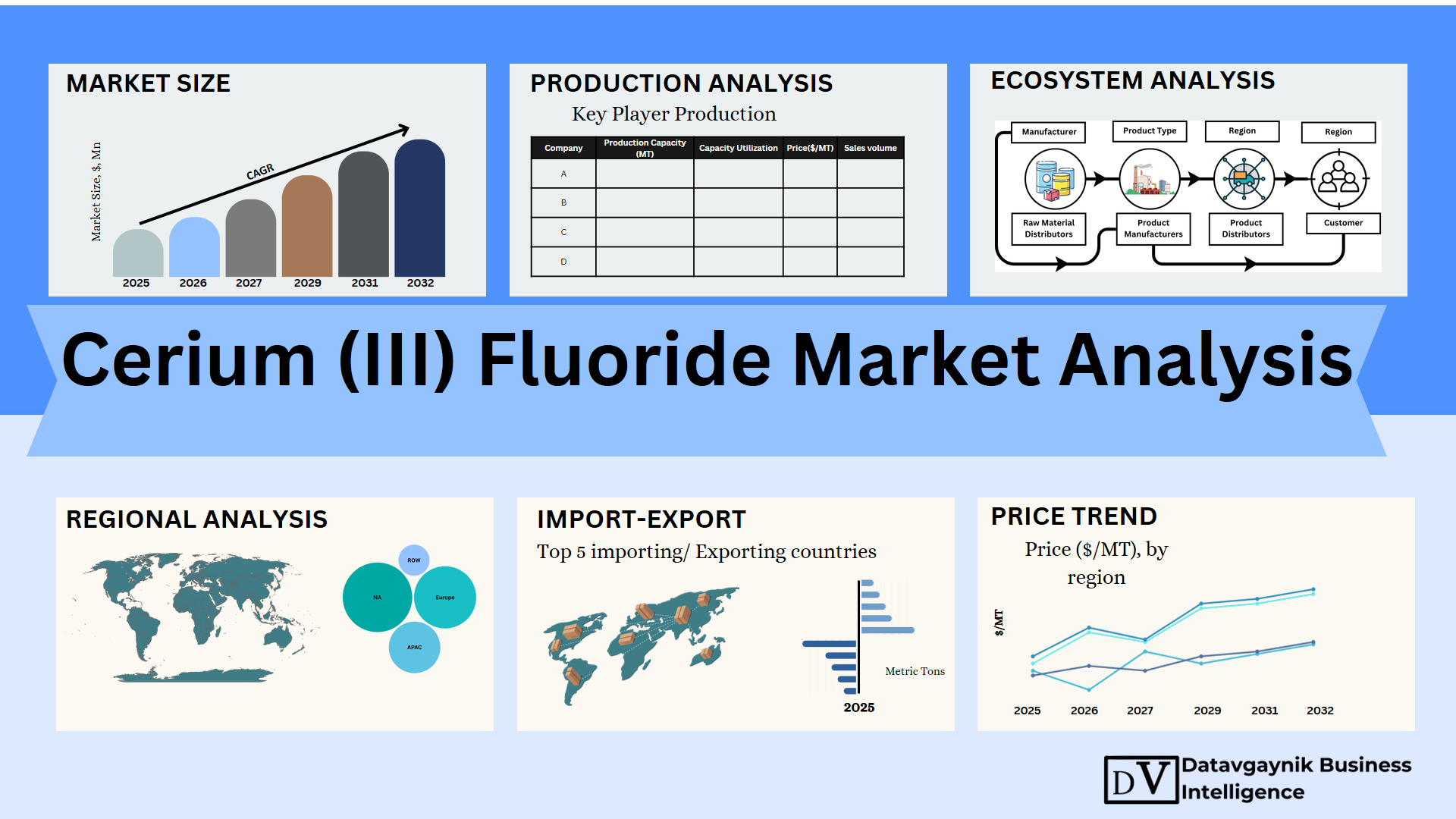
The Cerium (III) Fluoride Market is undergoing significant transformation, driven by rapid technological advancements in optics, semiconductors, and green energy sectors. As per Datavagyanik, the integration of cerium compounds into high-performance materials has positioned cerium (III) fluoride as a critical enabler of innovation. For instance, in the optical industry, the compound is heavily utilized in the production of precision lenses and specialized glasses due to its low refractive index and excellent UV absorption properties. With the optical lens market projected to exceed USD 25 billion by 2028, the rising demand for high-quality optical materials is directly strengthening the Cerium (III) Fluoride Market.
Rising Demand in the Renewable Energy Segment Fueling Cerium (III) Fluoride Market
A central driver of the Cerium (III) Fluoride Market is the exponential growth in the renewable energy segment. The increasing global adoption of photovoltaic technologies has elevated the importance of rare earth fluorides, particularly in improving the performance of solar cells. For example, cerium (III) fluoride is used to enhance the transmission of ultraviolet light in glass coverings used in solar panels, which in turn boosts overall cell efficiency.
With global solar PV capacity expected to reach over 4500 GW by 2032, the demand for cerium compounds is forecasted to climb sharply. Datavagyanik underscores that the Cerium (III) Fluoride Market Size is projected to grow in tandem with this surge, establishing it as a foundational material in clean energy infrastructure.
Datavagyanik also covers related markets such as the Cerium (III) Acetate Market, the Cerium (III) Iodide Market, and the Cerium (III) Oxalate Market. They create a more holistic picture of the ecosystem in which the primary topic exists, including technological shifts and market demands.
Catalytic Applications Reshaping the Cerium (III) Fluoride Market
Another powerful growth engine for the Cerium (III) Fluoride Market is its application as a catalyst or catalyst precursor in chemical reactions, particularly in the production of pharmaceuticals, polymers, and fine chemicals. Cerium (III) fluoride’s redox properties make it a versatile choice for organic synthesis, especially for oxidation-reduction reactions. For instance, it is being increasingly adopted as a green catalyst in pharmaceutical synthesis, replacing more toxic alternatives like chromium-based compounds. With the global pharmaceutical intermediates market growing at a CAGR of over 6.5%, the use of cerium (III) fluoride in cleaner, high-efficiency catalytic processes continues to expand.
Cerium (III) Fluoride Market Accelerated by Semiconductor and Electronics Industry Growth
The Cerium (III) Fluoride Market is deeply linked to the semiconductor and electronics industries, where it plays a pivotal role in polishing and surface preparation processes. The material’s unique chemical properties allow it to deliver high precision in polishing semiconductor wafers and optical components. As the world witnesses an uptick in demand for AI chips, high-speed computing hardware, and 5G-enabled devices, the consumption of cerium (III) fluoride in semiconductor manufacturing is set to increase. For example, the global semiconductor wafer polishing market alone is expected to reach USD 3.5 billion by 2030, providing robust tailwinds to the Cerium (III) Fluoride Market.
Green Chemistry Trends Bolstering the Cerium (III) Fluoride Market
Sustainability trends are also playing a vital role in shaping the Cerium (III) Fluoride Market. Cerium compounds, particularly cerium (III) fluoride, are gaining traction as environmentally friendly reagents in various chemical processes. Their ability to reduce the environmental burden compared to heavy-metal-based alternatives aligns with the goals of green chemistry. Datavagyanik indicates that the growing shift toward non-toxic and recyclable catalysts is catalyzing demand for cerium-based solutions across multiple verticals. For instance, the global green chemistry market is expected to surpass USD 130 billion by 2030, and cerium (III) fluoride is steadily capturing a share of that market due to its non-toxic profile.
Growth in Advanced Ceramics Enhancing the Cerium (III) Fluoride Market
Advanced ceramics is another high-impact application area contributing to the Cerium (III) Fluoride Market’s expansion. Cerium (III) fluoride is used to improve the thermal and mechanical properties of ceramic materials, especially those used in aerospace, defense, and electronic devices. For instance, in aerospace engineering, the addition of cerium-based compounds enhances material performance under extreme thermal conditions. With the global advanced ceramics market projected to grow at a CAGR of 7%, the demand for cerium (III) fluoride in high-temperature structural ceramics is increasing substantially. This segment alone accounts for a considerable portion of the overall Cerium (III) Fluoride Market Size.
Electromobility Revolution Supporting the Cerium (III) Fluoride Market
The accelerating transition to electric vehicles (EVs) is significantly bolstering the Cerium (III) Fluoride Market. The material finds utility in battery technology, fuel cells, and catalytic converters. For example, cerium (III) fluoride is used in the electrolyte systems of certain battery chemistries to enhance ionic conductivity and thermal stability. As global EV sales are forecast to exceed 50 million units annually by 2030, the upstream demand for rare earth materials, including cerium (III) fluoride, will grow in parallel. Datavagyanik emphasizes that the Cerium (III) Fluoride Market is well-positioned to benefit from this shift, particularly due to its integration in energy storage systems critical to electric mobility.
Strategic Importance of Rare Earth Supply Chains Influencing the Cerium (III) Fluoride Market
The geopolitical and strategic significance of rare earth elements has a direct impact on the Cerium (III) Fluoride Market. Cerium, being a prominent rare earth metal, is central to supply chain discussions among global superpowers. Countries are prioritizing domestic production and refining of cerium-based compounds to reduce dependency on imports, especially from China, which dominates over 85% of global rare earth processing.
This push toward localization and diversification of rare earth supply chains is resulting in new mining projects and refining capabilities in regions like the U.S., Australia, and parts of Europe, thereby enhancing the security and availability of cerium (III) fluoride. These developments are expected to increase the Cerium (III) Fluoride Market Size in these regions over the next decade.
Role of Cerium (III) Fluoride in Hydrogen Storage and Future Energy Solutions
Cerium (III) fluoride is also gaining prominence in hydrogen storage and future energy applications due to its redox-active behavior and potential in reversible storage materials. Research institutions and energy companies are exploring its role in improving hydrogen absorption and desorption cycles. As hydrogen emerges as a pivotal element in decarbonization strategies across industries, the supporting materials like cerium (III) fluoride are becoming more critical. Datavagyanik reports that pilot programs in Europe and Asia focusing on hydrogen energy are increasingly incorporating cerium compounds in their development pipelines, setting the stage for new long-term demand in the Cerium (III) Fluoride Market.
Expanding Use in Fluorescent and Display Technologies Elevating Cerium (III) Fluoride Market Demand
The Cerium (III) Fluoride Market is also witnessing growth from its role in fluorescent applications and phosphor technologies. Cerium (III) fluoride acts as a vital component in phosphor blends used for energy-efficient lighting and LED displays. As global LED lighting adoption crosses 70% of the lighting market share and display panel technologies shift toward mini-LED and micro-LED formats, the need for high-performance phosphors is rapidly increasing. Cerium-based fluorides help in achieving better brightness, stability, and energy efficiency, all of which are paramount in next-generation display systems. This contributes a steady and growing revenue stream to the Cerium (III) Fluoride Market.
Conclusion: A Multi-Dimensional Growth Trajectory for the Cerium (III) Fluoride Market
From optical applications and semiconductor advancements to energy transition and green chemistry, the Cerium (III) Fluoride Market is positioned at the intersection of multiple high-growth industries. Datavagyanik notes that the compound’s versatility in catalysis, energy storage, optics, and material sciences ensures its relevance across diverse sectors. With sustainability and technological innovation becoming global priorities, the Cerium (III) Fluoride Market Size is set to expand significantly through 2032. Future growth will be driven not just by increasing end-use applications, but also by strategic policy shifts, supply chain restructuring, and investments in rare earth material processing.
“Track Country-wise Cerium (III) Fluoride Production and Demand through our Cerium (III) Fluoride Production Database”
-
-
- Cerium (III) Fluoride production database for 26+ countries worldwide
- Cerium (III) Fluoride sales volume for 30+ countries
- Country-wise Cerium (III) Fluoride production capacity, production plant mapping, production capacity utilization for 26+ manufacturers
- Cerium (III) Fluoride production plants and production plant capacity analysis by top manufacturers
-
“Track real-time Cerium (III) Fluoride Prices, Cerium (III) Fluoride price charts for 26+ countries, Cerium (III) Fluoride weekly price tracker and Cerium (III) Fluoride monthly price tracker”
-
-
- Track real-time Cerium (III) Fluoride prices and Cerium (III) Fluoride price trend in 26+ countries though our excel-based Cerium (III) Fluoride price charts
- Real-time Cerium (III) Fluoride price tracker dashboard with 26+ countries
- Complete transparency on Cerium (III) Fluoride price trend through our Cerium (III) Fluoride monthly price tracker, Cerium (III) Fluoride weekly price tracker
-
North America Emerging as a Strategic Hub in the Cerium (III) Fluoride Market
The Cerium (III) Fluoride Market in North America is experiencing steady expansion, driven by the region’s focus on reshoring critical mineral supply chains and advancing clean technology initiatives. The United States, in particular, has intensified its efforts to develop domestic rare earth processing capabilities. For instance, ongoing projects in California and Texas are now supplying feedstock for local processing units that convert cerium oxide into cerium (III) fluoride. These developments reduce reliance on Chinese imports and are fueling steady demand across energy storage, electronics, and defense industries.
North America’s Cerium (III) Fluoride Market is further supported by the growing electric vehicle (EV) ecosystem. With U.S. EV sales surpassing 1.5 million units in 2023 and projected to reach 5 million annually by 2030, the need for cerium-based battery components and emission-control catalysts remains high. Datavagyanik indicates that such trends will continue to strengthen regional demand and incentivize investment in refining and downstream production facilities.
Asia Pacific Dominates Global Cerium (III) Fluoride Market Demand and Production
The Asia Pacific region commands the largest share in the global Cerium (III) Fluoride Market, primarily driven by the dominance of China in rare earth mining and processing. China contributes over 85% of the world’s cerium supply and continues to control a vast portion of cerium (III) fluoride production. Integrated supply chains and economies of scale allow Chinese producers to offer competitive Cerium (III) Fluoride Price points, ensuring their stronghold in both domestic and international markets.
China’s demand stems from its robust manufacturing ecosystem, including electronics, solar energy, and automotive applications. For example, with over 70% of global solar panels produced in China, the country accounts for a significant share of cerium (III) fluoride usage in photovoltaic applications. In addition, Japan and South Korea also represent high-value markets due to their advanced electronics and EV sectors. South Korea’s semiconductor exports exceeded USD 100 billion in 2023, reinforcing the country’s role as a significant consumer in the Cerium (III) Fluoride Market.
European Cerium (III) Fluoride Market Driven by Emission Control and Clean Energy Policies
Europe’s Cerium (III) Fluoride Market is characterized by a high level of regulatory pressure to reduce emissions and increase clean energy capacity. Countries like Germany, France, and Sweden are investing heavily in solar technologies, electric mobility, and hydrogen energy—all of which benefit from cerium (III) fluoride’s unique properties. Germany’s installed solar PV capacity is expected to exceed 200 GW by 2030, with cerium-based compounds playing a role in enhancing solar panel efficiency and durability.
France’s automotive sector continues to demand cerium-based catalysts, especially for hybrid and plug-in hybrid vehicles. Additionally, the EU’s push to establish a circular rare earth economy has resulted in initiatives focused on recycling cerium from end-of-life products, which helps stabilize Cerium (III) Fluoride Price Trend fluctuations. Datavagyanik suggests that Europe’s demand will remain resilient and become more self-sustaining as local refining and recycling infrastructure matures.
Cerium (III) Fluoride Market Gains Momentum in the Middle East and Africa
The Cerium (III) Fluoride Market in the Middle East and Africa is still at a nascent stage but is gaining momentum through clean energy investments. Saudi Arabia and the UAE have launched ambitious renewable energy projects, such as NEOM and the Mohammed bin Rashid Al Maktoum Solar Park, which demand advanced materials for energy generation and storage. Cerium (III) fluoride is being explored for use in energy storage systems and solar panels within these mega-projects.
In Africa, nations like South Africa are beginning to explore rare earth mineral reserves, with pilot programs underway to assess local cerium oxide processing. While production is limited, demand is expected to grow as infrastructure development and industrial expansion accelerate across the continent.
Latin America Presents Untapped Potential for the Cerium (III) Fluoride Market
Latin America represents a developing frontier in the Cerium (III) Fluoride Market. Countries like Brazil, Chile, and Argentina are focusing on expanding their renewable energy capacity, especially in solar and wind. Brazil’s national energy expansion plan targets 30% growth in solar energy by 2030, potentially boosting demand for cerium (III) fluoride in panel production and energy storage.
The region is also rich in mineral resources, which positions it well for future rare earth exploration and production. While the Cerium (III) Fluoride Market in Latin America remains underdeveloped, ongoing efforts to localize technology supply chains could lead to more strategic investments in cerium processing and application in the coming years.
Cerium (III) Fluoride Market Segmentation by Application
The Cerium (III) Fluoride Market is segmented across several high-growth application areas, including catalysis, solar energy, semiconductors, and pharmaceuticals. Catalysis remains the largest application segment, especially in emission control technologies used in internal combustion and hybrid vehicles. Cerium (III) fluoride is a key material in three-way catalytic converters and oxygen storage components, enabling vehicles to comply with stringent environmental regulations.
In solar energy, cerium (III) fluoride enhances the ultraviolet light transmission of photovoltaic glass and increases solar cell efficiency. With global solar installations growing at over 20% year-on-year, this segment continues to fuel strong market demand.
Semiconductor applications include polishing agents for wafers and lens coatings, where cerium’s properties ensure high precision. Meanwhile, in the pharmaceutical and fine chemical sectors, cerium (III) fluoride serves as a reagent in oxidation and reduction reactions used in the synthesis of active pharmaceutical ingredients.
Price Trends and Analysis in the Cerium (III) Fluoride Market
Cerium (III) Fluoride Price and Cerium (III) Fluoride Price Trend have shown noticeable volatility over the past decade, driven by fluctuations in rare earth supply, geopolitical tensions, and changes in demand patterns. For instance, during the 2020–2022 period, Cerium (III) Fluoride Price rose by over 35%, driven by increased demand for clean energy applications and supply disruptions due to pandemic-related restrictions.
Datavagyanik highlights that the Cerium (III) Fluoride Price Trend stabilized in 2023 with the easing of global supply chains and enhanced stockpiling by major manufacturers. However, price sensitivity remains a concern due to the concentration of supply in China. The long-term Cerium (III) Fluoride Price Trend is expected to exhibit moderate growth of 4% to 6% annually through 2032, supported by consistent demand in solar energy, EVs, and semiconductor applications.
In Europe and North America, Cerium (III) Fluoride Price is slightly higher due to import dependence and regulatory costs. Conversely, Asian countries benefit from lower Cerium (III) Fluoride Price levels due to proximity to production and refined supply chains. Despite regional variances, the global Cerium (III) Fluoride Price Trend is trending upward as new applications emerge and material specifications become more complex.
Production Landscape and Key Producers Shaping the Cerium (III) Fluoride Market
The Cerium (III) Fluoride Market is heavily reliant on a concentrated production base. China leads global output with vertically integrated rare earth operations, encompassing mining, refining, and compound manufacturing. Companies such as China Northern Rare Earth Group dominate global exports and supply the majority of international markets.
Australia is emerging as a notable secondary producer, with large-scale projects such as Lynas Rare Earths expanding their capabilities to process cerium oxide into downstream compounds including cerium (III) fluoride. The country’s strategic positioning as a non-China supplier is gaining support from European and U.S. buyers looking to diversify supply sources.
In the United States, companies like MP Materials are investing in domestic rare earth production with plans to vertically integrate into cerium-based compound production. These developments will reduce dependency on Chinese imports and support a more stable Cerium (III) Fluoride Price Trend in the region.
Conclusion: Global Dynamics and Future Outlook of the Cerium (III) Fluoride Market
The Cerium (III) Fluoride Market is evolving into a strategic component of multiple high-tech and green technology value chains. From North America’s reshoring initiatives to Asia’s dominance in production and Europe’s sustainability agenda, regional dynamics are shaping both the supply landscape and Cerium (III) Fluoride Price Trend.
Datavagyanik emphasizes that the future trajectory of the Cerium (III) Fluoride Market will be driven by clean energy adoption, semiconductor innovation, and policy frameworks targeting rare earth independence. As demand rises across geographies, maintaining a balanced and transparent Cerium (III) Fluoride Price will be essential for industry scalability.
Continued investment in production infrastructure and application research will be key to unlocking new opportunities across automotive, energy, electronics, and specialty chemical sectors. The Cerium (III) Fluoride Market is no longer a niche domain but a critical enabler of sustainable global industrial growth.
“Cerium (III) Fluoride Manufacturing Database, Cerium (III) Fluoride Manufacturing Capacity”
-
-
- Cerium (III) Fluoride top manufacturers market share for 26+ manufacturers
- Top 8 manufacturers and top 16 manufacturers of Cerium (III) Fluoride in North America, Europe, Asia Pacific
- Cerium (III) Fluoride production plant capacity by manufacturers and Cerium (III) Fluoride production data for 26+ market players
- Cerium (III) Fluoride production dashboard, Cerium (III) Fluoride production data in excel format
-
“Cerium (III) Fluoride price charts, Cerium (III) Fluoride weekly price tracker and Cerium (III) Fluoride monthly price tracker”
-
-
- Factors impacting real-time Cerium (III) Fluoride prices in 21+ countries worldwide
- Cerium (III) Fluoride monthly price tracker, Cerium (III) Fluoride weekly price tracker
- Real-time Cerium (III) Fluoride price trend, Cerium (III) Fluoride price charts, news and updates
- Tracking Cerium (III) Fluoride price fluctuations
-
Global Leaders Shaping the Cerium (III) Fluoride Market
The Cerium (III) Fluoride Market is increasingly defined by a select group of global manufacturers that have established technological dominance, vertically integrated operations, and well-developed international supply networks. These companies are responsible for the bulk of global production and distribution, supplying the compound across diverse sectors including electronics, energy, automotive, and specialty chemicals.
Among the major players in the Cerium (III) Fluoride Market, China Northern Rare Earth Group, Solvay, American Elements, and GFS Chemicals stand out as key contributors to global supply. These companies have built their market presence through years of strategic investment in refining capabilities, product innovation, and application-specific customizations.
China Northern Rare Earth Group – Market Dominance Through Scale
China Northern Rare Earth Group is the largest supplier in the Cerium (III) Fluoride Market, commanding an estimated 30%–35% global market share. As part of China’s rare earth industrial backbone, the company operates fully integrated facilities that manage everything from mining and separation to the production of high-purity cerium (III) fluoride compounds. The company’s advanced refining technologies allow it to produce material suitable for demanding applications such as polishing powders, optical coatings, and energy storage systems.
Its product line includes high-purity cerium (III) fluoride grades optimized for use in semiconductors and solar energy, offered under proprietary specifications tailored for customers in Japan, South Korea, and the U.S. The group’s scale of operations enables it to offer competitive pricing, making it a preferred supplier for bulk industrial users.
Solvay – Specialty Applications and Advanced Materials Focus
Solvay plays a pivotal role in the Cerium (III) Fluoride Market, particularly in Europe and North America, where the company supplies cerium compounds for advanced materials and high-performance applications. With an estimated 10%–12% market share, Solvay emphasizes product customization and quality control.
Its product line includes cerium (III) fluoride powders used in precision optics, polishing agents, and glass coatings. Solvay’s offerings are tailored for end-users in the aerospace and electronics industries, where consistent performance under extreme conditions is critical. The company’s presence in Europe provides logistical advantages for local manufacturers, and its ability to meet stringent REACH regulations has helped it retain long-term contracts with high-end clients.
American Elements – Serving the High-Purity Segment
American Elements has established itself as a reliable supplier in the Cerium (III) Fluoride Market, especially in North America and Europe. With a focus on laboratory-grade and high-purity industrial materials, the company holds approximately 7%–9% global market share.
Its product range includes nano-grade cerium (III) fluoride, sub-micron powders, and ultra-high purity variants with purity levels exceeding 99.99%. These are commonly used in research laboratories, semiconductor fabs, and specialty chemical synthesis. American Elements also offers customization of packaging and particle size distribution, targeting customers with specific application needs such as advanced ceramics or medical imaging technologies.
GFS Chemicals – Niche Applications and Domestic Reach
GFS Chemicals is another notable player in the Cerium (III) Fluoride Market, particularly within the U.S. domestic chemical supply chain. Holding a niche market share of 3%–4%, the company focuses on smaller batch production and specialty grade compounds for research, electronics, and pilot-scale manufacturing.
GFS offers cerium (III) fluoride in analytical reagent grades, appealing to R&D centers, government labs, and academic institutions. The company’s localized production base and rapid delivery capabilities make it a preferred supplier for U.S.-based operations that require agility and traceability in procurement.
Emerging Players and Regional Contributors
Outside of these top-tier players, several regional manufacturers are gaining momentum in the Cerium (III) Fluoride Market. Indian companies such as Indian Rare Earths Limited and Japan-based Shin-Etsu Chemical are expanding their footprints through capacity additions and exports. Australian firms like Lynas Rare Earths are also entering the downstream processing space, aiming to supply value-added rare earth compounds including cerium (III) fluoride to North American and European buyers looking to diversify their sourcing beyond China.
These emerging producers, although still in early stages, are projected to account for a growing share of the Cerium (III) Fluoride Market over the next decade as geopolitical pressures encourage supply chain realignment.
Cerium (III) Fluoride Market Share Dynamics
The Cerium (III) Fluoride Market is currently concentrated, with the top five producers accounting for over 65% of global supply. However, the dynamics are shifting. As government-backed investments into rare earth refining infrastructure accelerate in the U.S., Australia, and parts of Europe, new market entrants are expected to challenge incumbents, thereby redistributing market share.
For instance, China’s dominance, while still unmatched in terms of volume, is gradually facing competition from joint ventures in the U.S. and EU that aim to establish refining independence. These shifts are expected to moderate pricing pressures and enable more regional price stabilization.
Recent Developments in the Cerium (III) Fluoride Market
Several noteworthy industry developments have emerged in the past two years, signaling long-term shifts in the Cerium (III) Fluoride Market landscape.
- March 2024: China Northern Rare Earth Group announced the expansion of its rare earth processing facility in Inner Mongolia, adding 15,000 metric tons of annual refining capacity, including new lines dedicated to cerium (III) fluoride for battery-grade applications.
- September 2023: American Elements launched a new product line of nano-cerium (III) fluoride powders designed for use in high-efficiency LED phosphors and microelectronic applications, tapping into demand from quantum dot and microLED manufacturers.
- June 2023: Lynas Rare Earths completed a feasibility study on its downstream processing facility in Western Australia. The facility aims to produce cerium (III) fluoride and other value-added compounds, with production expected to begin in 2026.
- January 2023: Solvay signed a multi-year supply agreement with a European solar panel manufacturer, securing long-term demand for its high-transparency cerium fluoride coatings used in photovoltaic glass.
These developments reflect a broader trend of upstream integration, application-specific innovation, and regional capacity building—factors that will redefine the competitive dynamics in the Cerium (III) Fluoride Market over the next decade.
Conclusion: Competitive Edge Through Innovation and Regional Diversification
The Cerium (III) Fluoride Market is evolving beyond a commodity-based structure into a performance-driven, application-specific sector. Top manufacturers are expanding their capabilities not just in volume, but in value-added offerings, purity levels, and product customization. With rising demand from high-tech and clean energy sectors, the ability to innovate and serve niche applications will become a key differentiator.
Datavagyanik anticipates that market share will continue to fragment gradually as new players with localized production infrastructure enter the field. However, legacy producers with established supply chains and application-specific knowledge will maintain an edge in critical industrial verticals. The next wave of competition in the Cerium (III) Fluoride Market will likely center on purity, reliability, and proximity to end-user industries.
“Cerium (III) Fluoride Production Data and Cerium (III) Fluoride Production Trend, Cerium (III) Fluoride Production Database and forecast”
-
-
- Cerium (III) Fluoride production database for historical years, 10 years historical data
- Cerium (III) Fluoride production data and forecast for next 7 years
- Cerium (III) Fluoride sales volume by manufacturers
-
“Track Real-time Cerium (III) Fluoride Prices for purchase and sales contracts, Cerium (III) Fluoride price charts, Cerium (III) Fluoride weekly price tracker and Cerium (III) Fluoride monthly price tracker”
-
-
- Gain control on your purchase and sales contracts through our real-time Cerium (III) Fluoride price tracker and Cerium (III) Fluoride price trend analysis
- Cerium (III) Fluoride weekly price tracker and forecast for next four weeks
- Cerium (III) Fluoride monthly price tracker and forecast for next two months
-
Market Scenario, Demand vs Supply, Average Product Price, Import vs Export, till 2032
- Global Cerium (III) Fluoride Market revenue and demand by region
- Global Cerium (III) Fluoride Market production and sales volume
- United States Cerium (III) Fluoride Market revenue size and demand by country
- Europe Cerium (III) Fluoride Market revenue size and demand by country
- Asia Pacific Cerium (III) Fluoride Market revenue size and demand by country
- Middle East & Africa Cerium (III) Fluoride Market revenue size and demand by country
- Latin America Cerium (III) Fluoride Market revenue size and demand by
- Import-export scenario – United States, Europe, APAC, Latin America, Middle East & Africa
- Average product price – United States, Europe, APAC, Latin America, Middle East & Africa
- Market player analysis, competitive scenario, market share analysis
- Business opportunity analysis
Key questions answered in the Global Cerium (III) Fluoride Market Analysis Report:
- What is the market size for Cerium (III) Fluoride in United States, Europe, APAC, Middle East & Africa, Latin America?
- What is the yearly sales volume of Cerium (III) Fluoride and how is the demand rising?
- Who are the top market players by market share, in each product segment?
- Which is the fastest growing business/ product segment?
- What should be the business strategies and Go to Market strategies?
The report covers Cerium (III) Fluoride Market revenue, Production, Sales volume, by regions, (further split into countries):
- Asia Pacific (China, Japan, South Korea, India, Indonesia, Vietnam, Rest of APAC)
- Europe (UK, Germany, France, Italy, Spain, Benelux, Poland, Rest of Europe)
- North America (United States, Canada, Mexico)
- Latin America (Brazil, Argentina, Rest of Latin America)
- Middle East & Africa
Table of Contents
- Introduction to the Cerium (III) Fluoride Market
1 Overview of Cerium (III) Fluoride and Its Chemical Properties
1.2 Industrial Relevance and Key Applications of Cerium (III) Fluoride
1.3 Historical Development and Commercial Use - Chemical Composition and Structure of Cerium (III) Fluoride
1 Molecular Structure and Physical Properties
2.2 Key Characteristics of Cerium (III) Fluoride
2.3 Comparison with Other Cerium Compounds - Market Overview and Growth Forecast (2021–2032)
1 Current Market Size and Growth Projections
3.2 Key Market Drivers and Market Trends
3.3 Market Challenges and Opportunities - Applications of Cerium (III) Fluoride
1 Use in Optical and Photovoltaic Technologies
4.2 Role in Catalysis and Chemical Synthesis
4.3 Application in Metallurgy and Material Science
4.4 Emerging Uses in Electronics, Coatings, and Clean Technologies - Market Segmentation by End-Use Industry
1 Industrial Applications: Alloy Production, Catalysis
5.2 Energy and Electronics: Optical Systems and Battery Manufacturing
5.3 Pharmaceutical and Research Applications
5.4 Environmental Applications and Water Treatment - Regional Market Insights
1 North America: Market Size, Trends, and Regulatory Factors
6.2 Europe: Demand for Cerium (III) Fluoride in Advanced Applications
6.3 Asia-Pacific: Dominance in Production and Consumption
6.4 Latin America: Industrial Growth and Emerging Markets
6.5 Middle East & Africa: Investment Opportunities and Market Growth - Production and Manufacturing of Cerium (III) Fluoride
1 Manufacturing Techniques and Processes
7.2 Key Players in Cerium (III) Fluoride Production
7.3 Technological Advancements in Cerium (III) Fluoride Manufacturing - Supply Chain and Distribution Networks
1 Global Supply Chain Overview for Cerium (III) Fluoride
8.2 Key Suppliers and Logistics Challenges
8.3 Distribution Networks and Regional Export-Import Trends - Competitive Landscape
1 Leading Manufacturers and Market Players
9.2 Market Share Analysis and Competitive Strategies
9.3 Recent Mergers, Acquisitions, and Market Developments - Pricing Trends and Market Economics
1 Historical and Current Pricing Trends for Cerium (III) Fluoride
10.2 Factors Influencing Price Fluctuations
10.3 Economic Impact of Supply and Demand - Environmental and Regulatory Factors
1 Environmental Impact of Cerium (III) Fluoride Production
11.2 Regulatory Standards and Compliance in Manufacturing
11.3 Sustainability Initiatives in Cerium (III) Fluoride Production - Technological Innovations in Cerium (III) Fluoride Applications
1 Advances in Optical and Semiconductor Technologies
12.2 Role of Cerium (III) Fluoride in Green Chemistry
12.3 Research and Development Trends in Cerium Fluoride Uses - Market Opportunities and Growth Drivers
1 Growing Demand in High-Tech and Green Technologies
13.2 Expansion in Emerging Markets and New Applications
13.3 Opportunities for Innovation in Cerium (III) Fluoride Synthesis - Challenges and Risk Factors in the Cerium (III) Fluoride Market
1 Supply Chain Disruptions and Resource Availability
14.2 Volatility in Raw Material Costs
14.3 Environmental and Health Risks - Future Market Outlook and Projections (2021–2032)
1 Market Forecast for Cerium (III) Fluoride Production and Consumption
15.2 Technological Advancements and Their Impact on Demand
15.3 Regional Market Shifts and New Growth Opportunities - Strategic Recommendations for Market Stakeholders
1 Investment Opportunities and Strategies for Market Penetration
16.2 Risk Mitigation and Expansion Strategies
16.3 Focus on Sustainability and Long-Term Growth - Appendix
1 Research Methodology and Data Sources
17.2 Glossary of Terms and Definitions
17.3 List of Figures, Tables, and Charts

