

Introduction to Chromite (FeCr₂O₄) Market Dynamics
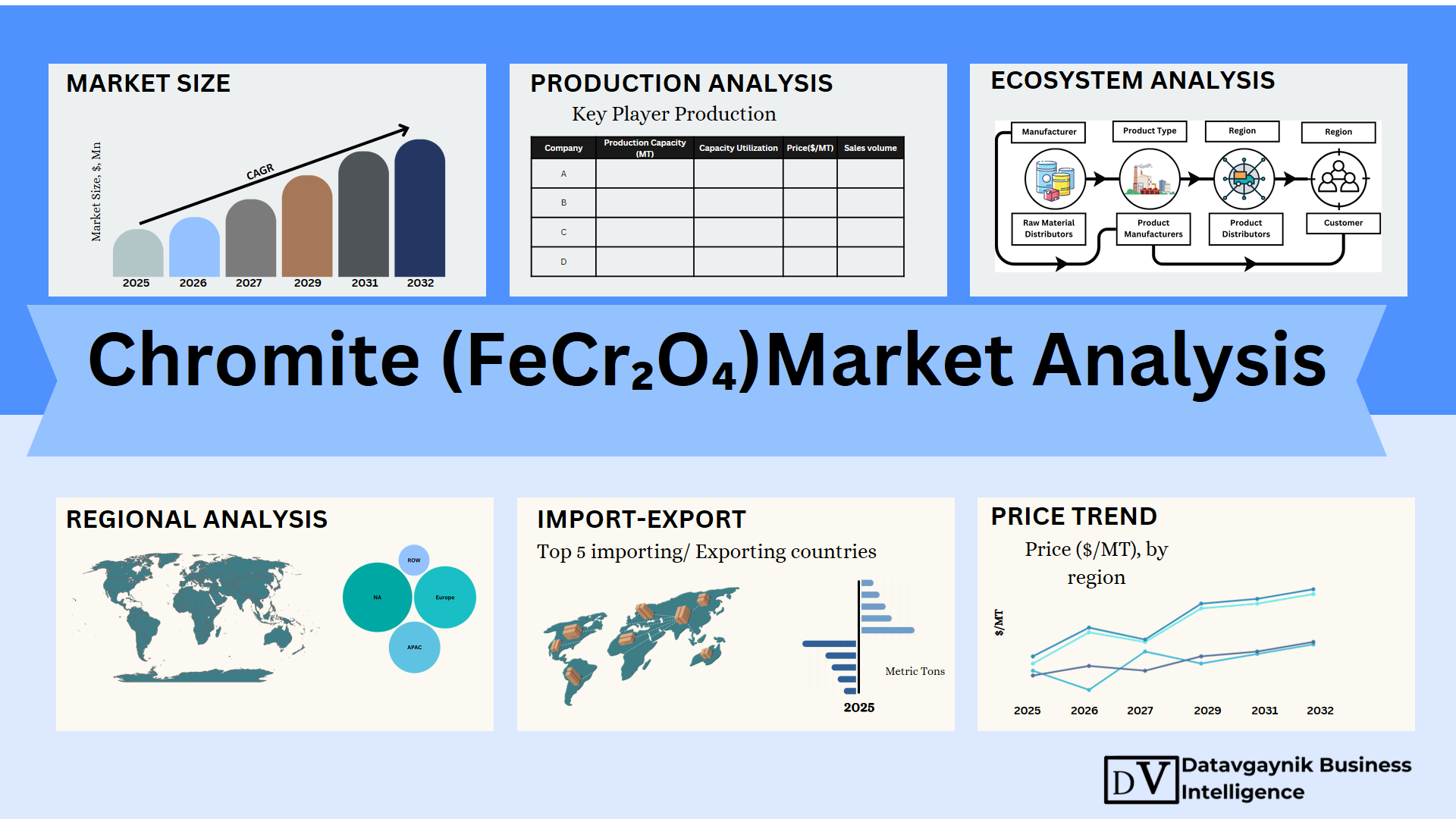
The global Chromite (FeCr₂O₄) Market has experienced significant growth and is projected to continue expanding at a steady pace between 2024 and 2032. This growth trajectory can be attributed to the growing demand for chromite in the production of ferrochrome, which is essential for the manufacturing of stainless steel. Chromite (FeCr₂O₄) Market Size is particularly influenced by various global industrial advancements, such as urbanization, technological advancements in production processes, and increased demand from emerging markets. A few pivotal sectors driving this market are automotive, infrastructure, and steel production.
Surge in Stainless Steel Production and Its Impact on Chromite Demand
The primary driver of the Chromite (FeCr₂O₄) Market is the increasing demand for stainless steel. Chromite is the key component in the production of ferrochrome, a critical alloy used in manufacturing stainless steel. Stainless steel is renowned for its strength, corrosion resistance, and aesthetic appeal, which makes it indispensable in industries such as construction, automotive, appliances, and infrastructure.
Data from Datavagyanik shows that global steel production is projected to grow by over 3% annually until 2032, with stainless steel consumption constituting a significant portion of that growth. This growth in steel production, especially in developing nations like India and China, is expected to directly influence the Chromite (FeCr₂O₄) Market Size, with an anticipated increase in chromite demand to meet ferrochrome requirements.
Datavagyanik also covers related markets such as the Chromite Ore Market. They create a more holistic picture of the ecosystem in which the primary topic exists, including technological shifts and market demands.
Expansion of the Automotive and Transportation Sector
The automotive and transportation industries are also contributing significantly to the demand for Chromite (FeCr₂O₄) Market growth. Stainless steel is a critical material used in manufacturing key automotive components such as exhaust systems, chassis, and suspension systems due to its durability and resistance to corrosion. As the global automotive industry grows—particularly in emerging markets—there is a corresponding rise in the demand for stainless steel and, by extension, chromite. For example, India’s vehicle production reached over 30 million units in 2024, and this number is expected to rise by 7% annually over the next decade. This surge in vehicle manufacturing increases the requirement for stainless steel, thereby driving the demand for Chromite (FeCr₂O₄) Market.
Infrastructure Development and Urbanization in Emerging Markets
Urbanization and infrastructure development in regions like Asia, Latin America, and Africa are poised to drive significant growth in the Chromite (FeCr₂O₄) Market. As developing countries continue to expand their infrastructure, the demand for stainless steel used in construction and infrastructure projects such as buildings, bridges, and pipelines continues to soar. For instance, China alone is investing over USD 1 trillion in infrastructure projects, which is directly increasing the demand for high-quality stainless steel and ferrochrome. Consequently, Chromite (FeCr₂O₄) Market Size is poised to grow in tandem with these developments, as chromite remains integral to ferrochrome production.
Technological Advancements in Steel Production Processes
Technological advancements in steel production processes are enhancing the efficiency of ferrochrome production, further boosting the demand for chromite. The use of electric arc furnaces (EAFs) and advancements in smelting technologies have made it more efficient to produce ferrochrome from chromite. These technologies not only reduce energy consumption but also improve the quality of ferrochrome. As steel producers increasingly adopt these technologies, the Chromite (FeCr₂O₄) Market is expected to witness sustained demand for high-grade chromite to meet the needs of advanced production methods.
Growth in High-Performance Alloys and Superalloys
Chromite’s role extends beyond stainless steel production into high-performance alloys and superalloys used in industries like aerospace, defense, and energy. These alloys require precise material properties, such as high resistance to high temperatures and mechanical stress, which are often achieved using chromium derived from chromite. The aerospace sector, for example, is witnessing robust growth, with an expected annual growth rate of 4.5% in commercial aircraft production. This growth is directly impacting the Chromite (FeCr₂O₄) Market as the demand for high-performance materials increases.
Increasing Demand from Emerging Economies
The rising industrial activity in emerging economies, particularly in Asia and Africa, is contributing significantly to the expansion of the Chromite (FeCr₂O₄) Market. Countries such as China, India, and South Africa are key consumers of chromite, driven by their rapidly growing steel industries. India’s chromite consumption is projected to increase by 6% annually over the next five years, as its infrastructure and steel production capacity expand. This burgeoning industrial base in emerging markets is fueling the growth in Chromite (FeCr₂O₄) Market demand.
Sustainability and Recycling Trends in the Chromite Market
Sustainability is becoming increasingly important in the steel and manufacturing industries, and this trend is influencing the Chromite (FeCr₂O₄) Market. Stainless steel is highly recyclable, and as recycling rates for steel and alloys improve, the demand for primary materials like chromite is also increasing. Steel recycling, particularly in advanced economies, is expected to grow by 4% annually, and this in turn is enhancing the need for high-quality chromite. The increased focus on reducing the environmental impact of mining and extraction is pushing industries to explore alternative sources of chromite, including recycling industrial waste to recover chromium.
Chromium’s Expanding Role in Other Industries
Beyond its key role in steel production, Chromite (FeCr₂O₄) Market is also witnessing increased demand from various other industries. Chromium derived from chromite is used in producing chemicals such as chromium oxide, chromic acid, and chromium sulfate, which have applications in sectors ranging from leather tanning to pigment manufacturing. The global chromium chemicals market is expected to grow by 6% annually, with significant demand arising from emerging markets in Asia and Africa. This expanding application scope for chromite broadens the overall market, as industries beyond steel are increasing their reliance on chromium for diverse purposes.
Impact of Geopolitical Factors on Chromite Market Growth
Geopolitical factors have also played a pivotal role in shaping the Chromite (FeCr₂O₄) Market. While certain regions, like South Africa, Kazakhstan, and India, control a majority of global chromite reserves, trade relations and political stability in these countries significantly impact supply chains. For example, South Africa’s dominance in global chromite production presents both challenges and opportunities. While South Africa supplies a large proportion of high-grade chromite to global markets, any geopolitical instability in the region could disrupt supply chains and impact global prices. Conversely, growing geopolitical tensions in the Middle East are encouraging investment in domestic chromite production in countries like Turkey and Iran, further diversifying the market.
“Track Country-wise Chromite (FeCr₂O₄) Production and Demand through our Chromite (FeCr₂O₄) Production Database”
-
-
- Chromite (FeCr₂O₄) production database for 23+ countries worldwide
- Chromite (FeCr₂O₄) sales volume for 28+ countries
- Country-wise Chromite (FeCr₂O₄) production capacity, production plant mapping, production capacity utilization for 23+ manufacturers
- Chromite (FeCr₂O₄) production plants and production plant capacity analysis by top manufacturers
-
“Track real-time Chromite (FeCr₂O₄) Prices, Chromite (FeCr₂O₄) price charts for 23+ countries, Chromite (FeCr₂O₄) weekly price tracker and Chromite (FeCr₂O₄) monthly price tracker”
-
-
- Track real-time Chromite (FeCr₂O₄) prices and Chromite (FeCr₂O₄) price trend in 23+ countries though our excel-based Chromite (FeCr₂O₄) price charts
- Real-time Chromite (FeCr₂O₄) price tracker dashboard with 23+ countries
- Complete transparency on Chromite (FeCr₂O₄) price trend through our Chromite (FeCr₂O₄) monthly price tracker, Chromite (FeCr₂O₄) weekly price tracker
-
Regional Demand Drivers in the Chromite (FeCr₂O₄) Market
The Chromite (FeCr₂O₄) Market is influenced significantly by regional demands, with key drivers emerging from diverse geographical areas. The largest consumers of chromite are regions with robust steel production capabilities, especially in countries like China, India, and South Africa. China remains the dominant consumer, driving nearly 40% of the global demand for chromite, primarily due to its massive steel production capacity, which stands at approximately 1 billion tons annually. The Chromite (FeCr₂O₄) Market in China is expected to maintain a growth rate of 4.5% per year as it continues to invest in infrastructure and industrial development.
India’s growing industrial base, particularly its steel production, is creating a similar surge in demand for chromite. India’s steel production is projected to grow at 6% annually, with the demand for chromite directly corresponding to this rise. As a result, the Chromite (FeCr₂O₄) Market in India is gaining momentum, driven by increased investments in steel production and infrastructure. Other emerging markets such as Brazil and Mexico are also contributing to the rising demand for chromite, with the construction and automotive sectors showing steady growth.
Chromite (FeCr₂O₄) Production Landscape
The global production of chromite is largely concentrated in a few key regions, with South Africa, Kazakhstan, and India leading the charge. South Africa is by far the largest producer, accounting for over 40% of global chromite production. The country’s Bushveld Igneous Complex is home to one of the largest chromite reserves globally, ensuring its position as a dominant player in the market. South Africa’s production capacity is estimated at around 13 million tons of chromite annually, with a large portion being exported to countries like China and India.
Kazakhstan, another key player in the Chromite (FeCr₂O₄) Market, holds significant reserves and production capabilities. With an annual output of approximately 3.5 million tons of chromite, Kazakhstan remains a key supplier, especially to markets in Europe and Asia. India also contributes significantly to global production, although its output is primarily focused on meeting domestic demand for ferrochrome production. As India continues to expand its steel production capacity, its chromite production is also expected to increase in tandem.
Other regions, such as Turkey and Zimbabwe, also play important roles in global chromite production. Turkey, with its proximity to both Europe and Asia, serves as a strategic location for the export of chromite to both regions. Zimbabwe’s chromite production is expected to grow steadily over the next decade, driven by increasing investments in the mining sector.
Chromite (FeCr₂O₄) Market Segmentation by Application
The Chromite (FeCr₂O₄) Market is primarily segmented based on its application in various industries. The largest and most dominant segment is stainless steel production, as chromite is the key component in producing ferrochrome, which is used in manufacturing stainless steel. Stainless steel accounts for over 80% of ferrochrome consumption globally, and with the continued growth in the construction, automotive, and aerospace industries, the demand for chromite is expected to rise significantly. The growth in the construction industry, particularly in Asia-Pacific and Latin America, is one of the key drivers for the continued growth of the Chromite (FeCr₂O₄) Market.
In addition to stainless steel, chromite is used in producing other chromium-based alloys used in high-performance applications. These alloys are critical in sectors requiring materials capable of withstanding high temperatures and mechanical stress, such as aerospace, military, and energy sectors. The demand for these alloys has been growing steadily, with aerospace production alone projected to grow at a compound annual growth rate (CAGR) of 4.5% over the next decade. As a result, chromite’s role in producing these alloys is becoming increasingly important.
Chromite (FeCr₂O₄) Price Trend and Market Dynamics
The price of chromite has seen fluctuations in recent years, primarily due to shifts in supply-demand dynamics. The Chromite (FeCr₂O₄) Price Trend has been influenced by several factors, including changes in production costs, geopolitical developments, and demand shifts in key markets. For instance, in 2024, the price of chromite ore surged by 8% in response to increasing demand from China, which is grappling with its expanding steel production needs. As a result, the global Chromite (FeCr₂O₄) Price has seen a steady upward trajectory, with an average price of $220 per ton.
Looking forward, the Chromite (FeCr₂O₄) Price Trend is expected to remain volatile, influenced by production costs, mining regulations, and demand fluctuations. Factors such as mining technology improvements, especially in beneficiation and smelting processes, are likely to influence the cost structure of chromite production. However, global geopolitical factors, including trade tensions and supply chain disruptions, may result in price increases in key markets, especially if supply from major producers like South Africa and Kazakhstan is affected.
Market Demand and Price Variations by Region
The Chromite (FeCr₂O₄) Market also exhibits regional price variations. For instance, the price of chromite is typically higher in regions that rely on imports, such as the United States and Europe, due to additional logistics costs and trade tariffs. In contrast, countries like South Africa, India, and Kazakhstan, where chromite is produced domestically, experience relatively lower prices due to reduced transportation and import duties.
In the Asia-Pacific region, the demand for chromite is particularly high, and this is reflected in the price trends. China, the world’s largest consumer of chromite, accounts for a significant portion of global imports, with the price of chromite ore in China being more competitive compared to other regions. The growth in infrastructure and industrialization in Southeast Asia is also driving demand for chromite, further pushing prices in this region.
In the Middle East, countries like Turkey and the UAE are witnessing growing demand for chromite, particularly as they increase their steel production capacities. This demand is creating upward pressure on prices, especially for high-grade chromite, which is crucial for producing high-quality ferrochrome. With infrastructure development projects on the rise, the Chromite (FeCr₂O₄) Price Trend in the region is expected to continue an upward trajectory, supported by increasing industrial activities.
Impact of Technological Advancements on Chromite Prices
Technological advancements in the mining and processing of chromite have the potential to alter the price dynamics of the Chromite (FeCr₂O₄) Market. Innovations in beneficiation technologies, such as high-intensity magnetic separation and flotation methods, are improving recovery rates and reducing the cost of production. This could result in more cost-effective production of chromite, which in turn may help stabilize prices in the long term. However, the initial capital investment required for such technologies may increase the price in the short term as producers invest in these advancements.
Moreover, the use of electric arc furnaces (EAFs) in steel production is also affecting the demand for chromite, as it improves the efficiency of ferrochrome production. The adoption of these technologies may lead to higher demand for high-quality chromite, especially in regions like China and India, where steel production continues to grow. This shift towards higher-quality ferrochrome production is expected to influence the Chromite (FeCr₂O₄) Price Trend, with prices for premium-grade chromite rising in response to increased demand.
The Future of Chromite (FeCr₂O₄) Market and Price Forecasts
Looking ahead, the Chromite (FeCr₂O₄) Market is set to continue its growth trajectory, driven by increasing steel production, infrastructure development, and technological advancements. The demand for high-quality chromite will remain strong, particularly in emerging economies. As a result, the Chromite (FeCr₂O₄) Price is expected to see moderate growth, with price volatility being influenced by factors such as supply chain disruptions, mining regulations, and geopolitical developments.
In conclusion, the Chromite (FeCr₂O₄) Market is poised for continued growth due to the robust demand across various industrial sectors. The geographic distribution of production, particularly in South Africa, Kazakhstan, and India, continues to influence global trade dynamics. With advancements in technology and a growing focus on sustainable mining practices, the market is expected to evolve, potentially stabilizing prices while meeting the ever-increasing demand from the global steel and ferrochrome industries.
“Chromite (FeCr₂O₄) Manufacturing Database, Chromite (FeCr₂O₄) Manufacturing Capacity”
-
-
- Chromite (FeCr₂O₄) top manufacturers market share for 23+ manufacturers
- Top 6 manufacturers and top 13 manufacturers of Chromite (FeCr₂O₄) in North America, Europe, Asia Pacific
- Chromite (FeCr₂O₄) production plant capacity by manufacturers and Chromite (FeCr₂O₄) production data for 23+ market players
- Chromite (FeCr₂O₄) production dashboard, Chromite (FeCr₂O₄) production data in excel format
-
“Chromite (FeCr₂O₄) price charts, Chromite (FeCr₂O₄) weekly price tracker and Chromite (FeCr₂O₄) monthly price tracker”
-
-
- Factors impacting real-time Chromite (FeCr₂O₄) prices in 18+ countries worldwide
- Chromite (FeCr₂O₄) monthly price tracker, Chromite (FeCr₂O₄) weekly price tracker
- Real-time Chromite (FeCr₂O₄) price trend, Chromite (FeCr₂O₄) price charts, news and updates
- Tracking Chromite (FeCr₂O₄) price fluctuations
-
Top Manufacturers and Market Share in the Chromite (FeCr₂O₄) Market
Key Players in the Chromite (FeCr₂O₄) Market
The Chromite (FeCr₂O₄) Market is highly competitive, with several key manufacturers dominating the global production and supply. These manufacturers play a critical role in meeting the rising demand for chromite, which is primarily used in producing ferrochrome for stainless steel production. Some of the leading players in the Chromite (FeCr₂O₄) Market include:
- South32 South32 is one of the largest producers of chromite globally, with a strong presence in South Africa. The company operates the Hillside and Mozal operations in the region, producing high-quality chromite for ferrochrome production. South32’s chromite production capacity is significant, and its South African Chrome product line is essential for many customers in the steel industry. The company’s long-standing operations in South Africa contribute to its dominant market position. South32 has consistently maintained a leading role in the Chromite (FeCr₂O₄) Market, with a market share of approximately 20%, particularly due to its strategic mine in the Bushveld Igneous Complex.
- Glencore Glencore is another major player in the Chromite (FeCr₂O₄) Market, with a diversified product portfolio including chromite ore, ferrochrome, and other chromium-based products. Glencore’s Eurasian Resources Group operates key chromite production facilities in Kazakhstan, which is one of the world’s leading producers of chromite. Their Kazchrome product line plays a significant role in meeting global ferrochrome demand. Glencore has a notable market share in the chromite industry, contributing roughly 15% of global production.
- Kaz Minerals Kaz Minerals, based in Kazakhstan, is a significant producer of chromite, especially focused on high-quality chromite products for ferrochrome production. The company’s Kazchrome product line is one of the most recognized in the market. With significant mining operations in Kazakhstan, Kaz Minerals has consistently been one of the largest suppliers of chromite to global markets, including China, Europe, and the Middle East. The company holds around 10% of the global market share for chromite production.
- Indo Ferro Alloys Indo Ferro Alloys, based in India, is another significant player in the Chromite (FeCr₂O₄) Market, specializing in the production of ferrochrome. The company’s chromite products are primarily used in the domestic steel industry, but Indo Ferro Alloys also exports substantial quantities to neighboring countries. Their Indo Ferro Chrome product line is highly regarded in the Indian subcontinent, where demand for stainless steel and ferrochrome is growing rapidly.
- Assmang (African Rainbow Minerals) Assmang, a subsidiary of African Rainbow Minerals (ARM), operates several chromite mines in South Africa, including the Cato Ridge and Black Rock mines. Assmang’s Chrome Ore products are crucial for ferrochrome production, and the company has a significant presence in the global Chromite (FeCr₂O₄) Market. Assmang’s market share is approximately 8%, and it exports chromite to key markets in Europe and Asia. Assmang’s product line is renowned for its consistency and quality, making it a preferred supplier for ferrochrome manufacturers.
- Omnicron (ZimAlloys) Omnicron, known for its ZimAlloys chromite brand, is a major player in the Chromite (FeCr₂O₄) Market, particularly in Zimbabwe. The company’s chromite is used extensively in the production of ferrochrome, which is essential for steel production. With a capacity to produce over 1 million tons of chromite annually, Omnicron plays a significant role in serving African and European markets. The company holds around 5% of the global market share.
Chromite (FeCr₂O₄) Market Share by Manufacturers
The Chromite (FeCr₂O₄) Market share is dominated by a handful of large-scale producers who have significant reserves and production capacity. South Africa, Kazakhstan, and India remain the top contributors to the global supply, with South African companies like South32 and Assmang controlling over 30% of the global chromite production.
Glencore’s Kazchrome operation in Kazakhstan has made the country one of the largest producers, contributing about 15% to the overall market share. Indian manufacturers like Indo Ferro Alloys are also gaining traction, particularly within the domestic market, where India is becoming an increasingly important producer of ferrochrome and stainless steel.
The global Chromite (FeCr₂O₄) Market is also seeing increasing competition from emerging producers in regions such as Zimbabwe and Turkey. While these players account for a smaller share, their market influence is growing as they ramp up production capacity and increase exports. For instance, Omnicron (ZimAlloys) has expanded its operations and now holds a market share of approximately 5%, primarily due to increasing demand from neighboring regions.
Product Lines and Offerings of Leading Manufacturers
- South32: South32 is known for producing premium-grade chromite with low impurity content, particularly from its South African operations. Their chromite products, marketed under the South African Chrome brand, are sold worldwide, particularly to stainless steel manufacturers in China and India. The company also produces ferrochrome, which is used in various steelmaking applications, including the automotive, construction, and infrastructure industries.
- Glencore: Glencore’s Kazchrome chromite product line is one of the most significant offerings in the global market. The company focuses on producing high-quality chromite with a high chromium content, which is essential for producing high-grade ferrochrome. The company’s facilities in Kazakhstan have state-of-the-art beneficiation and smelting technologies, making Kazchrome a preferred supplier for many global steelmakers.
- Kaz Minerals: Kaz Minerals’ Kazchrome product line is known for its high-quality chromite ore and ferrochrome, used extensively in the production of stainless steel. The company’s mining operations in Kazakhstan are complemented by advanced smelting facilities that produce ferrochrome with varying chromium contents, catering to both premium and standard steel applications.
- Indo Ferro Alloys: Indo Ferro Alloys specializes in producing high-purity ferrochrome for stainless steel manufacturers in India and abroad. Their Indo Ferro Chrome product line is recognized for its consistent quality, and the company has established strong relationships with domestic steel mills.
- Assmang (African Rainbow Minerals): Assmang offers a broad range of chromite ore products under the Cato Ridge and Black Rock brands. The company’s products are in high demand in Europe and Asia, and Assmang has established itself as one of the leading exporters of chromite from South Africa.
Recent News and Industry Developments
- South32’s Expansion in South Africa: On January 15, 2025, South32 announced its plans to expand chromite production at its Hillside operation in South Africa. This expansion is expected to increase its chromite output by 20% over the next three years, catering to the rising demand from steel manufacturers in China and India. The expansion will also involve significant investments in modern mining and beneficiation technologies.
- Glencore’s Strategic Acquisition of Kazchrome: In November 2024, Glencore acquired an additional stake in the Kazchrome operation, further solidifying its position in the global Chromite (FeCr₂O₄) Market. The acquisition will allow Glencore to increase its chromite supply to Asia and Europe, while improving its production efficiency with the integration of advanced smelting technologies.
- Kaz Minerals’ New Mining Project: On December 2, 2024, Kaz Minerals announced the development of a new chromite mine in Kazakhstan, which is expected to begin production in mid-2026. The mine will have an annual output capacity of 1.5 million tons of chromite and will cater primarily to the growing demand from the Asia-Pacific region.
- Indo Ferro Alloys’ Export Growth: In March 2025, Indo Ferro Alloys announced a 15% increase in exports to Southeast Asia and the Middle East. The company’s Indo Ferro Chrome product line has seen strong demand from growing steel industries in these regions, and Indo Ferro Alloys is planning to invest in expanding its production capacity to meet future demand.
- Omnicron’s Expansion in Zimbabwe: On February 25, 2025, Omnicron announced the expansion of its ZimAlloys operations in Zimbabwe. The company plans to increase its chromite production by 30% over the next two years to meet the rising demand from both local and international markets. This expansion is part of Omnicron’s broader strategy to become a major player in the global chromite market.
“Chromite (FeCr₂O₄) Production Data and Chromite (FeCr₂O₄) Production Trend, Chromite (FeCr₂O₄) Production Database and forecast”
-
-
- Chromite (FeCr₂O₄) production database for historical years, 10 years historical data
- Chromite (FeCr₂O₄) production data and forecast for next 7 years
- Chromite (FeCr₂O₄) sales volume by manufacturers
-
“Track Real-time Chromite (FeCr₂O₄) Prices for purchase and sales contracts, Chromite (FeCr₂O₄) price charts, Chromite (FeCr₂O₄) weekly price tracker and Chromite (FeCr₂O₄) monthly price tracker”
-
-
- Gain control on your purchase and sales contracts through our real-time Chromite (FeCr₂O₄) price tracker and Chromite (FeCr₂O₄) price trend analysis
- Chromite (FeCr₂O₄) weekly price tracker and forecast for next four weeks
- Chromite (FeCr₂O₄) monthly price tracker and forecast for next two months
-
Market Scenario, Demand vs Supply, Average Product Price, Import vs Export, till 2032
- Global Chromite (FeCr₂O₄) Market revenue and demand by region
- Global Chromite (FeCr₂O₄) Market production and sales volume
- United States Chromite (FeCr₂O₄) Market revenue size and demand by country
- Europe Chromite (FeCr₂O₄) Market revenue size and demand by country
- Asia Pacific Chromite (FeCr₂O₄) Market revenue size and demand by country
- Middle East & Africa Chromite (FeCr₂O₄) Market revenue size and demand by country
- Latin America Chromite (FeCr₂O₄) Market revenue size and demand by
- Import-export scenario – United States, Europe, APAC, Latin America, Middle East & Africa
- Average product price – United States, Europe, APAC, Latin America, Middle East & Africa
- Market player analysis, competitive scenario, market share analysis
- Business opportunity analysis
Key questions answered in the Global Chromite (FeCr₂O₄) Market Analysis Report:
- What is the market size for Chromite (FeCr₂O₄) in United States, Europe, APAC, Middle East & Africa, Latin America?
- What is the yearly sales volume of Chromite (FeCr₂O₄) and how is the demand rising?
- Who are the top market players by market share, in each product segment?
- Which is the fastest growing business/ product segment?
- What should be the business strategies and Go to Market strategies?
The report covers Chromite (FeCr₂O₄) Market revenue, Production, Sales volume, by regions, (further split into countries):
- Asia Pacific (China, Japan, South Korea, India, Indonesia, Vietnam, Rest of APAC)
- Europe (UK, Germany, France, Italy, Spain, Benelux, Poland, Rest of Europe)
- North America (United States, Canada, Mexico)
- Latin America (Brazil, Argentina, Rest of Latin America)
- Middle East & Africa
Table of Contents:
1. Overview of the Chromite (FeCr₂O₄) Market
1.1 Introduction to Chromite (FeCr₂O₄): Composition and Properties
1.2 Industrial Applications and Commercial Importance
1.3 Market Evolution and Growth Drivers
2. Chromite (FeCr₂O₄) Market Segmentation
2.1 Classification by Ore Grade and Purity
2.2 Segmentation by End-Use Industries (Metallurgy, Chemicals, Refractory, etc.)
2.3 Regional Market Breakdown and Growth Prospects
3. Global Chromite (FeCr₂O₄) Market Size and Forecast (2019-2032)
3.1 Revenue Trends and Growth Analysis
3.2 Demand-Supply Dynamics in the Chromite (FeCr₂O₄) Market
3.3 Investment Trends and Market Expansion Opportunities
4. Regional Market Analysis for Chromite (FeCr₂O₄)
4.1 North America: Market Size, Production Trends, Trade Overview
4.2 Europe: Demand-Supply Balance and Industry Challenges
4.3 Asia-Pacific: Chromite (FeCr₂O₄) Production Hubs and Market Outlook
4.4 Latin America: Export-Import Trends and Economic Influence
4.5 Middle East & Africa: Key Reserves, Mining Activities, and Market Growth
5. Chromite (FeCr₂O₄) Production and Supply Chain
5.1 Global Chromite (FeCr₂O₄) Production Volume (2019-2032)
5.2 Major Producing Countries and Production Techniques
5.3 Supply Chain Efficiency and Logistics Considerations
6. Competitive Analysis in the Chromite (FeCr₂O₄) Market
6.1 Leading Chromite (FeCr₂O₄) Producers and Their Market Shares
6.2 Competitive Strategies and Market Positioning
6.3 Pricing Structures and Profitability Trends
7. Global Trade Analysis of Chromite (FeCr₂O₄)
7.1 Export vs. Domestic Consumption Patterns
7.2 Import Trends and Global Trade Networks
7.3 Market Regulations Impacting Trade Flow
8. Market Demand and Consumption Trends
8.1 Chromite (FeCr₂O₄) Consumption by Industry Segment
8.2 End-User Preferences and Market Behavior
8.3 Growth Forecast for Chromite (FeCr₂O₄) Demand (2025-2032)
9. Chromite (FeCr₂O₄) Production Cost and Pricing Analysis
9.1 Key Cost Components in Chromite (FeCr₂O₄) Extraction and Processing
9.2 Impact of Energy, Labor, and Raw Material Prices on Production Costs
9.3 Profitability and Cost-Optimization Strategies
10. Industry Value Chain and Market Connectivity
10.1 Mining and Refining Technologies for Chromite (FeCr₂O₄)
10.2 Distribution Network and Supply Chain Management
10.3 Market Integration and Downstream Processing
11. Sales, Distribution, and Market Expansion Strategies
11.1 Sales Channels for Chromite (FeCr₂O₄) Producers
11.2 Key Distributors and Regional Suppliers
11.3 Growth Strategies for Market Penetration
12. Future Market Outlook and Forecast (2025-2032)
12.1 Projected Trends in Chromite (FeCr₂O₄) Production
12.2 Investment Opportunities and Market Innovations
12.3 Environmental and Sustainability Considerations

