

Market Summary and Growth Forecast
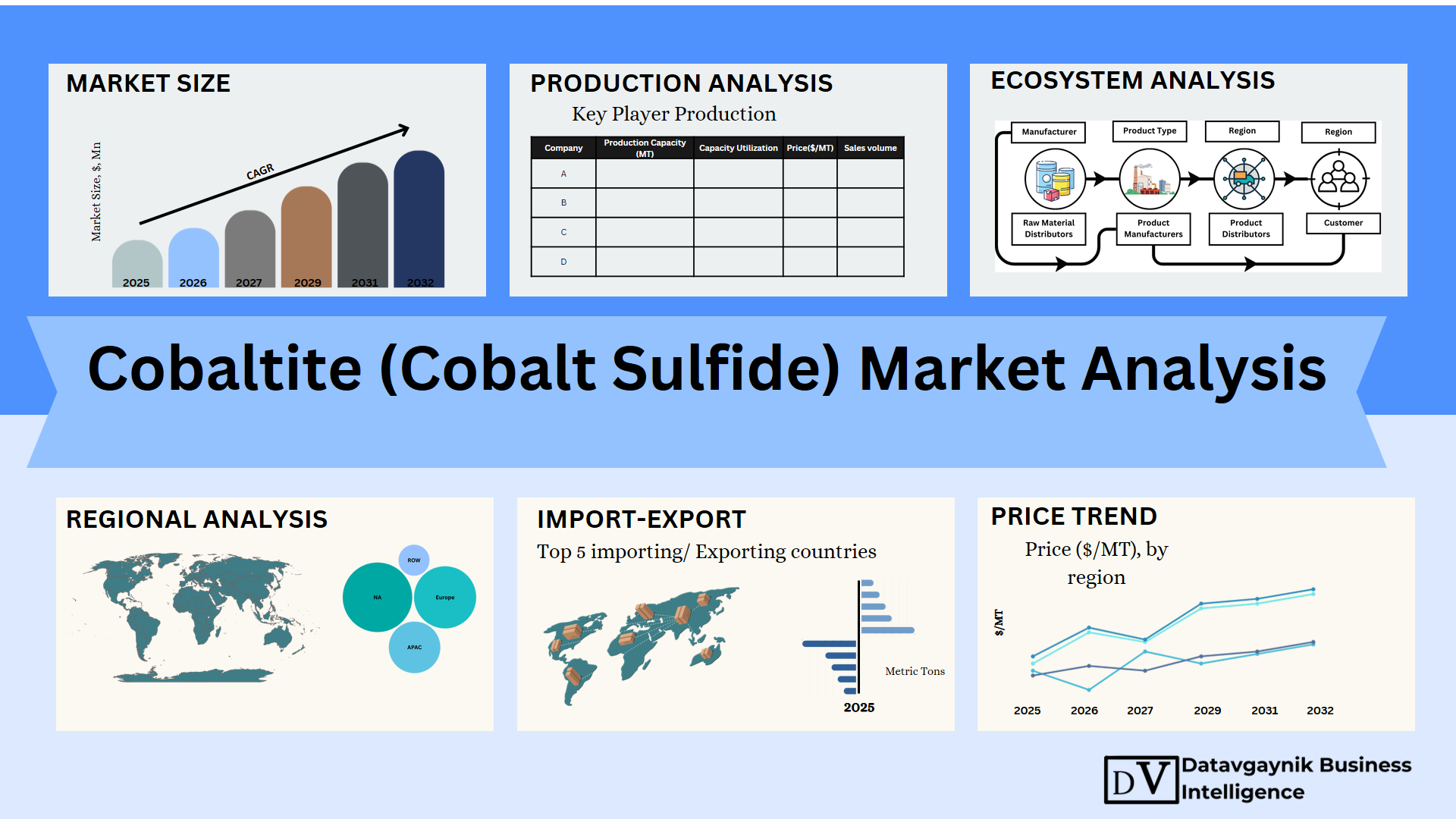
The global Cobaltite (Cobalt Sulfide) Market is valued at $126 million in 2026 and is expected to appreciate to $235 million by 2035, at a CAGR of 7.2%.
For this assessment, the market covers commercially produced cobalt sulfide compounds, including CoS, CoS₂, Co₃S₄ and Co₉S₈. It also considers cobaltite-derived material where it enters the cobalt sulfide value chain. Naturally occurring cobaltite is chemically different from synthetic cobalt sulfide. Cobaltite normally contains cobalt, arsenic and sulfur. So, it is treated as a mineral feedstock rather than as an equivalent finished material.
Commercial cobalt sulfides are supplied as powders, nanoparticles, sputtering targets, catalyst materials and customized compounds. Their business relevance comes from their electrochemical activity, catalytic performance and ability to form conductive composite structures. These properties support their use in energy storage research, hydrogen production, refining catalysts, thin films, sensors and advanced material development.
Datavagyanik also covers related markets such as the Cobalt Oxide Market, the Cobalt Sulfate Market, and the Cobalt Chloride Market. These compounds are commonly used in oxidation systems and industrial chemical processing, supporting shifts in formulation standards and regulatory compliance.
Market Size and Forecast
| Market indicator | Value |
| Global market size, 2026 | $126 million |
| Projected market size, 2035 | $235 million |
| Forecast period | 2026–2035 |
| Forecast CAGR | 7.2% |
| Main commercial forms | Powders, nanoparticles, targets and supported catalyst materials |
| Primary demand areas | Catalysis, energy storage, hydrogen systems, electronics and research |
The Cobaltite (Cobalt Sulfide) Market remains smaller than the markets for cobalt sulfate, cobalt oxide and conventional cobalt metal. That said, its value per kilogram can be much higher when the material is sold in nanoscale, ultra-high-purity or application-engineered form. A standard industrial powder and a 99.99% nanoscale material are not directly comparable. Their purity, surface area, particle structure and qualification requirements create very different pricing levels.
Technology development will be central to market expansion through 2035. Cobalt sulfide is being studied as an electrode material for supercapacitors, lithium-ion batteries, sodium-ion batteries and metal-air batteries. It is also being evaluated as a lower-cost alternative to noble-metal catalysts in hydrogen evolution and oxygen evolution reactions. Not every laboratory result will reach commercial production. Still, the widening pipeline creates demand for consistent, high-purity material.
Hydrogen production represents another strategic opening. Co₉S₈, CoS₂ and mixed cobalt sulfide structures can provide useful catalytic activity without relying entirely on platinum-group metals. Their commercial path will depend on stability, current density, scale-up cost and performance under long operating cycles. Demand is therefore likely to develop first through pilot systems, research programs and specialized electrodes.
Supply conditions remain important. Cobalt is classified as a critical mineral in several major economies. A large part of mined cobalt supply is concentrated in the Democratic Republic of Congo, while China holds a strong position in refining and chemical conversion. USGS expects global cobalt production capacity to expand materially, but geographic concentration remains a procurement concern. This pushes customers toward traceable sourcing, recycled cobalt and more diverse refining routes.
Regulation will influence both raw-material sourcing and downstream adoption. Battery regulations in Europe increasingly focus on material traceability, recycled content and lifecycle reporting. Responsible-mineral policies also require buyers to examine labour practices and origin data. Suppliers that can document cobalt provenance, impurity profiles and processing conditions should gain an advantage in high-value contracts.
At the same time, cobalt-free battery chemistries place a limit on the addressable opportunity. Lithium iron phosphate batteries do not use cobalt, while several manufacturers are working to reduce cobalt loading in nickel-based cathodes. Cobalt sulfide demand must therefore be assessed separately from general electric-vehicle battery growth. Its stronger opportunity lies in specialized electrodes, electrocatalysis and multifunctional nanomaterials rather than mainstream cathode production alone.
Production economics will also change. Hydrothermal synthesis, solvothermal processing, electrodeposition and chemical precipitation are widely used at the development stage. Commercial suppliers are working on tighter particle control and repeatable phase composition. Scale-up remains difficult because cobalt sulfides can form several closely related crystalline phases. Small variations in temperature, sulfur source or reaction time may alter conductivity and catalytic response.
Key Consumers and Clients
The principal customer groups include:
- Battery material developers producing experimental anodes, hybrid electrodes and conductive composites.
- Hydrogen technology companies developing non-precious-metal electrocatalysts.
- Petroleum refiners and catalyst manufacturers working with cobalt-containing sulfide catalyst systems.
- Electronics and thin-film companies purchasing high-purity powders and sputtering targets.
- Universities and national laboratories conducting electrochemical and material-science research.
- Specialty chemical distributors supplying controlled-purity materials in smaller volumes.
- Mining and metallurgical companies processing cobalt-bearing sulfide ores and intermediates.
Representative participants in the wider customer and development ecosystem include BASF, Umicore, Johnson Matthey, American Elements, Merck KGaA/Sigma-Aldrich, Thermo Fisher Scientific, Stanford Advanced Materials and specialist catalyst developers. These organizations should not all be interpreted as direct bulk cobalt sulfide buyers. Their relevance varies across manufacturing, distribution, research supply and downstream material development.
The Cobaltite (Cobalt Sulfide) Market will remain a technically demanding specialty-material business. Growth will come from better-performing formulations, not simply from higher cobalt consumption. Suppliers that can link phase purity and particle design to measurable application performance will be better positioned to capture premium revenue.
Market Segmentation and Forecast Scope
The Cobaltite (Cobalt Sulfide) Market can be evaluated by product type, material form, application, end user and region. Each dimension captures a different part of commercial demand. Product segmentation explains chemistry and value. Application segmentation shows where the material is consumed. End-user analysis identifies purchasing behaviour, while regional coverage reflects production capability and research activity.
By Product Type
- Cobalt(II) Sulfide (CoS)
- Cobalt Disulfide (CoS₂)
- Cobalt Sulfide (Co₃S₄)
- Cobalt Pentlandite (Co₉S₈)
- Mixed-Metal Cobalt Sulfides
- Natural Cobaltite and Cobalt-Bearing Sulfide Feedstock
Cobalt(II) Sulfide (CoS) serves as a basic commercial form. It is supplied as powder, nanopowder, dispersion and sputtering-target material. Its applications include research electrodes, coatings, optical materials and chemical synthesis.
Cobalt disulfide (CoS₂) attracts interest in electrocatalysis and electrochemical devices. Its electronic properties make it relevant to hydrogen evolution, battery electrodes and selected semiconductor research. However, stability and production repeatability remain important barriers.
Co₃S₄ is strategically important in supercapacitors and hybrid electrode structures. Its multiple cobalt oxidation states support redox activity. Researchers frequently combine it with graphene, carbon nanotubes, conductive polymers or nickel-based compounds to address conductivity and cycling limitations.
Co₉S₈ is gaining attention as an electrocatalyst and energy-storage material. Its potential lies in providing catalytic activity at a lower material cost than platinum-group metals. Commercial demand is still led by development programs rather than mass deployment.
Mixed-metal cobalt sulfides, such as nickel-cobalt sulfide, copper-cobalt sulfide and iron-cobalt sulfide, are likely to record the fastest technical progress. Combining cobalt with another metal can improve conductivity, active-site density and electrochemical stability. This is one of the most strategic areas for suppliers with advanced synthesis capabilities.
By Material Form
- Industrial-Grade Powder
- High-Purity and Ultra-High-Purity Powder
- Nanoparticles and Nanostructured Materials
- Sputtering Targets
- Dispersions and Supported Materials
- Natural Mineral Concentrates
High-purity and nanostructured materials accounted for approximately 29% of global revenue in 2026. Their share of physical volume is much lower because they command a substantial price premium. Purity levels, particle size, surface area and morphology have a direct effect on selling price.
Industrial-grade powder is used where bulk chemical functionality matters more than precise particle engineering. Nanoparticles, nanosheets, nanorods and porous structures are positioned toward batteries, supercapacitors, sensors and electrocatalysts. Sputtering targets address a smaller but high-value opportunity in thin films, displays, optical systems and experimental semiconductor structures.
Nanostructured cobalt sulfide is expected to be the fastest-growing material form through 2035. Demand will be supported by electrode development and catalyst research. Yet suppliers will need to demonstrate batch consistency. A strong laboratory result has limited commercial value if the same morphology cannot be reproduced at kilogram scale.
By Application
- Industrial and Refining Catalysts
- Hydrogen-Evolution and Oxygen-Evolution Catalysts
- Battery Electrode Materials
- Supercapacitors
- Thin Films and Semiconductor Research
- Sensors and Optical Materials
- Chemical Synthesis and Laboratory Research
Catalyst-related applications represented an estimated 41% of market revenue in 2026. This includes research-grade electrocatalysts, supported cobalt sulfide materials and cobalt-containing sulfide phases used within wider catalytic systems.
Energy-storage applications should advance faster than traditional uses. Cobalt sulfides offer relatively high theoretical electrochemical activity, but they can experience volume change, particle aggregation and capacity loss during repeated cycling. So, the most promising products are likely to be composites rather than unmodified cobalt sulfide powders.
Hydrogen-related catalysis is another high-growth segment. Cobalt sulfide structures are being developed for alkaline and acidic operating conditions. Market expansion will depend on whether these materials can maintain performance over thousands of operating hours, not just during short laboratory tests.
Thin-film applications remain specialized. They require high-density targets, controlled grain size and very low impurity levels. Revenue per unit can be attractive, but qualification cycles are long and annual volumes are limited.
By End User
- Specialty Chemical and Material Manufacturers
- Catalyst Producers
- Battery and Energy-Storage Developers
- Hydrogen Equipment and Electrolyzer Developers
- Electronics and Thin-Film Companies
- Research Institutes and Universities
- Mining and Metallurgical Companies
Specialty material companies require flexible product specifications and smaller batch sizes. Their purchasing decisions focus on purity, certificate-of-analysis data, particle distribution and reliable delivery.
Catalyst manufacturers assess surface activity, sulfur stability and compatibility with supporting materials. Battery and supercapacitor developers place more emphasis on conductivity, cycling behaviour, capacity retention and electrode-processing performance.
Universities and research institutions remain important customers because several cobalt sulfide technologies are still pre-commercial. Their individual order values are small. Collectively, however, they support premium sales of nanopowders, precursors and customized materials.
By Region
- North America
- Europe
- Asia Pacific
- Latin America
- Middle East and Africa
Asia Pacific is the largest production and consumption centre. China has an established cobalt-refining base, extensive chemical-processing capacity and a large battery-material research ecosystem. Japan and South Korea support demand for controlled-purity materials, electronic applications and advanced energy-storage development.
North America has a strong position in material research, hydrogen technology and specialty chemical supply. Government support for domestic critical-mineral processing may encourage regional production. However, dependence on imported cobalt intermediates remains a concern.
Europe is strategically important for sustainable processing, catalyst production and battery-material regulation. The region’s emphasis on traceability and recycled cobalt may create demand for certified materials with lower lifecycle emissions.
Latin America remains a developing market. Demand is concentrated in universities, mining-related activities and imported specialty chemicals. The region may gain relevance if local critical-mineral processing attracts fresh investment.
The Middle East and Africa combines upstream cobalt availability with growing industrial demand. The Democratic Republic of Congo dominates mined cobalt supply, but much of the material is exported for refining. Greater local beneficiation could improve the region’s future position in processed sulfide and other cobalt compounds.
Market Trends and Business Innovations
Innovation within the Cobaltite (Cobalt Sulfide) Market is moving away from conventional bulk powder toward engineered surfaces, mixed-metal structures and application-specific composites. Research teams are trying to solve three recurring problems: limited conductivity, structural change during cycling and unstable performance during long operating periods.
R&D Evolution
Early cobalt sulfide research concentrated on demonstrating basic electrochemical activity. Current programs are more application-driven. Researchers now compare active-surface density, reaction kinetics, charge-transfer resistance and durability under practical operating conditions.
Phase control has become a major R&D priority. CoS, CoS₂, Co₃S₄ and Co₉S₈ do not deliver identical performance. The selected crystalline phase affects conductivity, oxidation state and catalytic behaviour. Suppliers are therefore investing in tighter temperature control, more precise sulfur-to-cobalt ratios and improved post-synthesis treatment.
Interface engineering is another important theme. Cobalt sulfide particles are being grown directly on nickel foam, carbon cloth, graphene and carbon nanotubes. Direct growth can reduce binder use and improve electrical contact. It may also limit particle detachment during cycling.
Expert view: The next commercial step will not come from selling a generic cobalt sulfide powder. It will come from supplying a qualified material architecture that solves a defined electrode or catalyst problem.
Technology Evolution
Hydrothermal and solvothermal synthesis remain common because they allow control over particle shape and crystal structure. However, these batch processes can be slow and difficult to scale. Continuous precipitation, spray-based processing and controlled sulfidation are being explored to improve throughput.
Electrodeposition provides another route. It enables cobalt sulfide films to be formed directly on conductive substrates. This can reduce processing stages for electrocatalysts and supercapacitor electrodes. The method is particularly useful when film thickness and surface coverage must be closely controlled.
In situ sulfidation is also gaining attention. Under this approach, a cobalt-containing precursor is converted into an active sulfide structure on the selected support. This may improve contact between the active material and substrate. It also reduces handling of free nanoscale powder.
Commercial innovation is increasingly focused on:
- Low-temperature synthesis to reduce processing energy.
- Water-based production routes that limit solvent use.
- Continuous manufacturing for improved batch consistency.
- Direct-on-substrate growth to simplify electrode fabrication.
- Surface coatings that reduce oxidation and structural degradation.
- Recycled cobalt inputs for lower raw-material exposure.
Material-Science Innovation
Mixed-metal sulfides are among the most active development areas. Nickel-cobalt sulfides can provide stronger conductivity and richer redox activity than single-metal sulfides. Iron-cobalt and copper-cobalt systems may reduce cobalt intensity while preserving catalytic performance.
Carbon integration is equally important. Graphene, porous carbon, carbon nanotubes and nitrogen-doped carbon can improve electron movement and prevent cobalt sulfide particles from clustering. These hybrid structures are being assessed for supercapacitors, metal-air batteries and water-splitting systems.
Defect engineering provides another path. Controlled sulfur vacancies can change electronic behaviour and expose additional reaction sites. The process must be carefully managed, as excessive defects may weaken structural stability.
Core-shell and heterostructured materials are also emerging. In such systems, cobalt sulfide is combined with another oxide, hydroxide, phosphide or sulfide. The interface between the two materials can accelerate charge transfer. This may lead to higher activity without proportionally increasing cobalt content.
Expert view: Mixed-metal and carbon-supported structures should outpace pure cobalt sulfide products through 2035. They offer a better route to performance improvement and cobalt-use efficiency.
Energy Storage and Hydrogen Innovation
Cobalt sulfide electrodes are being developed for lithium-ion, sodium-ion and hybrid storage systems. Sodium-ion research is particularly relevant because sodium is more widely available than lithium. Cobalt sulfide can provide conversion-based storage behaviour, although expansion and contraction during cycling must be controlled.
Supercapacitor development is closer to the material’s natural strengths. Fast surface-redox reactions can support high power delivery. The main technical objective is to maintain capacitance after repeated charge-discharge cycles.
In hydrogen systems, cobalt sulfides are positioned as non-precious-metal electrocatalysts. Research has demonstrated activity in hydrogen-evolution reactions, including work on Co₉S₈ and CoS₂ structures. The remaining challenge is commercial durability. Electrolyzer developers require consistent output under heat, pressure and corrosive conditions.
Use case: A cobalt sulfide catalyst grown directly on conductive foam may reduce electrode-processing steps while increasing the number of exposed reaction sites. This can lower the catalyst loading needed for a pilot electrolyzer.
Partnerships, Investments and Market Announcements
Pure-play mergers involving only cobalt sulfide producers remain uncommon. The market is fragmented and much of the technical work sits inside universities, specialty-material companies and broader cobalt businesses. Recent commercial announcements are therefore concentrated in upstream cobalt security, refining and circular supply.
In April 2024, Electra Battery Materials and Eurasian Resources Group signed an agreement covering cobalt hydroxide supply for Electra’s planned North American refinery. The agreement supports regional cobalt processing and illustrates the wider push for geographically diversified cobalt chemicals.
In September 2024, members of the Minerals Security Partnership Finance Network highlighted support for North American cobalt-processing capacity. Such investments do not target cobalt sulfide alone, but they may improve access to traceable cobalt intermediates for specialty-compound producers.
In 2025, Samsung Electronics presented a circular cobalt-recovery process connected with the Galaxy S25 supply chain. This reflects a broader shift toward recovered cobalt as a secondary input. For cobalt sulfide suppliers, recycled feedstock could become commercially relevant once purity and impurity-control requirements are consistently met.
In 2026, a US-backed consortium proposed acquiring a strategic interest in Glencore’s Democratic Republic of Congo assets. The announcement underlines how cobalt availability, ownership and processing security are becoming linked to national industrial policy.
These developments matter because cobalt sulfide producers depend on reliable cobalt intermediates. Greater supply diversity can reduce procurement risk. That said, rising cobalt capacity may also put pressure on standard-grade material prices. Specialized producers will need to protect margins through purity, morphology control and customer qualification.
Commercial Outlook for Innovation
Three innovation routes appear most commercially credible:
- Nanostructured cobalt sulfides for supercapacitors and specialized batteries
- Supported cobalt sulfide electrocatalysts for hydrogen production
- Mixed-metal sulfides that reduce cobalt loading while improving performance
The Cobaltite (Cobalt Sulfide) Market will also benefit from better analytical tools. Automated microscopy, inline particle measurement and statistical process control can improve batch repeatability. AI is not yet a central commercial feature of the material itself. Its more realistic role is in screening chemical compositions, predicting stable crystal phases and optimizing synthesis conditions.
Expert view: Digital material discovery may shorten the time needed to identify promising cobalt sulfide formulations. Commercial success will still depend on scale-up, customer testing and long-duration performance data.
Competitive Intelligence and Benchmarking
Competition in the cobalt sulfide industry is fragmented. No single producer controls the global market. Large chemical distributors compete on product availability and laboratory reach. Specialist material companies compete on purity, particle design and customization. Smaller nanomaterial suppliers focus on research-grade products and low-volume orders.
The competitive landscape should not be confused with the wider cobalt industry. Major cobalt miners and refiners influence raw-material availability, but most do not directly market cobalt sulfide as a finished specialty material.
American Elements
American Elements holds a strong position in high-purity and application-engineered cobalt sulfide materials. Its portfolio covers conventional powder, nanoparticles, nanodispersions and sputtering targets. Purity levels extend from standard commercial grades to ultra-high-purity products.
The company’s strength is portfolio depth. It serves battery researchers, electronics developers, universities, catalyst laboratories and optical-material customers. Its ability to offer several particle sizes and physical forms makes it relevant to customers moving from early research to pilot-volume evaluation.
Its market position is strongest in North America and international research supply. However, its products sit mainly in the premium segment rather than commodity-scale industrial consumption.
Thermo Fisher Scientific
Thermo Fisher Scientific supplies cobalt sulfide materials through its specialty-chemical business. Its offering includes CoS and CoS₂ powders with defined metal-purity and particle-size specifications.
The company benefits from a broad global distribution network. It is well positioned among universities, industrial laboratories, chemical developers and quality-control teams. Customers can purchase small quantities without entering lengthy supply negotiations.
Its competitive advantage comes from product documentation, laboratory accessibility and integration with a much wider chemical catalogue. It is not positioned primarily as a large-volume cobalt sulfide manufacturer. Its role is closer to that of a reliable research and development supplier.
Stanford Advanced Materials
Stanford Advanced Materials supplies CoS and CoS₂ powders for catalyst, energy-storage, electronics and research applications. The company also offers other cobalt compounds and related advanced materials.
Its market position is based on product customization, global delivery and technical supply for emerging applications. The company targets customers that require more flexibility than large chemical distributors normally provide.
It has particular relevance in battery research, supercapacitors, photocatalysis and experimental thin-film applications. Its commercial opportunity lies in supporting pilot projects that may later move toward larger-volume qualification.
Merck KGaA / Sigma-Aldrich
Merck KGaA, through Sigma-Aldrich, participates in the market as a laboratory and specialty-chemical supplier. Its wider cobalt and sulfur-chemistry portfolio supports universities, analytical laboratories and corporate R&D teams.
The company’s position is supported by established quality systems, regulatory documentation and global procurement relationships. Customers often value lot traceability and certificates of analysis as much as the physical material.
Its role is strongest in controlled research quantities. The company has less exposure to large customized nanomaterial contracts than dedicated advanced-material suppliers.
Nanoshel
Nanoshel focuses on nanostructured cobalt sulfide. Its portfolio includes high-purity nanoparticles supplied in small and medium quantities. Target applications include energy storage, catalysis, sensors and electrochemical research.
The company competes through particle-level specifications and direct access to nanoscale materials. It has sales coverage across Europe, North America and India.
Its position is concentrated in research-grade demand. Scale-up capability, reproducibility and customer qualification will determine whether it can expand further into commercial electrode and catalyst programs.
Nanochemazone
Nanochemazone participates through a wide catalogue of metal sulfides, nanoparticles, powders and related inorganic materials. Its cobalt sulfide offering is aimed at research laboratories and advanced-material developers.
The company’s portfolio breadth allows customers to compare cobalt sulfide with nickel, copper, iron and mixed-metal sulfides. This is useful in composition-screening programs.
Its position is more specialized than that of large laboratory distributors. The company competes on product variety and custom material availability rather than on broad industrial-scale supply.
ESPI Metals
ESPI Metals operates in high-purity metals and inorganic compounds. Its capabilities are relevant to customers requiring controlled-composition powders, pieces and deposition materials.
The company’s position is linked to electronics, vacuum deposition, research and high-purity material applications. It serves technically demanding programs where impurity control matters more than bulk volume.
Its competitive role is strongest in specialized material supply. It does not compete directly with cobalt miners or large refinery-catalyst manufacturers.
Competitive Benchmarking
| Company | Main competitive area | Typical customer base | Market position |
| American Elements | Nanoparticles, powders, targets and dispersions | Energy, catalyst, electronics and research customers | Broad specialist |
| Thermo Fisher Scientific | Documented research-grade powders | Universities and industrial laboratories | Global laboratory supplier |
| Stanford Advanced Materials | Customized powders and advanced compounds | Pilot developers and material companies | Flexible specialty supplier |
| Merck KGaA / Sigma-Aldrich | Laboratory chemicals and research quantities | Academic and corporate R&D | Established global distributor |
| Nanoshel | Cobalt sulfide nanoparticles | Battery, sensor and catalyst researchers | Nanomaterial specialist |
| Nanochemazone | Metal sulfide and nanomaterial catalogue | Composition-screening and development teams | Emerging specialty participant |
| ESPI Metals | High-purity compounds and deposition materials | Electronics and material laboratories | High-purity niche supplier |
Product quality is judged through more than nominal purity. Customers compare crystal phase, sulfur-to-cobalt ratio, particle distribution, surface area, residual precursor content and oxidation stability. Suppliers able to provide application testing will hold an advantage over companies selling material only by chemical formula.
Regional Landscape and Adoption Outlook
Regional development reflects three separate capabilities: access to cobalt feedstock, capacity to produce high-purity compounds and strength in downstream material research. China leads in processing scale. The United States, Europe, Japan and South Korea are stronger in selected research and high-specification applications. India is developing from a smaller base.
United States
The United States is an important market for research-grade cobalt sulfide, electrocatalysts and experimental energy-storage materials. Demand comes from universities, national laboratories, chemical companies, hydrogen developers and semiconductor research programs.
The country has strong material-characterization infrastructure. It also has funding channels for critical minerals, hydrogen production, batteries and domestic chemical processing. These programs can indirectly support cobalt sulfide demand by funding catalyst and electrode development.
Domestic cobalt refining remains limited relative to China. This creates dependence on imported cobalt chemicals and specialty compounds. Investments in regional refining and recycling may improve supply security through 2035.
Commercial adoption should be fastest in supported electrocatalysts, thin films and customized research materials. Bulk battery-electrode demand will remain uncertain because mainstream battery producers generally use cobalt oxides and nickel-cobalt cathode materials rather than cobalt sulfide.
Europe
Europe combines catalyst-manufacturing expertise with strong regulation on battery sustainability and critical-material traceability. Germany, Belgium, France, the United Kingdom and the Nordic countries are among the most relevant markets.
Belgium benefits from an established cobalt-refining and specialty-material ecosystem. Germany supports chemical manufacturing, hydrogen R&D and automotive battery development. France is building greater capacity in batteries and critical-material recycling. The United Kingdom has a strong university-led material-science base.
European customers place heavy emphasis on responsible sourcing, safety documentation and lifecycle impact. Suppliers may need to disclose feedstock origin, recycled content and carbon intensity. This raises compliance costs but creates room for premium products with transparent supply chains.
Hydrogen research and refinery-catalyst expertise provide a realistic demand base. Growth in supercapacitors and specialized energy storage will be selective rather than uniform.
China
China is the leading regional market by production capability and downstream research activity. It holds a major position in cobalt refining, battery-material conversion and inorganic chemical manufacturing.
The country has a wide supplier base for conventional powders, nanoparticles and mixed-metal sulfides. It also has extensive academic output relating to Co₃S₄, Co₉S₈, nickel-cobalt sulfides and carbon-supported composites.
China’s cost advantage comes from integrated processing, access to imported cobalt intermediates and larger chemical-production clusters. This allows suppliers to offer customized compounds at competitive prices.
Domestic demand is supported by batteries, supercapacitors, hydrogen research, electronics and catalyst manufacturing. However, the shift toward cobalt-free LFP batteries limits direct exposure to mainstream electric-vehicle growth. Cobalt sulfide suppliers will need to target specialized electrochemical systems and catalytic uses.
Government support for new energy materials remains commercially helpful. That said, overseas customers are placing more attention on supply concentration and traceability. This may encourage qualified production outside China.
India
India represents a smaller but faster-developing market. Current consumption is led by research institutions, universities, specialty chemical distributors and energy-storage development programs.
The country has strengths in chemical processing and a growing battery ecosystem. It also has active research in supercapacitors, water splitting, sensors and nanomaterials. Most high-specification cobalt sulfide is still imported or produced in limited laboratory batches.
India’s strategic opportunity lies in lower-cost synthesis and scale-up. Local companies could produce nanostructured powders for domestic research customers before moving into export markets.
Government programs supporting green hydrogen, electric mobility and advanced chemistry cells can indirectly create demand. Yet cobalt availability remains a constraint because India has limited domestic mine supply. Recycling and international sourcing partnerships will be important.
Japan
Japan is a high-value rather than high-volume market. Its demand is connected with advanced electronics, battery research, precision materials and catalyst development.
Japanese buyers typically apply strict qualification standards. Consistency, contamination control and long-term supplier reliability are central purchasing criteria. This favours established specialty-material companies over low-cost suppliers with limited documentation.
Japan also has strong recycling and material-recovery capabilities. Recovered cobalt may become a more important input for high-purity compounds, provided the material meets demanding impurity limits.
Adoption through 2035 should concentrate on thin films, sensors, high-performance electrodes and next-generation battery research.
South Korea
South Korea has a strong battery-manufacturing and electronics ecosystem. Companies and research institutes are evaluating new electrode structures, recycling technologies and lower-cobalt material designs.
Cobalt sulfide is unlikely to replace mainstream nickel-cobalt cathode materials in the near term. Its more practical role is in experimental anodes, hybrid supercapacitors, sensors and electrocatalysts.
The country’s advantage is its ability to move promising materials from academic research into corporate evaluation. Close links between battery producers, electronics manufacturers and universities can shorten qualification timelines.
Circular cobalt supply is also gaining importance. Recycled inputs can reduce exposure to mined-material risk and improve lifecycle performance.
Middle East
The Middle East is relevant mainly through refining, hydrogen and petroleum catalyst applications. Saudi Arabia and the United Arab Emirates are the most strategically important markets.
Large hydrogen investments could create future demand for non-precious-metal catalyst systems. However, cobalt sulfide will need to prove durability under industrial electrolyzer conditions before it receives large commercial orders.
The region also has established petroleum-refining infrastructure. Cobalt-containing sulfide catalyst systems are already relevant to hydroprocessing, although the active material is often formed or activated within a supported catalyst rather than purchased as standalone cobalt sulfide.
Research funding and industrial partnerships may improve adoption, but the market will remain project-led through 2035.
Regional Comparison
| Region | Main strength | Funding and infrastructure position | Expected adoption outlook |
| United States | Hydrogen and advanced-material R&D | Strong research funding; limited refining | High-value technical growth |
| Europe | Catalysts, sustainable materials and recycling | Strong regulation and circularity funding | Moderate, quality-led growth |
| China | Refining and chemical production scale | Integrated supply chain and large manufacturing base | Largest regional demand |
| India | Chemical production and expanding energy research | Developing battery and hydrogen infrastructure | Faster growth from a small base |
| Japan | Precision materials and electronics | Mature research and qualification infrastructure | Stable premium demand |
| South Korea | Batteries, electronics and recycling | Strong corporate R&D base | Targeted high-growth applications |
| Middle East | Refining and hydrogen investment | Large project funding; early material adoption | Selective project-based growth |
Recent Developments, Opportunities and Restraints
Recent Developments
- February 2025 – Recycled cobalt deployment: Samsung Electronics announced a circular battery supply chain for its Galaxy S25 series. Batteries used in the program contain at least 50% recycled cobalt within their cobalt content. This signals stronger downstream acceptance of recovered cobalt.
- February 2025 – Export suspension: The Democratic Republic of Congo suspended cobalt exports to address oversupply and weak prices. The measure affected the wider cobalt feedstock ecosystem and increased uncertainty for downstream chemical producers.
- March 2025 – Capacity outlook: The U.S. Geological Survey projected that global cobalt production capacity could nearly double over the following five years. Greater capacity could improve material availability, although geographic concentration remains an issue.
- September 2025 – Export quota system: The Democratic Republic of Congo announced that its export suspension would be replaced by quotas. The framework set annual cobalt export limits of 96,600 metric tons for 2026 and 2027.
- February 2026 – Proposed strategic acquisition: Glencore and the US-backed Orion Critical Mineral Consortium signed a non-binding memorandum covering a possible 40% interest in Glencore’s two major DRC copper-cobalt operations. The assets were assigned a combined enterprise value of approximately $9 billion.
Opportunities and Business Insights
- Engineered electrocatalysts: Supported Co₉S₈, CoS₂ and mixed-metal structures can address demand for non-precious-metal hydrogen catalysts.
- Recycled cobalt materials: Battery and electronics recycling can create a secondary feedstock stream for specialty cobalt compounds. Purification and phase control will determine commercial suitability.
- Scalable nanomaterial production: Continuous synthesis and direct-on-substrate processing could lower production costs and improve batch consistency.
Market Restraints
- Competing chemistries: LFP and other cobalt-free battery systems reduce the connection between electric-vehicle growth and cobalt sulfide demand.
- Scale-up risk: Strong laboratory performance does not guarantee stable industrial production or long-duration operating life.
- Supply and regulatory exposure: Concentrated mining, changing export rules, cobalt-price volatility and environmental handling requirements can raise procurement costs.


