

Market Summary and Growth Forecast
The global Europium (III) Chloride Market is estimated at $14.8 million in 2026 and is expected to reach $28.1 million by 2035, growing at a CAGR of 7.4%.
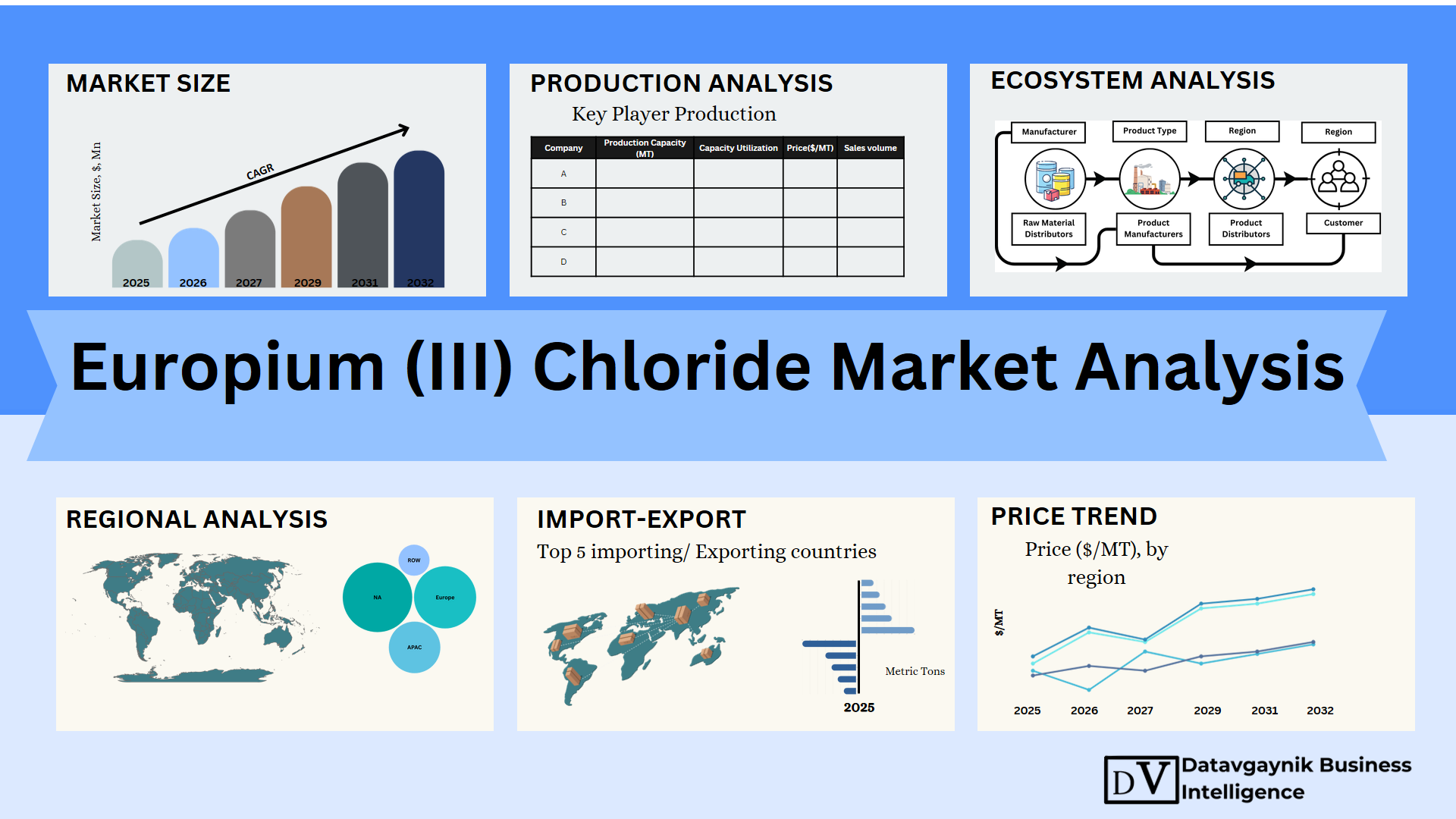
The market covers sales of Europium(III) chloride, mainly in anhydrous and hydrated forms, used as a high-purity europium precursor in phosphors, luminescent materials, specialty glass research, organometallic synthesis, advanced coatings, calibration materials, and selected life-science analytical workflows. It is not a bulk chemical market. It is small, technical, and heavily linked to purity, batch control, rare earth availability, and customer-specific qualification.
Datavagyanik also covers related markets such as the Europium (III) Carbonate Market, the Europium (III) Acetate Market, and the Europium (III) Bromide Market. They create a more holistic picture of the ecosystem in which the primary topic exists, including technological shifts and market demands.
| Market Indicator | 2026 Estimate | 2035 Forecast |
| Global market value | $14.8 million | $28.1 million |
| CAGR | 7.4% | |
| Estimated commercial volume | 11.5 metric tons | 19.6 metric tons |
| Blended realized ASP | $1,290/kg | $1,435/kg |
| Core demand base | Research, specialty chemicals, optoelectronics, analytical materials | Higher-purity optoelectronic and advanced material use |
The business relevance of the Europium (III) Chloride Market comes from its role as an enabling precursor rather than a finished performance material. Buyers don’t usually purchase it for volume economics. They buy it because europium ions provide strong red-emission behavior, stable luminescence, and useful coordination chemistry for high-value downstream systems. Thermo Fisher lists Europium(III) chloride as a starting material for other europium salts, europium(II) chloride, and organometallic europium compounds, which supports its role as a precursor chemical rather than a commodity input.
The 2026–2035 outlook is shaped by four forces. First, rare earth supply security is now a board-level concern. USGS estimated global rare earth mine production at about 390,000 tons in 2025, but downstream separation and refining remain concentrated. That matters because europium is not mined as a standalone material. It is recovered through rare earth separation streams.
Second, regulation is pushing buyers toward qualified, traceable supply. The EU Critical Raw Materials Act is designed to reduce dependency on single-country suppliers and strengthen domestic processing, recycling, and strategic material access. This does not directly regulate Europium(III) chloride as a standalone compound, but it changes procurement behavior for rare earth chemicals in Europe.
Third, China’s export-control actions have made buyers more sensitive to lead times, documentation, and alternate sourcing. China expanded rare earth export controls in October 2025, including additional scrutiny for semiconductor-linked users, while later licensing measures created selective relief for approved customers. For a small market like europium chloride, even limited shipment delays can affect inventory planning.
Fourth, technical demand is shifting from legacy phosphor use toward R&D-heavy applications. This includes europium complexes for OLED emitters, optical thermometry, luminescent tags, polymer beads, specialty coatings, and lead-free light-emitting materials. Sigma-Aldrich also positions Europium(III) chloride hexahydrate as a precursor for lanthanide-containing polystyrene beads used in calibration and internal standards for mass cytometry.
Key consumers and clients include high-purity chemical distributors, phosphor and luminescent material developers, OLED and display-material R&D labs, universities and national research institutes, analytical standard manufacturers, specialty glass developers, life-science reagent companies, and rare earth compound processors. The Europium (III) Chloride Market will remain narrow, but its value density should improve as more customers ask for 99.99%+ purity, ultra-dry grades, controlled impurity profiles, and small-batch repeatability.
Expert view: This is not a market where demand suddenly jumps because one mass application appears. The more realistic story is steady premiumization. Better purity. Better documentation. Smaller but more valuable batches. That is where margin sits.
Market Segmentation and Forecast Scope
The segmentation for the Europium (III) Chloride Market should be built around how buyers specify the compound, not only where it is used. In this market, purity level, hydration form, moisture sensitivity, and downstream qualification matter as much as application volume.
Segmentation by Product Type
| Product Type | Commercial Role | 2026 Share View | Growth Outlook |
| Europium(III) Chloride Hexahydrate | Common laboratory and synthesis-grade precursor. Easier to handle and more widely listed by chemical suppliers. | Hidden | Stable demand |
| Anhydrous Europium(III) Chloride | Used where moisture control is important, including organometallic synthesis and sensitive precursor chemistry. | Hidden | High-growth niche |
| High-Purity 99.99%+ Grades | Used in optoelectronic, analytical, and advanced material workflows where trace impurities can affect performance. | 38% in 2026 | Fastest-growing product class |
| Custom / Ultra-Dry Grades | Small-batch material for customers needing residual moisture control, tighter metals profile, or process-specific documentation. | Hidden | Strategic premium segment |
The fastest-growing product group will be high-purity 99.99%+ and ultra-dry grades. This is where the market is moving because downstream users care less about basic europium content and more about repeatable optical, chemical, and analytical performance. Thermo Fisher’s catalog shows commercial availability of ultra-dry 99.99% REO Europium(III) chloride with residual water specifications, which reflects how suppliers already differentiate premium material.
Segmentation by Application
| Application | Scope Included | Strategic Relevance |
| Luminescent Materials and Phosphor Precursors | Europium precursor use in red-emitting phosphors, specialty coatings, and experimental luminescent systems. | Mature but still important |
| OLED and Advanced Optoelectronic R&D | Europium complexes, emitter research, optical sensing, and display-material experimentation. | Fastest innovation-led segment |
| Organometallic and Coordination Chemistry | Synthesis of europium complexes and derivative salts. | Stable academic and specialty demand |
| Analytical Standards and Life-Science Materials | Lanthanide beads, calibration standards, mass cytometry-related precursor use. | Small but high-value |
| Specialty Glass and Laser Material Research | Europium-containing glass, optical materials, and doped systems. | Niche demand |
The most strategic application is OLED and advanced optoelectronic R&D. It won’t create bulk volume immediately. Still, it supports higher-value sales because customers need better grade control and technical documentation. Europium(III)-based luminescent complexes continue to attract research interest due to their red emission, thermal stability, and optical behavior in advanced materials.
Segmentation by End User
| End User | Demand Character | Procurement Behavior |
| Specialty Chemical Suppliers and Distributors | Stock standard and high-purity grades for laboratory and industrial customers. | Catalogue-based and contract supply |
| Advanced Materials Companies | Use europium chloride as a precursor for phosphors, coatings, and specialty luminescent materials. | Qualification-heavy |
| Research Institutes and Universities | Use small volumes for synthesis, photonics, coordination chemistry, and materials testing. | Small pack sizes, premium pricing |
| Life-Science Reagent Developers | Use europium compounds in bead-based standards and analytical workflows. | High documentation need |
| Display and Optoelectronic R&D Teams | Test europium complexes for emission, sensing, and specialty optical functions. | Project-based sourcing |
Research institutions will remain the broadest customer group by account count. Advanced material and analytical customers will contribute stronger revenue per kilogram.
Segmentation by Region
| Region | Market Role | 2026 Share View | Growth Outlook |
| North America | Strong in research, life sciences, defense-linked advanced materials, and specialty chemical distribution. | Hidden | Healthy growth |
| Europe | Strong in rare earth policy focus, academic photonics, recycling, and specialty material research. | Hidden | Policy-supported growth |
| Asia Pacific | Largest processing and consumption base. Strong links to rare earth chemicals, electronics, phosphors, and display materials. | 46% in 2026 | Largest and fastest scale region |
| LAMEA | Limited direct demand, mainly through academic labs, distributors, and small specialty imports. | Hidden | Low-base growth |
Asia Pacific leads because the region has deeper rare earth processing capacity, stronger electronics material activity, and closer integration with downstream display and chemical value chains. North America and Europe remain important for high-value R&D, analytical materials, and regulated supply qualification. That said, their demand will be more fragmented.
Use case: A European photonics lab working on europium-based red emitters may buy only a few hundred grams per year. But it may require 99.99% purity, impurity certificates, reproducible hydration state, and supplier traceability. That small order can carry far better value than a larger standard-grade sale.
Market Trends and Innovation Landscape
The innovation story in the Europium (III) Chloride Market is not about high-volume capacity expansion. It is about better precursor quality and more demanding downstream chemistry. Buyers want material that performs consistently in luminescent systems, analytical standards, organometallic routes, and experimental optoelectronics.
R&D Evolution
R&D is moving toward europium complexes with better emission efficiency, thermal stability, and integration into polymer, nanocrystal, and OLED-compatible systems. Recent research has highlighted Europium(III)-based luminescent materials for red-light-emitting complexes and advanced optical systems. The main technical aim is simple: stronger emission, lower quenching, better stability, and easier device integration.
A second R&D track is rare earth recycling. Europium recovery from end-of-life fluorescent lamp phosphors and electronic waste is getting more attention because europium is valuable, supply is concentrated, and recycling rates remain low. ETH Zurich researchers reported a method to separate europium more efficiently from fluorescent-lamp waste, with the next step focused on scale-up through industrial partners.
Expert view: Recycling will not replace primary rare earth supply during the forecast period. But for europium, even modest recovery can improve supply confidence because the downstream market is small and quality-sensitive.
Technology Evolution
The technology base is shifting from traditional phosphor chemistry toward multi-functional luminescent systems. Europium compounds are now being tested in optical sensing, thermometry, anti-counterfeiting materials, bioimaging-related systems, and next-generation OLED architectures. The commercial pull is still early, but the direction is clear. Material buyers are asking for cleaner precursors and tighter analytical control.
One important technical trend is the move from “available purity” to “application-ready purity.” Standard 99.9% material works for general synthesis. But optoelectronic, analytical, and device-facing customers often want 99.99%+, lower rare-earth cross-contamination, controlled moisture, and lot-to-lot reproducibility. This raises the value of high-purity Europium(III) chloride even if total tonnage remains modest.
Material Science Direction
For chemicals and materials, the main issue is not only europium content. It is the behavior of the chloride precursor during synthesis. Hydration state, solubility, trace contaminants, and conversion efficiency into downstream europium complexes can change performance. That is why high-purity anhydrous and ultra-dry grades are gaining attention.
In luminescent materials, Europium(III) is valued because its emission profile supports red-light applications. Rare earth phosphor references also show that phosphor applications require very high purity levels, often above 99.99%, which explains why upstream precursor quality is central to the value chain.
Expert view: The market will reward suppliers who can sell trust, not just chemistry. Certificates, impurity profiles, packaging stability, and repeat batches will matter more than broad catalog availability.
News, Partnerships, and Market Announcements
There have been no major public mergers or acquisitions specifically centered on Europium(III) chloride in the last two years. The product is too narrow for standalone M&A. The relevant announcements sit upstream in rare earth supply, recycling, and export licensing.
| Month / Year | Announcement | Market Impact |
| March 2025 | The European Commission announced 47 strategic projects for critical materials, including rare earth-related capacity and recycling activity. | Supports European supply-chain diversification and downstream buyer confidence. |
| April 2025 | China introduced rare earth export controls during trade tensions. | Increased buyer focus on inventory buffers, supplier qualification, and regional sourcing. |
| June 2025 | ETH Zurich researchers advanced europium separation from e-waste and fluorescent lamp streams. | Strengthens the long-term recycling pathway for europium-bearing materials. |
| October 2025 | China expanded rare earth export controls and added further scrutiny for semiconductor-linked users. | Raised procurement risk for rare earth chemical users and high-tech material buyers. |
| December 2025 | China began issuing streamlined rare earth export licenses for selected customers. | Reduced some shipment friction but did not remove structural supply risk. |
| November 2025 | India approved a rare earth permanent magnet manufacturing programme worth about $816 million. | Signals broader Asia-based rare earth localization, though the direct link to europium chloride is indirect. |
For the Europium (III) Chloride Market, the practical effect is clear. Customers will not only ask, “What is the price?” They will ask, “Can I get the same material again in six months?” That shift favors suppliers with rare earth sourcing visibility, analytical capability, and stable technical documentation.
Expert view: From 2026 onward, procurement teams may treat europium chloride like a strategic lab-scale input rather than a routine reagent. The dollar value is small. The switching cost can be high.
Competitive Intelligence and Benchmarking
Competition in this market is not built like a normal commodity chemical market. There are only a few meaningful demand pockets. So the supplier base is split into three layers: high-purity catalog suppliers, specialty rare earth compound providers, and upstream rare earth processors with indirect influence over availability and pricing.
| Company | Portfolio Position | Market Position and Benchmarking View |
| Thermo Fisher Scientific / Alfa Aesar | Supplies ultra-dry and high-purity europium chloride grades for research and specialty synthesis. Its listed material includes 99.99% REO grade with low residual water specification. | Strong in high-purity laboratory and research supply. The company’s advantage is documentation, global distribution, and small-pack availability rather than bulk rare earth processing. It is a preferred option for universities, advanced material labs, and specialty chemical buyers needing repeatable quality. |
| Merck KGaA / Sigma-Aldrich | Offers Europium(III) chloride grades used as precursors in luminescent compounds and lanthanide-containing bead systems. | Strong in analytical, academic, and life-science adjacent demand. Its position is strongest where buyers need trusted reagent sourcing, certificates, and access through established procurement systems. It is less of a bulk supplier and more of a qualified science-market channel. |
| American Elements | Supplies europium chloride in high-purity forms, including hydrate and anhydrous options, with custom material formats across rare earth compounds. | Positioned as a broad advanced-materials supplier. It competes well in custom specifications, technical sourcing, and larger non-standard orders. Its role is important for industrial R&D users who need more flexibility than standard catalog suppliers provide. |
| Ascensus Specialties / Strem Chemicals | Supplies anhydrous and hydrated europium chloride grades for organometallic, inorganic, and advanced materials research. | Strong in specialty chemistry and research-grade metal compounds. The Strem channel is relevant for laboratories working on luminescent films, coordination chemistry, and europium-doped material systems. Its strength is technical niche depth, not mass distribution. |
| Ereztech | Manufactures and sells anhydrous europium chloride in small and bulk volumes, with packaging options such as ampules, bottles, metal ampules, or bubblers. | A focused specialty supplier for customers needing controlled packaging and sensitive material handling. Its positioning is stronger in precursor chemistry and custom supply than broad catalog retail. |
| Stanford Advanced Materials | Supplies europium and rare earth material products for advanced industries such as aerospace, technology, medical, and energy applications. | A custom advanced-materials supplier with a wide rare earth portfolio. It is more relevant for project-based sourcing and specialty customer requests than for standardized reagent demand. |
| Edgetech Industries | Offers rare earth products including europium chloride, europium fluoride, europium nitrate, and related europium compounds. | Positioned as a rare earth and refractory materials supplier for research institutes and high-tech users. Its portfolio breadth gives it a useful role in mid-volume and custom rare earth sourcing. |
The competitive map shows a fragmented market. Thermo Fisher Scientific, Merck KGaA, and Ascensus Specialties / Strem Chemicals lead in qualified laboratory and research supply. American Elements, Ereztech, Stanford Advanced Materials, and Edgetech Industries are stronger in custom materials, rare earth sourcing, and project-linked demand.
No single company controls the market from end to end. That said, upstream rare earth concentration still affects everyone. China’s rare earth sector has been consolidated around large state-backed groups, and this indirectly shapes global pricing, lead times, and customer risk planning for europium-based chemicals.
Expert view: The winning suppliers will not simply be the cheapest. Buyers will pay for traceability, lot consistency, controlled moisture, and documentation. In a market this small, one failed batch can cost more than the reagent itself.
Regional Landscape and Adoption Outlook
The regional picture is shaped by two different forces. One is demand from research, phosphor chemistry, analytical materials, and optoelectronics. The other is access to rare earth separation and processing. These two forces do not always sit in the same country.
| Region / Country | Adoption Outlook | Growth Character | Key Market Signal |
| United States | The United States has strong demand from universities, national labs, defense-linked materials R&D, analytical suppliers, and optoelectronic research. Commercial consumption is small, but the quality requirement is high. | Moderate to strong growth from specialty materials and supply-chain localization. | U.S. rare earth policy is moving from discussion to direct industrial support. MP Materials announced a public-private partnership with the U.S. Department of Defense in July 2025 to accelerate domestic rare earth magnet supply-chain capacity. |
| Europe | Europe is a high-value demand region. Adoption is led by Germany, France, the Netherlands, Switzerland, Belgium, and the Nordic research cluster. Demand comes from photonics, specialty chemicals, EU-funded material research, and analytical science. | Strong growth in high-purity and traceable supply. | The EU approved 47 strategic projects under the Critical Raw Materials Act in March 2025, followed by additional projects outside the bloc in June 2025. This supports rare earth sourcing resilience, even if europium chloride itself remains a small downstream product. |
| China | China remains the most important upstream region due to rare earth mining, separation, oxide production, and chemical conversion capability. It also has domestic demand from phosphors, electronics, and specialty chemical users. | Largest ecosystem influence. Growth is steady but policy-controlled. | China’s rare earth industry is tightly managed through quotas, export controls, and consolidation around major state-backed producers. Reuters reported that China controls more than 90% of global processed rare earths and related technology. |
| India | India is still a small direct consumer of Europium(III) chloride, mainly through universities, research institutes, chemical distributors, and niche material science labs. | Low-base growth. More relevant after 2027 if domestic rare earth processing and advanced electronics ecosystems deepen. | India approved a rare earth permanent magnet manufacturing programme worth about $816 million in November 2025. The direct link to europium chloride is indirect, but it improves national attention on rare earth chemicals and downstream capability. |
| Japan | Japan is a technically advanced but selective market. Demand is tied to high-purity materials, display research, optical systems, specialty chemicals, and long-standing rare earth supply-chain strategy. | Stable, quality-led growth. | Japan’s strength is not mine volume. It sits in high-value processing, magnet technologies, materials know-how, recycling, and non-China supply diversification. The United States–Japan critical minerals framework announced in October 2025 also included cooperation around recycling and rare earth scrap. |
| South Korea | South Korea’s adoption is linked to electronics, display materials, batteries, semiconductors, and advanced manufacturing research. Direct europium chloride demand is modest but technically demanding. | Medium growth from display and electronics R&D. | South Korea is more of a downstream technology user than a major rare earth processor. Its growth will depend on supplier qualification, non-China sourcing options, and materials R&D tied to electronics and optical applications. |
| Middle East | The Middle East is not a core demand center for this product. Demand is mainly through universities, research labs, distributors, and selected energy or materials research programs in the UAE, Saudi Arabia, and Qatar. | Small and opportunistic. | The region may import more specialty chemicals as research infrastructure expands, but it is unlikely to become a major standalone market during 2026–2035. |
Asia Pacific will remain the largest regional base because rare earth processing, electronics manufacturing, and downstream material conversion are deeper there. China dominates the upstream side. Japan and South Korea lead in high-value application know-how. India is still emerging, but it has policy momentum.
North America and Europe will grow differently. Their direct volumes will remain modest, but their purchasing standards will be stricter. Buyers will ask for purity, documentation, non-disrupted supply, and acceptable sourcing risk. That plays well for premium suppliers.
Expert view: Regional growth will not only depend on who needs europium chemistry. It will depend on who can trust the supply chain. That is now the real adoption filter.
Recent Developments + Opportunities & Restraints
Recent Developments
| Month / Year | Event | Impact on the Market |
| March 2025 | The European Commission approved 47 strategic raw material projects under the Critical Raw Materials Act. | Supports European rare earth security and improves confidence for downstream specialty chemical buyers. |
| July 2025 | MP Materials announced a major public-private partnership with the U.S. Department of Defense to accelerate rare earth magnet independence. | Strengthens U.S. rare earth supply-chain capacity. Indirectly improves confidence in domestic rare earth material ecosystems. |
| October 2025 | China expanded rare earth export controls and added scrutiny for semiconductor and defense-linked users. | Increased lead-time risk and pushed buyers to qualify backup suppliers for rare earth chemicals. |
| November 2025 | India approved an $816 million rare earth permanent magnet manufacturing programme. | Supports rare earth localization and may help create a broader downstream rare earth chemical ecosystem in India. |
| April 2026 | The EU launched operations of a critical minerals procurement platform under its supply-chain diversification strategy. | Helps European buyers aggregate demand and reduce dependency risk in critical raw materials. |
Opportunities
- High-purity precursor demand
The best opportunity sits in 99.99%+ and ultra-dry material. Buyers in optoelectronics, analytical standards, and advanced material research need cleaner inputs. This supports higher margins even when volume remains small. - Non-China supplier qualification
Customers in the United States, Europe, Japan, South Korea, and India are likely to qualify secondary suppliers. This creates room for specialty distributors and custom rare earth compound suppliers. - Rare earth recycling linkages
Recovered europium from phosphor waste and e-waste can become more relevant over time. The opportunity is not immediate mass supply. It is strategic sourcing insurance.
Restraints
- Small demand base
This is a niche market. Even strong growth does not turn it into a large-volume chemical category. - Upstream concentration
Europium availability depends on rare earth separation streams. Supply risk remains high when processing is concentrated in a few regions. - Technical qualification barriers
Customers using Europium(III) chloride in luminescent, analytical, or device-linked systems may take time to approve a new supplier. That slows switching.


