

Surging Demand in Glass Applications Accelerates Feldspar Market Growth
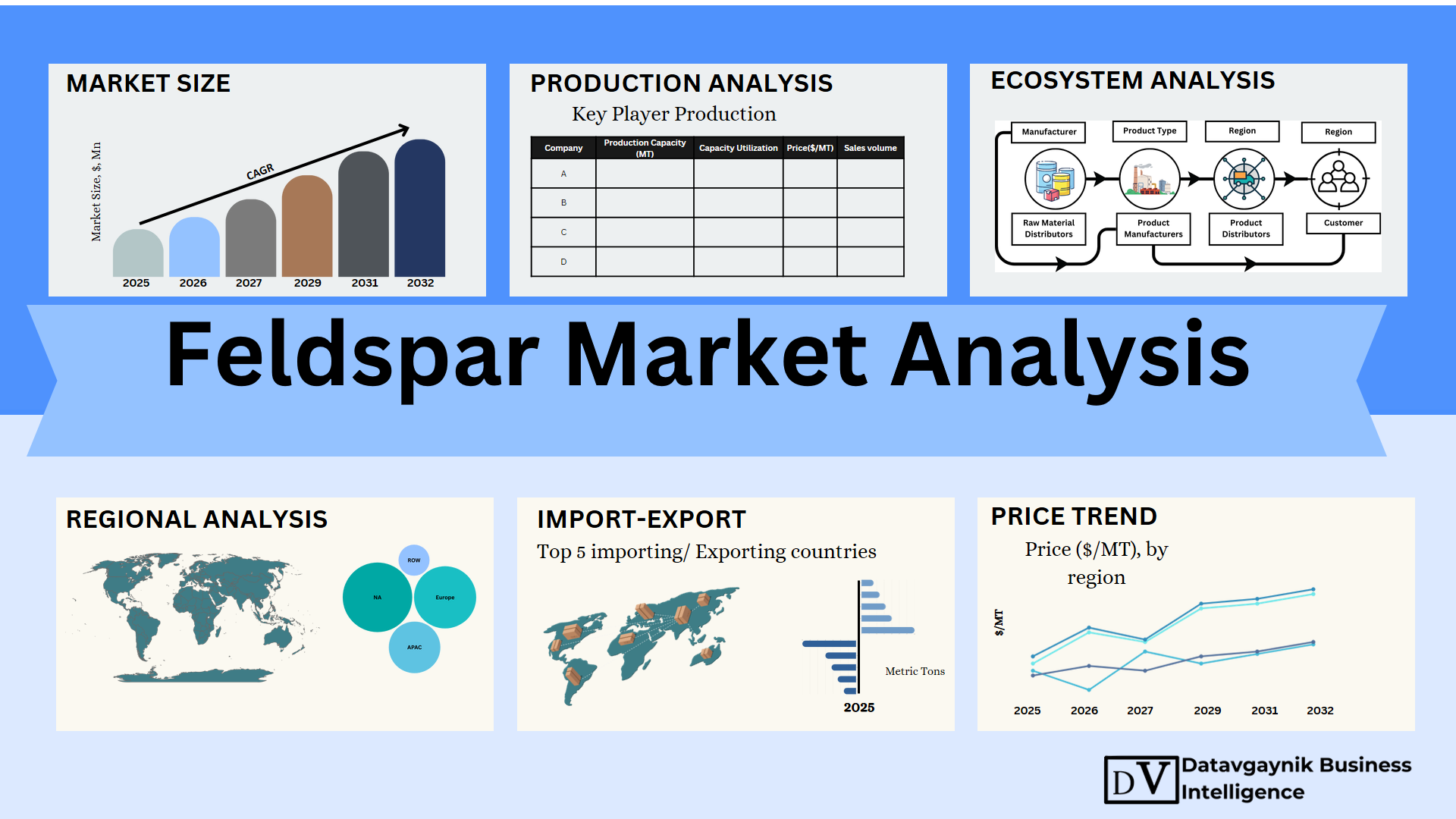
The feldspar market is witnessing robust momentum driven by escalating demand from the global glass manufacturing industry. Feldspar serves as a fluxing agent, reducing the melting temperature of quartz and helping control viscosity during glass production. According to Datavagyanik, the global flat glass market, a key end-use sector, surpassed USD 125 billion in 2023 and is expected to grow at a CAGR of 6.5% through 2032. This growth directly influences the feldspar market, particularly in regions with booming construction and automotive activity. For example, the automotive industry’s increasing requirement for lightweight and durable safety glass has fueled feldspar consumption across North America and Europe. Additionally, container glass production for food, beverages, and pharmaceuticals—sectors that are growing due to rising hygiene awareness and population—has increased feldspar demand exponentially.
Ceramic Industry Expansion Supporting Feldspar Market Dynamics
The feldspar market continues to benefit from the consistent expansion of the global ceramic industry. As a primary ingredient in ceramic tile, sanitary ware, and porcelain production, feldspar plays a critical role in enhancing the strength, texture, and durability of ceramic products. For instance, the global ceramic tiles market reached a value of over USD 80 billion in 2023 and is projected to exceed USD 120 billion by 2030. Much of this demand originates from the Asia Pacific region, where rapid urbanization in countries like India, China, and Indonesia has driven massive investments in residential and commercial construction. Datavagyanik highlights that India’s Smart Cities Mission and housing development schemes have led to a double-digit increase in ceramic tile consumption, directly boosting the feldspar market.
Electronics Industry Evolution Boosting the Feldspar Market
The feldspar market is also experiencing substantial demand from the electronics industry. Feldspar is crucial in manufacturing ceramic-based electronic components, including insulators, capacitors, and substrates used in smartphones, laptops, and electric vehicles. For example, the global consumer electronics market, valued at over USD 1 trillion in 2023, is expected to grow at a CAGR of 5% through 2030. Datavagyanik emphasizes that as smart devices become more compact and energy-efficient, demand for ceramic substrates made with feldspar is rising. South Korea, China, and Japan—leaders in semiconductor and electronic component manufacturing—are heavily reliant on feldspar-derived materials, which enhances the global feldspar market outlook.
Renewable Energy Boom Powering the Feldspar Market
A strong surge in renewable energy adoption is emerging as a transformative driver in the feldspar market. Feldspar is integral to producing solar glass, a key component in photovoltaic (PV) panels. As governments worldwide push for clean energy, the solar PV market has seen record growth. According to Datavagyanik, global solar panel installations surpassed 280 GW in 2023 and are projected to cross 400 GW annually by 2030. Each solar panel requires ultra-clear, low-iron glass manufactured using high-purity feldspar, making the mineral indispensable to green energy infrastructure. Countries such as China, the U.S., Germany, and India are expanding solar farms aggressively, reinforcing the feldspar market’s strategic importance in the global shift toward sustainability.
Construction Sector Investments Elevating the Feldspar Market
With infrastructure investment at an all-time high across both developed and emerging economies, the construction sector remains a pillar of support for the feldspar market. For instance, global construction output reached USD 13.5 trillion in 2023 and is expected to exceed USD 15 trillion by 2027, driven by megaprojects in urban development, smart cities, and transport infrastructure. Feldspar is extensively used in architectural glass, floor tiles, wall cladding, and sanitary ware. Datavagyanik highlights that construction activities in the Middle East—such as Saudi Arabia’s NEOM and the UAE’s Expo City—have caused a spike in demand for feldspar-based building materials. Similarly, government-funded renovation programs in Europe are revitalizing older buildings with energy-efficient glass and ceramic components, both of which depend heavily on feldspar.
Paints and Coatings Segment Amplifying Feldspar Market Potential
Another prominent growth avenue within the feldspar market is the paints and coatings sector. Feldspar acts as a functional filler, enhancing properties such as abrasion resistance, chemical durability, and surface finish. The global paints and coatings market reached USD 165 billion in 2023 and is projected to grow steadily, fueled by rising construction and automobile production. For instance, automotive coatings—critical for UV resistance and color retention—are increasingly incorporating feldspar to meet higher quality standards. Datavagyanik also notes that water-based architectural paints, designed for green buildings and VOC regulation compliance, are now integrating feldspar as a sustainable and cost-effective additive, reinforcing its relevance in eco-friendly product development.
Rising Demand for Lightweight Materials Propelling Feldspar Market
The feldspar market is seeing increased adoption in the plastics and rubber industries due to its ability to improve mechanical properties while reducing overall weight. As industries like automotive and packaging strive for weight optimization without compromising durability, feldspar emerges as an ideal filler. For instance, the global lightweight materials market is forecasted to grow from USD 185 billion in 2023 to over USD 300 billion by 2032. Applications such as under-the-hood automotive parts, flexible packaging films, and molded furniture components all benefit from feldspar’s low density and high stability. Datavagyanik confirms that feldspar is now being used in polypropylene and polyethylene compounds in place of more expensive and heavier fillers, making it a cost-efficient alternative in weight-sensitive applications.
Feldspar Market Size Fueled by Emerging Industrial Applications
The feldspar market size is further expanding due to its integration into niche industrial applications such as abrasives, adhesives, and sealants. Its high hardness and chemical inertness make feldspar suitable for sandpaper production and polishing agents. Additionally, the adhesives and sealants segment, valued at over USD 60 billion globally, utilizes feldspar to enhance rheology and mechanical strength. As advanced manufacturing techniques evolve, feldspar’s role is becoming more specialized. Datavagyanik emphasizes that industries requiring precision bonding—such as aerospace, electronics assembly, and construction—are incorporating feldspar-based composites to improve product lifecycle and environmental performance.
Consumer Preferences for Aesthetics Supporting Feldspar Market Trends
Modern consumer behavior is also shaping feldspar market trends. As residential and commercial buyers gravitate toward premium aesthetics, demand for feldspar-based ceramic tiles, countertops, and porcelain products has surged. For example, high-gloss vitrified tiles and engineered quartz surfaces owe much of their finish and durability to feldspar inputs. According to Datavagyanik, the global market for luxury interior surfaces grew by over 8% in 2023, with significant uptake across urban housing developments in India, Southeast Asia, and the Middle East. This evolving preference for long-lasting, visually appealing, and low-maintenance materials has turned feldspar into a cornerstone of interior design and architectural finishes.
Feldspar Market Backed by Robust Export and Production Networks
The feldspar market size is also reinforced by a strong global trade network. Countries like Turkey, India, and the United States are among the top producers and exporters. For instance, Turkey alone accounts for more than 30% of global feldspar exports, supplying raw material to ceramic giants in Italy and Spain. India, on the other hand, exports feldspar to Southeast Asia and the Middle East, where rapid construction and ceramic manufacturing are driving demand. Datavagyanik points out that vertical integration among feldspar miners and downstream ceramic and glass manufacturers is enhancing supply chain resilience, allowing for more consistent quality and competitive pricing across markets.
“Track Country-wise Feldspar Production and Demand through our Feldspar Production Database”
-
-
- Feldspar production database for 23+ countries worldwide
- Feldspar sales volume for 28+ countries
- Country-wise Feldspar production capacity, production plant mapping, production capacity utilization for 23+ manufacturers
- Feldspar production plants and production plant capacity analysis by top manufacturers
-
“Track real-time Feldspar Prices, Feldspar price charts for 23+ countries, Feldspar weekly price tracker and Feldspar monthly price tracker”
-
-
- Track real-time Feldspar prices and Feldspar price trend in 23+ countries though our excel-based Feldspar price charts
- Real-time Feldspar price tracker dashboard with 23+ countries
- Complete transparency on Feldspar price trend through our Feldspar monthly price tracker, Feldspar weekly price tracker
-
Asia Pacific Leading Global Growth in the Feldspar Market
The Asia Pacific feldspar market is witnessing exponential growth, driven by a convergence of industrial expansion, rapid urbanization, and rising exports. China, the region’s largest feldspar consumer, dominates due to its massive glass and ceramics industries. The country produced over 2.5 billion square meters of ceramic tiles in 2023, accounting for over 40% of global output. Datavagyanik highlights that feldspar demand in China surged by over 12% year-on-year, fueled by infrastructure investments and increasing solar panel installations. India, another major player, has seen feldspar consumption grow by more than 10% annually, with its Smart Cities Mission and booming tile industry acting as key catalysts. Southeast Asian economies such as Vietnam, Thailand, and Indonesia are also emerging as important feldspar markets due to expanding manufacturing bases and export-oriented ceramic production.
Europe Feldspar Market Gaining Traction Through Premium Manufacturing
The feldspar market in Europe is shaped by its focus on high-end ceramic and glass manufacturing. Italy and Spain, world leaders in ceramic tile exports, are among the largest consumers of feldspar in the region. For example, Italy exported ceramic tiles worth over USD 5 billion in 2023, with feldspar as a critical input in tile body and glaze formulation. Germany, on the other hand, integrates feldspar in specialty glass production for the automotive and architectural sectors. Datavagyanik notes that European feldspar consumption is increasingly aligned with green construction trends, which emphasize durable, recyclable materials such as feldspar-based ceramics and glass. Moreover, Europe’s strict quality and environmental standards have led to an uptick in demand for high-purity feldspar sourced from reliable producers like Turkey and India.
North America Feldspar Market Driven by Diversified Applications
The feldspar market in North America is supported by strong demand from multiple industries including glass, ceramics, electronics, and coatings. The United States remains the largest feldspar consumer in the region, with production centered in states such as North Carolina, Virginia, and California. Feldspar is vital to the U.S. flat glass market, which surpassed USD 30 billion in 2023, primarily due to demand from the construction and automotive sectors. Additionally, renewable energy growth—particularly in solar panel installations, which crossed 35 GW in new capacity in 2023—continues to elevate feldspar demand for solar glass production. Datavagyanik confirms that the feldspar market in North America is also increasingly influenced by its role in sustainable building materials and industrial ceramics used in high-performance electronics and aerospace components.
Middle East Feldspar Market Expanding Amidst Infrastructure Boom
The feldspar market across the Middle East is scaling rapidly, fueled by megaprojects and economic diversification strategies. Saudi Arabia, under Vision 2030, is developing futuristic cities such as NEOM and The Red Sea Project, leading to unprecedented demand for glass and ceramic products. Datavagyanik points out that feldspar consumption in Saudi Arabia increased by over 14% in 2023 alone, driven by rising use in flat glass for façades and high-end tiles for luxury interiors. Similarly, the UAE, Qatar, and Oman are investing heavily in hospitality, commercial real estate, and solar energy projects—all of which contribute to feldspar market expansion. The region’s preference for durable and aesthetic construction materials has led to a growing reliance on imported feldspar from Turkey and India.
Latin America and Africa Emerging as New Growth Corridors in the Feldspar Market
While historically underdeveloped in feldspar production and consumption, Latin America and Africa are now experiencing growing industrial demand. Brazil, the largest feldspar market in Latin America, is witnessing increased ceramic tile and glass production due to a recovery in the construction sector. Datavagyanik notes that Brazil’s feldspar consumption rose by nearly 9% in 2023, with new investments in residential infrastructure and export-oriented tile manufacturing. In Africa, countries like Egypt and South Africa are expanding feldspar applications in glass production for packaging and automotive use. Infrastructure development programs supported by multilateral institutions are further boosting demand for feldspar-based materials, positioning the continent as a promising future player in the feldspar market.
Feldspar Market Segmentation by Product Type Shows Distinct Preferences
The feldspar market is segmented primarily into sodium feldspar, potassium feldspar, and mixed feldspar. Sodium feldspar, due to its excellent fluxing properties, is heavily used in glass manufacturing. Datavagyanik reports that sodium feldspar accounts for over 60% of total feldspar consumption globally, with China and India leading in usage. Potassium feldspar, preferred for high-end ceramics and sanitary ware, is gaining traction in markets such as Europe and Japan, where quality and finish are prioritized. For example, Japan’s porcelain exports, valued at over USD 1 billion in 2023, depend largely on potassium feldspar. Mixed feldspar types are commonly used in cost-sensitive applications where balanced chemical properties are sufficient, such as adhesives and fillers.
Application-Based Segmentation Enhancing Feldspar Market Opportunities
Segmenting the feldspar market by application reveals significant diversity. Glass manufacturing holds the lion’s share, with over 45% of global feldspar consumption attributed to this segment. Ceramic production comes next, making up roughly 35% of demand. In addition, the paints and coatings segment is emerging as a high-potential application area, especially in developing regions where infrastructure growth is pushing the need for more durable and resistant coatings. The plastics and rubber segment also continues to gain momentum, supported by the lightweighting trend in automotive and packaging. Datavagyanik underscores that with each new application, feldspar’s versatility and cost-efficiency become more valuable to manufacturers seeking material performance improvements.
Feldspar Market Segmentation by End-Use Industry Driving Specialized Demand
The feldspar market also sees evolving dynamics when segmented by end-use industry. The construction sector remains the most dominant, accounting for nearly half of global feldspar consumption. For instance, high-rise buildings, airports, malls, and residential complexes all depend on feldspar-based glass and ceramic products. The automotive sector is the second-largest, where feldspar is used in lightweight glass, ceramic coatings, and interior fittings. Renewable energy, a fast-growing vertical, contributes notably through solar panel glass manufacturing. Datavagyanik emphasizes that with the global renewable energy market projected to surpass USD 2 trillion by 2032, feldspar’s role in clean energy supply chains will only strengthen.
Feldspar Price Trend Reflects Supply Chain and Energy Cost Volatility
The feldspar price trend has shown upward movement in recent years, influenced by rising energy prices, supply chain constraints, and growing global demand. For example, average feldspar prices increased by 8% globally in 2023 compared to the previous year. Regions such as Europe saw higher price volatility due to rising energy and transportation costs. In contrast, Asia Pacific benefited from relatively stable feldspar prices, thanks to proximity to raw material reserves and lower production costs. Datavagyanik attributes the current feldspar price trend to a combination of factors—rising freight costs, stricter mining regulations in some countries, and increased demand from high-growth sectors. Manufacturers are also investing in value-added feldspar products, such as refined feldspar for electronics, which fetch premium prices in global markets.
Feldspar Price Influenced by Trade Dynamics and Production Concentration
Global feldspar price dynamics are also shaped by the production concentration in a few key countries. Turkey, the world’s largest feldspar exporter, accounts for more than 30% of international supply, making its production and export policies critical to feldspar price stabilization. For instance, any disruption in Turkish mining operations has immediate ripple effects on feldspar prices in Europe and the Middle East. Similarly, India and the United States play vital roles in maintaining steady feldspar prices due to their capacity to supply both domestic and international markets. Datavagyanik highlights that the feldspar price trend remains sensitive to geopolitical developments, environmental policies, and shifts in demand from major end-use industries such as solar, electronics, and ceramics.
Feldspar Price Trend Encouraging Substitution and Strategic Procurement
As the feldspar price continues to trend upward in many regions, manufacturers are exploring strategies to optimize procurement and manage input costs. In the paints and coatings industry, for example, companies are mixing feldspar with other minerals like talc and kaolin to maintain performance while reducing expenses. The ceramic industry, particularly in cost-sensitive markets like Southeast Asia, is increasingly sourcing feldspar from multiple countries to avoid overdependence on a single supplier. Datavagyanik observes that long-term supply contracts, local beneficiation, and digital procurement tools are being adopted to mitigate feldspar price volatility and ensure consistent quality for critical applications.
“Feldspar Manufacturing Database, Feldspar Manufacturing Capacity”
-
-
- Feldspar top manufacturers market share for 23+ manufacturers
- Top 6 manufacturers and top 13 manufacturers of Feldspar in North America, Europe, Asia Pacific
- Feldspar production plant capacity by manufacturers and Feldspar production data for 23+ market players
- Feldspar production dashboard, Feldspar production data in excel format
-
“Feldspar price charts, Feldspar weekly price tracker and Feldspar monthly price tracker”
-
-
- Factors impacting real-time Feldspar prices in 18+ countries worldwide
- Feldspar monthly price tracker, Feldspar weekly price tracker
- Real-time Feldspar price trend, Feldspar price charts, news and updates
- Tracking Feldspar price fluctuations
-
Top Manufacturers Driving Competitive Landscape in the Feldspar Market
The feldspar market is shaped by a concentrated pool of manufacturers that command a significant share of the global supply. These companies have established robust mining operations, advanced processing technologies, and well-integrated supply chains to meet the growing demand from industries such as glass, ceramics, electronics, and coatings. A few key players dominate global production and exports, particularly from regions with abundant feldspar reserves like Turkey, India, the United States, and parts of Europe.
Eczacıbaşı Esan (Turkey) – Leading the Feldspar Market with Consistent Supply
Eczacıbaşı Esan, based in Turkey, holds a commanding position in the feldspar market. As one of the world’s largest producers and exporters, the company supplies high-purity sodium and potassium feldspar to global ceramic and glass manufacturers. Its product portfolio includes premium feldspar variants such as Esan Potassium Feldspar – KP40 and Esan Sodium Feldspar – SN20, which are tailored for high-performance applications in tile glazes, sanitary ware, and float glass. With a well-established logistics network and exports spanning over 40 countries, Eczacıbaşı Esan holds a market share of approximately 15–18% in the global feldspar market.
I-Minerals Inc. (United States) – Specialty Feldspar for High-End Applications
I-Minerals Inc., operating from Idaho, is a key feldspar supplier focused on producing high-purity feldspathic sands and specialty-grade materials. Its flagship project, the Bovill Kaolin Project, includes the extraction of Fortispar, a high-grade potassium feldspar designed for demanding ceramic and glass applications. I-Minerals’ strategic advantage lies in its vertically integrated operations that produce ultra-pure feldspar suited for electronics and solar glass production. The company caters primarily to the North American market, with an estimated market share of around 6–7%, and continues to expand its presence in value-added feldspar segments.
The Quartz Corp (USA–Norway Joint Venture) – High-Purity Feldspar for Tech Industries
The Quartz Corp, a joint venture between Imerys (France) and Norsk Mineral (Norway), is a prominent supplier of high-purity feldspar and other industrial minerals. Operating facilities in Spruce Pine (USA) and Drag (Norway), the company focuses on supplying feldspar to electronics, ceramics, and specialty glass manufacturers. Its Drag Feldspar and Spruce Pine High Purity Feldspar are known for their low iron content, making them suitable for solar panels and precision glass. The Quartz Corp controls approximately 5–6% of the global feldspar market and plays a strategic role in servicing high-tech applications with consistent mineral quality.
Sibelco (Belgium) – Global Supply Network in the Feldspar Market
Sibelco is a multinational industrial minerals company with significant influence in the feldspar market. Operating more than 200 production sites in over 40 countries, Sibelco supplies both sodium and potassium feldspar variants for the ceramics, glass, and construction industries. Products such as Sibelite K20 and Sibelite N30 are widely used in tile manufacturing and container glass. Sibelco’s vast distribution network across Europe, Asia, and the Americas provides flexibility in supply and responsiveness to market fluctuations. The company holds an estimated 8–10% share of the feldspar market and continues to invest in processing technologies and quality control systems.
Asia Minerals and Mining Development Limited (Thailand) – Regional Leader in Asia
Asia Minerals and Mining Development Limited (AMMD) is a major producer of feldspar in Southeast Asia, with operations centered in Thailand and Myanmar. The company specializes in supplying feldspar to regional ceramic and tile manufacturers. Its AMMD Sodium Feldspar G200 is widely used in glazes and vitrified tiles across Thailand, Vietnam, and Indonesia. AMMD benefits from proximity to rapidly expanding manufacturing hubs, offering competitive prices and reliable supply. The company commands a 4–5% market share in the feldspar market, especially in regional trade across Southeast Asia.
Sun Minerals (India) – Export-Oriented Feldspar Supplier
Sun Minerals is among India’s top feldspar exporters, with a portfolio that includes potassium feldspar lumps and powders suited for sanitary ware, porcelain, and glass. With mining operations in Rajasthan and Gujarat, the company ships feldspar to the Middle East, Southeast Asia, and Africa. Its product lines, such as Sun K-Feldspar Grade 1 and Sun Na-Feldspar Grade 2, cater to the strict specifications of international ceramic producers. India’s strategic location, coupled with abundant reserves, enables Sun Minerals to capture a 3–4% global feldspar market share with ongoing efforts to scale exports.
Feldspar Market Share by Leading Manufacturers
The feldspar market remains moderately consolidated, with the top five players accounting for over 40% of the global supply. Turkey-based producers, primarily Eczacıbaşı Esan, dominate the export landscape, especially in Europe and the Middle East. Meanwhile, companies like I-Minerals and The Quartz Corp cater to niche, high-purity markets with specialized feldspar for electronics and solar applications. Sibelco stands out with its global reach and balanced supply to all major feldspar-consuming industries.
Regional players such as Sun Minerals in India and AMMD in Thailand provide cost-effective solutions to emerging markets, offering flexibility in terms of volume and grade. Datavagyanik notes that market share dynamics are increasingly shifting toward companies capable of offering customized feldspar grades with consistent quality, faster delivery cycles, and adherence to environmental compliance.
Recent Developments in the Feldspar Market and Industry Activities
– January 2024: Eczacıbaşı Esan announced a USD 30 million investment to expand its feldspar processing plant in western Turkey, aiming to increase production capacity by 25% to meet rising demand from the EU’s ceramics industry.
– March 2024: Sibelco revealed plans to launch a new product line of ultra-white potassium feldspar tailored for high-end porcelain applications, targeting premium ceramic tile manufacturers in Italy and Japan.
– November 2023: I-Minerals Inc. secured a long-term supply agreement with a leading solar glass manufacturer in California, reinforcing the importance of its Fortispar product in the renewable energy sector.
– December 2023: The Quartz Corp began commercial production of high-purity feldspar tailored for 5G infrastructure components, focusing on ultra-flat ceramic substrates required for signal transmission devices.
– February 2024: Sun Minerals expanded its mining operations in Gujarat, India, with the addition of two new feldspar processing units aimed at boosting exports to Southeast Asian markets.
– April 2024: AMMD introduced a new feldspar blend optimized for faster vitrification in ceramic tile kilns, reducing energy consumption and emissions by up to 12%, aligning with Southeast Asia’s push for greener manufacturing processes.
These developments reflect a clear trend in the feldspar market: companies are increasingly focusing on advanced processing, sustainability, and application-specific customization to maintain competitiveness. As global demand continues to diversify and end-use industries evolve, the feldspar market is expected to remain dynamic, innovation-driven, and supply-sensitive in the years ahead.
“Feldspar Production Data and Feldspar Production Trend, Feldspar Production Database and forecast”
-
-
- Feldspar production database for historical years, 10 years historical data
- Feldspar production data and forecast for next 7 years
- Feldspar sales volume by manufacturers
-
“Track Real-time Feldspar Prices for purchase and sales contracts, Feldspar price charts, Feldspar weekly price tracker and Feldspar monthly price tracker”
-
-
- Gain control on your purchase and sales contracts through our real-time Feldspar price tracker and Feldspar price trend analysis
- Feldspar weekly price tracker and forecast for next four weeks
- Feldspar monthly price tracker and forecast for next two months
-
Market Scenario, Demand vs Supply, Average Product Price, Import vs Export, till 2032
- Global Feldspar Market revenue and demand by region
- Global Feldspar Market production and sales volume
- United States Feldspar Market revenue size and demand by country
- Europe Feldspar Market revenue size and demand by country
- Asia Pacific Feldspar Market revenue size and demand by country
- Middle East & Africa Feldspar Market revenue size and demand by country
- Latin America Feldspar Market revenue size and demand by
- Import-export scenario – United States, Europe, APAC, Latin America, Middle East & Africa
- Average product price – United States, Europe, APAC, Latin America, Middle East & Africa
- Market player analysis, competitive scenario, market share analysis
- Business opportunity analysis
Key questions answered in the Global Feldspar Market Analysis Report:
- What is the market size for Feldspar in United States, Europe, APAC, Middle East & Africa, Latin America?
- What is the yearly sales volume of Feldspar and how is the demand rising?
- Who are the top market players by market share, in each product segment?
- Which is the fastest growing business/ product segment?
- What should be the business strategies and Go to Market strategies?
The report covers Feldspar Market revenue, Production, Sales volume, by regions, (further split into countries):
- Asia Pacific (China, Japan, South Korea, India, Indonesia, Vietnam, Rest of APAC)
- Europe (UK, Germany, France, Italy, Spain, Benelux, Poland, Rest of Europe)
- North America (United States, Canada, Mexico)
- Latin America (Brazil, Argentina, Rest of Latin America)
- Middle East & Africa
Table of Contents:
Feldspar Market
1. Introduction to the Feldspar Market
1.1 Overview and Definition of Feldspar
1.2 Chemical Composition and Physical Characteristics
1.3 Industrial Applications and End-Use Sectors
2. Market Segmentation and Product Categorization
2.1 Classification of Feldspar by Type (Plagioclase, Orthoclase)
2.2 Market Breakdown by Application (Glass, Ceramics, Fillers, Others)
2.3 End-User Industry Demand and Market Trends
3. Global Feldspar Market Overview and Growth Trends
3.1 Market Valuation and Growth Projections (2019-2032)
3.2 Key Factors Driving Market Expansion
3.3 Market Constraints and Challenges Affecting Growth
4. Regional Analysis and Market Performance
4.1 North America Feldspar Market Insights
- U.S. Feldspar Production, Trade, and Consumption Trends4.2 Europe Market Landscape
- Regional Production Hubs and Key Importers4.3 Asia-Pacific Feldspar Market Outlook
- Major Producers, Demand Growth, and Trade Flow4.4 Latin America Market Perspective
- Feldspar Industry Growth and Export Potential4.5 Middle East & Africa Market Assessment
- Investment Trends and Industry Developments
5. Global Feldspar Production and Supply Chain Analysis
5.1 Feldspar Production Volumes by Country (2019-2032)
5.2 Processing and Manufacturing Trends in the Industry
5.3 Logistics, Distribution Networks, and Supply Chain Efficiency
6. Competitive Landscape and Market Participants
6.1 Leading Feldspar Producers and Market Share Analysis
6.2 Global Revenue and Market Positioning of Key Players (2019-2024)
6.3 Business Strategies, Acquisitions, and Expansions
6.4 Competitive Pricing Analysis and Future Business Strategies
7. Feldspar Production and Trade Analysis
7.1 Global Feldspar Production Capacity and Output Trends
7.2 International Trade Statistics – Imports and Exports
7.3 Supply and Demand Analysis in Major Markets
8. Consumption Analysis and Market Demand Forecast
8.1 Feldspar Consumption by Application Sector
8.2 End-Use Industry Trends Driving Demand Growth
8.3 Market Share of Different Feldspar Products
8.4 Forecast for Future Consumption Trends (2024-2032)
9. Cost Analysis and Manufacturing Economics
9.1 Feldspar Mining and Processing Costs
9.2 Raw Material Sourcing and Price Fluctuations
9.3 Profitability Analysis and Cost Optimization Strategies
10. Industry Value Chain and Distribution Channels
10.1 Feldspar Market Supply Chain Mapping
10.2 Role of Distributors and Traders in Market Expansion
10.3 Sales and Marketing Channels in the Feldspar Industry
11. Market Entry Strategies and Business Opportunities
11.1 Emerging Markets with High Investment Potential
11.2 Regulatory Framework and Trade Policies Impacting the Industry
11.3 Strategic Partnerships, Collaborations, and Mergers
11.4 Risk Mitigation Strategies and Sustainable Growth Approaches
12. Future Market Outlook and Technological Advancements
12.1 Feldspar Production Forecast and Market Trends (2024-2032)
12.2 Innovations in Feldspar Processing and Value-Added Products
12.3 Environmental and Sustainability Initiatives in the Industry
12.4 Strategic Recommendations for Market Players
Other recently published reports:

