

Global Growth Drivers in the Hematite (Fe₂O₃) Market
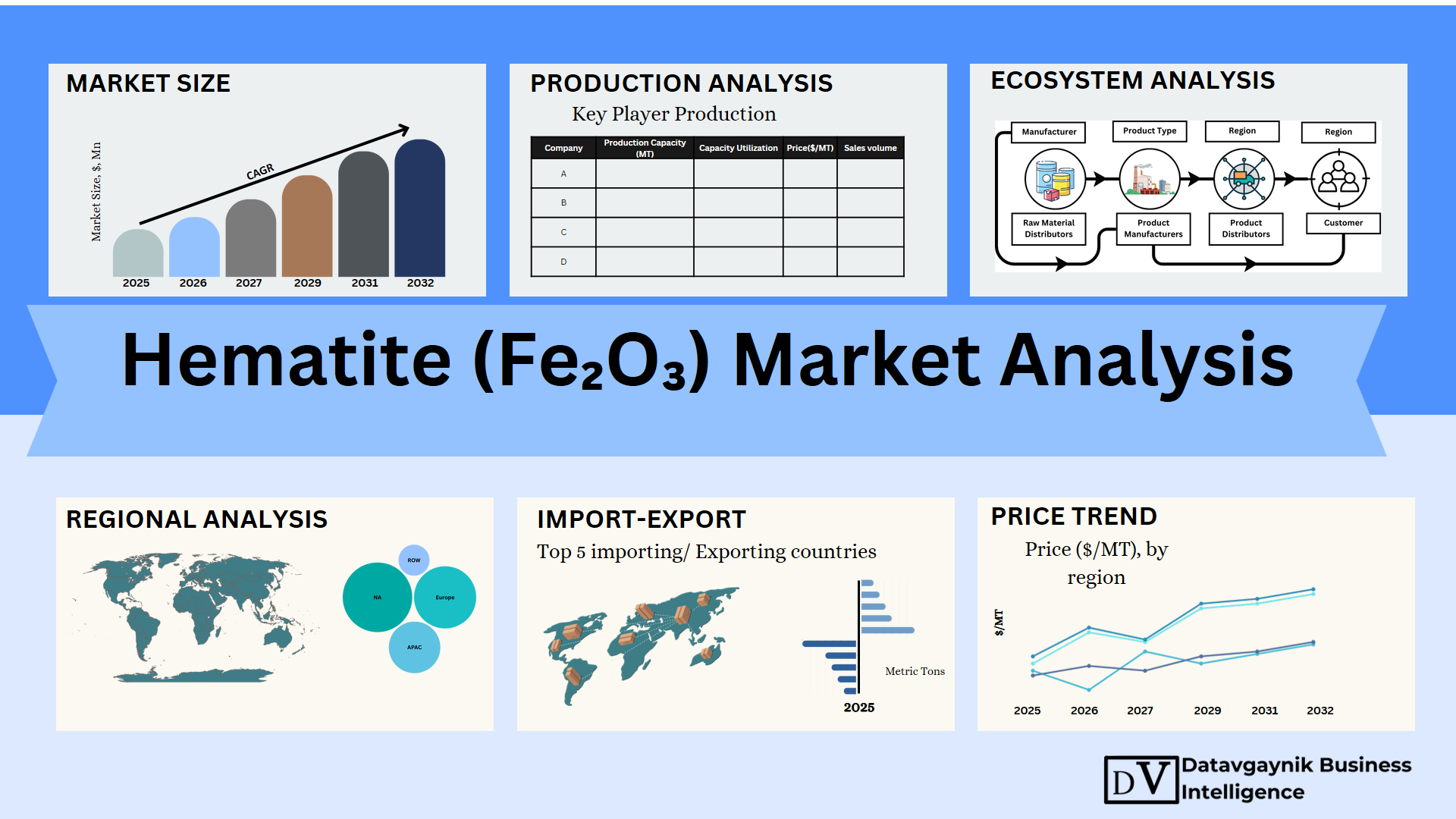
The global Hematite (Fe₂O₃) Market is experiencing significant growth, driven by multiple factors within the iron and steel industry. Hematite, one of the highest quality forms of iron ore, is in high demand due to its superior iron content, which results in stronger and more durable steel. The increasing need for steel in sectors such as construction, automotive, and manufacturing plays a crucial role in this trend. As per Datavagyanik insights, the global Hematite (Fe₂O₃) Market Size is expected to grow at a compounded annual growth rate (CAGR) of over 5% between 2024 and 2032, reflecting the robust growth of the iron ore industry.
Steel Production Growth and the Hematite (Fe₂O₃) Market
One of the key drivers of the growing demand for Hematite (Fe₂O₃) is the surge in global steel production. Hematite, being a high-grade iron ore, is a preferred choice for steelmakers due to its ability to yield stronger and more durable steel products. The steel industry’s growth is particularly significant in emerging markets such as India and China, where urbanization and infrastructure projects are driving steel demand. In fact, China alone, as the world’s largest steel producer, accounted for over 50% of the global steel output in 2023. This growth in steel production directly impacts the Hematite (Fe₂O₃) Market, as the demand for high-quality iron ore continues to rise to meet the steel industry’s needs.
Datavagyanik also covers related markets such as the Iron Oxide (Hematite) Market. These materials are considered in high-temperature and specialty chemical environments, where glass production, catalysis, and safety regulations influence adoption patterns.
Urbanization and Infrastructure Development Driving Hematite (Fe₂O₃) Demand
Rapid urbanization, especially in developing countries across Asia and Africa, is another significant factor contributing to the increased demand for Hematite (Fe₂O₃). With growing populations and the expansion of cities, the need for construction materials, particularly steel, is surging. The demand for Hematite (Fe₂O₃) is consequently increasing as the steel industry is required to meet the needs of these urbanization projects. For instance, India’s urban population is expected to grow by over 150 million by 2030, leading to a significant rise in steel consumption, and in turn, driving the need for higher-quality iron ores like Hematite.
The Rise of Green Steel and Hematite (Fe₂O₃) Innovation
As environmental concerns grow, there is a rising trend toward sustainable steel production methods, with a particular focus on green steel. Green steel production technologies utilize hydrogen and renewable energy sources to reduce carbon emissions during the steel-making process. This trend significantly impacts the Hematite (Fe₂O₃) Market, as these cleaner technologies require high-quality iron ore to minimize emissions. Hematite, with its lower impurity levels, is a key material for these innovative processes. The shift toward green steel production is expected to further boost the demand for Hematite, aligning with global sustainability goals and increasing the market’s attractiveness to both producers and consumers.
Economic Growth and Hematite (Fe₂O₃) Consumption
Economic recovery, particularly in emerging economies, is fueling industrial activities, and steel production is a direct beneficiary of this growth. With increased industrialization and infrastructure development, particularly in the construction and automotive sectors, the demand for steel, and by extension, Hematite (Fe₂O₃), has surged. The resurgence in global economic activity post-pandemic has been particularly evident in regions like Southeast Asia and Africa, where the rapid development of infrastructure projects, including roads, bridges, and residential buildings, has driven up steel consumption.
Limited Supply of Other Iron Ore Types and the Hematite (Fe₂O₃) Market
Hematite’s reputation as a high-grade iron ore, with higher iron content compared to other ores like magnetite, further drives its demand. The supply of lower-grade ores is increasingly constrained due to mining restrictions and environmental regulations, making Hematite an even more attractive option for steelmakers. In fact, recent reports indicate that global demand for Hematite is outpacing the supply of lower-grade ores. This trend is expected to continue as steel producers look for higher-quality iron ore to ensure efficiency and reduce processing costs. As the supply of alternative ores becomes increasingly limited, the Hematite (Fe₂O₃) Market will continue to benefit from growing demand.
Hematite (Fe₂O₃) and Renewable Energy Growth
The rise of renewable energy technologies, such as wind turbines and solar panels, is also contributing to the increased demand for steel, and subsequently, Hematite. Steel is an essential material in the construction of wind turbine structures, solar panel frames, and electric vehicle infrastructure. The push for clean energy and the growing electric vehicle market are driving the demand for steel, making Hematite even more vital as a raw material. According to data, global investment in renewable energy technologies is expected to increase by 10% annually, further propelling the need for steel and high-quality iron ore like Hematite.
Hematite (Fe₂O₃) Market Size and Resource Availability
The global Hematite (Fe₂O₃) Market also benefits from the widespread availability of this iron ore across multiple regions. Hematite is found in numerous countries, including Australia, Brazil, and South Africa, providing a stable supply to meet the growing demand. These countries have large-scale mining operations that can produce high-quality Hematite in significant volumes. As a result, the resource availability and stability of Hematite are critical factors that support the market’s consistent growth. The expansion of mining operations, coupled with advancements in extraction technologies, is expected to ensure the continued accessibility of Hematite, further driving its use in the global steel industry.
Hematite (Fe₂O₃) Market and Technological Advancements
Technological advancements in both mining and processing methods are another catalyst for the growth of the Hematite (Fe₂O₃) Market. As mining companies adopt more efficient extraction techniques, such as automated drilling and processing methods, the overall supply of Hematite is set to increase. These innovations not only reduce operational costs but also improve the quality of the ore, making it more competitive in the market. Furthermore, the development of beneficiation processes, which enhance lower-grade ores, ensures that Hematite remains a viable option in steel production. These technological strides enable the Hematite (Fe₂O₃) Market to meet the growing global demand, contributing to its expansion over the next decade.
Supply Chain Dynamics and Hematite (Fe₂O₃) Market Outlook
The global supply chain for Hematite has been significantly impacted by recent global events, including the COVID-19 pandemic. Disruptions in production and logistics have led to supply shortages in some regions, which have affected pricing and availability. However, as the global economy recovers, many countries are investing in strengthening their domestic supply chains for Hematite. This includes expanding mining operations, improving infrastructure, and investing in sustainable mining practices to ensure a steady supply. These efforts are expected to stabilize the market and provide a more resilient framework for meeting the growing demand for Hematite in the coming years.
Conclusion: Hematite (Fe₂O₃) Market and the Road Ahead
As the global demand for steel continues to rise, the Hematite (Fe₂O₃) Market stands to benefit from several key growth drivers. From the expanding construction and automotive sectors to the rise of green steel technologies, Hematite remains a critical raw material in the global industrial landscape. The ongoing advancements in mining technology and the push for sustainable practices further reinforce its position as a top choice for steel producers. The Hematite (Fe₂O₃) Market is set to see robust growth in the coming years, with regions like Asia-Pacific, Europe, and North America playing pivotal roles in its continued expansion.
“Track Country-wise Hematite (Fe₂O₃) Production and Demand through our Hematite (Fe₂O₃) Production Database”
-
-
- Hematite (Fe₂O₃) production database for 23+ countries worldwide
- Hematite (Fe₂O₃) sales volume for 28+ countries
- Country-wise Hematite (Fe₂O₃) production capacity, production plant mapping, production capacity utilization for 23+ manufacturers
- Hematite (Fe₂O₃) production plants and production plant capacity analysis by top manufacturers
-
“Track real-time Hematite (Fe₂O₃) Prices, Hematite (Fe₂O₃) price charts for 23+ countries, Hematite (Fe₂O₃) weekly price tracker and Hematite (Fe₂O₃) monthly price tracker”
-
-
- Track real-time Hematite (Fe₂O₃) prices and Hematite (Fe₂O₃) price trend in 23+ countries though our excel-based Hematite (Fe₂O₃) price charts
- Real-time Hematite (Fe₂O₃) price tracker dashboard with 23+ countries
- Complete transparency on Hematite (Fe₂O₃) price trend through our Hematite (Fe₂O₃) monthly price tracker, Hematite (Fe₂O₃) weekly price tracker
-
Geographical Demand for Hematite (Fe₂O₃) in Global Markets
The geographical demand for Hematite (Fe₂O₃) is heavily influenced by the demand for steel, particularly in countries with high industrial output. As steel remains a key material in construction, automotive, and manufacturing industries, regions with significant industrial development show the highest consumption of Hematite. The Asia-Pacific region, led by China and India, accounts for the largest share of the global demand for Hematite, with both countries seeing rapid industrial growth and urbanization.
For instance, China’s steel production surpassed 1 billion metric tons in 2022, maintaining its position as the largest steel producer globally, directly driving the demand for Hematite (Fe₂O₃). The increasing focus on infrastructure development in India, with investments in roads, railways, and urban housing, is expected to further bolster the need for steel, consequently expanding the demand for Hematite in the region.
Hematite (Fe₂O₃) Production by Region
When examining Hematite (Fe₂O₃) production, Australia, Brazil, and China are the dominant players in the global market. Australia remains the world’s leading producer and exporter of Hematite, primarily due to its large-scale mining operations in regions such as Western Australia. These operations focus on high-quality ore, which is in high demand for steel production. In 2023, Australia produced approximately 900 million metric tons of iron ore, with Hematite being a significant contributor to this output. Brazil follows closely behind, with its Carajás Mine in the Amazon basin being one of the largest sources of high-grade Hematite globally. Hematite from Brazil has a well-established reputation for quality, serving key markets in Asia and Europe.
China, while primarily a consumer of Hematite, also contributes to global production. However, its domestic supply has been diminishing due to the depletion of high-grade ore, prompting the country to rely increasingly on imports to meet its growing steel production needs. In addition to these major players, smaller producers from regions such as India, South Africa, and Russia are becoming more active in the Hematite market, leveraging technological advancements to expand their production capacity.
Hematite (Fe₂O₃) Market Segmentation: Application Areas
The Hematite (Fe₂O₃) Market is primarily segmented based on its applications, with steel production accounting for the largest share of consumption. Hematite, being a high-grade iron ore, is favored in the steel-making process due to its higher iron content, which results in stronger and more durable steel. The construction and automotive industries are major consumers of this steel. For instance, the global construction industry is expected to grow by 5% annually through 2032, driven by the rapid urbanization and infrastructure development projects in emerging economies. The automotive sector, particularly with the rise of electric vehicles (EVs), also sees increased demand for high-quality steel, which further drives Hematite consumption.
Hematite also finds significant use in cement production, where it contributes to the creation of iron oxide pigments, which give cement its distinctive color. While the demand from cement production is relatively smaller compared to steel, it still plays a role in the overall market dynamics. Other industrial applications include its use in the production of magnets and as a key ingredient in various industrial processes. However, these applications account for a smaller portion of the total Hematite consumption.
Hematite (Fe₂O₃) Price Trend and Global Market Influence
The price of Hematite (Fe₂O₃) is directly influenced by the global demand for iron ore and the prices of steel. In recent years, the Hematite (Fe₂O₃) Price has seen fluctuations due to shifts in global demand and supply chain disruptions. In 2022, the Hematite price surged to a high of approximately $150 per metric ton, driven by supply chain bottlenecks and the resurgence in steel production post-pandemic. The demand from major steel producers in China, India, and Europe, alongside limited supply from top producers, led to a tightening of the market, which further pushed prices up.
The Hematite (Fe₂O₃) Price Trend is expected to stabilize in the coming years, with some fluctuations due to global economic factors such as inflation, energy prices, and trade policies. However, the increasing shift towards sustainable production methods, such as green steel, may influence the price trend. Steelmakers are likely to favor high-quality ores like Hematite for their efficiency and lower emissions, thus supporting stable pricing. The price of Hematite will also continue to be influenced by the market dynamics of iron ore as a whole, with demand from countries like China and India playing a pivotal role.
Regional Price Trends for Hematite (Fe₂O₃)
In terms of regional pricing, the Asia-Pacific region, particularly China, plays a significant role in determining global Hematite (Fe₂O₃) pricing. Due to its position as the largest importer of iron ore, the demand from China has a substantial impact on the Hematite price. As the country’s steel industry continues to modernize and reduce emissions, the need for high-quality ores like Hematite is likely to persist. In 2023, China imported over 1 billion metric tons of iron ore, with Hematite accounting for a significant portion of this figure. This demand continues to influence the price trend, especially as China looks to balance its domestic production with international imports.
In Brazil, the pricing of Hematite is influenced by the country’s export capacity and its dominant position in the global market. The expansion of mining operations in Brazil, particularly in the Carajás Mine, is expected to support the steady supply of Hematite, which may lead to more stable prices in the region. However, logistical challenges, such as transportation infrastructure and international trade policies, can occasionally disrupt the price trend.
Hematite (Fe₂O₃) Price Forecast and Future Outlook
Looking ahead, the Hematite (Fe₂O₃) Price Trend is expected to experience gradual increases in the short term, driven by sustained demand from the steel industry. The global push for more sustainable steel production will likely result in a shift towards higher-grade ores like Hematite, which will continue to support its price stability. Additionally, with the expanding demand for renewable energy infrastructure, such as wind turbines and solar panel frames, the demand for steel – and thus for Hematite – is expected to grow. As countries like India and China continue their infrastructure and urbanization projects, the demand for Hematite will remain strong.
However, long-term price forecasts will depend heavily on global economic conditions, including fluctuations in steel production rates, changes in industrial output, and potential disruptions in supply chains. The evolving policies regarding mining practices, particularly in regions with significant Hematite deposits, will also play a role in determining the future pricing trend. Advancements in mining technology and increased recycling of iron and steel products could potentially reduce the reliance on primary ores like Hematite, which may affect price dynamics.
Hematite (Fe₂O₃) Market Competitive Landscape
The Hematite (Fe₂O₃) Market is characterized by the presence of several key players, with Australia and Brazil leading the charge in production and export. The competitive landscape in these regions is defined by the ongoing investments in mining infrastructure and technology. For instance, Australia’s large-scale mining operations are supported by advanced processing technologies that enhance the quality and efficiency of Hematite extraction. Brazil, with its extensive iron ore reserves, is also investing in expanding its mining capacity to meet global demand, particularly from Asia.
Emerging producers, particularly from countries like India and Russia, are gradually gaining market share. India’s growing mining sector and its proximity to key consumption markets in Asia make it an increasingly important player in the Hematite market. Russia, with its substantial iron ore reserves, is also expected to expand its production in response to rising global demand.
The competitive dynamics of the Hematite (Fe₂O₃) Market are also shaped by geopolitical factors and international trade agreements. Countries with stable and efficient mining operations have an advantage in terms of cost and production capacity. As the global economy continues to recover, more investment in mining operations and infrastructure is expected, creating opportunities for new entrants while intensifying competition among existing players.
Hematite (Fe₂O₃) Recycling Trends and Market Impact
Recycling plays a crucial role in the iron and steel industry, as it reduces the demand for primary raw materials, including Hematite. While the amount of Hematite used in steel production continues to grow, advancements in recycling technologies are expected to reduce the need for new extraction. The global steel industry is increasingly focusing on circular economy principles, promoting the reuse of scrap steel and other materials in the production process. This shift may impact the demand for Hematite over time, as more efficient recycling methods reduce the dependency on primary ores.
However, as the demand for high-quality steel remains robust, especially in the construction and automotive sectors, the reliance on high-grade iron ores like Hematite is expected to persist. The growth in recycling efforts will likely complement rather than completely replace the need for Hematite, which will continue to be a key material in steel production.
Conclusion: Hematite (Fe₂O₃) Market Outlook
The Hematite (Fe₂O₃) Market is positioned for steady growth in the coming years, with demand driven by key factors such as the ongoing expansion of the global steel industry, urbanization, and advancements in sustainable production technologies. While regional dynamics play a significant role in shaping the demand and pricing trends, global factors such as technological innovation, supply chain disruptions, and geopolitical conditions will continue to influence the market landscape. The Hematite (Fe₂O₃) Price Trend is expected to remain relatively stable in the near term, with gradual increases driven by the strong demand for high-quality iron ore. With a growing focus on sustainability and the increasing need for infrastructure, Hematite remains a critical material in the global industrial economy.
“Hematite (Fe₂O₃) Manufacturing Database, Hematite (Fe₂O₃) Manufacturing Capacity”
-
-
- Hematite (Fe₂O₃) top manufacturers market share for 23+ manufacturers
- Top 6 manufacturers and top 13 manufacturers of Hematite (Fe₂O₃) in North America, Europe, Asia Pacific
- Hematite (Fe₂O₃) production plant capacity by manufacturers and Hematite (Fe₂O₃) production data for 23+ market players
- Hematite (Fe₂O₃) production dashboard, Hematite (Fe₂O₃) production data in excel format
-
“Hematite (Fe₂O₃) price charts, Hematite (Fe₂O₃) weekly price tracker and Hematite (Fe₂O₃) monthly price tracker”
-
-
- Factors impacting real-time Hematite (Fe₂O₃) prices in 18+ countries worldwide
- Hematite (Fe₂O₃) monthly price tracker, Hematite (Fe₂O₃) weekly price tracker
- Real-time Hematite (Fe₂O₃) price trend, Hematite (Fe₂O₃) price charts, news and updates
- Tracking Hematite (Fe₂O₃) price fluctuations
-
Top Manufacturers in the Hematite (Fe₂O₃) Market
The Hematite (Fe₂O₃) Market features a variety of prominent manufacturers that are essential players in global production, mining, and supply. These companies are responsible for supplying the iron ore needed for a wide range of applications, primarily in steel production. The following manufacturers play a pivotal role in meeting the growing demand for Hematite.
- LANXESS AG
LANXESS AG is a leading player in the production of iron oxide pigments, including those derived from Hematite (Fe₂O₃). Their products under the Bayferrox brand are extensively used in construction, coatings, and plastics. The company has been focusing on expanding its product range and improving sustainability in its operations. With a strong foothold in Europe and North America, LANXESS continues to innovate in the Hematite-based pigment market, providing solutions that meet the stringent requirements of industrial consumers.
- Huntsman International LLC
Huntsman International is another major manufacturer involved in producing iron oxide pigments, including Hematite-based products. Known for its diverse chemical portfolio, Huntsman serves industries such as automotive, construction, and consumer goods. The company’s ability to adapt to changing market demands and its commitment to sustainability make it a competitive player in the Hematite market. Huntsman has positioned itself as a key supplier of high-performance iron oxide pigments with applications in various sectors.
- Cathay Industries
Cathay Industries specializes in synthetic iron oxide pigments, including those derived from Hematite. With global production capabilities, Cathay is known for its high-quality products that serve markets worldwide. In recent years, Cathay made a significant move to expand its market reach by acquiring the iron oxide pigment business of Venator Materials. This strategic acquisition is set to strengthen Cathay’s position in the Hematite (Fe₂O₃) Market, allowing the company to cater to the growing demand from industries like construction and coatings.
- Toda Kogyo Corporation
Toda Kogyo is recognized for its production of functional pigments and iron oxide products, including Hematite-based materials. The company has focused on providing high-quality iron oxide for a range of industrial applications, including steel production. Toda Kogyo’s efforts in technological innovation and sustainable practices have solidified its position in the market. Their products are widely used in paints, coatings, and other applications that require consistent quality and performance.
- Shenghua Group Deqing Huayuan Pigment Co., Ltd.
Shenghua Group is one of the largest producers of iron oxide pigments, including those derived from Hematite. The company is based in Asia and has a significant market share in both domestic and international markets. Shenghua Group’s products are essential in various applications, including the manufacture of pigments for concrete, coatings, and plastics. The company’s strategic investments in production capacity expansion and technology enhancements have contributed to its growth in the Hematite market.
- Hunan Three-Ring Pigments Co., Ltd.
Hunan Three-Ring Pigments is a major producer of iron oxide pigments, with a strong presence in the Hematite market. The company has focused on developing sustainable and high-performance products for use in sectors like construction and manufacturing. Hunan Three-Ring has also made significant advancements in product development, collaborating with academic institutions to create eco-friendly iron oxide pigments. This innovation enhances the company’s market share and positions it as a key player in the global Hematite industry.
- Jiangsu Yuxing Industry and Trade Co., Ltd.
Jiangsu Yuxing Industry is a well-established producer of iron oxide pigments, including those made from Hematite. The company’s product offerings include various grades of Hematite for different industrial uses, including coatings, construction, and plastics. Jiangsu Yuxing serves both domestic and international markets, and its strong distribution channels support its position in the global Hematite market. The company has a reputation for delivering consistent quality and meeting industry-specific requirements.
- Alabama Pigments Company, LLC
Alabama Pigments is a specialized manufacturer of natural red iron oxide pigments, which are derived from Hematite. The company is primarily involved in serving industries such as construction and coatings. Alabama Pigments’ commitment to sustainable and environmentally friendly production practices has positioned it as a trusted supplier of Hematite-based products. Their natural iron oxide pigments are known for their durability and vibrant colors, making them essential in a wide range of industrial applications.
Hematite (Fe₂O₃) Market Share by Manufacturers
The global Hematite (Fe₂O₃) Market is dominated by a few key players that collectively control a significant share of the market. While exact market share percentages are not readily available, it is clear that companies like LANXESS, Huntsman International, and Cathay Industries play a leading role in the global supply of Hematite. These companies cater to a wide range of industries, including construction, automotive, and manufacturing.
In the Asia-Pacific region, Shenghua Group and Hunan Three-Ring Pigments hold substantial market shares, due to their production capacity and market reach in emerging economies. These regions are experiencing rapid industrialization, which further drives the demand for Hematite-based products.
Meanwhile, companies like Jiangsu Yuxing Industry have a strong presence in both domestic and international markets, supporting demand in regions with growing infrastructure needs. Their extensive product offerings and distribution networks give them a competitive edge in meeting the growing demand for high-quality Hematite.
Recent Developments in the Hematite (Fe₂O₃) Market
The Hematite (Fe₂O₃) Market has seen a number of important developments in recent years that have shaped the competitive landscape.
- November 2022: Cathay Industries announced the acquisition of Venator Materials’ iron oxide pigment business. This move enhances Cathay’s global presence and strengthens its market share, particularly in Europe and North America. The acquisition also allows the company to expand its product portfolio and serve new customer segments.
- September 2020: Hunan Three-Ring Pigments Co., Ltd. partnered with the Changsha University of Science and Technology to develop new, sustainable, high-performance iron oxide pigments. This innovation focuses on reducing environmental impact while increasing product quality and efficiency. The new pigment solutions are expected to meet the increasing demand from the construction and coatings sectors.
- August 2021: Shenghua Group Deqing Huayuan Pigment Co., Ltd. invested in advanced technologies to enhance the quality and production capacity of its Hematite-based products. The company continues to focus on expanding its global footprint, particularly in Europe and North America, as these markets are seeing increased demand for high-quality iron oxide pigments.
- July 2018: Toda Kogyo Corporation entered into a joint venture with TDK to expand its product offerings in the iron oxide pigment market. This collaboration has enabled Toda Kogyo to access new technologies and broaden its customer base in industries that require advanced Hematite-based products.
“Hematite (Fe₂O₃) Production Data and Hematite (Fe₂O₃) Production Trend, Hematite (Fe₂O₃) Production Database and forecast”
-
-
- Hematite (Fe₂O₃) production database for historical years, 10 years historical data
- Hematite (Fe₂O₃) production data and forecast for next 7 years
- Hematite (Fe₂O₃) sales volume by manufacturers
-
“Track Real-time Hematite (Fe₂O₃) Prices for purchase and sales contracts, Hematite (Fe₂O₃) price charts, Hematite (Fe₂O₃) weekly price tracker and Hematite (Fe₂O₃) monthly price tracker”
-
-
- Gain control on your purchase and sales contracts through our real-time Hematite (Fe₂O₃) price tracker and Hematite (Fe₂O₃) price trend analysis
- Hematite (Fe₂O₃) weekly price tracker and forecast for next four weeks
- Hematite (Fe₂O₃) monthly price tracker and forecast for next two months
-
Market Scenario, Demand vs Supply, Average Product Price, Import vs Export, till 2032
- Global Hematite (Fe₂O₃) Market revenue and demand by region
- Global Hematite (Fe₂O₃) Market production and sales volume
- United States Hematite (Fe₂O₃) Market revenue size and demand by country
- Europe Hematite (Fe₂O₃) Market revenue size and demand by country
- Asia Pacific Hematite (Fe₂O₃) Market revenue size and demand by country
- Middle East & Africa Hematite (Fe₂O₃) Market revenue size and demand by country
- Latin America Hematite (Fe₂O₃) Market revenue size and demand by
- Import-export scenario – United States, Europe, APAC, Latin America, Middle East & Africa
- Average product price – United States, Europe, APAC, Latin America, Middle East & Africa
- Market player analysis, competitive scenario, market share analysis
- Business opportunity analysis
Key questions answered in the Global Hematite (Fe₂O₃) Market Analysis Report:
- What is the market size for Hematite (Fe₂O₃) in United States, Europe, APAC, Middle East & Africa, Latin America?
- What is the yearly sales volume of Hematite (Fe₂O₃) and how is the demand rising?
- Who are the top market players by market share, in each product segment?
- Which is the fastest growing business/ product segment?
- What should be the business strategies and Go to Market strategies?
The report covers Hematite (Fe₂O₃) Market revenue, Production, Sales volume, by regions, (further split into countries):
- Asia Pacific (China, Japan, South Korea, India, Indonesia, Vietnam, Rest of APAC)
- Europe (UK, Germany, France, Italy, Spain, Benelux, Poland, Rest of Europe)
- North America (United States, Canada, Mexico)
- Latin America (Brazil, Argentina, Rest of Latin America)
- Middle East & Africa
Table of Contents:
1. Introduction to the Hematite (Fe₂O₃) Market
1.1 Definition and Properties of Hematite (Fe₂O₃)
1.2 Applications and Industrial Significance
1.3 Market Trends and Growth Potential
2. Hematite (Fe₂O₃) Market Segmentation
2.1 Classification by Product Type
2.2 Segmentation by End-Use Industry
2.3 Hematite (Fe₂O₃) Market by Geographic Regions
3. Global Hematite (Fe₂O₃) Market Overview (2019-2032)
3.1 Market Size and Growth Analysis
3.2 Revenue Trends and Future Projections
3.3 Emerging Opportunities in the Hematite (Fe₂O₃) Market
4. Regional Hematite (Fe₂O₃) Market Insights
4.1 North America: Market Size, Sales, Pricing Trends, Trade Analysis
4.2 Europe: Market Size, Production, Demand-Supply Gap
4.3 Asia-Pacific: Hematite (Fe₂O₃) Production and Consumption Trends
4.4 Latin America: Export-Import Trends and Price Variations
4.5 Middle East & Africa: Resource Availability and Market Demand
5. Hematite (Fe₂O₃) Production Landscape
5.1 Global Hematite (Fe₂O₃) Production Trends (2019-2032)
5.2 Key Manufacturing Regions and Production Hubs
5.3 Market Share of Leading Producers
6. Competitive Landscape in the Hematite (Fe₂O₃) Market
6.1 Major Hematite (Fe₂O₃) Producers and Market Share (2019-2024)
6.2 Competitive Positioning and Strategic Developments
6.3 Hematite (Fe₂O₃) Pricing and Profit Margins
7. Hematite (Fe₂O₃) Trade and Supply Chain Analysis
7.1 Global Trade Flow: Export vs Import Analysis
7.2 Hematite (Fe₂O₃) Production vs Export Trends
7.3 Consumption Patterns Across Key Markets
8. Hematite (Fe₂O₃) Market Demand Analysis
8.1 Consumption Trends by Industry
8.2 Market Demand by Product Category
8.3 Forecasted Growth in Demand (2025-2032)
9. Manufacturing and Cost Structure Analysis
9.1 Raw Material Availability and Supply Chain
9.2 Cost Breakdown of Hematite (Fe₂O₃) Production
9.3 Influence of Energy and Labor Costs on Production
10. Hematite (Fe₂O₃) Industry Value Chain Analysis
10.1 Exploration and Extraction Process
10.2 Refining and Processing Technologies
10.3 Distribution Channels and Market Accessibility
11. Sales, Marketing, and Distribution Network
11.1 Hematite (Fe₂O₃) Sales Strategies by Key Players
11.2 Distribution Channels and Logistics Networks
11.3 List of Hematite (Fe₂O₃) Distributors and Buyers
12. Future Outlook and Market Forecast (2025-2032)
12.1 Hematite (Fe₂O₃) Production Projections
12.2 Future Investment Opportunities in the Market
12.3 Regulatory and Environmental Considerations

