

Iron(III) Oxide (Magnetite) Market Surges with Steel Industry Expansion
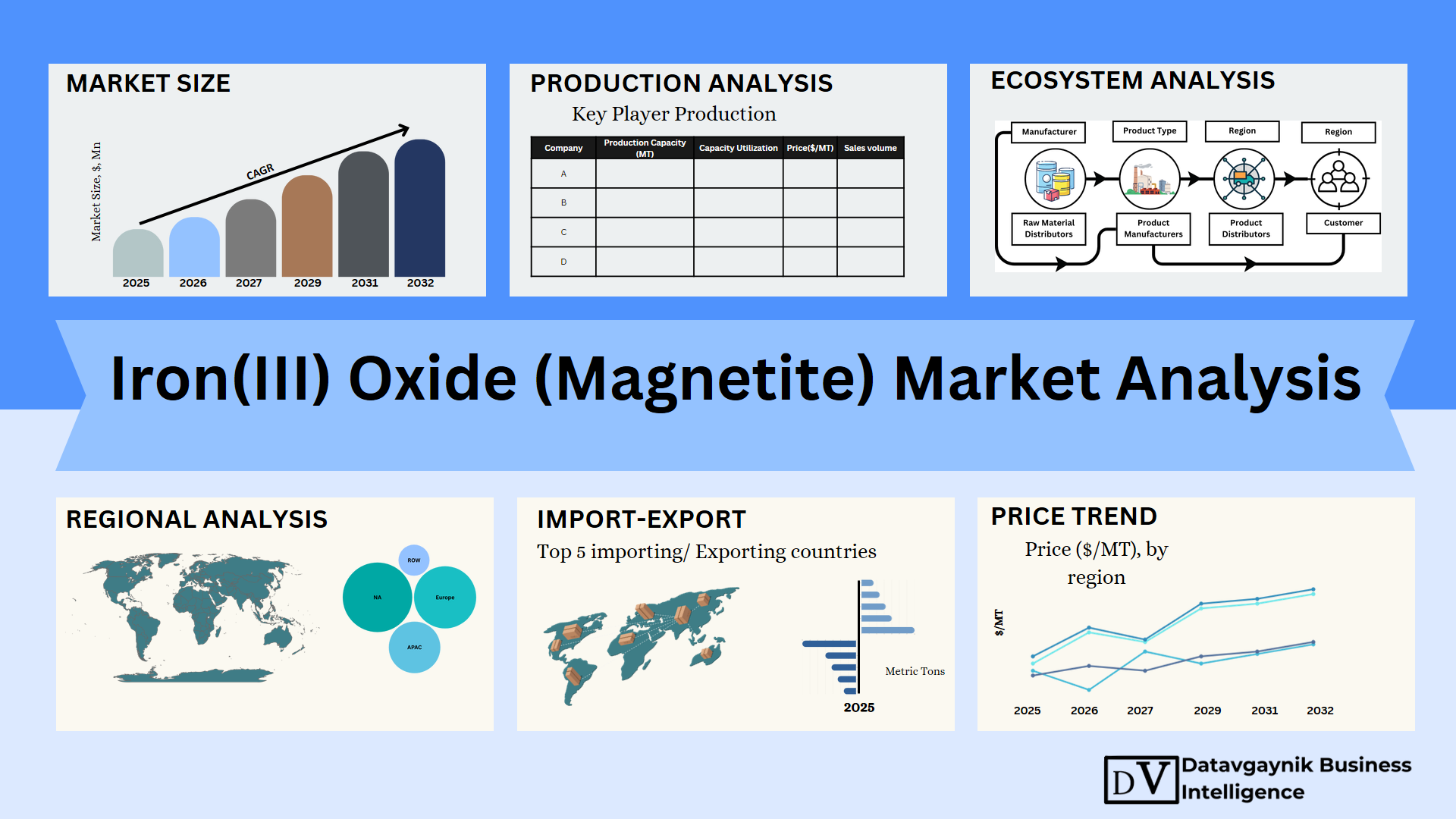
The Iron(III) Oxide (Magnetite) Market is experiencing a notable uptrend, largely driven by the continuous growth of the global steel industry. Magnetite, as a high-grade iron ore, is vital to steel production due to its high iron content and superior efficiency in reducing emissions. For instance, Magnetite’s lower impurity levels translate to reduced carbon emissions during blast furnace operations, a critical factor as the steel sector aims to decarbonize.
According to Datavagyanik, global crude steel output reached nearly 1.89 billion metric tons in 2023 and is projected to grow at a compound annual growth rate (CAGR) of 2.8% through 2032. With steel demand rising in construction, automotive, and infrastructure, the Iron(III) Oxide (Magnetite) Market is set to follow an upward trajectory.
Iron(III) Oxide (Magnetite) Market Driven by Infrastructure Investment Worldwide
Massive infrastructure spending across major economies is a major growth lever for the Iron(III) Oxide (Magnetite) Market. Countries like India, China, and the United States are investing heavily in transportation networks, urban development, and renewable energy projects. For example, India’s National Infrastructure Pipeline (NIP) aims to deploy over USD 1.4 trillion by 2025 into roads, railways, and ports. Similarly, China’s Belt and Road Initiative and the U.S. Bipartisan Infrastructure Law, with over USD 1.2 trillion in allocations, are heavily steel-intensive. Since Magnetite is a preferred raw material for steelmaking, such initiatives directly translate into demand acceleration in the Iron(III) Oxide (Magnetite) Market.
Datavagyanik also covers related markets such as the Iron(III) p-toluenesulfonate Market, the Magnetite (Fe₃O₄) Market, and the Iron oxide nanoparticles Market. These materials are considered in high-temperature and specialty chemical environments, where glass production, catalysis, and safety regulations influence adoption patterns.
Automotive Sector Enhancing Demand in the Iron(III) Oxide (Magnetite) Market
The automotive industry is another critical contributor to the Iron(III) Oxide (Magnetite) Market, particularly in manufacturing high-strength steel components. From chassis to engine blocks, steel accounts for nearly 60% of a vehicle’s weight, and Magnetite-based iron is increasingly used to ensure performance and durability. With global automotive production recovering post-pandemic and electric vehicle (EV) manufacturing gaining traction, steel consumption is rising. Datavagyanik reports that global EV sales surpassed 14 million units in 2023, up 35% from 2022, significantly influencing upstream demand for Magnetite. This industrial trend is reinforcing the long-term outlook of the Iron(III) Oxide (Magnetite) Market.
Iron(III) Oxide (Magnetite) Market Bolstered by Magnetic and Electronic Applications
Beyond steel, the Iron(III) Oxide (Magnetite) Market is also expanding into electronics and magnetic material applications. Magnetite’s natural ferrimagnetism makes it suitable for data storage devices, electric motors, and MRI contrast agents. For instance, ferrite magnets, widely used in consumer electronics and automotive systems, rely heavily on Magnetite for core performance. Datavagyanik highlights that the global magnetic materials market is forecasted to reach USD 36 billion by 2030, with Magnetite-based ferrites occupying a significant share. As digitalization and electrification continue to rise, the Iron(III) Oxide (Magnetite) Market is poised to benefit from increasing cross-sectoral integration.
Water Treatment and Environmental Use Cases Expand Iron(III) Oxide (Magnetite) Market Potential
Environmental applications are becoming a high-growth area for the Iron(III) Oxide (Magnetite) Market. Magnetite’s ability to bind with and remove contaminants from water and soil has made it a preferred material in remediation technologies. For example, in wastewater treatment plants, Magnetite is employed for phosphate removal and as a reusable filtering medium. With environmental regulations tightening across the EU, North America, and Asia-Pacific, demand for such eco-friendly solutions is rising. Datavagyanik estimates that the global market for industrial water treatment chemicals is expected to reach USD 19.5 billion by 2027, and Magnetite’s role within this framework is becoming increasingly critical.
Iron(III) Oxide (Magnetite) Market Size Expands with Renewable Energy Storage Integration
Energy storage systems, especially those supporting renewable energy, are opening new frontiers for the Iron(III) Oxide (Magnetite) Market. Magnetite is being researched and used in lithium-ion battery anodes and thermal energy storage units. For instance, Magnetite nanoparticles offer high conductivity and specific capacity, making them ideal for next-generation battery chemistries. As global energy systems shift toward intermittent renewable sources, the need for large-scale, long-duration storage is expanding. Datavagyanik projects the global energy storage market to surpass 400 GWh of installed capacity by 2030. This evolution supports both the technological and commercial expansion of the Iron(III) Oxide (Magnetite) Market.
Technological Advancements Transforming Iron(III) Oxide (Magnetite) Market Landscape
Innovation is playing a crucial role in reshaping the Iron(III) Oxide (Magnetite) Market. Advanced beneficiation technologies, including magnetic separation, flotation, and pelletization, have enhanced Magnetite’s usability and cost-efficiency. For instance, automated mineral sorting and AI-based ore grading are improving recovery rates and lowering operational costs. Additionally, research into Magnetite nanoparticles is leading to high-value applications in biomedicine and catalysts. As per Datavagyanik, the global nanomaterials market is growing at over 14% annually, and Magnetite nanostructures are among the fastest expanding sub-segments. These innovations are helping broaden the addressable market scope of Magnetite well beyond traditional iron and steel industries.
Iron(III) Oxide (Magnetite) Market Size Strengthened by High-Purity Grade Demand
The Iron(III) Oxide (Magnetite) Market Size is also being driven by increased demand for high-purity Magnetite in specialized applications. Sectors such as electronics, metallurgy, and biotechnology require Magnetite with precise particle size and chemical composition. For example, high-purity Magnetite is used in the production of iron catalysts, which are vital in ammonia synthesis and fuel processing. Additionally, precision-grade Magnetite is used in ferrofluids for aerospace and defense applications. With the rise of advanced manufacturing and material sciences, these niche requirements are becoming more prominent, thereby supporting overall market expansion.
Decarbonization and Green Steel Movement Propel Iron(III) Oxide (Magnetite) Market Growth
The global drive for carbon neutrality is reshaping raw material supply chains, including the Iron(III) Oxide (Magnetite) Market. Magnetite-based ironmaking is more compatible with hydrogen-based reduction techniques than hematite-based processes. For instance, direct reduced iron (DRI) methods using Magnetite can reduce CO2 emissions by up to 90% compared to traditional blast furnaces. Countries like Sweden and Germany are leading in green steel production, with companies such as SSAB and Thyssenkrupp investing heavily in Magnetite-based hydrogen steel plants. These initiatives are placing Magnetite at the core of sustainable metallurgy, further strengthening demand in the Iron(III) Oxide (Magnetite) Market.
Strategic Mining Projects Fuel Iron(III) Oxide (Magnetite) Market Opportunities
Strategic mining operations across Australia, Brazil, and Africa are enhancing the global availability of high-quality Magnetite, thereby bolstering the Iron(III) Oxide (Magnetite) Market. Australia’s Pilbara region alone hosts over 10 billion tons of Magnetite reserves, and companies like Fortescue and Magnetite Mines are ramping up extraction to meet international demand. Similarly, Brazil’s Vale and African operators in Guinea are expanding Magnetite output to support infrastructure development and industrialization across Asia and Europe. These production hubs are instrumental in stabilizing global supply chains and maintaining price competitiveness in the Iron(III) Oxide (Magnetite) Market.
“Track Country-wise Iron(III) Oxide (Magnetite) Production and Demand through our Iron(III) Oxide (Magnetite) Production Database”
-
-
- Iron(III) Oxide (Magnetite) production database for 23+ countries worldwide
- Iron(III) Oxide (Magnetite) sales volume for 28+ countries
- Country-wise Iron(III) Oxide (Magnetite) production capacity, production plant mapping, production capacity utilization for 23+ manufacturers
- Iron(III) Oxide (Magnetite) production plants and production plant capacity analysis by top manufacturers
-
“Track real-time Iron(III) Oxide (Magnetite) Prices, Iron(III) Oxide (Magnetite) price charts for 23+ countries, Iron(III) Oxide (Magnetite) weekly price tracker and Iron(III) Oxide (Magnetite) monthly price tracker”
-
-
- Track real-time Iron(III) Oxide (Magnetite) prices and Iron(III) Oxide (Magnetite) price trend in 23+ countries though our excel-based Iron(III) Oxide (Magnetite) price charts
- Real-time Iron(III) Oxide (Magnetite) price tracker dashboard with 23+ countries
- Complete transparency on Iron(III) Oxide (Magnetite) price trend through our Iron(III) Oxide (Magnetite) monthly price tracker, Iron(III) Oxide (Magnetite) weekly price tracker
-
North America Leading Technological Integration in the Iron(III) Oxide (Magnetite) Market
The Iron(III) Oxide (Magnetite) Market in North America, particularly in the United States and Canada, has seen consistent growth due to technological innovations in steel production and environmental remediation. For example, the U.S. continues to invest in electric arc furnaces (EAFs) that favor high-grade Magnetite for reduced emissions and operational efficiency. Datavagyanik highlights that over 70% of steel production in the U.S. is now through EAFs, which has increased demand for processed Magnetite concentrate. In Canada, sustainable mining practices in provinces like Quebec and British Columbia have enabled high-purity Magnetite exports, especially for use in water treatment and niche applications such as medical-grade ferrites.
Asia Pacific Dominates Global Iron(III) Oxide (Magnetite) Market Consumption
Asia Pacific remains the epicenter of the Iron(III) Oxide (Magnetite) Market, with China, India, Japan, and South Korea driving demand. China, responsible for producing over 50% of the world’s steel, consumes massive volumes of Magnetite annually. For instance, in 2023, China’s steel industry processed more than 900 million metric tons of iron ore, with Magnetite accounting for a growing share due to ongoing environmental regulations that prioritize cleaner production. India’s infrastructure expansion and Smart Cities Mission have bolstered steel demand, with Magnetite-based raw materials preferred in new blast furnace and DRI facilities. Datavagyanik notes that Asia Pacific accounted for over 62% of the global Iron(III) Oxide (Magnetite) Market volume in 2023.
Europe Embracing Green Steel to Fuel Iron(III) Oxide (Magnetite) Market Growth
The Iron(III) Oxide (Magnetite) Market in Europe is evolving rapidly, driven by the transition to green steel. Countries like Germany, Sweden, and the Netherlands are investing in hydrogen-based DRI plants that favor Magnetite over other ores due to its chemical efficiency. For example, the HYBRIT project in Sweden is pioneering fossil-free steel production using Magnetite and hydrogen, targeting a 90% reduction in emissions compared to traditional blast furnaces. Additionally, the EU’s Carbon Border Adjustment Mechanism (CBAM) is encouraging local steelmakers to source higher-grade ores like Magnetite, reinforcing regional demand.
Middle East Investing in Sustainable Infrastructure and Iron(III) Oxide (Magnetite) Market
In the Middle East, countries such as Saudi Arabia and the UAE are integrating Magnetite into their national industrial strategies. Saudi Arabia’s Vision 2030 has placed emphasis on domestic steel production for infrastructure and smart cities, increasing Magnetite imports for DRI processes. The UAE’s Khalifa Industrial Zone (KIZAD) has become a hub for green steel initiatives, sourcing Magnetite for reduced carbon steel projects. According to Datavagyanik, Magnetite demand in the region grew by over 7.5% year-on-year in 2023, with forecasts indicating continued expansion due to mega-projects like NEOM and the Etihad Rail network.
Australia and Brazil Anchoring Global Iron(III) Oxide (Magnetite) Market Production
Australia and Brazil are the leading producers in the global Iron(III) Oxide (Magnetite) Market. Australia’s Pilbara region is home to significant Magnetite reserves, and projects such as Fortescue’s Iron Bridge are ramping up output to over 22 million tons annually. This production is largely exported to Asia, especially China and South Korea. Brazil, through companies like Vale, has expanded its Magnetite production capacity with enhanced beneficiation techniques that yield high-purity concentrate for blast furnace and pelletizing applications. Together, these two countries accounted for more than 35% of Magnetite exports globally in 2023, according to Datavagyanik.
Africa Emerging as a Strategic Contributor to the Iron(III) Oxide (Magnetite) Market
Africa’s role in the Iron(III) Oxide (Magnetite) Market is becoming increasingly important as countries like South Africa, Guinea, and Mauritania invest in mining infrastructure. For instance, the Simandou project in Guinea, considered the world’s largest untapped high-grade iron ore reserve, has begun initial Magnetite exploration with commercial production expected by 2026. South Africa already exports Magnetite concentrate to Europe and Asia, particularly for steelmaking and water treatment purposes. African governments are also prioritizing beneficiation at source, thereby increasing the export value of Magnetite while supporting local industrial growth.
Segmentation by Application Reinforces Iron(III) Oxide (Magnetite) Market Diversity
The Iron(III) Oxide (Magnetite) Market is segmented across various application verticals, including steelmaking, environmental applications, electronics, and energy storage. Steel production remains the dominant segment, contributing over 70% of total Magnetite consumption in 2023. However, environmental applications such as groundwater remediation and heavy metal absorption are growing at a CAGR of over 6.5%, driven by urban pollution and stricter waste discharge norms. The electronics segment, including usage in ferrite cores and sensors, is also witnessing steady demand, especially in East Asia, where semiconductor and EV industries are flourishing.
Grade-Based Segmentation Drives High-Purity Iron(III) Oxide (Magnetite) Market Growth
The Iron(III) Oxide (Magnetite) Market is also segmented by ore grade—high-grade Magnetite (iron content above 65%) and low-grade Magnetite (below 60%). High-grade Magnetite is increasingly favored by steelmakers adopting energy-efficient DRI and EAF processes. For example, high-grade Magnetite requires less coking coal during processing, reducing emissions and overall costs. In 2023, high-grade Magnetite accounted for nearly 58% of global consumption, up from 52% in 2021. Low-grade Magnetite, while less economically attractive, continues to find use in pigment manufacturing and as ballast in engineering applications.
Regional Iron(III) Oxide (Magnetite) Price Trends Show Diverging Patterns
The Iron(III) Oxide (Magnetite) Price and Iron(III) Oxide (Magnetite) Price Trend vary significantly across regions based on quality, logistics, and market demand. In Asia Pacific, average Magnetite prices ranged from USD 115–130 per metric ton in 2023 due to strong steel demand in China and India. In contrast, Europe witnessed higher prices, often exceeding USD 140 per metric ton, driven by demand for green steel inputs and limited domestic supply. According to Datavagyanik, Iron(III) Oxide (Magnetite) Price in North America remained relatively stable at around USD 125 per ton, supported by local supply chains and steady demand from construction and automotive sectors.
Logistics and Energy Costs Impacting Iron(III) Oxide (Magnetite) Price Trend
The Iron(III) Oxide (Magnetite) Price Trend is also shaped by logistics and fuel prices. For instance, in early 2023, freight costs from Australia to China spiked by 20% due to port congestion and energy shortages, temporarily raising Magnetite prices by USD 8–10 per ton. Similarly, European importers faced cost pressures due to increased carbon taxes and higher rail transportation expenses. Magnetite prices are highly sensitive to diesel and bunker fuel rates, which impact transoceanic shipping. Datavagyanik notes that fluctuations in shipping rates could cause quarterly price shifts of up to 7% in high-volume markets.
Iron(III) Oxide (Magnetite) Market Adjusts to Demand-Supply Balances and Strategic Stockpiling
Short-term Iron(III) Oxide (Magnetite) Price movements are also influenced by stockpiling strategies of large steel producers. For example, China’s winter production curbs in 2022–2023 led to strategic stockpiling of high-grade Magnetite, resulting in temporary price hikes. Conversely, softening construction activity in Europe during Q2 2023 led to a 6% decline in Magnetite prices due to oversupply. Such fluctuations highlight the importance of dynamic pricing models and long-term contracts in ensuring supply stability in the Iron(III) Oxide (Magnetite) Market.
Future Iron(III) Oxide (Magnetite) Price Trend Supported by Sustainability and Energy Transition
The long-term Iron(III) Oxide (Magnetite) Price Trend is expected to be shaped by sustainability initiatives and the energy transition. As more steelmakers commit to decarbonization, demand for Magnetite—particularly high-grade and pelletized forms—is projected to rise. Datavagyanik forecasts that average global Magnetite prices will rise 3–4% annually through 2030, driven by green steel targets and the phase-out of lower-quality hematite ores. Furthermore, emerging uses of Magnetite in thermal energy storage systems and battery technologies could create new pricing structures based on material purity and end-use classification.
Global Supply Chains to Define Iron(III) Oxide (Magnetite) Market Stability
The stability of the Iron(III) Oxide (Magnetite) Market will ultimately depend on how producers and consumers navigate global supply chain constraints. Countries investing in localized processing, such as pelletizing plants near mines or hydrogen-based ironmaking facilities, are likely to maintain a competitive edge. For example, Australia and Brazil are establishing dedicated corridors for Magnetite logistics with optimized rail and port infrastructure. Such forward integration is expected to reduce cost volatility, improve delivery timelines, and stabilize Iron(III) Oxide (Magnetite) Price trends across regional markets.
“Iron(III) Oxide (Magnetite) Manufacturing Database, Iron(III) Oxide (Magnetite) Manufacturing Capacity”
-
-
- Iron(III) Oxide (Magnetite) top manufacturers market share for 23+ manufacturers
- Top 6 manufacturers and top 13 manufacturers of Iron(III) Oxide (Magnetite) in North America, Europe, Asia Pacific
- Iron(III) Oxide (Magnetite) production plant capacity by manufacturers and Iron(III) Oxide (Magnetite) production data for 23+ market players
- Iron(III) Oxide (Magnetite) production dashboard, Iron(III) Oxide (Magnetite) production data in excel format
-
“Iron(III) Oxide (Magnetite) price charts, Iron(III) Oxide (Magnetite) weekly price tracker and Iron(III) Oxide (Magnetite) monthly price tracker”
-
-
- Factors impacting real-time Iron(III) Oxide (Magnetite) prices in 18+ countries worldwide
- Iron(III) Oxide (Magnetite) monthly price tracker, Iron(III) Oxide (Magnetite) weekly price tracker
- Real-time Iron(III) Oxide (Magnetite) price trend, Iron(III) Oxide (Magnetite) price charts, news and updates
- Tracking Iron(III) Oxide (Magnetite) price fluctuations
-
Key Players Driving the Iron(III) Oxide (Magnetite) Market
The Iron(III) Oxide (Magnetite) Market is shaped by a combination of global giants and regional leaders who specialize in mining, pigment production, and advanced materials. These companies not only lead in volume production but also define the pace of technological innovation and sustainability practices in the industry.
Among the most prominent players is LANXESS AG, a major German-based chemical company known for its synthetic iron oxide pigments. Its Bayferrox® product line includes a broad range of high-performance Magnetite-based black pigments, used extensively in construction materials, coatings, and plastics. These pigments are recognized for their weather resistance, tinting strength, and chemical purity, making them ideal for premium architectural applications.
Huntsman Corporation has established itself as a leader in iron oxide pigment production, particularly in North America and Europe. The company offers high-quality black Magnetite pigments through its Ferroxide® range, which are widely used in paints, rubber, and polymers. Huntsman’s competitive advantage lies in its vertically integrated supply chain and high-grade mineral sourcing.
Cathay Industries is a key player in the Asia Pacific region, supplying Magnetite pigments that serve construction, electronics, and energy industries. Its CATHAYTHERM® series caters to high-temperature applications, including automotive components and industrial coatings. Cathay’s production model emphasizes sustainability, with ongoing investments in waste-reduction and clean processing technologies.
Toda Kogyo Corporation, a Japan-based manufacturer, focuses heavily on functional pigments and nanomaterials. The company is known for its development of ultra-fine Magnetite particles used in magnetic recording media, battery electrodes, and medical applications. Toda Kogyo’s products are typically engineered for precision performance and are used in demanding sectors like electronics and healthcare.
Alabama Pigments Company in the United States has built a strong reputation in the production of natural Magnetite pigments. Its offerings are tailored to the brick, paver, and construction sectors, where iron oxide pigments are required for integral coloration and durability. The company emphasizes product consistency and natural pigment sourcing from regional mining operations.
Jiangsu Yuxing Industry and Trade, based in China, is a significant producer of Magnetite for both pigment and metallurgical use. The company markets micronized and granulated Magnetite for ceramics, concrete additives, and wastewater treatment. Jiangsu Yuxing has grown its export footprint across Southeast Asia and Europe, contributing to the diversification of global supply.
Tata Pigments, a division of Tata Steel in India, is a prominent supplier of iron oxide pigments in South Asia. Their Tata Red and Tata Black product lines include Magnetite-rich pigments utilized in decorative paints, paving blocks, and reinforced cement structures. With a strong focus on backward integration, Tata Pigments benefits from consistent raw material availability and economies of scale.
Iron(III) Oxide (Magnetite) Market Share by Leading Manufacturers
The Iron(III) Oxide (Magnetite) Market is moderately consolidated, with a handful of multinational corporations accounting for a large portion of the global volume. LANXESS AG is estimated to hold the largest share at around 15% of the global market, thanks to its expansive pigment portfolio and distribution network across Europe and North America.
Huntsman Corporation commands approximately 12% of the market, leveraging its high-quality black iron oxide products and integration with end-user industries. Cathay Industries follows closely with around 10%, driven by its presence in Asia-Pacific and its tailored product offerings for specialized thermal and pigment applications.
Toda Kogyo maintains a niche yet significant 8% share, largely in high-precision and nanotechnology segments. Alabama Pigments holds a 5% share within the construction pigment niche in North America, while Jiangsu Yuxing and Tata Pigments contribute with 4% and 3% respectively, serving regional and export markets. The remainder of the market is fragmented among smaller manufacturers supplying region-specific or customized applications.
Product Portfolio Expansion Strengthens Market Position
Top manufacturers in the Iron(III) Oxide (Magnetite) Market are continuously diversifying their product portfolios to serve emerging needs in sectors such as renewable energy, water treatment, and electronics.
For instance, several companies are now producing Magnetite nanoparticles for use in lithium-ion batteries, where they serve as anode materials with improved conductivity and charge capacity. Additionally, pigment producers have expanded into thermally stable Magnetite grades to meet the rising demand from high-performance coatings used in the automotive and aerospace sectors.
Construction remains a central focus for many producers, where Magnetite pigments are used to impart rich color, UV stability, and enhanced thermal performance to concrete and masonry products. Some manufacturers have also developed Magnetite slurries and composites for use in radiation shielding materials in healthcare and nuclear applications.
Recent Developments and Strategic Moves in the Iron(III) Oxide (Magnetite) Market
In recent years, strategic collaborations and capacity expansions have reshaped the Iron(III) Oxide (Magnetite) Market landscape.
In October 2024, a new industrial consortium was launched in South Australia under the name Green Iron SA. This consortium includes multiple companies with expertise in Magnetite mining, port operations, and hydrogen technologies. The initiative focuses on producing export-grade Magnetite pellets and establishing a direct reduced iron (DRI) facility powered by renewable energy. The project is expected to contribute significantly to green steel exports to Asia, particularly to markets in Japan and South Korea.
In November 2024, several leading Australian producers began feasibility studies to double their Magnetite output in response to rising demand from Chinese and Southeast Asian steelmakers. This expansion is aligned with Australia’s ambition to capture a greater share of the global iron ore export market while transitioning toward greener mining operations.
Simultaneously, Indian manufacturers have increased investments in domestic Magnetite beneficiation plants to reduce reliance on hematite imports and to support local infrastructure projects. As a result, Magnetite production in states such as Odisha and Chhattisgarh has grown by over 6% year-on-year.
Across Europe, manufacturers are aligning with regional decarbonization goals by sourcing Magnetite compatible with hydrogen reduction processes. Pilot-scale green steel projects in Germany and Sweden have now reached early production stages, with full-scale commercialization anticipated by 2026.
“Iron(III) Oxide (Magnetite) Production Data and Iron(III) Oxide (Magnetite) Production Trend, Iron(III) Oxide (Magnetite) Production Database and forecast”
-
-
- Iron(III) Oxide (Magnetite) production database for historical years, 10 years historical data
- Iron(III) Oxide (Magnetite) production data and forecast for next 7 years
- Iron(III) Oxide (Magnetite) sales volume by manufacturers
-
“Track Real-time Iron(III) Oxide (Magnetite) Prices for purchase and sales contracts, Iron(III) Oxide (Magnetite) price charts, Iron(III) Oxide (Magnetite) weekly price tracker and Iron(III) Oxide (Magnetite) monthly price tracker”
-
-
- Gain control on your purchase and sales contracts through our real-time Iron(III) Oxide (Magnetite) price tracker and Iron(III) Oxide (Magnetite) price trend analysis
- Iron(III) Oxide (Magnetite) weekly price tracker and forecast for next four weeks
- Iron(III) Oxide (Magnetite) monthly price tracker and forecast for next two months
-
Market Scenario, Demand vs Supply, Average Product Price, Import vs Export, till 2032
- Global Iron(III) Oxide (Magnetite) Market revenue and demand by region
- Global Iron(III) Oxide (Magnetite) Market production and sales volume
- United States Iron(III) Oxide (Magnetite) Market revenue size and demand by country
- Europe Iron(III) Oxide (Magnetite) Market revenue size and demand by country
- Asia Pacific Iron(III) Oxide (Magnetite) Market revenue size and demand by country
- Middle East & Africa Iron(III) Oxide (Magnetite) Market revenue size and demand by country
- Latin America Iron(III) Oxide (Magnetite) Market revenue size and demand by
- Import-export scenario – United States, Europe, APAC, Latin America, Middle East & Africa
- Average product price – United States, Europe, APAC, Latin America, Middle East & Africa
- Market player analysis, competitive scenario, market share analysis
- Business opportunity analysis
Key questions answered in the Global Iron(III) Oxide (Magnetite) Market Analysis Report:
- What is the market size for Iron(III) Oxide (Magnetite) in United States, Europe, APAC, Middle East & Africa, Latin America?
- What is the yearly sales volume of Iron(III) Oxide (Magnetite) and how is the demand rising?
- Who are the top market players by market share, in each product segment?
- Which is the fastest growing business/ product segment?
- What should be the business strategies and Go to Market strategies?
The report covers Iron(III) Oxide (Magnetite) Market revenue, Production, Sales volume, by regions, (further split into countries):
- Asia Pacific (China, Japan, South Korea, India, Indonesia, Vietnam, Rest of APAC)
- Europe (UK, Germany, France, Italy, Spain, Benelux, Poland, Rest of Europe)
- North America (United States, Canada, Mexico)
- Latin America (Brazil, Argentina, Rest of Latin America)
- Middle East & Africa
Table of Contents:
1. Introduction to the Iron(III) Oxide (Magnetite) Market
- Overview and Chemical Properties of Iron(III) Oxide (Magnetite)
- Industrial and Technological Applications
- Market Trends and Growth Potential
2. Segmentation of the Iron(III) Oxide (Magnetite) Market
- Classification by Purity and Composition
- Industrial and Commercial Applications Breakdown
- End-Use Sector Demand and Market Distribution
3. Global Iron(III) Oxide (Magnetite) Market Size and Forecast (2019-2032)
- Revenue Analysis and Market Growth Trends
- Demand-Supply Dynamics in the Global Market
- Future Investment and Expansion Prospects
4. Regional Market Analysis and Industry Performance
4.1 North America
- Iron(III) Oxide (Magnetite) Market Demand and Growth Trends
- Iron(III) Oxide (Magnetite) Production vs Imports
- Regulatory Landscape and Environmental Considerations
4.2 Europe
- Key Producers and Market Share Distribution
- Economic and Industrial Impact on Market Growth
- Trade and Market Supply Chain Insights
4.3 Asia-Pacific
- Leading Iron(III) Oxide (Magnetite) Production Regions
- Export Trends and Industrial Applications
- Market Demand in Emerging Economies
4.4 Latin America
- Iron(III) Oxide (Magnetite) Production Capacity vs Domestic Demand
- Market Expansion Strategies and Industry Trends
- Investment Potential and Business Development
4.5 Middle East & Africa
- Regional Market Growth and Strategic Developments
- Iron(III) Oxide (Magnetite) Trade Flow and Policy Impact
- Future Growth Opportunities and Industry Forecast
5. Iron(III) Oxide (Magnetite) Production Trends and Technological Advancements (2019-2032)
- Innovations in Iron(III) Oxide (Magnetite) Production Technologies
- Advances in Processing and Extraction Techniques
- Sustainable Production Practices and Cost Efficiency
6. Competitive Landscape in the Iron(III) Oxide (Magnetite) Market
- Major Manufacturers and Industry Leaders
- Competitive Strategies and Business Expansions
- Research & Development in Iron(III) Oxide (Magnetite) Production
7. Market Revenue, Pricing Trends, and Economic Outlook (2019-2024)
- Iron(III) Oxide (Magnetite) Market Revenue by Region and Industry Sector
- Price Volatility and Cost Determinants
- Future Pricing Projections and Market Forecast
8. Global Trade, Logistics, and Supply Chain Analysis
- Iron(III) Oxide (Magnetite) Production vs Export Market Overview
- Import-Export Market Trends and Trade Challenges
- Logistics, Distribution, and Supply Chain Optimization
9. Demand-Supply Dynamics and Consumption Analysis
- Market Demand by End-Use Industries and Sectors
- Regional Consumption Trends and Key Market Drivers
- Future Market Demand and Growth Forecast
10. Iron(III) Oxide (Magnetite) Production Costs and Raw Material Sourcing
- Cost Breakdown in Iron(III) Oxide (Magnetite) Manufacturing
- Raw Material Availability and Supply Chain Challenges
- Cost-Effective Production Strategies and Market Sustainability
11. Industrial Chain and Market Ecosystem Overview
- Procurement, Processing, and Distribution Networks
- Downstream Market Influence and Key Industry Applications
- Industry Innovations and Market Growth Potential
12. Sales, Distribution, and Marketing Strategies in the Iron(III) Oxide (Magnetite) Market
- Global Market Distribution Channels and Expansion Plans
- Key Distributors and Market Accessibility Strategies
- Customer Engagement and Industry-Specific Sales Tactics
13. Future Market Projections and Investment Opportunities
- Iron(III) Oxide (Magnetite) Market Growth Forecast and Technological Innovations
- Business Expansion and Market Diversification Strategies
- Investment Prospects and Industry Development Plans

