

Jamesonite (Lead Iron Antimony Sulfide) Market Driven by Increasing Demand for Lead-Antimony Alloys
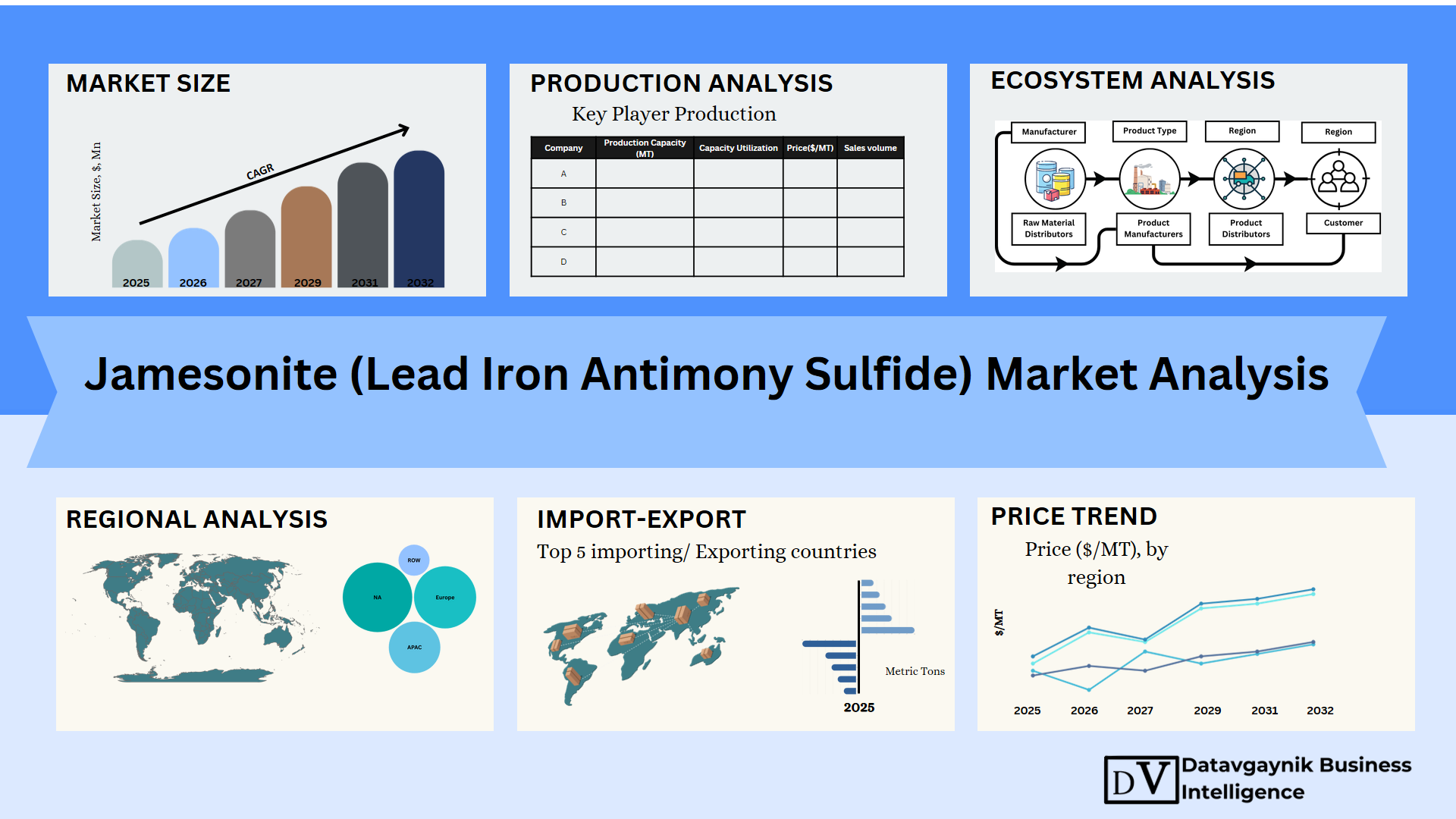
The Jamesonite (Lead Iron Antimony Sulfide) Market is witnessing a surge in demand, primarily driven by the increasing consumption of lead-antimony alloys across various industries. These alloys are extensively used in the automotive sector, particularly for battery grids and cable sheathing, due to their corrosion resistance and improved hardness. For instance, the production of lead-acid batteries, which still dominate the global automotive battery market, relies heavily on antimony to enhance battery performance and extend lifecycle. Datavagyanik highlights that over 70% of global antimony consumption is attributed to flame retardants and lead-acid batteries, making Jamesonite a strategic raw material for alloy manufacturing.
Jamesonite (Lead Iron Antimony Sulfide) Market Trends in Flame Retardant Applications
One of the major growth pillars for the Jamesonite (Lead Iron Antimony Sulfide) Market is the escalating demand for antimony in flame retardant formulations. With increasing fire safety regulations across construction, electronics, and textile industries, flame retardants are no longer optional but mandated by law in many jurisdictions. For example, European fire safety standards such as EN 13501 have significantly pushed manufacturers to incorporate antimony trioxide into polymer matrices. Jamesonite, being a natural source of antimony, is increasingly tapped to meet this regulatory-driven demand. Datavagyanik confirms that the European flame retardant market alone is expected to grow at a CAGR of 5.7% through 2030, ensuring long-term prospects for the Jamesonite (Lead Iron Antimony Sulfide) Market.
Datavagyanik also covers related markets such as the Stibnite (Antimony Sulfide) Market, the Galena (Lead Sulfide) Market, and the Tetrahedrite (Copper Antimony Sulfide) Market. They create a more holistic picture of the ecosystem in which the primary topic exists, including technological shifts and market demands.
Jamesonite (Lead Iron Antimony Sulfide) Market Driven by Electronics and Semiconductor Industry
The Jamesonite (Lead Iron Antimony Sulfide) Market is strongly influenced by its role in electronics manufacturing. Antimony derived from Jamesonite plays a critical role in producing semiconductors and solders. Antimony-based compounds, such as antimony selenide and antimony telluride, are utilized in thermoelectric devices and photoconductors. For instance, consumer electronics like smartphones, high-speed computers, and solar inverters demand high-purity semiconductor components, where antimony offers thermal stability and electron mobility. Datavagyanik reports a 12% annual rise in demand for semiconductor-grade antimony, reinforcing the Jamesonite (Lead Iron Antimony Sulfide) Market as a foundational segment of the electronics value chain.
Jamesonite (Lead Iron Antimony Sulfide) Market Supported by Growth in Energy Storage Sector
Another transformative factor driving the Jamesonite (Lead Iron Antimony Sulfide) Market is the exponential growth in the energy storage segment. The rising deployment of energy storage systems for grid stabilization and renewable integration has sustained the demand for lead-acid batteries. Despite the rise of lithium-ion batteries, lead-acid variants remain dominant in industrial backup systems, telecommunication towers, and automotive start-stop systems. Jamesonite, as a compound rich in both lead and antimony, is instrumental in this domain. Datavagyanik notes that global battery-grade antimony demand reached 80,000 metric tons in 2023 and is projected to exceed 120,000 metric tons by 2030, ensuring robust market traction for Jamesonite-based ores.
Jamesonite (Lead Iron Antimony Sulfide) Market and the Role of Sustainable Recycling Initiatives
With growing emphasis on sustainability and resource efficiency, the Jamesonite (Lead Iron Antimony Sulfide) Market is increasingly integrated into the recycling economy. The recycling of lead-acid batteries has become a significant secondary source of lead and antimony. For instance, the EU Battery Directive mandates recycling efficiencies above 65% for lead-acid batteries, with similar regulations in the U.S. and Asia-Pacific. Datavagyanik confirms that recycled lead now accounts for over 55% of global lead supply, and a growing share of antimony is also recovered through pyrometallurgical processing. Jamesonite’s composition makes it highly suitable for refining operations, aligning it with global trends in circular economy practices.
Jamesonite (Lead Iron Antimony Sulfide) Market Fueled by Construction Sector Applications
The construction industry remains a steady driver for the Jamesonite (Lead Iron Antimony Sulfide) Market, primarily through demand for lead-based radiation shielding, roofing sheets, and soldering materials. Radiation shielding is critical in healthcare infrastructure, nuclear facilities, and even aerospace components. For instance, lead shielding is mandated in radiology rooms, where antimony improves the tensile strength of protective materials. Datavagyanik highlights that global construction spending on healthcare infrastructure is rising by 6% annually, which in turn fuels the consumption of lead-antimony materials derived from Jamesonite.
Jamesonite (Lead Iron Antimony Sulfide) Market Dynamics in Solar Energy Applications
Jamesonite (Lead Iron Antimony Sulfide) Market growth is also tied to emerging technologies in solar energy. Antimony-based materials are under active investigation for use in next-generation photovoltaic cells. Gallium antimonide and antimony selenide have shown promise for enhancing solar cell efficiency through better light absorption and stability. As solar installations rise—projected to exceed 350 GW annually by 2027 according to Datavagyanik—the demand for specialty semiconductors including antimony compounds is set to rise. This opens new avenues for Jamesonite as a mineral resource feeding into clean energy material pipelines.
Jamesonite (Lead Iron Antimony Sulfide) Market Size Expansion through Diversified End-Use Industries
The Jamesonite (Lead Iron Antimony Sulfide) Market Size is expanding due to its application across a diversified set of industries. These include mining, electronics, automotive, and renewable energy sectors. For instance, antimony sulfides from Jamesonite are used in friction materials such as brake pads, while lead finds use in ammunition and protective coatings. This broad end-use diversity cushions the Jamesonite (Lead Iron Antimony Sulfide) Market from cyclic fluctuations in any single sector. Datavagyanik notes that compound annual growth rates of 4% to 6% are anticipated across major application areas, reinforcing market resilience.
Jamesonite (Lead Iron Antimony Sulfide) Market and Technological Advancements in Metallurgy
Ongoing advancements in metallurgy are contributing to demand growth in the Jamesonite (Lead Iron Antimony Sulfide) Market. New smelting and separation technologies are improving recovery rates of lead and antimony from complex sulfide ores like Jamesonite. For example, hydrometallurgical processes and bioleaching methods are increasingly being adopted to recover valuable metals in an environmentally sustainable way. These technologies are especially critical in regions with stringent environmental regulations. Datavagyanik indicates that improved ore beneficiation methods can boost antimony recovery rates by 15% to 20%, improving the economic feasibility of mining lower-grade Jamesonite deposits.
Jamesonite (Lead Iron Antimony Sulfide) Market Benefiting from Strategic Supply Chain Developments
The Jamesonite (Lead Iron Antimony Sulfide) Market is strategically positioned within the broader metal supply chain, particularly for critical raw materials like antimony. With antimony now designated as a critical mineral in both the EU and U.S., governments and private players are investing in stable supply chain development. For example, recent bilateral agreements between European mining firms and Central Asian producers aim to secure long-term supplies of antimony and lead ores. These developments indirectly support the stability and expansion of the Jamesonite (Lead Iron Antimony Sulfide) Market, which is a primary feedstock source for both metals.
Jamesonite (Lead Iron Antimony Sulfide) Market Size Projected to Expand with Global Electrification Efforts
The global shift towards electrification is poised to significantly impact the Jamesonite (Lead Iron Antimony Sulfide) Market Size. As electrification spans transport, energy grids, and industrial systems, the underlying demand for robust energy storage, high-performance conductors, and thermal-resistant components will grow rapidly. Jamesonite-derived materials, with their conductive, anti-corrosive, and thermal insulation properties, are well-suited to meet these needs. Datavagyanik anticipates a 6.5% CAGR for the Jamesonite (Lead Iron Antimony Sulfide) Market through 2032, supported by policy mandates for energy efficiency and emission reduction.
“Track Country-wise Jamesonite (Lead Iron Antimony Sulfide) Production and Demand through our Jamesonite (Lead Iron Antimony Sulfide) Production Database”
-
- Jamesonite (Lead Iron Antimony Sulfide) production database for 26+ countries worldwide
- Jamesonite (Lead Iron Antimony Sulfide) sales volume for 30+ countries
- Country-wise Jamesonite (Lead Iron Antimony Sulfide) production capacity, production plant mapping, production capacity utilization for 26+ manufacturers
- Jamesonite (Lead Iron Antimony Sulfide) production plants and production plant capacity analysis by top manufacturers
“Track real-time Jamesonite (Lead Iron Antimony Sulfide) Prices, Jamesonite (Lead Iron Antimony Sulfide) price charts for 26+ countries, Jamesonite (Lead Iron Antimony Sulfide) weekly price tracker and Jamesonite (Lead Iron Antimony Sulfide) monthly price tracker”
-
- Track real-time Jamesonite (Lead Iron Antimony Sulfide) prices and Jamesonite (Lead Iron Antimony Sulfide) price trend in 26+ countries though our excel-based Jamesonite (Lead Iron Antimony Sulfide) price charts
- Real-time Jamesonite (Lead Iron Antimony Sulfide) price tracker dashboard with 26+ countries
- Complete transparency on Jamesonite (Lead Iron Antimony Sulfide) price trend through our Jamesonite (Lead Iron Antimony Sulfide) monthly price tracker, Jamesonite (Lead Iron Antimony Sulfide) weekly price tracker
Geographical Demand Patterns in the Jamesonite (Lead Iron Antimony Sulfide) Market
The Jamesonite (Lead Iron Antimony Sulfide) Market exhibits concentrated geographical demand across regions heavily reliant on energy storage, electronics manufacturing, renewable energy, and construction infrastructure. In Europe, nations such as Germany, France, and the United Kingdom are emerging as strategic demand hubs due to their expanding electric vehicle (EV) production, stringent fire safety norms, and push for solar energy installations. For instance, Germany’s continued leadership in EV adoption, with over 1.3 million electric cars registered by the end of 2023, has significantly increased the requirement for lead-acid batteries and semiconductors, thereby driving the need for Jamesonite as a key raw material.
In North America, the United States remains a primary consumer within the Jamesonite (Lead Iron Antimony Sulfide) Market due to its advanced automotive industry, electronics manufacturing base, and increasing investment in grid-scale battery storage. Lead-acid batteries continue to dominate utility backup systems and industrial applications, supporting steady demand for Jamesonite-derived lead and antimony. Datavagyanik estimates that over 65% of the antimony consumed in North America is used in flame retardants and battery alloys, two applications directly tied to Jamesonite.
Asia Pacific demonstrates the strongest growth trajectory in the Jamesonite (Lead Iron Antimony Sulfide) Market, particularly due to the dominant presence of China, India, Japan, and South Korea. China alone accounts for over 50% of the global antimony consumption, largely driven by its electronics and solar energy sectors. For example, gallium antimonide, derived from Jamesonite-sourced antimony, is widely used in semiconductors manufactured in China’s Shenzhen and Chongqing regions. India’s solar energy drive, aiming for 280 GW capacity by 2030, is also expanding demand for arsenic and antimony-based materials used in high-efficiency solar cells.
Production Landscape of the Jamesonite (Lead Iron Antimony Sulfide) Market
The production of Jamesonite is closely linked to mining operations that target polymetallic sulfide ores, often found in association with gold, copper, and lead deposits. China remains the world’s largest producer of Jamesonite, leveraging its vast ore reserves in provinces like Yunnan and Hunan. Datavagyanik reveals that China produced over 60,000 metric tons of antimony in 2023, a significant portion of which was extracted from Jamesonite and other sulfide ores. These materials are refined domestically to meet internal demand from electronics and battery manufacturers.
Latin America, particularly Peru and Bolivia, is also a key production region in the Jamesonite (Lead Iron Antimony Sulfide) Market. These countries host several high-altitude polymetallic mining zones where Jamesonite naturally occurs alongside arsenopyrite and stibnite. In Peru, the Cerro de Pasco region is known for yielding antimony-bearing ores that are used in domestic alloy industries and exported to Asia. Similarly, Bolivia’s Oruro region contributes to the regional supply of antimony and lead, supporting the Jamesonite value chain.
Africa’s contribution to the Jamesonite (Lead Iron Antimony Sulfide) Market is growing steadily, especially from South Africa and Namibia. In South Africa, Jamesonite is often extracted from tailings of gold mining operations in the Witwatersrand Basin. These secondary extraction processes help reduce waste while providing an additional revenue stream through antimony and lead recovery. Datavagyanik forecasts that African Jamesonite production could rise by 6% annually as investments in gold and base metal recovery intensify.
Segmentation Overview in the Jamesonite (Lead Iron Antimony Sulfide) Market
The Jamesonite (Lead Iron Antimony Sulfide) Market is segmented across three primary vectors: application, end-user industry, and material type. In terms of application, the electronics and semiconductor segment holds a leading share. Jamesonite-derived antimony is essential in the manufacture of gallium antimonide and other compounds used in LEDs, solar panels, and integrated circuits. Datavagyanik underscores that this segment will experience a CAGR of over 7% through 2030 due to the global shift toward high-speed electronics and energy-efficient devices.
In the energy storage application segment, Jamesonite plays a vital role through its contribution to lead-acid battery production. While lithium-ion batteries dominate passenger EVs, lead-acid batteries still control the commercial vehicle, industrial backup, and off-grid energy markets. The stability and recyclability of these batteries maintain their relevance. For example, over 80% of forklift trucks and telecom towers still rely on lead-acid batteries, ensuring a strong and steady demand for Jamesonite in this segment.
The flame retardants segment, particularly in construction and textiles, also commands a sizable share of the Jamesonite (Lead Iron Antimony Sulfide) Market. The use of antimony trioxide, obtained from Jamesonite, in halogenated flame retardants is standard across building materials and electronics casings. Datavagyanik highlights that this segment benefits from global fire safety codes, with consumption expected to increase by 5.5% annually, especially in Europe and Asia-Pacific.
End-user segmentation reveals that the automotive sector remains dominant, due to its dual reliance on lead-acid batteries and semiconductors. Construction follows closely, particularly in infrastructure projects requiring radiation shielding and flame-resistant materials. The electronics industry, encompassing consumer devices and industrial equipment, is also a major end-user, supported by increasing demand for compact, high-performance electronic components.
Material-wise, the Jamesonite (Lead Iron Antimony Sulfide) Market is segmented into lead-based alloys and antimony compounds. Lead-based alloys are extensively used in battery grids, roofing materials, and soldering applications. Meanwhile, antimony compounds are crucial for flame retardants, semiconductors, and solar cell coatings. Datavagyanik forecasts balanced growth in both segments, driven by sustainable demand across multiple industries.
Jamesonite (Lead Iron Antimony Sulfide) Price and Supply Chain Dynamics
Jamesonite (Lead Iron Antimony Sulfide) Price trends are influenced by several interdependent factors, including global demand for antimony and lead, mining output, energy prices, and geopolitical conditions. The average Jamesonite (Lead Iron Antimony Sulfide) Price saw a sharp increase in 2021–2022 due to pandemic-induced supply chain disruptions and a spike in battery demand. However, prices stabilized somewhat in 2023 due to increased recycling activities and improved production outputs in China and Latin America.
As of early 2024, Datavagyanik indicates that the average Jamesonite (Lead Iron Antimony Sulfide) Price ranges between USD 4,500 to USD 5,200 per metric ton, depending on purity and regional availability. The Jamesonite (Lead Iron Antimony Sulfide) Price is expected to remain elevated over the next five years due to constrained global antimony supply and the growing strategic importance of antimony in defense and clean energy technologies. In the European Union, for instance, antimony is officially listed as a critical raw material, which adds further pressure on secure sourcing, thereby impacting the Jamesonite (Lead Iron Antimony Sulfide) Price Trend.
Jamesonite (Lead Iron Antimony Sulfide) Price Trend is also closely tied to developments in the secondary materials market. As recycling technologies improve and recovery rates of antimony and lead rise, pricing pressures are expected to ease somewhat. However, volatility remains a concern due to concentration of supply in politically sensitive regions. For example, over 70% of global antimony reserves are located in China, which poses a potential risk for supply chain stability.
In addition, transportation costs, regulatory changes, and environmental compliance expenses have also contributed to fluctuations in the Jamesonite (Lead Iron Antimony Sulfide) Price. For instance, rising freight rates and carbon taxes in Europe have increased the landed cost of imported Jamesonite, especially from African and South American producers. These factors make it imperative for downstream manufacturers to diversify sourcing strategies and invest in domestic processing capabilities.
Outlook on Regional Trade and Jamesonite (Lead Iron Antimony Sulfide) Price Trend
Looking ahead, Datavagyanik projects that the global trade in Jamesonite will become more strategic, as countries focus on securing critical minerals for their energy transition and defense industries. The United States, for instance, has passed legislation incentivizing domestic sourcing of antimony and lead, which could shift future demand patterns. Similarly, the European Critical Raw Materials Act promotes localized processing of strategic ores like Jamesonite to mitigate supply chain risks.
As demand rises and supply tightens, the Jamesonite (Lead Iron Antimony Sulfide) Price Trend is expected to exhibit moderate to strong growth. Datavagyanik anticipates an average annual price increase of 4% to 6% through 2030, especially for high-grade Jamesonite concentrates with higher antimony and lead content. This makes Jamesonite not just a mineral commodity, but a strategic asset in the emerging industrial economy.
“Jamesonite (Lead Iron Antimony Sulfide) Manufacturing Database, Jamesonite (Lead Iron Antimony Sulfide) Manufacturing Capacity”
-
-
- Jamesonite (Lead Iron Antimony Sulfide) top manufacturers market share for 26+ manufacturers
- Top 8 manufacturers and top 16 manufacturers of Jamesonite (Lead Iron Antimony Sulfide) in North America, Europe, Asia Pacific
- Jamesonite (Lead Iron Antimony Sulfide) production plant capacity by manufacturers and Jamesonite (Lead Iron Antimony Sulfide) production data for 26+ market players
- Jamesonite (Lead Iron Antimony Sulfide) production dashboard, Jamesonite (Lead Iron Antimony Sulfide) production data in excel format
-
“Jamesonite (Lead Iron Antimony Sulfide) price charts, Jamesonite (Lead Iron Antimony Sulfide) weekly price tracker and Jamesonite (Lead Iron Antimony Sulfide) monthly price tracker”
-
-
- Factors impacting real-time Jamesonite (Lead Iron Antimony Sulfide) prices in 21+ countries worldwide
- Jamesonite (Lead Iron Antimony Sulfide) monthly price tracker, Jamesonite (Lead Iron Antimony Sulfide) weekly price tracker
- Real-time Jamesonite (Lead Iron Antimony Sulfide) price trend, Jamesonite (Lead Iron Antimony Sulfide) price charts, news and updates
- Tracking Jamesonite (Lead Iron Antimony Sulfide) price fluctuations
-
Leading Producers in the Jamesonite (Lead Iron Antimony Sulfide) Market
The Jamesonite (Lead Iron Antimony Sulfide) Market is led by a small group of mining and metallurgy companies that control a significant portion of global production and processing capacity. These manufacturers are primarily located in regions with rich polymetallic sulfide ore deposits, including China, Latin America, and parts of Africa. These companies play a crucial role in extracting, refining, and supplying Jamesonite-derived antimony, lead, and iron to industries worldwide, especially the energy storage, electronics, and construction sectors.
Hunan Gold Corporation – China
Hunan Gold Corporation is one of the most influential players in the Jamesonite (Lead Iron Antimony Sulfide) Market, operating across several mines in the Hunan and Guangxi provinces of China. The company is vertically integrated and processes both primary and by-product ores, supplying high-purity antimony and lead compounds to manufacturers in the electronics and battery sectors. Its antimony trioxide product line is especially prominent in flame retardants and semiconductor manufacturing. With advanced smelting facilities and strong domestic logistics networks, Hunan Gold controls a significant portion of China’s Jamesonite output and exports.
Muliashi Mining – Zambia
Muliashi Mining is a rising African contributor to the Jamesonite (Lead Iron Antimony Sulfide) Market, known for its production of polymetallic ores including Jamesonite as a by-product. The company focuses on refining and export of lead-antimony concentrates, much of which is shipped to processing plants in Asia. Muliashi’s operations are closely aligned with Zambia’s gold and copper mining sector, leveraging tailings and secondary mineral deposits to extract valuable sulfides. Its recent investment in flotation separation technology has improved recovery efficiency of antimony and lead from low-grade Jamesonite ores.
Quiruvilca Mining – Peru
In Latin America, Quiruvilca Mining is a key player in the Jamesonite (Lead Iron Antimony Sulfide) Market, with extensive operations in Peru’s northern mining corridor. The company’s underground mines yield Jamesonite-rich ores that are processed into lead-antimony alloys and arsenic intermediates. These products are supplied to domestic alloy manufacturers and exported to East Asia. Quiruvilca has developed a product line for lead-based solders and antimony-doped semiconductors, particularly catering to electronics manufacturers in Taiwan and South Korea.
Thompson Creek Metals – Canada
Thompson Creek Metals has emerged as a notable participant in the Jamesonite (Lead Iron Antimony Sulfide) Market through its diversified sulfide mining operations in North America. While originally focused on molybdenum, the company has expanded into lead-antimony ores, including Jamesonite concentrates processed in its British Columbia facility. Its high-purity antimony oxide product is increasingly being used in U.S.-based flame retardant and battery applications. The firm supplies intermediate compounds for manufacturers producing high-efficiency semiconductors and radiation shielding materials.
Yunnan Tin Group – China
Though widely recognized for its tin production, Yunnan Tin Group has diversified into the Jamesonite (Lead Iron Antimony Sulfide) Market through integrated mining and smelting units that produce antimony-lead alloys. The company operates refining complexes capable of producing multiple metallic derivatives, including antimony sulfide concentrates and lead oxide powders. Its downstream business includes the manufacture of industrial-grade flame retardants and battery materials, with a strong customer base in mainland China and Southeast Asia. The company’s broad product line and market reach position it as a formidable player in the global Jamesonite landscape.
United Mining and Chemical Company – Ukraine
In Eastern Europe, United Mining and Chemical Company has increased its stake in the Jamesonite (Lead Iron Antimony Sulfide) Market, particularly by tapping antimony-bearing sulfide ores in the Carpathian region. Its refining division produces lead-antimony ingots and specialty oxides used in Eastern European battery production and industrial coatings. The company’s vertical integration allows it to maintain competitive pricing and supply chain stability for regional buyers. With growing demand for antimony in EU member states, the company’s strategic position in Europe provides a critical alternative to Asian imports.
Jamesonite (Lead Iron Antimony Sulfide) Market Share by Manufacturers
The Jamesonite (Lead Iron Antimony Sulfide) Market is relatively consolidated, with the top five players collectively accounting for approximately 60%–65% of global supply. China-based producers dominate the landscape, accounting for over 45% of total production, followed by Latin American miners contributing nearly 20%. African companies, though smaller in volume, are experiencing rapid capacity expansions that could shift the balance in the coming years.
Hunan Gold Corporation alone holds an estimated 20%–22% share of the global Jamesonite (Lead Iron Antimony Sulfide) Market, owing to its vast reserves and production infrastructure. Yunnan Tin Group and Quiruvilca Mining each account for 10%–12%, while Thompson Creek Metals and United Mining and Chemical Company contribute around 5%–8% each. Other producers and artisanal miners collectively make up the remaining 35%–40%, often with limited scale and reach.
Recent Developments in the Jamesonite (Lead Iron Antimony Sulfide) Market
In late 2023, Hunan Gold Corporation announced a new investment of USD 75 million to upgrade its Jamesonite ore flotation and separation facilities. This investment is projected to improve ore recovery efficiency by 18% and reduce waste generation, positioning the company for expanded exports in 2024 and beyond.
In March 2024, Quiruvilca Mining signed a multi-year supply agreement with a South Korean electronics consortium to deliver 5,000 metric tons of antimony concentrates annually. This strategic agreement strengthens Jamesonite’s positioning in high-end semiconductor manufacturing and reinforces demand visibility over the medium term.
In January 2024, United Mining and Chemical Company unveiled its plan to commission a new processing plant focused on lead-antimony intermediate products. The facility, expected to be operational by Q2 2025, will add 12,000 metric tons of annual refining capacity, enhancing the company’s ability to serve EU-based battery and electronics manufacturers.
Meanwhile, in February 2024, Muliashi Mining began pilot testing of a closed-loop processing system aimed at maximizing antimony recovery from secondary ores, including Jamesonite tailings. If successful, this initiative could be scaled across Zambia, bolstering Africa’s footprint in the global Jamesonite (Lead Iron Antimony Sulfide) Market.
The Jamesonite (Lead Iron Antimony Sulfide) Market continues to evolve with growing strategic importance, driven by investments in battery materials, flame retardants, and advanced semiconductors. As manufacturers expand processing capabilities and strengthen supply chain partnerships, the market is poised for significant expansion over the next decade. Let me know if you’d like to proceed with a section on demand outlook or investment opportunities next.
“Jamesonite (Lead Iron Antimony Sulfide) Production Data and Jamesonite (Lead Iron Antimony Sulfide) Production Trend, Jamesonite (Lead Iron Antimony Sulfide) Production Database and forecast”
-
-
- Jamesonite (Lead Iron Antimony Sulfide) production database for historical years, 10 years historical data
- Jamesonite (Lead Iron Antimony Sulfide) production data and forecast for next 7 years
- Jamesonite (Lead Iron Antimony Sulfide) sales volume by manufacturers
-
“Track Real-time Jamesonite (Lead Iron Antimony Sulfide) Prices for purchase and sales contracts, Jamesonite (Lead Iron Antimony Sulfide) price charts, Jamesonite (Lead Iron Antimony Sulfide) weekly price tracker and Jamesonite (Lead Iron Antimony Sulfide) monthly price tracker”
-
-
- Gain control on your purchase and sales contracts through our real-time Jamesonite (Lead Iron Antimony Sulfide) price tracker and Jamesonite (Lead Iron Antimony Sulfide) price trend analysis
- Jamesonite (Lead Iron Antimony Sulfide) weekly price tracker and forecast for next four weeks
- Jamesonite (Lead Iron Antimony Sulfide) monthly price tracker and forecast for next two months
-
Market Scenario, Demand vs Supply, Average Product Price, Import vs Export, till 2032
- Global Jamesonite (Lead Iron Antimony Sulfide) Market revenue and demand by region
- Global Jamesonite (Lead Iron Antimony Sulfide) Market production and sales volume
- United States Jamesonite (Lead Iron Antimony Sulfide) Market revenue size and demand by country
- Europe Jamesonite (Lead Iron Antimony Sulfide) Market revenue size and demand by country
- Asia Pacific Jamesonite (Lead Iron Antimony Sulfide) Market revenue size and demand by country
- Middle East & Africa Jamesonite (Lead Iron Antimony Sulfide) Market revenue size and demand by country
- Latin America Jamesonite (Lead Iron Antimony Sulfide) Market revenue size and demand by
- Import-export scenario – United States, Europe, APAC, Latin America, Middle East & Africa
- Average product price – United States, Europe, APAC, Latin America, Middle East & Africa
- Market player analysis, competitive scenario, market share analysis
- Business opportunity analysis
Key questions answered in the Global Jamesonite (Lead Iron Antimony Sulfide) Market Analysis Report:
- What is the market size for Jamesonite (Lead Iron Antimony Sulfide) in United States, Europe, APAC, Middle East & Africa, Latin America?
- What is the yearly sales volume of Jamesonite (Lead Iron Antimony Sulfide) and how is the demand rising?
- Who are the top market players by market share, in each product segment?
- Which is the fastest growing business/ product segment?
- What should be the business strategies and Go to Market strategies?
The report covers Jamesonite (Lead Iron Antimony Sulfide) Market revenue, Production, Sales volume, by regions, (further split into countries):
- Asia Pacific (China, Japan, South Korea, India, Indonesia, Vietnam, Rest of APAC)
- Europe (UK, Germany, France, Italy, Spain, Benelux, Poland, Rest of Europe)
- North America (United States, Canada, Mexico)
- Latin America (Brazil, Argentina, Rest of Latin America)
- Middle East & Africa
Table of Contents
- Introduction to the Jamesonite (Lead Iron Antimony Sulfide) Market
1 Overview of Jamesonite and Its Chemical Properties
1.2 Historical Context and Significance of Jamesonite in Mining and Industry
1.3 Industrial Relevance of Jamesonite (Lead Iron Antimony Sulfide) - Chemical Composition and Characteristics of Jamesonite (Lead Iron Antimony Sulfide)
1 Molecular Structure and Key Chemical Features of Jamesonite
2.2 Physical Properties and Reactivity of Jamesonite
2.3 Comparison with Other Lead, Iron, and Antimony Sulfide Minerals - Market Dynamics and Trends (2021–2032)
1 Market Size, Share, and Growth Projections
3.2 Key Drivers of Demand: Mining, Metallurgy, and Chemical Applications
3.3 Market Challenges and Barriers to Growth - Applications of Jamesonite (Lead Iron Antimony Sulfide)
1 Use in Metallurgical Processes and Alloys
4.2 Role in Antimony and Lead Extraction and Refining
4.3 Applications in Chemical Synthesis and Catalysis
4.4 Emerging Applications in Energy Storage, Environmental Solutions, and Clean Technologies - Market Segmentation by End-Use Industry
1 Mining and Metallurgical Industries: Extraction and Refining of Lead and Antimony
5.2 Chemical and Pharmaceutical Industries: Role in Catalysis and Synthesis
5.3 Energy and Environmental Applications: Role in Waste Treatment and Green Technologies
5.4 Electronics and Electrical Industry: Use of Jamesonite in Semiconductors and Conductive Materials - Regional Market Insights
1 North America: Market Trends, Technological Advancements, and Regulatory Landscape
6.2 Europe: Demand for Jamesonite and Impact of Environmental Regulations
6.3 Asia-Pacific: Leading Region for Mining and Consumption of Jamesonite
6.4 Latin America: Opportunities in Emerging Markets and Industrial Applications
6.5 Middle East & Africa: Market Development and Investment Opportunities - Production and Manufacturing of Jamesonite (Lead Iron Antimony Sulfide)
1 Mining and Extraction Methods for Jamesonite
7.2 Key Manufacturers and Their Global Market Share
7.3 Innovations in Jamesonite Production and Processing - Supply Chain and Distribution Networks
1 Overview of the Jamesonite Supply Chain
8.2 Key Suppliers, Distributors, and Logistics Considerations
8.3 Distribution Challenges and Trade Dynamics in Global Markets - Competitive Landscape
1 Leading Companies in the Jamesonite (Lead Iron Antimony Sulfide) Market
9.2 Market Share Analysis and Competitive Strategies
9.3 Mergers, Acquisitions, and Strategic Collaborations in the Jamesonite Market - Pricing Trends and Economic Analysis
1 Price Trends for Jamesonite and Other Lead, Iron, and Antimony Sulfide Minerals
10.2 Economic Factors Affecting the Cost of Jamesonite Materials
10.3 Impact of Demand-Supply Dynamics on Pricing and Stability - Environmental and Regulatory Considerations
1 Environmental Impact of Jamesonite Mining and Processing
11.2 Regulatory Compliance and Standards in Mining and Processing
11.3 Sustainable Mining Practices and Innovations in Arsenic and Lead Handling - Technological Innovations in Jamesonite Applications
1 Advances in Metallurgical Technologies Using Jamesonite
12.2 Research in Catalysis and Chemical Reactions Involving Jamesonite
12.3 Innovations in Green Technologies and Sustainable Energy Solutions - Market Opportunities and Growth Drivers
1 Increased Demand in Mining and Metallurgical Industries
13.2 Growth in Renewable Energy and Clean Technology Sectors
13.3 Expansion of Applications in Emerging Economies and New Sectors - Risks and Challenges in the Jamesonite Market
1 Resource Scarcity and Mining Challenges
14.2 Environmental and Health Risks Associated with Lead and Antimony
14.3 Regulatory Barriers and Compliance Risks - Future Market Outlook and Projections (2021–2032)
1 Long-Term Market Forecast for Jamesonite Demand and Production
15.2 Technological Innovations and Their Impact on the Market
15.3 Regional Shifts in Market Demand and Global Trends - Strategic Recommendations for Stakeholders
1 Investment and Expansion Strategies for Industry Players
16.2 Focus on Sustainability, Innovation, and Market Leadership
16.3 Risk Management and Long-Term Growth Plans - Appendix
1 Research Methodology and Data Sources
17.2 Glossary of Key Terms and Definitions
17.3 List of Figures, Tables, and Diagrams

