

Rising Construction Activity Fuels Demand in the Kaolin (China Clay) Market
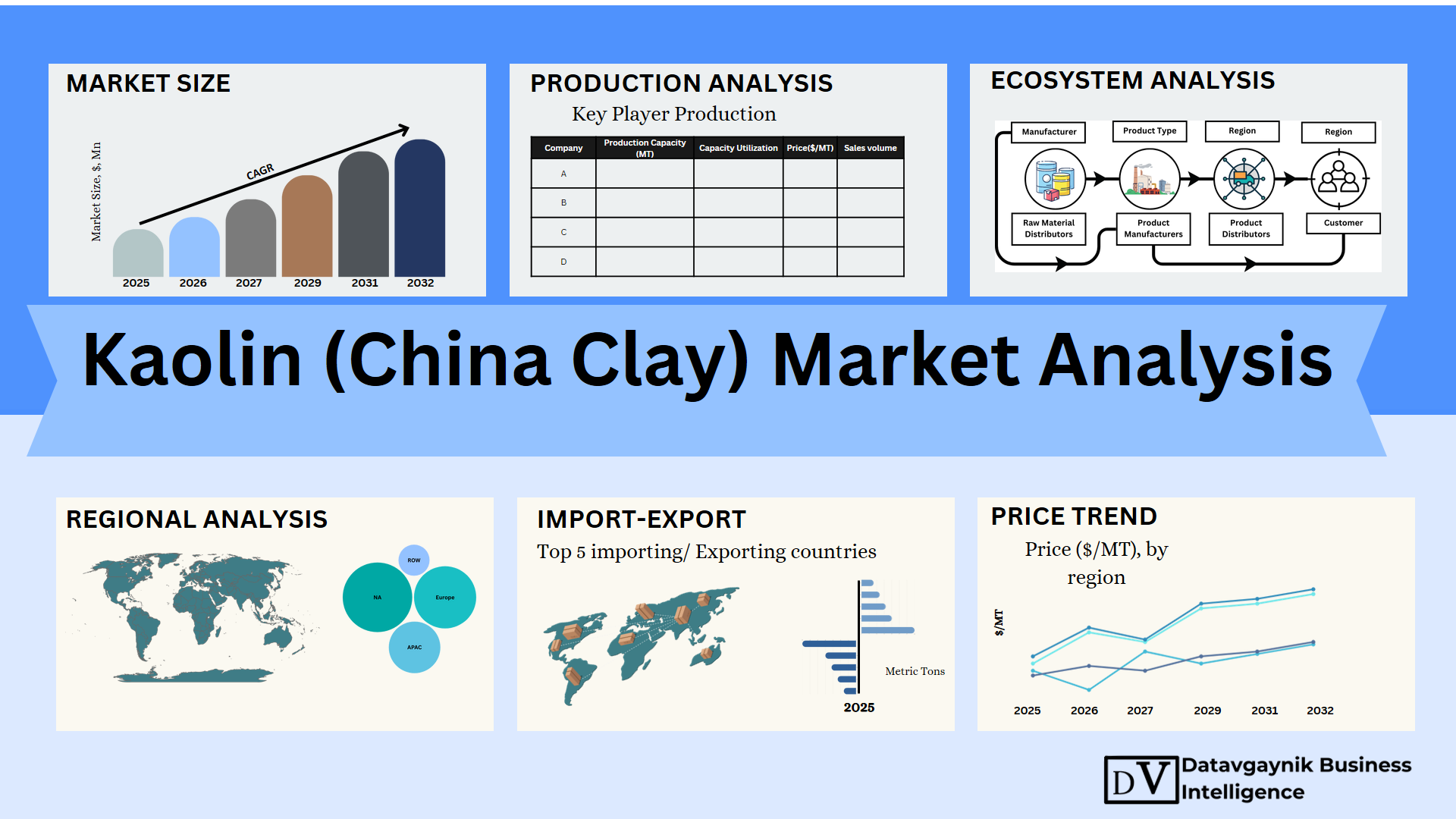
The Kaolin (China Clay) Market is witnessing a strong upward trajectory, primarily driven by booming construction activity across emerging and developed economies. For instance, global construction output surpassed USD 12 trillion in 2023 and is forecast to grow at over 4.5% CAGR until 2030. This expansion directly correlates with heightened demand for kaolin-based materials such as paints, coatings, tiles, and adhesives. In high-growth regions like Asia Pacific, where urbanization and megacity projects are accelerating, kaolin is being used in ceramic tiles, sanitary ware, and heat-resistant paints. The material’s unique properties—such as plasticity, whiteness, and chemical inertness—make it indispensable in construction-grade applications.
Kaolin (China Clay) Market Driven by the Surging Ceramics Industry
A pivotal growth engine for the Kaolin (China Clay) Market is the global ceramics industry, which is projected to reach USD 408 billion by 2032. Kaolin is a core raw material in ceramic manufacturing, offering structural integrity and high-temperature resistance. For example, in India alone, tile production exceeded 1.25 billion square meters in 2023, with Gujarat and Rajasthan accounting for a lion’s share. Similarly, China—home to the world’s largest ceramics market—continues to invest in high-grade porcelain, where kaolin content determines the product’s durability and aesthetic value. In developed nations such as Italy and Germany, premium sanitary ware and tableware lines are increasingly kaolin-intensive, driven by consumer preference for sleek, high-gloss finishes.
Datavagyanik also covers related markets such as the Kaolin Market and the Kaolin Fillers Market. These related markets contribute valuable context to the primary topic by highlighting complementary trends and technologies.
Expansion in the Specialty Paper Segment Boosts the Kaolin (China Clay) Market
While traditional paper use may be declining, the Kaolin (China Clay) Market benefits immensely from growth in the specialty paper segment. Specialty paper—including packaging, thermal, and coated varieties—requires kaolin as a filler and coating agent to enhance printability, brightness, and texture. According to Datavagyanik, global packaging paper demand rose by over 6.3% in 2023, particularly driven by the exponential rise of e-commerce and the shift toward sustainable packaging solutions. In the United States and Western Europe, kaolin plays a crucial role in improving the appearance and functionality of recycled and virgin paper, often replacing synthetic fillers due to its eco-friendly profile.
Growing Use in Plastics and Rubber Expands the Kaolin (China Clay) Market
The plastics and rubber sectors are increasingly becoming key demand centers for the Kaolin (China Clay) Market. Kaolin functions as a cost-effective reinforcing filler, improving tensile strength, thermal resistance, and chemical stability. For example, the global thermoplastics market reached USD 370 billion in 2023, with industries such as automotive, construction, and consumer goods relying on kaolin-loaded polymers for lightweight, high-durability components. In EV manufacturing, kaolin-filled plastics are used in battery casings and heat shields, offering performance advantages while meeting sustainability goals. Rubber products, including seals and hoses, also benefit from kaolin’s ability to reduce shrinkage and improve dispersion in the production process.
Paints and Coatings Sector Pushes the Kaolin (China Clay) Market Forward
Another critical contributor to the Kaolin (China Clay) Market is the global paints and coatings industry, valued at over USD 180 billion in 2023. Kaolin is used as an extender and pigment in decorative and industrial coatings, where it enhances opacity, surface smoothness, and durability. For instance, energy-efficient building materials increasingly rely on kaolin-based coatings for reflective insulation and UV protection. In automotive applications, kaolin contributes to anti-corrosive properties in underbody coatings and primers. As construction activities in countries such as Saudi Arabia, the UAE, and Brazil accelerate, demand for durable and eco-friendly coatings is surging, pushing kaolin consumption higher.
Cosmetics and Personal Care Segment Enriches the Kaolin (China Clay) Market
The cosmetics industry, with a valuation of over USD 430 billion in 2023, is rapidly integrating kaolin for its natural absorbent and soothing properties. The Kaolin (China Clay) Market is thus benefiting from the shift toward clean-label beauty products. For example, kaolin is used in facial masks, powders, and cleansers to reduce oil and impurities without causing skin irritation. Countries like South Korea, Japan, and France—leaders in the global cosmetics supply chain—are increasingly sourcing high-purity kaolin for use in premium skincare products. This trend is further supported by rising consumer awareness about sustainable, non-toxic ingredients, accelerating the market’s growth.
Pharmaceutical Applications Reinforce the Kaolin (China Clay) Market
Pharmaceutical-grade kaolin is gaining traction as a safe, inert excipient in tablet manufacturing and gastrointestinal treatments. The global pharmaceuticals market exceeded USD 1.5 trillion in 2023, and the Kaolin (China Clay) Market is increasingly aligning itself with this growth. Kaolin’s role as a binding agent and absorbent makes it ideal for antidiarrheal drugs and topical ointments. In markets like the U.S., Germany, and Japan, pharmaceutical companies are demanding kaolin with higher purity and particle control, fostering innovation in kaolin refinement processes. For example, ultrafine kaolin is now being integrated into drug delivery systems to ensure controlled absorption and minimal side effects.
Agricultural Advancements Stimulate the Kaolin (China Clay) Market
The agriculture sector is adopting kaolin as a biocompatible pest control agent and anti-caking material in fertilizers. In 2023, the global bio-pesticides market grew by over 9%, with sustainable farming practices gaining traction in regions like Latin America, Southeast Asia, and Africa. Kaolin-based crop protectants form a protective barrier on plants, reducing insect damage and preventing sunburn. For example, apple orchards in the U.S. and grape plantations in France have successfully deployed kaolin sprays to reduce pesticide use by up to 30%. With the growing push for chemical-free farming, the Kaolin (China Clay) Market stands to gain significantly from this eco-friendly application.
Fiberglass Industry Contributions Elevate the Kaolin (China Clay) Market
The fiberglass industry, which surpassed USD 16 billion in 2023, relies on kaolin for its ability to improve fiber strength and thermal performance. As infrastructure and renewable energy sectors expand, so too does demand for kaolin-reinforced fiberglass used in wind turbine blades, bridge reinforcements, and industrial insulation. For instance, the U.S. Department of Energy’s investment in offshore wind energy includes projects that specify fiberglass composites with kaolin to meet performance and environmental standards. Similar trends in China and Germany are accelerating kaolin’s adoption in glass-reinforced applications across infrastructure and energy platforms.
Sustainability Trends Accelerate the Kaolin (China Clay) Market Growth
Sustainability remains a dominant theme across all industries utilizing kaolin. The Kaolin (China Clay) Market benefits from the mineral’s abundance, low environmental footprint, and ability to replace synthetic or hazardous additives. For example, kaolin can substitute titanium dioxide in certain applications, reducing manufacturing costs and improving product safety. In paints, ceramics, and packaging, the demand for biodegradable, recyclable, and non-toxic components is pushing manufacturers to opt for kaolin-rich formulations. The European Union’s Green Deal and India’s ESG mandates are compelling manufacturers to adopt more sustainable input materials—making kaolin a top choice for compliance and innovation.
Kaolin (China Clay) Market Size Reflects Cross-Sectoral Momentum
Datavagyanik estimates the Kaolin (China Clay) Market Size exceeded USD 5.2 billion in 2023, with expectations to cross USD 7.8 billion by 2030 at a CAGR exceeding 5.9%. This growth is backed by strong fundamentals across construction, automotive, consumer goods, and industrial manufacturing sectors. For example, the rise in EV production, demand for high-end ceramics, and consumer shift toward natural cosmetics all intersect in driving kaolin usage. The market is also experiencing increasing investment in ultrafine and surface-treated kaolin variants, which are customized for advanced polymers and high-temperature ceramics, unlocking new revenue streams and regional opportunities.
Innovation and Regional Expansion Redefine the Kaolin (China Clay) Market Landscape
Technological advancements in kaolin processing are reshaping the Kaolin (China Clay) Market. Innovations such as flotation, magnetic separation, and chemical bleaching are improving product purity, making kaolin suitable for high-value sectors like electronics and medical ceramics. At the same time, emerging economies in Asia Pacific, the Middle East, and Latin America are investing heavily in domestic kaolin mining and processing capabilities. For instance, Oman and Vietnam are developing regional export hubs, while India is scaling up kaolin refinement to meet local demand in construction and packaging. These developments are transforming the competitive dynamics of the global kaolin supply chain.
“Track Country-wise Kaolin (China Clay) Production and Demand through our Kaolin (China Clay) Production Database”
-
-
- Kaolin (China Clay) production database for 23+ countries worldwide
- Kaolin (China Clay) sales volume for 28+ countries
- Country-wise Kaolin (China Clay) production capacity, production plant mapping, production capacity utilization for 23+ manufacturers
- Kaolin (China Clay) production plants and production plant capacity analysis by top manufacturers
-
“Track real-time Kaolin (China Clay) Prices, Kaolin (China Clay) price charts for 23+ countries, Kaolin (China Clay) weekly price tracker and Kaolin (China Clay) monthly price tracker”
-
-
- Track real-time Kaolin (China Clay) prices and Kaolin (China Clay) price trend in 23+ countries though our excel-based Kaolin (China Clay) price charts
- Real-time Kaolin (China Clay) price tracker dashboard with 23+ countries
- Complete transparency on Kaolin (China Clay) price trend through our Kaolin (China Clay) monthly price tracker, Kaolin (China Clay) weekly price tracker
-
North America Emerges as a Technology-Driven Contributor to the Kaolin (China Clay) Market
The Kaolin (China Clay) Market in North America remains robust, with the United States accounting for over 85% of regional demand. This is largely driven by the presence of well-established end-user industries such as paper, paints, ceramics, and pharmaceuticals. For example, Georgia is home to some of the world’s richest kaolin deposits, producing more than 6 million metric tons annually. Datavagyanik identifies that U.S. exports of high-purity kaolin to Europe and Asia have grown by over 4.5% year-on-year, especially for applications in advanced ceramics and medical-grade fillers. The regional market is further buoyed by domestic innovation in ultrafine and calcined kaolin processing, positioning North America as a global leader in value-added kaolin production.
Europe’s Premium Product Demand Drives Growth in the Kaolin (China Clay) Market
Europe continues to represent a lucrative region for the Kaolin (China Clay) Market, particularly due to its demand for premium, eco-friendly materials. Germany, the United Kingdom, and Italy are key consumers, especially within the high-end ceramics, sustainable packaging, and personal care industries. For instance, Germany’s ceramic exports crossed USD 2.8 billion in 2023, with kaolin being a core input. France and the U.K. are also investing in sustainable construction initiatives that rely heavily on kaolin-based insulation coatings. Finland’s production of high-purity grades has made it a preferred supplier within the EU, with kaolin exports to neighboring countries rising by 6.8% last year, according to Datavagyanik.
Asia Pacific Dominates Global Kaolin (China Clay) Market with Surging Demand
Asia Pacific is the fastest-growing region in the global Kaolin (China Clay) Market, accounting for more than 45% of global consumption. China, India, and Japan dominate regional demand due to massive expansions in construction, ceramics, paper, and plastics. For example, China’s tile production exceeded 8 billion square meters in 2023, with kaolin consumption surpassing 7 million metric tons. India’s kaolin output grew by 5.2% last year, driven by its booming real estate and ceramics clusters in Gujarat and Rajasthan. Datavagyanik highlights that rising exports of kaolin-based packaging materials from Southeast Asian countries such as Vietnam and Indonesia are contributing significantly to regional market expansion.
Middle East and Africa Strengthen Import-Driven Kaolin (China Clay) Market Dynamics
The Kaolin (China Clay) Market in the Middle East and Africa is growing steadily, although the region depends largely on imports. Saudi Arabia, the UAE, and Egypt are leading consumers, especially in construction and ceramics. For instance, Saudi Arabia’s Vision 2030 infrastructure roadmap has created substantial demand for kaolin-based paints and adhesives. Imports of high-purity kaolin from the U.S. and Brazil into the Middle East grew by 8.6% in 2023, signaling rising demand for consistent quality materials. South Africa is also emerging as a local producer, with annual kaolin production exceeding 200,000 metric tons, most of which is consumed domestically in the paper and tile industries.
Latin America Presents Emerging Opportunities in the Kaolin (China Clay) Market
Latin America’s Kaolin (China Clay) Market is expanding with the growth of urbanization and industrial manufacturing. Brazil, which holds one of the world’s highest quality kaolin reserves, produced more than 2.4 million metric tons in 2023. Datavagyanik points to increasing demand from Mexico and Argentina, especially in the paints and rubber sectors, as industrial output scales up. For example, kaolin imports into Mexico surged by 11.3% over the past year, driven by demand in construction coatings and plastic fillers. Regional producers are also exploring new applications such as bioplastics and eco-friendly agricultural films to diversify end-user segments.
Global Production Trends Reshape the Kaolin (China Clay) Market Landscape
Global production of kaolin exceeded 40 million metric tons in 2023, with the top five producers—China, the United States, Brazil, India, and the United Kingdom—accounting for nearly 70% of output. China remains the leader, with a focus on both high-volume and specialty-grade production. Brazil is gaining prominence as a global exporter, leveraging its cost-effective and high-brightness kaolin reserves. Datavagyanik notes that advances in beneficiation technologies—such as flotation, calcination, and magnetic separation—are enabling the production of kaolin with improved brightness, particle size distribution, and chemical purity, further supporting its penetration into high-value sectors like electronics and pharmaceuticals.
Kaolin (China Clay) Market Segmentation Unlocks Multi-Industry Potential
The Kaolin (China Clay) Market is segmented by grade, including hydrous, calcined, delaminated, and surface-modified variants. Hydrous kaolin, accounting for nearly 40% of global consumption, remains a staple in ceramics and paper applications due to its natural plasticity and brightness. Calcined kaolin, known for its superior opacity and UV resistance, is rapidly gaining traction in paints, plastics, and advanced ceramics. For instance, demand for calcined kaolin in the plastic masterbatch segment rose by 9.1% in 2023. Surface-modified kaolin, treated with silane or titanate, is in high demand in the automotive and electronics sectors, where superior dispersion and compatibility with polymers are essential.
Application-Based Segmentation Drives Growth Across the Kaolin (China Clay) Market
By application, the Kaolin (China Clay) Market is diversified into paper, ceramics, paints and coatings, plastics and rubber, pharmaceuticals, cosmetics, and agriculture. The paper sector still leads in terms of volume, but the fastest-growing segments include pharmaceuticals and cosmetics. For example, Datavagyanik reports that kaolin demand in personal care rose by 6.7% globally in 2023, driven by clean beauty trends and increasing use in anti-acne and oil-control formulations. Similarly, in agriculture, kaolin use in pest management solutions expanded by 8% year-over-year, particularly in organic farming zones across Europe and North America.
End-Use Industry Segmentation Shapes the Future of the Kaolin (China Clay) Market
The Kaolin (China Clay) Market is heavily influenced by end-use industries such as construction, automotive, consumer goods, industrial manufacturing, and packaging. In construction, kaolin is vital for formulating heat-reflective coatings and high-performance adhesives. Automotive manufacturers, especially in EV production, are using kaolin-filled plastics to reduce weight and improve heat tolerance. In packaging, kaolin serves as a barrier enhancer in coated paper and biodegradable plastic applications. For instance, packaging firms in Japan and South Korea are investing in kaolin-based lamination solutions to replace petroleum-based alternatives, supporting regional sustainability goals.
Kaolin (China Clay) Price Dynamics Reflect Supply Chain and Energy Factors
The Kaolin (China Clay) Price has experienced moderate volatility over the past two years, primarily influenced by energy costs, logistics disruptions, and raw material availability. For example, average global Kaolin (China Clay) Price per metric ton ranged between USD 140–170 in 2023, with specialty grades fetching over USD 220. Datavagyanik notes that pricing is also affected by beneficiation and processing costs, particularly for calcined and surface-modified variants, which require energy-intensive treatment. Freight and packaging costs added an additional 8–10% to final export prices in 2023 due to container shortages and inflation in global logistics.
Regional Disparities Define the Kaolin (China Clay) Price Trend
Regional differences continue to influence the Kaolin (China Clay) Price Trend. For instance, kaolin sourced in Brazil and India is priced more competitively due to lower labor and mining costs. In contrast, European and North American grades, especially those processed for pharmaceuticals or electronics, are priced higher due to stringent quality standards and advanced refinement technologies. In Southeast Asia, rising domestic demand is pushing Kaolin (China Clay) Price levels upward, especially in countries like Vietnam and Indonesia where downstream processing industries are scaling rapidly.
Market Consolidation and Long-Term Contracts Shape Kaolin (China Clay) Price Stability
Datavagyanik observes that consolidation in the Kaolin (China Clay) Market is creating more stable pricing structures through long-term supplier agreements. Key producers are securing contracts with large-scale paper, ceramics, and plastic manufacturers to hedge against raw material price swings. For example, multi-year agreements between U.S. kaolin suppliers and European construction product firms have helped stabilize Kaolin (China Clay) Price volatility by locking in processing and transportation costs. This trend toward supply chain integration is expected to reduce pricing uncertainties and improve cost predictability across global markets.
Kaolin (China Clay) Price Trend Influenced by Sustainability-Driven Demand Shifts
Sustainability imperatives are reshaping the Kaolin (China Clay) Price Trend, especially as buyers shift from synthetic additives to kaolin-based alternatives. As demand grows for biodegradable coatings and non-toxic excipients, higher-purity kaolin variants are commanding premium prices. For example, cosmetic-grade kaolin has seen price increases of 5–7% annually since 2021 due to growing global demand from organic skincare brands. Similar trends are emerging in the pharmaceutical sector, where stringent FDA and EU compliance requirements are pushing demand—and consequently prices—for ultra-refined grades.
“Kaolin (China Clay) Manufacturing Database, Kaolin (China Clay) Manufacturing Capacity”
-
-
- Kaolin (China Clay) top manufacturers market share for 23+ manufacturers
- Top 6 manufacturers and top 13 manufacturers of Kaolin (China Clay) in North America, Europe, Asia Pacific
- Kaolin (China Clay) production plant capacity by manufacturers and Kaolin (China Clay) production data for 23+ market players
- Kaolin (China Clay) production dashboard, Kaolin (China Clay) production data in excel format
-
“Kaolin (China Clay) price charts, Kaolin (China Clay) weekly price tracker and Kaolin (China Clay) monthly price tracker”
-
-
- Factors impacting real-time Kaolin (China Clay) prices in 18+ countries worldwide
- Kaolin (China Clay) monthly price tracker, Kaolin (China Clay) weekly price tracker
- Real-time Kaolin (China Clay) price trend, Kaolin (China Clay) price charts, news and updates
- Tracking Kaolin (China Clay) price fluctuations
-
Key Manufacturers Dominate the Global Kaolin (China Clay) Market Landscape
The global Kaolin (China Clay) Market is moderately consolidated, with a handful of multinational players controlling a significant portion of total production and distribution. These companies leverage advanced beneficiation technologies, vertically integrated supply chains, and diversified product portfolios to maintain competitive advantages. Datavagyanik estimates that the top five manufacturers collectively account for over 55% of the global Kaolin (China Clay) Market share, with influence extending across North America, Europe, Asia Pacific, and Latin America.
Imerys Group Leads the Global Kaolin (China Clay) Market Share
France-based Imerys S.A. stands as the largest player in the global Kaolin (China Clay) Market, with a market share exceeding 20%. The company operates multiple kaolin mines across the U.S., U.K., France, and Brazil and focuses on high-value industrial solutions. Imerys’ flagship product lines include Polsperse, Polwhite, and Kaowhite, tailored for applications in paper, paints, rubber, and ceramics. The company’s extensive investment in calcined kaolin technologies has allowed it to cater to advanced applications such as automotive coatings, construction materials, and personal care formulations. Imerys is also expanding into eco-friendly variants, aligning its strategy with the demand for sustainable mineral solutions.
BASF Corporation Strengthens Position in High-Performance Kaolin Solutions
BASF SE, headquartered in Germany, holds a notable share in the Kaolin (China Clay) Market, primarily through its North American operations. BASF’s kaolin division, previously headquartered in Georgia, U.S., has long served high-performance markets with product lines such as MetaMax, Ultrex, and Satintone. These products are used in paints, paper coatings, automotive primers, and thermoplastics. For example, Satintone 5HB is designed for reinforcing polyolefins and improving impact resistance in molded components. Datavagyanik notes that BASF’s focus on high-end, engineered kaolin products positions it as a premium supplier in the market.
Thiele Kaolin Company Focuses on Tailored Industry Applications
U.S.-based Thiele Kaolin Company is a leading privately held player in the Kaolin (China Clay) Market, with a strong emphasis on innovation and niche markets. Its product portfolio includes Kaofil, Thiele Gloss, and Thiele Satin, serving the paper, paint, plastic, and rubber sectors. The company has carved out a competitive position through customized formulations for specialty paper coatings and high-gloss ceramics. Thiele has expanded its production capacities in Georgia and invested in sustainable mining practices, strengthening its presence in North America and select Asia-Pacific markets.
KaMin LLC Expands Global Reach Through Strategic Acquisitions
KaMin LLC, another major U.S. player, commands a strong position in the Kaolin (China Clay) Market, especially in engineered kaolin solutions for performance applications. Its popular brands include KaMin HG, Translink, and Hydrite, used in packaging, construction materials, and cosmetics. The company’s 2021 acquisition of BASF’s kaolin minerals business significantly increased its global footprint, allowing it to supply to over 60 countries. Datavagyanik highlights KaMin’s innovation in surface-modified kaolin products, which are gaining traction in electronics, polymers, and pharmaceutical excipients.
LB Minerals Enhances European Kaolin (China Clay) Market Penetration
Czech Republic-based LB Minerals, part of Lasselsberger Group, is one of Europe’s top kaolin producers, particularly dominant in Central and Eastern Europe. The company focuses on high-purity, low-impurity kaolin for ceramic tiles, sanitary ware, and construction adhesives. Its flagship offerings, such as LBK White and LBK Ceram, are widely used by tile manufacturers in Italy, Poland, and Germany. LB Minerals has also expanded exports to the Middle East and Asia. Its vertical integration with tile manufacturing provides a unique edge in ensuring material compatibility and quality control.
Sibelco Group Builds Momentum in Specialty Kaolin Markets
Belgium-based Sibelco is gaining market share in the Kaolin (China Clay) Market through strategic expansion and diversification. With operations in more than 30 countries, Sibelco offers kaolin products for ceramics, paints, plastics, and agricultural applications. Its Sil-Ka and Cer-Ka brands are widely recognized for their fine particle distribution and high brightness, making them suitable for use in luxury ceramic and sanitary ware. Sibelco’s investments in energy-efficient calcination processes and sustainable mining have enabled the company to meet strict European Union environmental standards while boosting operational efficiency.
China Kaolin Market Led by Local Giants and Regional Specialization
In China, domestic producers dominate the Kaolin (China Clay) Market, serving the world’s largest ceramic and packaging industries. Major players such as Datong Coal Industrial Jinyu Kaolin Chemical and Longyan Kaolin Chemical focus on low-cost, high-volume production. These companies supply to China’s massive tile and sanitary ware sectors, where price sensitivity is high. However, several local players are now transitioning toward refined and ultrafine kaolin grades to serve the growing electronics and pharmaceutical sectors. With ceramic exports from China reaching USD 14.5 billion in 2023, local kaolin producers are positioned for long-term growth.
Kaolin (China Clay) Market Share Distribution Highlights Regional Disparities
Datavagyanik estimates that North America accounts for approximately 28% of the global Kaolin (China Clay) Market share by manufacturers, led by the U.S. The Asia Pacific region holds around 36% share, with China as the dominant force. Europe represents about 24%, with strong demand in Germany, the U.K., and Italy. Latin America and the Middle East & Africa contribute the remaining 12%, although their share is expected to rise as construction and industrial investments continue to grow. Manufacturer consolidation and long-term supply contracts are gradually shaping a more structured market landscape with reduced pricing volatility.
Recent Developments and Strategic Moves in the Kaolin (China Clay) Market
- In November 2023, Imerys launched a new line of ultrafine kaolin products under the Kaowhite Ultra brand, targeting high-end cosmetic and pharmaceutical applications.
- KaMin LLC completed the integration of BASF’s kaolin division in Q2 2023, adding new facilities and extending its reach in Europe and Latin America.
- Thiele Kaolin Company announced a USD 35 million investment in its Georgia processing plant in August 2023, aimed at increasing calcined kaolin output by 20% to meet rising demand in paints and plastics.
- In January 2024, Sibelco initiated a collaboration with a Japanese electronics manufacturer to supply kaolin for use in advanced ceramic capacitors, tapping into the fast-growing electronic materials segment.
- LB Minerals opened a new processing unit in April 2023 in Slovakia to cater to the rising demand for high-purity kaolin in Central Europe’s ceramics industry.
- Chinese producer Datong Kaolin began pilot production of pharma-grade kaolin in March 2024, signaling the region’s intent to move up the value chain and compete in specialized applications.
“Kaolin (China Clay) Production Data and Kaolin (China Clay) Production Trend, Kaolin (China Clay) Production Database and forecast”
-
-
- Kaolin (China Clay) production database for historical years, 10 years historical data
- Kaolin (China Clay) production data and forecast for next 7 years
- Kaolin (China Clay) sales volume by manufacturers
-
“Track Real-time Kaolin (China Clay) Prices for purchase and sales contracts, Kaolin (China Clay) price charts, Kaolin (China Clay) weekly price tracker and Kaolin (China Clay) monthly price tracker”
-
-
- Gain control on your purchase and sales contracts through our real-time Kaolin (China Clay) price tracker and Kaolin (China Clay) price trend analysis
- Kaolin (China Clay) weekly price tracker and forecast for next four weeks
- Kaolin (China Clay) monthly price tracker and forecast for next two months
-
Market Scenario, Demand vs Supply, Average Product Price, Import vs Export, till 2032
- Global Kaolin (China Clay) Market revenue and demand by region
- Global Kaolin (China Clay) Market production and sales volume
- United States Kaolin (China Clay) Market revenue size and demand by country
- Europe Kaolin (China Clay) Market revenue size and demand by country
- Asia Pacific Kaolin (China Clay) Market revenue size and demand by country
- Middle East & Africa Kaolin (China Clay) Market revenue size and demand by country
- Latin America Kaolin (China Clay) Market revenue size and demand by
- Import-export scenario – United States, Europe, APAC, Latin America, Middle East & Africa
- Average product price – United States, Europe, APAC, Latin America, Middle East & Africa
- Market player analysis, competitive scenario, market share analysis
- Business opportunity analysis
Key questions answered in the Global Kaolin (China Clay) Market Analysis Report:
- What is the market size for Kaolin (China Clay) in United States, Europe, APAC, Middle East & Africa, Latin America?
- What is the yearly sales volume of Kaolin (China Clay) and how is the demand rising?
- Who are the top market players by market share, in each product segment?
- Which is the fastest growing business/ product segment?
- What should be the business strategies and Go to Market strategies?
The report covers Kaolin (China Clay) Market revenue, Production, Sales volume, by regions, (further split into countries):
- Asia Pacific (China, Japan, South Korea, India, Indonesia, Vietnam, Rest of APAC)
- Europe (UK, Germany, France, Italy, Spain, Benelux, Poland, Rest of Europe)
- North America (United States, Canada, Mexico)
- Latin America (Brazil, Argentina, Rest of Latin America)
- Middle East & Africa
Table of Contents:
Kaolin (China Clay) Market
1. Introduction to the Kaolin (China Clay) Market
1.1 Definition and Composition of Kaolin (China Clay)
1.2 Physical and Chemical Properties of Kaolin
1.3 Key Industrial and Commercial Applications
2. Market Segmentation and Product Classification
2.1 Categorization by Type (Calcined, Hydrous, Delaminated, Surface-Modified)
2.2 Kaolin (China Clay) Market Segmentation by Application (Paper, Ceramics, Paints & Coatings, Rubber, Others)
2.3 Key End-Use Sectors Driving Demand
3. Global Kaolin (China Clay) Market Overview and Growth Analysis
3.1 Market Size and Growth Forecast (2019-2032)
3.2 Emerging Trends and Technological Developments
3.3 Market Challenges, Opportunities, and Competitive Landscape
4. Regional Market Insights and Industry Performance
4.1 North America Kaolin (China Clay) Market Analysis
- U.S. Kaolin (China Clay) Production, Demand, and Export Statistics4.2 Europe Market Landscape
- Leading Countries, Consumption Patterns, and Market Share4.3 Asia-Pacific Kaolin (China Clay) Market Expansion
- Key Producers, Trade Networks, and Growth Potential4.4 Latin America Market Trends
- Market Entry Strategies and Demand Analysis4.5 Middle East & Africa Kaolin (China Clay) Market Overview
- Industrial Applications and Investment Opportunities
5. Global Kaolin (China Clay) Production and Supply Chain Analysis
5.1 Kaolin (China Clay) Production Volume and Global Distribution (2019-2032)
5.2 Key Mining Locations and Processing Centers
5.3 Supply Chain Challenges and Logistics Optimization
6. Competitive Landscape and Market Players
6.1 Leading Kaolin (China Clay) Manufacturers and Market Share
6.2 Revenue and Market Positioning of Key Players (2019-2024)
6.3 Business Strategies, Expansion Plans, and Acquisitions
6.4 Competitive Pricing and Market Penetration Strategies
7. Kaolin (China Clay) Production and Trade Analysis
7.1 Global Production Trends and Utilization Rates
7.2 Import-Export Trends Across Major Markets
7.3 Supply and Demand Dynamics by Region
8. Consumption Analysis and Market Demand Forecast
8.1 Kaolin (China Clay) Consumption by Product Type
8.2 Demand Growth in Major Industrial Sectors
8.3 Market Share Analysis by Application Segment
8.4 Future Demand Projections and Consumption Trends (2024-2032)
9. Cost Analysis and Manufacturing Economics
9.1 Kaolin (China Clay) Extraction, Processing, and Refinement Costs
9.2 Raw Material Procurement and Supply Trends
9.3 Cost Optimization Strategies and Profitability Analysis
10. Kaolin (China Clay) Market Value Chain and Distribution Channels
10.1 Supply Chain Analysis from Extraction to End-Use Application
10.2 Distribution Networks and Role of Key Distributors
10.3 Sales Strategies and Regional Market Penetration
11. Market Entry Strategies and Investment Opportunities
11.1 High-Growth Markets and Investment Hotspots
11.2 Regulatory Landscape and Compliance Standards
11.3 Joint Ventures, Strategic Partnerships, and Industry Collaborations
11.4 Risk Management and Sustainable Business Strategies
12. Future Market Outlook and Industry Innovations
12.1 Kaolin (China Clay) Production Forecast and Market Growth (2024-2032)
12.2 Advancements in Processing Technologies and Product Development
12.3 Environmental Sustainability and Regulatory Compliance Trends
12.4 Strategic Recommendations for Market Players and Investors

