

Market Summary and Growth Forecast
The global LFP (Lithium Iron Phosphate) Powder Market will witness a robust CAGR of 15.8%, valued at USD 11.2 billion in 2026, expected to appreciate and reach USD 41.8 billion by 2035.
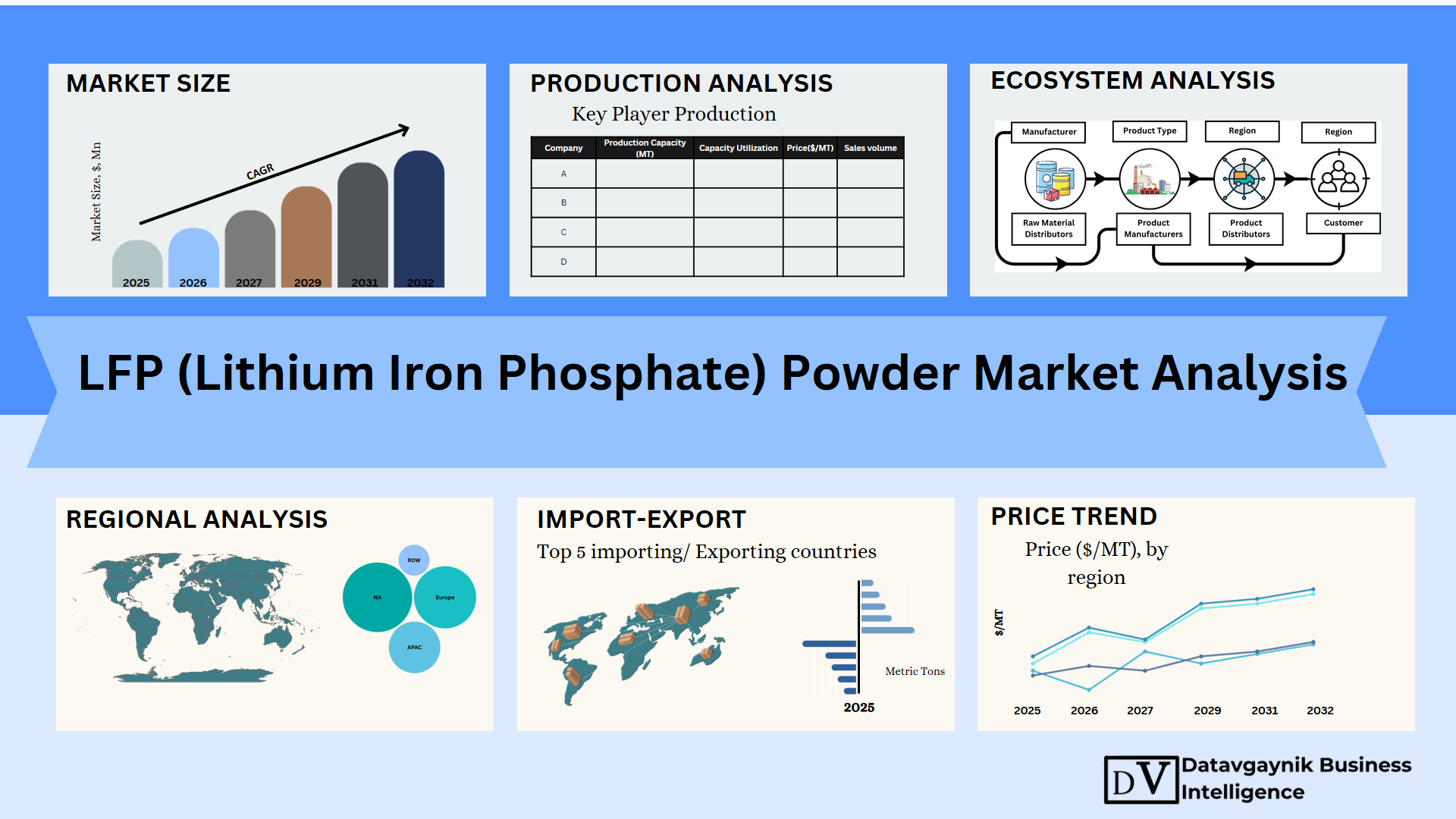
LFP powder is the cathode active material used in lithium iron phosphate batteries. It is produced through controlled synthesis of lithium, iron, phosphate, carbon coating additives, and particle-engineering processes. The material sits at the center of the low-cost battery chemistry shift because it offers strong thermal stability, long cycle life, lower dependence on nickel and cobalt, and better safety performance in high-volume battery applications.
By 2026, the market is no longer only a China-led EV battery story. It is becoming a broader energy storage and industrial electrification material market. Battery makers are using LFP powder for electric cars, electric two-wheelers, buses, grid-scale storage systems, residential storage, commercial backup systems, telecom power, and low-speed mobility. The chemistry is not the highest-energy option. That is true. But it wins where cost, safety, supply security, and cycle life matter more than maximum driving range.
The strategic relevance of the LFP (Lithium Iron Phosphate) Powder Market during 2026–2035 comes from three forces moving at the same time. First, battery OEMs are reducing exposure to cobalt and nickel price volatility. Second, energy storage demand is scaling faster than many traditional battery forecasts assumed. Third, governments are pushing battery localization through incentives, mineral security policies, and domestic manufacturing support. This gives LFP powder producers a larger role in the battery value chain than they had five years ago.
A practical way to view the market is simple: LFP powder demand follows cell manufacturing expansion. When a battery cell plant adds LFP capacity, powder demand rises before finished battery shipments show up in end-market data. This makes LFP powder a leading indicator for low-cost battery deployment.
| Market Indicator | 2026 Estimate | 2035 Forecast | Analyst View |
| Global LFP powder market size | USD 11.2 billion | USD 41.8 billion | Growth remains volume-led, but pricing discipline will matter as capacity expands. |
| CAGR, 2026–2035 | 15.8% | — | Strong but not linear. Oversupply cycles may create short-term price pressure. |
| Estimated global LFP powder demand | 1.95 million tons | 6.85 million tons | Demand growth is tied to EV penetration, stationary storage, and lower-cost battery platforms. |
| Average realized market price | USD 5,740 per ton | USD 6,100 per ton | Long-term price recovery is expected as higher-grade, export-qualified material gains share. |
| Battery-grade share of demand | Above 92% | Above 96% | Technical qualification will separate tier-1 suppliers from commodity producers. |
The market’s growth path will not be smooth. The near-term supply base is already crowded, especially in China. Several producers expanded aggressively when LFP adoption accelerated in passenger EVs and stationary storage. So, 2026–2028 may show margin pressure even while shipment volumes rise. This matters for investors. A high-growth market can still punish weak-cost suppliers.
Technology will be the main filter. Buyers are not just asking for powder. They are asking for consistency across particle size, tap density, moisture control, carbon coating, impurity levels, batch stability, and electrochemical performance. In EV cells, poor powder consistency can affect energy density, cycle performance, and cell yield. In energy storage systems, the tolerance may be slightly wider, but long cycle life and safety still depend on stable cathode material quality.
Regulation also supports market expansion, though indirectly. Battery supply chain policies in the United States, Europe, India, Japan, and South Korea are pushing local cell manufacturing, traceability, and lower-risk material sourcing. The LFP chemistry benefits from this environment because it avoids cobalt and nickel exposure. That said, lithium sourcing and precursor supply still remain strategic concerns. The market is cleaner from a critical metals standpoint, but it is not free from supply chain risk.
Production economics will shape competition through 2035. LFP powder is not as raw-material intensive as high-nickel cathode chemistries, but it is process-sensitive. Energy cost, yield, reactor design, precursor quality, carbon coating technology, and scale utilization all affect producer margin. Large integrated producers with long-term lithium supply, captive precursor capability, and qualified battery OEM relationships will hold an advantage. Smaller producers may survive in local or industrial battery niches, but qualification into global cell platforms will be harder.
The key stakeholders include battery cell manufacturers, cathode active material producers, EV OEMs, energy storage system integrators, lithium suppliers, phosphate chemical suppliers, iron precursor suppliers, equipment manufacturers, testing laboratories, recycling companies, governments, industry associations, and institutional investors. Their interests are not identical. EV OEMs want lower battery cost and supply diversification. Energy storage developers want long-life cells at predictable pricing. Governments want local capacity and reduced import dependence. Investors want exposure to the battery chain, but without buying into oversupplied assets.
The real opportunity in this market is not just more LFP powder capacity. It is qualified capacity. Battery buyers will increasingly separate suppliers that can deliver stable, high-performance material at scale from producers selling undifferentiated powder into spot markets.
In revenue terms, Asia Pacific will remain the anchor of the LFP (Lithium Iron Phosphate) Powder Market in 2026, mainly because China controls a large portion of LFP cathode production and downstream cell capacity. But by 2035, North America and Europe should account for a larger share as domestic battery plants mature and local qualification programs advance. This does not mean China loses its lead. It means the market becomes less one-dimensional.
The base-case forecast assumes continued adoption of LFP batteries in mass-market EVs, commercial vehicles, two-wheelers, and stationary storage. It also assumes sodium-ion batteries will grow in selected stationary and low-speed mobility applications, but not displace LFP at scale before 2030. Sodium-ion is a real competitive watchpoint. Still, LFP has manufacturing maturity, supplier depth, and proven bankability in grid storage. Those advantages are difficult to replace quickly.
By 2035, the LFP (Lithium Iron Phosphate) Powder Market should be larger, more regionalized, and more technically segmented. Commodity-grade powder will face pricing pressure. Battery-grade and high-performance powder will command better margins. The winners will be companies that can combine scale, qualification, cost control, and chemistry-level reliability.
Competitive Intelligence and Benchmarking
The competitive structure of the LFP (Lithium Iron Phosphate) Powder Market is highly supply-led. China controls the deepest production base, while North America, Europe, India, Japan, and South Korea are still building localized cathode material ecosystems. The market is not only about installed capacity. Qualification matters more. A powder supplier must pass long validation cycles for particle consistency, carbon coating quality, impurity control, tap density, moisture level, batch stability, and cell-level performance.
In 2026, the top supplier base remains concentrated around Chinese cathode material specialists, followed by a smaller group of regional players trying to localize LFP powder outside China.
| Company | Core Portfolio Focus | Market Position in 2026 | Strategic Read |
| Hunan Yuneng | Battery-grade LFP cathode materials, phosphate-based cathode platforms, large-volume supply for EV and storage cells | One of the largest global LFP powder producers | Scale advantage gives it strong cost leverage, but margin discipline depends on capacity utilization. |
| Wanrun New Energy | LFP cathode materials, iron phosphate precursors, energy storage and power battery cathode supply | Major Chinese supplier with strong presence in power and storage battery chains | Balanced precursor and cathode positioning supports integrated cost control. |
| Shenzhen Dynanonic | Nano-structured LFP and phosphate cathode materials, higher-performance LFP variants, LMFP development | Technology-led supplier with strong R&D image | Strong position where buyers need tighter particle engineering and improved rate performance. |
| Lopal Technology / LBM | LFP cathode materials, overseas LFP supply chain development, battery material platforms | Export-oriented Chinese supplier expanding through Southeast Asia | Its Indonesia-linked capacity gives it an advantage for non-China customer sourcing. |
| Gotion High-Tech | Integrated battery cells, LFP cathode material capability, energy storage and EV battery platforms | Vertically integrated battery player with material-side participation | More strategic as a captive and ecosystem player than as a pure merchant powder supplier. |
| ICL Group | Phosphate chemicals, battery materials, LFP cathode active material development | Strategic non-China entrant with upstream phosphate strength | Good raw-material logic, but project execution and policy support remain decisive. |
| Aleees | LFP and LMFP cathode materials, long-cycle battery material platforms, licensing and technical partnerships | Taiwan-based specialist with export and technology credibility | Relevant for customers seeking proven non-mainland China know-how and technical collaboration. |
Hunan Yuneng sits at the scale end of the market. Its position is built around high-volume LFP cathode material supply for large battery cell customers. The company benefits from procurement scale, production learning, and direct exposure to the Chinese EV and energy storage boom. Its challenge is not demand visibility. It is defending price and margin when industry supply runs ahead of customer offtake.
Wanrun New Energy competes through cathode material and precursor integration. This matters because LFP powder economics are sensitive to iron phosphate quality, process yield, and production stability. The company is well placed in the mass-market battery chain, especially where customers need reliable LFP volumes for both power batteries and energy storage batteries.
Shenzhen Dynanonic has a more technology-oriented profile. Its positioning is linked to nano-LFP, improved material dispersion, and high-performance phosphate cathode systems. This type of supplier tends to compete less on pure tonnage and more on product qualification, performance stability, and next-generation variants such as manganese-enhanced phosphate materials.
Lopal Technology / LBM is important because of its export-facing strategy. Non-China battery makers are trying to reduce exposure to single-country supply chains, but they still need Chinese process know-how. Lopal’s Southeast Asia footprint gives customers a practical bridge: Chinese material expertise with a more flexible regional supply route.
Gotion High-Tech is not viewed only as a powder supplier. It is better understood as an integrated battery platform with LFP chemistry depth. Its relevance comes from cell manufacturing, energy storage systems, and internal material know-how. This gives it strategic control over chemistry cost and cell performance.
ICL Group represents the upstream-to-cathode localization logic outside China. Its phosphate base gives it a natural route into LFP cathode active materials. The opportunity is clear: regional battery supply chains need non-China LFP powder. The risk is also clear: cathode production needs technical qualification, customer locking, and strong policy support.
Aleees occupies a specialist position. It has long experience in LFP cathode materials and technical collaboration. While it does not match the largest Chinese players by scale, it has relevance in export markets, licensing-led models, and customers that value proven LFP process know-how.
The competitive gap is moving from “who can produce LFP powder” to “who can produce qualified powder at scale, with predictable cost, stable chemistry, and bankable customer approvals.”
Regional Landscape and Adoption Outlook
The regional outlook for the LFP (Lithium Iron Phosphate) Powder Market reflects the global battery map. China leads on supply. North America and Europe are trying to localize. India is building from a low base. Japan and South Korea are adapting from their historic strength in nickel-rich chemistries. Rest of the World demand is rising through energy storage, buses, two-wheelers, and distributed power systems.
| Region | 2026 Market Position | Adoption Outlook to 2035 | White Space |
| China | Dominant producer and consumer | Remains the global benchmark for LFP cost, scale, and supplier depth | Higher-grade export qualification and LMFP migration |
| North America | Import-dependent but localization-focused | Strong growth from EV platforms and grid storage | Domestic LFP cathode material capacity |
| Europe | Policy-backed but technically underbuilt | Demand rises through affordable EVs, buses, and stationary storage | Local cathode active material supply |
| India | Early-stage but strategically important | Fast growth from two-wheelers, buses, storage, and local battery manufacturing | Integrated battery materials and precursor production |
| Japan | Selective adoption | More active in specialty, stationary, and advanced chemistry development | Partnerships and high-reliability niche supply |
| South Korea | Historically NMC-heavy but shifting | LFP gains traction as Korean cell makers target ESS and mass-market EVs | LFP process localization and cost competitiveness |
| Rest of World | Demand-led, supply-light | Growth driven by storage, telecom backup, fleet electrification, and industrial batteries | Regional assembly and localized material sourcing |
North America is moving from battery assembly ambition to materials localization. The United States has strong demand logic because grid storage, data centers, utility-scale renewables, and lower-cost EV platforms favor LFP batteries. Canada also has a role through battery minerals and clean industrial policy. Yet the region still lacks deep LFP powder manufacturing. Most cell projects need either imported cathode material or licensed process technology. This creates a clear gap for qualified LFP powder plants, precursor producers, and recycling-linked cathode supply.
Europe is policy-rich but execution-constrained. Battery localization, carbon footprint rules, and supply chain traceability all support regional LFP cathode development. Germany, France, Spain, Hungary, and Poland are important because of automotive clusters and cell manufacturing plans. The challenge is cost. European energy, permitting, and labor costs make it hard to compete with China on commodity LFP powder. Europe’s best opportunity is not low-end powder. It is cleaner, traceable, automotive-qualified material with strong customer contracts.
China remains the center of the market. It has the largest base of LFP cathode material producers, cell makers, equipment suppliers, precursor producers, and technical labor. China also has the fastest feedback loop between powder producers and battery cell customers. This gives domestic suppliers a practical advantage in process refinement. The main risk is oversupply. When too many plants chase the same demand pool, selling prices fall and smaller producers get squeezed.
India is still small in LFP powder production, but its adoption curve is attractive. Electric two-wheelers, three-wheelers, buses, telecom backup, solar storage, and public energy storage projects all fit LFP’s cost and safety profile. The government’s manufacturing push helps, but the upstream material base remains thin. India needs lithium supply routes, iron phosphate quality control, electrolyte integration, and cell qualification infrastructure. This is a white space market, not a mature one.
Japan has a more selective LFP outlook. Japanese firms have strong battery engineering depth, but the domestic industry has historically leaned toward high-performance chemistries and specialty applications. LFP adoption is more likely in stationary storage, cost-sensitive mobility, and partnerships where safety and long cycle life carry more weight than energy density. Japan may not become a large-volume LFP powder producer, but it can influence process quality, advanced materials testing, and next-generation phosphate chemistry.
South Korea is making a strategic adjustment. Korean battery makers built global strength around nickel-rich cathodes, but LFP is now too important to ignore. Energy storage systems, U.S. localization, and affordable EV battery programs are pushing Korean suppliers to develop LFP platforms. The gap is cost competitiveness. To win in LFP, Korean companies need manufacturing efficiency closer to Chinese benchmarks.
Rest of the World includes Southeast Asia, Latin America, the Middle East, and parts of Africa. Demand is fragmented but real. Southeast Asia has strong potential in two-wheelers, buses, and battery assembly. Indonesia is emerging as a battery materials and cell production hub. Brazil and Mexico offer EV and stationary storage opportunities. The Middle East is more storage-led, supported by solar deployment and grid balancing needs. Africa remains underserved, but telecom backup, mini-grids, and off-grid solar storage create long-term demand.
Regionalization will not remove China’s lead by 2035. But it will change buyer behavior. Large customers will increasingly ask for dual sourcing, local qualification, and supply chain traceability instead of relying on one production geography.
End-User Dynamics and Use Case
End-user demand in the LFP (Lithium Iron Phosphate) Powder Market is led by battery cell manufacturers. They are the direct buyers or technical qualifiers of LFP powder. However, the real demand signal comes from downstream applications: EVs, energy storage systems, electric buses, two-wheelers, telecom backup, industrial batteries, and renewable energy integration.
Electric vehicle manufacturers use LFP-based batteries mainly in mass-market cars, entry-level models, fleet vehicles, buses, and commercial vehicles. The attraction is simple: lower pack cost, better safety, longer cycle life, and reduced dependence on cobalt and nickel. For short-to-mid-range EV platforms, LFP often makes stronger commercial sense than high-nickel chemistry.
Energy storage system integrators are the fastest-growing end-user influence group. Grid storage, solar-plus-storage, commercial backup, and data center power systems need long-duration reliability and thermal safety. LFP fits this profile. These buyers are less sensitive to battery weight than EV buyers, so LFP’s lower energy density is less of a penalty.
Two-wheeler and three-wheeler OEMs are important in India, Southeast Asia, and parts of Latin America. These platforms need affordable, safe, and durable batteries. LFP works well where operating temperatures are high and cost sensitivity is sharp.
Telecom and industrial backup users adopt LFP batteries as a replacement for lead-acid systems. The shift is driven by longer service life, lower maintenance, and better cycling performance. This demand does not always grab headlines, but it creates steady base consumption for LFP powder through battery module suppliers.
Use Case Scenario
A utility-scale solar developer in Rajasthan selected LFP-based battery storage for a renewable energy smoothing project. The project required batteries that could handle daily cycling, high ambient temperature, and long operating life without aggressive cooling cost. The battery cell supplier qualified LFP powder based on particle consistency, low impurity levels, and cycle-life performance. For the developer, the decision was not about maximum energy density. It was about safety, cost per cycle, and predictable performance over years of operation.
This type of use case explains why LFP powder demand is expanding beyond passenger EVs. Stationary storage buyers evaluate batteries differently. They care about lifetime throughput, warranty risk, fire safety, balance-of-system cost, and bankability. That gives LFP chemistry a strong commercial case.
The end-user story is shifting from “EV battery material” to “infrastructure battery material.” That shift is important because stationary storage can absorb large volumes of LFP powder even when EV demand moves through short-term cycles.
Recent Developments + Opportunities & Restraints
Recent Developments
January 2025 — ICL and Shenzhen Dynanonic signed a strategic agreement for LFP cathode material production in Europe.
The agreement pointed to the growing push for localized LFP cathode supply in Europe. The planned structure combined ICL’s phosphate material base with Dynanonic’s LFP production know-how. For the market, the signal was clear: Europe wants LFP chemistry, but it needs technical partners to build credible cathode capacity.
June 2025 — Lopal Technology disclosed a multi-year LFP cathode material supply agreement linked to Southeast Asian battery production.
The agreement covered LFP cathode material supply from 2026–2030 and highlighted the role of Indonesia and Southeast Asia as alternative battery material hubs. This is important because customers are looking for supply routes outside mainland China while still relying on Chinese process expertise.
August 2025 — Wanrun New Energy added LFP production capacity at its Shandong base.
The additional capacity strengthened Wanrun’s position in high-volume LFP supply. It also showed how Chinese producers continue to expand despite pricing pressure. For buyers, this supports material availability. For suppliers, it increases the risk of price competition.
November 2025 — ICL decided to discontinue its U.S. LFP facility effort and terminate the planned Spain joint venture with Dynanonic.
This was a useful reality check for the industry. LFP localization outside China is attractive on paper, but project economics, policy funding, execution risk, and customer commitments must align. Not every announced project will reach commercial scale.
December 2025 — IFC backed GFCL EV’s integrated battery-materials plant in Gujarat, including LFP cathode material capability.
This development strengthened India’s battery material localization story. The investment supports domestic production of battery materials used in EV and energy storage systems, reducing future dependence on imported cathode material.
Opportunities
Emerging market battery localization is the largest opportunity. India, Southeast Asia, Latin America, and the Middle East need lower-cost battery systems for mobility, solar storage, telecom backup, and grid balancing. LFP powder suppliers that secure early qualification in these markets can build long customer relationships.
Energy storage demand gives LFP powder a second growth engine beyond EVs. Utility-scale storage, commercial backup, and data center power systems increasingly favor safe and long-cycle battery chemistry. This supports stable demand even when passenger EV sales slow.
Process automation and quality control can improve supplier margins. LFP powder production depends on tight process discipline. Advanced monitoring, automated particle-size control, moisture management, and digital batch traceability can reduce rejection rates and improve customer qualification.
Restraints
Overcapacity remains the most visible restraint. Several producers expanded aggressively after LFP demand accelerated. If capacity runs ahead of qualified demand, market pricing can weaken even while volume demand rises.
Localization outside China is difficult. New plants need technical expertise, customer qualification, reliable lithium supply, iron phosphate consistency, environmental approvals, and competitive energy cost. Policy support helps, but it does not replace operating capability.
Chemistry competition is rising. Sodium-ion batteries may compete in low-cost storage and short-range mobility. LMFP may also take share in applications that need better energy density than standard LFP. This does not remove LFP’s role, but it will pressure lower-grade powder suppliers.


