

Market Summary and Growth Forecast
The global Low Friction Coatings Market is valued at $3,520 million in 2026 and is expected to appreciate to $5,998 million by 2035, at a CAGR of 6.1%.
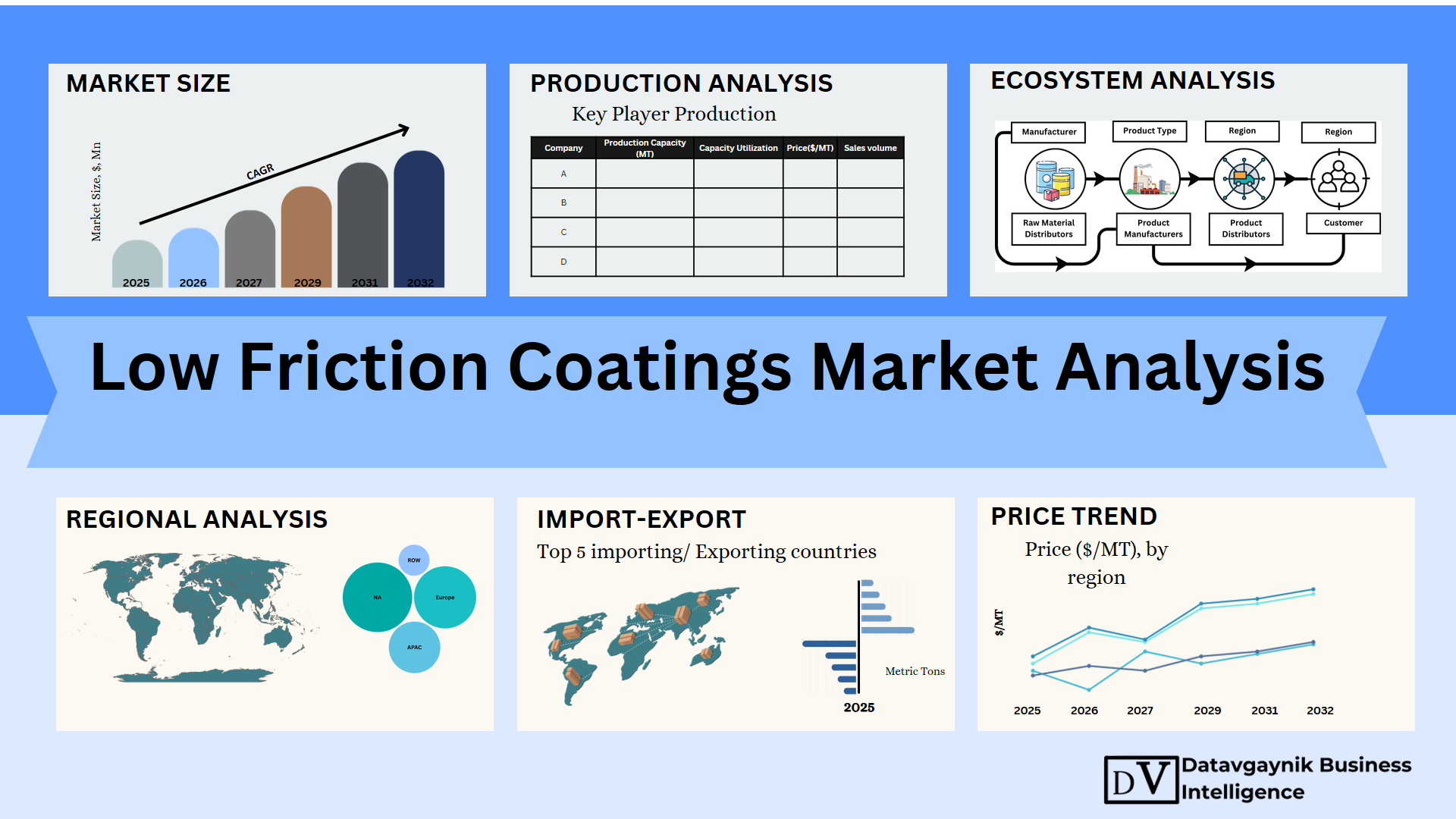
Low-friction coatings are engineered surface layers applied to components that slide, rotate, oscillate or repeatedly contact another surface. Their main purpose is to reduce friction, control wear, prevent seizure and improve operating life. The market includes fluoropolymer-based coatings, bonded solid lubricants, molybdenum disulfide systems, graphite formulations, diamond-like carbon coatings and other thin-film surface treatments.
Datavagyanik also covers related markets such as the Low Friction Polymer Coatings Market, the Polytetrafluoroethylene (PTFE) low friction coatings Market, and the Anti-friction coatings Market. These related markets contribute valuable context to the primary topic by highlighting complementary trends and technologies.
The estimate covers coating materials and outsourced coating-service revenue. It excludes conventional lubricating oils and greases, untreated low-friction polymers, decorative coatings and broad corrosion-protection products without a defined tribological function.
For business leaders, the Low Friction Coatings Market is becoming less dependent on routine component protection and more closely linked with energy efficiency, equipment reliability and lifecycle cost. Manufacturers are using engineered surfaces to reduce lubricant consumption, extend maintenance intervals and improve the performance of smaller components operating under higher loads.
Global Market Forecast
| Forecast indicator | Market estimate |
| Global market size, 2026 | $3,520 million |
| Estimated market size, 2030 | $4,461 million |
| Projected market size, 2035 | $5,998 million |
| CAGR, 2026–2035 | 6.1% |
| Absolute revenue addition | $2,478 million |
These figures are based on an independent model combining coated-component production, outsourced surface-treatment revenue, coating consumption, average coating realization and expected changes in material mix.
Business Relevance During 2026–2035
The commercial value of these coatings is normally much higher than their cost as a percentage of the finished component. A thin coating can protect an expensive bearing, valve, gear, actuator or injection component from premature failure. This gives coating suppliers pricing power where they can document longer service life or lower energy loss.
Demand in the Low Friction Coatings Market comes mainly from applications where conventional lubrication is insufficient, undesirable or difficult to maintain. Coatings are also used as an additional protection layer when grease or oil remains present.
Industrial examples include:
- Dry-running or intermittently lubricated bearings
- Automotive piston, fuel-system and transmission components
- Aerospace actuators, fasteners, valves and landing systems
- Compressors, pumps and hydraulic equipment
- Cutting, forming and precision manufacturing tools
- Medical instruments and moving device components
- Railway wheel-end and traction-system bearings
- Food-processing machinery requiring clean operation
SKF, for example, applies carbon-based low-friction surfaces to bearings exposed to poor lubrication, contamination and variable loads. Oerlikon Balzers supplies diamond-like carbon systems combining high hardness with reduced friction, while DuPont offers bonded anti-friction coatings within its specialty lubrication portfolio. These examples show that the market sits between specialty chemicals, precision manufacturing and surface-engineering services.
Major Forces Shaping Market Growth
Electrification and drivetrain redesign: Electric vehicles eliminate several conventional engine components, but they create new coating requirements in high-speed bearings, e-axles, reduction gears, compressors, pumps and thermal-management systems. Lower noise and reduced rotational resistance are especially important because electric drivetrains expose mechanical noise that was previously masked by combustion engines.
Industrial automation: Robots, automated assembly systems, semiconductor equipment and precision motion platforms depend on repeatable movement. These systems use compact components with tight tolerances. A coating failure may interrupt an entire production line, so buyers increasingly evaluate coatings through total downtime avoided rather than price per kilogram.
Longer maintenance cycles: Mining, rail, power generation, aerospace and heavy industrial operators are extending service intervals. This supports coatings that can tolerate start-stop operation, marginal lubrication, contamination and high contact pressure.
Aerospace and defence production: Aircraft engines, actuation systems, fasteners and control mechanisms require thin coatings that reduce friction without materially changing component dimensions. Qualification cycles are long, but approved materials can generate stable recurring revenue.
Environmental regulation: Fluoropolymer-based coatings remain important because of their chemical resistance and friction performance. That said, PFAS reporting and regulatory review are increasing formulation, documentation and compliance costs. In the United States, the EPA has strengthened review and reporting requirements for defined PFAS categories, including requirements that may affect fluoropolymer-containing coatings. This is pushing suppliers to develop PFAS-free bonded coatings, advanced carbon films and PVD alternatives rather than removing low-friction functionality altogether.
Vehicle regulation is also expanding beyond exhaust emissions. Europe’s Euro 7 framework introduces controls for non-exhaust emissions such as brake and tyre particles. Low-friction technology will not independently solve this issue, but it will support broader engineering programs focused on wear control, component efficiency and material durability.
Key Consumers and Clients
The principal purchasing groups include:
- Automotive OEMs and Tier-one suppliers: Bosch, ZF, Magna, Aisin, Schaeffler and comparable component manufacturers
- Bearing and motion-control companies: SKF, Timken, NSK, NTN and industrial bearing producers
- Aerospace and defence manufacturers: GE Aerospace, Safran, RTX, Honeywell and their machining partners
- Industrial machinery manufacturers: Pump, compressor, hydraulic, robotics, machine-tool and process-equipment companies
- Energy-sector equipment suppliers: Turbine, valve, drilling, wind-power and power-transmission manufacturers
- Medical-device companies: Surgical instrument, catheter-component, implant-tool and diagnostic equipment manufacturers
- Contract coaters and component processors: Businesses applying PVD, PACVD, bonded lubricant, spray and dip-coated systems on behalf of OEMs
Use case: A bearing used in a conveyor or railway wheel assembly may already contain grease. A low-friction coating provides protection during start-up, lubricant starvation or contamination. This may prevent surface damage before a stable lubricant film develops.
Expert view: The strongest value proposition is not simply a lower coefficient of friction. Buyers will pay more for a coating that produces predictable wear, reduces maintenance events and remains stable across temperature, load and contamination changes.
Market Segmentation and Forecast Scope
The Low Friction Coatings Market is best segmented by material system, application, end-user industry and region. These dimensions describe different parts of the purchasing decision and should not be combined into one classification.
Material segmentation identifies how the coating achieves low friction. Application segmentation identifies the component being coated. End-user segmentation identifies the industry purchasing or specifying the solution. Regional segmentation measures where the coating is consumed or applied.
By Coating Chemistry and Material
| Segment | Scope and market position |
| PTFE and Other Fluoropolymer-Based Coatings | Used where low surface energy, chemical resistance and non-stick behavior are required. This category represents approximately 36.4% of 2026 revenue, making it the largest material group. Its growth will moderate as buyers evaluate PFAS exposure and alternative materials. |
| Molybdenum Disulfide-Based Coatings | Selected for high-load, low-speed, vacuum and dry-running conditions. Demand remains strong in aerospace, defence, fasteners and heavy equipment. |
| Graphite and Polymer-Bonded Solid Lubricants | Used in general engineering, fasteners, locks, hinges, valves, agricultural equipment and moderate-load sliding systems. |
| Diamond-Like Carbon and Carbon-Based Coatings | Thin, hard coatings used for precision components requiring both wear resistance and low friction. This is projected to be the fastest-growing material category, with an estimated 7.8% CAGR during 2026–2035. |
| Ceramic, Nitride and Hybrid Coatings | Includes multilayer and composite systems designed to balance friction, hardness, corrosion resistance and operating temperature. |
| Other Specialty Systems | Includes tungsten disulfide, soft-metal films, sol-gel systems and application-specific nanocomposite formulations. |
PTFE and fluoropolymer systems will retain a large installed base because of their established processing routes and broad chemical resistance. However, their future growth will depend on regulatory status, fluoropolymer grade, end-use criticality and the ability of suppliers to control emissions during production and application.
Diamond-like carbon coatings will gain share in precision automotive parts, medical instruments, high-speed bearings and industrial motion systems. Hydrogen-free DLC, doped DLC and multilayer carbon coatings are especially strategic because suppliers can alter hardness, friction, adhesion and temperature performance through deposition design.
By Application
Bearings, Bushings and Sliding Surfaces: These components form a stable demand base across industrial machinery, vehicles, railways, energy equipment and material-handling systems. Coatings provide emergency-running protection and reduce damage during insufficient lubrication.
Gears and Transmission Components: Growth is being supported by compact gearboxes, electric drivetrains, robotics and precision reducers. Coating specifications are moving toward lower film thickness and improved resistance to rolling-sliding contact.
Pistons, Valves and Fluid-Control Components: This category includes compressor components, fuel systems, hydraulic valves, pump parts and sealing interfaces. Chemical resistance and dimensional consistency are as important as friction reduction.
Fasteners, Springs and Connectors: Coatings help control installation torque, prevent galling and improve repeated assembly. Demand is distributed across automotive, aerospace, construction equipment and industrial manufacturing.
Cutting and Forming Tools: Low-friction hard coatings reduce material adhesion and improve chip flow, surface quality and tool life. Coating adoption rises where manufacturers process aluminum, titanium, composites and other difficult materials.
Medical and Precision Instruments: These applications require smooth movement, wear resistance, controlled surface interaction and, in selected cases, biocompatibility. Qualification standards create entry barriers but also support premium pricing.
Other Applications: These include moulds, textile equipment, packaging machinery, firearm components where legally permitted, consumer mechanisms and specialized scientific instruments.
By End User
| End-user segment | Forecast interpretation |
| Automotive and Transportation | Represents approximately 31.2% of 2026 market revenue. Demand is shifting from conventional engine parts toward electrified drivetrains, braking systems, rail equipment and high-efficiency bearings. |
| Industrial Machinery and General Engineering | Broadest customer base. Includes pumps, compressors, hydraulics, robotics, conveyors, machine tools and production equipment. |
| Aerospace and Defence | Strategic premium segment with demanding qualification, traceability and operating-environment requirements. |
| Energy and Power Equipment | Covers wind systems, turbines, valves, oil and gas equipment, power transmission and hydrogen-related machinery. |
| Medical Devices and Instruments | Smaller in volume but attractive in value because of precision requirements and regulated purchasing processes. |
| Electronics and Precision Manufacturing | Includes semiconductor equipment, compact mechanisms, automation components and sensitive motion systems. |
| Food Processing and Packaging | Uses clean-running and chemically resistant coatings in areas where lubricant migration must be controlled. |
| Other End Users | Includes construction, textiles, marine equipment and specialized consumer products. |
Automotive and transportation will remain the largest end-user group, but its product mix will change. Coating demand associated with pistons and fuel systems will mature. Demand from electric drivetrains, high-speed bearings, thermal-management equipment, braking systems and lightweight components will rise.
Medical devices and precision instruments are expected to record one of the highest growth rates. The opportunity is concentrated in premium coating services rather than high-volume commodity formulations.
By Region
North America: Demand is supported by aerospace, defence, medical devices, industrial machinery and vehicle production. The region also has a strong network of contract surface-treatment companies. PFAS reporting obligations will encourage documentation-heavy procurement and alternative coating development.
Europe: Europe remains a technically advanced market for automotive components, bearings, aerospace systems and industrial machinery. Regulation will have a stronger effect on formulation choices here than in most other regions. Suppliers with PVD, PACVD and PFAS-free capabilities will be well positioned.
Asia Pacific: Asia Pacific is projected to generate the largest incremental revenue through 2035. China leads in industrial component production, while Japan and South Korea maintain strong positions in precision manufacturing, automotive systems, electronics and advanced materials. India is becoming an important growth market for automotive components, railways, industrial machinery and local coating services.
LAMEA: The region has a smaller market base. Demand is concentrated in mining, oil and gas, industrial maintenance, transportation equipment and power-sector machinery. Brazil, Mexico, Saudi Arabia, the UAE and South Africa represent the main commercial pockets.
Strategic Segment Outlook
The fastest expansion is expected in:
- Diamond-Like Carbon and Carbon-Based Coatings
- Medical and Precision Instrument Applications
- Electric Drivetrain and High-Speed Bearing Components
- PVD and PACVD Contract Coating Services
- PFAS-Free Bonded Solid-Lubricant Systems
- Asia Pacific Component-Coating Capacity
Expert view: Market segmentation will increasingly move beyond chemistry. OEMs will classify suppliers by validated operating window—load, speed, temperature, counter-surface and lubricant compatibility. This favors companies that sell application engineering rather than a standard coating formula.
Market Trends and Business Innovations
Innovation in the Low Friction Coatings Market is moving from simple friction reduction toward complete surface-system engineering. Coating developers now optimize friction, wear, adhesion, corrosion resistance, thermal stability and lubricant interaction at the same time.
The commercial goal is also changing. Earlier coating programs often focused on making a component last longer. Current programs are more likely to target energy loss, system efficiency, lubricant reduction, lower noise, cleaner operation and predictable performance over the component’s full service life.
R&D Evolution: From Coating Formulas to Tribological Systems
Friction performance depends on more than coating chemistry. It is affected by substrate hardness, surface roughness, contact pressure, speed, temperature, humidity, lubricant type and counter-material.
As a result, R&D teams are designing the complete tribological pair. This means the coating and the opposing surface are evaluated together. Surface preparation, interlayers and final finishing are becoming part of the formulation package.
Leading development programs are focusing on:
- Multilayer structures with separate adhesion, load-bearing and low-friction layers
- Gradient coatings that reduce stress between the substrate and surface film
- Coatings designed around a specific oil, grease or refrigerant
- Controlled surface textures that retain lubricant
- Lower-temperature curing for aluminum, polymers and heat-sensitive alloys
- Thin films that maintain tight dimensional tolerances
- Improved performance under mixed and boundary lubrication
- Longer endurance under stop-start operation
Use case: A coating that performs well on polished steel may fail when applied to a rough aluminum surface. Current development programs therefore define substrate preparation and surface finish as part of the coating specification rather than treating them as separate production steps.
Evolution of Diamond-Like Carbon Coatings
DLC technology is becoming one of the industry’s main innovation areas. These coatings combine carbon-based structures with very high hardness and a low-friction surface. Different deposition methods and dopants allow suppliers to adjust stress, adhesion, electrical behavior and temperature stability.
Hydrogen-free DLC is attracting attention where higher hardness and very low friction are required. Silicon-doped DLC can improve selected friction and surface-interaction properties. Metal-doped and multilayer DLC systems are being evaluated for high-load drivetrains, precision machinery and medical applications.
Commercial adoption will depend on deposition cost, coating uniformity and the ability to process larger production batches. The technology is therefore moving from specialist components toward broader industrial volumes as coating equipment becomes more productive. Oerlikon Balzers notes that hydrogen-free DLC can provide higher hardness and very low friction, while SKF uses carbon-based coated bearing surfaces for severe or poorly lubricated operating conditions.
PFAS-Free and Reduced-Fluorine Formulation Programs
Fluoropolymer coatings will remain commercially important. Their combination of chemical resistance, low surface energy and processing familiarity is difficult to replace with one universal alternative.
However, regulatory scrutiny is changing R&D priorities. Suppliers are developing:
- Non-fluorinated polymer binders
- Molybdenum disulfide and graphite hybrids
- Waterborne bonded solid-lubricant coatings
- PVD and PACVD surface treatments
- Carbon-based films
- Ceramic-polymer composites
- Application-specific fluoropolymer reduction strategies
The replacement decision will vary by use case. A low-load hinge may shift to a non-fluorinated bonded coating relatively quickly. An aerospace valve operating across extreme temperatures may require several years of qualification.
Ionbond has positioned PVD and PACVD technologies as potential alternatives to hard chrome and PFAS-based coatings in selected aerospace applications. This illustrates how regulation may shift revenue from chemical coating materials toward capital-intensive coating services.
Expert view: PFAS scrutiny is more likely to redistribute market revenue than eliminate demand. Buyers still need low friction. The commercial question is which chemistry or deposition route can deliver it with an acceptable compliance profile.
Advanced Deposition and Production Technology
PVD and PACVD equipment is improving in batch consistency, deposition speed and process control. Modern systems can apply very thin coatings while controlling composition across complex surfaces.
In September 2024, Oerlikon Balzers introduced its INVENTA PVD system using Advanced Arc Technology. The launch reflects the industry’s investment in more controlled and productive thin-film deposition.
Production innovation is concentrating on:
- Faster chamber loading and unloading
- Improved coating uniformity
- Higher target utilization
- Reduced process temperatures
- Better control of droplet formation in arc deposition
- Automated cleaning and surface preparation
- In-line thickness and adhesion measurement
- Recipe-based production for repeat OEM orders
These improvements may lower the minimum economic batch size. Smaller component manufacturers could therefore gain access to advanced coatings that were previously economical only for aerospace or high-volume automotive programs.
Application-Specific Material Innovation
The industry is moving away from claims that one coating can address every friction problem.
Automotive: Development is focused on e-axles, reduction gears, bearings, braking components, compressors and high-load powertrain interfaces.
Aerospace: Suppliers are targeting hard-chrome replacement, lubricant reduction, corrosion resistance and stable operation across wide temperature ranges.
Railways: Coatings are being evaluated for torque reduction, wear control and reliability in wheel-end bearings. In October 2024, SKF announced a tribological black-oxide solution intended to reduce railway bearing torque at low and intermediate speeds.
Medical instruments: DLC capacity is being expanded for surgical tools and precision instruments where wear resistance, clean surfaces and smooth movement are important. Ionbond has expanded DLC capacity at its New Jersey coating centre using a hybrid PVD/PACVD system to serve growing surgical-instrument demand.
Hydrogen equipment: Valves, compressors, pumps and engine components may require coatings that resist wear and hydrogen-related operating conditions. Ionbond has publicly discussed DLC development for hydrogen combustion-engine components, indicating an emerging technical niche.
Mergers, Acquisitions and Capacity Expansion
The competitive landscape is consolidating around technology access, regional coating capacity and OEM qualification.
In February 2025, NTI Nanofilm announced the strategic acquisition of EuropCoating Group. The acquired business brought capabilities in PVD, anodic oxidation and DLC coatings, along with facilities serving industrial and medical customers in Europe. The transaction illustrates the value placed on regional service capacity and qualified thin-film technology.
Ionbond expanded DLC coating capacity in France during 2024, adding equipment to its facility near Toulouse. This investment supports demand from aerospace, mobility and other high-performance industries.
The market is likely to see further transactions involving:
- Independent PVD and DLC coating centres
- Regional surface-treatment companies
- Precision component manufacturers with captive coating lines
- PFAS-free specialty coating developers
- Equipment companies with proprietary deposition technologies
Acquirers are not only purchasing revenue. They are buying customer approvals, coating recipes, experienced technicians and proximity to OEM production sites.
Commercial Innovation and Supplier Business Models
Suppliers are expanding beyond material sales. Common models now include:
Coating as a Service: The supplier receives components, applies the coating and returns finished parts. This model is attractive for PVD and DLC systems because customers avoid chamber investment and technical staffing.
Licensed or Captive Production: High-volume OEMs install coating lines within their own production plants, supported by equipment and process specialists.
Joint Development Programs: Coating suppliers work with OEM engineering teams during component design. Early involvement improves the chance that the coating becomes part of the formal component specification.
Performance-Based Selling: Suppliers demonstrate reduced torque, longer maintenance intervals or higher cycle life instead of competing only on coating price.
Regional Coating Networks: Global suppliers operate multiple service centres so OEMs can use the same coating specification across production locations.
Expert view: The Low Friction Coatings Market will increasingly reward companies that combine materials science, deposition equipment and local application support. A supplier with the lowest-friction laboratory sample will not automatically win. The winning supplier will reproduce the same result across thousands of components, several factories and multiple years of production.
Competitive Intelligence and Benchmarking
Competition in the Epoxy coated power transmission systems Market is divided between two supplier groups. The first consists of specialists in coated and laminated busbars. The second includes large electrical-equipment companies supplying complete busway, switchgear and power-distribution systems.
No single company controls every application. Data centres favour modular busway suppliers. Electric vehicles and power electronics require customised laminated conductors. Industrial and infrastructure projects create demand for cast-resin systems with high protection against moisture, dust and mechanical damage.
Leading Company Benchmark
| Company | Core Portfolio Position | Primary Market Strength | Competitive Direction |
| Mersen | Custom laminated and epoxy powder-coated busbars | Electric mobility, power electronics, rail and industrial equipment | Automated production and application-specific engineering |
| ABB | Low- and medium-voltage busway, including cast-resin configurations | Commercial buildings, industrial plants and data centres | Integration with switchgear and electrical protection |
| Schneider Electric | Modular busway and data-centre power-distribution architecture | Data centres, buildings and industrial facilities | Flexible installation, monitoring and digital power management |
| Legrand | Busbars, cable-bus systems and data-centre power infrastructure | Hyperscale and colocation data centres | Acquisition-led regional expansion |
| Delta Electronics | Epoxy cast-resin busways and integrated data-centre infrastructure | Data centres and high-density computing facilities | Compact systems connected with broader power-management solutions |
| EAE Electric | Cast-resin, enclosed and medium-voltage busbar systems | Industrial sites, tunnels, oil and gas, transport and infrastructure | Broad current range and harsh-environment capability |
Mersen
Mersen has the strongest direct alignment with the epoxy-coated component segment. Its portfolio covers laminated busbars, powder-coated conductors and complete power interconnection assemblies for vehicles, renewable-energy equipment, rail systems, industrial drives and computing infrastructure.
The company operates its own electrostatic powder-coating capability. This supports conductors with difficult geometries and applications that need high dielectric protection. It also combines coating with stamping, machining, soldering, lamination and thermal or electrical modelling.
Its main competitive advantage is engineering depth. Mersen can work at the component level, rather than supplying only complete building-level busways. In December 2024, the company disclosed an automated busbar production line for battery modules and identified cell interconnection and power conversion as priority growth areas.
Expert view: Mersen is positioned to benefit where the conductor must be designed around the customer’s battery, inverter or power-electronics architecture.
ABB
ABB competes through a broad portfolio of enclosed, modular and cast-resin busway systems. Its solutions span commercial and industrial low-voltage distribution, data-centre installations and selected medium-voltage infrastructure.
The company’s low-voltage systems can support ratings up to 5,000 amperes, while its broader enclosed-bus portfolio includes epoxy-insulated configurations for higher-voltage industrial connections. Its cast-resin systems are designed to provide a watertight external barrier in demanding environments.
ABB’s position is strengthened by its switchgear, circuit-protection, automation and power-quality businesses. This allows the company to sell the busway as part of a wider electrical package. The model is effective in factories, hospitals, commercial buildings and data centres where customers prefer a single integrated supplier.
Schneider Electric
Schneider Electric is primarily positioned in modular building and data-centre power distribution. Its busway portfolio serves low-voltage feeder, plug-in and rack-level applications.
The company places greater emphasis on installation flexibility than on epoxy coating as an individual material technology. Its newer data-centre system uses an open-track design with removable tap-off units, allowing operators to add or relocate electrical loads with limited disruption. The system was introduced for high-density and scalable computing environments.
Its competitive advantage comes from combining busway hardware with switchgear, energy management, monitoring, cooling and prefabricated data-centre infrastructure. This increases Schneider’s relevance in projects where busway selection is made as part of the complete data-centre architecture.
Legrand
Legrand is building a stronger position in data-centre power transmission through acquisitions. Its expanded portfolio covers conventional power busbars, cable-bus systems, modular power-distribution assemblies and white-space infrastructure.
In March 2025, the company acquired Malaysia-based Linkk Busway Systems, a specialist in power busbars for data-centre grey-space applications. The acquired company generated annual revenue of approximately €45 million and employed more than 240 people.
Legrand has also added busbar and power-distribution specialists in North America and Europe. This indicates a strategy based on regional production and shorter project-delivery cycles, rather than exporting every system from a central manufacturing base.
Delta Electronics
Delta Electronics supplies cast-resin busway systems as part of its wider data-centre power-management portfolio. Its systems use epoxy-based encapsulation to improve environmental protection, electrical insulation and installation density.
The company covers lower-current server-room distribution as well as higher-current infrastructure connections. Certain systems extend from approximately 250 amperes to 6,400 amperes, allowing Delta to address power distribution from central electrical rooms to downstream computing loads.
Delta’s strategic position is strongest where customers purchase busways together with uninterruptible power supplies, power-distribution units, cooling equipment and monitoring platforms. This integrated approach is well suited to Asian data-centre projects and multinational operators seeking standardised infrastructure.
EAE Electric
EAE Electric has developed a broad busbar portfolio covering standard enclosed systems, cast-resin designs and medium-voltage configurations. Its epoxy-and-mineral composite insulation is used to protect conductors against moisture, impact and difficult operating conditions.
The company’s cast-resin systems cover approximately 630–6,300 amperes, while its medium-voltage systems address ratings up to 17.5 kilovolts. This gives EAE a wider infrastructure focus than suppliers concentrated only on server-room distribution.
Its products are relevant in tunnels, ports, industrial plants, transport infrastructure and oil and gas facilities. EAE also has a commercially useful position in the Middle East, Europe and developing Asian markets where infrastructure projects require robust systems at competitive cost.
Competitive Assessment
The highest-value segment is not standard coated copper or aluminium. It is the engineering surrounding the conductor. Suppliers earn stronger margins when they provide:
- Electrical and thermal simulation
- Conductor forming and machining
- Automated coating or encapsulation
- Joint and connector engineering
- High-voltage and dielectric testing
- Installation support
- Integrated monitoring
So, competition will gradually shift away from stand-alone coating services. The leading companies will sell qualified power-distribution assemblies with documented electrical, thermal and mechanical performance.
Regional Landscape and Adoption Outlook
Regional adoption of epoxy-coated power transmission systems depends on data-centre construction, grid investment, manufacturing activity, electric-vehicle production and local electrical standards. Asia provides the largest manufacturing base. North America generates high-value data-centre demand. Europe remains important for industrial, rail and renewable-energy applications.
Regional Comparison
| Market | Adoption Level | Growth Outlook | Primary Demand Centres | Funding and Regulatory Environment |
| United States | High | Very strong | Data centres, industrial facilities, battery plants and semiconductor manufacturing | Private capital, utility investment, UL and NEC compliance |
| Europe | High | Strong | Data centres, rail, renewable energy and industrial electrification | Grid modernisation, EU environmental rules and IEC standards |
| China | Very high | Strong | EVs, batteries, electronics, data centres and industrial equipment | State-supported infrastructure and domestic manufacturing |
| India | Moderate | Very strong | Data centres, renewable energy, metros and industrial expansion | Central and state incentives with major grid investment |
| Japan | High | Moderate to strong | Data centres, rail, automation and semiconductor plants | High certification requirements and coordinated infrastructure planning |
| South Korea | High | Strong | Semiconductor clusters, batteries, data centres and electronics | Public infrastructure support and private industrial investment |
| Middle East | Moderate | Strong | Data centres, utilities, oil and gas, transport and commercial infrastructure | Sovereign funding, utility investment and economic-diversification programmes |
United States
The United States represents one of the strongest value-growth markets. Demand is being shaped by hyperscale data centres, cloud infrastructure, semiconductor plants, battery manufacturing and ageing industrial electrical systems.
U.S. data centres consumed approximately 176 TWh of electricity in 2023. The Department of Energy estimates that consumption could reach 325–580 TWh by 2028, equal to approximately 6.7%–12.0% of national electricity use. This creates direct demand for high-current switchgear, busways, transformers and rack-level distribution systems.
Busway adoption is strongest where facilities need rapid construction and frequent load changes. Modular distribution reduces the amount of field-installed cabling and allows new equipment to be connected through tap-off units.
The regulatory environment is strict. Products must comply with applicable UL, National Electrical Code, short-circuit, fire-safety and seismic requirements. Domestic testing and engineering support are therefore important competitive factors.
Private data-centre capital will remain the principal funding source. Federal and state programmes supporting semiconductor manufacturing, battery plants, grid reliability and clean-energy infrastructure add secondary demand.
Europe
Europe is a mature but strategically important market. Germany, the United Kingdom, France, the Netherlands, Ireland, Italy and the Nordic countries provide the largest demand pools.
Germany leads in industrial electrification and automated manufacturing. The United Kingdom, Ireland, the Netherlands and Germany are important data-centre markets. France benefits from nuclear-backed electricity and industrial infrastructure. Nordic countries attract selected facilities through renewable-power availability and cooler operating conditions.
Approximately 40% of Europe’s distribution grids are more than 40 years old. The European Commission estimates that around €584 billion of electricity-grid investment will be required, while cross-border transmission capacity is expected to double by 2030.
This creates opportunities in substations, switchgear, renewable integration and industrial power systems. However, project approvals and grid-connection delays can restrict the speed of new data-centre and manufacturing developments.
Regulation is more environmentally demanding than in most other regions. Suppliers must manage chemical compliance, fire performance, energy efficiency, material traceability and end-of-life reporting. This may favour low-emission curing systems and epoxy formulations that use less hazardous inputs.
China
China is the largest volume centre for coated busbars and associated power assemblies. It combines extensive production of electric vehicles, batteries, solar equipment, industrial electronics, data-centre hardware and electrical equipment.
Domestic demand is broad. High-volume powder-coated busbars are required in battery packs, charging systems and industrial equipment. Cast-resin busways serve data centres, factories, commercial buildings and infrastructure projects.
In July 2024, China issued a green-development plan for data centres. The plan targeted average power usage effectiveness below 1.5 by 2025 and increased use of renewable power, efficient equipment and resource-recovery systems.
China has a strong local supply chain for copper and aluminium processing, powder coating, busbar manufacturing and electrical assembly. So, pricing is highly competitive. International companies must differentiate through high-voltage capability, application engineering, product reliability and relationships with multinational customers.
Eastern and southern industrial provinces remain the main demand centres. Western regions are becoming more relevant as data-centre capacity is located closer to renewable-energy resources.
India
India is expected to record one of the highest growth rates from a smaller installed base. Demand is supported by data centres, renewable energy, metro rail, manufacturing investment, commercial construction and upgrades to electricity networks.
India’s operational data-centre capacity is estimated at around 1.5 GW in 2026 and could approach 5 GW by 2030. Maharashtra, Tamil Nadu, Telangana, Karnataka and the National Capital Region will account for a large part of this expansion.
The country is also developing transmission infrastructure to integrate large amounts of renewable generation. The Central Electricity Authority’s planning work covers transmission requirements for more than 500 GW of renewable capacity by 2030, with longer-term planning extending toward 2035–2036.
India remains price sensitive. Conventional cable systems will continue to compete in small projects. Epoxy-coated busways will gain share where floor space, installation speed, water resistance or maintenance access justifies the higher initial cost.
Domestic production is likely to expand. International suppliers will increasingly use Indian fabrication, enclosure and assembly partners to reduce delivery time and meet local-content preferences.
Japan
Japan is a technologically advanced, quality-led market. Demand comes from data centres, semiconductor manufacturing, railway systems, factory automation, power electronics and energy-storage applications.
Purchasing decisions place strong weight on compact dimensions, thermal performance, earthquake resistance, product life and supplier quality systems. This supports premium busbars and high-specification cast-resin systems rather than low-cost standard products.
The expansion of AI and communications infrastructure is increasing electricity requirements. In June 2025, Japan’s Ministry of Economy, Trade and Industry highlighted the need for coordinated development between electricity networks, telecommunications infrastructure and data-centre operators.
Tokyo and Osaka remain the main data-centre clusters. New capacity is also being considered in regions with stronger access to land, renewable energy and grid infrastructure. Power availability will be a bigger constraint than end-user demand.
South Korea
South Korea has strong demand from semiconductor production, battery manufacturing, electric vehicles and advanced electronics. The country’s industrial structure creates a concentrated market for high-current power-distribution equipment.
The planned semiconductor cluster in Yongin is especially important. In November 2024, government agencies, Samsung Electronics, SK Hynix, KEPCO, K-water and other institutions reached an agreement covering power and water infrastructure for the cluster.
The government also announced low-interest financing of approximately KRW 4.25 trillion for 2025 to support semiconductor investment and related infrastructure.
The main opportunity lies in factory-level power distribution. Semiconductor fabrication plants require dense, reliable electrical systems with strict control of contamination, downtime and voltage disturbance. Local manufacturers will dominate standard equipment, while international suppliers can compete in specialised busways, monitoring and high-reliability assemblies.
Middle East
The Middle East is relevant because of rapid investment in data centres, utilities, transport, oil and gas, commercial buildings and industrial diversification. The United Arab Emirates and Saudi Arabia are the leading markets.
The UAE currently has the strongest near-term data-centre project base. In January 2025, Dubai inaugurated the second phase of a solar-powered green data centre located within the Mohammed bin Rashid Al Maktoum Solar Park.
Dubai also allows qualifying industrial users and data centres to install captive solar capacity that can cover up to 100% of their required load. This strengthens demand for power conversion, switchgear and high-current distribution equipment.
Saudi Arabia offers the larger long-term opportunity. Its cloud, AI and data-residency programmes are encouraging local computing infrastructure, while industrial and utility projects support demand for cast-resin systems capable of operating in heat, dust and corrosive environments.
Expert view: The Middle East will remain project-driven rather than volume-driven. Suppliers with local engineering, installation and after-sales service will outperform companies relying only on imported equipment.
Recent Developments, Opportunities and Restraints
Recent Developments
- July 2024 – China: Government agencies introduced a green data-centre action plan covering energy efficiency, renewable electricity, water conservation and equipment improvement. The policy supports demand for efficient, compact power-distribution infrastructure.
- December 2024 – Mersen: The company disclosed its first automated busbar production line for battery modules and identified smart busbars, cell interconnection and motor-power conversion as priority applications.
- January 2025 – United Arab Emirates: Dubai inaugurated the second phase of its solar-powered green data centre, expanding regional demand for reliable busways, switchgear and integrated electrical infrastructure.
- March 2025 – Legrand: The company announced the acquisition of Malaysia-based Linkk Busway Systems, adding a specialist supplier of power busbars for data-centre grey-space applications.
- June 2025 – Japan: METI and the Ministry of Internal Affairs and Communications advanced public-private coordination between electricity, telecommunications and data-cententre infrastructure under the country’s watt-bit collaboration programme.
Opportunities and Business Insights
High-density computing infrastructure: AI data centres require more current per rack and more flexible electrical layouts. This creates demand for compact busways, modular tap-off systems and low-inductance power assemblies.
Electric vehicles and battery storage: Custom busbars can replace multiple cables and connectors. Suppliers can increase revenue per system by adding sensing, mounting hardware, insulation, joining and testing.
Emerging-market localisation: India, Southeast Asia and the Middle East offer room for local coating and assembly facilities. Regional production can reduce freight cost, project delays and exposure to import duties.
Market Restraints
Volatile metal costs: Copper and aluminium represent a large part of production cost. Rapid price changes can weaken margins on fixed-price projects.
Qualification requirements: Coating thickness, edge coverage, curing, adhesion and dielectric performance require tight control. A small defect can lead to rejection of the complete assembly.
Difficult end-of-life treatment: Thermoset epoxy is difficult to separate from metal conductors. Environmental rules may raise recycling, documentation and material-development costs.
Alternative technologies: Cables, insulated sleeves, air-insulated bars and conventional sandwich busways remain competitive where space and environmental protection are less critical.


