

Magnetite (Fe₃O₄) Market Growth and Demand Drivers
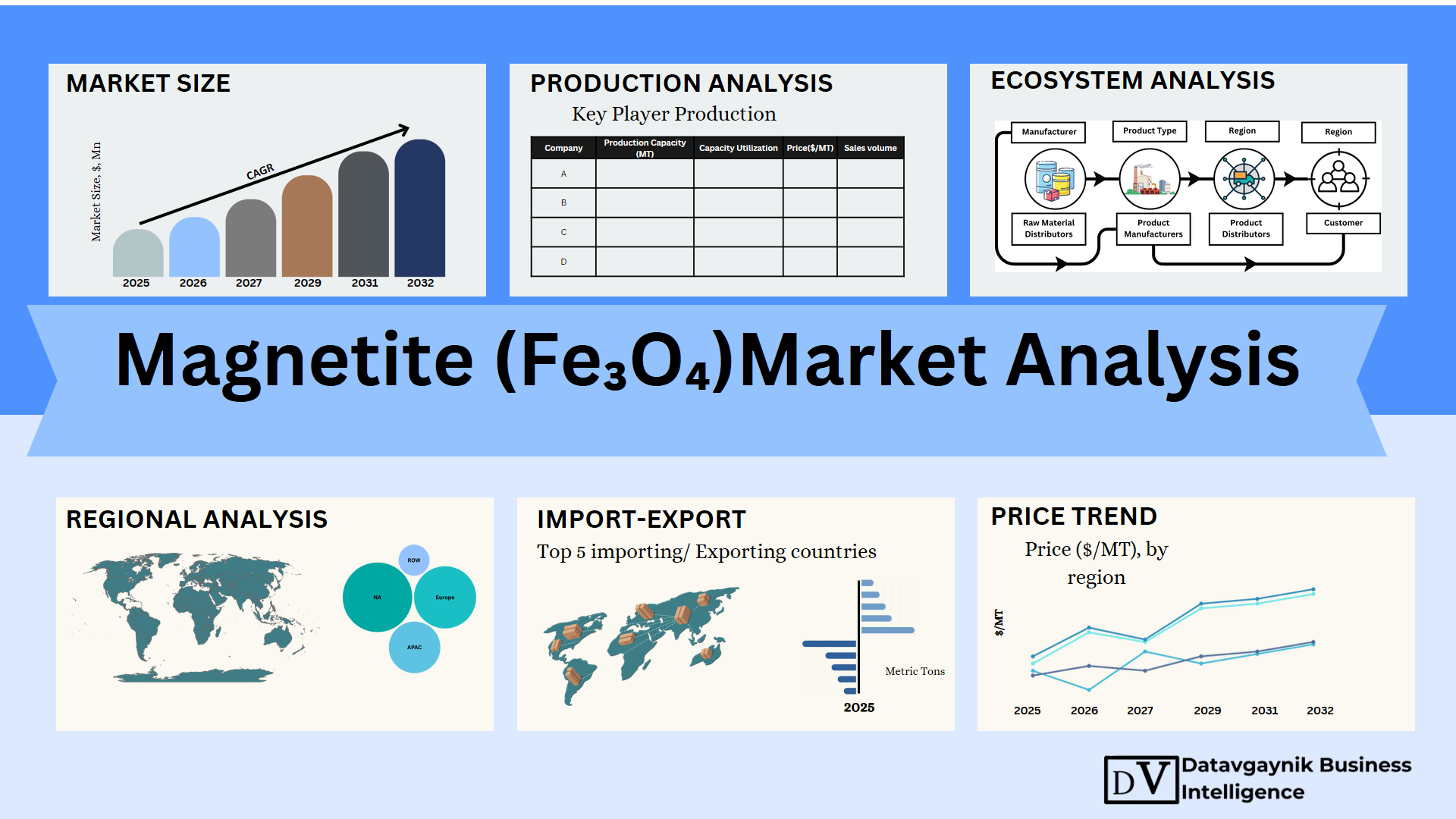
The global Magnetite (Fe₃O₄) Market is poised for robust growth through 2032, driven by several dynamic trends that are shaping the industrial and environmental landscape. As demand for high-quality iron ore surges, magnetite, with its superior iron content, is rapidly becoming a preferred choice in steel production and various other applications. The increasing use of Magnetite (Fe₃O₄) across a range of industries—including construction, automotive, and energy—is expected to fuel significant expansion in market size and production capacity over the coming years.
Increasing Demand for Steel and Magnetite (Fe₃O₄)
The demand for steel, and consequently for Magnetite (Fe₃O₄), has witnessed an impressive surge, primarily driven by the booming construction and infrastructure sectors. As global urbanization accelerates, countries across Asia, Africa, and Latin America are ramping up their steel production capabilities to meet the requirements of growing cities and industrial facilities. For instance, the global steel consumption is forecasted to grow at a compound annual growth rate (CAGR) of around 3.5% between 2024 and 2032, with emerging economies like India and China showing a particularly strong demand.
In addition to steel’s critical role in infrastructure, automotive manufacturing is also a major consumer of steel, which directly translates into rising magnetite consumption. The Magnetite (Fe₃O₄) Market Size is set to grow in tandem with the surge in steel demand, with the magnetite used for producing high-strength, lightweight steels, particularly in automotive applications. As demand for electric vehicles (EVs) grows, a shift toward stronger and more efficient steel alloys further propels the demand for Magnetite (Fe₃O₄).
Datavagyanik also covers related markets such as the Iron(III) Oxide (Magnetite) Market. These materials are considered in high-temperature and specialty chemical environments, where glass production, catalysis, and safety regulations influence adoption patterns.
Magnetite (Fe₃O₄) and Environmental Sustainability
Sustainability considerations are playing an increasingly significant role in shaping the Magnetite (Fe₃O₄) Market. The growing push for environmentally friendly steel production is driving the demand for magnetite, known for its efficient extraction and reduced environmental impact compared to lower-grade ores. Technologies like hydrogen-based direct reduction in steelmaking processes are emerging, making magnetite even more attractive due to its higher iron content, which supports cleaner and more energy-efficient production methods.
Data indicates that the global carbon emissions from steel production, one of the largest industrial sources of CO2, could be reduced by as much as 30% if the industry switches to cleaner technologies like hydrogen reduction. The efficient use of Magnetite (Fe₃O₄) in these technologies is an important contributor to the global sustainability goals, making it a key player in environmentally conscious steel production. As countries implement stricter environmental regulations, magnetite’s demand in cleaner steel production processes will continue to rise.
Technological Advancements in Magnetite (Fe₃O₄) Beneficiation
Technological innovation, particularly in beneficiation technologies such as magnetic separation, is a critical driver of Magnetite (Fe₃O₄) market growth. Magnetic separation allows for the efficient extraction of magnetite from low-grade deposits, thereby lowering production costs and enhancing profitability. The advancement of processing technologies ensures that magnetite can be sourced from a broader range of deposits, making it more accessible for industries worldwide.
In recent years, significant advancements in beneficiation techniques have led to an increase in the use of low-grade magnetite, improving its availability in the market. For example, the introduction of more efficient magnetic separation technologies has increased the overall quality of magnetite, reducing the cost of steel production while simultaneously addressing the growing demand for higher-grade iron ore. The adoption of such technologies is essential to meeting the global demand for magnetite and ensuring its economic viability.
Magnetite (Fe₃O₄) in Heavy Media Separation
Beyond its role in steel production, Magnetite (Fe₃O₄) is increasingly used in various industrial applications, one of the most important being heavy media separation (HMS). This process is commonly used in coal washing to separate impurities from valuable materials. Magnetite’s high density makes it an ideal material for this application, particularly in coal mining operations where it plays a crucial role in enhancing the efficiency of the separation process.
The demand for Magnetite (Fe₃O₄) in heavy media separation has grown steadily, with a projected CAGR of 4.5% from 2024 to 2032. This is particularly evident in regions with established mining operations, such as Australia, South Africa, and China, where magnetite is in high demand for various industrial applications. As global coal production continues to meet energy demands, the demand for magnetite in heavy media separation will remain a key driver for the Magnetite (Fe₃O₄) Market.
Geographical Growth of the Magnetite (Fe₃O₄) Market
Regional dynamics are playing a pivotal role in the expansion of the Magnetite (Fe₃O₄) market, particularly in countries with abundant reserves of iron ore such as Australia, Brazil, and Russia. Australia, the world’s largest exporter of magnetite, continues to meet the growing global demand for high-quality iron ore, contributing significantly to the global market share. The country’s magnetite production capacity is expected to increase by 6% annually, ensuring it remains a major supplier to countries like China, the world’s largest consumer of magnetite, and other rapidly developing economies.
Meanwhile, in emerging economies like India and Brazil, the development of new mining operations is facilitating increased magnetite production. As steel production grows in these regions, so too does the demand for Magnetite (Fe₃O₄), positioning them as key players in the global market. The growth of the Magnetite (Fe₃O₄) Market Size in these regions is particularly strong, with projected sales revenues increasing at an annual growth rate of 5-6%.
Magnetite (Fe₃O₄) and its Role in the Growing Infrastructure Sector
One of the most important factors driving the Magnetite (Fe₃O₄) market is the rapid development of infrastructure projects globally. As countries, especially in Asia and Africa, continue to expand their infrastructure to meet the demands of urbanization, the demand for steel has increased, which, in turn, raises the need for magnetite. For example, in India, the steel sector is expected to grow at a CAGR of 8% from 2024 to 2032, largely driven by infrastructure projects and a growing population.
In Africa, where infrastructure development is accelerating, magnetite is becoming increasingly important in steel production. This trend is reflected in the rising demand for steel in the region, with significant investments in construction and urbanization projects that directly contribute to a more substantial need for Magnetite (Fe₃O₄).
Magnetite (Fe₃O₄) in Other Industrial Applications
The Magnetite (Fe₃O₄) market is also benefitting from expanding applications in various industrial sectors. For instance, magnetite is used in the manufacturing of magnetic materials, iron-based catalysts, and even as a material in certain types of nuclear power plants. Its magnetic properties are especially valuable in environmental applications such as wastewater treatment and pollution control.
The versatility of Magnetite (Fe₃O₄) in these industrial applications further drives market growth. The development of new applications in emerging sectors, such as renewable energy and waste management, provides new avenues for magnetite consumption. The increase in demand for clean technologies and resource-efficient applications will further cement the role of magnetite in driving industrial innovation across a range of sectors.
“Track Country-wise Magnetite (Fe₃O₄) Production and Demand through our Magnetite (Fe₃O₄) Production Database”
-
-
- Magnetite (Fe₃O₄) production database for 23+ countries worldwide
- Magnetite (Fe₃O₄) sales volume for 28+ countries
- Country-wise Magnetite (Fe₃O₄) production capacity, production plant mapping, production capacity utilization for 23+ manufacturers
- Magnetite (Fe₃O₄) production plants and production plant capacity analysis by top manufacturers
-
“Track real-time Magnetite (Fe₃O₄) Prices, Magnetite (Fe₃O₄) price charts for 23+ countries, Magnetite (Fe₃O₄) weekly price tracker and Magnetite (Fe₃O₄) monthly price tracker”
-
-
- Track real-time Magnetite (Fe₃O₄) prices and Magnetite (Fe₃O₄) price trend in 23+ countries though our excel-based Magnetite (Fe₃O₄) price charts
- Real-time Magnetite (Fe₃O₄) price tracker dashboard with 23+ countries
- Complete transparency on Magnetite (Fe₃O₄) price trend through our Magnetite (Fe₃O₄) monthly price tracker, Magnetite (Fe₃O₄) weekly price tracker
-
Geographical Demand for Magnetite (Fe₃O₄) Market
The demand for Magnetite (Fe₃O₄) is heavily influenced by the geographical regions where steel production is thriving. In Asia-Pacific, North America, and Europe, magnetite plays a pivotal role in the iron and steel industry, especially in regions with significant infrastructure projects and urbanization. Notably, the largest consumer of magnetite is China, which is the world’s largest producer and consumer of steel. This is directly tied to the country’s demand for high-grade iron ore, which includes magnetite. China’s demand for magnetite is projected to continue growing at a steady pace, largely due to its dominance in the steel industry, which is expected to grow at a CAGR of 4% from 2024 to 2032.
India, another key player in the Magnetite (Fe₃O₄) Market, is experiencing rapid industrialization and urbanization, which is expected to drive demand for steel and, by extension, for magnetite. The country’s steel sector is expanding at an impressive rate, with a growth rate of approximately 8% per annum. This surge in demand for steel is being driven by large-scale infrastructure projects and the growing automotive sector, which relies on high-quality steel produced using magnetite. As India’s urban population increases, the demand for steel—and consequently for Magnetite (Fe₃O₄)—will only rise.
Magnetite (Fe₃O₄) Production in Key Regions
When it comes to production, Australia is the leading producer of Magnetite (Fe₃O₄), followed by countries like Brazil, Russia, and China. Australia’s magnetite production remains robust, with large-scale mining operations in Western Australia, known for its high-quality iron ore reserves. The country’s magnetite exports are projected to reach nearly $10 billion by 2024, with an annual growth rate of about 5%. This positions Australia as a critical player in global magnetite trade, particularly to steelmaking giants like China and India.
Brazil, another major producer, has a well-established magnetite production base, with significant reserves found in Minas Gerais. The country is expected to increase its magnetite exports by 4.5% annually through 2032, bolstering its position as a leading supplier to global markets. Magnetite from Brazil is valued for its high iron content, making it particularly attractive to countries in Europe and Asia that require high-quality iron ore for steel production. Russia, with its vast magnetite deposits, also plays a significant role in global production, although a large portion of its magnetite is consumed domestically, particularly in its steelmaking sector.
China, while a major producer of magnetite, is increasingly relying on imports to meet the growing demand for high-quality iron ore. The country’s shift towards importing more premium magnetite is driven by the demand for cleaner, more efficient steel production methods. China’s imports of magnetite have been rising steadily, with a growth rate of 3.5% annually through 2032, driven by its increasing need for high-grade iron ore.
Magnetite (Fe₃O₄) Market Segmentation by Application
The Magnetite (Fe₃O₄) Market is segmented into various applications, with steel production being the largest and most prominent segment. Magnetite is widely used in the production of iron, which is subsequently used in the manufacture of steel. As global steel demand continues to rise, the consumption of magnetite is expected to follow suit. The global steel industry is projected to grow at a CAGR of 3.5% through 2032, and this directly influences the demand for magnetite, as it is a critical raw material in steel production. This demand is especially pronounced in regions like Asia-Pacific, where rapid industrialization and urbanization are driving the need for steel in infrastructure projects.
Another important application for magnetite is in heavy media separation (HMS). This technique is widely used in coal washing to separate impurities from valuable coal. The high density of magnetite makes it an ideal material for this purpose, particularly in regions with significant coal mining activities, such as Australia, China, and South Africa. The increasing demand for clean coal and resource-efficient mining technologies is expected to drive the demand for magnetite in this application, with the market growing at a CAGR of 4% from 2024 to 2032.
Magnetite is also used in environmental applications, including wastewater treatment, pollution control, and water filtration systems. Its magnetic properties make it an excellent material for removing contaminants from water and wastewater. The rising global awareness of environmental issues and stricter regulations on pollution control are likely to increase the demand for magnetite in these applications, especially in industrialized nations like the United States and those in Europe. The global market for magnetite in environmental applications is expected to grow steadily, driven by both regulatory pressures and growing environmental concerns.
Magnetite (Fe₃O₄) Price Trend
The price trend for Magnetite (Fe₃O₄) has been fluctuating in recent years, with key factors such as supply and demand dynamics, geopolitical events, and transportation costs impacting prices. Over the past few years, magnetite prices have been on the rise due to strong demand from the steel industry, particularly in countries like China and India. Additionally, the shift towards higher-quality iron ores, including magnetite, has contributed to the upward price pressure. The Magnetite (Fe₃O₄) Price is expected to remain relatively stable in the short term, with occasional spikes driven by changes in steel production rates and iron ore supply fluctuations.
For instance, in 2023, the price of high-grade magnetite increased by approximately 8% due to disruptions in global supply chains, particularly from major producing countries like Australia and Brazil. These disruptions were compounded by increased demand from steel producers seeking higher-quality iron ore. The Magnetite (Fe₃O₄) Price Trend is expected to continue on an upward trajectory through 2032, although it may experience periodic fluctuations due to changes in global steel demand and iron ore supply.
The rising costs of magnetite are also influenced by environmental regulations that increase the cost of mining and processing. As governments worldwide impose stricter environmental standards on mining operations, the cost of extracting and processing magnetite is expected to rise, leading to higher prices for the ore. However, advancements in beneficiation technologies and increased production capacity in key regions like Australia and Brazil may help mitigate some of these price increases in the long term.
Market Price Fluctuations and Impacts on the Magnetite (Fe₃O₄) Market
Market price fluctuations for Magnetite (Fe₃O₄) have significant implications for the broader market. For example, when prices spike, steel producers may face higher production costs, which can lead to higher prices for steel and other related products. This, in turn, can impact downstream industries that rely on steel, such as construction and automotive manufacturing. However, if magnetite prices remain stable or decline, steel producers could benefit from lower raw material costs, potentially driving down the overall cost of steel production.
The Magnetite (Fe₃O₄) Price Trend will also be shaped by geopolitical events that affect global supply chains. For instance, trade tensions or disruptions in key magnetite-producing countries could lead to supply shortages, driving prices up. Conversely, a favorable geopolitical environment could lead to price stabilization, particularly if new production capacities are brought online or if existing producers increase output to meet growing demand.
Future Outlook for Magnetite (Fe₃O₄) Price and Market Growth
Looking ahead, the price of Magnetite (Fe₃O₄) is expected to grow steadily, driven by continued demand for high-quality iron ore and steel production. As the global economy recovers from the pandemic and industrialization continues in emerging markets, the need for steel—and, by extension, for magnetite—will remain robust. The growing focus on sustainability in the steel industry will also drive demand for cleaner, higher-grade iron ore, further boosting the demand for magnetite.
The Magnetite (Fe₃O₄) Price Trend is expected to reflect the interplay between supply and demand, with key regions like China, India, and Australia continuing to play central roles in driving market growth. As the steel industry focuses on reducing carbon emissions and increasing production efficiency, the demand for high-quality magnetite will remain strong, positioning it as a key commodity in the global steel supply chain.
In conclusion, the Magnetite (Fe₃O₄) Market is set to experience continued growth, driven by geographic demand from emerging economies, strong production capacities in key regions, and a steady price trend that reflects the dynamic balance of supply and demand in global markets. The increasing focus on environmental sustainability, technological advancements in beneficiation processes, and growing steel production are all expected to keep the market for magnetite expanding at a healthy rate, ensuring its continued relevance in the global economy.
“Magnetite (Fe₃O₄) Manufacturing Database, Magnetite (Fe₃O₄) Manufacturing Capacity”
-
-
- Magnetite (Fe₃O₄) top manufacturers market share for 23+ manufacturers
- Top 6 manufacturers and top 13 manufacturers of Magnetite (Fe₃O₄) in North America, Europe, Asia Pacific
- Magnetite (Fe₃O₄) production plant capacity by manufacturers and Magnetite (Fe₃O₄) production data for 23+ market players
- Magnetite (Fe₃O₄) production dashboard, Magnetite (Fe₃O₄) production data in excel format
-
“Magnetite (Fe₃O₄) price charts, Magnetite (Fe₃O₄) weekly price tracker and Magnetite (Fe₃O₄) monthly price tracker”
-
-
- Factors impacting real-time Magnetite (Fe₃O₄) prices in 18+ countries worldwide
- Magnetite (Fe₃O₄) monthly price tracker, Magnetite (Fe₃O₄) weekly price tracker
- Real-time Magnetite (Fe₃O₄) price trend, Magnetite (Fe₃O₄) price charts, news and updates
- Tracking Magnetite (Fe₃O₄) price fluctuations
-
Top Manufacturers in the Magnetite (Fe₃O₄) Market
The Magnetite (Fe₃O₄) Market is shaped by key players in the industry, ranging from large-scale mining operations to specialized producers of high-grade iron ore. These manufacturers have built a reputation for supplying magnetite to industries worldwide, especially in steel production and other heavy industries. Leading companies in the global market are involved in the extraction, processing, and sale of magnetite, with each offering a range of product lines catering to different industry needs.
Leading Manufacturers and Product Lines
- BHP Group
BHP Group is one of the largest players in the global Magnetite (Fe₃O₄) Market, with significant operations in Australia. The company’s magnetite mines are primarily located in Western Australia, where BHP operates the Yandi and Jimblebar mines. These mines produce high-grade magnetite concentrate, used primarily in steel production and heavy media separation processes. BHP has also invested in advanced beneficiation technologies, including magnetic separation, to ensure high product quality and reduce production costs.
Product Line:
- Magnetite concentrate for steel production
- Magnetite for heavy media separation (HMS)
- Rio Tinto
Another leading manufacturer in the Magnetite (Fe₃O₄) Market is Rio Tinto, a globally recognized mining giant with extensive iron ore operations. The company’s flagship magnetite projects are located in Western Australia at the Western Turner Syncline and Hope Downs mines. Rio Tinto’s magnetite is used in a range of applications, including steelmaking and the production of magnetic materials. The company has continued to expand its production capabilities and is actively working on enhancing its processing techniques to improve ore extraction efficiency.
Product Line:
- Magnetite concentrate for steel production
- Magnetite pellets and lump iron ore for industrial applications
- Vale S.A.
Vale is a significant player in the Magnetite (Fe₃O₄) Market, especially in Brazil, where the company operates some of the largest magnetite reserves in the world. Vale’s Carajás Mine is renowned for producing high-quality magnetite ore, and the company has diversified its product offerings to include magnetite pellets used in direct reduction steelmaking processes. Vale’s magnetite products are in high demand across Asia and Europe due to their high iron content and minimal impurities.
Product Line:
- Magnetite ore and concentrate for steel production
- Iron ore pellets for direct reduction steelmaking
- Fortescue Metals Group Ltd.
Fortescue Metals, a leading Australian iron ore producer, is also involved in the magnetite market, primarily through its operations in Western Australia. The company focuses on producing both hematite and magnetite, with a growing emphasis on the latter as demand for higher-grade ores continues to rise. Fortescue’s Iron Bridge Magnetite Project is one of its key assets, expected to significantly boost its production capacity for high-grade magnetite concentrate over the coming years.
Product Line:
- Magnetite concentrate for steel production
- High-grade magnetite for heavy media separation
- Anglo American PLC
Anglo American is a key global player in the Magnetite (Fe₃O₄) Market, with magnetite production primarily taking place in South Africa and Australia. The company’s operations are characterized by a focus on sustainability and innovative mining practices, which include the development of more efficient beneficiation processes for magnetite extraction. Anglo American’s products are used across several industries, including steelmaking, manufacturing, and environmental applications.
Product Line:
- Magnetite ore concentrate
- Iron ore products for industrial use
Magnetite (Fe₃O₄) Market Share by Manufacturers
The Magnetite (Fe₃O₄) Market is dominated by a few large players who control a significant portion of the global supply. BHP, Rio Tinto, Vale, and Fortescue collectively account for a substantial share of the market, particularly in terms of production volume. These companies’ extensive global operations and the high quality of their products make them major contributors to the market’s growth. It is estimated that these top players represent around 60–70% of the global market share, with their production capacity and strategic expansions continuing to shape the market’s future.
Smaller producers and regional players also hold a share of the market, especially in emerging economies where magnetite demand is growing rapidly. Companies in China, India, and South Africa are particularly well-positioned to tap into the rising demand for magnetite in local steel production. These players focus on the domestic market, supplying magnetite to meet the steel and coal washing needs of their respective regions.
The market share by manufacturers varies depending on the region. For instance, in Australia, where magnetite production is booming, BHP and Rio Tinto hold a dominant position. In Brazil, Vale is the market leader, controlling a significant portion of magnetite production. The growing demand in emerging markets has also led to increased market share for companies with operations in Asia, Africa, and Latin America.
Recent News and Industry Developments
- BHP’s Investment in Magnetite Expansion
In early 2024, BHP announced a $1.5 billion investment to expand its magnetite production capabilities in Western Australia. This investment is aimed at increasing its production of high-grade magnetite concentrate, catering to the rising demand from the steel industry in Asia. With this investment, BHP plans to boost its magnetite production by 25% over the next five years, making it one of the largest suppliers of magnetite in the region.
- Rio Tinto’s Technological Advancements in Magnetite Processing
In March 2024, Rio Tinto unveiled a new beneficiation technology at its Western Turner Syncline mine in Western Australia. The company reported that the new technology would increase the yield of magnetite concentrate by up to 20%, thereby improving both production efficiency and environmental sustainability. This advancement reflects Rio Tinto’s commitment to staying at the forefront of innovation in the magnetite market.
- Fortescue’s Iron Bridge Magnetite Project Update
Fortescue Metals Group’s Iron Bridge Magnetite Project is expected to begin production in 2025, with the company forecasting an annual production capacity of 22 million tons of high-grade magnetite concentrate. The project is expected to strengthen Fortescue’s position in the global magnetite market, particularly as demand for premium iron ore continues to grow.
- Vale’s Expansion into the Asian Magnetite Market
In 2024, Vale signed a strategic partnership agreement with steelmakers in Japan and South Korea, focusing on the export of high-quality magnetite pellets. This collaboration marks Vale’s entry into the Asian magnetite market, with the company targeting an increase in export volume by 15% over the next three years. Vale’s commitment to expanding its presence in Asia reflects the growing demand for cleaner, higher-grade magnetite in the steel industry.
- Anglo American’s Sustainable Mining Initiatives
Anglo American announced in February 2024 that it had achieved a significant milestone in reducing carbon emissions at its magnetite operations in South Africa. The company has introduced energy-efficient technologies and sustainable mining practices aimed at reducing the carbon footprint of magnetite extraction. Anglo American plans to continue its investment in green mining technologies, positioning itself as a leader in environmentally responsible magnetite production.
“Magnetite (Fe₃O₄) Production Data and Magnetite (Fe₃O₄) Production Trend, Magnetite (Fe₃O₄) Production Database and forecast”
-
-
- Magnetite (Fe₃O₄) production database for historical years, 10 years historical data
- Magnetite (Fe₃O₄) production data and forecast for next 7 years
- Magnetite (Fe₃O₄) sales volume by manufacturers
-
“Track Real-time Magnetite (Fe₃O₄) Prices for purchase and sales contracts, Magnetite (Fe₃O₄) price charts, Magnetite (Fe₃O₄) weekly price tracker and Magnetite (Fe₃O₄) monthly price tracker”
-
-
- Gain control on your purchase and sales contracts through our real-time Magnetite (Fe₃O₄) price tracker and Magnetite (Fe₃O₄) price trend analysis
- Magnetite (Fe₃O₄) weekly price tracker and forecast for next four weeks
- Magnetite (Fe₃O₄) monthly price tracker and forecast for next two months
-
Market Scenario, Demand vs Supply, Average Product Price, Import vs Export, till 2032
- Global Magnetite (Fe₃O₄) Market revenue and demand by region
- Global Magnetite (Fe₃O₄) Market production and sales volume
- United States Magnetite (Fe₃O₄) Market revenue size and demand by country
- Europe Magnetite (Fe₃O₄) Market revenue size and demand by country
- Asia Pacific Magnetite (Fe₃O₄) Market revenue size and demand by country
- Middle East & Africa Magnetite (Fe₃O₄) Market revenue size and demand by country
- Latin America Magnetite (Fe₃O₄) Market revenue size and demand by
- Import-export scenario – United States, Europe, APAC, Latin America, Middle East & Africa
- Average product price – United States, Europe, APAC, Latin America, Middle East & Africa
- Market player analysis, competitive scenario, market share analysis
- Business opportunity analysis
Key questions answered in the Global Magnetite (Fe₃O₄) Market Analysis Report:
- What is the market size for Magnetite (Fe₃O₄) in United States, Europe, APAC, Middle East & Africa, Latin America?
- What is the yearly sales volume of Magnetite (Fe₃O₄) and how is the demand rising?
- Who are the top market players by market share, in each product segment?
- Which is the fastest growing business/ product segment?
- What should be the business strategies and Go to Market strategies?
The report covers Magnetite (Fe₃O₄) Market revenue, Production, Sales volume, by regions, (further split into countries):
- Asia Pacific (China, Japan, South Korea, India, Indonesia, Vietnam, Rest of APAC)
- Europe (UK, Germany, France, Italy, Spain, Benelux, Poland, Rest of Europe)
- North America (United States, Canada, Mexico)
- Latin America (Brazil, Argentina, Rest of Latin America)
- Middle East & Africa
Table of Contents:
1. Introduction to the Magnetite (Fe₃O₄) Market
1.1 Overview and Chemical Composition of Magnetite (Fe₃O₄)
1.2 Industrial and Commercial Applications of Magnetite (Fe₃O₄)
1.3 Growth Drivers and Market Dynamics
2. Magnetite (Fe₃O₄) Market Segmentation
2.1 Segmentation by Product Purity and Grades
2.2 Classification by End-Use Sectors (Steel, Energy, Pigments, etc.)
2.3 Geographic Segmentation and Regional Market Trends
3. Global Magnetite (Fe₃O₄) Market Outlook (2019-2032)
3.1 Market Size, Revenue, and Growth Forecast
3.2 Demand-Supply Trends in the Magnetite (Fe₃O₄) Market
3.3 Investment Potential and Emerging Market Opportunities
4. Regional Analysis of the Magnetite (Fe₃O₄) Market
4.1 North America: Production, Market Value, and Trade Flow
4.2 Europe: Market Expansion, Industry Regulations, and Trade Statistics
4.3 Asia-Pacific: Magnetite (Fe₃O₄) Production Hubs and Consumption Patterns
4.4 Latin America: Market Performance and Competitive Landscape
4.5 Middle East & Africa: Availability of Magnetite Reserves and Market Growth
5. Magnetite (Fe₃O₄) Production and Extraction
5.1 Global Magnetite (Fe₃O₄) Production Statistics (2019-2032)
5.2 Leading Mining and Processing Regions
5.3 Production Techniques and Efficiency Improvements
6. Competitive Landscape in the Magnetite (Fe₃O₄) Market
6.1 Market Share Analysis of Leading Magnetite (Fe₃O₄) Producers
6.2 Strategic Developments and Competitive Strategies
6.3 Magnetite (Fe₃O₄) Pricing Structures and Market Trends
7. Magnetite (Fe₃O₄) Trade and Global Supply Chain
7.1 Export vs. Import Analysis of Magnetite (Fe₃O₄)
7.2 Production vs. Domestic Consumption Trends
7.3 Market Integration and International Trade Policies
8. Consumption Trends and Market Demand
8.1 Magnetite (Fe₃O₄) Consumption by Industry and Application
8.2 Key Consumers and Buyer Segments in the Market
8.3 Future Demand Growth and Market Expansion Forecast
9. Magnetite (Fe₃O₄) Production Cost Analysis
9.1 Breakdown of Mining, Processing, and Transportation Costs
9.2 Cost Influence Factors: Raw Materials, Labor, and Energy
9.3 Strategies to Improve Production Efficiency and Cost Reduction
10. Magnetite (Fe₃O₄) Industry Value Chain and Market Integration
10.1 Mining and Ore Processing Technologies
10.2 Distribution and Logistics in the Magnetite (Fe₃O₄) Market
10.3 End-User Access and Market Reach
11. Magnetite (Fe₃O₄) Sales, Distribution, and Marketing Strategies
11.1 Market Channels for Magnetite (Fe₃O₄) Distribution
11.2 Key Distributors, Traders, and Supply Chain Participants
11.3 Magnetite (Fe₃O₄) Market Expansion Strategies
12. Future Outlook and Market Forecast (2025-2032)
12.1 Projected Growth in Magnetite (Fe₃O₄) Production
12.2 Emerging Investment Opportunities in the Magnetite (Fe₃O₄) Market
12.3 Sustainability and Environmental Considerations

