

Robust expansion trajectory of the Natrolite Market driven by cross-industry adoption
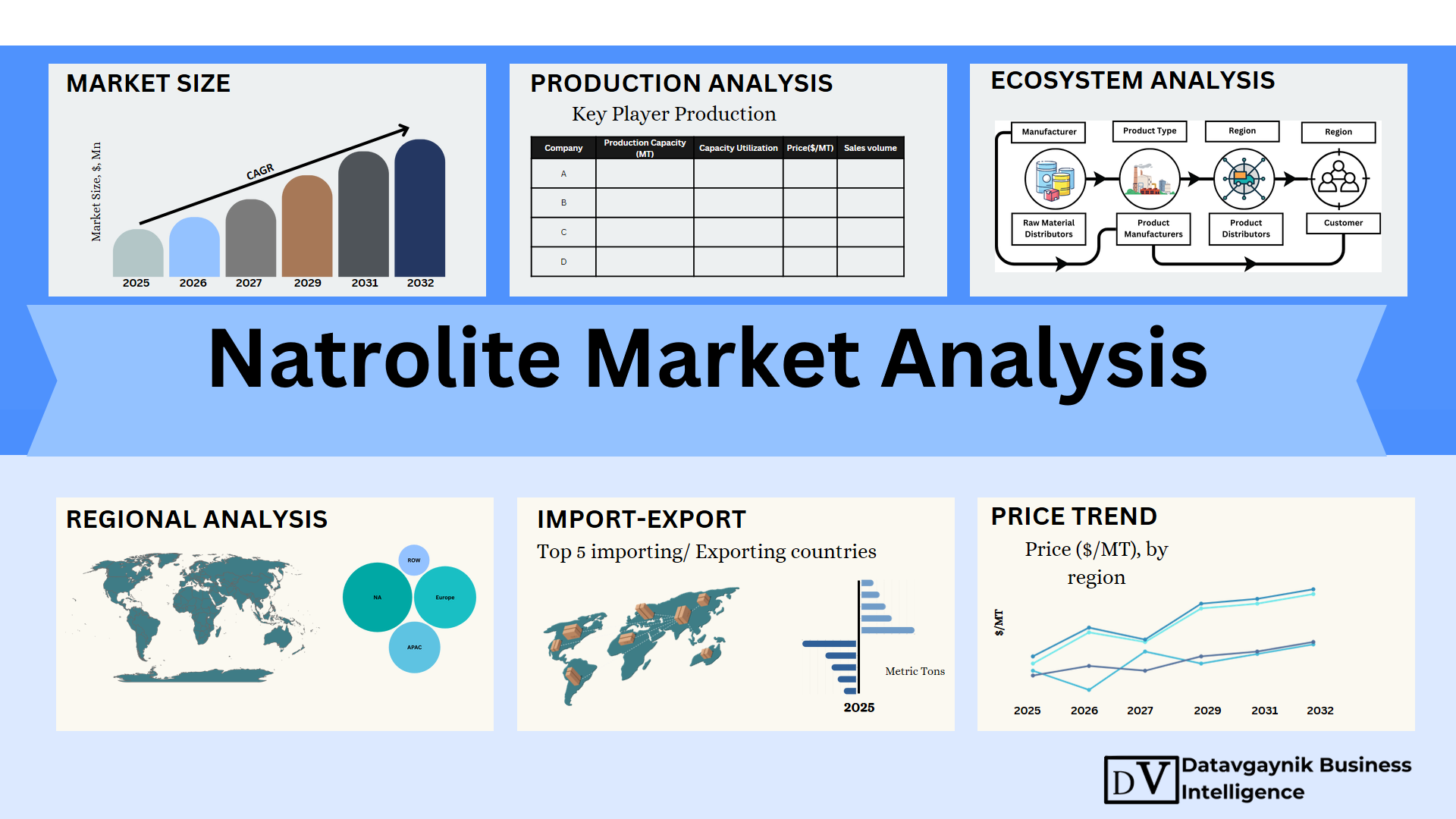
The Natrolite Market is entering a dynamic growth phase, underpinned by its rising applicability across critical sectors such as water treatment, agriculture, construction, and industrial processing. According to Datavagyanik, the Natrolite Market size is projected to witness sustained double-digit growth through 2032, supported by its proven ion-exchange and adsorption capabilities that are finding increasing relevance in sustainability-focused applications. For instance, natrolite’s effectiveness in removing ammonia and heavy metals from municipal wastewater makes it an integral component in advanced water purification technologies.
Natrolite Market demand driven by water treatment sector investments
One of the key growth accelerators for the Natrolite Market is the global investment surge in water and wastewater treatment infrastructure. For example, in 2023 alone, over USD 300 billion was allocated globally to upgrade water systems, with a significant share directed toward Asia-Pacific and North America. Natrolite is extensively used in this sector due to its high ion-exchange capacity and selective adsorption of toxic substances. The demand for ammonia and heavy metal removal from wastewater is especially critical in urban and industrial zones, such as in China and India, where over 60 percent of freshwater sources are under stress. This is directly contributing to a measurable rise in natrolite usage across municipal and industrial facilities.
Sustainable agriculture practices catalyzing Natrolite Market growth
Agricultural applications are emerging as a major driver of the Natrolite Market, especially in regions facing chronic water scarcity and soil degradation. Natrolite is used as a soil conditioner to enhance water retention and nutrient exchange capacity in farmlands. For example, in countries like Australia, where over 65 percent of arable land is exposed to drought conditions, natrolite has helped improve crop yields by up to 20 percent due to its moisture-conserving properties. Additionally, its role in livestock feed to reduce ammonia emissions is gaining momentum, especially in the European Union, where agricultural emissions are tightly regulated under the Common Agricultural Policy. This dual functionality in plant and animal farming reinforces natrolite’s value in promoting sustainable agriculture.
Natrolite Market poised for long-term demand in green construction materials
The global construction sector’s transition toward energy-efficient and sustainable building materials is creating a strong pull for the Natrolite Market. Natrolite is used in lightweight concrete mixtures as a pozzolanic material that improves thermal insulation and structural durability. For instance, Germany and Sweden are adopting natrolite-based materials to comply with EU climate directives and BREEAM certifications. In the United States, green construction is forecasted to grow at a CAGR of 11.7 percent through 2030, and natrolite is increasingly integrated into eco-conscious infrastructure projects. Its ability to reduce the carbon footprint of concrete by replacing part of the cement content makes natrolite a material of strategic importance in sustainable building initiatives worldwide.
Clean energy applications offering long-term scalability in the Natrolite Market
As the global energy mix shifts toward renewables and hydrogen, the role of natrolite in energy storage and gas separation has expanded significantly. Natrolite’s microporous structure is ideal for use as a molecular sieve in hydrogen purification and biogas upgrading. For example, South Korea’s hydrogen roadmap, targeting over 6.2 million fuel cell vehicles by 2040, includes dedicated investments in materials like natrolite for hydrogen storage and purification infrastructure. Similarly, in biogas applications across Denmark and the Netherlands, natrolite is deployed in purification units to separate methane from CO₂ and other contaminants. These evolving applications align directly with decarbonization targets and are solidifying the Natrolite Market’s position in the clean energy value chain.
Healthcare and detoxification sectors emerging as new growth frontiers for the Natrolite Market
The Natrolite Market is also finding relevance in the health and wellness industry, particularly in dietary supplements and detoxification products. With rising consumer interest in heavy metal detoxification and clean-label formulations, natrolite’s ability to bind toxins in the gastrointestinal tract is being utilized in nutraceuticals. For example, in North America and Western Europe, detox product sales grew by over 14 percent year-over-year in 2023. Natrolite-based supplements are especially popular in urban markets where pollution exposure and lifestyle diseases are driving demand for natural detoxification products. While still a niche segment, this application of natrolite is poised for long-term upside given increasing regulatory scrutiny on supplement safety and a shift toward evidence-based natural products.
Environmental regulations and sustainability mandates intensifying Natrolite Market adoption
Governments and regulatory bodies across the globe are tightening environmental standards, further propelling demand in the Natrolite Market. In particular, the European Union’s Green Deal and the U.S. Inflation Reduction Act are fostering a market ecosystem where eco-friendly materials like natrolite are prioritized. For instance, natrolite’s role in soil remediation, air purification, and emissions control aligns with carbon neutrality targets set by over 70 countries. The product’s natural origin and low environmental impact make it a preferred alternative to synthetic chemical agents in pollution control, especially in emerging economies that are rapidly industrializing yet committed to environmental stewardship.
Natrolite Market expanding through regional infrastructure development and urbanization
In fast-growing regions such as Southeast Asia, Sub-Saharan Africa, and Latin America, the Natrolite Market is seeing increased penetration due to accelerating urbanization and infrastructure development. For instance, infrastructure spending in India is expected to surpass USD 1.4 trillion by 2030, with significant allocations for smart cities and water resilience projects. Natrolite is being deployed in urban water filtration systems, agricultural soil stabilization programs, and eco-friendly construction. These multifaceted applications are positioning natrolite as a foundational material in the urban transformation of emerging economies. Moreover, local production and export-import activities are rising in response to these regional demands, adding to global natrolite trade volumes.
Strategic sourcing and global supply dynamics influencing the Natrolite Market
Supply-side factors are equally shaping the Natrolite Market trajectory. Major producers such as the United States, Turkey, and China dominate natural natrolite extraction, while synthetic variants are gaining popularity in high-performance industrial use cases. For example, Turkey’s exports of natural zeolites, including natrolite, increased by over 18 percent in 2023, mainly to Europe and the Middle East. On the other hand, synthetic natrolite is being manufactured for precision applications in gas filtration and catalyst design in Japan and Germany. This bifurcation in supply—natural for bulk environmental applications and synthetic for specialized uses—is allowing the Natrolite Market to cater to both mass and niche segments efficiently.
Technological innovation opening new avenues in the Natrolite Market
Ongoing R&D is paving the way for novel natrolite-based materials with enhanced performance. For instance, modified natrolite structures are being tested for use in lithium-ion battery recycling and as catalyst supports in green chemistry applications. In the United States, collaborations between universities and material science companies are exploring natrolite’s efficacy in CO₂ sequestration at coal-fired power plants. Such innovations are expected to contribute to long-term market diversification and create high-value opportunities across sectors, from advanced manufacturing to circular economy models.
“Track Country-wise Natrolite Production and Demand through our Natrolite Production Database”
-
-
- Natrolite production database for 23+ countries worldwide
- Natrolite sales volume for 28+ countries
- Country-wise Natrolite production capacity, production plant mapping, production capacity utilization for 23+ manufacturers
- Natrolite production plants and production plant capacity analysis by top manufacturers
-
“Track real-time Natrolite Prices, Natrolite price charts for 23+ countries, Natrolite weekly price tracker and Natrolite monthly price tracker”
-
-
- Track real-time Natrolite prices and Natrolite price trend in 23+ countries though our excel-based Natrolite price charts
- Real-time Natrolite price tracker dashboard with 23+ countries
- Complete transparency on Natrolite price trend through our Natrolite monthly price tracker, Natrolite weekly price tracker
-
Diverse regional consumption shaping the global Natrolite Market landscape
The Natrolite Market exhibits significant geographic diversity, with demand patterns shaped by regional priorities such as water security, agricultural sustainability, and industrial innovation. North America continues to lead in high-value applications, particularly in water treatment and clean energy sectors. For example, the United States accounts for over 22 percent of global natrolite consumption, supported by federal funding through the Infrastructure Investment and Jobs Act, which allocates over USD 55 billion for water system upgrades through 2026. In parallel, natrolite’s integration into renewable energy infrastructure and carbon capture systems is reinforcing its strategic importance across industrial applications.
Rapid industrialization in Asia-Pacific propelling Natrolite Market demand
Asia-Pacific is the fastest-growing region in the Natrolite Market, driven by large-scale industrialization, urbanization, and rising environmental awareness. For instance, India’s National Mission for Clean Ganga, with a funding pool exceeding USD 3 billion, is directly increasing the deployment of natrolite in water treatment systems across northern states. Meanwhile, China, already a leading producer, is also a major consumer due to its aggressive investments in industrial emission controls and soil remediation. Natrolite usage in China has grown at a CAGR of 9.5 percent over the past five years, particularly in agriculture and municipal wastewater applications. This dual role as both a production hub and consumption powerhouse positions Asia-Pacific at the center of global Natrolite Market expansion.
Environmental regulations accelerating Natrolite Market growth in Europe
Europe represents a mature but steadily growing region in the Natrolite Market, supported by stringent environmental directives. Countries like Germany, France, and the Netherlands are incorporating natrolite into green building materials to meet EU carbon neutrality goals under the European Green Deal. For example, Germany’s natrolite demand in construction has grown by over 12 percent since 2020, as builders increasingly adopt zeolite-based concrete additives to comply with BREEAM and LEED certifications. Moreover, the agricultural sector in southern Europe, particularly in Spain and Italy, is leveraging natrolite to improve soil quality and water use efficiency in drought-prone regions.
Natrolite Market demand expanding across Middle East through water sustainability
The Natrolite Market in the Middle East is shaped by its urgent need for sustainable water management in arid environments. Countries like Saudi Arabia, the UAE, and Qatar are major consumers of natrolite in municipal and industrial water treatment systems. Saudi Arabia’s Vision 2030 and the UAE’s food security strategy both prioritize technologies that enhance water reuse and agricultural resilience. For example, natrolite-based treatment facilities in Riyadh have increased wastewater recovery efficiency by 25 percent in pilot programs since 2022. This progress illustrates how the mineral is becoming central to water sustainability initiatives in the region.
Emerging Latin American markets contributing to Natrolite Market growth
Latin America is an emerging contributor to global Natrolite Market growth, driven by rising awareness around sustainable farming and infrastructure development. In Brazil, natrolite is increasingly used to mitigate the effects of pesticide-heavy farming on soil quality, especially in the soybean and sugarcane sectors. Meanwhile, Mexico is incorporating natrolite into municipal water filtration projects under CONAGUA’s modernization plan. As these markets strengthen regulatory standards and expand industrial capacity, natrolite’s role is expected to intensify across both public and private sector initiatives.
Global Natrolite Market production capacity concentrated in key mining hubs
Natrolite production is geographically concentrated in countries with abundant natural zeolite deposits, such as the United States, Turkey, China, and India. Turkey alone accounts for nearly 30 percent of global natural natrolite exports, supplying regions such as the Middle East, Europe, and Southeast Asia. For example, Turkish natrolite exports rose by 18.7 percent in 2023, reflecting increased demand for eco-friendly raw materials. Meanwhile, the United States focuses on domestic use in high-end industrial applications but still exports significant volumes to Canada and Mexico. China’s dual role as a producer and consumer allows it to balance domestic consumption with targeted exports to South Korea and Japan, especially for synthetic-grade natrolite used in energy storage technologies.
Segmentation of the Natrolite Market by application revealing diverse growth vectors
The Natrolite Market is segmented by application into water and wastewater treatment, agriculture, construction, industrial processing, and healthcare. The water treatment segment remains the largest, accounting for nearly 38 percent of global market share, followed by agriculture at 24 percent. For instance, the deployment of natrolite-based filtration in India and China’s rural sanitation programs is expected to rise by over 15 percent annually through 2030. The construction segment is also gaining momentum, particularly in regions investing heavily in green infrastructure such as Northern Europe and the western United States. In industrial applications, natrolite is emerging as a critical component in gas separation and catalyst processes, especially within the petrochemical and clean energy sectors.
Natrolite Market segmentation by end-use industry expanding with energy and healthcare adoption
From an end-use industry perspective, the Natrolite Market is seeing substantial diversification. While traditional demand from the environmental and agricultural sectors continues to dominate, newer applications in energy and healthcare are becoming more prominent. For instance, in South Korea, natrolite is being integrated into hydrogen production systems, supporting the country’s goal of establishing 1,200 hydrogen refueling stations by 2040. Meanwhile, in the United States, nutraceutical companies are using natrolite in detox supplements, where retail sales for natural heavy metal binders grew by 21 percent in 2023 alone. This widening of end-use segments is not only increasing natrolite volume demand but also enhancing the material’s perceived value across industries.
Global Natrolite Price Trend shaped by supply constraints and rising demand
The Natrolite Price Trend has shown an upward trajectory over the past five years, primarily due to growing demand and limited high-grade deposits. For example, natural natrolite prices have risen by approximately 14 percent between 2019 and 2024, with spikes in 2022 due to supply chain disruptions and energy price volatility. Synthetic natrolite, which is primarily used in specialized industrial applications, commands a premium of up to 35 percent over natural variants due to higher processing costs and limited production capacities. This price disparity reflects the segmentation in natrolite’s industrial use cases and is expected to continue as demand increases in high-purity applications.
Regional Natrolite Price differences linked to logistics and trade agreements
Natrolite Price differences are also influenced by regional logistics and trade dynamics. In the Asia-Pacific region, natrolite prices are relatively stable due to localized supply chains and government subsidies for eco-material imports in countries like India and Indonesia. In contrast, European markets face higher landed costs due to dependency on Turkish and Eastern European supply, combined with EU environmental tariffs. For instance, average natrolite import costs in Germany are 18 percent higher than in China, driven by transportation and regulatory compliance costs. These regional variances are reshaping sourcing strategies and encouraging localized production investments in previously import-dependent nations.
Long-term Natrolite Price stability expected through vertical integration and resource optimization
Datavagyanik anticipates moderate stabilization in the Natrolite Price Trend over the long term as producers pursue vertical integration strategies and invest in resource optimization. For example, several companies in Turkey and India are developing hybrid mining and processing facilities to reduce costs and improve export margins. Additionally, improvements in processing technology, such as ultrasonic beneficiation and nano-scale refinement, are expected to improve material yield and reduce waste by up to 30 percent. These innovations are likely to ease upward pressure on prices while maintaining quality standards for high-performance use cases.
Natrolite Market outlook driven by balance of production, policy, and innovation
The medium to long-term outlook for the Natrolite Market is defined by a balancing act between rising demand, environmental compliance, and production scalability. As global focus intensifies on sustainability, circular economy principles, and clean technologies, natrolite will play a pivotal role across sectors. Whether it’s enabling clean water access in Africa, reducing CO₂ emissions in European construction, or enhancing agricultural output in Australia, natrolite is transitioning from a niche material to a core enabler of global sustainability objectives. These converging forces are expected to drive market consolidation, encourage innovation, and reinforce the Natrolite Market’s position as a high-impact, future-ready materials segment.
“Natrolite Manufacturing Database, Natrolite Manufacturing Capacity”
-
-
- Natrolite top manufacturers market share for 23+ manufacturers
- Top 6 manufacturers and top 13 manufacturers of Natrolite in North America, Europe, Asia Pacific
- Natrolite production plant capacity by manufacturers and Natrolite production data for 23+ market players
- Natrolite production dashboard, Natrolite production data in excel format
-
“Natrolite price charts, Natrolite weekly price tracker and Natrolite monthly price tracker”
-
-
- Factors impacting real-time Natrolite prices in 18+ countries worldwide
- Natrolite monthly price tracker, Natrolite weekly price tracker
- Real-time Natrolite price trend, Natrolite price charts, news and updates
- Tracking Natrolite price fluctuations
-
Top manufacturers shaping the competitive landscape of the Natrolite Market
The Natrolite Market is dominated by a blend of established players and specialized regional producers, each contributing uniquely to the sector’s growth. While the market remains fragmented in terms of natural natrolite, major industrial-grade and synthetic natrolite producers are consolidating their positions by expanding application-specific product lines. The ongoing push for environmentally sustainable solutions across sectors such as water treatment, agriculture, and industrial processing is accelerating strategic investments from these manufacturers.
Key global players in the Natrolite Market include KMI Zeolite Inc., Bear River Zeolite Co., Zeolyst International, St. Cloud Mining Company, Rota Mining Corporation, and Sued-Chemie. Each of these manufacturers serves a distinct end-user segment, and their market shares vary based on geography, product specialization, and vertical integration capabilities.
KMI Zeolite Inc. leveraging natural deposits to dominate North American Natrolite Market
KMI Zeolite Inc. is one of the most prominent natural natrolite suppliers in the United States, controlling a substantial share of the North American Natrolite Market. The company owns large-scale natural zeolite reserves in Nevada and offers an extensive range of natrolite-rich products catering to soil conditioning, livestock feed, and environmental filtration. Their product line includes agricultural zeolite blends, pet waste odor neutralizers, and heavy-metal absorption solutions used in industrial discharge treatment. With increasing environmental regulations and demand for organic farming additives in North America, KMI Zeolite continues to expand its distribution network across states with intensive agricultural activity.
Bear River Zeolite expanding application portfolio across agriculture and detox sectors
Bear River Zeolite Co. is another major supplier operating out of Idaho. The company has built its market position by focusing on high-grade natural zeolite products with strong natrolite content. Their product portfolio includes feed-grade and horticultural-grade materials, with recent expansion into health and wellness applications. The company’s refined zeolite powders are now being used in the detox supplement segment, catering to consumer demand for natural heavy metal binding agents. Bear River Zeolite holds a strong regional market share in the western U.S. and is progressively entering export markets in Latin America and Asia-Pacific.
Zeolyst International capitalizing on high-performance synthetic natrolite
While natural natrolite dominates the agricultural and construction space, synthetic natrolite is critical for advanced industrial applications. Zeolyst International, a global leader in synthetic zeolite production, plays a pivotal role in the high-performance end of the Natrolite Market. The company specializes in catalyst-grade zeolites used in emission control, petrochemical refining, and gas separation. Their synthetic natrolite-based molecular sieves are deployed in hydrogen purification and carbon capture processes, particularly in countries with aggressive net-zero targets. Zeolyst holds one of the highest shares in the industrial synthetic natrolite segment, supplying clients across North America, Europe, and East Asia.
St. Cloud Mining Company maintaining steady output for construction-grade Natrolite Market
St. Cloud Mining operates large zeolite mines in New Mexico and serves primarily the construction and environmental remediation sectors. Their natural natrolite products are widely used in lightweight concrete, green roofing systems, and contaminated site stabilization. The company’s pozzolanic natrolite materials are used in low-carbon concrete mixes, offering thermal insulation and enhanced structural durability. St. Cloud’s client base includes state-level infrastructure agencies, commercial developers, and environmental contractors. Their market share is driven by repeat demand in the construction industry and growing interest in alternative building materials that align with green certification requirements.
Rota Mining Corporation fueling Middle East and Europe Natrolite Market with cost-effective solutions
Based in Turkey, Rota Mining Corporation is one of the largest exporters of natural zeolite, including natrolite-rich grades. The company dominates the Middle East and parts of Europe, supplying bulk materials for water purification, animal husbandry, and odor control. Rota’s strategic location and low-cost logistics model enable it to serve countries like Saudi Arabia, the UAE, and Germany with competitive pricing and consistent quality. The company’s product portfolio includes agricultural zeolites, aquaculture filtration media, and municipal wastewater treatment blends. Rota Mining is particularly important for regions without domestic natrolite reserves, giving it a logistical edge in the global Natrolite Market.
Manufacturer market share dynamics in the Natrolite Market
In terms of market share, no single company holds more than 20 percent of the total global Natrolite Market, indicating a moderately fragmented landscape. However, within specific segments—such as synthetic natrolite or agricultural-grade natural natrolite—certain manufacturers dominate. Zeolyst International, for example, commands an estimated 40 percent share in the synthetic segment, while KMI Zeolite and Bear River Zeolite collectively control over 60 percent of the U.S. market for natural natrolite-based agricultural and soil amendment products. Rota Mining leads in exports to the Middle East, while St. Cloud Mining has a dominant position in supplying natrolite for green construction projects across the American Southwest.
Recent developments shaping the Natrolite Market trajectory
The Natrolite Market has witnessed a flurry of strategic moves and new product launches over the past few years. In early 2024, a U.S.-based agritech firm announced a partnership with KMI Zeolite to develop natrolite-infused fertilizer products aimed at improving water retention in arid soils. This joint venture is expected to scale production for the agricultural sector, particularly in drought-prone regions like California and Arizona.
In mid-2023, Bear River Zeolite completed an expansion of its refining plant, increasing its production capacity by 30 percent to meet rising demand in nutraceuticals and organic farming. This facility upgrade also included improvements in micronization capabilities, allowing the company to produce ultrafine natrolite powders for use in high-end detox supplements.
Zeolyst International, in late 2023, unveiled a new generation of synthetic natrolite catalysts for use in hydrogen fuel systems. These next-gen materials are designed for enhanced thermal stability and extended lifecycle performance in fuel cell vehicles, especially as nations like South Korea and Japan scale their hydrogen mobility programs.
In January 2024, Rota Mining secured long-term supply contracts with two major water utilities in the UAE, focusing on the delivery of natural natrolite filtration media to support desalination waste treatment and municipal reuse programs. These contracts signal increased confidence in natrolite-based solutions for water-stressed regions.
St. Cloud Mining, meanwhile, launched a research initiative with a U.S. university to evaluate the performance of natrolite in carbon-negative concrete formulations. The early-phase trials are already demonstrating promising results in strength-to-weight ratio improvements and reduced cement usage.
“Natrolite Production Data and Natrolite Production Trend, Natrolite Production Database and forecast”
-
-
- Natrolite production database for historical years, 10 years historical data
- Natrolite production data and forecast for next 7 years
- Natrolite sales volume by manufacturers
-
“Track Real-time Natrolite Prices for purchase and sales contracts, Natrolite price charts, Natrolite weekly price tracker and Natrolite monthly price tracker”
-
-
- Gain control on your purchase and sales contracts through our real-time Natrolite price tracker and Natrolite price trend analysis
- Natrolite weekly price tracker and forecast for next four weeks
- Natrolite monthly price tracker and forecast for next two months
-
Market Scenario, Demand vs Supply, Average Product Price, Import vs Export, till 2032
- Global Natrolite Market revenue and demand by region
- Global Natrolite Market production and sales volume
- United States Natrolite Market revenue size and demand by country
- Europe Natrolite Market revenue size and demand by country
- Asia Pacific Natrolite Market revenue size and demand by country
- Middle East & Africa Natrolite Market revenue size and demand by country
- Latin America Natrolite Market revenue size and demand by
- Import-export scenario – United States, Europe, APAC, Latin America, Middle East & Africa
- Average product price – United States, Europe, APAC, Latin America, Middle East & Africa
- Market player analysis, competitive scenario, market share analysis
- Business opportunity analysis
Key questions answered in the Global Natrolite Market Analysis Report:
- What is the market size for Natrolite in United States, Europe, APAC, Middle East & Africa, Latin America?
- What is the yearly sales volume of Natrolite and how is the demand rising?
- Who are the top market players by market share, in each product segment?
- Which is the fastest growing business/ product segment?
- What should be the business strategies and Go to Market strategies?
The report covers Natrolite Market revenue, Production, Sales volume, by regions, (further split into countries):
- Asia Pacific (China, Japan, South Korea, India, Indonesia, Vietnam, Rest of APAC)
- Europe (UK, Germany, France, Italy, Spain, Benelux, Poland, Rest of Europe)
- North America (United States, Canada, Mexico)
- Latin America (Brazil, Argentina, Rest of Latin America)
- Middle East & Africa
Table of Contents:
-
Introduction to the Natrolite Market
1.1. Overview of Natrolite and Its Chemical Properties
1.2. Key Applications and Importance of Natrolite
1.3. Market Landscape and Trends in Natrolite Production -
Market Drivers and Challenges in Natrolite
2.1. Key Drivers of Demand for Natrolite
2.2. Challenges Affecting Natrolite Production and Market Growth
2.3. Technological Innovations in Natrolite Manufacturing
2.4. Opportunities in Emerging Markets for Natrolite -
Global Natrolite Market Overview
3.1. Market Size, Trends, and Growth Projections (2019-2032)
3.2. Global Natrolite Supply and Demand Analysis
3.3. Competitive Structure and Key Market Players -
Regional Analysis of the Natrolite Market
4.1. North America
4.1.1. U.S. Market Insights and Production Overview
4.1.2. Natrolite Export and Import Dynamics
4.2. Europe
4.2.1. European Market Size and Production Trends
4.2.2. Key Regional Players and Consumption Patterns
4.3. Asia Pacific
4.3.1. Market Dynamics in China, India, and Japan
4.3.2. Natrolite Production and Growth in APAC
4.4. Latin America
4.4.1. Market Insights and Key Growth Areas in Latin America
4.5. Middle East & Africa
4.5.1. Natrolite Market Potential in the MEA Region -
Production Insights and Forecasts for Natrolite
5.1. Global Natrolite Production Overview
5.2. Key Manufacturers and Market Share Distribution
5.3. Production Processes and Technological Developments
5.4. Cost Breakdown and Key Factors Influencing Natrolite Production -
Consumption and End-Use Applications of Natrolite
6.1. Consumption Trends by Region and Industry
6.2. Key Applications of Natrolite (e.g., Water Treatment, Construction, Filtration)
6.3. Regional Consumption Breakdown and Market Share -
Natrolite Market by Type and Product Category
7.1. Natural Natrolite
7.2. Processed Natrolite
7.3. Market Share and Growth by Product Category -
Production and Revenue Forecast for Natrolite (2023-2032)
8.1. Global Production Projections and Regional Outlook
8.2. Price Forecast and Market Trends for Natrolite
8.3. Long-Term Production and Revenue Forecasts -
Competitive Landscape in the Natrolite Market
9.1. Market Share and Competitive Analysis of Key Players
9.2. Company Profiles: Production Capacities and Market Strategies
9.3. Strategic Movements: Mergers, Acquisitions, and Collaborations -
Cost and Pricing Analysis of Natrolite Production
10.1. Breakdown of Natrolite Production Costs
10.2. Pricing Trends in the Natrolite Market
10.3. Impact of Raw Materials and Production Efficiency on Pricing -
Supply Chain and Distribution in the Natrolite Market
11.1. Key Raw Materials and Supplier Network
11.2. Supply Chain Challenges in Natrolite Production
11.3. Distribution Channels and Global Logistics Insights -
Environmental and Regulatory Aspects of Natrolite Production
12.1. Environmental Impact of Natrolite Mining and Production
12.2. Sustainable Practices and Green Technologies in Natrolite Manufacturing
12.3. Regulatory Framework Affecting the Natrolite Industry -
Conclusion and Strategic Insights for the Natrolite Market
13.1. Key Growth Drivers and Future Market Trends
13.2. Strategic Recommendations for Industry Participants
13.3. Final Thoughts on Natrolite Production and Market Outlook

