

Global Trends and Demand Dynamics in the Nucleating Agents Market
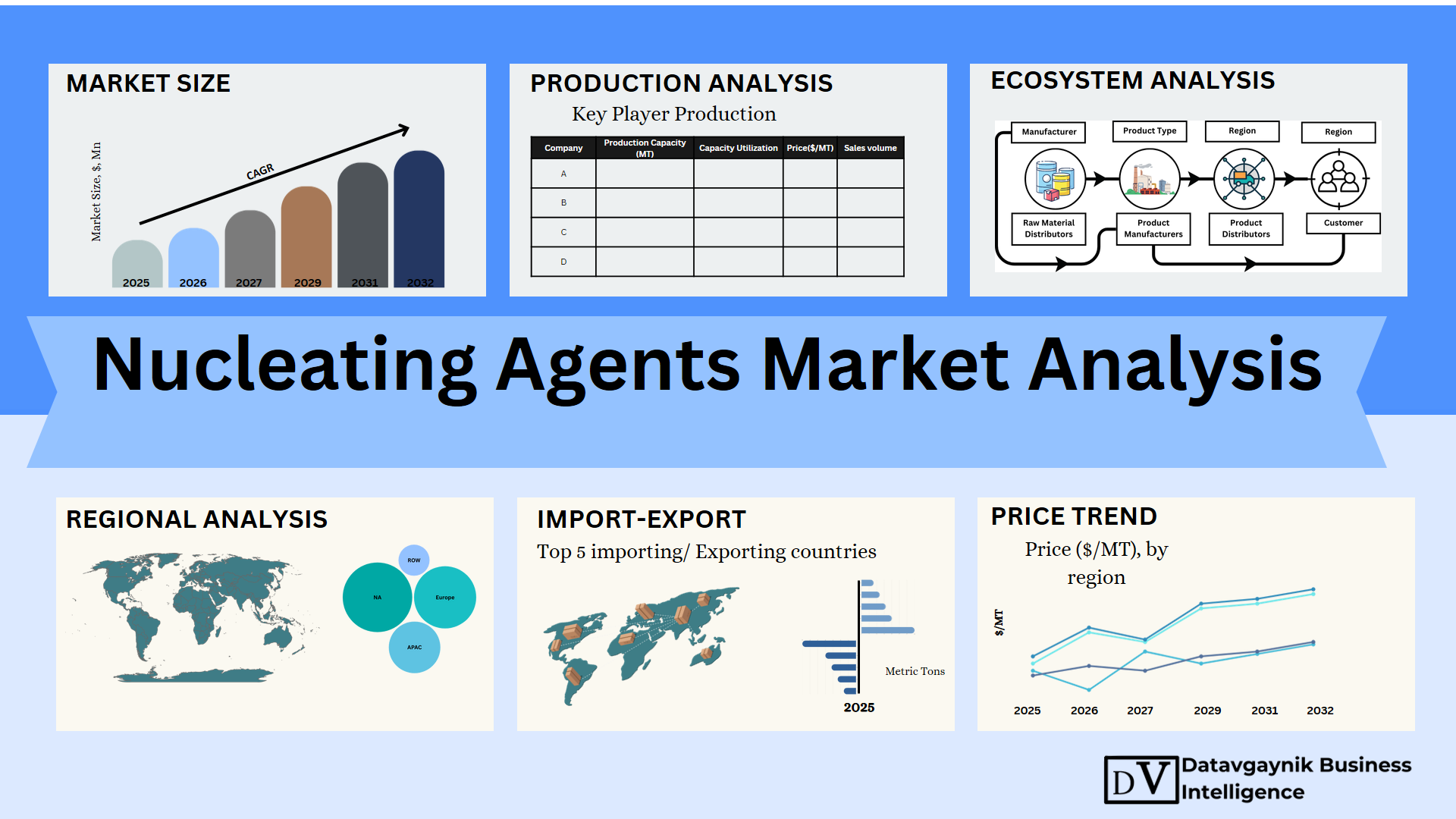
Accelerated Growth of High-Performance Polymers Driving the Nucleating Agents Market
The nucleating agents market is experiencing sustained momentum as high-performance polymers become integral across automotive, electronics, and consumer goods sectors. For instance, the global polypropylene (PP) production, one of the most nucleated polymers, is expected to exceed 90 million metric tons by 2030. Nucleating agents are instrumental in improving the crystallinity, stiffness, and thermal resistance of such polymers, directly impacting their suitability for lightweight and durable applications. As industries continue replacing metals and glass with advanced plastics, demand for nucleating agents is accelerating, particularly in injection molding, extrusion, and thermoforming processes.
Nucleating Agents Market Growth Anchored in Packaging Innovation
One of the strongest growth anchors for the nucleating agents market lies in the evolving global packaging landscape. As per Datavagyanik, food-grade packaging demand has increased at over 6% CAGR in the last five years, with a parallel rise in demand for polymers offering enhanced transparency, thermal resistance, and mechanical integrity. Nucleating agents are pivotal in modifying polypropylene and polyethylene terephthalate (PET) for better visual appeal and performance. For example, packaging for ready-to-eat meals, microwaveable containers, and sustainable beverage bottles relies on nucleated plastics to meet both regulatory and consumer expectations for recyclability and durability.
Datavagyanik also covers related markets such as the Polypropylene Nucleating Agent Market. They offer supporting insights that clarify downstream implications and strategic challenges in the context of the main topic.
Automotive Lightweighting Trends Fueling the Nucleating Agents Market
The nucleating agents market is also gaining traction through the rising emphasis on automotive lightweighting, a direct response to emission regulations and electric vehicle (EV) development. In 2023, over 14 million EVs were sold globally, indicating a 35% year-over-year increase. With the automotive sector aiming to reduce component weight by up to 20%, the use of nucleated polypropylene in dashboards, interior trims, and under-the-hood components has become standard. For instance, nucleating agents increase the modulus of PP composites by up to 25%, enabling them to replace heavier traditional materials without compromising mechanical strength.
Healthcare Industry Boosting the Nucleating Agents Market Through High-Purity Applications
The healthcare industry is rapidly emerging as a strategic end-user, expanding the application scope of the nucleating agents market. The increased production of medical-grade plastics—used in syringes, diagnostic devices, sterilizable trays, and pharmaceutical containers—is fueling demand for nucleating agents that enhance dimensional stability and heat deflection temperature. For example, medical polymers treated with nucleating agents can withstand autoclave sterilization cycles at temperatures exceeding 120°C. With medical plastics consumption expected to surpass 9 million metric tons by 2027, nucleating agents play an indispensable role in meeting the sector’s high precision and safety standards.
Sustainability and Bioplastics Opening New Pathways in the Nucleating Agents Market
Sustainability transitions in global material usage are reshaping the nucleating agents market. The shift from conventional to biodegradable and recyclable polymers is increasing the use of nucleating agents that enhance the performance of bioplastics like polylactic acid (PLA) and bio-based polyethylene. For instance, the incorporation of nucleating agents reduces the crystallization half-time of PLA by up to 60%, significantly improving processing efficiency. Datavagyanik projects that bioplastics will represent over 12% of total plastic production by 2032, creating parallel demand for sustainable nucleating technologies aligned with global environmental mandates.
Evolving Polymer Processing Technologies Elevating the Nucleating Agents Market
Advancements in polymer processing—especially in 3D printing, injection molding, and thermoforming—are further reinforcing the relevance of the nucleating agents market. For example, rapid molding cycles enabled by nucleating agents allow manufacturers to reduce cycle times by 15–20%, resulting in energy savings and increased throughput. High-precision components in electronics, such as casings and connectors, benefit from the improved dimensional stability offered by nucleating additives. This trend is particularly notable in East Asia, where semiconductor and electronic device production continues to rise, indirectly stimulating demand for high-specification nucleated polymers.
Demand Growth in Emerging Economies Enhancing the Nucleating Agents Market Outlook
Emerging economies across Asia, the Middle East, and Latin America are becoming key contributors to the nucleating agents market. Urbanization, industrialization, and infrastructure investments are creating strong downstream demand for performance polymers. For instance, India’s packaging sector is growing at over 10% annually, driven by e-commerce, FMCG, and food retail expansion. Nucleating agents are increasingly utilized in these applications to ensure consistent quality and structural strength. Similarly, Southeast Asian countries are ramping up production of rigid and flexible packaging films that rely on nucleating technologies to achieve required thermal and optical characteristics.
Consumer Goods Sector Expanding the Reach of the Nucleating Agents Market
The global consumer goods industry continues to leverage nucleating agents in polymer formulations for products such as storage containers, kitchenware, appliances, and electronics. Demand for aesthetics, mechanical strength, and thermal endurance has pushed manufacturers to rely on clarified and nucleated PP and PET. For example, nucleated polymers reduce warping and shrinkage, which is critical in precision-molded items. With the consumer appliances segment alone expected to grow at a CAGR of 7.1% through 2030, nucleating agents are gaining prominence as essential additives for manufacturing consistency and efficiency.
Nucleating Agents Market Size Expansion Driven by Polypropylene Demand
The nucleating agents market size is closely linked to global polypropylene trends. With PP demand projected to grow from approximately 80 million metric tons in 2024 to over 105 million metric tons by 2032, nucleating agents will see proportional growth. Over 30% of all PP applications now incorporate nucleating agents to enhance stiffness and transparency. As polymer converters continue seeking material optimization without increasing costs, nucleating additives have become standard across packaging, automotive, and appliance-grade PP products.
Regulatory Push for Low-Carbon Materials Supporting the Nucleating Agents Market
Governmental policies supporting circular economy and low-carbon material adoption are indirectly fostering growth in the nucleating agents market. Initiatives such as Europe’s Green Deal and plastic recycling mandates across the U.S. and Asia-Pacific are encouraging industries to use recyclable, lightweight polymers. Nucleating agents are essential in improving the recyclability profile of polymers like PET and PP by enabling lower processing temperatures and maintaining clarity after reprocessing. This alignment with environmental objectives strengthens the long-term relevance of nucleating agents across multiple industrial domains.
Nucleating Agents Market Penetration Rising in Electrical and Electronics Industry
The electronics industry is witnessing rising integration of nucleated polymers for applications requiring heat resistance and dimensional accuracy. For example, nucleated PET and polyamide composites are increasingly used in laptop components, mobile phone housings, and LED lighting fixtures. The precision molding enabled by nucleating agents supports mass production of complex components with minimal defects. With electronics manufacturing hubs expanding across South Korea, Japan, Taiwan, and Germany, the nucleating agents market is positioning itself as a strategic enabler of innovation in next-generation consumer electronics.
Track Country-wise Nucleating Agents Production and Demand through our Nucleating Agents Production Database
-
- Nucleating Agents production database for 27+ countries worldwide
- Nucleating Agents Powder sales volume for 31+ countries
- Country-wise Nucleating Agents production capacity and production plant mapping, production capacity utilization for 27+ manufacturers
- Nucleating Agents production plants and production plant capacity analysis for top manufacturers
Asia Pacific Dominance in the Nucleating Agents Market
The Asia Pacific region remains the central hub for demand in the nucleating agents market, primarily driven by China, India, Japan, and South Korea. For instance, China accounts for over 35% of global polymer processing output, which in turn directly boosts the consumption of nucleating agents. China’s packaging industry, valued at over USD 450 billion, has shown an annual growth rate exceeding 7%, propelled by e-commerce, FMCG, and food processing sectors. Nucleating agents are widely integrated into polypropylene (PP) and polyethylene terephthalate (PET) applications in China to meet performance requirements in these high-demand segments.
India is witnessing a steep rise in demand for nucleating agents as the country’s industrialization continues. With packaging demand in India growing at over 10% CAGR, the need for heat-resistant, transparent, and recyclable polymer solutions is prompting manufacturers to deploy nucleating agents across food packaging, pharma containers, and logistics films. Meanwhile, Japan and South Korea are driving high-value demand from automotive and electronics, where nucleated engineering plastics are used in precision components requiring dimensional stability under heat and load.
North America’s Innovation-Led Growth in the Nucleating Agents Market
The North American nucleating agents market is characterized by innovation-led adoption and diversified end-use applications. The United States, in particular, has been investing heavily in advanced packaging, automotive lightweighting, and medical device production. For example, the U.S. healthcare plastics market is expected to cross USD 14 billion by 2028, which is stimulating demand for nucleating agents that can improve the performance of medical-grade polymers.
Nucleated polypropylene and PET are being increasingly used to manufacture rigid packaging containers, sterilizable vials, and food trays. Moreover, automotive companies across the U.S. are transitioning to nucleated plastics to meet fuel economy standards. In Canada and Mexico, rising demand from construction and consumer goods has added to the regional nucleating agents consumption.
Europe’s Sustainability Focus Reinforcing the Nucleating Agents Market
Europe’s stringent sustainability regulations and circular economy goals have made the region a key adopter of eco-efficient additives. Countries such as Germany, France, Italy, and the UK are focusing on enhancing the recyclability of polymers used in packaging and automotive parts. For example, Germany’s growing electric vehicle component production is relying on nucleated polymers for weight reduction and improved mechanical strength. In France, PET and bio-based plastics reinforced with nucleating agents are increasingly used in FMCG and pharmaceutical packaging.
In addition, the European Commission’s directives on reducing single-use plastics are driving a shift toward biodegradable polymers, which require nucleating agents to enhance performance. These trends position Europe as a region where environmental compliance and performance optimization drive consistent demand in the nucleating agents market.
Emerging Economies of Latin America and the Middle East Fueling the Nucleating Agents Market
Countries like Brazil, Mexico, and Argentina are rapidly increasing their consumption of nucleated polymers across packaging and agriculture. For instance, Brazil’s agricultural film market, growing at over 6% annually, uses nucleating agents to improve the strength and weather resistance of greenhouse films and mulch layers. Additionally, consumer goods and processed food sectors in Latin America are turning to nucleated polypropylene for rigid packaging solutions.
In the Middle East, Saudi Arabia and the UAE are expanding downstream polymer processing, driven by diversification strategies. Nucleating agents are being imported and integrated into polyethylene and polypropylene formulations used in construction pipes, food containers, and automotive interiors. With countries focusing on domestic manufacturing growth under initiatives such as Saudi Vision 2030, the demand outlook in the region is set to strengthen further.
Production Landscape of the Nucleating Agents Market
The nucleating agents market production landscape is consolidated in regions with robust chemical manufacturing ecosystems. Asia Pacific leads with China accounting for a significant share of global production due to economies of scale, cost advantages, and availability of raw materials. Major producers in China supply both domestic and international markets, particularly in Southeast Asia and the Middle East.
India is also ramping up its production capacities, supported by its growing polymer processing sector. The country’s expanding chemical clusters in Gujarat and Maharashtra are seeing new capacity additions for polymer additives, including nucleating agents.
In North America, the United States maintains a stronghold in specialty-grade nucleating agents, especially for high-performance applications in medical, automotive, and food-grade packaging. The production here is often focused on R&D-intensive and application-specific formulations.
European production centers, especially in Germany, Italy, and Belgium, emphasize environmentally compliant nucleating agents tailored to local regulations. These manufacturers prioritize high-purity and biodegradable polymer-compatible nucleating solutions. While Europe remains a net exporter of specialty nucleating agents, it imports commodity-grade additives from Asia to serve volume-intensive markets.
Segmentation Trends Shaping the Nucleating Agents Market
The nucleating agents market is segmented by type, polymer compatibility, and application, each reflecting a distinct set of demand drivers.
By type, alpha-nucleating agents dominate due to their ability to increase crystallization temperature, stiffness, and dimensional stability—ideal for automotive and packaging applications. Beta-nucleating agents are gaining relevance in construction and impact-resistant applications such as automotive bumpers and pipes. Clarifying agents, a subtype of nucleating additives, are particularly prominent in the food packaging segment due to their transparency enhancement properties.
By polymer, polypropylene remains the largest consumer of nucleating agents. PP’s versatility in both rigid and flexible packaging, coupled with its recyclability, drives high usage. PET is a fast-growing segment, particularly in sustainable packaging and medical applications. Other polymers like polyamides, polylactic acid (PLA), and engineering plastics are gaining traction due to niche high-performance uses.
Application-wise, packaging accounts for the largest share of the nucleating agents market, driven by growing consumption of microwavable containers, caps, closures, and transparent trays. Automotive follows closely, with increasing adoption of nucleated polymers for under-the-hood components, dashboards, and trims. Medical and healthcare applications are expanding rapidly due to demand for sterilizable and high-purity plastic products.
Nucleating Agents Price and Nucleating Agents Price Trend Analysis
The nucleating agents price has seen a moderate upward trend over the last three years, driven by rising raw material costs, increased energy prices, and growing demand for specialized grades. For instance, nucleating agents price for high-performance formulations used in medical and food packaging can range between USD 6,000 to USD 9,000 per metric ton, depending on purity and functional capabilities.
Datavagyanik notes that nucleating agents price trend is also impacted by supply chain dynamics in Asia, especially fluctuations in China’s chemical production ecosystem. In 2022 and 2023, temporary production curbs and logistics disruptions contributed to a 10–15% surge in nucleating agents prices globally.
In Europe, regulations around chemical safety and recyclability have increased the cost of compliance, influencing the nucleating agents price trend upward for biodegradable-compatible additives. However, advancements in production technologies are gradually reducing costs for mainstream grades, thereby stabilizing nucleating agents prices for volume applications like PP packaging and automotive interiors.
North America has witnessed more stable nucleating agents prices due to domestic raw material availability and localized supply chains. Nonetheless, demand for specialty grades is pushing premium pricing in healthcare and electronics segments.
“Nucleating Agents Manufacturing Database, Nucleating Agents Manufacturing Capacity”
-
-
- Nucleating Agents top manufacturers market share for 27+ manufacturers
- Top 8 manufacturers and top 17 manufacturers of Nucleating Agents in North America, Europe, Asia Pacific
- Production plant capacity by manufacturers and Nucleating Agents production data for 27+ market players
- Nucleating Agents production dashboard, Nucleating Agents production data in excel format
-
Competitive Landscape and Manufacturer Share in the Nucleating Agents Market
The nucleating agents market is consolidated among a few global chemical giants and specialty additive manufacturers who collectively drive innovation, pricing trends, and market reach. These players operate through vertically integrated supply chains and focus on both commodity-grade and specialty nucleating agents, catering to industries such as packaging, automotive, healthcare, and electronics.
Milliken & Company
Milliken & Company is a global leader in the nucleating agents market, holding a substantial share with its proprietary Hyperform product line. The Hyperform HPN series is widely adopted in polypropylene applications to enhance clarity, stiffness, and cycle time reduction. The company is known for its ability to deliver additives that support sustainability initiatives, such as improving the recyclability of PP and reducing energy consumption during processing. Milliken’s extensive distribution network across North America, Europe, and Asia ensures strong presence in both developed and emerging markets.
BASF SE
BASF is a key player in the nucleating agents market, offering a wide range of polymer additives under its performance materials division. Its nucleating agents are designed for use in high-specification applications across automotive and packaging. The company focuses on tailor-made solutions that improve the crystallization behavior of semi-crystalline polymers. BASF’s nucleating agents are especially used in rigid packaging and technical plastic compounds, where mechanical performance is critical. Their integration of additive technologies with polymer production gives them a competitive edge in supply assurance and formulation flexibility.
Clariant AG
Clariant is another prominent manufacturer with a strong presence in the nucleating agents market through its Licocene and AddWorks series. The company specializes in polymer performance enhancement through nucleation, stabilization, and compatibilization. Clariant’s product lines target applications such as polypropylene films, fibers, and injection molded components. The company has carved out a niche in providing highly efficient nucleating agents for temperature-sensitive and biodegradable plastics, aligning with the growing push for circular economy compliance.
Adeka Corporation
Japan-based Adeka Corporation holds a strategic position in the nucleating agents market with its diversified range of polymer additives. The company offers nucleating agents suited for polypropylene, polyethylene, PET, and engineering resins. Adeka’s proprietary formulations are widely utilized in Japan’s electronics and packaging sectors, and its expansion into Southeast Asia has positioned it as a regional supplier of high-performance additives. Adeka focuses heavily on research and development, enabling continuous innovation in nucleation chemistry to suit evolving application needs.
PolyOne (Avient Corporation)
Avient Corporation, formerly PolyOne, has a solid share in the nucleating agents market through its OnCap and ColorMatrix platforms. These additive solutions are integrated into masterbatches for processors seeking ease of dispersion and enhanced crystallization kinetics. Avient’s strength lies in its capability to deliver functional additives along with colorants and stabilizers, offering comprehensive solutions to polymer processors. The company’s reach spans packaging, healthcare, and consumer products, with recent growth driven by demand for FDA-compliant and low-VOC nucleating agents.
GCH Technology Co., Ltd.
Based in China, GCH Technology is a fast-growing player in the nucleating agents market, particularly in Asia. The company offers a portfolio of nucleating and clarifying agents for polypropylene, polyesters, and biodegradable polymers. GCH has gained recognition for its cost-effective solutions catering to local and regional manufacturers, enabling it to build share in China, Southeast Asia, and parts of the Middle East. The company’s competitive pricing and localized support make it a preferred choice among mid-tier converters in the region.
Nucleating Agents Market Share by Manufacturer
As of the latest market assessment, Milliken & Company leads the global nucleating agents market with an estimated share of over 30%, driven by its dominance in clarifying agents for polypropylene. Clariant and BASF together hold another 25–30%, primarily through their focus on specialized additives and technical-grade nucleating agents. Adeka Corporation and Avient account for roughly 10–15% collectively, depending on regional demand shifts and product adoption cycles.
In Asia, local manufacturers like GCH Technology are estimated to hold 5–7% market share, which continues to rise due to domestic demand and price competitiveness. The remainder of the market consists of smaller regional manufacturers and private-label suppliers catering to niche or low-cost segments.
Manufacturer Strategies and Competitive Positioning
Key players in the nucleating agents market are focusing on differentiation through application-specific innovation, sustainability-driven performance improvements, and expansion into biodegradable polymer additives. For instance, companies like Milliken are investing in formulations that reduce haze in recycled polypropylene, while Clariant is pushing nucleating systems compatible with compostable materials. Avient is integrating smart additives into 3D printing and medical device materials, providing end-to-end functionality enhancements.
Meanwhile, firms like BASF are working closely with OEMs in the automotive and appliance sectors to tailor nucleated compounds for new electric vehicle and smart home applications. These collaborations enable manufacturers to maintain influence across the value chain and ensure long-term customer retention.
Recent Developments in the Nucleating Agents Market
- March 2024: Milliken launched Hyperform HPN 5000L, a next-generation nucleating agent targeting clarified polypropylene used in transparent food containers. The new product claims improved stiffness-to-clarity ratio and faster cycle times by 18%.
- January 2024: Clariant announced the expansion of its manufacturing facility in Germany to increase capacity for bio-based nucleating agents designed for PLA and other compostable polymers, aligning with EU packaging waste targets.
- September 2023: BASF revealed a collaboration with an automotive Tier-1 supplier to co-develop nucleated PA6 compounds for EV battery enclosures, aiming to reduce weight and improve dimensional stability under heat.
- July 2023: Adeka expanded its production unit in Thailand to meet growing demand for polymer additives across Southeast Asia, including nucleating agents for polypropylene used in industrial packaging.
- May 2023: Avient introduced a new additive masterbatch combining colorant and nucleation agents optimized for medical-grade syringes and pharmaceutical containers, with compliance certifications for Europe and North America.
“Nucleating Agents Production Data and Nucleating Agents Production Trend, Nucleating Agents Production Database and forecast”
-
-
- Nucleating Agents production database for historical years, 10 years historical data
- Nucleating Agents production data and forecast for next 7 years
-
Market Scenario, Demand vs Supply, Average Product Price, Import vs Export, till 2035
- Global Nucleating Agents Market revenue and demand by region
- Global Nucleating Agents Market production and sales volume
- United States Nucleating Agents Market revenue size and demand by country
- Europe Nucleating Agents Market revenue size and demand by country
- Asia Pacific Nucleating Agents Market revenue size and demand by country
- Middle East & Africa Nucleating Agents Market revenue size and demand by country
- Latin America Nucleating Agents Market revenue size and demand by
- Import-export scenario – United States, Europe, APAC, Latin America, Middle East & Africa
- Average product price – United States, Europe, APAC, Latin America, Middle East & Africa
- Market player analysis, competitive scenario, market share analysis
- Business opportunity analysis
Key questions answered in the Global Nucleating Agents Market Analysis Report:
- What is the market size for Nucleating Agents in United States, Europe, APAC, Middle East & Africa, Latin America?
- What is the yearly sales volume of Nucleating Agents and how is the demand rising?
- Who are the top market players by market share, in each product segment?
- Which is the fastest growing business/ product segment?
- What should be the business strategies and Go to Market strategies?
The report covers Nucleating Agents Market revenue, Production, Sales volume, by regions, (further split into countries):
- Asia Pacific (China, Japan, South Korea, India, Indonesia, Vietnam, Rest of APAC)
- Europe (UK, Germany, France, Italy, Spain, Benelux, Poland, Rest of Europe)
- North America (United States, Canada, Mexico)
- Latin America (Brazil, Argentina, Rest of Latin America)
- Middle East & Africa
Table of Contents:
- Introduction to Nucleating Agents
- Definition, Scope, and Applications of Nucleating Agents
- Segmentation of Nucleating Agents by Product Type
- Organic vs Inorganic Nucleating Agents
- Role of Clarifying Agents in the Market
- Global Market Dynamics and Trends (2019-2035)
- Growth Drivers
- Challenges and Opportunities
- Impact of Regulatory Standards
- United States Market Analysis
- Market Size, Revenue, and Growth Forecast
- Domestic Production vs Imports
- Key Players and Market Share Analysis
- Europe Market Overview
- Industry Insights and Production Trends
- Regional Demand and Export Potential
- Pricing Trends in European Markets
- Asia Pacific Market Trends
- Demand Drivers Across Emerging Economies
- Manufacturing and Supply Chain Insights
- Market Growth Forecasts
- Latin America Market Outlook
- Nucleating Agent Applications in Regional Industries
- Key Importers and Distributors
- Sales Performance Analysis
- Middle East & Africa Market Overview
- Market Size and Regional Opportunities
- Production and Consumption Patterns
- Growth Factors Specific to the Region
- Production Analysis and Capacity Forecasts (2019-2035)
- Global Production Insights by Region
- Planned Expansions and Capacity Additions
- Competitive Landscape
- Key Players by Market Segment
- Innovations and R&D Activities
- Competitive Market Share Analysis (2019-2025)
- Global Revenue Breakdown by Manufacturer
- Revenue Trends and Market Contribution
- Key Financial Performances of Major Companies
- Consumption Analysis by End-Use Industry
- Packaging Industry Trends
- Automotive Sector Applications
- Medical and Pharmaceutical Usage Patterns
- Regional Consumption Insights
- Regional Breakdown of Nucleating Agent Demand
- Consumption vs Import Trends Across Regions
- Manufacturing Cost Analysis
- Cost Structure of Nucleating Agent Production
- Raw Material Costs and Availability
- Operational Costs and Efficiency Metrics
- Key Raw Material Market Overview
- Sources and Supply Chains
- Price Trends and Availability
- Key Suppliers and Partnerships
- Industrial Chain Analysis
- Upstream and Downstream Market Integration
- Role of Distributors and End-Use Customers
- Marketing Strategies and Channels
- Distribution Models
- Online and Offline Sales Channels
- Branding and Market Penetration Strategies
- Key Sales Partners and Distributors
- Regional Distributor Insights
- Major Sales Networks
- Customer Insights and Demand Patterns
- Key Consumer Segments by Application
- Customer Preferences and Trends
- Future Market Forecasts (2030-2035)
- Anticipated Growth in Production and Consumption
- Innovations and Emerging Applications
- Long-Term Revenue Projections

