

Surging Demand in Energy Transition Fueling the Pentlandite (Nickel Sulfide) Market
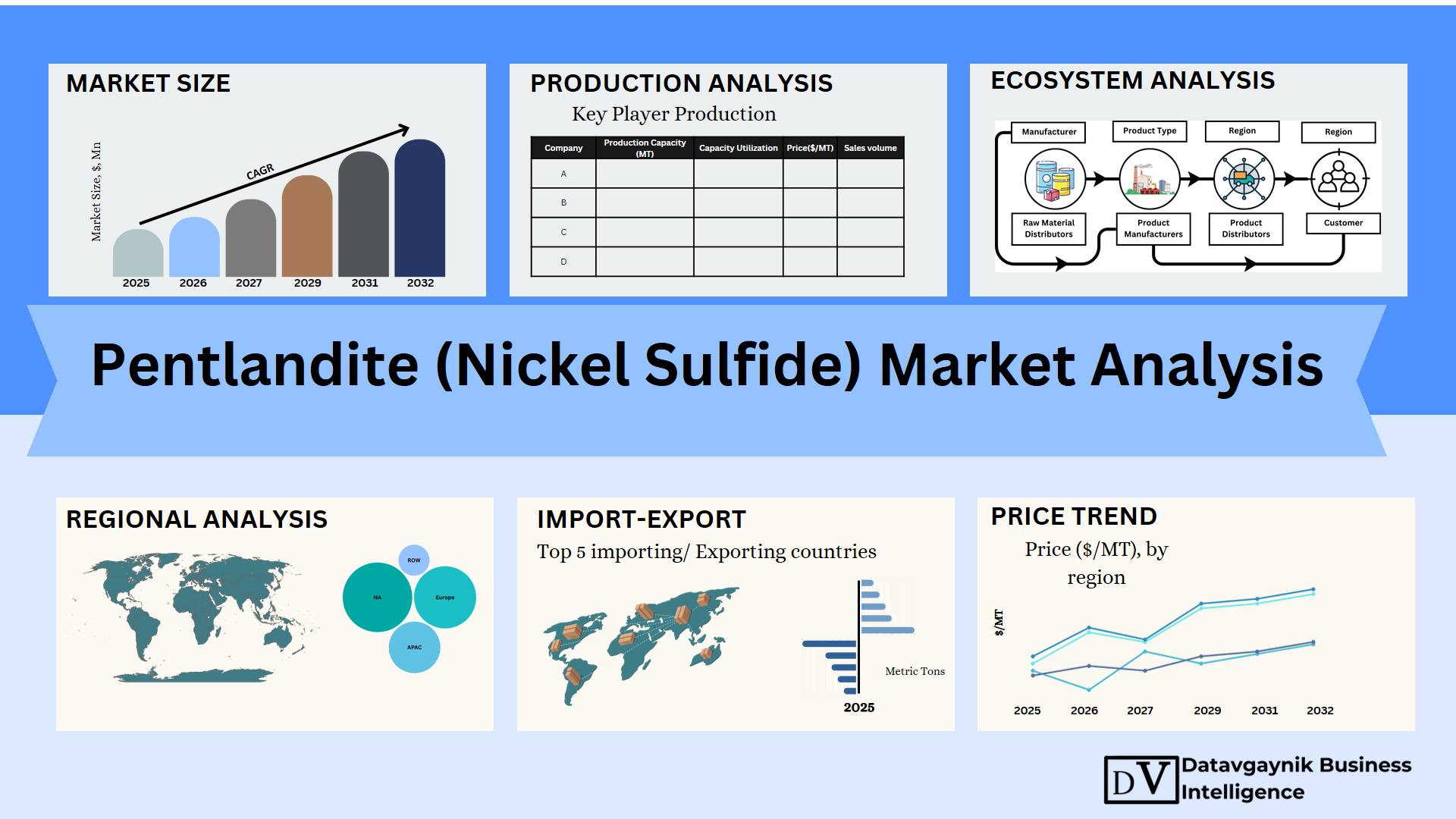
The Pentlandite (Nickel Sulfide) Market is undergoing a significant transformation as the global energy landscape pivots toward low-carbon technologies. Nickel, extracted primarily from pentlandite ores, plays a vital role in this shift due to its indispensable use in lithium-ion battery chemistries.
Datavagyanik highlights that global electric vehicle (EV) sales surged past 14 million units in 2023, representing more than 18% of total car sales, up from just 4% in 2020. This exponential adoption has led to a sharp increase in demand for nickel-rich cathodes, particularly NMC (Nickel Manganese Cobalt) and NCA (Nickel Cobalt Aluminum), which are integral to improving battery energy density and lifespan. As a result, the Pentlandite (Nickel Sulfide) Market is witnessing robust traction from the EV manufacturing sector.
Battery Revolution Driving the Pentlandite (Nickel Sulfide) Market
Battery manufacturers are increasingly favoring nickel-rich chemistries to enhance range, reduce charging times, and improve energy storage capacity. For instance, Tesla and CATL are shifting towards high-nickel formulations in their battery packs to optimize performance for next-generation EVs. This growing demand for battery-grade nickel has put pentlandite, the most economically viable nickel sulfide mineral, at the center of supply chain strategies. In 2023 alone, battery sector nickel demand accounted for over 15% of total global nickel usage, and this share is expected to exceed 30% by 2030. Consequently, the Pentlandite (Nickel Sulfide) Market is evolving into a strategic asset base for future energy infrastructure.
Datavagyanik also covers related markets such as the Polydymite (Nickel Sulfide) Market, the Millerite (Nickel Sulfide) Market, and the Nickel Oxide Market. These materials are considered in high-temperature and specialty chemical environments, where glass production, catalysis, and safety regulations influence adoption patterns.
Pentlandite (Nickel Sulfide) Market Trends in Renewable Energy Storage
Beyond EVs, renewable energy storage systems are amplifying the reliance on pentlandite-derived nickel. As solar and wind installations scale up, the need for grid-scale energy storage using nickel-based batteries is accelerating. For example, nickel-metal hydride and advanced lithium-ion batteries are increasingly being deployed in utility-scale battery farms for grid stabilization. In regions such as the United States, Australia, and Germany, renewable capacity additions are translating directly into elevated pentlandite demand. Datavagyanik estimates that the global installed capacity of renewable energy surpassed 3,700 GW in 2023, a 12% year-on-year increase, and battery storage installations are growing at over 20% CAGR. This shift further reinforces the long-term expansion of the Pentlandite (Nickel Sulfide) Market.
Stainless Steel Industry Reinforces Stability in the Pentlandite (Nickel Sulfide) Market
While new energy sectors are pushing future demand, traditional industries continue to form the bedrock of the Pentlandite (Nickel Sulfide) Market. Stainless steel production, which consumes over 65% of global nickel, remains a dominant application. For instance, Type 304 and Type 316 stainless steels require nickel to enhance corrosion resistance, strength, and flexibility. These grades are extensively used in construction, transportation, and industrial equipment. Countries with high infrastructure spending, such as India and China, are sustaining demand for stainless steel, with India’s stainless steel consumption increasing at a pace of over 7% per annum. Such industrial trends ensure that pentlandite-derived nickel remains essential even as the market diversifies toward green technologies.
Electronics Industry Bolstering the Pentlandite (Nickel Sulfide) Market
The electronics sector presents a compelling secondary growth avenue for the Pentlandite (Nickel Sulfide) Market. Nickel’s superior conductivity and resistance to oxidation make it ideal for use in semiconductors, printed circuit boards (PCBs), connectors, and electroplated components in smartphones, laptops, and other consumer electronics. With over 1.4 billion smartphones shipped globally in 2023 and the Internet of Things (IoT) ecosystem expanding rapidly, the demand for high-performance nickel components is growing. For example, nickel is a preferred material for magnetic sensors and rechargeable battery terminals in portable electronics, which directly feeds back into pentlandite consumption.
Pentlandite (Nickel Sulfide) Market Responding to Aerospace and Defense Demands
Nickel-based superalloys, derived primarily from pentlandite, are mission-critical in aerospace and defense. These alloys are favored for their thermal stability and resistance to mechanical stress, making them suitable for jet engine turbines, heat exchangers, and missile components. The resurgence in global defense budgets, particularly in the U.S., Europe, and East Asia, is leading to renewed investment in aerospace-grade materials. For example, the global aerospace superalloy market is projected to grow at a CAGR of over 6% through 2030, signaling consistent demand for high-purity pentlandite-derived nickel. This segment ensures that the Pentlandite (Nickel Sulfide) Market retains strategic importance across both civil and defense sectors.
Emergence of Green Hydrogen Projects Accelerating the Pentlandite (Nickel Sulfide) Market
The increasing number of green hydrogen projects globally is another factor accelerating the Pentlandite (Nickel Sulfide) Market. Electrolyzers used for hydrogen production require nickel-based catalysts due to their cost-effectiveness and efficiency in alkaline environments. For instance, proton exchange membrane (PEM) and alkaline electrolyzers depend heavily on nickel alloys for their anode components. With over 100 GW of hydrogen electrolyzer projects announced globally by 2030, nickel demand from this sector is expected to multiply, adding another robust layer to the pentlandite-driven supply chain.
Urbanization Trends in Emerging Markets Fueling the Pentlandite (Nickel Sulfide) Market
Datavagyanik notes that rapid urbanization in markets like India, Brazil, Nigeria, and Southeast Asia is pushing demand for stainless steel, electrical infrastructure, and modern transportation, all of which require significant nickel inputs. For instance, India is projected to invest over $1.4 trillion in infrastructure under its National Infrastructure Pipeline, which includes bridges, railways, and smart cities. These projects require large volumes of nickel-bearing alloys, directly benefiting the Pentlandite (Nickel Sulfide) Market. The interplay between urbanization and industrial growth is expected to support pentlandite consumption for decades.
Pentlandite (Nickel Sulfide) Market Size Set for Expansion with Rising Recycling Trends
While primary production continues to lead, the emergence of nickel recycling is also reshaping the Pentlandite (Nickel Sulfide) Market. End-of-life EV batteries, stainless steel scrap, and industrial waste are increasingly being recycled to extract nickel, reducing pressure on mining. However, even with increased recycling, primary demand from pentlandite remains essential. Datavagyanik projects that recycled nickel will meet only 25% of the global demand by 2030, leaving a significant gap to be fulfilled by pentlandite mining. Thus, market players are now investing in both mining operations and advanced recycling technologies, creating a hybrid growth ecosystem.
Pentlandite (Nickel Sulfide) Market Dynamics Strengthened by Policy Push
Government policies are playing an instrumental role in supporting the Pentlandite (Nickel Sulfide) Market. For example, the U.S. Inflation Reduction Act provides incentives for sourcing critical minerals like nickel from domestic or allied sources. Similarly, the European Union’s Critical Raw Materials Act emphasizes reducing reliance on external suppliers and enhancing local processing capabilities. These policy measures are driving exploration, investment, and infrastructure development in nickel mining, especially in regions like North America, Europe, and Southeast Asia. The Pentlandite (Nickel Sulfide) Market is expected to benefit immensely as countries seek to build secure, transparent, and sustainable critical mineral supply chains.
Technology Innovations Redefining the Pentlandite (Nickel Sulfide) Market
Innovations in extraction and refining technologies are significantly improving yield and sustainability in pentlandite processing. For instance, pressure acid leaching and bioleaching methods are now being used to process lower-grade ores with minimal environmental impact. These technologies not only increase recovery efficiency but also reduce carbon emissions, water consumption, and tailing hazards. Mining companies in Australia, Canada, and Finland are adopting such innovations to align with global ESG goals. As ESG compliance becomes a critical investment criterion, companies with technologically advanced pentlandite operations are poised for long-term competitive advantage.
Conclusion: Pentlandite (Nickel Sulfide) Market Positioned for Long-Term Structural Growth
With applications spanning from next-gen energy to aerospace and construction, the Pentlandite (Nickel Sulfide) Market is structurally aligned with high-growth, future-proof industries. The global shift toward electrification, decarbonization, and industrial modernization is translating into sustained nickel demand, keeping pentlandite mining and processing at the forefront of strategic materials planning. As per Datavagyanik, the Pentlandite (Nickel Sulfide) Market size is projected to grow steadily through 2032, driven by a mix of policy support, technological innovation, and multi-sector industrial demand. Players investing early in value-added processing, sustainable mining, and integrated supply chains stand to capture significant market share in this evolving landscape.
“Track Country-wise Pentlandite (Nickel Sulfide) Production and Demand through our Pentlandite (Nickel Sulfide) Production Database”
-
-
- Pentlandite (Nickel Sulfide) production database for 26+ countries worldwide
- Pentlandite (Nickel Sulfide) sales volume for 30+ countries
- Country-wise Pentlandite (Nickel Sulfide) production capacity, production plant mapping, production capacity utilization for 26+ manufacturers
- Pentlandite (Nickel Sulfide) production plants and production plant capacity analysis by top manufacturers
-
“Track real-time Pentlandite (Nickel Sulfide) Prices, Pentlandite (Nickel Sulfide) price charts for 26+ countries, Pentlandite (Nickel Sulfide) weekly price tracker and Pentlandite (Nickel Sulfide) monthly price tracker”
-
-
- Track real-time Pentlandite (Nickel Sulfide) prices and Pentlandite (Nickel Sulfide) price trend in 26+ countries though our excel-based Pentlandite (Nickel Sulfide) price charts
- Real-time Pentlandite (Nickel Sulfide) price tracker dashboard with 26+ countries
- Complete transparency on Pentlandite (Nickel Sulfide) price trend through our Pentlandite (Nickel Sulfide) monthly price tracker, Pentlandite (Nickel Sulfide) weekly price tracker
-
Asia Pacific Leading Global Demand in the Pentlandite (Nickel Sulfide) Market
The Asia Pacific region dominates the global Pentlandite (Nickel Sulfide) Market in both consumption and production. China, as the world’s largest consumer of nickel, remains at the epicenter of pentlandite demand. This is driven by the country’s stronghold in electric vehicle (EV) manufacturing, stainless steel production, and infrastructure development. For example, over 60% of global EV batteries are produced in China, most of which utilize nickel-rich cathode chemistries. The expansion of high-speed rail networks, smart cities, and industrial corridors has also amplified demand for nickel-intensive stainless steel and alloys.
Indonesia is central to pentlandite production in the region. With the world’s largest nickel reserves, the country has shifted from exporting unprocessed ore to building an integrated value chain that includes mining, smelting, and battery precursor production. In 2023, Indonesia accounted for over 50% of global nickel production. The government’s strategic ban on raw nickel ore exports has catalyzed billions of dollars in foreign investment, particularly from Chinese and South Korean battery and EV manufacturers. This localized processing model has significantly elevated the country’s role in the global Pentlandite (Nickel Sulfide) Market.
Pentlandite (Nickel Sulfide) Market Expanding Across North America
In North America, the United States and Canada are advancing domestic capabilities to secure critical mineral supply chains, including pentlandite-based nickel. The U.S., under clean energy and national security frameworks, is prioritizing domestic sourcing of battery metals. Several mining projects in Minnesota and Michigan are being fast-tracked due to rich pentlandite deposits. These initiatives align with the Inflation Reduction Act, which mandates sourcing of EV battery materials from domestic or allied sources to qualify for tax incentives.
Canada, with established mining infrastructure and a reputation for ESG-compliant operations, plays a vital role in the Pentlandite (Nickel Sulfide) Market. Mining hubs in Sudbury (Ontario), Voisey’s Bay (Newfoundland and Labrador), and Thompson (Manitoba) are leading producers of high-grade nickel sulfide ores. These facilities supply both the domestic battery industry and export markets in Europe and Asia. With Canada’s EV and renewable energy ambitions gaining momentum, pentlandite production is expected to increase by more than 25% over the next five years.
Europe’s Strategic Push Boosts the Pentlandite (Nickel Sulfide) Market
Europe’s transition to a green economy is directly impacting the Pentlandite (Nickel Sulfide) Market. Germany, Norway, and Finland are the region’s strongest players. Germany, a hub for automotive innovation, is scaling up battery gigafactories and EV output. For instance, Volkswagen and BMW are investing heavily in nickel-rich battery chemistries, leading to a surge in pentlandite imports and downstream nickel processing.
Finland’s role as Europe’s nickel refining powerhouse cannot be overstated. Home to one of the largest nickel refineries in the region, Finland is also expanding pentlandite mining operations to ensure long-term raw material security. Meanwhile, Norway is advancing both EV adoption and battery recycling capacities, increasing circular demand for pentlandite-derived nickel.
Eastern Europe is also emerging as a key contributor. Poland and Hungary are witnessing large-scale investments in battery manufacturing and industrial development, which indirectly elevates pentlandite demand across the region.
Middle East and Africa Registering Emerging Growth in the Pentlandite (Nickel Sulfide) Market
Although not traditionally associated with nickel mining, the Middle East is increasingly investing in the critical minerals ecosystem. Saudi Arabia’s Vision 2030 initiative has placed strong emphasis on mining diversification. Recent exploration in the Arabian Shield has revealed promising pentlandite prospects. As Saudi Arabia scales up solar and wind energy deployment, demand for battery storage—and therefore pentlandite-derived nickel—is expected to follow suit.
Africa, particularly countries like Madagascar, South Africa, and Tanzania, hosts large untapped pentlandite reserves. For instance, South Africa’s Bushveld complex and Madagascar’s Ambatovy mine are emerging contributors to global nickel supply. Investments from Chinese and European players are positioning Africa as a new frontier in the Pentlandite (Nickel Sulfide) Market, especially as global manufacturers seek to diversify their sourcing away from geopolitical hotspots.
Latin America’s Role in the Global Pentlandite (Nickel Sulfide) Market
Latin America holds strategic potential in the Pentlandite (Nickel Sulfide) Market through both resource abundance and proximity to North American markets. Brazil’s laterite and sulfide nickel reserves are substantial, and with increased interest from European automakers, exploration activity is rising. Cuba, with its long-standing nickel mining legacy, continues to export to China and Canada. Although political and logistical challenges persist, investment in advanced extraction technologies could make Latin America a reliable supplier in the future.
Pentlandite (Nickel Sulfide) Market Segmentation Reflects Broad-Based Demand
The Pentlandite (Nickel Sulfide) Market is segmented by application into electric vehicles, energy storage systems, stainless steel production, aerospace, electronics, and green hydrogen technologies. Among these, EVs remain the fastest-growing segment. For example, the global EV fleet is expected to exceed 200 million by 2030, up from 26 million in 2023, driving a compound annual growth rate of over 30% in battery-grade nickel demand. Consequently, pentlandite remains a key mineral in cathode manufacturing across NMC and NCA technologies.
In stainless steel production, pentlandite-derived nickel plays an irreplaceable role. The construction and shipbuilding sectors in Asia, the Middle East, and Europe account for more than 60% of stainless steel consumption. As urban infrastructure expands and marine projects increase, this application segment continues to anchor the Pentlandite (Nickel Sulfide) Market.
Aerospace applications represent a smaller but highly specialized share. Superalloys using pentlandite-based nickel are used in turbines, combustion chambers, and jet engine components due to their high heat tolerance and structural integrity. With defense budgets increasing globally and commercial aviation rebounding post-pandemic, this segment offers resilient demand.
Pentlandite (Nickel Sulfide) Price Trend Driven by Supply-Demand Imbalance
The Pentlandite (Nickel Sulfide) Price has seen significant volatility over the past three years. In 2021, average nickel prices hovered around $18,000 per metric ton. By early 2022, geopolitical disruptions and surging battery demand pushed the price beyond $25,000 per ton. Prices then fluctuated amid macroeconomic uncertainties, but a consistent upward trend has re-emerged due to tightening supply chains.
As of Q1 2024, the average Pentlandite (Nickel Sulfide) Price ranges between $20,500 to $23,000 per metric ton, depending on grade and source. Premiums are being paid for ESG-compliant and traceable nickel, particularly in Europe and North America. This pricing trend is expected to hold as battery manufacturers prioritize ethical sourcing and transparency under regulatory pressure.
The long-term Pentlandite (Nickel Sulfide) Price Trend is expected to remain bullish. Datavagyanik projects that demand will outstrip supply by over 15% by 2028, driven by exponential battery sector growth and slower-than-expected mine commissioning timelines. For instance, bringing a new pentlandite mine online typically takes 7–10 years, while EV battery demand is rising annually. This lag reinforces an upward pressure on prices.
Supply Chain Fragmentation Affecting Pentlandite (Nickel Sulfide) Price Stability
One of the most defining factors impacting the Pentlandite (Nickel Sulfide) Price is supply chain fragmentation. The current global landscape sees over-reliance on Indonesia, the Philippines, and Russia for primary production. Any policy shift, trade barrier, or logistical disruption in these countries causes sharp market reactions. For example, the Indonesian export ban in 2020 caused a nearly 30% price jump within months.
To mitigate volatility, downstream players are forming long-term offtake agreements with mining companies. Automakers and battery cell producers are even investing directly in mining operations, securing pentlandite supplies to stabilize procurement costs and hedge against price surges.
Conclusion: Regional and Segmental Complexity Shapes the Pentlandite (Nickel Sulfide) Market
The global Pentlandite (Nickel Sulfide) Market is defined by regional disparities in production and consumption, evolving application segments, and a highly sensitive pricing environment. Each region brings a unique dimension—Asia Pacific drives volume, North America pushes policy-driven demand, Europe leads in refining and ethical sourcing, while Africa and Latin America are rising in resource contribution.
With the Pentlandite (Nickel Sulfide) Price and Pentlandite (Nickel Sulfide) Price Trend closely tied to geopolitical, technological, and industrial variables, market participants must adapt to volatility through diversification and innovation. Datavagyanik maintains that the next decade will be transformative for this market, shaped by the dual forces of green energy expansion and supply-side restructuring.
“Pentlandite (Nickel Sulfide) Manufacturing Database, Pentlandite (Nickel Sulfide) Manufacturing Capacity”
-
-
- Pentlandite (Nickel Sulfide) top manufacturers market share for 26+ manufacturers
- Top 8 manufacturers and top 16 manufacturers of Pentlandite (Nickel Sulfide) in North America, Europe, Asia Pacific
- Pentlandite (Nickel Sulfide) production plant capacity by manufacturers and Pentlandite (Nickel Sulfide) production data for 26+ market players
- Pentlandite (Nickel Sulfide) production dashboard, Pentlandite (Nickel Sulfide) production data in excel format
-
“Pentlandite (Nickel Sulfide) price charts, Pentlandite (Nickel Sulfide) weekly price tracker and Pentlandite (Nickel Sulfide) monthly price tracker”
-
-
- Factors impacting real-time Pentlandite (Nickel Sulfide) prices in 21+ countries worldwide
- Pentlandite (Nickel Sulfide) monthly price tracker, Pentlandite (Nickel Sulfide) weekly price tracker
- Real-time Pentlandite (Nickel Sulfide) price trend, Pentlandite (Nickel Sulfide) price charts, news and updates
- Tracking Pentlandite (Nickel Sulfide) price fluctuations
-
Top Manufacturers Dominating the Pentlandite (Nickel Sulfide) Market
The Pentlandite (Nickel Sulfide) Market is led by a group of globally recognized mining and metallurgical companies that control a substantial portion of global nickel sulfide extraction and processing capacity. These manufacturers have developed integrated value chains from mining to refining, positioning themselves strategically to meet the growing demand from electric vehicles, renewable energy storage, aerospace, and stainless steel sectors.
Vale S.A.
Vale S.A., headquartered in Brazil, is one of the largest producers of pentlandite-derived nickel globally. The company operates high-grade nickel sulfide mines and associated processing facilities in Canada, notably in Voisey’s Bay and Sudbury Basin. Vale has a diversified product line that includes nickel matte, powder, briquettes, and pellets. The company’s production focus is increasingly aligned with battery-grade nickel demand, and it has committed capital towards transitioning its operations to support sustainable battery supply chains.
Norilsk Nickel (Nornickel)
Nornickel, based in Russia, is among the top players in the Pentlandite (Nickel Sulfide) Market with a dominant position in sulfide-based nickel production. The company operates extensive mining and refining operations in the Norilsk region, extracting pentlandite-rich ores with high nickel content. It produces Class 1 nickel, which is preferred for battery and aerospace applications. Nornickel has long-standing capabilities in supplying nickel for high-performance superalloys and remains a critical supplier despite regional geopolitical disruptions.
BHP Group
The BHP Group’s Nickel West division, located in Western Australia, has emerged as a major player in the Pentlandite (Nickel Sulfide) Market. The operations span from underground mining to smelting and refining, focusing on the production of high-purity nickel suitable for lithium-ion battery applications. BHP has also entered into supply agreements with global EV and battery manufacturers, demonstrating its strategic pivot towards clean energy markets.
Jinchuan Group
Jinchuan Group from China is one of Asia’s largest nickel producers and a key stakeholder in the Pentlandite (Nickel Sulfide) Market. It operates mines and smelters capable of processing both laterite and sulfide ores, with a strong focus on pentlandite due to its higher nickel yield. The company supplies refined nickel to China’s expansive stainless steel and EV battery industries and is actively investing in capacity expansion to meet surging domestic demand.
Sumitomo Metal Mining Co., Ltd.
Sumitomo Metal Mining of Japan maintains an influential presence in the Pentlandite (Nickel Sulfide) Market through integrated operations spanning mining, smelting, and refining. Its focus lies in the production of battery-grade nickel sulfate, which is a key input for cathode materials. With Japan’s growing emphasis on green energy and EV manufacturing, Sumitomo’s strategic alignment with battery supply chains reinforces its market position.
Glencore Plc
Glencore Plc operates nickel sulfide mines in Canada (Raglan and Sudbury) and New Caledonia. The company is a major supplier of nickel to the global market and plays a critical role in the Pentlandite (Nickel Sulfide) Market. Glencore’s product portfolio spans ferronickel, matte, and refined nickel, catering to both traditional and emerging sectors. The company is increasingly focusing on low-carbon production technologies and recycling as part of its sustainability framework.
Pentlandite (Nickel Sulfide) Market Share by Manufacturers
In terms of market share, Vale and Nornickel together account for over one-third of the global Pentlandite (Nickel Sulfide) Market output, with their vertically integrated supply chains and access to high-grade deposits giving them a strategic advantage. BHP Group follows with a growing share, particularly in the Asia-Pacific market, where demand for battery-grade nickel continues to soar. Jinchuan Group and Glencore hold sizable shares in both raw nickel production and refined product exports, especially to battery and stainless steel manufacturers in China, South Korea, and Europe. Sumitomo’s share is more niche, centered around high-purity nickel sulfate for advanced batteries.
The overall Pentlandite (Nickel Sulfide) Market remains moderately consolidated, with the top five producers controlling a significant portion of global supply. However, increased exploration, regional diversification, and technological advancements in processing are opening up the space for emerging players and junior miners.
Product Lines and Technological Focus
Manufacturers are increasingly refining their product lines to align with the energy transition. Vale and BHP are prioritizing nickel sulfate production and have restructured their product development towards EV and grid-scale battery markets. Nornickel continues to support both high-performance alloy and battery sectors with high-purity nickel. Jinchuan is aggressively expanding its smelting and cathode precursor facilities. Sumitomo and Glencore are investing in next-generation refining processes, including hydrometallurgical routes, to improve recovery from low-grade pentlandite ores and reduce environmental impact.
Recent Developments and Industry Moves
- In Q1 2024, BHP began construction of a new battery-grade nickel sulfate plant at its Kwinana facility in Australia. This move is expected to significantly boost its share in the battery materials segment.
- Vale completed a strategic reorganization of its base metals division, separating its nickel and copper assets into a new entity focused exclusively on clean energy supply chains.
- Jinchuan announced a $1.2 billion investment into new refining infrastructure in Guangxi province, targeting an output of over 200,000 tons of nickel sulfate annually by 2026.
- Sumitomo entered into a strategic partnership with a major Japanese automaker to co-develop cathode materials using nickel sulfate sourced from its Philippine joint ventures.
- Glencore expanded its nickel recycling capabilities in Canada, aligning with rising demand for sustainable raw materials from recycled EV batteries.
- Nornickel initiated a decarbonization program in its Norilsk operations, targeting a 20% reduction in emissions by 2030 while maintaining nickel output.
These developments signal a strategic shift in the Pentlandite (Nickel Sulfide) Market, where traditional mining companies are evolving into advanced material suppliers with a clear focus on clean technologies. As global regulations around ESG compliance tighten and consumers demand transparency across supply chains, companies that can ensure ethical sourcing, low-carbon processing, and product innovation will be best positioned to consolidate their market share in the coming years.
“Pentlandite (Nickel Sulfide) Production Data and Pentlandite (Nickel Sulfide) Production Trend, Pentlandite (Nickel Sulfide) Production Database and forecast”
-
-
- Pentlandite (Nickel Sulfide) production database for historical years, 10 years historical data
- Pentlandite (Nickel Sulfide) production data and forecast for next 7 years
- Pentlandite (Nickel Sulfide) sales volume by manufacturers
-
“Track Real-time Pentlandite (Nickel Sulfide) Prices for purchase and sales contracts, Pentlandite (Nickel Sulfide) price charts, Pentlandite (Nickel Sulfide) weekly price tracker and Pentlandite (Nickel Sulfide) monthly price tracker”
-
-
- Gain control on your purchase and sales contracts through our real-time Pentlandite (Nickel Sulfide) price tracker and Pentlandite (Nickel Sulfide) price trend analysis
- Pentlandite (Nickel Sulfide) weekly price tracker and forecast for next four weeks
- Pentlandite (Nickel Sulfide) monthly price tracker and forecast for next two months
-
Market Scenario, Demand vs Supply, Average Product Price, Import vs Export, till 2032
- Global Pentlandite (Nickel Sulfide) Market revenue and demand by region
- Global Pentlandite (Nickel Sulfide) Market production and sales volume
- United States Pentlandite (Nickel Sulfide) Market revenue size and demand by country
- Europe Pentlandite (Nickel Sulfide) Market revenue size and demand by country
- Asia Pacific Pentlandite (Nickel Sulfide) Market revenue size and demand by country
- Middle East & Africa Pentlandite (Nickel Sulfide) Market revenue size and demand by country
- Latin America Pentlandite (Nickel Sulfide) Market revenue size and demand by
- Import-export scenario – United States, Europe, APAC, Latin America, Middle East & Africa
- Average product price – United States, Europe, APAC, Latin America, Middle East & Africa
- Market player analysis, competitive scenario, market share analysis
- Business opportunity analysis
Key questions answered in the Global Pentlandite (Nickel Sulfide) Market Analysis Report:
- What is the market size for Pentlandite (Nickel Sulfide) in United States, Europe, APAC, Middle East & Africa, Latin America?
- What is the yearly sales volume of Pentlandite (Nickel Sulfide) and how is the demand rising?
- Who are the top market players by market share, in each product segment?
- Which is the fastest growing business/ product segment?
- What should be the business strategies and Go to Market strategies?
The report covers Pentlandite (Nickel Sulfide) Market revenue, Production, Sales volume, by regions, (further split into countries):
- Asia Pacific (China, Japan, South Korea, India, Indonesia, Vietnam, Rest of APAC)
- Europe (UK, Germany, France, Italy, Spain, Benelux, Poland, Rest of Europe)
- North America (United States, Canada, Mexico)
- Latin America (Brazil, Argentina, Rest of Latin America)
- Middle East & Africa
Table of Contents
- Introduction to Pentlandite Market
1 Overview of Pentlandite as a Primary Nickel Ore
1.2 Importance of Nickel Sulfide in the Global Metal Market
1.3 Historical Perspective on Pentlandite Mining - Geological and Mineralogical Analysis
1 Formation and Distribution of Pentlandite Deposits
2.2 Physical and Chemical Properties of Pentlandite
2.3 Comparison with Other Nickel-Bearing Ores - Global Market Overview and Trends (2021–2032)
1 Market Size and Revenue Growth Analysis
3.2 Global Demand-Supply Dynamics
3.3 Technological Trends Influencing the Market - Regional Market Insights
1 North America: Role in Global Nickel Production
4.2 Europe: Transition to Sustainable Nickel Mining
4.3 Asia-Pacific: Market Growth in High-Technology Sectors
4.4 Latin America: Emerging Mining Opportunities
4.5 Middle East & Africa: Exploration and Development Trends - Extraction and Refining Processes
1 Mining Methods for Pentlandite Extraction
5.2 Advances in Refining Techniques for High-Purity Nickel
5.3 Innovations in Low-Impact Mining and Processing - Market Segmentation by Grade and Application
1 Nickel Content and Ore Grades in Pentlandite
6.2 Applications in Batteries, Alloys, and Catalysts
6.3 Market Segmentation by Industrial Use - Competitive Landscape
1 Major Pentlandite Mining Companies and Their Strategies
7.2 Market Share Analysis of Key Players
7.3 Competitive Dynamics Among Emerging Producers - Supply Chain and Logistics
1 Overview of the Nickel Sulfide Supply Chain
8.2 Transportation and Distribution Challenges
8.3 Strategies for Efficient Logistics in Pentlandite Trade - Global Trade and Pricing Analysis
1 Export and Import Trends of Nickel Sulfide
9.2 Analysis of Price Volatility in the Market
9.3 Impact of Global Trade Policies on Pentlandite - End-Use Industries and Applications
1 Role of Nickel in Battery Technologies
10.2 Pentlandite’s Contribution to Stainless Steel Production
10.3 Applications in Chemical Catalysis and Emerging Technologies - Environmental and Regulatory Aspects
1 Environmental Challenges in Pentlandite Mining
11.2 Compliance with Regional and International Regulations
11.3 Strategies for Sustainable and Eco-Friendly Operations - Market Drivers and Opportunities
1 Rising Demand for Nickel in EV Battery Production
12.2 Expansion of Mining Operations in Emerging Economies
12.3 Development of High-Purity Nickel Products for Advanced Applications - Market Challenges and Risk Factors
1 Declining Ore Grades and Resource Scarcity
13.2 Increasing Pressure from Environmental Activists
13.3 Market Risks Due to Nickel Price Fluctuations - Future Market Projections (2021–2032)
1 Pentlandite Production and Consumption Forecasts
14.2 Regional Shifts in Market Dynamics
14.3 Technological Innovations and Their Impact on Market Growth - Strategic Recommendations
1 Investment Strategies for Pentlandite Mining Companies
15.2 Opportunities for Market Expansion in High-Demand Sectors
15.3 Emphasis on Sustainability for Long-Term Profitability - Appendix
1 Research Methodology and Data Sources
16.2 Glossary of Key Terms and Definitions
16.3 List of Figures and Tables

