

Market Summary and Growth Forecast
The global Pneumatic Fenders Market is valued at $565 million in 2026 and is expected to appreciate to $895 million by 2035, at a CAGR of 5.2%.
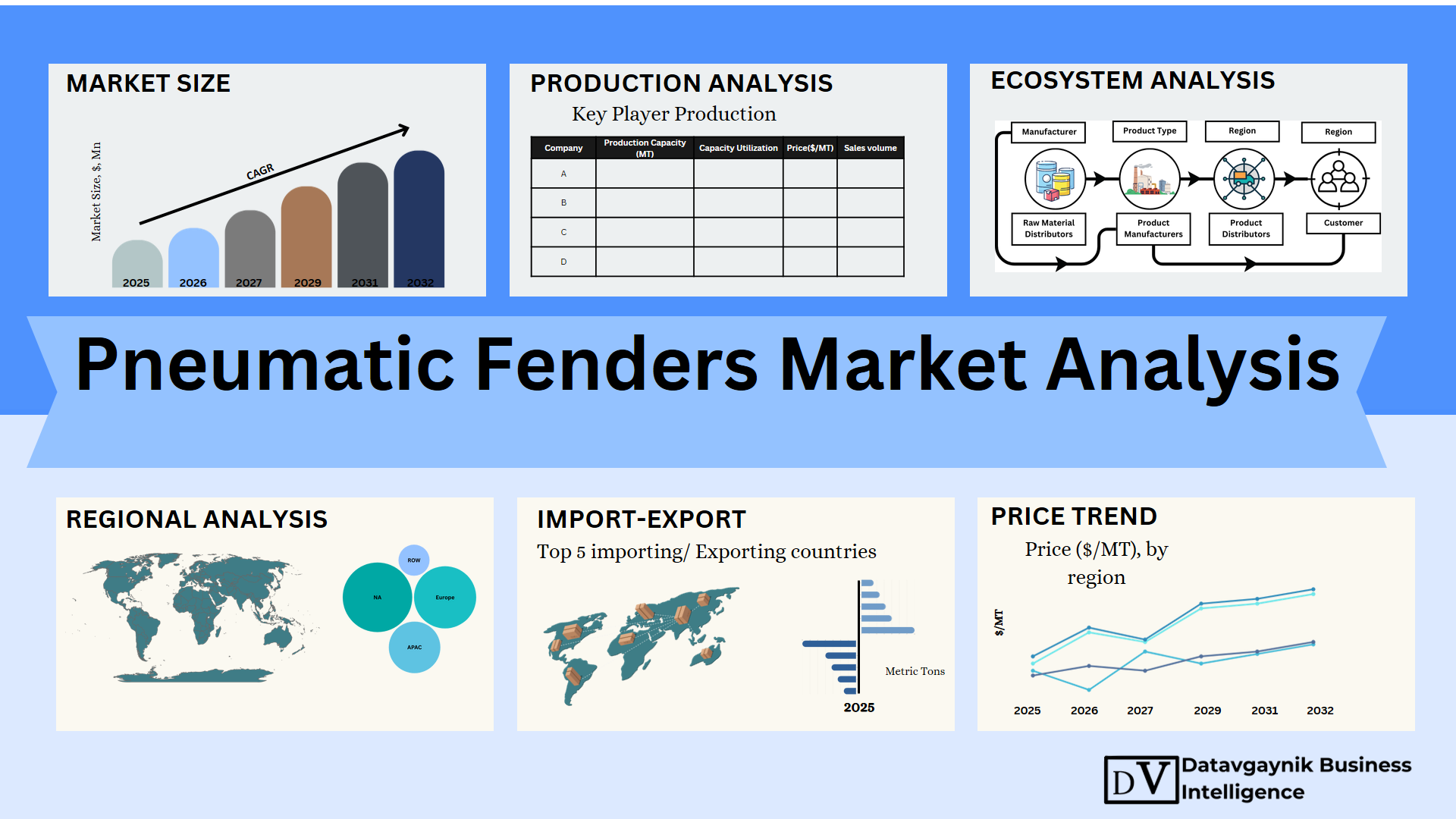
Pneumatic fenders are air-filled rubber protection systems used to absorb berthing energy and reduce contact pressure between vessels or between a vessel and a port structure. Their floating design allows the fender to follow changing water levels. This makes them suitable for ship-to-ship transfers, offshore terminals, naval facilities, temporary berths, and ports handling vessels with different freeboard levels.
Datavagyanik also covers related markets such as the Polyamide Pneumatic Actuator Market. Tracking these sectors reveals parallel dynamics and helps anticipate shifts likely to affect the primary market.
The commercial role of these products is tied to marine asset protection. Damage during berthing can result in repair expenses, cargo delays, environmental exposure, and lost operating time. A certified fender is a relatively small investment compared with the value of an LNG carrier, tanker, naval vessel, or offshore platform it protects.
Demand in the Pneumatic Fenders Market will be supported by the expansion of LNG and crude oil transfer infrastructure. Floating storage and regasification units, offshore terminals, and ship-to-ship energy transfers require fenders that can accommodate vessel movement without placing excessive pressure on the hull. Large pneumatic units are particularly relevant where permanent berthing structures are unavailable or commercially impractical.
Port modernization is another demand factor. Older ports are being adapted to receive larger vessels, while new terminals in Asia, the Middle East, Africa, and Latin America are being designed for more flexible vessel combinations. Pneumatic fenders offer a practical option because they can be installed without extensive structural modification. They can also be relocated when berth configurations change.
The technology is governed mainly by ISO 17357-1:2014 for high-pressure floating pneumatic rubber fenders and ISO 17357-2:2014 for low-pressure products. These standards define material, dimensional, performance, testing, and inspection requirements. Compliance is becoming more important in tenders because buyers want verifiable energy-absorption performance rather than nominal product dimensions alone. ISO confirms that the high-pressure standard covers fenders used for ship-to-ship and ship-to-structure berthing.
Production is concentrated among established Japanese, European, and Asian manufacturers, supported by a wider group of regional fabricators. The manufacturing process requires controlled rubber compounding, reinforcement-layer placement, vulcanization, pressure testing, and performance validation. So, the commercial barrier is not simply the ability to manufacture a large rubber body. Consistent energy absorption, low reaction force, air retention, and structural integrity must also be demonstrated.
Raw-material economics will remain important through 2035. Natural and synthetic rubber, reinforcing tire cord, steel chains, aircraft-tire nets, flanges, and valves account for a large part of production cost. Higher steel and rubber prices can raise tender values. However, buyers generally place lifecycle performance ahead of the lowest initial price in LNG, offshore, and naval applications.
The market’s expansion will remain measured rather than explosive. Pneumatic fenders are durable capital products, so replacement cycles are long. Orders are also project-based and may shift between years. That said, growing vessel size, higher offshore transfer activity, stricter inspection practices, and the replacement of uncertified products create a stable revenue base.
| Market indicator | 2026 | 2035 |
| Global market value | $565 million | $895 million |
| Forecast CAGR | — | 5.2% |
| Main demand base | Commercial ports and ship-to-ship transfers | Offshore energy, modern ports and specialized vessels |
| Strategic purchasing factor | ISO compliance and acquisition cost | Lifecycle reliability and verified performance |
Key consumers and clients
- Commercial port authorities and terminal operators
- Oil, LNG, LPG, and petrochemical terminal owners
- Ship-to-ship transfer service providers
- Offshore platform and floating production operators
- Shipyards and marine engineering contractors
- Shipping lines and vessel owners
- Naval forces, coast guards, and defense shipyards
- Tug, salvage, and emergency-response operators
- Fender rental and marine equipment service companies
Expert view: By 2035, purchasing decisions will place greater weight on certified performance, service history, and inspection support. Low-cost products without traceable testing may remain present, but they will face tighter acceptance in high-value energy and defense projects.
Market Segmentation and Forecast Scope
The Pneumatic Fenders Market can be assessed by pressure class, construction format, application, end user, and region. Each dimension addresses a different commercial question. Pressure class determines performance behavior. Construction format affects installation and protection. Application indicates the operating environment, while end-user segmentation explains procurement patterns.
By Product Type
- High-pressure pneumatic fenders
- Low-pressure pneumatic fenders
- Hydro-pneumatic fenders
High-pressure pneumatic fenders account for an estimated 72% of global revenue in 2026. They are widely used for commercial ship-to-ship transfers, permanent port installations, and terminals serving tankers, LNG carriers, bulk vessels, and container ships. Standard initial internal pressure classifications commonly include 50 kPa and 80 kPa designs, selected according to required energy absorption and allowable reaction force.
Low-pressure pneumatic fenders use a large contact area to distribute loads across the hull. Their portability and ability to be deflated support temporary operations, sensitive hull structures, yachts, naval vessels, and selected offshore work. The segment is smaller but commercially relevant where low hull pressure is more important than compact installed size.
Hydro-pneumatic fenders combine air and water to support contact below the waterline. They are designed mainly for submarines and vessels with unusual hull geometry, low freeboard, or deep draft. This is a specialized category with limited unit demand but high engineering and certification value.
Hydro-pneumatic systems are projected to be the most technically strategic product group. Growth will come from naval fleet renewal and submarine-support infrastructure. However, standard high-pressure units will continue to generate most market revenue.
By Construction and Protection Format
- Sling-type pneumatic fenders
- Chain-and-tire-net fenders
- Ribbed or reinforced-body designs
- Customized heavy-duty assemblies
Sling-type fenders are supplied without a surrounding chain-and-tire net. They are lighter and easier to handle in applications where external abrasion and repeated contact are limited.
Chain-and-tire-net fenders include a protective layer made from chains, used tires, sleeves, shackles, and related fittings. The network protects the rubber body from abrasion and distributes external contact forces. These fenders are common in demanding commercial and offshore operations.
Customized assemblies are developed for unusual vessel sizes, severe operating conditions, or highly specific berth geometry. Their production volumes are lower, but the higher engineering content supports stronger unit pricing.
By Application
- Ship-to-ship transfer
- Ship-to-quay and ship-to-jetty berthing
- Offshore platforms and floating terminals
- Naval and submarine berthing
- Shipyards, dry docks, and repair facilities
- Temporary and emergency berthing
Ship-to-ship transfer represents an estimated 38% of market revenue in 2026. The segment benefits from crude oil, refined product, LNG, and LPG transfers conducted away from permanent terminals. Pneumatic fenders are well suited to this work because their large contact area and floating movement accommodate differences between the two vessels.
Ship-to-quay applications form a stable demand base across commercial ports. Pneumatic units may be used permanently or introduced as temporary protection when a berth receives an unusually large vessel.
Offshore platforms and floating terminals are forecast to record the fastest commercial growth through 2035. Floating LNG infrastructure, FPSOs, offshore loading operations, and remote energy projects need equipment that can be deployed without conventional quay construction. Large-diameter products generate substantial revenue because of their higher material, testing, and handling requirements.
Use case: A floating LNG terminal receiving carriers of different sizes can reposition pneumatic units according to vessel geometry. This gives the operator more berth flexibility than a completely fixed fender arrangement.
By End User
- Port and terminal operators
- Oil and gas companies
- Shipping and marine logistics companies
- Defense and government agencies
- Shipyards and marine contractors
- Equipment rental and service providers
Port and terminal operators purchase fenders for new berths, terminal upgrades, replacements, and contingency inventories. Procurement commonly involves engineering consultants, EPC contractors, and third-party inspection agencies.
Oil and gas companies require large certified products for LNG, crude oil, LPG, and offshore transfer operations. This group places strong emphasis on documented energy absorption, reaction force, traceable materials, and inspection records.
Defense agencies form a smaller but strategically important customer group. Naval berthing may require specialized pressure profiles, hull-contact characteristics, and hydro-pneumatic designs. Tender qualification is strict and purchasing cycles are long.
Rental and service providers are gaining relevance for temporary port work, offshore campaigns, emergency replacement, and short-duration ship-to-ship projects. Rental allows operators to access large certified fenders without purchasing equipment that may be used only periodically.
By Region
- North America
- Europe
- Asia Pacific
- Latin America
- Middle East and Africa
Asia Pacific is the largest regional market. The region combines high vessel traffic, extensive shipbuilding activity, expanding LNG handling, large commercial ports, and a strong manufacturing base. China, Japan, South Korea, Singapore, Indonesia, and India are central demand locations.
North America generates demand from LNG export terminals, petroleum logistics, commercial ports, naval bases, and coastal infrastructure upgrades. Tender requirements are technically rigorous, and suppliers with engineering and after-sales capabilities are better placed to compete.
Europe has a mature port network but continues to require replacement fenders, offshore support systems, floating energy infrastructure, and rental services. Northern European ports and offshore operations support demand for certified, durable products.
The Middle East and Africa are expected to form the fastest-growing regional grouping through 2035. Port expansion, offshore energy projects, crude and LNG terminals, and new maritime trade corridors will create opportunities. Local servicing and rapid equipment availability will be critical, as the cost of transporting large fenders can materially affect delivered prices.
Latin American demand will remain linked to commodity-export terminals, offshore oil and gas operations, naval infrastructure, and port modernization. Brazil, Mexico, Chile, Panama, and selected Caribbean locations represent notable project markets.
Market Trends and Business Innovations
Innovation in the Pneumatic Fenders Market is focused on reliability, scale, verification, and operational support. The basic air-filled concept is mature. So, manufacturers are improving the product around that core rather than replacing it.
R&D Evolution
R&D programs increasingly use application-specific berthing calculations. Fender selection considers vessel displacement, approach velocity, berthing angle, hull pressure limits, environmental conditions, and safety margins. Suppliers are using these variables to engineer product size and internal pressure more precisely.
Simulation is also improving. Finite-element analysis helps evaluate stress in the rubber body, reinforcement layers, flanges, and end fittings before a prototype is produced. This may reduce design revisions for oversized offshore or naval units. Physical compression and pressure-retention tests will remain essential because digital analysis cannot replace certified performance testing.
A further focus is consistency between published performance and delivered products. Manufacturers are strengthening material traceability, dimensional inspection, air-leak testing, prototype validation, and third-party certification. Yokohama Rubber, Trelleborg Marine and Infrastructure, and ShibataFenderTeam state that their pneumatic products are manufactured or tested in line with ISO 17357-1:2014 requirements.
Technology Evolution
Larger fenders are being engineered for offshore energy assets and very large vessels. Yokohama Rubber reports that it developed a 6.0-meter × 11.5-meter floating fender for an LNG-FPSO application. The development illustrates how suppliers are moving beyond standard port sizes toward high-energy, project-specific equipment.
Low-pressure systems are another area of development. These products create a larger contact surface and lower pressure on the vessel’s hull. They are useful for vessels that cannot tolerate concentrated loads. Hydro-pneumatic systems take this concept further by enabling controlled contact below the waterline, particularly for submarines.
Manufacturing methods are also receiving closer scrutiny. Wrapped and molded construction approaches can both meet the relevant standard when correctly executed. Buyers are therefore paying more attention to reinforcement continuity, adhesion quality, vulcanization control, testing, and documented performance than to manufacturing labels alone.
Digital technology is entering mainly through inspection and asset management. Pressure sensors, serialized maintenance records, QR-based documentation, and remotely accessible inspection histories can help operators track inflation pressure, repair events, age, and certification status. Full AI integration is not yet a central market feature. Data-based maintenance is the more realistic near-term direction.
Expert view: The most useful digital advance will not be an “intelligent fender” in isolation. It will be a traceable service record that tells the terminal when the unit was tested, repaired, rotated, or exposed to abnormal impact.
Material Science and Durability
The fender body generally combines an abrasion-resistant outer rubber layer, reinforcement using synthetic tire-cord fabric, and an inner rubber layer designed to retain pressurized air. Material development is therefore directed toward four practical goals:
- Better resistance to abrasion, weathering, seawater, and ultraviolet exposure
- Stronger adhesion between rubber and reinforcement layers
- Lower risk of air leakage and fatigue cracking
- Longer service life under repeated compression
The protective net is evolving as well. Better chain sleeves, galvanized components, high-strength fittings, and improved tire arrangements can reduce localized wear. These components are commercially important because damage often begins at contact points rather than through immediate failure of the complete fender body.
Sustainability will influence materials, but slowly. Manufacturers can improve rubber utilization, extend operating life, repair reusable units, and recover steel components. However, safety-critical marine applications will limit rapid substitution with unproven recycled materials. Lifecycle extension is likely to deliver a more immediate environmental benefit than a wholesale change in raw materials.
Service, Rental and Lifecycle Innovation
The market is shifting from product-only supply toward lifecycle support. Services include berth assessment, product selection, installation, inflation, inspection, repair, chain-net replacement, pressure checks, and emergency deployment.
Rental is becoming commercially attractive for temporary projects. Trelleborg offers floating pneumatic and foam fender rental services in Europe and Asia Pacific, including delivery and installation. This model reduces upfront capital requirements for operators with short-duration needs and creates recurring service revenue for suppliers. Trelleborg’s rental service reflects this broader move toward availability-based support.
Fender-handling systems are another adjacent innovation. In 2023, Trelleborg entered a multi-year exclusive distribution agreement with VIKING Life-Saving Equipment for fender davit systems. Davits support safer deployment, retrieval, and storage of large floating fenders. The partnership expands the commercial offer from the fender itself to the surrounding handling system.
Competitive and Business-Model Developments
The supplier landscape is moving toward broader marine-protection portfolios. Major manufacturers increasingly combine pneumatic fenders with fixed rubber fenders, foam-filled systems, mooring products, monitoring tools, installation support, and maintenance services. This improves their position in large port and offshore contracts where buyers prefer fewer accountable vendors.
Partnerships with regional distributors and marine service firms will remain important. Pneumatic fenders are bulky, and emergency demand can be time-sensitive. A supplier with nearby inventory, technicians, inflation equipment, spare chains, and repair capability may have an advantage even when the core product is manufactured elsewhere.
Formal mergers in this niche occur less frequently than distribution and service partnerships. The practical consolidation is happening through wider product portfolios, local representation, and bundled contracts.
Expert view: Future competition will not be decided by rubber price alone. Suppliers that combine verified performance, rapid regional delivery, installation support, and repair capability will secure a larger share of premium projects through 2035.
Competitive Intelligence and Benchmarking
Competition is divided between premium global suppliers, engineering-led marine system companies, regional manufacturers, and equipment-rental specialists. Large LNG, oil transfer, naval, and offshore contracts generally favor suppliers with documented testing, international certification, and installation support. Regional manufacturers compete more heavily on price, customization, and delivery time.
Yokohama Rubber Co., Ltd.
Yokohama Rubber holds a strong position in high-pressure floating pneumatic fenders. Its experience covers conventional ship-to-ship units, fixed pneumatic systems, and oversized fenders for LNG and offshore applications. The company has established recognition among energy terminals, naval users, port authorities, and transfer-service providers.
Its competitive position is built around proven operating history, controlled rubber production, large-size engineering, and compliance with ISO 17357-1:2014. The company’s development of a 6.0-meter × 11.5-meter unit for an LNG-FPSO demonstrates its capability in technically demanding projects. Premium pricing is supported by certification, field performance, and brand confidence.
Trelleborg Marine and Infrastructure
Trelleborg Marine and Infrastructure offers high-pressure, low-pressure, and hydro-pneumatic solutions alongside fixed fenders, mooring systems, monitoring tools, and port-engineering services. This wide portfolio allows it to compete for complete berth-protection packages rather than isolated product orders.
Its global engineering network is an advantage in ports, offshore energy terminals, naval facilities, and complex berthing projects. Trelleborg also provides rental, installation, maintenance, and handling support. This creates recurring service income and strengthens customer retention.
The company is positioned around engineered performance rather than volume-led pricing. Its hydro-pneumatic capabilities are particularly relevant to submarine berthing and vessels requiring contact below the waterline.
ShibataFenderTeam Group
ShibataFenderTeam competes as an engineering-centered supplier of pneumatic, foam-filled, and fixed rubber fender systems. Its pneumatic range includes different pressure levels and construction methods. The company emphasizes that both wrapped and molded designs can meet international standards when manufacturing and testing are properly controlled.
Its market position is supported by technical documentation, project engineering, quality control, and a global distributor network. It is particularly competitive in commercial ports, offshore terminals, shipyards, and projects where consultants specify documented energy absorption and reaction-force performance.
James Fisher Fendercare
James Fisher Fendercare is a major service and distribution participant rather than a conventional large-scale fender manufacturer. It supplies, rents, deploys, inspects, and maintains premium pneumatic fenders. It also supports ship-to-ship transfer operations and provides related hoses, mooring products, and marine equipment.
Its market strength comes from equipment availability, international operating bases, trained marine personnel, and a large rental inventory. This position is important when customers need certified fenders for temporary projects or emergency replacement.
The company’s cooperation with Yokohama Rubber gives it access to established pneumatic-fender technology while allowing it to concentrate on lifecycle services. Its model is especially relevant to LNG transfers, petroleum movements, offshore campaigns, and ports that do not want to own rarely used oversized equipment.
Qingdao Evergreen Maritime
Qingdao Evergreen Maritime is a Chinese manufacturer supplying pneumatic rubber fenders, foam-filled systems, ship-launching airbags, and other marine products. The company addresses both domestic Chinese demand and export markets.
Its competitive strengths include production scale, customization, broader dimensional availability, and cost positioning. It serves commercial ports, shipyards, offshore contractors, and distributors seeking lower procurement costs than those typically associated with premium Japanese and European brands.
The main competitive challenge for Chinese suppliers is not product availability. It is gaining acceptance in high-specification tenders where independent prototype testing, material traceability, and long operating references carry substantial weight.
Nanjing JIER Marine
Nanjing JIER Marine supplies pneumatic and hydro-pneumatic fenders alongside fixed rubber systems, foam-filled units, mooring bollards, and port accessories. Its portfolio allows it to participate in both standard product supply and broader berth-engineering packages.
The company has a competitive position in price-sensitive ports and infrastructure projects, particularly across Asia, the Middle East, Africa, and emerging maritime markets. Its hydro-pneumatic offering also gives it access to specialized naval and semi-submersible applications.
JIER’s ability to provide customized dimensions and supporting port equipment improves its appeal to EPC contractors. However, international growth depends on consistent testing, third-party acceptance, and locally available technical support.
| Company | Core market position | Portfolio breadth | Service strength | Strategic application |
| Yokohama Rubber | Premium technology leader | High | High through partners | LNG, offshore and ship-to-ship |
| Trelleborg Marine and Infrastructure | Integrated marine systems supplier | Very high | Very high | Ports, offshore and naval |
| ShibataFenderTeam | Engineering-led global supplier | High | High | Commercial ports and terminals |
| James Fisher Fendercare | Rental and lifecycle specialist | Medium | Very high | Temporary and STS operations |
| Qingdao Evergreen Maritime | Cost-competitive manufacturer | High | Moderate | Shipyards and emerging markets |
| Nanjing JIER Marine | Customized port-equipment supplier | High | Moderate | Ports, offshore and naval |
Expert view: Competitive advantage is shifting from manufacturing capacity toward verified performance and equipment availability. Large customers increasingly want the fender, deployment system, inspection record, repair support, and emergency replacement capability under one commercial arrangement.
Regional Landscape and Adoption Outlook
Regional demand reflects port investment, vessel traffic, offshore energy activity, shipbuilding capacity, and the maturity of procurement standards. Asia remains the production and consumption center, while North America and Europe generate technically demanding replacement and LNG-related business.
United States
The United States represents a high-value market supported by commercial ports, naval bases, petroleum terminals, and expanding LNG export infrastructure. Demand is concentrated along the Gulf Coast, Atlantic Coast, and selected Pacific ports.
Texas and Louisiana are important growth locations because of LNG terminal construction and energy exports. New and expanded facilities require marine protection systems for carriers, service vessels, loading areas, and temporary construction berths. The growing LNG ecosystem also creates demand for rental fenders during commissioning and maintenance.
Public port authorities fund general berth modernization, while private energy companies finance specialized terminal infrastructure. Procurement typically requires engineering calculations, traceable testing, safety documentation, and third-party inspection. This creates a relatively high entry barrier for unverified products.
The United States will remain a moderate-growth but premium-priced market. Replacement demand, naval procurement, and energy-terminal construction will be more important than large-scale installation across standard container ports.
Europe
Europe has a mature port network, so replacement and infrastructure adaptation generate more business than completely new port construction. The leading demand centers include the Netherlands, Germany, Norway, Italy, Spain, the United Kingdom, and Belgium.
The expansion of floating LNG import infrastructure has strengthened demand for temporary and semi-permanent fender arrangements. Offshore energy activity in the North Sea supports requirements for platform-support vessels, floating facilities, and transfer operations.
European customers give strong weight to lifecycle cost, certified performance, worker safety, and environmental impact. Rental and refurbishment services are therefore more developed than in many emerging regions. European ports may rent oversized pneumatic units for temporary calls rather than maintain underutilized equipment.
Europe also has strict public procurement and technical-documentation practices. Suppliers offering verified ISO 17357 compliance, inspection services, and regional inventory hold a clear advantage.
China
China is one of the largest production and consumption centers. Its market is supported by a broad port network, high cargo throughput, shipbuilding activity, naval investment, offshore projects, and domestic fender manufacturing.
Major demand locations include Shanghai, Ningbo-Zhoushan, Qingdao, Tianjin, Shenzhen, and coastal energy terminals. Large commercial ports generally use a combination of fixed and floating fenders. Pneumatic systems are chosen for temporary berths, ship-to-ship transfers, shipyards, offshore operations, and terminals handling changing vessel profiles.
China has a cost and supply-chain advantage because rubber-product manufacturers, steel-component suppliers, shipyards, and port-equipment companies are located within the same industrial ecosystem. This allows shorter lead times and extensive customization.
That said, quality varies between suppliers. Export-oriented manufacturers are investing in international certification and third-party testing to compete in premium projects outside China. The country will remain an important volume market, although price competition may limit average revenue growth.
India
India is among the most attractive emerging markets through 2035. Growth is linked to Sagarmala projects, new deep-water ports, LNG and petroleum terminals, private port investment, naval modernization, and rising cargo volumes.
In FY 2025–26, India’s major ports handled a record 915 million tonnes of cargo. The Sagarmala program covered 845 projects valued at ₹6.06 lakh crore, while 315 projects worth ₹1.57 lakh crore had been completed by April 2026. This project pipeline expands the addressable base for berthing and mooring equipment.
High-potential locations include Gujarat, Maharashtra, Kerala, Tamil Nadu, Andhra Pradesh, and Odisha. Gujarat combines commercial ports, LNG terminals, petroleum handling, and ship-recycling activity. Maharashtra is developing the large Vadhavan port project. Kerala’s Vizhinjam facility strengthens India’s deep-water container infrastructure.
Funding comes from the central government, state maritime boards, public port authorities, and private operators such as Adani Ports, JSW Infrastructure, and APM Terminals. Procurement remains price-aware, but certification is becoming more important in LNG, naval, and international terminal projects.
Japan
Japan is both an established technology base and a mature end market. Demand comes from LNG import terminals, industrial ports, shipyards, naval and coast-guard facilities, and replacement of aging marine equipment.
Japanese procurement places strong emphasis on reliability, product history, quality assurance, and long service life. Yokohama Rubber gives the country an important domestic technology position. The market also benefits from Japan’s extensive experience with large vessels, offshore transfer systems, and high-specification marine rubber products.
Market expansion will be modest because port infrastructure is mature. However, premium replacement demand, LNG operations, and specialized vessels will preserve attractive unit values.
South Korea
South Korea combines large commercial ports with one of the world’s most capable shipbuilding industries. Busan, Ulsan, Incheon, Gwangyang, and major shipyards operated by HD Hyundai, Hanwha Ocean, and Samsung Heavy Industries form the core demand ecosystem.
Pneumatic fenders are used in ship construction, vessel outfitting, repair yards, energy terminals, and temporary berthing. Offshore-platform construction and LNG-carrier production also support demand for large, certified units.
Domestic shipyards have strong engineering capability and demanding supplier-qualification processes. This favors manufacturers able to provide technical calculations, consistent rubber performance, and on-time project delivery. Growth will remain stable, with shipbuilding cycles influencing annual purchases.
Middle East
The Middle East is a strategic high-growth region due to crude oil exports, LNG expansion, petrochemical logistics, naval spending, and large port-development programs. The most important markets include the UAE, Saudi Arabia, Qatar, and Oman.
The UAE has developed major maritime hubs at Jebel Ali, Khalifa Port, and Fujairah. Saudi Arabia is investing in ports, industrial terminals, shipbuilding, and offshore energy. Qatar’s LNG expansion supports carrier movements and associated marine infrastructure. Oman offers growth through Duqm, Sohar, and Salalah.
Projects are funded by national energy companies, sovereign-backed port groups, industrial-zone developers, and private partners. Tender sizes can be large, but customers expect rapid regional service because equipment downtime at an oil or LNG terminal is expensive.
The region presents a strong opportunity for premium suppliers and rental companies. Local stocking, repair capability, and relationships with EPC contractors will be central to market access.
| Geography | Adoption level | Principal growth engine | Procurement characteristic |
| United States | High | LNG exports and naval infrastructure | Strict technical qualification |
| Europe | High and mature | Replacement, FSRUs and offshore energy | Lifecycle and sustainability focus |
| China | High | Ports, shipbuilding and domestic production | Strong price competition |
| India | Developing rapidly | New ports and rising cargo handling | Public-private investment mix |
| Japan | Mature | Replacement and specialized applications | Premium quality preference |
| South Korea | High | Shipbuilding and energy terminals | Engineering-led qualification |
| Middle East | Developing rapidly | LNG, oil terminals and port expansion | Large projects and regional servicing |
Recent Developments, Opportunities and Restraints
Recent Developments
- August 2024 – India approves major port investment: The Indian government confirmed the ₹76,220 crore Vadhavan Major Port project in Maharashtra. The deep-water development will expand container and general maritime capacity, creating future demand for berthing systems, floating protection, and port-service equipment.
- November 2025 – LNG and LPG terminal agreement in the UAE: AD Ports Group and Nimex Terminals signed agreements to develop private-sector LNG and LPG terminal hubs at Khalifa Port. The arrangement carries a stated value exceeding AED 30 billion over its commercial term and is designed to accommodate large gas carriers.
- February 2026 – Rapid fender-deployment solution introduced: James Fisher announced a new system intended to accelerate fender deployment. The development addresses a practical industry challenge: moving, installing, and recovering large floating fenders safely and with less vessel time.
- April 2026 – India expands the Sagarmala program: The government reported 845 projects worth ₹6.06 lakh crore, including completed coastal berths that added 9.84 million tonnes per annum of handling capacity. Sagarmala 2.0 was supported by ₹85,482 crore and intended to catalyze further maritime investment.
Opportunities and Business Insights
Emerging port infrastructure: India, the Middle East, Southeast Asia, and parts of Africa offer the strongest greenfield opportunity. Suppliers can target new deep-water ports, LNG terminals, naval facilities, and offshore logistics bases.
Rental and service-based revenue: Temporary operations do not always justify equipment ownership. Rental, inspection, repair, deployment, and certified replacement services can create recurring revenue and reduce dependence on irregular product orders.
Remote condition monitoring: Pressure sensors, RFID identification, digital inspection records, and service alerts can improve maintenance planning. AI has limited direct relevance today, but predictive analytics may become useful once operators collect reliable pressure, impact, and repair data.
Market Restraints
- Long replacement cycles restrict repeat product sales.
- Uncertified, low-price products create margin pressure in less regulated markets.
- Large fenders are costly to transport, store, deploy, and recover.
- Rubber and steel price movements affect manufacturing costs.
- Port and LNG projects can face long approval and construction delays.
- Failure to inspect pressure, chains, nets, and fittings creates operational risk.
- Foam-filled and fixed rubber systems compete in applications where air retention or routine inspection is viewed as a disadvantage.
Expert view: The Pneumatic Fenders Market offers steady expansion, but value will concentrate around large certified products and lifecycle services. Suppliers competing only on initial price will remain exposed to irregular orders and limited customer loyalty.


