

Rising Demand in Nuclear Sector Driving the Polonium Oxide Market
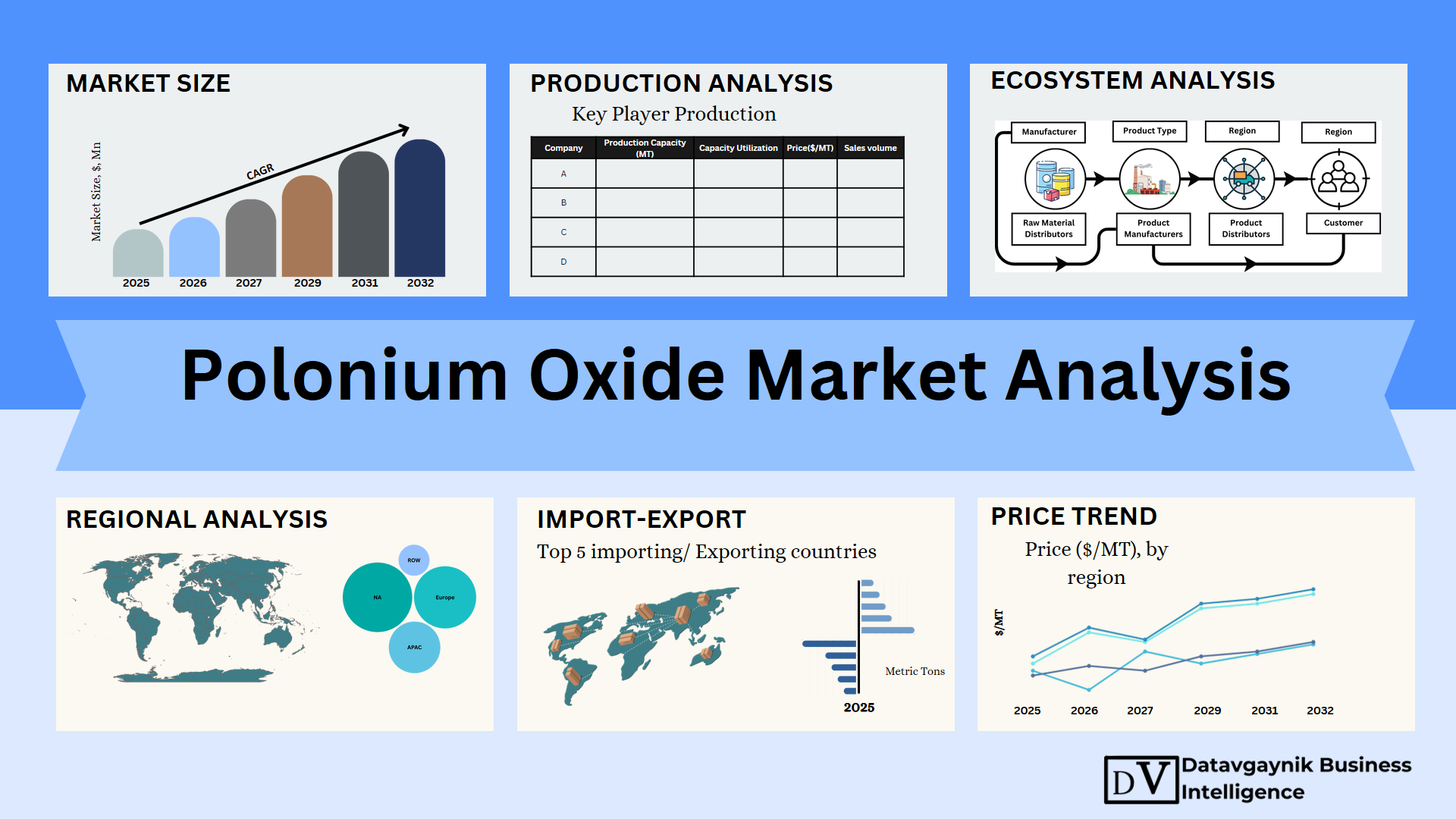
The Polonium Oxide Market is experiencing significant traction due to increasing reliance on advanced nuclear technologies. Polonium-210, a derivative of polonium oxide, is a key material in neutron sources used for initiating nuclear reactions. According to Datavagyanik, the global nuclear energy capacity surpassed 390 GW in 2023, driven by expansions in countries like China, Russia, and the United States. These developments are directly contributing to heightened demand for neutron-emitting materials like polonium oxide. For instance, China’s nuclear generation grew by 5.5% year-over-year, while its new reactor pipeline continues to expand, prompting increased imports of high-grade nuclear materials. As a result, the Polonium Oxide Market is increasingly intertwined with the global nuclear infrastructure buildout.
Polonium Oxide Market Fueled by Advancements in Space-Based Power Technologies
Another major driver of the Polonium Oxide Market is the rapid acceleration of space missions and the adoption of radioisotope thermoelectric generators (RTGs). RTGs depend on alpha-emitting isotopes such as polonium-210 for compact, long-lasting power in extreme environments. For instance, NASA’s deep-space missions, such as the Voyager and New Horizons probes, utilize RTGs that benefit from the dense energy output of polonium-derived materials.
As private firms like SpaceX and national agencies including CNSA and ISRO scale up interplanetary missions, the use of polonium oxide in RTG systems is becoming more prominent. Datavagyanik highlights that space exploration budgets globally exceeded $108 billion in 2023, with at least 12% allocated to power and propulsion systems, indicating robust future growth potential for the Polonium Oxide Market.
Datavagyanik also covers related markets such as the Polonium Sulfate Market. These compounds are commonly used in oxidation systems and industrial chemical processing, supporting shifts in formulation standards and regulatory compliance.
Polonium Oxide Market Trends Driven by Industrial Static Elimination Applications
The industrial applications of polonium oxide are expanding rapidly, particularly in static elimination devices used in electronics manufacturing. In high-precision environments such as semiconductor cleanrooms, polonium-based static eliminators ensure defect-free production. Global semiconductor sales were valued at $526 billion in 2023 and are projected to reach $630 billion by 2026, reflecting a CAGR of over 6%. With such growth, demand for clean manufacturing conditions is accelerating. For example, Samsung and Intel have invested heavily in facilities equipped with advanced electrostatic discharge protection systems that rely on polonium oxide. This trend is creating consistent, regulated demand for the Polonium Oxide Market in high-tech manufacturing.
Strategic Role of Polonium Oxide Market in Defense Technologies
The defense sector’s increasing use of polonium oxide is also a defining trend in the Polonium Oxide Market. The compound’s neutron-emitting capacity is pivotal for military-grade nuclear devices and research. Countries like the United States, France, and China have steadily expanded R&D in compact nuclear power systems for defense, allocating upwards of $3 billion annually for nuclear material innovation. For instance, the U.S. Department of Energy has collaborated with national laboratories to explore miniature RTGs for unmanned reconnaissance systems. These initiatives translate into higher polonium oxide procurement for neutron source development, making the defense sector a strategic contributor to Polonium Oxide Market expansion.
Emerging Medical Innovations Amplifying Polonium Oxide Market Growth
Medical research represents a rising frontier in the Polonium Oxide Market. The alpha-emitting nature of polonium-210 has drawn interest in targeted alpha therapy (TAT), especially for treating difficult cancers like glioblastoma and metastatic melanoma. For example, clinical studies conducted by leading oncology institutes in Europe and Japan have demonstrated the efficacy of alpha particles in destroying cancer cells with minimal collateral damage. Although this application is in early stages, the market is witnessing increasing investment. Datavagyanik reports that global funding for radiopharmaceutical R&D grew by 17% in 2023, totaling nearly $5.8 billion. The integration of polonium oxide into this segment could generate long-term growth, especially if regulatory approvals align with research breakthroughs.
Polonium Oxide Market Size Boosted by Material Science and Coating Applications
Advanced material research has opened new avenues for the Polonium Oxide Market. Polonium oxide’s thermal and radioactive characteristics make it a candidate for high-temperature coatings and nano-material research. For instance, aerospace coating suppliers are investigating its application in extreme-environment protective layers for propulsion systems. The global high-performance coatings market, valued at $12.5 billion in 2023, is expected to exceed $17 billion by 2027. Even if polonium oxide captures a niche share of this segment, it represents a significant uplift in the Polonium Oxide Market Size. Research institutions in Germany and South Korea are spearheading trials to integrate the compound into composites that can resist radiation and extreme heat.
Regulatory Complexity Shaping the Polonium Oxide Market Landscape
While the opportunities are expanding, the Polonium Oxide Market is highly influenced by regulatory frameworks due to the compound’s radioactive nature. Countries that utilize or import polonium oxide must comply with International Atomic Energy Agency (IAEA) guidelines and local nuclear regulatory commissions. For instance, the U.S. Nuclear Regulatory Commission enforces strict licensing for possession and use, which restricts the market to authorized entities. Despite these constraints, regulatory clarity has improved trade flows. France and the UK, for example, have established export channels that comply with Nuclear Suppliers Group (NSG) directives, facilitating safe cross-border transactions and thereby strengthening the Polonium Oxide Market Size on a controlled scale.
Growing Investments and Infrastructure Reinforcing Polonium Oxide Market Expansion
Infrastructure investment in nuclear and space research labs is directly fueling the Polonium Oxide Market. For example, France’s CEA (Commissariat à l’Énergie Atomique) invested over €1.1 billion in 2023 to upgrade its nuclear materials research facilities. Likewise, India’s BARC (Bhabha Atomic Research Centre) has enhanced its isotope laboratories to support advanced alpha-emitter research. These investments are not just theoretical—they result in actual procurement of polonium-based compounds. According to Datavagyanik, the global investment in isotope research and radiological infrastructure grew by 13% annually between 2021 and 2023, a trend expected to continue through 2030, ensuring a stable demand foundation for the Polonium Oxide Market.
Export-Oriented Growth Opportunities in the Polonium Oxide Market
The Polonium Oxide Market also presents lucrative opportunities for export-oriented players operating in Russia, the United States, and select European countries. Russia, for instance, maintains a robust polonium-210 production capacity through state-supported nuclear programs and has supplied countries in Asia and the Middle East for research and industrial use. Belgium’s Institute for Radioelements (IRE) exports isotopes under stringent safety agreements, often bundled with material handling services. As emerging markets like the UAE and Saudi Arabia ramp up nuclear infrastructure, demand for imported polonium oxide is expected to grow. Datavagyanik estimates that the Middle East’s controlled imports of radiological materials increased by over 20% between 2021 and 2023, offering long-term potential for experienced producers.
“Track Country-wise Astatine Oxide Production and Demand through our Astatine Oxide Production Database”
-
-
- Astatine Oxide production database for 22+ countries worldwide
- Astatine Oxide sales volume for 27+ countries
- Country-wise Astatine Oxide production capacity, production plant mapping, production capacity utilization for 22+ manufacturers
- Astatine Oxide production plants and production plant capacity analysis by top manufacturers
-
“Track real-time Astatine Oxide Prices, Astatine Oxide price charts for 22+ countries, Astatine Oxide weekly price tracker and Astatine Oxide monthly price tracker”
-
-
- Track real-time Astatine Oxide prices and Astatine Oxide price trend in 22+ countries though our excel-based Astatine Oxide price charts
- Real-time Astatine Oxide price tracker dashboard with 22+ countries
- Complete transparency on Astatine Oxide price trend through our Astatine Oxide monthly price tracker, Astatine Oxide weekly price tracker
-
North America Dominates High-Precision Applications in the Polonium Oxide Market
The North American Polonium Oxide Market, led by the United States, holds a critical position in global demand, particularly in high-precision industrial and defense applications. The U.S. continues to invest heavily in nuclear innovation, allocating over $9 billion in 2023 for Department of Energy initiatives, including advanced neutron sources and small modular reactors. For instance, national laboratories like Oak Ridge and Los Alamos are engaged in polonium-210 research for both energy and military purposes, directly driving polonium oxide consumption.
Furthermore, the United States’ leadership in space missions contributes significantly to the Polonium Oxide Market. RTGs using polonium derivatives are part of long-duration spacecraft developed under NASA’s Artemis and Dragonfly programs. Datavagyanik identifies North America as accounting for nearly 32% of global polonium oxide consumption in 2023, reflecting the region’s technological maturity and regulatory infrastructure.
European Innovation Strengthening the Polonium Oxide Market
Europe’s Polonium Oxide Market is characterized by advanced nuclear power operations, robust research infrastructure, and strategic industrial usage. France, Germany, and the United Kingdom are primary contributors. France, with 56 nuclear reactors, continues to push the boundaries of polonium oxide application in neutron moderation and energy materials. For instance, the French Alternative Energies and Atomic Energy Commission (CEA) has implemented programs to test new radioisotopic materials, including polonium oxide, for next-generation reactor designs.
Germany, with its focus on industrial manufacturing, particularly in semiconductors, utilizes polonium-based static eliminators in ultra-clean production facilities. In 2023, German exports of semiconductor equipment surpassed €27 billion, indicating strong downstream demand for contamination-control technologies that depend on radioactive static control materials. According to Datavagyanik, Europe commands 28% of the Polonium Oxide Market, with the region expected to expand further through pan-European collaborations in nuclear safety and medical isotopes.
Asia-Pacific Emerging as a Key Growth Region in the Polonium Oxide Market
The Asia-Pacific Polonium Oxide Market has experienced dynamic growth, driven by the region’s strategic expansion in nuclear energy and deep space exploration. China, India, South Korea, and Japan lead in both consumption and localized production. China, in particular, is building over 20 new nuclear reactors under its Five-Year Plan, which includes substantial funding for polonium-based neutron sources. The China National Space Administration’s Chang’e missions also utilize RTG technology, creating sustained demand for polonium oxide.
India’s growing emphasis on isotope research and RTG-based satellite power aligns with increasing demand for niche radiological materials. Datavagyanik reports that Asia-Pacific accounted for 25% of global polonium oxide volume in 2023, and this share is projected to rise above 30% by 2027 due to the region’s cumulative growth in high-technology infrastructure.
Middle East Expanding Niche Opportunities in the Polonium Oxide Market
In the Middle East, the Polonium Oxide Market is gaining momentum, largely due to the nuclear ambitions of the UAE and Saudi Arabia. The Barakah Nuclear Power Plant in the UAE, the first of its kind in the Arab world, represents a significant use case for neutron-emitting compounds, including polonium oxide. Saudi Arabia, under its Vision 2030, has allocated over $30 billion for clean energy and nuclear research, creating emerging demand for specialized isotopic materials.
Iran, with its existing nuclear expertise, remains a regional hub for radiological R&D, contributing to polonium oxide applications in both defense and medical fields. Though market volume remains small compared to larger regions, Datavagyanik identifies the Middle East as a high-potential geography for targeted polonium oxide applications, especially in research reactors and radiopharmaceuticals.
Global Production Landscape of the Polonium Oxide Market
Polonium oxide production is highly centralized, with only a few countries capable of synthesizing and handling the material safely. Russia remains the dominant global producer, with facilities that extract polonium-210 via neutron irradiation of bismuth-209. The Mayak Production Association is known to be a principal source of this isotope, which is further refined into polonium oxide.
The United States also maintains limited production through its national laboratories, largely for domestic defense and scientific use. France and Belgium contribute small-scale but strategic production capabilities within Europe, with the Institute for Radioelements (IRE) in Belgium playing a key role in isotope distribution under strict IAEA oversight. Datavagyanik estimates that Russia supplied over 65% of the global polonium oxide volume in 2023, followed by 15% from Europe and 10% from North America.
Application-Based Segmentation of the Polonium Oxide Market
The Polonium Oxide Market is segmented by application into four core verticals: nuclear energy, aerospace, industrial static eliminators, and medical research. Nuclear energy remains the largest segment, accounting for over 40% of the market. Countries with expanding reactor fleets, such as China and the UAE, are primary drivers.
The aerospace segment holds approximately 25% market share, fueled by RTG development in the U.S., Russia, and India. For example, the Indian Space Research Organisation has initiated RTG feasibility studies for its upcoming lunar and interplanetary missions, setting a strong precedent for sustained polonium oxide demand.
Static eliminators used in cleanroom manufacturing account for about 20% of the Polonium Oxide Market, with major adoption across Japan, Germany, and South Korea. Lastly, the medical segment—although currently under 10% of market share—is poised for double-digit CAGR over the next decade as alpha therapy trials progress in Japan, Canada, and Switzerland.
Regional End-User Segmentation in the Polonium Oxide Market
By end-user industry, the Polonium Oxide Market is segmented into defense, energy, industrial manufacturing, and healthcare. The defense sector leads North America and Russia in usage, particularly in neutron-based technologies. In contrast, Asia-Pacific and Europe see higher industrial uptake, including electronics and coatings sectors.
The healthcare segment is gaining prominence in countries like Japan and Canada, where public-private partnerships are funding clinical trials for polonium-based radiopharmaceuticals. Datavagyanik projects that the healthcare share in polonium oxide applications could double by 2030, reaching nearly 20% of total demand if clinical outcomes remain favorable.
Polonium Oxide Price Trend Influenced by Limited Supply and High Regulatory Costs
The Polonium Oxide Price is among the highest in the isotopic material spectrum due to its hazardous nature, production complexity, and tight supply chain. As of Q4 2024, the average global Polonium Oxide Price ranges between $120,000 and $160,000 per gram, depending on purity levels and regulatory requirements.
A key factor influencing the Polonium Oxide Price Trend is regulatory compliance. For instance, export licenses under the Nuclear Suppliers Group framework often include costs related to secure transport and end-user verification, which are passed onto the buyer. Additionally, disposal protocols further elevate the total lifecycle cost of polonium oxide-based products.
Regional Pricing Variations Shaping the Polonium Oxide Market
In Russia, where polonium oxide production is state-supported, prices remain relatively lower, estimated at $110,000–$130,000 per gram for state buyers. However, for buyers in Western Europe or the United States, import restrictions and packaging standards push the Polonium Oxide Price well above $150,000 per gram.
Datavagyanik reports that the Polonium Oxide Price Trend is expected to remain upward due to restricted production expansion and increasing downstream applications. Countries like India and South Korea, which rely on imports, face the highest price pressures, especially during high-demand cycles in space and medical research sectors.
Future Outlook for the Polonium Oxide Price Trend
The Polonium Oxide Price Trend over the next five years is projected to follow a moderate upward curve, with an estimated CAGR of 4–6% through 2030. This outlook is based on growing demand from nuclear and medical research and continued limitations on production scalability.
For example, if the European Space Agency’s Jupiter Icy Moons Explorer mission proceeds with RTG enhancements, the procurement of polonium oxide could strain the current supply. Similarly, the introduction of alpha therapy drugs using polonium-210 isotopes will likely add incremental pressure to pricing.
Datavagyanik indicates that the Polonium Oxide Market will likely benefit from vertical integration among producers, research institutions, and end-users to mitigate pricing volatility. Partnerships between isotope manufacturers and radiopharma companies are already being explored to create closed-loop sourcing mechanisms, which could stabilize the Polonium Oxide Price Trend in the medium term.
“Astatine Oxide Manufacturing Database, Astatine Oxide Manufacturing Capacity”
-
-
- Astatine Oxide top manufacturers market share for 22+ manufacturers
- Top 6 manufacturers and top 12 manufacturers of Astatine Oxide in North America, Europe, Asia Pacific
- Astatine Oxide production plant capacity by manufacturers and Astatine Oxide production data for 22+ market players
- Astatine Oxide production dashboard, Astatine Oxide production data in excel format
-
“Astatine Oxide price charts, Astatine Oxide weekly price tracker and Astatine Oxide monthly price tracker”
-
-
- Factors impacting real-time Astatine Oxide prices in 17+ countries worldwide
- Astatine Oxide monthly price tracker, Astatine Oxide weekly price tracker
- Real-time Astatine Oxide price trend, Astatine Oxide price charts, news and updates
- Tracking Astatine Oxide price fluctuations
-
Leading Manufacturers in the Polonium Oxide Market
The Polonium Oxide Market is characterized by a limited number of specialized manufacturers due to the compound’s highly radioactive nature and stringent regulatory controls. The primary producers are concentrated in countries with advanced nuclear technologies and robust safety protocols.
- Mayak Production Association (Russia):
Mayak Production Association stands as a pivotal entity in Russia’s nuclear industry, historically recognized for its production of polonium-210, the precursor to polonium oxide. The facility’s capabilities encompass the entire production cycle, from irradiation of bismuth targets to chemical processing and refinement. Mayak’s polonium products are integral to Russia’s space and defense sectors, particularly in the development of radioisotope thermoelectric generators (RTGs) and neutron sources.
- Oak Ridge National Laboratory (United States):
In the United States, Oak Ridge National Laboratory (ORNL) plays a significant role in the research and production of specialized isotopes, including polonium-210. While ORNL’s production scale is comparatively smaller, it focuses on high-purity outputs tailored for research institutions and niche industrial applications. The laboratory’s contributions are vital to advancements in nuclear science and radiological studies.
- Institute for Radioelements (Belgium):
Belgium’s Institute for Radioelements (IRE) is renowned for its expertise in the production and processing of radioisotopes. Although primarily focused on medical isotopes, IRE’s infrastructure supports the handling of various radioactive materials, positioning it as a potential contributor to the European polonium oxide supply chain. IRE’s commitment to safety and innovation underpins its role in the broader radioisotope market.
Market Share Distribution Among Manufacturers
The Polonium Oxide Market is predominantly led by Russia’s Mayak Production Association, which accounts for an estimated 65% of global production. This dominance is attributed to Russia’s extensive nuclear infrastructure and historical emphasis on isotope production. The United States, through facilities like ORNL, contributes approximately 15% to the market, focusing on specialized, high-purity applications. European entities, including Belgium’s IRE, collectively represent around 10% of production, with the remaining 10% distributed among other nations with emerging capabilities in isotope production.
Specific Product Lines and Applications
Mayak Production Association:
Mayak’s product portfolio includes polonium-210 used in the fabrication of RTGs, which are essential for powering space probes and satellites. Additionally, their polonium-based neutron sources are utilized in oil well logging and other industrial radiography applications.
Oak Ridge National Laboratory:
ORNL specializes in producing research-grade polonium-210, catering to academic and governmental research projects. Their outputs support studies in nuclear physics, material science, and radiological health.
Institute for Radioelements:
IRE’s focus on medical isotopes positions it to explore the production of polonium-based compounds for potential therapeutic applications, particularly in targeted alpha-particle cancer therapies. While this is an emerging field, IRE’s infrastructure is well-suited for such developments.
Recent Industry Developments and News
Diversification Efforts in Nuclear Fuel Supply (January 2024):
In response to geopolitical tensions and the need for supply chain resilience, Western countries have been actively seeking to reduce dependence on Russian-origin nuclear materials. This strategic shift has prompted investments in domestic production capabilities and exploration of alternative suppliers for critical isotopes, including polonium-210. Such initiatives aim to ensure a stable and diversified supply chain for sensitive materials.
Advancements in Medical Isotope Applications (March 2024):
Recent research has highlighted the potential of polonium-210 in targeted alpha-particle therapies for cancer treatment. Institutions in Europe and North America are conducting clinical trials to assess the efficacy and safety of these treatments. Positive outcomes could open new avenues for polonium oxide applications in the medical sector, expanding the market beyond traditional industrial uses.
Regulatory Developments Impacting Isotope Trade (May 2024):
The U.S. administration announced increased tariffs on certain critical minerals and radioactive elements, including polonium, as part of broader trade policy adjustments. Tariffs on these materials are set to rise from 0% to 25%, potentially affecting import costs and encouraging domestic production initiatives. These policy changes underscore the importance of strategic planning for stakeholders in the polonium oxide supply chain.
Environmental Research on Polonium Transfer in Marine Ecosystems (June 2024):
A study published in Toxics examined the transfer of polonium between marine organisms, providing insights into its environmental behavior and potential ecological impacts. Understanding these dynamics is crucial for assessing environmental safety and informing regulatory frameworks related to polonium use and disposal.
“Astatine Oxide Production Data and Astatine Oxide Production Trend, Astatine Oxide Production Database and forecast”
-
-
- Astatine Oxide production database for historical years, 10 years historical data
- Astatine Oxide production data and forecast for next 7 years
- Astatine Oxide sales volume by manufacturers
-
“Track Real-time Astatine Oxide Prices for purchase and sales contracts, Astatine Oxide price charts, Astatine Oxide weekly price tracker and Astatine Oxide monthly price tracker”
-
-
- Gain control on your purchase and sales contracts through our real-time Astatine Oxide price tracker and Astatine Oxide price trend analysis
- Astatine Oxide weekly price tracker and forecast for next four weeks
- Astatine Oxide monthly price tracker and forecast for next two months
-
Market Scenario, Demand vs Supply, Average Product Price, Import vs Export, till 2032
- Global Polonium Oxide Market revenue and demand by region
- Global Polonium Oxide Market production and sales volume
- United States Polonium Oxide Market revenue size and demand by country
- Europe Polonium Oxide Market revenue size and demand by country
- Asia Pacific Polonium Oxide Market revenue size and demand by country
- Middle East & Africa Polonium Oxide Market revenue size and demand by country
- Latin America Polonium Oxide Market revenue size and demand by
- Import-export scenario – United States, Europe, APAC, Latin America, Middle East & Africa
- Average product price – United States, Europe, APAC, Latin America, Middle East & Africa
- Market player analysis, competitive scenario, market share analysis
- Business opportunity analysis
Key questions answered in the Global Polonium Oxide Market Analysis Report:
- What is the market size for Polonium Oxide in United States, Europe, APAC, Middle East & Africa, Latin America?
- What is the yearly sales volume of Polonium Oxide and how is the demand rising?
- Who are the top market players by market share, in each product segment?
- Which is the fastest growing business/ product segment?
- What should be the business strategies and Go to Market strategies?
The report covers Polonium Oxide Market revenue, Production, Sales volume, by regions, (further split into countries):
- Asia Pacific (China, Japan, South Korea, India, Indonesia, Vietnam, Rest of APAC)
- Europe (UK, Germany, France, Italy, Spain, Benelux, Poland, Rest of Europe)
- North America (United States, Canada, Mexico)
- Latin America (Brazil, Argentina, Rest of Latin America)
- Middle East & Africa
Table of Contents:
1. Introduction to the Polonium Oxide Market
- Definition and Scope of the Polonium Oxide Market
- Key Properties and Industrial Importance
- Market Evolution and Emerging Applications
2. Segmentation of the Polonium Oxide Market
- Classification Based on Purity and Grade
- Categorization by End-Use Industries
- Application-Specific Market Breakdown
3. Global Polonium Oxide Market Outlook and Forecast (2019-2032)
- Market Size and Revenue Analysis
- Demand Trends and Industry Expansion
- Key Growth Factors and Market Challenges
4. Regional Insights in the Polonium Oxide Market
4.1 North America
- Market Growth and Industry Developments
- Polonium Oxide Production vs Imports
- Pricing Trends and Market Demand
4.2 Europe
- Key Producers and Market Size Analysis
- Industrial Applications and Consumption Trends
- Regional Trade and Supply Chain Overview
4.3 Asia-Pacific
- Market Expansion and Industrial Usage
- Leading Countries in Polonium Oxide Production
- Regional Import-Export Analysis
4.4 Latin America
- Emerging Demand and Market Trends
- Domestic Production vs Global Trade
- Market Entry Opportunities
4.5 Middle East & Africa
- Growth Potential in the Polonium Oxide Market
- Key Investments and Regional Developments
- Trade Policies and Market Dynamics
5. Polonium Oxide Production Trends (2019-2032)
- Global Production Capacity and Trends
- Technological Advancements in Polonium Oxide Production
- Sustainability and Safety Considerations
6. Competitive Landscape in the Polonium Oxide Market
- Key Manufacturers and Market Positioning
- Industry Strategies and Innovations
- Competitive Market Share Analysis
7. Revenue and Pricing Trends in the Polonium Oxide Market (2019-2024)
- Market Revenue by Region and Sector
- Price Fluctuations and Influencing Factors
- Forecast for Future Pricing Trends
8. Trade, Supply Chain, and Market Logistics
- Polonium Oxide Production vs Export Analysis
- Consumption vs Import Statistics
- Supply Chain Constraints and Distribution Networks
9. Consumption Analysis and Market Demand
- Regional Demand for Polonium Oxide
- Consumption by Industry and Application
- Future Demand Projections
10. Cost Analysis of Polonium Oxide Production
- Breakdown of Manufacturing Expenses
- Key Raw Materials and Supply Challenges
- Cost Structure Optimization Strategies
11. Industrial Chain and Market Ecosystem
- Overview of the Industrial Supply Chain
- Upstream and Downstream Market Players
- Innovations and Market-Driven Changes
12. Distribution Strategies and Sales Channels
- Leading Distributors and Supply Chain Models
- Market Accessibility and Customer Preferences
- Key Buyers and Industrial End-Users
13. Future Outlook and Forecast for the Polonium Oxide Market
- Market Expansion and Investment Opportunities
- Technological Innovations in Polonium Oxide Production
- Long-Term Industry Prospects and Challenges

