

Polyphosphates Market Trends Reflect Rising Industrial and Consumer Applications
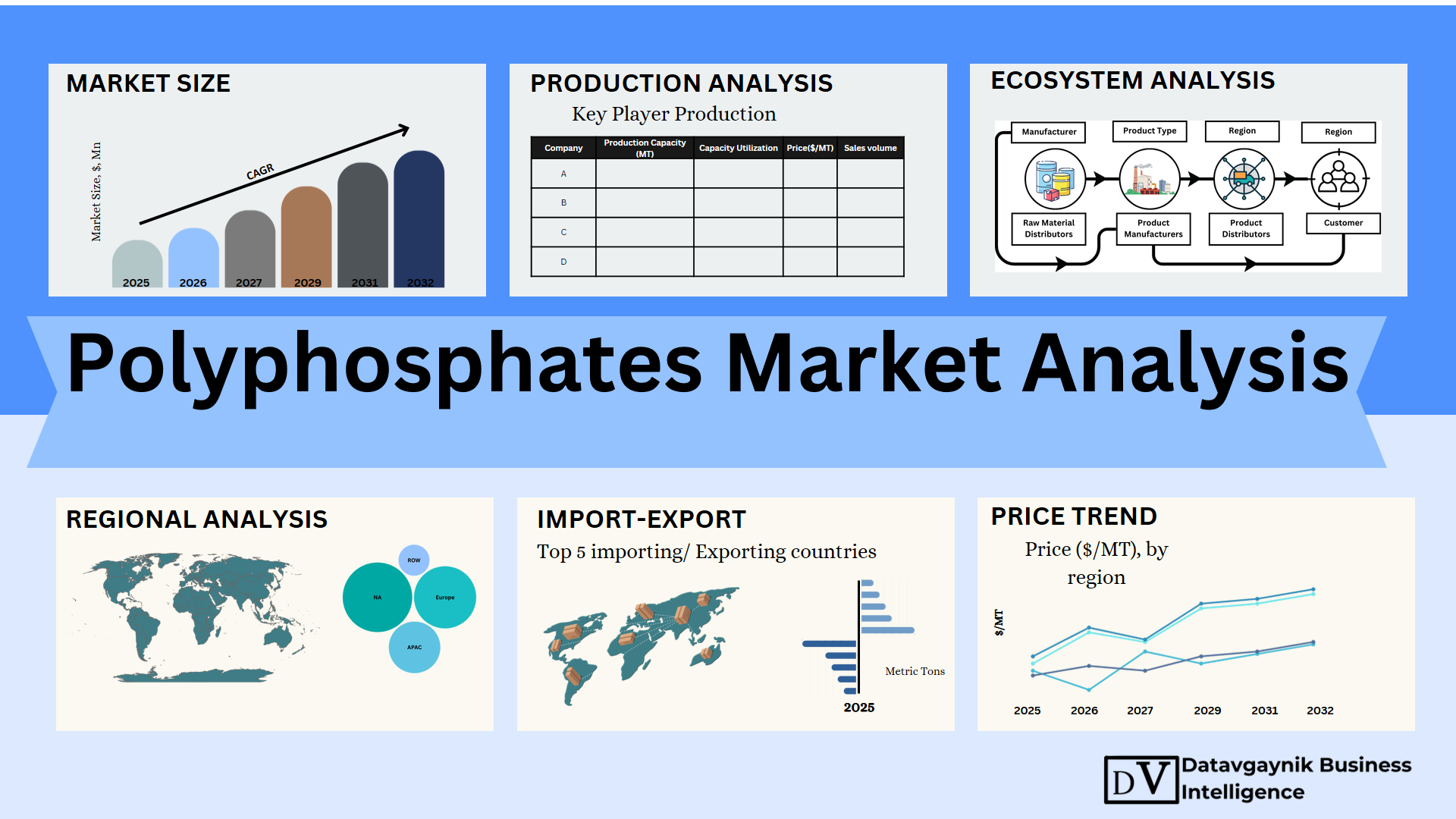
The Polyphosphates Market is undergoing rapid transformation as its applicability expands across sectors such as water treatment, detergents, food preservation, agriculture, and specialty chemicals. The demand for polyphosphates is growing consistently due to their multifunctional properties, including water softening, chelation, corrosion inhibition, and food preservation. As these industries evolve with increasing complexity and sustainability requirements, polyphosphates have become indispensable in supporting process efficiency, product quality, and environmental compliance. The global Polyphosphates Market is responding with innovation and capacity expansion, signaling a strong outlook through 2032.
Water Treatment as a Core Growth Pillar in the Polyphosphates Market
A primary driver of the Polyphosphates Market is the water treatment industry, which continues to rely on polyphosphates for scale inhibition and sequestration of hardness ions. For instance, regions with high calcium and magnesium concentrations in their groundwater systems, such as parts of Asia-Pacific, North America, and the Middle East, are actively adopting polyphosphates in residential, commercial, and industrial water systems. Polyphosphates help extend equipment life and reduce maintenance in water heaters, boilers, and pipelines by preventing mineral scale formation.
Datavagyanik indicates that municipal and industrial water treatment segments are together contributing more than 35% to the consumption volume of polyphosphates in developed regions. With urbanization accelerating and water scarcity increasing globally, especially in water-stressed nations, the Polyphosphates Market is poised to grow at a CAGR of over 6% in the water treatment domain alone.
Detergents and Cleaning Industry Fueling the Polyphosphates Market Demand
The Polyphosphates Market is witnessing a parallel surge in demand from the detergents and cleaning agents sector. Polyphosphates act as builders, significantly improving detergent performance by binding with calcium and magnesium ions, thereby enhancing the solubility and effectiveness of surfactants. This is especially vital in hard water conditions, where cleaning efficiency typically drops.
For example, the Asia-Pacific region has experienced an over 10% annual growth in consumption of synthetic detergents, with polyphosphates playing a crucial role in formulation. As per Datavagyanik, the increase in household and commercial hygiene awareness post-COVID-19 has further boosted this demand, with polyphosphates accounting for a 20% share of total builder agents used in modern detergent compositions.
Polyphosphates Market Growth Anchored by Food and Beverage Preservation Applications
A major expansion point for the Polyphosphates Market is its role in food preservation. Polyphosphates are utilized in processed meats, seafood, dairy, and bakery items to improve texture, retain moisture, and extend shelf life. As global food processing continues to scale in response to rising urban populations and changing dietary patterns, polyphosphates are becoming vital functional additives.
For instance, North America and Europe collectively accounted for over 40% of food-grade polyphosphate consumption in 2023. These regions are characterized by high consumption of frozen and ready-to-eat meals where polyphosphates are essential for maintaining product quality. Datavagyanik projects that food and beverage applications will contribute approximately USD 750 million to the Polyphosphates Market Size by 2030, with rising demand from emerging economies in Asia and Latin America further accelerating the trend.
Agricultural Productivity Driving the Polyphosphates Market Expansion
In the agricultural sector, the Polyphosphates Market is benefiting from the shift toward high-efficiency fertilizers. Polyphosphates offer improved phosphorus availability, enhance soil nutrient absorption, and reduce nutrient fixation in the soil matrix. As a result, they are increasingly being incorporated into liquid and specialty fertilizer blends.
For example, polyphosphate-based fertilizers are showing strong uptake in countries like Brazil, India, and China, where boosting crop yields is essential to meet domestic food security goals. Datavagyanik highlights that the use of ammonium polyphosphates in these markets grew by more than 12% CAGR from 2020 to 2024. The continuous demand for precision agriculture and sustainable fertilization practices is expected to secure a long-term upward trajectory for the Polyphosphates Market in the agri-input space.
Industrial Usage Patterns Reinforcing the Polyphosphates Market Outlook
Beyond the traditional application areas, the Polyphosphates Market is being increasingly shaped by demand from industrial sectors such as metal finishing, ceramics, and paints. Polyphosphates function as dispersants, corrosion inhibitors, and anti-scaling agents, particularly in high-value manufacturing operations.
For instance, in the automotive and aerospace industries, polyphosphates are used in surface treatments to protect components against corrosion and enhance coating adhesion. The growth of industrial infrastructure and manufacturing capacity in Southeast Asia and Eastern Europe is creating new nodes of demand. Datavagyanik notes that industrial polyphosphate consumption in Eastern Europe grew by more than 8% in 2023, underlining the role of emerging economies in expanding the market base.
Environmental and Regulatory Trends Shaping the Polyphosphates Market
Environmental regulations are increasingly shaping how polyphosphates are manufactured, applied, and disposed of. While traditional phosphate-based compounds have faced scrutiny for their role in eutrophication, polyphosphates are gaining favor due to their better degradability and efficiency at lower concentrations. In particular, sodium polyphosphates and potassium polyphosphates are being reformulated to meet stricter norms around wastewater discharge.
Datavagyanik indicates that the push toward green chemistry and circular economy models has prompted key manufacturers to invest in environmentally optimized production technologies. For instance, several firms in Europe are already producing food-grade polyphosphates using renewable feedstocks and low-emission processes. This shift is anticipated to further strengthen the Polyphosphates Market Size in eco-sensitive applications such as food additives, personal care, and pharmaceuticals.
Technological Innovation Accelerating Polyphosphates Market Diversification
Advancements in chemical synthesis and formulation are also expanding the functional capabilities of polyphosphates. High-purity variants and specialty blends are being developed for use in biomedical applications, dental care products, and electronic cleaning agents. These emerging niches are contributing to market diversification and premiumization, with products commanding higher margins.
For example, the launch of calcium polyphosphate variants for use in dental remineralization and bone regeneration treatments is opening up new frontiers in the healthcare industry. Datavagyanik estimates that niche applications such as medical-grade polyphosphates will account for more than USD 250 million of the Polyphosphates Market Size by 2032.
Polyphosphates Market to Benefit from Urbanization and Infrastructure Growth
The broader structural trends of urbanization and infrastructure development are significantly influencing the Polyphosphates Market. In urban settings, polyphosphates are vital in municipal water management, while in the construction sector, they are used in fire-retardant formulations and cement additives. Countries undertaking large-scale infrastructure development, such as India, Indonesia, and the UAE, are witnessing heightened demand for these applications.
For instance, urban water distribution networks increasingly rely on polyphosphates to control scale formation and corrosion in pipelines, especially in areas where groundwater is the primary supply. Datavagyanik underscores that infrastructure-led water treatment investment will be a key catalyst for polyphosphate consumption in South and Southeast Asia through 2030.
“Track Country-wise Polyphosphates Production and Demand through our Polyphosphates Production Database”
-
-
- Polyphosphates production database for 27+ countries worldwide
- Polyphosphates Powder sales volume for 31+ countries
- Country-wise Polyphosphates production capacity and production plant mapping, production capacity utilization for 27+ manufacturers
- Polyphosphates production plants and production plant capacity analysis for top manufacturers
-
North America Driving Structural Demand Across the Polyphosphates Market
The Polyphosphates Market in North America remains one of the most mature yet steadily expanding segments globally. The United States and Canada represent strongholds for industrial applications, water treatment, and food-grade usage of polyphosphates. For example, over 60% of commercial and residential buildings in the U.S. utilize water treatment systems where polyphosphates are used to inhibit scale and corrosion. Datavagyanik confirms that industrial demand alone in the U.S. Polyphosphates Market grew by over 5% year-on-year in 2023, propelled by the increased deployment of polyphosphates in metal treatment and process water cycles.
Additionally, food processing applications are highly regulated in this region, leading to the growing usage of food-grade polyphosphates to meet compliance and performance benchmarks. Processed meat, seafood, and poultry industries collectively contribute to nearly 40% of food-grade polyphosphate consumption in North America, particularly sodium and potassium-based variants.
Europe’s Regulatory Environment Catalyzing Premium Polyphosphates Market
In Europe, the Polyphosphates Market is characterized by strong environmental oversight and innovation in high-purity product lines. Germany, France, the UK, and the Nordic nations are central to demand, particularly in industrial cleaning, specialty food processing, and agriculture. For instance, Germany alone accounts for more than 20% of European polyphosphate demand due to its widespread application in automotive metal treatment, boiler systems, and eco-friendly detergents.
Datavagyanik reports that the shift towards biodegradable and phosphate-compliant detergents has accelerated the adoption of low-impact polyphosphates across the region. France and the UK are also emphasizing sustainable agriculture, leading to an uptrend in polyphosphate-based fertilizers that improve nutrient efficiency without environmental degradation.
Asia Pacific Emerging as the Fastest Growing Polyphosphates Market
Asia Pacific dominates the global Polyphosphates Market in terms of production volume and is rapidly catching up in consumption due to rising demand from agriculture, industrial manufacturing, and water infrastructure. China, India, Japan, and South Korea form the backbone of this expansion. China leads both in domestic production and export, leveraging its robust chemical industry ecosystem.
For instance, China exported over 600 kilotons of polyphosphates in 2023, with strong outbound flows to Southeast Asia, Latin America, and parts of Europe. Domestically, China’s agriculture and food preservation sectors together account for more than 35% of polyphosphate usage. Meanwhile, India’s Polyphosphates Market has been expanding at over 8% CAGR over the past four years, particularly in the fertilizer segment, due to its reliance on phosphorus-based nutrients to sustain high agricultural productivity.
Datavagyanik highlights that as urban water demand increases in Asian megacities, the need for efficient water treatment solutions is leading to significant adoption of polyphosphates in municipal utilities, industrial parks, and real estate developments.
Middle East and Africa Seeing Strategic Uptake in Polyphosphates Market
The Polyphosphates Market in the Middle East and Africa is showing promising signs of growth, particularly in water desalination, food processing, and precision agriculture. Countries such as Saudi Arabia, UAE, and Egypt are heavily investing in water resource optimization technologies where polyphosphates play a role in scaling inhibition and pipeline corrosion control.
In arid agricultural zones, polyphosphate-enriched fertilizers are being used to optimize phosphorus delivery under low-moisture conditions. Datavagyanik identifies the Middle East’s fertilizer-grade polyphosphates consumption as growing at over 6% annually due to soil enhancement initiatives and controlled-release agricultural technologies.
Africa, particularly in emerging markets like Kenya and Nigeria, is witnessing early adoption of polyphosphates in food preservation and basic industrial cleaning products. As industrialization accelerates, Africa’s share in the global Polyphosphates Market is expected to steadily rise.
Latin America Offering Niche Growth in Agriculture and Food Processing
In Latin America, the Polyphosphates Market is being driven by agricultural expansion, especially in Brazil and Argentina, where high-performance fertilizers are essential for large-scale crop production. Brazil, the continent’s largest agricultural exporter, consumes significant volumes of polyphosphate-based fertilizers to boost yields of soybeans, sugarcane, and maize. For instance, over 70% of specialty phosphate fertilizers used in Brazil now incorporate ammonium polyphosphates for their dual nutrient release properties.
Datavagyanik also notes that the food processing sector in Latin America, which is transitioning toward modern packaging and export-grade preservation methods, is pushing demand for food-grade polyphosphates. With increased investment in agribusiness and food exports, the region is poised to add meaningful volume to the global Polyphosphates Market over the coming decade.
Global Production Centers and Supply Chain Overview in the Polyphosphates Market
The global Polyphosphates Market is supported by major production hubs concentrated in China, the United States, Germany, and Japan. These countries dominate due to their advanced chemical industries, integrated supply chains, and technological edge in formulation development. China alone contributes over 45% of total global polyphosphate output, with state-of-the-art manufacturing clusters in Jiangsu, Shandong, and Zhejiang provinces.
Datavagyanik observes that the rise in energy-efficient and low-emission production technologies is becoming a central theme in the Polyphosphates Market. For instance, several German and Japanese manufacturers are now deploying closed-loop systems to reduce waste discharge and enhance recovery of phosphate materials during production.
Market Segmentation Enhancing Specialization in the Polyphosphates Market
The Polyphosphates Market is segmented by type, application, and end-use industry. Key product types include sodium polyphosphates, potassium polyphosphates, ammonium polyphosphates, and calcium polyphosphates. Each category serves a specific niche. For example, ammonium polyphosphates dominate the fire-retardant coatings segment, while sodium polyphosphates are prevalent in food processing and detergents.
Application-wise, agriculture continues to lead with over 35% share in global demand, followed by water treatment, food and beverage, detergents, and fire safety. Datavagyanik affirms that growth in the food and beverage application segment is set to outpace others by 2028, particularly in Asia Pacific and Latin America.
Polyphosphates Price and Polyphosphates Price Trend Reflect Supply-Demand Tensions
The Polyphosphates Price has witnessed moderate volatility in recent years due to fluctuations in raw material availability, energy costs, and regulatory shifts. For instance, the average Polyphosphates Price in Asia ranged between USD 1,150 to USD 1,300 per metric ton in 2023, with prices expected to remain under upward pressure due to increased demand in fertilizers and water treatment.
In Europe, the Polyphosphates Price Trend is influenced by strict compliance and the push toward green formulations. Prices of food-grade and pharmaceutical-grade polyphosphates have been trending upward at 5% CAGR over the past three years due to additional processing and certification costs.
Meanwhile, in North America, Polyphosphates Price movements are closely tied to supply chain disruptions and freight costs. Datavagyanik notes that specialty product lines such as high-purity ammonium polyphosphates have witnessed a 12% price increase between 2022 and 2024.
Regional Disparities and Future Outlook for Polyphosphates Price Trend
The future Polyphosphates Price Trend will likely be driven by a blend of regulatory compliance costs, supply chain realignments, and the growing demand for premium-grade polyphosphates. For instance, the increasing preference for biodegradable and phosphate-compliant formulations is leading to incremental costs in production and formulation development.
Datavagyanik anticipates that price differentiation will widen between commodity-grade and specialty polyphosphates. Standard industrial-grade sodium polyphosphates may remain price-stable, while high-performance ammonium and potassium variants used in fire retardants, pharmaceuticals, and agriculture are likely to witness steady price inflation through 2030.
“Polyphosphates Manufacturing Database, Polyphosphates Manufacturing Capacity”
-
-
- Polyphosphates top manufacturers market share for 27+ manufacturers
- Top 8 manufacturers and top 17 manufacturers of Polyphosphates in North America, Europe, Asia Pacific
- Production plant capacity by manufacturers and Polyphosphates production data for 27+ market players
- Polyphosphates production dashboard, Polyphosphates production data in excel format
-
Leading Manufacturers Defining the Competitive Landscape of the Polyphosphates Market
The Polyphosphates Market is highly competitive and moderately consolidated, with a blend of multinational chemical corporations and regional producers contributing to its growth. Key manufacturers are focusing on expanding production capacities, investing in sustainable process technologies, and launching application-specific product lines to gain strategic advantage. As demand continues to rise across sectors such as water treatment, agriculture, detergents, and food preservation, global manufacturers are optimizing their portfolios to serve both commodity and specialty segments within the Polyphosphates Market.
ICL Group – Dominating Specialty and Food-Grade Polyphosphates Market
ICL Group stands among the top global producers in the Polyphosphates Market, with a strong presence in food-grade and industrial-grade phosphate derivatives. The company’s product line includes TARIL™ and ICL Food Specialties, which are widely used in processed meats, seafood, and dairy applications. Its food additives business holds a substantial share of the North American and European food-grade polyphosphates market, supported by extensive regulatory compliance and formulation capabilities.
ICL also maintains a robust footprint in agricultural-grade polyphosphates, particularly ammonium polyphosphate fertilizers used across North America, Latin America, and parts of Asia. The company continues to focus on expanding sustainable phosphorus value chains and is investing in advanced R&D to develop next-generation biodegradable phosphate formulations.
Innophos Holdings – Key Supplier in North America’s Polyphosphates Market
Innophos is a major manufacturer specializing in purified phosphates and serves diverse industries including food, beverages, pharmaceuticals, and water treatment. Its Cal-Rise®, Versaphos®, and Polyfos® lines are highly regarded in the U.S. market for their consistency and functionality across processed food and personal care segments.
Innophos controls a significant portion of the polyphosphates share in the North American market and operates integrated manufacturing facilities in the U.S. and Mexico. The company’s product customization capabilities and focus on food safety compliance have enabled it to maintain a loyal customer base among multinational food processors and detergent manufacturers.
Nutrien Ltd. – A Fertilizer Giant with a Stronghold in Agricultural Polyphosphates
Nutrien Ltd. plays a vital role in the global Polyphosphates Market through its extensive line of phosphorus-based fertilizers. The company’s ESN Smart Nitrogen and Ammonium Polyphosphate (APP) fertilizers are widely used in precision agriculture, especially across North America, where demand for enhanced nutrient-use efficiency is increasing.
Nutrien’s market share in the agricultural polyphosphates segment remains dominant due to its vertically integrated supply chain, extensive retail network, and ability to produce high-volume polyphosphates at scale. The company is also expanding its focus into digital agriculture platforms to optimize polyphosphate application based on soil analytics.
Arkema Group – Advanced Applications in Industrial and Water Treatment Polyphosphates
Arkema Group holds a strong position in the industrial polyphosphates space, with applications spanning water treatment, corrosion control, and paints. Its CECA subsidiary produces performance additives including polyphosphates for industrial dispersants and boiler water conditioners.
Arkema has carved out a notable share of the European Polyphosphates Market, particularly through partnerships in wastewater treatment and energy infrastructure. The company’s innovation-led strategy, coupled with its sustainability commitment, has led to the development of phosphorus-based solutions with reduced environmental footprint and enhanced operational efficiency.
Aditya Birla Chemicals – Rapid Expansion in Asia’s Polyphosphates Market
Aditya Birla Chemicals is a significant manufacturer of polyphosphates in Asia, particularly active in India and Southeast Asia. The company’s product line includes industrial-grade sodium and potassium polyphosphates used in textiles, food additives, ceramics, and cleaning products. With expanding production capacity and cost-effective manufacturing in the Indian subcontinent, the company is rapidly increasing its share in the Polyphosphates Market across Asia Pacific and the Middle East.
Its recent investments in specialty chemicals and performance additives have helped solidify its position as a key regional supplier. The company is also exploring opportunities in water purification and high-purity food additive grades to expand its product relevance.
Fosfa Group – Central Europe’s Leading Polyphosphates Producer
Fosfa, based in the Czech Republic, is a specialist in condensed phosphates and holds a significant share in Central and Eastern Europe’s Polyphosphates Market. The company offers both food-grade and technical-grade products including FosfaClean, used in cleaning agents and detergents.
Its vertically integrated operations, from phosphorus extraction to end-product formulation, provide cost and quality control advantages. Fosfa’s polyphosphates are exported to over 80 countries, with increasing demand from emerging markets for its environmentally friendly phosphate solutions.
Market Share Dynamics in the Global Polyphosphates Market
The global Polyphosphates Market is moderately fragmented, with the top five manufacturers accounting for approximately 45% to 50% of total global production. ICL and Innophos dominate the food and industrial polyphosphates sectors in North America and Europe. Nutrien and Aditya Birla Chemicals lead in agricultural-grade products, particularly in large farming economies. Meanwhile, Fosfa and Arkema are strong in regional supply of specialty polyphosphates across Europe and Asia.
Tier-II manufacturers and regional players serve niche market needs and account for the remaining market share, particularly in segments like water treatment and ceramic dispersants. These companies often compete on cost efficiency, local distribution networks, and tailored product offerings.
Recent Developments and Strategic Moves in the Polyphosphates Market
- October 2023 – ICL announced the expansion of its food-grade polyphosphates capacity in St. Louis, U.S., aimed at meeting the rising demand for clean-label additives and moisture retention solutions in processed meats and poultry.
- December 2023 – Nutrien launched a new line of ammonium polyphosphate-based liquid fertilizers designed for precision farming in Brazil and Argentina, targeting crops with high phosphorus uptake such as soybean and maize.
- February 2024 – Arkema completed a process upgrade at its phosphorus additive facility in France, enhancing the efficiency of polyphosphate dispersants used in wastewater treatment and anti-scaling systems.
- March 2024 – Aditya Birla Chemicals inaugurated a new production line for potassium polyphosphates in Gujarat, India, specifically designed for food additive and dairy processing applications in Asia.
- April 2024 – Fosfa Group entered a distribution agreement with a UAE-based water treatment firm to supply sodium polyphosphates for scale control in desalination plants and residential water filtration systems.
These developments reflect the strategic direction of key players in the Polyphosphates Market toward specialization, sustainability, and regional adaptation. The focus on regulatory compliance, eco-friendly innovation, and downstream customization is expected to intensify, especially as demand accelerates in food security, water infrastructure, and industrial performance enhancement.
“Polyphosphates Production Data and Polyphosphates Production Trend, Polyphosphates Production Database and forecast”
-
-
- Polyphosphates production database for historical years, 10 years historical data
- Polyphosphates production data and forecast for next 7 years
-
Market Scenario, Demand vs Supply, Average Product Price, Import vs Export, till 2035
- Global Polyphosphates Market revenue and demand by region
- Global Polyphosphates Market production and sales volume
- United States Polyphosphates Market revenue size and demand by country
- Europe Polyphosphates Market revenue size and demand by country
- Asia Pacific Polyphosphates Market revenue size and demand by country
- Middle East & Africa Polyphosphates Market revenue size and demand by country
- Latin America Polyphosphates Market revenue size and demand by
- Import-export scenario – United States, Europe, APAC, Latin America, Middle East & Africa
- Average product price – United States, Europe, APAC, Latin America, Middle East & Africa
- Market player analysis, competitive scenario, market share analysis
- Business opportunity analysis
Key questions answered in the Global Polyphosphates Market Analysis Report:
- What is the market size for Polyphosphates in United States, Europe, APAC, Middle East & Africa, Latin America?
- What is the yearly sales volume of Polyphosphates and how is the demand rising?
- Who are the top market players by market share, in each product segment?
- Which is the fastest growing business/ product segment?
- What should be the business strategies and Go to Market strategies?
The report covers Polyphosphates Market revenue, Production, Sales volume, by regions, (further split into countries):
- Asia Pacific (China, Japan, South Korea, India, Indonesia, Vietnam, Rest of APAC)
- Europe (UK, Germany, France, Italy, Spain, Benelux, Poland, Rest of Europe)
- North America (United States, Canada, Mexico)
- Latin America (Brazil, Argentina, Rest of Latin America)
- Middle East & Africa
Table of Contents:
- Introduction to Polyphosphates
- Definition and Chemical Structure
- Overview of Polyphosphate Applications and Importance
- Polyphosphate Types and Classifications
- Inorganic vs. Organic Polyphosphates
- Different Forms of Polyphosphates and Their Uses
- Key Characteristics and Functions of Polyphosphates
- Polyphosphate Market Overview
- Global Market Size and Growth Projections (2020-2035)
- Key Drivers and Market Trends
- Challenges and Opportunities in the Polyphosphate Market
- Applications of Polyphosphates
- Water Treatment and Purification
- Detergents and Cleaning Agents
- Food and Beverage Preservation
- Agriculture: Fertilizers and Plant Growth Regulators
- Industrial Applications: Paints, Coatings, and Corrosion Inhibition
- Regional Market Analysis
- North America: Market Dynamics, Trends, and Regulatory Landscape
- Europe: Market Drivers, Key Players, and Sustainability Initiatives
- Asia Pacific: Growing Demand in Manufacturing and Agriculture
- Latin America: Market Expansion and Regulatory Considerations
- Middle East & Africa: Industrial Growth and Adoption Trends
- Polyphosphate Production Process
- Raw Materials Used in Polyphosphate Manufacturing
- Key Production Technologies and Innovations
- Environmental Considerations in Polyphosphate Production
- Market Segmentation by End-Use Industry
- Water Treatment and Filtration
- Household Cleaning and Detergents
- Food Preservation and Processing
- Agricultural Chemicals and Fertilizers
- Oil & Gas and Industrial Manufacturing
- Polyphosphate Supply Chain and Distribution
- Overview of the Polyphosphate Supply Chain
- Key Suppliers and Distribution Channels
- Logistics and Cost Considerations in Polyphosphate Distribution
- Competitive Landscape in the Polyphosphate Market
- Leading Market Players and Their Strategies
- Market Share Analysis of Key Manufacturers
- Competitive Challenges and Market Entry Barriers
- Sustainability in the Polyphosphate Market
- Environmental Impact and Waste Management
- Trends Toward Eco-Friendly and Green Alternatives
- Regulatory Pressures and Sustainability Certifications
- Polyphosphate Market Trends and Innovations
- Advances in Polyphosphate Production Technologies
- Innovations in Polyphosphate Formulations for Specific Applications
- Research and Development in Polyphosphate Chemistry
- Cost Analysis of Polyphosphates
- Production Cost Breakdown and Factors Affecting Prices
- Price Trends and Forecasts (2020-2035)
- Economic Impact of Polyphosphate Usage on End-User Industries
- Regulatory Framework and Standards
- Global and Regional Regulations Governing Polyphosphate Use
- Compliance with Environmental and Safety Standards
- The Role of Certifications and Approvals in Market Adoption
- Polyphosphate Market Forecast and Future Outlook
- Growth Forecast for Polyphosphate Demand by Region
- Future Trends and Emerging Applications
- Opportunities in Untapped Markets and Industries
- Consumer Behavior and Demand Dynamics
- Understanding End-User Preferences and Trends
- Factors Driving the Demand for Polyphosphates in Various Industries
- Market Adoption by Consumers and Industrial Sectors
- Polyphosphate Innovations in Food and Beverage
- Role of Polyphosphates in Food Processing and Preservation
- Consumer Trends in Natural and Preservative-Free Alternatives
- Impact of Regulatory Changes on Polyphosphate Usage in Food
- Polyphosphates in Water Treatment and Environmental Impact
- Role of Polyphosphates in Water Softening and Treatment
- Environmental Concerns and the Move Toward Sustainable Water Treatment Solutions
- Regulation of Polyphosphate Use in Water Treatment Systems
- Technological Advancements in Polyphosphate Formulation
- Development of Novel Polyphosphate Compounds
- Tailored Polyphosphate Products for Specific Industry Needs
- Enhancing Efficiency and Functionality Through Technology
- Challenges in the Polyphosphate Market
- Fluctuations in Raw Material Costs and Supply Chain Risks
- Environmental Concerns and Regulatory Hurdles
- Competition from Alternative Chemicals and Technologies
- Conclusion and Strategic Insights
- Key Takeaways and Market Predictions
- Strategies for Market Growth and Investment Opportunities
- Future Prospects for Polyphosphates in Emerging Markets

