

Emerging Demand Drivers in the Polypropylene Nucleating Agent Market
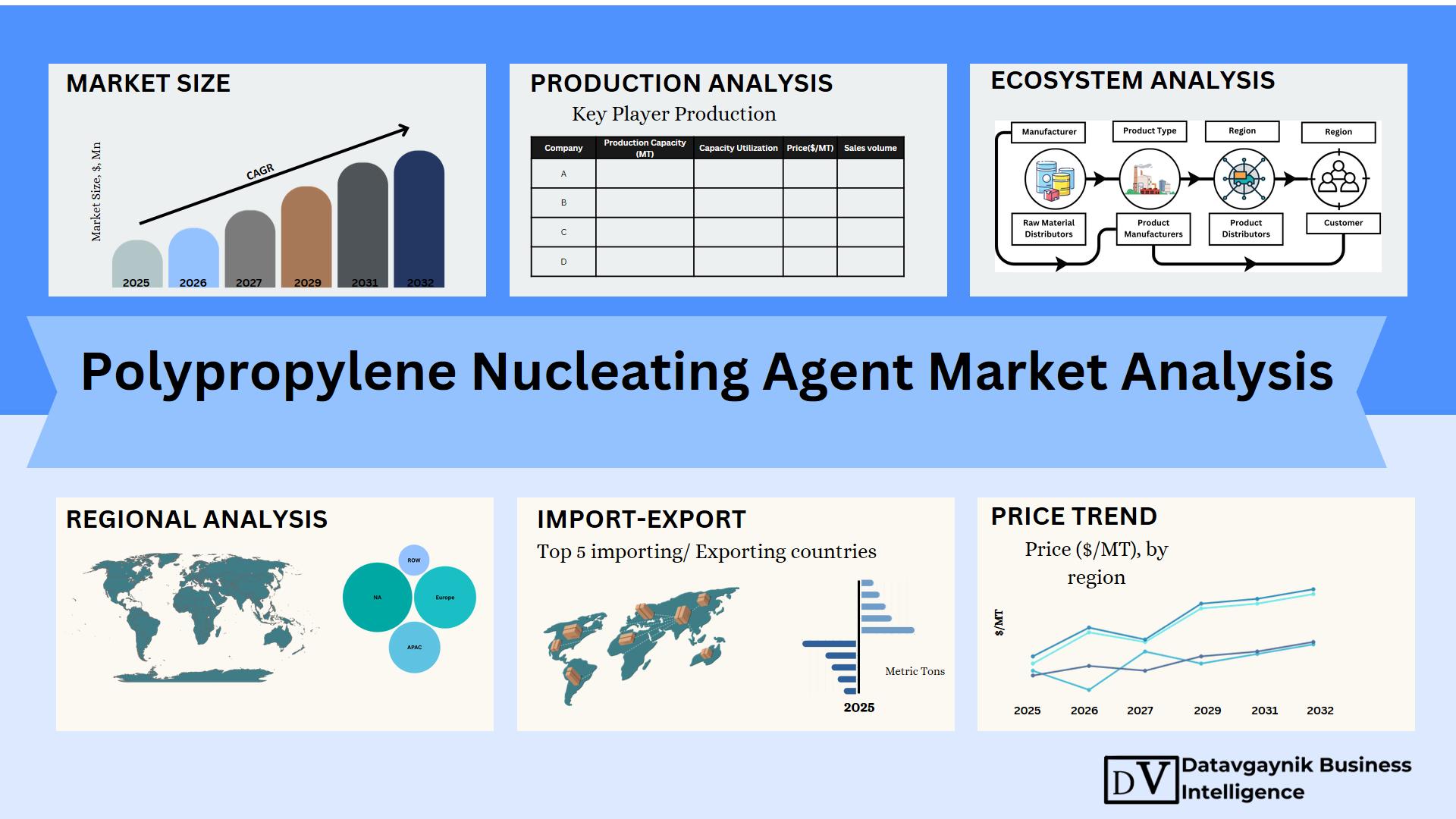
The Polypropylene Nucleating Agent Market is undergoing a structural transformation, driven by the increasing demand for enhanced polymer performance across a spectrum of end-use industries. A growing emphasis on lightweight materials, faster production cycles, and higher product clarity is shaping the material science strategies of manufacturers globally. As a result, the Polypropylene Nucleating Agent Market is becoming increasingly pivotal in enabling these performance gains, particularly in packaging, automotive, and consumer goods applications.
Automotive Sector’s Transition Fueling the Polypropylene Nucleating Agent Market
A prominent factor contributing to the growth of the Polypropylene Nucleating Agent Market is the automotive industry’s transition towards lightweight and fuel-efficient vehicles. Polypropylene, when enhanced with nucleating agents, achieves improved stiffness, better dimensional stability, and faster crystallization times, making it highly suitable for manufacturing interior trims, dashboards, bumpers, and door panels. For instance, as per Datavagyanik, over 75 million passenger vehicles were produced globally in 2023, and more than 60% of interior plastic components in these vehicles utilized polypropylene-based materials. The increased application of nucleated polypropylene components contributes to substantial weight savings, aiding OEMs in meeting stringent emissions and fuel economy targets.
Datavagyanik also covers related markets such as the Nucleating Agents Market, the Polypropylene Market, and the Polypropylene Wax Market. Understanding these markets sheds light on emerging innovations and industry crossovers that impact the main topic.
Packaging Innovation Driving Expansion in the Polypropylene Nucleating Agent Market
Another major growth driver for the Polypropylene Nucleating Agent Market is the packaging industry’s demand for materials with superior visual clarity, rigidity, and heat resistance. Nucleating agents are essential in the production of polypropylene-based films, trays, and containers that exhibit high transparency and durability. The global flexible packaging market is projected to surpass USD 390 billion by 2030, and polypropylene is increasingly becoming the polymer of choice for brands aiming to improve shelf appeal and sustainability. For example, nucleated polypropylene enables thinner packaging with higher strength, leading to material savings and reduced environmental footprint. This efficiency directly contributes to a higher adoption rate of nucleating agents across packaging converters and brand owners.
Polypropylene Nucleating Agent Market Size Bolstered by Sustainable Manufacturing Trends
Sustainability trends are further enhancing the Polypropylene Nucleating Agent Market Size. Manufacturers are under pressure to reduce energy consumption and material waste, and nucleating agents contribute significantly to these goals. By accelerating the crystallization of polypropylene, these additives reduce cycle times by up to 20%, which not only increases throughput but also decreases energy usage during molding processes. Datavagyanik highlights that energy-efficient manufacturing is now a key procurement criterion among tier-1 automotive and FMCG suppliers, leading to a wider implementation of nucleating agents within their supply chains. This is especially evident in regions such as Europe and North America, where carbon reduction mandates are intensifying.
Rising Demand for High-Performance Consumer Goods Accelerating the Polypropylene Nucleating Agent Market
Consumer goods, particularly in household appliances and personal care packaging, represent a critical growth segment within the Polypropylene Nucleating Agent Market. The shift in consumer preference toward products that are both durable and aesthetically superior has accelerated the usage of nucleated polypropylene. For example, in rigid packaging for shampoos, creams, and detergents, nucleating agents enhance surface gloss and rigidity, making the packaging more attractive while maintaining performance. In addition, the home appliances market—valued at over USD 500 billion globally—is incorporating nucleated polypropylene in internal parts and housing units, benefiting from both visual clarity and mechanical strength.
Thermal Resistance and Processing Efficiency Enhancing the Polypropylene Nucleating Agent Market
Thermal performance is another domain where the Polypropylene Nucleating Agent Market is witnessing substantial traction. In applications demanding high heat resistance, such as food containers that require microwave or dishwasher compatibility, nucleating agents play a critical role. They increase the heat distortion temperature of polypropylene by up to 10–15°C, enabling broader application coverage. Moreover, nucleating agents contribute to smoother mold release and better dimensional control in complex geometries, making them indispensable in precision molding industries. These functional improvements are driving a consistent rise in product adoption across advanced manufacturing sectors.
Regulatory Push Towards Recyclability and Its Role in the Polypropylene Nucleating Agent Market
The increasing emphasis on recycling and circular economy practices is creating new avenues within the Polypropylene Nucleating Agent Market. Polypropylene is inherently recyclable, and the presence of nucleating agents does not hinder its recyclability, which makes it a preferred material for brands and regulators focused on sustainable packaging. For example, companies manufacturing thermoformed trays and lids for foodservice are now incorporating nucleated polypropylene grades approved for post-consumer recycling streams. Datavagyanik forecasts that by 2030, over 45% of rigid plastic packaging in developed economies will be designed for recyclability, a transition that strongly supports the growth of the Polypropylene Nucleating Agent Market.
Technological Innovations Strengthening the Polypropylene Nucleating Agent Market
In recent years, innovation in nucleating agent formulations has further expanded the Polypropylene Nucleating Agent Market. Next-generation nucleating agents offer dual functionality by combining crystallization speed with improved transparency or odor neutrality. This is especially useful in high-end consumer packaging or medical devices where appearance and chemical inertness are critical. For instance, advanced sorbitol-based clarifying nucleating agents are enabling the production of near-glass-like polypropylene containers for cosmetics and pharmaceutical applications. These innovations are helping manufacturers differentiate their product offerings while maintaining compliance with regulatory and functional benchmarks.
Global Supply Chain Resilience and Regional Capacity Building in the Polypropylene Nucleating Agent Market
The Polypropylene Nucleating Agent Market is also benefiting from increased regionalization of supply chains and domestic capacity additions. Post-2020, there has been a sharp focus on reducing import dependency and improving supply chain resilience in North America and Europe. Several manufacturers have expanded local compounding capacities to integrate nucleating agents directly into polypropylene resins. This trend has not only ensured shorter lead times but also enabled the customization of formulations for regional end-user requirements. As a result, regional Polypropylene Nucleating Agent Market Size is expanding faster than previously anticipated.
Strategic Integration of Nucleating Agents in Polypropylene Formulations Across Industries
Across industries, there is an increasing recognition of the strategic value offered by nucleating agents in polypropylene formulation. From high-speed injection molding of automotive parts to extrusion of thin-walled packaging, the consistent benefits in performance, cycle reduction, and product aesthetics have solidified the position of nucleating agents as essential additives. Datavagyanik emphasizes that OEMs and converters now routinely specify nucleated polypropylene grades to meet functional and economic targets in production, further reinforcing the embedded role of nucleating agents in polymer material strategies.
“Track Country-wise Polypropylene Nucleating Agent Production and Demand through our Polypropylene Nucleating Agent Production Database”
-
-
- Polypropylene Nucleating Agent production database for 27+ countries worldwide
- Polypropylene Nucleating Agent Powder sales volume for 31+ countries
- Country-wise Polypropylene Nucleating Agent production capacity and production plant mapping, production capacity utilization for 27+ manufacturers
- Polypropylene Nucleating Agent production plants and production plant capacity analysis for top manufacturers
-
Regional Demand Trends Strengthening the Polypropylene Nucleating Agent Market
The Polypropylene Nucleating Agent Market is witnessing accelerated demand across multiple geographies, each driven by distinct industrial dynamics and application priorities. In North America, the integration of nucleating agents in polypropylene resin is increasingly centered around high-performance automotive and packaging applications. For instance, the United States continues to lead regional adoption due to its mature automotive sector, which alone consumes over 2.5 million metric tons of polypropylene annually. Enhanced variants of PP containing nucleating agents are now specified in a wide array of under-the-hood and interior components, particularly in electric vehicles where weight and thermal performance are key.
In Europe, regulatory emphasis on sustainability and recyclable packaging is catalyzing the uptake of nucleated polypropylene. Countries like Germany, France, and the Netherlands are setting benchmarks in incorporating polypropylene grades with nucleating agents for food-grade packaging and medical disposables. Datavagyanik estimates that Europe will account for over 27% of global Polypropylene Nucleating Agent Market demand by 2028, underpinned by the region’s transition to circular economy models and its high standards for thermal and optical material performance.
Asia Pacific, however, continues to lead in both volume consumption and growth velocity. China, India, South Korea, and Japan are anchoring regional growth with their high manufacturing output across consumer goods, packaging, and automotive sectors. For example, India’s packaging sector grew at a CAGR of over 8.5% from 2020 to 2024, and with polypropylene dominating rigid packaging formats, nucleating agents have become a mainstream requirement. This region alone accounted for over 40% of total Polypropylene Nucleating Agent Market consumption in 2023, and is expected to widen its share further due to urbanization, industrial expansion, and growing demand for thermally stable and recyclable packaging formats.
Production Ecosystem Driving the Polypropylene Nucleating Agent Market
The production landscape of the Polypropylene Nucleating Agent Market is primarily centered around chemical hubs with access to advanced polymerization infrastructure. Asia Pacific is the largest producer of nucleating agents, with China, Japan, and South Korea leading exports globally. These countries benefit from scale economies, vertical integration of polypropylene resin manufacturing, and proximity to high-volume end users. For example, Chinese manufacturers have ramped up production of sorbitol-based clarifying agents and talc-based nucleating agents to meet both domestic and international requirements, exporting substantial volumes to Southeast Asia, the Middle East, and Europe.
North America, particularly the United States, is home to major producers of high-purity and specialty nucleating agents used in advanced molding applications. Companies in the region are focusing on formulation-based innovations that offer dual benefits—faster cycle times and superior product finish. Similarly, Europe hosts several advanced producers that specialize in hybrid nucleating agents combining organic and inorganic chemistries. These innovations cater to stringent quality norms set by European automotive and medical sectors, making the region a critical contributor to global Polypropylene Nucleating Agent Market supply.
Segmentation by Nucleating Agent Type in the Polypropylene Nucleating Agent Market
Within the Polypropylene Nucleating Agent Market, product segmentation is typically categorized into organic, inorganic, and hybrid nucleating agents. Organic nucleating agents, such as sorbitol derivatives, dominate the packaging segment due to their superior clarity and cost-effectiveness. These are especially favored for applications in transparent containers and thermoformed trays, where visual appeal is critical.
Inorganic nucleating agents, such as talc and sodium benzoate, are widely used in automotive applications due to their high thermal stability and stiffness enhancement. For instance, high-talc PP compounds are standard in automotive interiors for dashboards and door panels. Hybrid nucleating agents are gaining attention in electronics and appliances, offering a balance of transparency, strength, and temperature resistance.
Datavagyanik highlights that hybrid formulations are expected to grow at over 9% CAGR through 2030 due to their adaptability across both performance and regulatory metrics. Their growing demand across sectors such as consumer electronics, smart packaging, and medical devices is expected to expand the product mix of the Polypropylene Nucleating Agent Market significantly in the next five years.
Segmentation by Application and End-Use Sector in the Polypropylene Nucleating Agent Market
Application-wise, the Polypropylene Nucleating Agent Market is segmented into packaging, automotive, consumer goods, textiles and fibers, and others such as electronics and healthcare. Packaging remains the largest consumer, with rigid and semi-rigid packaging formats driving consistent demand for nucleated polypropylene. With over 35% of polypropylene used globally in packaging formats, nucleating agents are integral to maintaining material clarity, stiffness, and reduced cycle times.
Automotive follows as the second largest application segment, with nucleated polypropylene used in both visible and structural components. Datavagyanik projects that over 15% of global automotive PP usage will be in nucleated grades by 2026 due to increasing demand for lightweight and durable parts in electric vehicles.
Consumer goods applications, particularly in kitchenware, personal care packaging, and appliance housings, are growing at a steady pace. Nucleating agents enable improved gloss, tactile finish, and mechanical resilience in polypropylene-based consumer products. The textiles and fiber segment is still emerging but is expected to gain traction due to the demand for lightweight, breathable, and recyclable nonwoven polypropylene fabrics in hygiene and filtration applications.
Polypropylene Nucleating Agent Price Dynamics and Regional Price Differentials
The Polypropylene Nucleating Agent Price has shown moderate volatility over the past few years, largely influenced by raw material cost fluctuations and energy prices in key producing regions. For instance, sorbitol-based nucleating agents—widely used in transparent packaging—witnessed a 12% price hike between 2022 and 2023 due to supply disruptions in sugar alcohol feedstocks. On the other hand, talc-based agents remained relatively stable, supported by abundant mineral reserves and low-cost processing.
In 2024, the average global Polypropylene Nucleating Agent Price ranged between USD 3,500 to USD 4,200 per metric ton, depending on purity and formulation. Prices in North America and Europe are typically higher due to strict quality standards and higher labor costs. In contrast, Asia Pacific benefits from economies of scale and regional sourcing of feedstock, keeping the Polypropylene Nucleating Agent Price relatively competitive.
Datavagyanik anticipates continued upward pressure on the Polypropylene Nucleating Agent Price Trend in the short term, driven by rising demand from packaging and automotive sectors. However, technological advancements and regional production capacity additions are expected to ease the inflationary trend beyond 2026.
Price Trend Outlook and Cost Optimization in the Polypropylene Nucleating Agent Market
The long-term Polypropylene Nucleating Agent Price Trend is expected to align with global demand for high-performance polymers and the evolution of production technologies. Manufacturers are focusing on cost optimization strategies such as localized feedstock integration, backward linkages, and process digitization to manage input costs. For example, producers in South Korea and Germany are deploying AI-driven process control systems in compounding facilities to improve yield and reduce energy consumption per unit of nucleating agent produced.
Furthermore, the increasing popularity of masterbatch formulations—where nucleating agents are pre-dispersed in a carrier resin—has contributed to better cost control and ease of processing. This not only improves dispersion uniformity but also reduces wastage and material incompatibility during production.
With these advancements, the Polypropylene Nucleating Agent Price Trend is likely to stabilize over the next 3–5 years, especially as global supply chains recover from recent disruptions and new capacities become operational across Asia and the Middle East.
Global Trade and Strategic Supply Alignments in the Polypropylene Nucleating Agent Market
Geographical production imbalances and regional demand patterns have resulted in a dynamic trade landscape for the Polypropylene Nucleating Agent Market. Asia Pacific, particularly China and South Korea, dominates exports, supplying to high-consumption markets in North America, the Middle East, and Latin America. For instance, in 2023, China exported over 28,000 metric tons of various nucleating agent formulations, with packaging converters and automotive compounders in the U.S. and Mexico among the top buyers.
Conversely, Europe continues to import specialized nucleating agents from Japan and the U.S. for high-performance applications in electronics, medical, and premium packaging. This cross-regional dependency has encouraged strategic partnerships between additive suppliers and polypropylene compounders to ensure security of supply and long-term price agreements.
As regulatory pressures increase and the need for sustainable solutions intensifies, these partnerships will likely expand to include product development initiatives, further strengthening the regional competitiveness of the Polypropylene Nucleating Agent Market.
“Polypropylene Nucleating Agent Manufacturing Database, Polypropylene Nucleating Agent Manufacturing Capacity”
-
-
- Polypropylene Nucleating Agent top manufacturers market share for 27+ manufacturers
- Top 8 manufacturers and top 17 manufacturers of Polypropylene Nucleating Agent in North America, Europe, Asia Pacific
- Production plant capacity by manufacturers and Polypropylene Nucleating Agent production data for 27+ market players
- Polypropylene Nucleating Agent production dashboard, Polypropylene Nucleating Agent production data in excel format
-
Top Manufacturers in the Polypropylene Nucleating Agent Market
The Polypropylene Nucleating Agent Market is led by a concentrated group of global manufacturers that dominate both innovation and volume supply. These companies have built strong positions through extensive product portfolios, proprietary chemistries, global distribution networks, and strategic integration with polypropylene compounders. The competitive landscape is marked by continual R&D investments, expansion of production capacities, and development of high-performance nucleating agents tailored to sector-specific requirements.
Milliken & Company – Leader in Clarifying Agents
Milliken & Company remains one of the most dominant players in the Polypropylene Nucleating Agent Market. The company’s flagship product line, Hyperform HPN, has become a benchmark in the industry for performance enhancement. Hyperform HPN additives offer superior crystallization efficiency, increased stiffness, and improved optical properties. These features are particularly critical in packaging applications where high clarity and fast processing are key competitive factors. Milliken has leveraged its advanced R&D capabilities to develop several iterations of the Hyperform line, including HPN 500L and HPN 715, which cater to different application requirements in consumer packaging and industrial containers.
Clariant International – Comprehensive Additive Solutions
Clariant holds a significant share in the Polypropylene Nucleating Agent Market with its extensive range of nucleating and clarifying agents. The company’s Licocene and AddWorks product lines are widely used by polypropylene compounders and end-use industries. These additives are particularly favored in applications requiring enhanced thermal stability, reduced cycle times, and uniform polymer morphology. Clariant has focused on offering application-specific solutions, especially in sectors such as medical packaging, food-grade containers, and thin-walled automotive parts. The company has also been active in launching bio-based and sustainable additives to align with environmental goals in Europe and North America.
BASF – Innovator in Multi-functional Nucleating Agents
BASF is another major player in the Polypropylene Nucleating Agent Market, known for delivering high-performance additives that combine nucleation with other functionalities such as UV stabilization and anti-static behavior. Its Irgastab and Irgaclear series of nucleating agents are widely adopted in premium packaging and industrial applications. BASF has focused on enhancing product differentiation by combining multiple additive functionalities into a single formulation. This approach has gained traction in markets like electronics packaging and specialty automotive components, where space, performance, and reliability are non-negotiable.
ADEKA Corporation – Strong Presence in Asia Pacific
Japanese chemical manufacturer ADEKA Corporation has emerged as a strong regional player with growing international influence. Its nucleating agent product line, ADK STAB NA series, is gaining popularity in Asia Pacific for both clarity-enhancing and high-crystallization applications. The company has built strong partnerships with polypropylene resin manufacturers and compounders in Japan, South Korea, and Southeast Asia. ADEKA’s emphasis on cost-effective formulations without compromising performance has enabled it to capture market share in developing economies, where price sensitivity is high.
PolyOne/Avient Corporation – Specialty Masterbatch Leader
Avient Corporation, formerly PolyOne, is recognized for its specialized nucleating agent masterbatches that offer processors a convenient, pre-dispersed additive solution. The company serves clients in the consumer goods, packaging, and healthcare sectors with tailor-made solutions for polypropylene modification. Avient’s OnCap product line includes various nucleating agent formulations that improve stiffness, thermal resistance, and clarity while reducing cycle time and energy usage. Its masterbatch strategy aligns well with mid-sized compounders and converters who prefer ready-to-use solutions for ease of processing and uniformity.
Shandong Rainwell – Rising Chinese Producer
In China, Shandong Rainwell has rapidly scaled its presence in the Polypropylene Nucleating Agent Market, particularly in sorbitol-based clarifying agents. The company is focused on supplying to domestic packaging converters, with plans for overseas expansion. Its products are cost-effective and compatible with a wide range of polypropylene resins. As demand rises in Southeast Asia and Africa, Shandong Rainwell’s scalable production model and local sourcing of feedstock provide a competitive edge for price-sensitive markets.
Polypropylene Nucleating Agent Market Share by Manufacturers
As of 2024, the global Polypropylene Nucleating Agent Market is concentrated among the top five manufacturers, who collectively control over 70% of the total market share. Milliken & Company alone commands an estimated 25–28% share globally, owing to its dominance in clarifying agents and strong customer relationships across packaging, medical, and food sectors. Clariant follows with a 15–18% share, buoyed by its integrated solutions and widespread use in Europe. BASF holds approximately 10–12% of the market, especially in value-added and specialty-grade formulations.
ADEKA and Avient together account for around 10–12%, with their focus on Asia Pacific and masterbatch segments respectively. Regional players in China, India, and South Korea make up the remaining 25–30%, mostly serving localized demand in automotive and consumer goods markets. The fragmentation in lower-value applications allows smaller players to thrive in regional clusters, though the high-end segments remain dominated by innovation-led multinationals.
Recent Developments in the Polypropylene Nucleating Agent Market
In March 2024, Milliken announced the expansion of its nucleating agent production facility in South Carolina, adding capacity for Hyperform HPN products to meet growing demand in North and South America. This move is aimed at reducing lead times and improving supply resilience for clients in automotive and food packaging sectors.
In February 2024, Clariant unveiled its next-generation AddWorks AG series at a European packaging expo, focused on enhancing polypropylene recyclability while maintaining performance properties. These new formulations are targeted at converters involved in circular economy initiatives, especially under Europe’s new extended producer responsibility regulations.
In January 2024, ADEKA launched an upgraded version of its ADK STAB NA-100 series with improved thermal performance for under-the-hood automotive parts. The new variant is being adopted by Japanese automotive suppliers who require parts capable of withstanding higher engine compartment temperatures without deformation.
BASF, in late 2023, established a collaborative research partnership with a European medical packaging consortium to develop nucleating agents that comply with pharmaceutical-grade migration standards. This alliance is expected to result in specialized additives for sterile medical packaging and drug delivery systems.
Shandong Rainwell, meanwhile, signed a multi-year supply agreement in December 2023 with a Southeast Asian packaging major for the delivery of sorbitol-based nucleating agents. The agreement covers volume commitments and collaborative product development tailored to tropical climate performance requirements.
“Polypropylene Nucleating Agent Production Data and Polypropylene Nucleating Agent Production Trend, Polypropylene Nucleating Agent Production Database and forecast”
-
-
- Polypropylene Nucleating Agent production database for historical years, 10 years historical data
- Polypropylene Nucleating Agent production data and forecast for next 7 years
-
Market Scenario, Demand vs Supply, Average Product Price, Import vs Export, till 2035
- Global Polypropylene Nucleating Agent Market revenue and demand by region
- Global Polypropylene Nucleating Agent Market production and sales volume
- United States Polypropylene Nucleating Agent Market revenue size and demand by country
- Europe Polypropylene Nucleating Agent Market revenue size and demand by country
- Asia Pacific Polypropylene Nucleating Agent Market revenue size and demand by country
- Middle East & Africa Polypropylene Nucleating Agent Market revenue size and demand by country
- Latin America Polypropylene Nucleating Agent Market revenue size and demand by
- Import-export scenario – United States, Europe, APAC, Latin America, Middle East & Africa
- Average product price – United States, Europe, APAC, Latin America, Middle East & Africa
- Market player analysis, competitive scenario, market share analysis
- Business opportunity analysis
Key questions answered in the Global Polypropylene Nucleating Agent Market Analysis Report:
- What is the market size for Polypropylene Nucleating Agent in United States, Europe, APAC, Middle East & Africa, Latin America?
- What is the yearly sales volume of Polypropylene Nucleating Agent and how is the demand rising?
- Who are the top market players by market share, in each product segment?
- Which is the fastest growing business/ product segment?
- What should be the business strategies and Go to Market strategies?
The report covers Polypropylene Nucleating Agent Market revenue, Production, Sales volume, by regions, (further split into countries):
- Asia Pacific (China, Japan, South Korea, India, Indonesia, Vietnam, Rest of APAC)
- Europe (UK, Germany, France, Italy, Spain, Benelux, Poland, Rest of Europe)
- North America (United States, Canada, Mexico)
- Latin America (Brazil, Argentina, Rest of Latin America)
- Middle East & Africa
Table of Contents:
- Introduction to Polypropylene Nucleating Agents
- Overview of Nucleating Agents and Their Role in Polypropylene Processing
- Key Benefits of Nucleating Agents in Enhancing Polypropylene Properties
- Types of Polypropylene Nucleating Agents
- Organic vs. Inorganic Nucleating Agents
- Common Nucleating Agents Used in Polypropylene Production
- Comparison of Performance: Nucleating Agents for Polypropylene vs. Other Polymers
- Chemical Composition and Mechanism of Polypropylene Nucleating Agents
- Chemical Properties and Additive Mechanism in Polymer Crystallization
- Impact on Crystallization Rate, Clarity, and Mechanical Strength of Polypropylene
- Global Market Overview for Polypropylene Nucleating Agents
- Market Trends, Key Growth Drivers, and Technological Developments
- Role of Nucleating Agents in the Growing Demand for High-performance Polypropylene
- Market Size, Share, and Forecast (2019-2035)
- Global Market Value and Projected Growth
- Regional and Segment-wise Market Breakdown
- Regional Market Insights
- North America: Trends and Demand Drivers in Polypropylene Processing
- Europe: Regulatory Influence and Market Developments
- Asia Pacific: Production Capacity and Growing Consumption
- Latin America: Adoption of Nucleating Agents in Emerging Markets
- Middle East & Africa: Market Potential and Industry Developments
- Manufacturing and Production of Polypropylene Nucleating Agents
- Production Methods for Polypropylene Nucleating Agents
- Key Players in Nucleating Agent Manufacturing
- Innovations and Efficiencies in the Production Process
- Raw Materials and Sourcing for Nucleating Agents
- Sourcing Key Materials for Nucleating Agent Production
- Supply Chain Challenges and Regional Availability of Raw Materials
- Material Cost Implications for Nucleating Agent Pricing
- Price Trends and Market Influences
- Pricing Analysis of Polypropylene Nucleating Agents (2019-2035)
- Factors Impacting the Price of Nucleating Agents
- Regional Price Variations and Economic Factors
- End-Use Applications of Polypropylene Nucleating Agents
- Applications in Packaging: Rigid and Flexible Packaging Solutions
- Automotive: Lightweight Components and Energy-efficient Production
- Consumer Goods: Applications in Household Products and Electronics
- Medical Devices: Use in Pharmaceutical Packaging and Medical Components
- Competitive Landscape of the Polypropylene Nucleating Agent Market
- Market Share of Key Players and Competitive Strategies
- Strategic Positioning of Leading Manufacturers
- Key Market Movements: Mergers, Acquisitions, and Collaborations
- Demand and Consumption Patterns
- Drivers of Demand for Polypropylene Nucleating Agents in Various Sectors
- Regional Consumption Trends and Growth Projections
- Impact of Technological Advancements on Market Demand
- Technological Advancements in Polypropylene Nucleating Agents
- Innovations in Nucleating Agent Formulations and Their Impact on Polypropylene
- Development of High-performance Additives for Specialized Applications
- Future Research Directions in Nucleating Agent Technology
- Challenges in the Polypropylene Nucleating Agent Market
- Production Challenges in Scaling Nucleating Agent Manufacturing
- Regulatory Challenges and Compliance with Safety Standards
- Competition from Alternative Additives and Materials
- Environmental Impact and Sustainability
- Environmental Footprint of Polypropylene Nucleating Agent Production
- Sustainability Considerations and Eco-friendly Alternatives
- Recycling and End-of-life Management for Polypropylene Products
- Regulatory and Compliance Landscape
- Global Regulatory Framework for Nucleating Agents
- Industry Standards for Safety, Performance, and Environmental Impact
- Regional Regulatory Challenges and Market Access
- Investment Opportunities in the Polypropylene Nucleating Agent Market
- Investment Trends and Opportunities for Market Participants
- Market Entry Strategies for New Players and Innovators
- Key Areas of Investment Potential and Future Growth
- Future Outlook and Market Projections
- Long-term Market Trends and Emerging Opportunities
- Innovations Driving the Future of Polypropylene Nucleating Agents
- Predictions for Market Growth in Key Sectors
- Strategic Recommendations for Stakeholders
- Key Insights for Manufacturers, Suppliers, and Investors
- Best Practices for Market Expansion and Competitive Advantage
- Recommendations for Policymakers and Industry Leaders

