

Potassium Iodide Market Growth Driven by Healthcare and Nuclear Safety Priorities
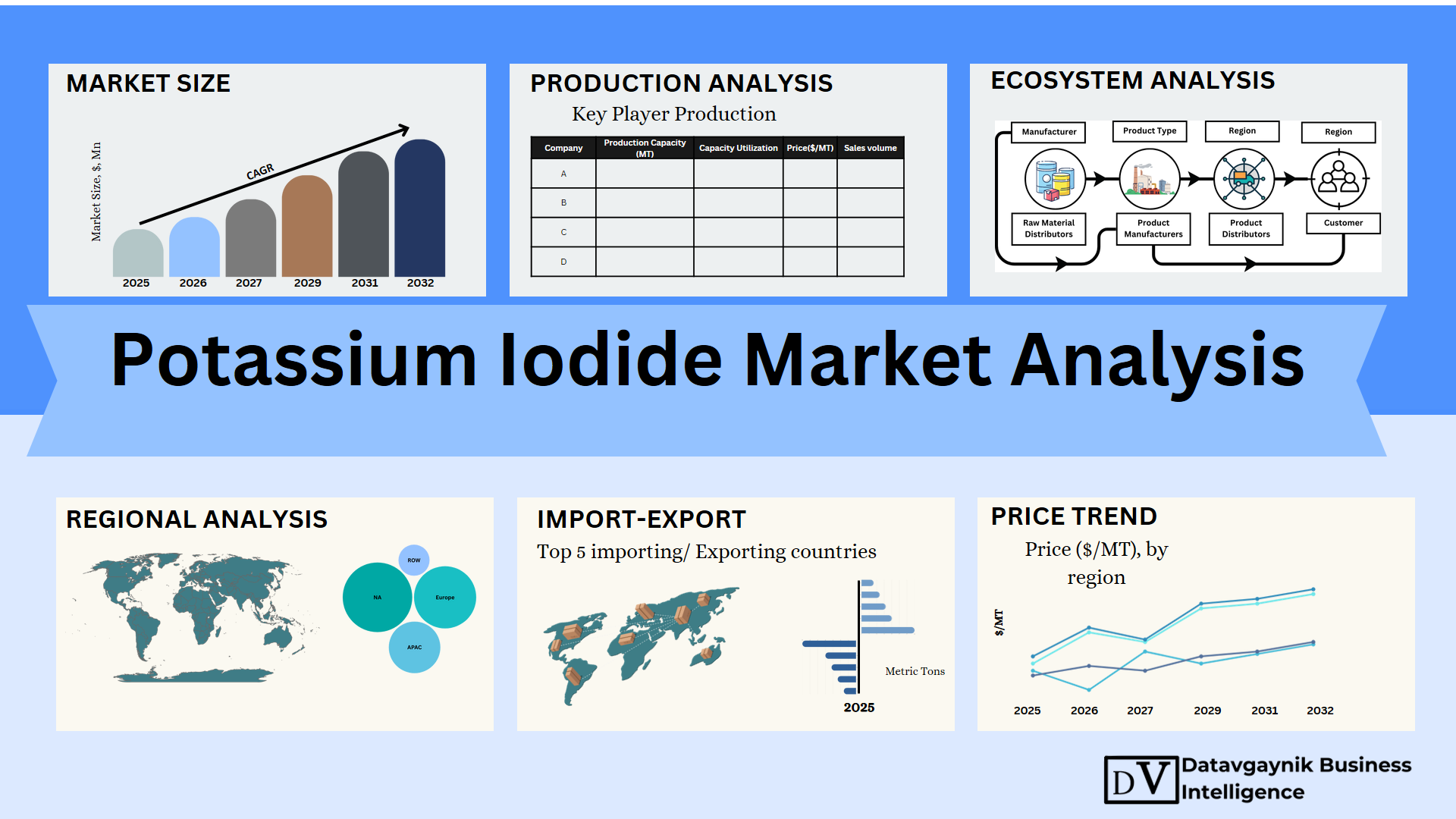
The Potassium Iodide Market is experiencing a substantial uptrend as global healthcare preparedness and nuclear safety continue to dominate policy frameworks. Datavagyanik analysis reveals that a growing number of countries are integrating potassium iodide tablets into national stockpiles as part of nuclear emergency preparedness strategies. For instance, in the United States alone, state and federal agencies have increased procurement of pharmaceutical-grade potassium iodide to protect populations from radioactive iodine exposure. This development is directly contributing to the expansion of the Potassium Iodide Market Size across North America and Europe.
Increased investments in nuclear energy infrastructure, particularly in Asia Pacific and the Middle East, are further intensifying the need for thyroid-protective agents such as potassium iodide. With over 440 operational nuclear reactors worldwide and several more in development, the demand for emergency preparedness materials is set to remain robust. For example, nations like Poland and South Korea have announced renewed nuclear safety protocols, significantly raising the forecasted demand for potassium iodide tablets in public and institutional sectors. These proactive measures are directly fueling the growth trajectory of the global Potassium Iodide Market.
Rising Thyroid Disorders Driving Pharmaceutical Demand in the Potassium Iodide Market
The pharmaceutical sector remains a leading end-user in the Potassium Iodide Market, primarily due to its essential role in the treatment of thyroid-related disorders. As per Datavagyanik, the global incidence of thyroid disorders has increased by over 35% over the last decade, with hypothyroidism and thyroid cancer cases rising notably in urban populations. Potassium iodide plays a critical function in regulating iodine levels and preventing goiter and other iodine-deficiency-related complications. This demand is particularly strong in the United States, Germany, China, and Japan, where both public and private healthcare investments are increasing.
Moreover, pharmaceutical manufacturers are capitalizing on the growing awareness of iodine deficiency by incorporating potassium iodide into a wider range of formulations, including respiratory expectorants and iodine-based radiopharmaceuticals. The Potassium Iodide Market is benefiting from this trend, as the expansion of treatment options correlates directly with higher consumption rates. For instance, India has recorded a double-digit CAGR in iodine-based drug production, creating additional demand for high-purity potassium iodide in pharmaceutical supply chains.
Datavagyanik also covers related markets such as the Sodium Iodide Market, the Zinc iodide Market, and the Ammonium Iodide Market. They offer supporting insights that clarify downstream implications and strategic challenges in the context of the main topic.
Potassium Iodide Market Boosted by Salt Iodization and Nutritional Supplement Trends
The global effort to eradicate iodine deficiency disorders (IDDs) has significantly impacted the Potassium Iodide Market. Potassium iodide remains a cornerstone ingredient in salt iodization programs mandated by governments and global health organizations. Datavagyanik data suggests that over 120 countries have made iodized salt mandatory, leading to consistent bulk purchases of potassium iodide by salt manufacturers. In countries like Indonesia, Nigeria, and India, where iodine deficiency affects millions, this trend is creating long-term demand stability.
In parallel, the growing consumer shift toward fortified foods and nutritional supplements is expanding the application base of potassium iodide. For example, in North America and Western Europe, health-focused consumers are increasingly opting for multivitamins containing iodine, pushing dietary supplement manufacturers to procure pharmaceutical-grade potassium iodide. The rising prevalence of personalized nutrition and preventative healthcare further enhances the Potassium Iodide Market’s outlook in the health and wellness segment.
Agricultural Advancements Strengthen Potassium Iodide Market Penetration
The role of potassium iodide in animal feed as a micronutrient additive is another critical growth vector for the Potassium Iodide Market. Livestock farming operations globally are emphasizing feed fortification to enhance animal productivity and health outcomes. For instance, large-scale dairy and meat producers in Brazil, China, and the United States are increasingly using potassium iodide-enriched feed to combat iodine deficiency in cattle, poultry, and swine. Datavagyanik analysis reveals that iodine-fortified feed contributes to improved fertility rates and milk yield in livestock, making it an economically beneficial choice for farmers.
As global demand for animal protein continues to grow—projected to rise by 70% by 2050—nutritional feed additives like potassium iodide will play a vital role in meeting productivity targets. This has positioned agriculture as a strong secondary contributor to the overall Potassium Iodide Market expansion, particularly in regions with large-scale animal husbandry operations.
Geopolitical Uncertainty and Emergency Preparedness Accelerate Potassium Iodide Market Demand
Global geopolitical instability and heightened awareness around nuclear risk have significantly elevated the strategic importance of potassium iodide. Countries with active nuclear energy programs or those under potential geopolitical threat have ramped up the procurement and distribution of potassium iodide for civilian protection. Datavagyanik highlights that following recent conflicts and natural disasters affecting nuclear infrastructure, several European and Asian governments have distributed potassium iodide tablets to populations living within proximity of nuclear plants.
For instance, following increased nuclear tension in Eastern Europe, Poland ordered millions of potassium iodide tablets to be stocked and distributed by local health authorities. Similarly, Japan, with its past experience of nuclear fallout, continues to prioritize potassium iodide in its national emergency supplies. This growing need for readiness is generating sustained demand in the Potassium Iodide Market and influencing import-export trends for pharmaceutical-grade materials.
Industrial Applications Adding Niche Momentum to the Potassium Iodide Market
Although healthcare and nutrition dominate the demand landscape, the Potassium Iodide Market is also finding growth opportunities in industrial applications. Used as a reagent in chemical synthesis, a stabilizer in photographic emulsions, and a precursor for iodine-based compounds, potassium iodide is experiencing moderate but stable demand from specialty chemical manufacturers. For example, electronic component production in East Asia and high-end photography in North America are sectors where potassium iodide plays a role in specific chemical processes.
Datavagyanik notes that while industrial applications account for a smaller share of the overall Potassium Iodide Market Size, their contribution is significant in regions with well-developed manufacturing ecosystems. Countries such as South Korea, Japan, and Germany are investing in cleaner and more efficient chemical synthesis technologies, where potassium iodide continues to serve as an integral additive.
Research and Development Accelerating Use Cases in the Potassium Iodide Market
Research institutions and pharmaceutical labs globally are increasing their consumption of potassium iodide in experimental and diagnostic processes. Datavagyanik observes that potassium iodide is often used in test reactions, titration studies, and as a reactant in new drug formulation trials. As R&D budgets continue to rise—especially in biotechnology, oncology, and endocrinology—so does the procurement of high-purity potassium iodide.
For instance, the United States alone spent over $90 billion on healthcare R&D in 2023, with a growing share allocated to endocrine system treatments. This has a cascading impact on potassium iodide suppliers catering to laboratory-grade requirements. Similarly, academic institutions across Europe and Asia Pacific are incorporating potassium iodide in curriculum-based research activities, increasing its demand in educational and institutional supply channels.
Environmental and Regulatory Support Reinforcing Potassium Iodide Market Foundations
Regulatory mandates remain a vital catalyst in the Potassium Iodide Market. Governments and international health organizations have imposed clear guidelines around iodine supplementation in food and livestock feed. These regulations not only create baseline demand but also ensure consistent adoption across various regions. For instance, the WHO and UNICEF have jointly advocated for universal salt iodization, which directly fuels potassium iodide consumption globally.
Moreover, in regions like the European Union, the pharmaceutical use of potassium iodide is regulated under stringent quality frameworks, pushing manufacturers to produce higher-grade variants. This regulatory clarity reduces entry barriers for suppliers and encourages long-term investments in production facilities. Datavagyanik projects that regulatory consistency across healthcare, food, and agriculture will play a defining role in the sustained growth of the Potassium Iodide Market in the coming decade.
“Track Country-wise Potassium Iodide Production and Demand through our Potassium Iodide Production Database”
-
-
- Potassium Iodide production database for 26+ countries worldwide
- Potassium Iodide sales volume for 30+ countries
- Country-wise Potassium Iodide production capacity, production plant mapping, production capacity utilization for 26+ manufacturers
- Potassium Iodide production plants and production plant capacity analysis by top manufacturers
-
“Track real-time Potassium Iodide Prices, Potassium Iodide price charts for 26+ countries, Potassium Iodide weekly price tracker and Potassium Iodide monthly price tracker”
-
-
- Track real-time Potassium Iodide prices and Potassium Iodide price trend in 26+ countries though our excel-based Potassium Iodide price charts
- Real-time Potassium Iodide price tracker dashboard with 26+ countries
- Complete transparency on Potassium Iodide price trend through our Potassium Iodide monthly price tracker, Potassium Iodide weekly price tracker
-
North America Driving Strategic Growth in the Potassium Iodide Market
The Potassium Iodide Market in North America is anchored by strong institutional demand from the healthcare and nuclear safety sectors. The United States leads regional consumption due to extensive preparedness programs and the high prevalence of thyroid-related disorders. For instance, over 20 million Americans are estimated to suffer from thyroid disease, directly increasing pharmaceutical-grade potassium iodide demand. Datavagyanik notes that emergency stockpiling of potassium iodide by the U.S. Department of Health and Human Services and state-level agencies has accelerated post-2020, as part of disaster-readiness protocols.
In Canada, the Potassium Iodide Market is primarily driven by healthcare facilities and pharmaceutical manufacturers, which rely on imports to meet domestic needs. Although Canada has limited iodine resources, its strict quality regulations for drug-grade inputs result in significant purchases from the U.S. and Japan, reinforcing North America’s position as a high-value potassium iodide market.
Potassium Iodide Market Gaining Momentum Across Europe
Europe’s Potassium Iodide Market is benefiting from widespread adoption in nuclear emergency preparedness and food fortification strategies. Countries such as France, Germany, and the UK are key consumers, driven by a combination of high healthcare standards and robust nuclear infrastructure. For example, France—home to over 50 nuclear reactors—has a well-established protocol of distributing potassium iodide tablets to residents within a 20 km radius of nuclear sites. This creates consistent institutional demand, especially for government-certified suppliers.
Eastern European countries like Poland, Romania, and Ukraine have seen a sharp increase in demand due to rising nuclear risks and recent geopolitical tensions. Datavagyanik highlights that Poland distributed over 5 million potassium iodide tablets in 2023 alone, a clear indication of the region’s reliance on this compound as a radiation shield. Additionally, countries with historically low iodine intake continue to fortify salt and other foods using potassium iodide, further supporting its widespread use in the European Potassium Iodide Market.
Asia Pacific Emerging as the Fastest-Growing Potassium Iodide Market
Asia Pacific represents the most dynamic region for the Potassium Iodide Market, fueled by booming healthcare needs, expanding food security programs, and nuclear energy investments. China and India are at the forefront, with rapidly growing demand across pharmaceuticals, salt iodization, and livestock nutrition. In India, the National Iodine Deficiency Disorders Control Programme reaches over 800 million people, with potassium iodide serving as the primary iodizing agent. This initiative alone accounts for thousands of metric tons of potassium iodide consumption annually.
Japan and South Korea also play pivotal roles, especially in the nuclear safety segment. Japan’s post-Fukushima policy mandates potassium iodide reserves in all nuclear zones, while South Korea integrates potassium iodide into both emergency response and pharmaceutical infrastructure. Datavagyanik expects the Asia Pacific Potassium Iodide Market to register a CAGR above 8% through 2030, outpacing mature markets in North America and Europe.
Middle East and Africa Strengthening Presence in the Potassium Iodide Market
The Potassium Iodide Market in the Middle East and Africa is gaining prominence, especially in nuclear safety and healthcare. The UAE, home to the Barakah Nuclear Power Plant, has adopted rigorous safety protocols that include bulk procurement of potassium iodide. Saudi Arabia is following a similar path, with its Vision 2030 plan involving new nuclear projects and corresponding safety measures. In Africa, demand is led by salt iodization programs in countries like Ethiopia, Nigeria, and Kenya. For example, Nigeria’s Universal Salt Iodization policy has made potassium iodide a strategic import in the public health sector.
Latin America Sustaining Demand in Agriculture and Nutrition
In Latin America, the Potassium Iodide Market is supported by dual demand from food and agricultural sectors. Countries like Brazil and Argentina use potassium iodide extensively in salt iodization and livestock feed. Chile’s position as a leading global iodine exporter also plays a key role in stabilizing regional potassium iodide availability. Datavagyanik notes that iodine from Chilean brine fields supplies several Latin American countries, enabling consistent formulation of potassium iodide-based products for animal and human consumption.
Potassium Iodide Market Production and Global Supply Chain Dynamics
Global production of potassium iodide is heavily influenced by access to raw iodine, which is mainly extracted from brine sources. Japan, Chile, and the United States are the largest iodine-producing regions and thus dominate potassium iodide manufacturing. Japanese manufacturers focus on ultra-high-purity pharmaceutical grades, while Chile supplies bulk raw material to formulators in Europe, Asia, and North America.
India and China have increased their domestic production capacities to meet rising internal demand. In particular, India’s government is incentivizing local API (Active Pharmaceutical Ingredient) production, which includes potassium iodide, to reduce import dependency. Datavagyanik identifies this trend as a potential shift in global trade flows, especially as Asia aims to reduce reliance on external suppliers.
Market Segmentation Strengthening the Potassium Iodide Market Landscape
The Potassium Iodide Market is segmented by application, form, grade, and end-use industry. On the application front, healthcare and pharmaceuticals dominate, accounting for over 35% of global demand. This is followed by food and nutrition at 30%, nuclear safety at 20%, agriculture at 10%, and industrial uses making up the balance. By form, solid potassium iodide—typically in powder or crystalline formats—remains the most widely used due to ease of transport and shelf stability.
In terms of grade, pharmaceutical-grade potassium iodide commands premium pricing due to strict quality regulations and purity requirements, while industrial-grade variants are used in feed and chemical manufacturing. The end-user industry segmentation reflects a diverse set of stakeholders: pharmaceutical companies, government agencies, food processors, animal feed manufacturers, and nuclear facilities.
Potassium Iodide Price and Potassium Iodide Price Trend Observations
The Potassium Iodide Price varies significantly depending on grade, region, and purity. In 2024, pharmaceutical-grade potassium iodide prices ranged between USD 45 to USD 60 per kilogram, driven by strong demand from healthcare and government sectors. Industrial-grade potassium iodide is priced lower, averaging around USD 20 to USD 30 per kilogram.
Datavagyanik expects the Potassium Iodide Price Trend to remain upward in the short term due to supply chain constraints and rising global preparedness initiatives. For instance, increased nuclear risk preparedness in Europe and Asia has led to bulk procurement programs, tightening pharmaceutical-grade supply and driving up prices by over 10% year-on-year. Seasonal fluctuations also influence the Potassium Iodide Price Trend, particularly in agricultural cycles and iodized salt production periods.
Emerging economies expanding their public health programs are expected to further increase demand, putting additional pressure on supply and stabilizing the Potassium Iodide Price Trend at elevated levels through at least 2027. Manufacturers are thus incentivized to expand production capacities and invest in high-efficiency purification systems to remain competitive in a tightening global market.
“Potassium Iodide Manufacturing Database, Potassium Iodide Manufacturing Capacity”
-
-
- Potassium Iodide top manufacturers market share for 26+ manufacturers
- Top 8 manufacturers and top 16 manufacturers of Potassium Iodide in North America, Europe, Asia Pacific
- Potassium Iodide production plant capacity by manufacturers and Potassium Iodide production data for 26+ market players
- Potassium Iodide production dashboard, Potassium Iodide production data in excel format
-
“Potassium Iodide price charts, Potassium Iodide weekly price tracker and Potassium Iodide monthly price tracker”
-
-
- Factors impacting real-time Potassium Iodide prices in 21+ countries worldwide
- Potassium Iodide monthly price tracker, Potassium Iodide weekly price tracker
- Real-time Potassium Iodide price trend, Potassium Iodide price charts, news and updates
- Tracking Potassium Iodide price fluctuations
-
Top Manufacturers in the Potassium Iodide Market and Their Global Influence
The Potassium Iodide Market is shaped by a competitive mix of multinational corporations, regional producers, and vertically integrated suppliers with access to iodine reserves. These companies vary in scale, specialization, and geographic coverage, but collectively influence global pricing, purity standards, and availability of potassium iodide across industries. The market’s structure favors players that can maintain regulatory compliance, consistent quality, and secure iodine raw material inputs. Based on production volumes, strategic alliances, and end-market penetration, a few key players hold a substantial share of the Potassium Iodide Market.
Ajay-SQM Group – Integrated Leadership in Raw Material and Finished Product Supply
The Ajay-SQM Group represents one of the most influential forces in the Potassium Iodide Market, holding an estimated 18–20% share globally. With direct access to iodine reserves from Chile through SQM and manufacturing operations in the U.S., the company ensures both upstream and downstream integration. Ajay-SQM’s portfolio includes industrial and pharmaceutical-grade potassium iodide under proprietary lines such as Ajay-KI Pharma™ and Ajay-KI FeedMix™. These products are used extensively in salt iodization programs, nutritional supplements, and as radiation protective agents.
Their strategic logistics hubs in North America and Latin America give them an edge in timely delivery, especially to public health agencies and food manufacturers. Their recent investment in a new production unit for pharma-grade potassium iodide in the U.S. reflects the growing demand from institutional buyers and hospitals for high-purity products.
Iofina plc – High-Purity Specialization in Potassium Iodide
Iofina plc, headquartered in the UK with operations in the United States, is recognized for its strong position in pharmaceutical-grade potassium iodide. The company secures iodine through environmentally efficient extraction from brine sources in the U.S., supporting a consistent and sustainable supply chain. Iofina’s specialized product line IOflo™ KI is tailored for applications in thyroid treatment, radiological protection, and multivitamin formulations. Holding a 10–12% share of the Potassium Iodide Market, Iofina caters to both government and private healthcare sectors across Europe, North America, and select Asian markets.
Their emphasis on high-purity, low-impurity formulations makes them a preferred supplier to pharmaceutical manufacturers operating under stringent regulatory environments. Additionally, the company is developing extended-release potassium iodide tablets aimed at radiation protection, a move expected to increase their share in the public sector.
Deepwater Chemicals – North American Regulatory Compliance Leader
Deepwater Chemicals, a U.S.-based subsidiary of Toyota Tsusho America, plays a key role in the Potassium Iodide Market through its commitment to regulatory-grade compliance. The company focuses on meeting U.S. Pharmacopeia (USP) and European Pharmacopoeia (EP) standards for medical and nuclear emergency applications. Its product line includes DeepPure™ KI tablets and crystalline powders used in hospital, military, and emergency preparedness programs.
With a market share estimated at 8–10%, Deepwater Chemicals’ strength lies in its credibility among state and federal institutions, particularly for inclusion in national stockpiles. The company has recently enhanced its manufacturing capabilities, allowing for higher batch volumes and faster lead times—a critical factor in emergency procurement situations.
Godo Shigen Co., Ltd. – Dominant Player in the Japanese Potassium Iodide Market
Godo Shigen, based in Japan, is a major producer of potassium iodide catering to both domestic and international clients. The company benefits from proximity to iodine-rich reserves and serves a large portion of the Asian pharmaceutical and nutrition sectors. Its flagship product Godo-KI Ultra™ is used in medical-grade formulations, fortified foods, and research applications. Holding around 7–8% of the global Potassium Iodide Market, the company is a key supplier to countries in Southeast Asia, as well as exporters targeting high-end applications.
Their consistent R&D efforts have led to the development of potassium iodide grades suitable for radiation therapy and advanced imaging agents. The company’s expansion into powder premixes for feed applications reflects a strategy to diversify across industries without compromising on purity.
Nippoh Chemicals Co., Ltd. – Advanced Specialty Chemical Supplier
Nippoh Chemicals is another prominent Japanese manufacturer with a reputation for producing ultra-refined potassium iodide used in electronics, laboratory, and pharmaceutical applications. Their market share is estimated to be 6–7% globally, with high influence in niche sectors like semiconductors and specialty reagents. Their potassium iodide line, marketed under NipPure™, is engineered for minimal impurities and consistent performance in sensitive formulations.
By focusing on ultra-high-purity output, Nippoh Chemicals has positioned itself as a supplier of choice for biotech labs, academic institutions, and manufacturers requiring advanced purity assurance.
Loba Chemie – Rising Influence from India
Loba Chemie, headquartered in India, is emerging as a significant player in the Asia Pacific Potassium Iodide Market. The company’s growth is tied to the rise in domestic pharmaceutical manufacturing and educational institution demand. Loba offers both analytical and pharmaceutical-grade potassium iodide under its LobaLab™ series, with a growing export footprint in Africa and Southeast Asia.
Although its global market share is around 4–5%, the company’s rapid growth and alignment with India’s government-backed API production initiatives make it one to watch. Their expansion plans include a new formulation unit focused on iodine derivatives, signaling their intent to climb further up the value chain.
Potassium Iodide Market Share Distribution Overview
- Ajay-SQM Group: 18–20%
- Iofina plc: 10–12%
- Deepwater Chemicals: 8–10%
- Godo Shigen Co., Ltd.: 7–8%
- Nippoh Chemicals Co., Ltd.: 6–7%
- Loba Chemie: 4–5%
- Others (Regional/Local Producers): 40–45%
The remaining share of the Potassium Iodide Market is divided among local and regional producers that supply industrial-grade or agricultural potassium iodide. These include suppliers in China, Eastern Europe, and Latin America catering to non-pharmaceutical markets, where volume requirements are high but purity thresholds are lower.
Recent Developments and Strategic Industry Updates
- In January 2024, Iofina launched a new product formulation of extended-release potassium iodide tablets for nuclear emergency kits. This product is undergoing regulatory testing and is expected to be introduced into the U.S. government supply chain within the year.
- In February 2024, Deepwater Chemicals completed an upgrade of its Oklahoma facility, increasing capacity by 25% to meet rising demand from healthcare and civil defense institutions in the U.S. and Canada.
- In March 2024, Godo Shigen announced an export agreement with a leading South Korean hospital chain to supply potassium iodide for use in oncology treatments and radiation exposure therapy.
- In April 2024, Ajay-SQM Group disclosed a new agreement with Brazil’s national salt fortification authority to supply potassium iodide through 2027, reinforcing their position in the Latin American market.
These developments highlight the strategic positioning of top manufacturers to meet increasing global demand across healthcare, food safety, nuclear preparedness, and animal nutrition. As regulatory requirements tighten and governments escalate iodine supplementation programs, the Potassium Iodide Market is expected to further consolidate around players with advanced production technologies, scalable logistics, and proven compliance capabilities.
“Potassium Iodide Production Data and Potassium Iodide Production Trend, Potassium Iodide Production Database and forecast”
-
-
- Potassium Iodide production database for historical years, 10 years historical data
- Potassium Iodide production data and forecast for next 7 years
- Potassium Iodide sales volume by manufacturers
-
“Track Real-time Potassium Iodide Prices for purchase and sales contracts, Potassium Iodide price charts, Potassium Iodide weekly price tracker and Potassium Iodide monthly price tracker”
-
-
- Gain control on your purchase and sales contracts through our real-time Potassium Iodide price tracker and Potassium Iodide price trend analysis
- Potassium Iodide weekly price tracker and forecast for next four weeks
- Potassium Iodide monthly price tracker and forecast for next two months
-
Market Scenario, Demand vs Supply, Average Product Price, Import vs Export, till 2032
- Global Potassium Iodide Market revenue and demand by region
- Global Potassium Iodide Market production and sales volume
- United States Potassium Iodide Market revenue size and demand by country
- Europe Potassium Iodide Market revenue size and demand by country
- Asia Pacific Potassium Iodide Market revenue size and demand by country
- Middle East & Africa Potassium Iodide Market revenue size and demand by country
- Latin America Potassium Iodide Market revenue size and demand by
- Import-export scenario – United States, Europe, APAC, Latin America, Middle East & Africa
- Average product price – United States, Europe, APAC, Latin America, Middle East & Africa
- Market player analysis, competitive scenario, market share analysis
- Business opportunity analysis
Key questions answered in the Global Potassium Iodide Market Analysis Report:
- What is the market size for Potassium Iodide in United States, Europe, APAC, Middle East & Africa, Latin America?
- What is the yearly sales volume of Potassium Iodide and how is the demand rising?
- Who are the top market players by market share, in each product segment?
- Which is the fastest growing business/ product segment?
- What should be the business strategies and Go to Market strategies?
The report covers Potassium Iodide Market revenue, Production, Sales volume, by regions, (further split into countries):
- Asia Pacific (China, Japan, South Korea, India, Indonesia, Vietnam, Rest of APAC)
- Europe (UK, Germany, France, Italy, Spain, Benelux, Poland, Rest of Europe)
- North America (United States, Canada, Mexico)
- Latin America (Brazil, Argentina, Rest of Latin America)
- Middle East & Africa
Table of Contents:
Potassium Iodide Market
- Introduction to Potassium Iodide
-
- 1.1 Overview and Key Properties of Potassium Iodide
- 1.2 Historical Significance and Industrial Applications
- Market Overview and Dynamics
-
- 2.1 Key Drivers of Potassium Iodide Demand
- 2.2 Market Challenges and Restraints
- 2.3 Opportunities in Emerging Applications
- Product Segmentation of Potassium Iodide
-
- 3.1 Pharmaceutical-Grade Potassium Iodide
- 3.2 Industrial-Grade Potassium Iodide
- 3.3 High-Purity and Specialty Grades
- Applications of Potassium Iodide
-
- 4.1 Role in Thyroid Protection and Radiation Emergencies
- 4.2 Use in Iodized Salt Production and Food Fortification
- 4.3 Applications in Pharmaceuticals and Medicine
- 4.4 Role in Photography and Imaging Processes
- 4.5 Advanced Applications in Specialty Chemicals
- Global Market Overview and Insights
-
- 5.1 Historical Market Trends (2019-2024)
- 5.2 Forecasted Growth and Future Trends (2024-2032)
- Regional Market Analysis
-
- 6.1 North America: Growth in Emergency Medical Supplies
- 6.2 Europe: Regulatory Landscape and Market Dynamics
- 6.3 Asia Pacific: Expanding Applications in Food and Healthcare
- 6.4 Latin America: Opportunities in Nutritional Fortification
- 6.5 Middle East & Africa: Market Potential and Challenges
- Production and Manufacturing Insights
-
- 7.1 Leading Producers and Global Manufacturing Capacities
- 7.2 Innovations in Potassium Iodide Production
- Raw Material and Supply Chain Analysis
-
- 8.1 Sourcing of Iodine and Key Inputs
- 8.2 Supply Chain Challenges and Risk Management
- End-Use Market Demand and Consumption Trends
-
- 9.1 Growth in Emergency Medical Stockpiling
- 9.2 Use in Food Fortification and Nutritional Products
- 9.3 Role in Chemical and Industrial Applications
- Pricing Trends and Cost Structure
-
- 10.1 Historical Pricing Data for Potassium Iodide
- 10.2 Cost Dynamics in Production and Distribution
- Global Trade and Market Connectivity
-
- 11.1 Export Patterns of Leading Producers
- 11.2 Import Demand in High-Consumption Regions
- 11.3 Regulatory Challenges in International Trade
- Competitive Landscape
-
- 12.1 Analysis of Key Market Players and Their Market Shares
- 12.2 Strategies for Competitive Advantage
- 12.3 Recent Developments and Investments
- Technological Innovations in Potassium Iodide Applications
-
- 13.1 Advancements in Medical and Pharmaceutical Uses
- 13.2 New Applications in Advanced Technologies
- Environmental and Safety Considerations
-
- 14.1 Environmental Impact of Potassium Iodide Manufacturing
- 14.2 Safety Standards and Compliance Regulations
- Emerging Trends and Market Opportunities
-
- 15.1 Growth in Preparedness and Emergency Supplies
- 15.2 Role in Innovative Food and Chemical Products
- Future Market Projections (2024-2032)
-
- 16.1 Regional Supply and Demand Scenarios
- 16.2 Growth Potential in Emerging Economies
- Distribution and Sales Channels
-
- 17.1 Role of Distribution Networks in Market Expansion
- 17.2 Opportunities in Direct and Online Sales Platforms
- Investment Opportunities in Potassium Iodide Market
-
- 18.1 Strategic Areas for Growth and Development
- 18.2 Collaborations and Mergers for Market Expansion
- Macroeconomic and Policy Impacts
-
- 19.1 Influence of Economic Trends on Market Dynamics
- 19.2 Effects of Trade and Regulatory Policies
- Strategic Recommendations for Stakeholders
-
- 20.1 Market Entry Strategies for New Players
- 20.2 Innovation and Sustainability as Growth Drivers

