

Rigid Frame Trucks Demand Concentrates Around High-Output Mining Regions and Long-Haul Quarry Operations
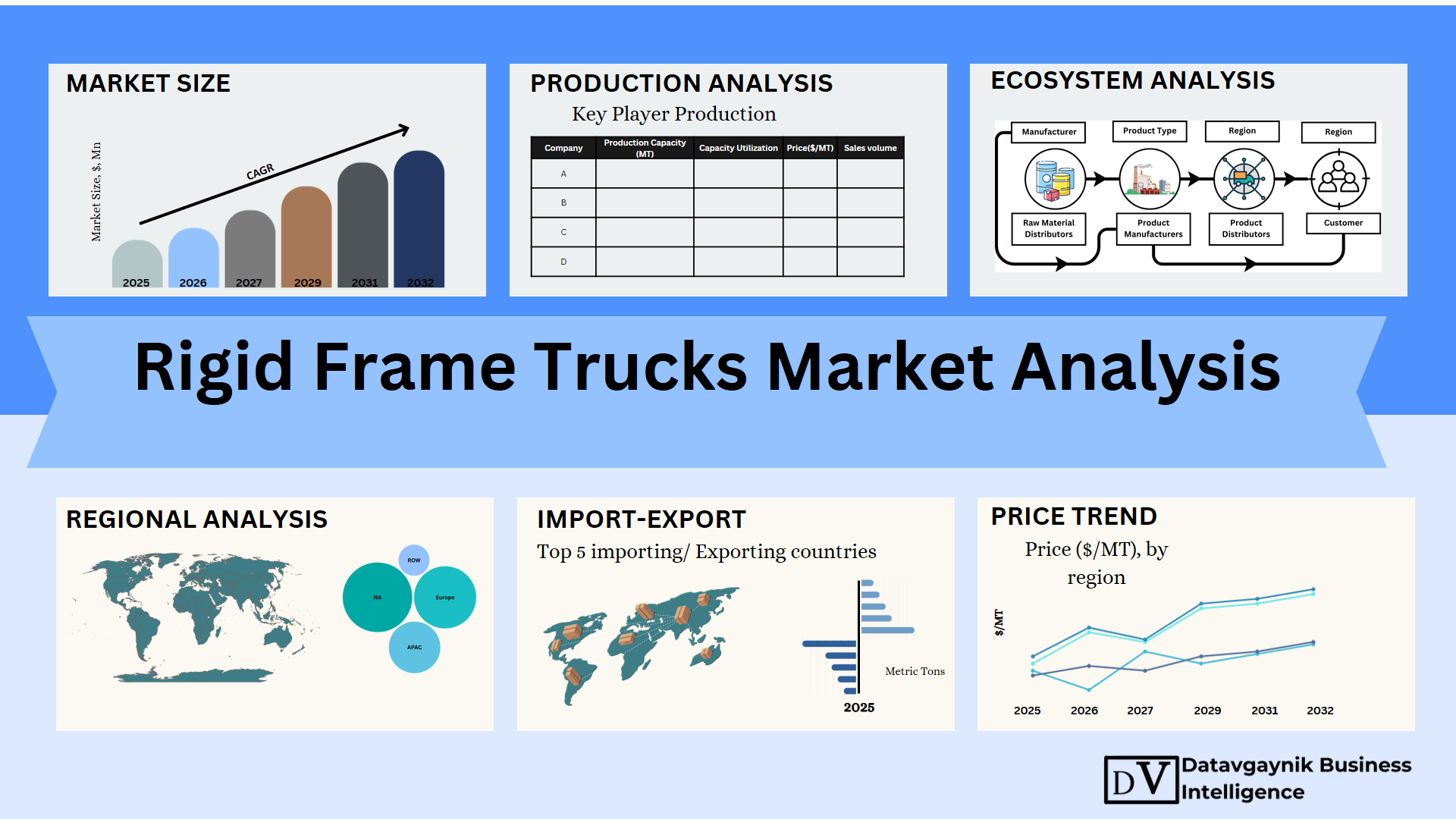
Rigid Frame Trucks remain concentrated in countries where mine output, overburden movement, quarry throughput, and large civil earthmoving create continuous hauling cycles rather than intermittent transport demand. The global Rigid Frame Trucks market is estimated at USD 8.7 billion in 2026, with a CAGR of about 7.1% through 2032, taking the market toward nearly USD 13.1 billion by the forecast year, based on off-highway dump truck demand patterns and the higher-value share held by rigid-frame mining and quarry trucks. Demand is led by Australia, China, India, Indonesia, Chile, the United States, Canada, South Africa, Brazil, and selected Gulf infrastructure markets, where buyers are mining companies, quarry operators, cement producers, coal producers, iron ore miners, copper mines, and large contractors that require 40-tonne to 400-tonne payload-class hauling equipment.
Australia and Chile create the strongest high-payload demand for rigid-frame mining trucks
Australia is one of the clearest demand anchors because iron ore mining in Western Australia requires large payload rigid-frame haulage fleets with high utilization. In May 2025, Western Australia’s iron ore profile reported 866 million tonnes of iron ore sold in 2024 at an average unit price of A$148 per tonne. This production scale supports continuing fleet demand in the Pilbara, where haul distances, pit depth, and long operating hours favor ultra-class rigid-frame trucks rather than articulated trucks or road-going dumpers.
Mining houses in Australia also have a mature maintenance ecosystem. Caterpillar, Komatsu, Liebherr, Hitachi, Epiroc-connected service providers, and major dealer groups operate strong field-service networks around iron ore, coal, gold, and lithium basins. This makes Australia stronger than many emerging mining markets because buyers are not only purchasing trucks; they are buying uptime, rebuild programs, component exchange, tire management, autonomous-ready controls, and engine or electric-drive support.
Chile is another high-intensity rigid truck market because copper mines operate at large scale and high altitude. In September 2024, BHP announced that it would test Caterpillar’s Dynamic Energy Transfer system on large mining trucks, including trials connected with its Escondida copper operations in Chile. This matters for Rigid Frame Trucks because Chilean copper mines face rising diesel cost, haul-road energy intensity, and decarbonization pressure. The adoption logic is not simply new truck buying; it is fleet modernization around powertrain efficiency, trolley-assist readiness, and haulage productivity.
Codelco’s 2024 copper production reached around 1.328 million tonnes, showing that Chile continues to carry a large mining equipment replacement base even when ore grades and project execution remain difficult. For rigid-frame truck suppliers, Chile is service-led: fleet replacement is tied to mine life extension, truck-hour accumulation, and the availability of field mechanics in Antofagasta and other northern mining zones.
Asia’s rigid-frame truck demand is split between coal volume, local supply, and price-sensitive procurement
India and Indonesia represent high-volume demand, but the purchase behavior differs from Australia and Chile. India’s coal sector crossed one billion tonnes of output in FY2024–25, with all-India coal production at 1,047.523 million tonnes, up 4.98% from 997.826 million tonnes in FY2023–24. This directly supports the use of rigid-frame trucks in Coal India operations, captive coal blocks, iron ore mines in Odisha, limestone mines supplying cement plants, and large infrastructure earthmoving jobs.
India’s demand is stronger in the 60-tonne to 150-tonne payload range, with selective use of ultra-class trucks in larger open-cast coal mines. The customer base includes Coal India subsidiaries, state mining corporations, private mining contractors, cement producers, steel-linked iron ore miners, and EPC contractors working in large excavation packages. Procurement remains cost-sensitive, so equipment selection often balances payload, fuel consumption, tire life, maintenance access, and financing terms.
Indonesia is one of the largest coal-linked markets for rigid and heavy off-highway hauling equipment. By December 2024, Indonesia’s national coal production had reached more than 812 million tonnes, with domestic consumption above 365 million tonnes and exports above 417 million tonnes. The country’s coal mines in Kalimantan and Sumatra generate demand for rigid-frame and wide-body haul trucks, but local procurement is more fragmented than in Australia. Chinese OEMs, Japanese brands, and global premium suppliers compete through price, parts availability, dealer support, and mine-contractor relationships.
China remains both a demand center and a supply center. Chinese mines, cement quarries, hydropower earthworks, and infrastructure-linked excavation projects absorb large volumes of rigid and wide-body mining trucks. At the same time, Chinese manufacturers have increased export reach in Southeast Asia, Africa, Central Asia, and Latin America. This puts pricing pressure on premium OEMs, especially in mid-payload classes where buyers compare upfront cost against long-term component life.
North America remains replacement-led, with quarry, aggregates, oil sands, and metal mining users
The United States and Canada do not show the same unit-growth intensity as India or Indonesia, but they remain high-value markets because of replacement, rebuild, and productivity-focused procurement. In the U.S., rigid-frame trucks are used heavily in aggregates, limestone, coal, copper, gold, and large construction-material operations. Quarry operators often run smaller payload classes than open-pit mines, but they require strong dealer proximity because truck downtime directly disrupts crusher feed and plant utilization.
Canada’s demand is more mining-weighted, with oil sands, gold, copper, nickel, and iron ore supporting larger payload fleets. The buyer logic is harsh-weather durability, payload efficiency, service access, emissions compliance, and high machine availability. Northern mine locations also increase the value of parts logistics and maintenance planning. A truck with lower acquisition cost has limited buyer appeal if major component lead times are long or field service coverage is weak.
Caterpillar’s 2024 Resource Industries sales were reported at more than USD 12 billion, covering mining and heavy construction customers. This indicates that North America and global mining customers continued to spend heavily on equipment, parts, and services even when some machine volumes softened. For Rigid Frame Trucks, that softness matters: demand is not uniform growth; it is mixed between new truck delivery, rebuilds, powertrain upgrades, and fleet-life extension.
Quarry and construction applications support smaller rigid-frame truck classes
Mining dominates value, but quarrying and heavy civil construction create a wider buyer base. Cement plants, aggregates producers, road contractors, dam builders, port developers, and tunneling spoil-handling contractors use rigid-frame trucks where site roads are prepared, haul cycles are repetitive, and payload efficiency is more important than maneuverability. Articulated dump trucks are preferred on softer ground and tighter sites, while rigid-frame trucks fit better in stable haul-road operations with high daily tonnage.
The strongest quarry markets are the United States, China, India, Germany, France, the United Kingdom, Turkey, Brazil, Saudi Arabia, and the UAE. Demand is closely linked to cement consumption, aggregates output, and infrastructure spending. In the Gulf, quarry and construction demand is connected to road, port, industrial-zone, and urban construction activity, but the fleet base is smaller than mining-heavy markets.
Supply availability favors countries with dealer networks and rebuild capacity
Rigid Frame Trucks are not bought like ordinary commercial vehicles. The operating model depends on tire supply, drivetrain repair, hydraulic service, operator training, telematics, rebuild kits, and mine-site technical support. Australia, the United States, Canada, Chile, and South Africa have stronger supplier ecosystems because large mining fleets justify permanent service infrastructure.
Emerging markets face two constraints. First, imported high-payload trucks require foreign exchange availability, financing, port logistics, and skilled commissioning. Second, parts and tire availability can become a bottleneck when mines expand faster than local service capacity. These constraints explain why some buyers in Indonesia, India, Africa, and Central Asia select lower-cost or locally supported alternatives even when premium trucks offer stronger long-term productivity.
Regional constraints keep the market concentrated despite broad mining demand
The main constraint is not lack of application need; it is the capital intensity of fleet replacement. A single high-payload rigid mining truck represents a large capital decision, and full fleet renewal requires matching excavators, shovels, loaders, workshops, fuel or charging systems, haul-road design, and trained operators. Mines also delay replacement when commodity prices weaken or when contractors extend machine life through rebuilds.
Emissions rules and decarbonization targets are changing the buying discussion in Australia, Chile, Canada, and parts of Europe. However, diesel-electric, trolley-assist, battery-ready, and dynamic energy-transfer systems remain selective rather than universal. The near-term market remains led by proven payload economics, maintenance access, and cost per tonne moved.
Rigid Frame Trucks therefore show a regionally concentrated market profile: Australia and Chile lead in high-payload mining intensity; India and Indonesia drive coal-linked volume; China influences both demand and supply pricing; North America remains replacement- and service-led; and the Middle East, Africa, and Latin America add project-based demand where mining and quarry activity justify dedicated haulage fleets.
Country-Level Segmentation Shows Rigid Frame Trucks Are Bought Around Mine Scale, Payload Class, and Service Reach
Country-level segmentation in Rigid Frame Trucks is shaped less by general construction activity and more by the number of operating open-pit mines, quarry depth, mineral output, haul-road design, payload requirement, and dealer service coverage. The strongest demand does not automatically come from the largest economy; it comes from countries where each mine moves high daily tonnage and where truck utilization can exceed 5,000–6,000 operating hours per year.
Australia sits at the premium end of the segmentation map. Western Australia’s iron ore mines, Queensland’s coal operations, and gold and lithium mines across multiple states create demand for 150-tonne to 400-tonne payload trucks. The country’s buyer base is concentrated among large mining groups and mine contractors rather than fragmented small users. Fleet decisions are based on cost per tonne moved, autonomous-readiness, engine life, electric-drive performance, tire wear, and parts availability. Australia also has one of the strongest rebuild cultures in the market because mining trucks are kept productive through major component exchange, engine overhaul, frame inspection, and second-life deployment.
India is different. The market is larger in operating-site count but more mixed by payload class. Coal India subsidiaries, private mine developers, limestone producers, iron ore miners, and mine-development operators use rigid-frame trucks, but demand is still concentrated in mid-to-large payload categories rather than only ultra-class trucks. India’s FY2024–25 coal output crossed 1.04 billion tonnes, and this keeps demand tied to overburden removal, coal evacuation, and captive mine expansion. Procurement often favors trucks that combine acceptable payload, lower acquisition cost, local parts access, and fuel economy. Indian buyers also place high value on local dealer presence because mining sites in Jharkhand, Odisha, Chhattisgarh, Madhya Pradesh, Telangana, and Rajasthan require quick tire, hydraulic, transmission, and engine support.
Indonesia is a contractor-led and coal-linked market. Kalimantan and Sumatra account for much of the demand for heavy haulage equipment, but procurement is more price-sensitive than in Australia. Indonesia’s 2024 coal output exceeded 830 million tonnes, which supports high machine utilization; however, buyer behavior is divided between global OEM trucks at larger mines and Chinese or lower-cost alternatives in contractor fleets. Payload segmentation is therefore wide: large rigid mining trucks serve high-output coal pits, while wide-body rigid trucks and mid-payload units are used by contractors looking for lower upfront capital cost.
China has the broadest domestic supply structure. Demand comes from coal, metals, cement, aggregates, hydropower works, and large excavation sites, but the country also functions as a major manufacturing and export base for rigid and wide-body mining trucks. Chinese suppliers compete strongly in the 60-tonne to 150-tonne range across Asia, Africa, Central Asia, and Latin America. This creates a pricing reference point for emerging markets. Premium OEMs still lead in the highest payload classes and demanding mine environments, but Chinese brands gain access where buyers prioritize quick delivery, lower acquisition cost, and acceptable serviceability.
Chile and Peru represent copper-led demand. Chile is stronger in ultra-class and high-altitude mine applications, where engine cooling, braking performance, trolley-assist readiness, and electric-drive reliability matter. Peru has a smaller installed base but remains important because copper, gold, and zinc mines require replacement fleets and haulage expansion. Procurement in both countries is concentrated among major mining groups, not small contractors. Service access in Antofagasta, Santiago, Arequipa, and Lima therefore influences brand choice.
North America is segmented by application rather than only payload. Canada’s oil sands and hard-rock mining create demand for large payload units, while the United States has a broader mix of quarry, aggregates, coal, copper, gold, and construction-material operations. U.S. buyers often purchase through established dealer networks and rely heavily on parts contracts, preventive maintenance, telematics, and rebuild economics. Smaller rigid-frame trucks are more visible in quarry and aggregates operations, while ultra-class trucks remain concentrated in large mines.
Product Type Segmentation Follows Payload, Drive System, and Operating Duty
Rigid Frame Trucks are usually segmented by payload class, drive configuration, application duty, and service model.
- Below 100 tonnes: used in quarries, cement mines, smaller coal operations, aggregates, and large construction sites. Buyers focus on acquisition price, maneuverability, maintenance simplicity, and dealer access.
- 100–200 tonnes: strong in coal, limestone, iron ore, and contractor-operated open-pit mines. This is a competitive range because both premium OEMs and lower-cost suppliers are active.
- 200–300 tonnes: used in larger copper, iron ore, coal, and oil sands operations where haul distance and shovel matching justify higher capital expenditure.
- Above 300 tonnes: concentrated in Australia, Canada, Chile, the United States, Brazil, and selected large mines in Africa. Buyers here demand proven reliability, frame life, electric-drive performance, automation compatibility, and long-term service contracts.
Diesel-mechanical trucks remain relevant in lower and mid-payload categories because they are easier to maintain and familiar to contractors. Diesel-electric trucks dominate higher payload operations because they handle heavy-duty hauling, braking, and grade performance more effectively. Battery-electric, trolley-assist, dynamic energy-transfer, and hybrid systems are still selective, but the adoption base is growing in Australia, Chile, Brazil, and Canada where mining companies have decarbonization targets and high diesel consumption.
Customer Segmentation Is Concentrated Among Mines, Contractors, Quarries, and Cement Producers
Large mining companies are the highest-value customers because they buy fleets, not single units. Their procurement process includes mine planning, shovel-truck matching, payload calculation, haul-road design, tire availability, emissions targets, and lifecycle cost modelling. These buyers often sign long-term supply, parts, rebuild, and maintenance agreements.
Mining contractors form the second major customer group. Their buying behavior is different because equipment cost must be recovered through contract rates. Contractors are more likely to compare premium trucks with lower-cost suppliers, lease options, used equipment, and rebuild alternatives. This makes financing availability and resale value important.
Quarry and aggregates operators represent a more regional customer base. They usually operate smaller truck fleets and demand high uptime because trucks feed crushers and processing plants. Their service requirement is less complex than large mines, but downtime tolerance is low. Cement and limestone producers sit between quarry users and mine operators: their fleets are smaller than iron ore or coal mines, but their operations are continuous and replacement-led.
Channel and Service Structure Determines Real Market Access
The channel structure for Rigid Frame Trucks is dealer-led in mature mining markets and distributor-led in emerging markets. In Australia, North America, Chile, South Africa, and Brazil, OEM-authorized dealers often provide sales, maintenance, parts warehouses, field technicians, rebuild facilities, condition monitoring, operator training, and component exchange. This creates high buyer trust because mines do not evaluate only the truck body and engine; they evaluate the supplier’s ability to keep the fleet running.
In India, Indonesia, Africa, and Central Asia, channel strength varies sharply by region. A supplier with a lower truck price can still lose business if it lacks tire logistics, spare engines, transmission support, hydraulic repair, field mechanics, and diagnostic tools near the mining belt. This is why service coverage acts as a market barrier. Rigid-frame mining trucks require technical support across engines, AC drives, brakes, suspension cylinders, structural frames, dump bodies, payload systems, and telematics. Buyers prefer suppliers that can commit to uptime rather than only equipment delivery.
Replacement behavior also differs by region. Australia, Canada, Chile, and the United States have structured rebuild programs and component-life tracking. India and Indonesia show a higher tendency to extend equipment life when commodity prices soften or contractor margins tighten. In African mining markets, replacement is often linked to project financing, mine expansion approvals, and availability of imported parts.
Regional Supplier Ecosystem for Rigid Frame Trucks Is Led by OEM Scale and Site-Level Support
The Rigid Frame Trucks supplier ecosystem is led by Caterpillar, Komatsu, Liebherr, Hitachi Construction Machinery, Volvo Construction Equipment in smaller rigid hauler categories, SANY, XCMG, Zoomlion-linked heavy equipment channels, NHL, and other Chinese mining truck manufacturers. Competitive strength differs by region because this market rewards installed base, dealer reach, rebuild capability, and product qualification more than catalog breadth.
Caterpillar holds one of the strongest global positions through its Cat mining truck portfolio, including the 777, 785, 789, 793, 794 AC, 796 AC, and 798 AC truck families. Its advantage comes from broad payload coverage, engine and drivetrain familiarity, autonomous and fleet-management capabilities, dealer parts reach, and a large installed base in North America, Australia, Latin America, Africa, and Asia. Caterpillar’s Resource Industries business reported more than USD 12 billion in 2024 sales, showing the scale of its exposure to mining equipment, parts, and services. For buyers, Cat’s advantage is not only product availability; it is the depth of dealer support and rebuild infrastructure.
Komatsu is a top-tier supplier in large mining trucks, with products such as the 730E, 830E, 930E, 980E, and 960E families, and the FrontRunner Autonomous Haulage System. In April 2026, Komatsu announced that its FrontRunner system had commissioned its 1,000th autonomous ultra-class haul truck globally. This strengthens Komatsu’s position in Australia, the Americas, and large mines seeking autonomous fleet operation. Komatsu’s advantage is strongest where customers value automation, electric-drive experience, remote operations, and integration with high-volume mining fleets.
Liebherr has a strong position in high-payload rigid mining trucks through models such as the T 264, T 274, and T 284. The T 274 offers a 305-tonne payload class, while the T 284 is positioned as one of the largest mining trucks in the world. Liebherr’s advantage is strongest where mines require high payload, AC drive performance, trolley-assist compatibility, and integration with Liebherr mining excavators. The company’s global service organization supports its positioning in Australia, South Africa, the Americas, and selected large mining markets. Its partnership with Fortescue also shows how electric mining trucks are moving from concept toward fleet-level procurement.
Hitachi Construction Machinery competes through its EH series mining dump trucks and mining solutions. In September 2024, Hitachi introduced the EH4000AC-5, with a 242-tonne payload, 21 tonnes higher than the EH4000AC-3. The company also began a full-battery ultra-large dump truck trial in June 2024, reflecting customer demand for lower-emission haulage. Hitachi’s competitive strength is linked to mining excavator relationships, AC-drive technology, and service support in markets where its excavators already have strong penetration.
Chinese suppliers are increasingly important in price-sensitive and developing markets. XCMG, SANY, NHL, and other domestic manufacturers compete in rigid and wide-body mining truck classes. Their strongest advantage is lower upfront price, faster availability in some regions, and growing export activity. They are stronger in Southeast Asia, Africa, Central Asia, and parts of Latin America where mining contractors need lower capital cost and can manage service trade-offs. Their limitation remains long-term proof in ultra-class fleets, global component support, and established rebuild ecosystems compared with premium OEMs.
Volvo Construction Equipment is more relevant in smaller rigid hauler classes used in quarrying and earthmoving rather than ultra-class mining. Its strength comes from construction-equipment channels, dealer service, and quarry customers that already use Volvo loaders, excavators, and articulated haulers.
Pricing, Distribution Cost, and Replacement Economics Shape Supplier Selection
Rigid Frame Trucks have high acquisition cost, but the buying decision is usually controlled by cost per tonne moved. A lower purchase price can lose value if fuel consumption, tire life, component replacement, payload loss, or downtime is higher. Large mines compare truck productivity against shovel matching, haul distance, cycle time, fuel burn, tire consumption, and rebuild cost.
Distribution cost is material in remote mining countries. Transporting large trucks requires ports, heavy-haul logistics, assembly teams, commissioning engineers, and mine-site testing. Replacement parts also carry high working-capital cost because dealers must hold engines, wheel motors, tires, hydraulic cylinders, brakes, sensors, and structural components close to mine belts. This favors established suppliers in mature markets and gives local or regional distributors an advantage in emerging markets if they can keep inventory available.
Service pricing also affects customer retention. Mines often negotiate multi-year maintenance and repair contracts, component-exchange programs, telematics packages, and rebuild schedules. In replacement-led markets, suppliers with strong rebuild economics can keep customers even when new truck orders slow.
Recent Developments Affecting Rigid Frame Trucks and Mining Haulage
- September 2024, Australia and Chile: BHP announced plans to trial Caterpillar’s Dynamic Energy Transfer system on battery-electric and diesel-electric mining trucks. This supports demand for next-generation rigid mining trucks that can operate with lower fuel intensity on high-utilization haul roads.
- September 2024, Australia: Fortescue and Liebherr announced a large-scale partnership covering 360 autonomous battery-electric mining trucks, 55 electric excavators, and 60 battery-powered dozers. The agreement strengthened the commercial case for electric rigid mining trucks in iron ore operations.
- September 2024, Japan/global mining market: Hitachi Construction Machinery introduced the EH4000AC-5 with a 242-tonne payload, increasing payload by 21 tonnes compared with the earlier EH4000AC-3 model. The model targets productivity improvement in large mining fleets.
- July 2024, Brazil: Vale partnered with Komatsu and Cummins to develop dual-fuel mining trucks using diesel and ethanol blends. The target is to reduce direct carbon emissions while retaining the payload capability required in large mining operations.
- April 2026, global mining market: Komatsu announced the commissioning of its 1,000th autonomous ultra-class haul truck with the FrontRunner Autonomous Haulage System. This confirms that autonomous operation is no longer limited to pilot fleets in premium mining regions.


