

Rising Diagnostic Demand Accelerates Growth in the Rubidium Chloride Market
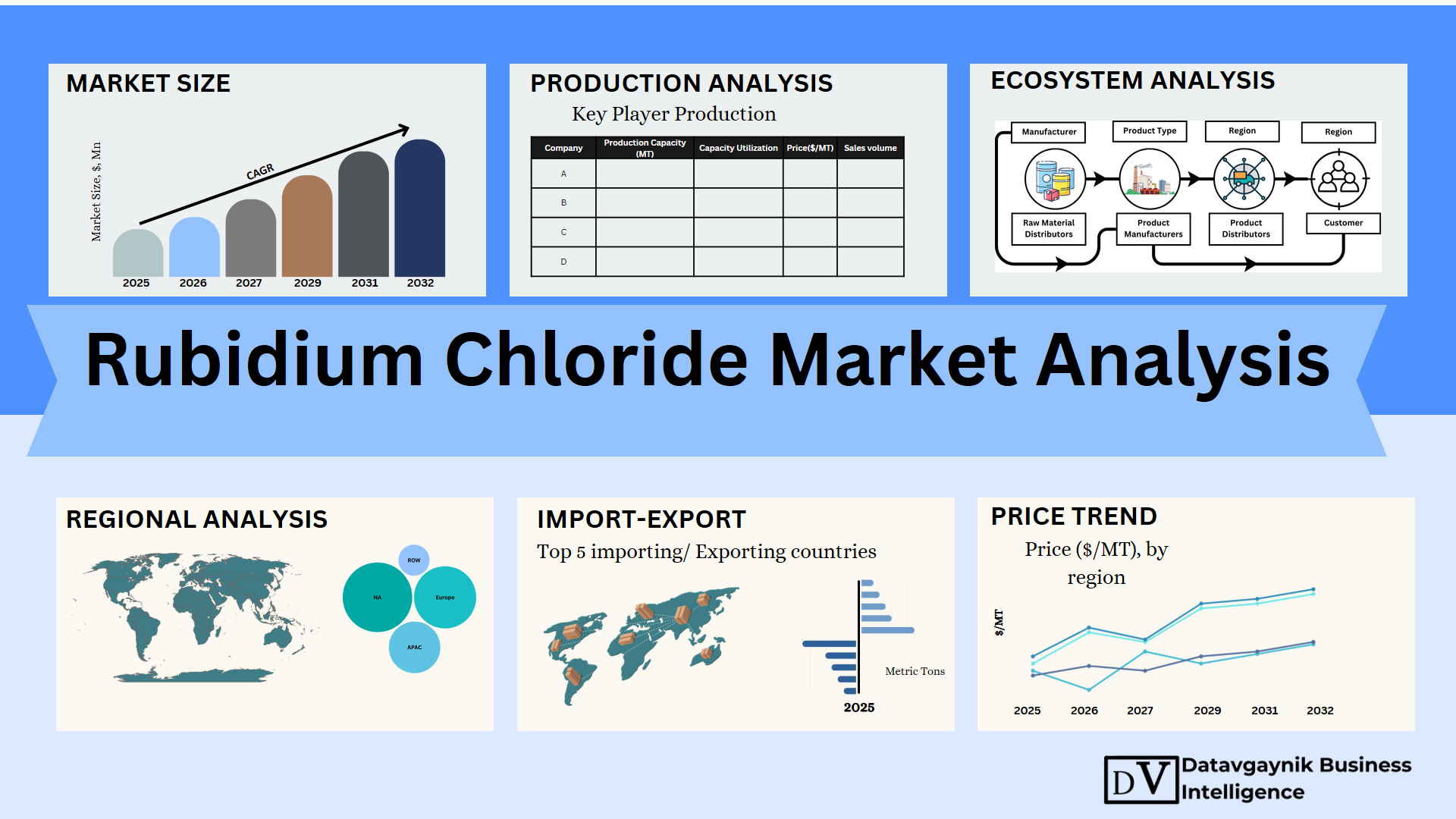
The Rubidium Chloride Market is witnessing strong growth due to its rising demand in nuclear medicine, particularly in positron emission tomography (PET) imaging. As per Datavagyanik, cardiovascular diseases continue to account for a significant percentage of global mortality, leading to a surge in diagnostic testing. For instance, rubidium-82, derived from rubidium chloride, is increasingly used as a radiotracer in cardiac PET scans. With over 17.9 million deaths annually attributed to cardiovascular disorders, the adoption of PET diagnostics is climbing rapidly. Consequently, the Rubidium Chloride Market is expanding as healthcare institutions integrate more advanced imaging modalities to support accurate and timely diagnosis.
Expansion of Radiopharmaceutical Applications Boosts Rubidium Chloride Market Size
Radiopharmaceuticals are a cornerstone in modern diagnostics and are increasingly becoming a strategic area for investment. Rubidium chloride plays a central role in producing short-lived isotopes such as rubidium-82, which are essential in real-time cardiac assessments. With governments and healthcare providers in North America, Europe, and Asia heavily investing in nuclear imaging centers, the Rubidium Chloride Market Size is projected to grow substantially. For example, the U.S. alone sees over 8 million nuclear imaging procedures annually, many of which rely on isotopes derived from rubidium chloride, reinforcing its indispensable role in healthcare.
Datavagyanik also covers related markets such as the Rubidium Oxide Market, the Rubidium Sulfate Market, and the Rubidium Carbonate Market. These compounds are commonly used in oxidation systems and industrial chemical processing, supporting shifts in formulation standards and regulatory compliance.
Advancements in Renewable Energy Fuel Rubidium Chloride Market Growth
As the push for clean energy intensifies, the Rubidium Chloride Market is benefiting from increased R&D in perovskite-based solar cells. Rubidium chloride has been found to improve both the efficiency and lifespan of these solar cells, which are rapidly gaining traction as a next-generation alternative to traditional silicon photovoltaics. For instance, perovskite solar cell efficiency has climbed from 3.8% in 2009 to over 25% in recent lab results, largely due to the incorporation of stabilizers like rubidium chloride. As countries such as China, Germany, and India escalate renewable energy deployment to meet climate goals, demand within the Rubidium Chloride Market is anticipated to rise consistently.
Quantum Technology Integration Enhances Rubidium Chloride Market Outlook
Quantum computing and communication systems are redefining the future of technology, and rubidium chloride has emerged as a critical material in this transformation. Its use in creating Bose-Einstein condensates and as a medium in atomic clocks makes it essential for precision-based systems. For example, rubidium atomic clocks are already deployed in GPS satellites, ensuring microsecond-level accuracy. As tech companies and national laboratories increase investments in quantum technologies, the Rubidium Chloride Market is expected to experience robust expansion, especially in countries like the U.S., Japan, and the UK that are spearheading these advancements.
Healthcare Innovation and Investment Drive the Rubidium Chloride Market
With life sciences research at an all-time high, the Rubidium Chloride Market is gaining from its applications in cellular imaging, ion channel research, and density gradient studies in molecular biology. For instance, rubidium chloride is commonly used in laboratory research to simulate potassium ion transport in neurons, supporting studies in epilepsy and neurodegenerative diseases. Increased investment from pharmaceutical companies and public agencies in neuroscience research is translating into higher consumption of rubidium chloride in research facilities and universities globally.
Strong Demand from Optics and Electronics Strengthens the Rubidium Chloride Market
In the electronics sector, rubidium chloride contributes to the manufacture of high-performance optical components and specialized glass. These materials are integral to applications such as fiber optics, laser systems, and space-based instruments. The Rubidium Chloride Market is therefore benefitting from the rising consumption in industries that require materials with superior thermal and optical properties. For instance, the use of rubidium in photonic devices is increasing as companies develop next-generation sensors for defense and telecommunications.
Energy Storage Innovation Pushes Forward the Rubidium Chloride Market
Energy storage solutions, especially those linked to grid stabilization and electric mobility, are increasingly incorporating rubidium-based compounds to enhance battery performance. For example, rubidium chloride is being investigated for its role in improving electrolyte stability in high-density batteries. As global investment in battery technology surpasses $100 billion annually, rubidium chloride’s application as a performance-enhancing material is becoming more visible. This trend is particularly pronounced in countries aiming to dominate the electric vehicle and stationary storage markets, thereby driving the Rubidium Chloride Market.
Global Healthcare Infrastructure Development Favors Rubidium Chloride Market Expansion
Emerging economies are investing heavily in healthcare infrastructure, particularly in diagnostic imaging capabilities. Countries such as India, Brazil, and South Africa are expanding their nuclear medicine departments to improve early disease detection rates. As a result, the Rubidium Chloride Market is gaining traction in these regions, supported by increasing imports of radiopharmaceutical precursors. Datavagyanik highlights that with more than 50% of global population growth expected in Asia and Africa by 2050, the Rubidium Chloride Market will continue to witness new demand centers beyond traditional strongholds.
Strategic Government Initiatives Support Rubidium Chloride Market Development
Multiple governments are implementing policies to foster innovation in materials science and clean energy. For instance, the European Union’s Green Deal and the U.S. Department of Energy’s Advanced Research Projects Agency–Energy (ARPA-E) initiative are fueling R&D in solar materials and battery chemistry. Rubidium chloride, given its high functionality in both sectors, stands to benefit. These strategic initiatives are expected to increase public-private partnerships and further solidify the Rubidium Chloride Market’s role in national innovation strategies.
Technological Synergy Unlocks New Avenues in the Rubidium Chloride Market
Cross-sectoral innovation is creating unexpected synergies that enhance the scope of the Rubidium Chloride Market. For instance, the integration of rubidium-based components in defense systems that require precision navigation, or in autonomous vehicles that rely on satellite-based timing, is contributing to its growing relevance. Moreover, collaborations between academic institutions and tech giants are leading to the discovery of novel applications for rubidium chloride in emerging fields such as neuromorphic computing and high-precision sensing.
Conclusion: Rubidium Chloride Market Positioned for Long-Term Momentum
Datavagyanik observes that the Rubidium Chloride Market is benefiting from a rare convergence of technological, environmental, and healthcare-driven transformations. Its versatility—spanning radiopharmaceuticals, solar technologies, quantum computing, and biological research—ensures its enduring relevance across sectors. With the Rubidium Chloride Market Size projected to grow significantly through 2032, driven by both mature and emerging markets, manufacturers and stakeholders are poised to capture substantial value by aligning their capabilities with this compound’s multifaceted growth trajectory.
“Track Country-wise Rubidium Chloride Production and Demand through our Rubidium Chloride Production Database”
-
-
- Rubidium Chloride production database for 25+ countries worldwide
- Rubidium Chloride sales volume for 29+ countries
- Country-wise Rubidium Chloride production capacity, production plant mapping, production capacity utilization for 25+ manufacturers
- Rubidium Chloride production plants and production plant capacity analysis by top manufacturers
-
“Track real-time Rubidium Chloride Prices, Rubidium Chloride price charts for 25+ countries, Rubidium Chloride weekly price tracker and Rubidium Chloride monthly price tracker”
-
-
- Track real-time Rubidium Chloride prices and Rubidium Chloride price trend in 25+ countries though our excel-based Rubidium Chloride price charts
- Real-time Rubidium Chloride price tracker dashboard with 25+ countries
- Complete transparency on Rubidium Chloride price trend through our Rubidium Chloride monthly price tracker, Rubidium Chloride weekly price tracker
-
North America Leads with Robust Medical and Technological Applications in the Rubidium Chloride Market
The Rubidium Chloride Market in North America, particularly the United States, remains a dominant force due to strong demand from the healthcare and advanced technology sectors. The U.S. accounts for the largest consumption of rubidium chloride in nuclear medicine, with rubidium-82 being a primary radiotracer used for PET scans. Datavagyanik notes that with over 25% of nuclear imaging procedures in the country involving cardiac diagnostics, the U.S. healthcare system is a consistent growth driver for the Rubidium Chloride Market. In addition, the region’s leadership in quantum computing and defense-grade GPS systems further amplifies demand for rubidium chloride in high-precision technologies.
Europe Strengthens Position in Renewable and Diagnostic Segments of the Rubidium Chloride Market
Europe’s Rubidium Chloride Market is gaining ground through its focus on clean energy technologies, nuclear medicine, and optical advancements. Countries like Germany and France are leading adopters due to their intensive R&D infrastructure. Germany, for instance, is integrating rubidium chloride into perovskite-based solar technologies under its “Energiewende” transition program. France, on the other hand, is leveraging its robust radiopharmaceutical network to support PET imaging for oncology and cardiology. The growing emphasis on healthcare innovation, coupled with investments in renewable technologies, is positioning Europe as a significant consumer in the Rubidium Chloride Market.
Asia Pacific Emerges as a High-Growth Region in the Rubidium Chloride Market
Asia Pacific represents the fastest-growing region in the Rubidium Chloride Market, driven by demand from China, Japan, and India. China leads in the production and consumption of rubidium chloride due to its expansive electronics manufacturing ecosystem and strategic investments in quantum technology.
For example, China’s quantum communication network—one of the largest globally—relies on rubidium-based atomic clocks for encryption and precision. India’s healthcare reforms and its target of 450 GW renewable capacity by 2030 are generating strong interest in rubidium chloride for both solar applications and nuclear diagnostics. Japan, renowned for its technological precision, is utilizing rubidium chloride in R&D for photonics, semiconductor devices, and quantum computing. The convergence of healthcare, energy, and electronics sectors ensures that the Asia Pacific Rubidium Chloride Market will continue to accelerate at a steady pace.
Middle East Sees Emerging Demand in Specialized Sectors within the Rubidium Chloride Market
The Middle East is steadily carving out a role in the Rubidium Chloride Market, especially in Saudi Arabia, UAE, and Israel. Healthcare modernization initiatives in these countries have led to investments in PET imaging facilities, resulting in the adoption of rubidium-82 isotopes. Saudi Arabia, for instance, has increased nuclear medicine diagnostic procedures in its government hospitals, creating consistent demand. Additionally, the region’s focus on innovation in oil exploration and advanced communications opens up avenues for rubidium chloride use in specialty materials and precision timekeeping systems.
Latin America and Africa Show Early-Stage Potential in the Rubidium Chloride Market
Although still in nascent stages, Latin America and Africa are beginning to participate in the Rubidium Chloride Market. Countries such as Brazil and South Africa are investing in PET imaging capabilities, supported by private and public healthcare expansion. Brazil, for example, has introduced cardiovascular screening programs in its urban centers, which involve rubidium-based tracers. Meanwhile, Africa’s emphasis on diagnostic development and university-led biological research could create localized demand for rubidium chloride in the coming decade.
Global Production Landscape of the Rubidium Chloride Market
Canada Holds Strategic Importance in the Rubidium Chloride Market Supply Chain
Canada remains a key global producer of rubidium chloride due to its pollucite deposits, particularly at the Tanco Mine in Manitoba. Datavagyanik highlights that Canada supplies high-purity grades of rubidium chloride for critical applications in PET imaging and semiconductor research. Canadian exports primarily serve the U.S., European, and Japanese markets. The strategic control over high-quality raw materials makes Canada a linchpin in the global Rubidium Chloride Market.
China Balances Production and Import Demand in the Rubidium Chloride Market
China not only produces rubidium chloride domestically but also imports it to meet surging demand in its healthcare and electronics sectors. Domestic production is supplemented by imports from Canada and Germany. Chinese firms are rapidly developing proprietary rubidium processing technologies to secure long-term supply chains. With rising domestic consumption and export activity, China plays a dual role of being both a major consumer and supplier in the Rubidium Chloride Market.
United States Relies on Imports but Drives High-End Applications in the Rubidium Chloride Market
While the United States lacks extensive rubidium-bearing mineral resources, it remains a top consumer in the Rubidium Chloride Market. Imports from Canada and select European suppliers meet its domestic needs. The U.S. demand is driven by hospitals, biotech firms, defense labs, and technology companies working on atomic clocks, battery chemistry, and advanced diagnostic imaging. The dependency on imports is prompting discussions around strategic reserves and alternative supply channels.
Market Segmentation Highlights in the Rubidium Chloride Market
By Grade: High-Purity vs. Industrial
The Rubidium Chloride Market is segmented into industrial grade and high-purity grade. High-purity rubidium chloride dominates healthcare and research applications where contamination-free composition is essential. For example, in radiopharmaceutical production, even trace impurities can affect isotope behavior. In contrast, industrial-grade rubidium chloride is utilized in energy storage and glass production due to its cost-effectiveness in large-scale manufacturing environments.
By Form: Powder vs. Solution
Powdered rubidium chloride holds the largest market share due to its ease of transportation and broad utility in synthesis, electronics, and biological studies. The solution form is primarily used in laboratory settings for density gradient experiments and cellular ion transport simulations. In molecular biology, for instance, rubidium chloride solution facilitates RNA and DNA separation in ultracentrifugation, a crucial procedure in genetic research.
By Application Area
Healthcare and nuclear medicine continue to lead in rubidium chloride consumption due to its irreplaceable role in PET scans. The energy segment is rapidly rising, with perovskite-based solar technology poised to disrupt the photovoltaic market. Electronics and optics, particularly atomic clocks and laser-based instrumentation, contribute a steady demand. Research and academia form a consistent end-user base through universities and private labs conducting neuroscience and ion transport studies.
Rubidium Chloride Price and Rubidium Chloride Price Trend Analysis
Supply-Side Constraints Drive Up Rubidium Chloride Price
The Rubidium Chloride Price has shown a consistent upward trajectory over the last five years due to limited global reserves and increasing demand from niche high-tech sectors. For instance, rubidium chloride sourced from pollucite remains expensive due to extraction and refining complexity. A kilogram of high-purity rubidium chloride can range from $2,500 to $4,000 depending on purity and supply chain volatility.
Rubidium Chloride Price Trend Reflects Demand from Nuclear Medicine and Renewable Energy
The Rubidium Chloride Price Trend reflects surges in demand for radiopharmaceuticals and solar technologies. During 2022–2024, global rubidium chloride consumption for PET tracers grew by approximately 7.8% annually, resulting in a corresponding rise in price. Additionally, with perovskite solar research attracting billions in global investment, demand spikes in R&D centers have tightened supply, keeping the Rubidium Chloride Price high.
Geopolitical and Logistics Factors Influence Rubidium Chloride Price Trend
Transportation restrictions, export controls, and geopolitical tensions also contribute to the Rubidium Chloride Price Trend. For instance, fluctuations in trade agreements between North America and Asia have impacted delivery timelines, especially for high-purity shipments. As manufacturers explore vertical integration to secure long-term supply, this could potentially stabilize Rubidium Chloride Price levels beyond 2026.
Future Outlook: Rubidium Chloride Price to Stay Elevated Amid Strategic Applications
Datavagyanik projects that the Rubidium Chloride Price will remain elevated in the medium term due to rising quantum tech investments and limited diversification of supply. Recycling programs and exploration of alternate rubidium sources may offer relief in the long term, but until then, the Rubidium Chloride Price Trend will continue to mirror high-stakes technological applications.
“Rubidium Chloride Manufacturing Database, Rubidium Chloride Manufacturing Capacity”
-
-
- Rubidium Chloride top manufacturers market share for 25+ manufacturers
- Top 7 manufacturers and top 15 manufacturers of Rubidium Chloride in North America, Europe, Asia Pacific
- Rubidium Chloride production plant capacity by manufacturers and Rubidium Chloride production data for 25+ market players
- Rubidium Chloride production dashboard, Rubidium Chloride production data in excel format
-
“Rubidium Chloride price charts, Rubidium Chloride weekly price tracker and Rubidium Chloride monthly price tracker”
-
-
- Factors impacting real-time Rubidium Chloride prices in 20+ countries worldwide
- Rubidium Chloride monthly price tracker, Rubidium Chloride weekly price tracker
- Real-time Rubidium Chloride price trend, Rubidium Chloride price charts, news and updates
- Tracking Rubidium Chloride price fluctuations
-
Leading Manufacturers in the Rubidium Chloride Market
American Elements: Pioneering High-Purity Rubidium Chloride Production
American Elements stands at the forefront of the Rubidium Chloride Market, specializing in the production of high-purity rubidium chloride. Their product lines cater to advanced applications in sectors such as electronics, healthcare, and research. By focusing on ultra-high purity levels, American Elements supports critical technologies including atomic clocks and specialized medical imaging equipment. Their commitment to quality and innovation has solidified their position as a key supplier in the global market.
Ganfeng Lithium Co. Ltd.: Expanding into Rubidium Chloride Production
Ganfeng Lithium Co. Ltd., traditionally recognized for its lithium products, has strategically diversified into the rubidium chloride sector. Leveraging their extensive experience in alkali metals, Ganfeng has developed rubidium chloride products that meet the stringent requirements of modern electronics and energy storage applications. This expansion reflects their adaptability and responsiveness to the evolving demands of the market.
Merck KGaA: Supplying High-Quality Rubidium Chloride for Research
Merck KGaA has established itself as a significant player in the Rubidium Chloride Market by providing high-quality rubidium chloride tailored for research and pharmaceutical applications. Their products are integral to various scientific studies and medical formulations, underscoring Merck’s dedication to advancing healthcare and scientific research through reliable chemical supplies.
Sinomine Resource Group: Ensuring Steady Supply of Rubidium Chloride
Sinomine Resource Group plays a crucial role in the Rubidium Chloride Market by managing the extraction and processing of rubidium-bearing minerals. Their operations ensure a consistent and reliable supply of rubidium chloride, supporting industries such as electronics, healthcare, and specialty glass manufacturing. Sinomine’s integrated approach from mining to processing underscores their significance in the supply chain.
Jiangxi Special Electric Motor Co. Ltd.: Integrating Rubidium Chloride in Advanced Technologies
Jiangxi Special Electric Motor Co. Ltd. has incorporated rubidium chloride into its portfolio, focusing on its applications in advanced technologies. Their utilization of rubidium chloride in precision instruments and specialized equipment highlights the compound’s versatility and the company’s commitment to technological innovation.
Lepidico Ltd.: Innovating Extraction Processes for Rubidium Chloride
Lepidico Ltd. has introduced innovative extraction technologies to the Rubidium Chloride Market, focusing on sustainable and efficient methods to obtain rubidium from lepidolite. Their proprietary processes not only enhance yield but also reduce environmental impact, aligning with the industry’s move towards greener production techniques.
International Lithium Corp.: Exploring New Sources for Rubidium Chloride
International Lithium Corp. is actively engaged in the exploration and development of rubidium-rich mineral deposits. Their efforts aim to diversify the sources of rubidium chloride, ensuring a stable supply to meet growing global demand. By identifying and developing new mining sites, they contribute to the resilience and expansion of the market.
Rubidium Chloride Market Share by Manufacturers
The Rubidium Chloride Market is characterized by a mix of established chemical companies and specialized firms. American Elements and Merck KGaA hold significant shares due to their extensive product lines and global distribution networks. Ganfeng Lithium Co. Ltd. and Sinomine Resource Group have captured substantial portions of the market by leveraging their expertise in mineral extraction and processing. Lepidico Ltd. and International Lithium Corp., though smaller in scale, are gaining market share through innovative technologies and exploration initiatives. The collective efforts of these manufacturers ensure a competitive and dynamic market landscape.
Recent Developments in the Rubidium Chloride Market
In July 2024, Everest Metals announced achieving a 91% rubidium recovery rate from their Mt Edon project, marking a significant advancement in extraction efficiency. This development is poised to enhance the supply chain and potentially reduce production costs in the Rubidium Chloride Market. Everest Metals
In August 2024, Ganfeng Lithium Co. Ltd. expanded its production facilities to include rubidium chloride, responding to the increasing demand from the electronics and energy storage sectors. This strategic move is expected to strengthen Ganfeng’s position in the market and contribute to meeting global supply needs.
In September 2024, Merck KGaA launched a new line of high-purity rubidium chloride products aimed at the pharmaceutical industry, emphasizing their commitment to supporting medical research and development. This initiative aligns with the growing applications of rubidium chloride in healthcare.
These developments reflect the dynamic nature of the Rubidium Chloride Market, with manufacturers continually innovating and expanding to meet the evolving demands of various industries.
” Rubidium Chloride Production Data and Rubidium Chloride Production Trend, Rubidium Chloride Production Database and forecast”
-
-
- Rubidium Chloride production database for historical years, 10 years historical data
- Rubidium Chloride production data and forecast for next 7 years
- Rubidium Chloride sales volume by manufacturers
-
“Track Real-time Rubidium Chloride Prices for purchase and sales contracts, Rubidium Chloride price charts, Rubidium Chloride weekly price tracker and Rubidium Chloride monthly price tracker”
-
-
- Gain control on your purchase and sales contracts through our real-time Rubidium Chloride price tracker and Rubidium Chloride price trend analysis
- Rubidium Chloride weekly price tracker and forecast for next four weeks
- Rubidium Chloride monthly price tracker and forecast for next two months
-
Market Scenario, Demand vs Supply, Average Product Price, Import vs Export, till 2032
- Global Rubidium Chloride Market revenue and demand by region
- Global Rubidium Chloride Market production and sales volume
- United States Rubidium Chloride Market revenue size and demand by country
- Europe Rubidium Chloride Market revenue size and demand by country
- Asia Pacific Rubidium Chloride Market revenue size and demand by country
- Middle East & Africa Rubidium Chloride Market revenue size and demand by country
- Latin America Rubidium Chloride Market revenue size and demand by
- Import-export scenario – United States, Europe, APAC, Latin America, Middle East & Africa
- Average product price – United States, Europe, APAC, Latin America, Middle East & Africa
- Market player analysis, competitive scenario, market share analysis
- Business opportunity analysis
Key questions answered in the Global Rubidium Chloride Market Analysis Report:
- What is the market size for Rubidium Chloride in United States, Europe, APAC, Middle East & Africa, Latin America?
- What is the yearly sales volume of Rubidium Chloride and how is the demand rising?
- Who are the top market players by market share, in each product segment?
- Which is the fastest growing business/ product segment?
- What should be the business strategies and Go to Market strategies?
The report covers Rubidium Chloride Market revenue, Production, Sales volume, by regions, (further split into countries):
- Asia Pacific (China, Japan, South Korea, India, Indonesia, Vietnam, Rest of APAC)
- Europe (UK, Germany, France, Italy, Spain, Benelux, Poland, Rest of Europe)
- North America (United States, Canada, Mexico)
- Latin America (Brazil, Argentina, Rest of Latin America)
- Middle East & Africa
Table of Contents:
Rubidium Chloride Market
- Introduction to Rubidium Chloride
-
- 1.1 Overview and Chemical Properties of Rubidium Chloride
- 1.2 Historical Context and Industrial Importance
- Market Dynamics and Industry Insights
-
- 2.1 Key Drivers of Rubidium Chloride Market Growth
- 2.2 Challenges and Risks in Market Development
- 2.3 Emerging Opportunities and Trends
- Rubidium Chloride Product Segmentation
-
- 3.1 High-Purity Rubidium Chloride
- 3.2 Research-Grade Rubidium Chloride
- 3.3 Industrial-Grade Rubidium Chloride
- Applications of Rubidium Chloride
-
- 4.1 Use in Biomedical Research and Diagnostics
- 4.2 Role in Electronics and Optoelectronics
- 4.3 Applications in Specialty Chemicals and Catalysis
- 4.4 Emerging Uses in Quantum Computing and Advanced Materials
- Global Market Overview and Trends
-
- 5.1 Market Overview and Historical Data (2019-2024)
- 5.2 Future Market Projections and Growth Trends (2024-2032)
- Regional Market Analysis
-
- 6.1 North America: Technological Developments and Market Demand
- 6.2 Europe: Research-Driven Growth and Regulatory Insights
- 6.3 Asia Pacific: Expansion of Industrial and Research Applications
- 6.4 Latin America: Opportunities in Niche Markets
- 6.5 Middle East & Africa: Challenges and Market Potential
- Production and Manufacturing Insights
-
- 7.1 Leading Producers and Manufacturing Capabilities
- 7.2 Innovations in Rubidium Chloride Synthesis
- Raw Material Analysis and Supply Chain Dynamics
-
- 8.1 Sources of Rubidium and Extraction Processes
- 8.2 Key Supply Chain Challenges and Solutions
- End-Use Demand and Consumption Analysis
-
- 9.1 Medical and Pharmaceutical Applications
- 9.2 Use in High-Performance Electronics
- 9.3 Specialty Chemicals and Industrial Applications
- Pricing Analysis and Cost Structure
-
- 10.1 Historical Price Trends for Rubidium Chloride
- 10.2 Cost Components in Production and Distribution
- Global Trade and Market Connectivity
-
- 11.1 Export Trends of Leading Producers
- 11.2 Import Demand in High-Growth Regions
- 11.3 Trade Barriers and Regulatory Impacts
- Competitive Landscape and Key Market Players
-
- 12.1 Analysis of Leading Companies
- 12.2 Market Share Distribution
- 12.3 Strategic Developments and Innovations
- Technological Advancements in Rubidium Chloride Applications
-
- 13.1 Progress in Biomedical Applications
- 13.2 Emerging Role in Quantum Technologies
- Environmental and Safety Considerations
-
- 14.1 Environmental Impact of Rubidium Chloride Production
- 14.2 Compliance with Safety Standards and Regulations
- Emerging Trends and Opportunities
-
- 15.1 Growth in Advanced Optics and Photonics
- 15.2 Potential in Sustainable Technologies
- Future Market Projections (2024-2032)
-
- 16.1 Regional Demand Projections
- 16.2 Supply-Demand Scenarios
- Distribution and Sales Channels
-
- 17.1 Key Distributors and Their Role in the Market
- 17.2 Opportunities in Digital Sales Platforms
- Investment Landscape and Strategic Opportunities
-
- 18.1 Focus Areas for Investment in Rubidium Chloride
- 18.2 Partnerships and Collaborative Opportunities
- Macroeconomic Factors Influencing the Market
-
- 19.1 Impact of Global Economic Trends on Rubidium Chloride Demand
- 19.2 Influence of Trade Policies and Political Factors
- Strategic Recommendations for Stakeholders
-
- 20.1 Entry Strategies for Emerging Markets
- 20.2 Innovation and Differentiation as Growth Drivers

