

Rising Demand in Photovoltaics Accelerates Growth in the Selenium Dioxide Market
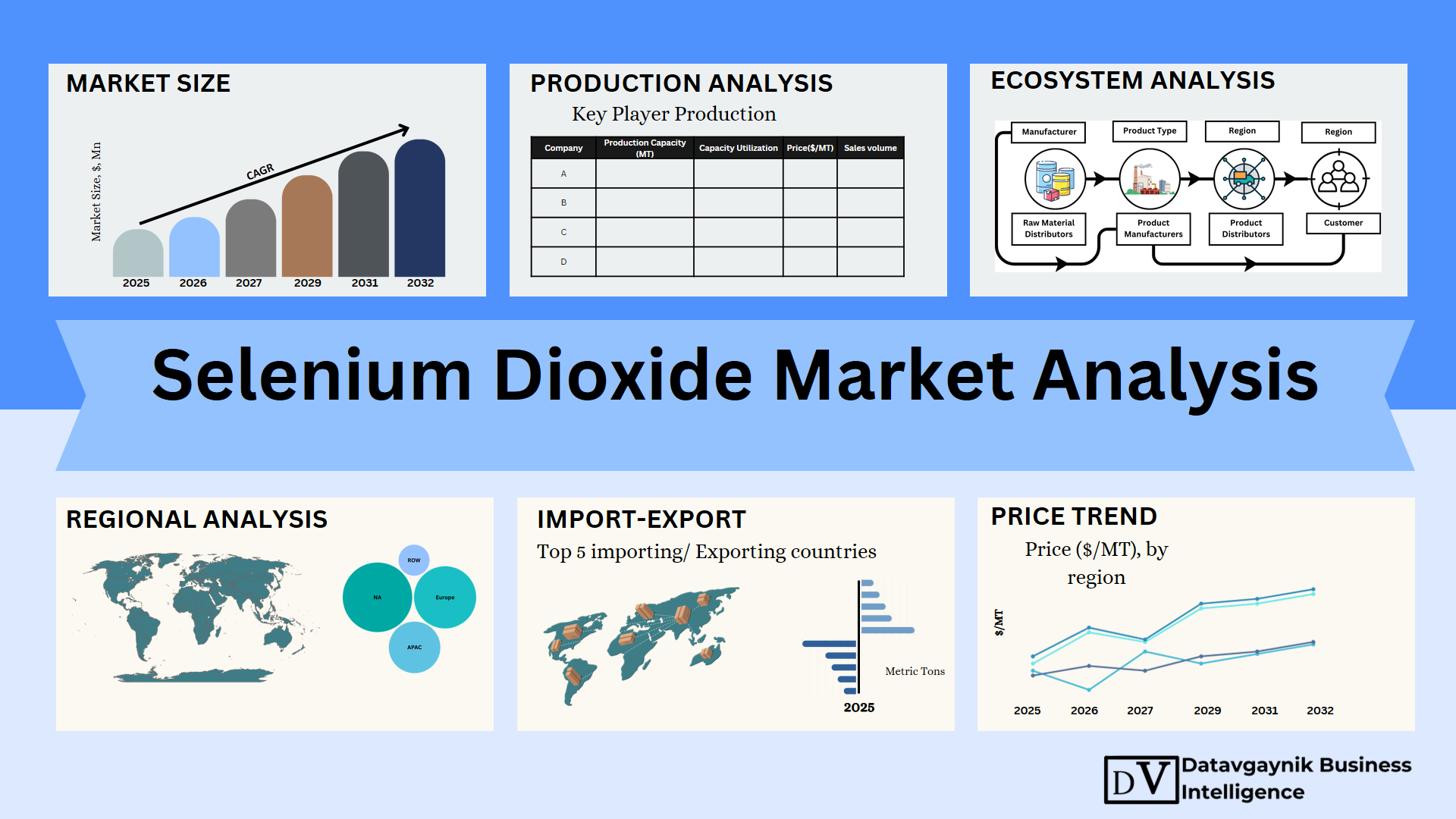
The Selenium Dioxide Market is experiencing robust momentum, largely fueled by the global shift towards renewable energy. Selenium dioxide plays an essential role in the production of thin-film photovoltaic cells, especially cadmium telluride (CdTe) solar panels. These solar technologies are gaining traction due to their cost efficiency and ability to perform under diffused light conditions. For instance, the global solar PV market grew by over 30% in 2023, with CdTe-based modules accounting for a sizable portion of new installations, particularly in the United States and China. This surge directly reflects a parallel increase in the demand for selenium dioxide, cementing its strategic importance in the clean energy value chain.
As per Datavagyanik, the Selenium Dioxide Market Size is projected to expand significantly through 2032, underpinned by aggressive clean energy targets in major economies. Government programs such as the U.S. Inflation Reduction Act, which allocates over $369 billion for energy security and climate change, further fuel investment in solar manufacturing infrastructure, indirectly boosting selenium dioxide consumption.
Electronics and Semiconductor Growth Supporting the Selenium Dioxide Market
The Selenium Dioxide Market is also being supported by strong advances in semiconductor and electronics production. Selenium dioxide is used in various optoelectronic devices, including light-sensitive components and integrated circuits. The compound’s role in improving signal transmission and stability makes it indispensable in high-performance electronics.
For instance, global semiconductor sales surpassed $580 billion in 2023, marking a 10% increase over the previous year, driven by growing demand in sectors such as electric vehicles, 5G infrastructure, and AI-powered consumer electronics. Selenium dioxide’s application in these technologies makes it a vital compound in semiconductor fabrication. Emerging markets such as India and Vietnam are expanding their domestic semiconductor manufacturing capabilities, further driving demand in the Selenium Dioxide Market.
Datavagyanik also covers related markets such as the Silicon dioxide Market, the Titanium dioxide Market, and the Tin Dioxide Market. These materials are considered in high-temperature and specialty chemical environments, where glass production, catalysis, and safety regulations influence adoption patterns.
Expanding Glass Industry Amplifies Selenium Dioxide Market Growth
The global glass manufacturing industry continues to be a foundational driver of the Selenium Dioxide Market. Selenium dioxide is extensively used both as a decolorizing agent—neutralizing greenish hues caused by iron—and as a colorant for producing ruby or pink-tinted specialty glass. This is particularly relevant in automotive and architectural glass segments, where aesthetic value and optical clarity are paramount.
The global flat glass market alone exceeded $135 billion in 2023 and is projected to grow at a CAGR of over 6% through 2030. For example, architectural demand for advanced coated and colored glass in energy-efficient buildings and automotive glazing systems is directly increasing the requirement for selenium dioxide. Regions such as the Middle East and Asia-Pacific are heavily investing in smart infrastructure, opening new opportunities for selenium-based formulations in specialty glass production.
Agriculture Sector Strengthening Demand in the Selenium Dioxide Market
Agricultural applications represent another significant growth vector for the Selenium Dioxide Market. Selenium dioxide is a key precursor in the production of selenium-enriched fertilizers and animal feed additives. Selenium is a trace element vital for animal health and crop yield enhancement, particularly in regions where soil selenium levels are deficient.
For example, countries such as China, India, and Brazil have reported rising adoption of selenium-enriched products to combat selenium deficiencies in livestock and food crops. As per Datavagyanik, selenium-enhanced feed supplements have seen an annual growth rate of 7–8% over the past three years, especially in cattle and poultry farming. This expansion in animal nutrition is directly translating to growing demand in the Selenium Dioxide Market, particularly for standard-purity grades used in agri-inputs.
Pharmaceutical and Nutraceutical Innovations Fuel Selenium Dioxide Market Opportunities
The Selenium Dioxide Market is also benefiting from developments in pharmaceutical and nutraceutical sectors. Selenium compounds, derived from selenium dioxide, are known for their antioxidant and immune-boosting properties. These compounds are used in formulating supplements and selenium-based drugs aimed at supporting thyroid function, combating oxidative stress, and enhancing overall wellness.
For instance, the global nutraceuticals market crossed $450 billion in 2023 and is expected to maintain a CAGR of 7–9% through the end of the decade. Selenium-based formulations are gaining recognition as preventative health solutions, especially in aging populations across North America, Europe, and parts of Asia. Increased health awareness post-pandemic has accelerated the uptake of selenium-enriched supplements, reinforcing the compound’s value in healthcare applications and its role in propelling the Selenium Dioxide Market forward.
Industrial Catalysis and Chemical Synthesis Driving Selenium Dioxide Market Expansion
The role of selenium dioxide as a highly efficient oxidizing agent makes it indispensable in chemical synthesis and catalysis. It is widely used in the production of specialty chemicals, including organic intermediates for pharmaceuticals, dyes, and agrochemicals. Its unique oxidation capability supports selective reactions, especially in producing ketones and aldehydes.
Datavagyanik highlights that global demand for fine and specialty chemicals is expanding at a CAGR of 6.2%, driven by pharmaceutical innovation and custom chemical formulations. This uptrend has led to an increase in catalytic applications for selenium dioxide, particularly in Europe and the U.S., where there is a focus on green chemistry and sustainable production routes. This sustained demand underpins long-term growth in the Selenium Dioxide Market.
Environmental Regulations Accelerating Selenium Dioxide Market Growth
Environmental applications are adding another dimension to the Selenium Dioxide Market. The compound is used in emissions control systems, particularly in industrial scrubbing technologies designed to capture and neutralize harmful pollutants. With increasing global regulatory pressure to reduce industrial emissions, selenium dioxide’s role as a functional agent in flue gas treatment is becoming more prominent.
For example, the European Union’s Industrial Emissions Directive and the U.S. Clean Air Act are tightening emission norms across sectors such as metal refining, chemical processing, and power generation. Datavagyanik reports that adoption of advanced air purification systems has grown by over 9% annually in the past two years, creating new use cases for selenium dioxide. Its deployment in these environmental solutions is steadily contributing to a more diversified and resilient Selenium Dioxide Market.
Technological Advancements in Nanomaterials Bolstering Selenium Dioxide Market Outlook
The Selenium Dioxide Market is also being shaped by cutting-edge research into selenium-based nanomaterials. Selenium dioxide nanoparticles are gaining attention in advanced materials science due to their antimicrobial properties and electrical conductivity. These characteristics are being explored for applications in biomedical engineering, sensors, and nanophotonic devices.
For instance, studies conducted across universities in Japan and South Korea have demonstrated the potential of selenium dioxide nanostructures in targeted drug delivery systems and photothermal therapies. This wave of innovation, combined with academic-industry partnerships, is opening new frontiers for high-purity selenium dioxide products. As per Datavagyanik, R&D investments into selenium nanomaterials grew by 12% in 2023 alone, positioning this niche as a high-growth segment of the Selenium Dioxide Market.
Regional Trends Reinforcing Global Selenium Dioxide Market Size Expansion
Regionally, Asia-Pacific continues to dominate the Selenium Dioxide Market due to its industrial and agricultural base. China, as the world’s largest selenium producer and consumer, plays a pivotal role in global supply and pricing. The country’s push toward domestic solar manufacturing and modernization of agriculture is steadily increasing its selenium dioxide consumption. Likewise, India’s smart farming initiatives and growing electronics sector are raising the local demand for selenium-based compounds.
In contrast, North America and Europe are characterized by high-purity applications in semiconductors, pharmaceuticals, and environmental technologies. The United States has emerged as a critical hub for selenium dioxide demand, with increasing investments in solar infrastructure and semiconductor fabrication facilities. Datavagyanik estimates that the Selenium Dioxide Market Size in North America alone will grow at a CAGR of 5.7% from 2024 to 2032, driven by clean energy targets and industrial innovation.
Europe, on the other hand, is leveraging selenium dioxide in specialty glass, renewable technologies, and precision agriculture. Germany and France are at the forefront of using selenium compounds in both technical and biological domains. The region’s strong environmental compliance culture and technology-centric industries continue to bolster demand across multiple applications, reinforcing the Selenium Dioxide Market’s long-term stability.
“Track Country-wise Selenium Dioxide Production and Demand through our Selenium Dioxide Production Database”
-
-
- Selenium Dioxide production database for 23+ countries worldwide
- Selenium Dioxide sales volume for 28+ countries
- Country-wise Selenium Dioxide production capacity, production plant mapping, production capacity utilization for 23+ manufacturers
- Selenium Dioxide production plants and production plant capacity analysis by top manufacturers
-
“Track real-time Selenium Dioxide Prices, Selenium Dioxide price charts for 23+ countries, Selenium Dioxide weekly price tracker and Selenium Dioxide monthly price tracker”
-
-
- Track real-time Selenium Dioxide prices and Selenium Dioxide price trend in 23+ countries though our excel-based Selenium Dioxide price charts
- Real-time Selenium Dioxide price tracker dashboard with 23+ countries
- Complete transparency on Selenium Dioxide price trend through our Selenium Dioxide monthly price tracker, Selenium Dioxide weekly price tracker
-
North American Selenium Dioxide Market Driven by Semiconductor and Clean Energy Initiatives
In North America, the Selenium Dioxide Market is gaining momentum as the region reinforces its focus on semiconductor manufacturing, clean energy development, and agricultural sustainability. The United States, in particular, plays a central role with its domestic capacity for both production and consumption. The CHIPS and Science Act, signed in 2022, allocated over $52 billion in federal funding to boost domestic semiconductor fabrication. Selenium dioxide, as a vital compound in thin-film semiconductors, directly benefits from this policy landscape.
Moreover, solar power installations in the U.S. increased by 40% year-over-year in 2023, surpassing 35 gigawatts of new capacity. This surge in solar adoption significantly expands the application of selenium dioxide in photovoltaic modules, bolstering its demand. Canada, meanwhile, contributes to the Selenium Dioxide Market through its use in agriculture and metallurgy, especially in selenium-deficient soil regions and metal refining sectors. These factors collectively make North America a high-consumption, high-value region within the global selenium dioxide landscape.
Europe’s Selenium Dioxide Market Strengthened by Specialty Glass and Agriculture Applications
Europe remains a crucial player in the Selenium Dioxide Market due to its diverse industrial applications and emphasis on regulatory compliance. Germany, France, and the UK are among the leading countries utilizing selenium dioxide across specialty glass manufacturing, electronics, and precision agriculture.
Germany’s advanced glass industry has seen increased incorporation of selenium dioxide to produce colored and low-iron glass for architectural and automotive applications. For instance, German glass exports exceeded €5.2 billion in 2023, with specialty glass comprising a notable segment. France has also accelerated selenium usage in agriculture, particularly in the production of selenium-enriched fertilizers and animal supplements. Selenium deficiency in European soil, especially in Nordic and Eastern regions, reinforces the market need for supplementation products. The Selenium Dioxide Market in Europe is further supported by research-driven applications in pharmaceuticals and optoelectronics.
Asia Pacific Dominates Selenium Dioxide Market Through Manufacturing and Agriculture Growth
The Asia Pacific region leads the global Selenium Dioxide Market in terms of both volume and growth trajectory. China, the world’s largest producer and consumer of selenium dioxide, dominates the market due to its expansive industrial base, growing demand in photovoltaics, and robust mining operations.
For example, China accounted for over 40% of global solar PV capacity additions in 2023, many of which rely on thin-film modules requiring selenium dioxide. Its copper mining and smelting activities yield selenium as a byproduct, which is further refined into selenium dioxide for domestic and export use. In India, the growing focus on agricultural modernization and solar power development has fueled new selenium dioxide applications. Indian agriculture increasingly adopts selenium-enriched fertilizers, especially in selenium-deficient zones such as Punjab and Uttar Pradesh, where studies show up to 30% yield improvements in selenium-supplemented crops.
Japan and South Korea, with advanced electronics sectors, utilize high-purity selenium dioxide in semiconductor manufacturing and R&D. South Korea’s push for EVs and smart tech further drives growth, positioning the region as a hub for technological applications of selenium dioxide.
Middle East Selenium Dioxide Market Rising With Renewable and Agricultural Development
The Middle East Selenium Dioxide Market is expanding steadily as countries invest in sustainable agriculture and renewable energy infrastructure. Saudi Arabia and the UAE, in particular, are leading the regional uptake of selenium dioxide. Saudi Arabia’s ambitious Vision 2030 plan includes increased adoption of solar energy and modernization of agricultural practices, both of which support the use of selenium dioxide.
Photovoltaic deployment in the Kingdom has grown by over 25% annually, with selenium dioxide-based CdTe panels gaining traction. Meanwhile, the UAE has made significant strides in using selenium-enhanced fertilizers in desert farming initiatives. These practices are especially valuable in soil-deficient regions, driving both short- and long-term demand for selenium dioxide in the Middle East.
Emerging Economies Contributing to Global Selenium Dioxide Market Balance
Several emerging markets, including Brazil, Vietnam, and South Africa, are contributing to the balance of global selenium dioxide demand. Brazil’s livestock and poultry industries are major consumers of selenium-based supplements, as selenium deficiency directly impacts animal productivity. Brazil’s selenium-enriched feed additive market grew at a CAGR of 6.5% between 2020 and 2023, offering a compelling case for selenium dioxide’s relevance in animal health.
Vietnam and Indonesia are expanding their electronics and agricultural processing industries, relying more on imported selenium dioxide from China and the United States. South Africa, known for its mining expertise, has started exploring selenium dioxide production from its base metal refining operations, hinting at potential regional self-sufficiency in the coming years.
Selenium Dioxide Market Segmentation by Application Broadens Scope
The Selenium Dioxide Market benefits from wide segmentation across multiple applications, each contributing to its global stability. Photovoltaics and semiconductors account for nearly 30% of total selenium dioxide consumption, primarily in high-purity form. Agriculture—spanning fertilizers and animal nutrition—constitutes another 25–28%, followed by the glass industry at 20%, chemical synthesis at 15%, and niche segments such as pharmaceuticals and cosmetics making up the remainder.
Each of these applications demands a different purity grade and form (solid or liquid), which influences processing and supply chain dynamics. For instance, the growth in thin-film solar cells has created rising demand for ultrapure selenium dioxide, while general-purpose selenium dioxide used in fertilizers and pigments remains less refined but highly cost-sensitive.
Selenium Dioxide Market Segmentation by Form and Purity Reflects Industry Specialization
The Selenium Dioxide Market is segmented into solid and liquid forms, with solid selenium dioxide accounting for approximately 70% of global usage. Solid forms—powder or crystalline—are preferred in glass production, animal feed, and pigments due to ease of handling and long shelf life. Liquid selenium dioxide, which provides better control in chemical reactions, is used primarily in synthesis and emissions control.
Purity levels further define the market. High-purity selenium dioxide is in strong demand from electronics, semiconductors, and pharmaceutical sectors, often priced at a premium due to the rigorous refinement processes. Standard-purity selenium dioxide is used in agriculture and industrial pigments. As per Datavagyanik, the high-purity segment is growing faster, at a CAGR of 6.8% from 2024–2032, compared to 4.2% in the standard-purity segment.
Global Production Centers Reshaping Selenium Dioxide Market Supply Chains
Selenium dioxide production is heavily concentrated in regions with active mining and copper refining industries. China remains the undisputed leader, accounting for more than 50% of global selenium dioxide output. This dominance stems from its integrated copper mining and smelting operations, where selenium is recovered as a byproduct and further oxidized into selenium dioxide.
The United States and Belgium also have modest but technologically advanced selenium dioxide production capabilities. In the U.S., the compound is produced in specialized facilities associated with copper smelting and chemical processing, with a focus on high-purity outputs. European producers, such as those in Belgium and Germany, primarily cater to specialty chemical and glass manufacturers across the EU.
India and Russia are expanding production capacities through partnerships with mining and metallurgy sectors. These nations are focusing on backward integration to reduce reliance on selenium dioxide imports, while simultaneously exploring export potential in Southeast Asia and the Middle East.
Selenium Dioxide Price and Supply Dynamics Influenced by Raw Material Availability
The Selenium Dioxide Price is intrinsically tied to the availability of selenium as a byproduct of base metal refining, particularly copper. Fluctuations in copper production can create ripples across the selenium supply chain. For instance, during periods of low copper output, selenium supply tightens, pushing up Selenium Dioxide Prices globally.
Datavagyanik notes that Selenium Dioxide Prices averaged between $50–$80 per kilogram for high-purity grades in 2023, with spikes observed during raw material disruptions. Standard-purity grades traded in the $20–$35 per kilogram range. These prices are expected to remain volatile as geopolitical tensions and mining reforms in major producing countries affect availability.
The Selenium Dioxide Price Trend also reflects downstream demand from fast-growing sectors like solar energy and animal nutrition. In 2022–2023, increased installations of CdTe solar modules in North America and China caused a 12% hike in Selenium Dioxide Prices. Moreover, rising feed additive production in Asia and Latin America created temporary supply bottlenecks, further driving up prices.
Selenium Dioxide Price Trend Forecast Shows Moderate Upward Trajectory
Datavagyanik projects a moderate upward Selenium Dioxide Price Trend over the next five years, largely driven by expanding demand across high-purity applications and tighter environmental regulations. With the expected increase in solar panel manufacturing and semiconductor fabrication, high-purity selenium dioxide will see steady price appreciation.
Conversely, the Selenium Dioxide Price Trend for standard-purity forms used in agriculture and pigments may remain relatively stable, supported by balanced supply and slower demand growth. Innovations in recycling selenium from industrial waste could potentially ease price pressures, though technological feasibility and cost barriers remain.
Overall, the Selenium Dioxide Price Trend is expected to track inflation-adjusted industrial growth, barring major geopolitical disruptions or sudden shifts in global copper mining activity.
“Selenium Dioxide Manufacturing Database, Selenium Dioxide Manufacturing Capacity”
-
-
- Selenium Dioxide top manufacturers market share for 23+ manufacturers
- Top 6 manufacturers and top 13 manufacturers of Selenium Dioxide in North America, Europe, Asia Pacific
- Selenium Dioxide production plant capacity by manufacturers and Selenium Dioxide production data for 23+ market players
- Selenium Dioxide production dashboard, Selenium Dioxide production data in excel format
-
“Selenium Dioxide price charts, Selenium Dioxide weekly price tracker and Selenium Dioxide monthly price tracker”
-
-
- Factors impacting real-time Selenium Dioxide prices in 18+ countries worldwide
- Selenium Dioxide monthly price tracker, Selenium Dioxide weekly price tracker
- Real-time Selenium Dioxide price trend, Selenium Dioxide price charts, news and updates
- Tracking Selenium Dioxide price fluctuations
-
Top Manufacturers Reshaping the Selenium Dioxide Market Landscape
The Selenium Dioxide Market is increasingly consolidated among a select group of global manufacturers who control a significant portion of production and downstream distribution. These manufacturers are not only responsible for ensuring consistent supply but are also pioneering innovations in product purity, application diversification, and export competitiveness.
Companies such as Omkar Speciality Chemicals, Baiyin Nonferrous Group, Daye Nonferrous Metals Group, Hunan Jufa Technology, and Huanghua Jinhua Additives are among the most prominent players in the market. Each brings unique technical capabilities and strategic positioning across different end-use sectors including glass manufacturing, agriculture, pharmaceuticals, and semiconductors.
Omkar Speciality Chemicals – High-Purity Leader in the Selenium Dioxide Market
Omkar Speciality Chemicals plays a dominant role in the high-purity segment of the Selenium Dioxide Market. The company’s production lines focus heavily on ultrapure selenium dioxide that caters to advanced electronics, semiconductor fabrication, and pharmaceutical synthesis. Their product range includes refined crystalline selenium dioxide, tailored for low-contaminant applications where stability and performance are critical.
This specialization gives Omkar a stronghold in markets such as North America and Europe, where purity standards in electronics and medical compounds are stringent. The company’s flexible manufacturing capabilities also allow it to offer customized selenium dioxide formulations, which has helped build long-term partnerships with tech and healthcare companies.
Baiyin Nonferrous Group – Bulk Supplier Dominating Selenium Dioxide Market Volume
Baiyin Nonferrous Group is a key volume player in the Selenium Dioxide Market. Leveraging its extensive base metal refining operations, the company extracts selenium as a byproduct and processes it into selenium dioxide for large-scale industrial use. Its strength lies in supplying the glass and metallurgy sectors, especially in countries with growing construction and infrastructure demands.
This company is known for its steady and high-capacity production model, which makes it a reliable source of selenium dioxide for commodity-grade applications. It also benefits from logistical integration that supports fast exports across Asia, the Middle East, and Europe, enabling cost-effective fulfillment of bulk orders.
Daye Nonferrous Metals Group – Specialist in Feed-Grade Selenium Dioxide
Daye Nonferrous Metals Group has strategically positioned itself in the agriculture and animal nutrition segments of the Selenium Dioxide Market. The company’s product lines are optimized for use in producing selenium-enriched feed additives and micronutrient fertilizers. By offering consistent quality and moderate purity levels, Daye meets the specific needs of selenium-deficient soil zones and livestock industries.
Its influence is especially pronounced in regions focusing on food security and livestock health. The company continues to scale up its selenium dioxide output in response to increasing demand for fortified animal nutrition solutions.
Hunan Jufa Technology – Advancing Agricultural and Photovoltaic Applications
Hunan Jufa Technology stands out as a dual-purpose supplier, targeting both agricultural and renewable energy sectors. It produces selenium dioxide variants tailored for fertilizer production, while simultaneously developing high-purity grades for photovoltaic cells. The company is well-regarded for its R&D efforts focused on improving the absorption and bioavailability of selenium compounds in soil treatment products.
In the solar energy space, its selenium dioxide materials are increasingly being used in the synthesis of CdTe thin-film panels. The company’s strong alignment with sustainability goals positions it favorably as clean energy investments surge globally.
Huanghua Jinhua Additives – Selenium Dioxide Market Player in Nutrient Formulations
Huanghua Jinhua Additives is primarily active in producing selenium dioxide used in fertilizer enrichment and animal feed. The company provides liquid and granular forms of selenium dioxide suitable for blending into premixes, concentrates, and bulk agri-inputs. Their product line is particularly attractive to agribusinesses focused on selenium-deficient territories where crop productivity can be significantly improved through targeted supplementation.
This company has built a strong customer base in Southeast Asia and Latin America, where agriculture remains a primary economic driver and selenium supplementation is rapidly expanding.
Selenium Dioxide Market Share Insights by Manufacturer
Among the top players, Baiyin Nonferrous Group and Daye Nonferrous Metals Group collectively hold the largest market share by volume, due to their dominance in bulk and mid-purity segments. Omkar Speciality Chemicals, while not the largest in terms of output, captures a sizable share of the high-value segment thanks to its specialization in pharmaceutical and electronics-grade materials.
Hunan Jufa Technology and Huanghua Jinhua Additives cater to growing mid-market demand, particularly in renewable energy and agriculture, respectively. The Selenium Dioxide Market remains moderately consolidated, with the top five manufacturers accounting for more than 60% of the global supply, based on estimated volumes and regional coverage.
Recent Developments and Strategic Movements in the Selenium Dioxide Market
In recent years, several important developments have reshaped the competitive landscape of the Selenium Dioxide Market. Key players are increasingly diversifying their production lines to cater to high-growth application segments, such as photovoltaics and nanomaterials.
- In early 2024, manufacturers began ramping up selenium dioxide production capacity in response to expanded government support for domestic solar panel manufacturing across Asia and North America. Several facility expansions were announced with completion timelines set for late 2025.
- In Q3 2023, a major upgrade in selenium purification technology was implemented by a leading Asian supplier, enabling the production of >99.99% purity selenium dioxide for medical-grade applications.
- By mid-2023, suppliers catering to agriculture saw a noticeable uptick in demand for selenium-enriched fertilizers, following widespread government recommendations to combat regional soil selenium deficiency in major farming regions.
- Several manufacturers initiated long-term supply agreements with battery and semiconductor producers in late 2023, signaling a broader shift in selenium dioxide usage toward next-generation electronic devices.
These strategic moves signal a transition from commodity-grade selenium dioxide toward more value-added, application-specific variants. As manufacturers continue to invest in processing technology and global logistics, competition is expected to intensify in niche application areas, while bulk producers will maintain dominance through scale and pricing efficiency.
“Selenium Dioxide Production Data and Selenium Dioxide Production Trend, Selenium Dioxide Production Database and forecast”
-
-
- Selenium Dioxide production database for historical years, 10 years historical data
- Selenium Dioxide production data and forecast for next 7 years
- Selenium Dioxide sales volume by manufacturers
-
“Track Real-time Selenium Dioxide Prices for purchase and sales contracts, Selenium Dioxide price charts, Selenium Dioxide weekly price tracker and Selenium Dioxide monthly price tracker”
-
-
- Gain control on your purchase and sales contracts through our real-time Selenium Dioxide price tracker and Selenium Dioxide price trend analysis
- Selenium Dioxide weekly price tracker and forecast for next four weeks
- Selenium Dioxide monthly price tracker and forecast for next two months
-
Market Scenario, Demand vs Supply, Average Product Price, Import vs Export, till 2032
- Global Selenium Dioxide Market revenue and demand by region
- Global Selenium Dioxide Market production and sales volume
- United States Selenium Dioxide Market revenue size and demand by country
- Europe Selenium Dioxide Market revenue size and demand by country
- Asia Pacific Selenium Dioxide Market revenue size and demand by country
- Middle East & Africa Selenium Dioxide Market revenue size and demand by country
- Latin America Selenium Dioxide Market revenue size and demand by
- Import-export scenario – United States, Europe, APAC, Latin America, Middle East & Africa
- Average product price – United States, Europe, APAC, Latin America, Middle East & Africa
- Market player analysis, competitive scenario, market share analysis
- Business opportunity analysis
Key questions answered in the Global Selenium Dioxide Market Analysis Report:
- What is the market size for Selenium Dioxide in United States, Europe, APAC, Middle East & Africa, Latin America?
- What is the yearly sales volume of Selenium Dioxide and how is the demand rising?
- Who are the top market players by market share, in each product segment?
- Which is the fastest growing business/ product segment?
- What should be the business strategies and Go to Market strategies?
The report covers Selenium Dioxide Market revenue, Production, Sales volume, by regions, (further split into countries):
- Asia Pacific (China, Japan, South Korea, India, Indonesia, Vietnam, Rest of APAC)
- Europe (UK, Germany, France, Italy, Spain, Benelux, Poland, Rest of Europe)
- North America (United States, Canada, Mexico)
- Latin America (Brazil, Argentina, Rest of Latin America)
- Middle East & Africa
Table of Contents:
1. Overview of the Selenium Dioxide Market
- Definition and Chemical Properties
- Key Industrial and Commercial Applications
- Market Dynamics and Emerging Trends
2. Market Segmentation and Classification
- Segmentation by Purity and Grade
- Application-Based Market Distribution
- End-User Industries and Consumption Trends
3. Global Selenium Dioxide Market Size and Forecast (2019-2032)
- Industry Growth Analysis and Market Expansion
- Selenium Dioxide Market Revenue Trends
- Future Growth Projections and Investment Scope
4. Regional Market Analysis and Demand Patterns
4.1 North America
- Selenium Dioxide Market Demand and Supply Trends
- Selenium Dioxide Production Capacity vs Imports
- Regulatory Framework and Industrial Utilization
4.2 Europe
- Regional Manufacturing Trends and Key Players
- Selenium Dioxide Market Pricing and Trade Policies
- Market Penetration and Application Expansion
4.3 Asia-Pacific
- Leading Producers and Market Growth Trajectories
- Export-Import Analysis and Trade Relations
- Rising Demand in Emerging Economies
4.4 Latin America
- Market Expansion and Industry Investments
- Selenium Dioxide Production Trends vs Consumption Rates
- Business Development Opportunities in the Region
4.5 Middle East & Africa
- Strategic Developments and Market Growth Potential
- Selenium Dioxide Production Capabilities and Supply Chains
- Investment Prospects and Market Entry Strategies
5. Selenium Dioxide Production Trends and Technological Developments (2019-2032)
- Industrial Manufacturing Processes and Innovations
- Global Selenium Dioxide Production Output Analysis
- Efficiency Improvements and Sustainability Initiatives
6. Competitive Landscape in the Selenium Dioxide Market
- Key Market Players and Business Strategies
- Competitive Market Share and Industry Positioning
- Mergers, Acquisitions, and Strategic Partnerships
7. Revenue, Pricing Trends, and Market Valuation (2019-2024)
- Selenium Dioxide Market Revenue Breakdown by Region
- Pricing Trends and Cost Structure in the Industry
- Economic Factors Influencing Selenium Dioxide Market Pricing
8. Trade, Logistics, and Supply Chain Analysis
- Selenium Dioxide Production vs Global Export Figures
- Regional Consumption vs Import Trends
- Distribution Networks and Market Challenges
9. Demand-Supply Dynamics and Consumption Analysis
- End-User Industry Demand for Selenium Dioxide
- Market Consumption Trends by Application Sector
- Future Demand Forecast and Market Growth Potential
10. Cost Structure and Manufacturing Insights
- Cost Breakdown in Selenium Dioxide Production
- Raw Material Sourcing and Supply Chain Management
- Price Sensitivity and Production Optimization Strategies
11. Industrial Chain and Market Ecosystem Overview
- Raw Material Procurement and Industrial Processes
- Downstream Market Influence and Product Applications
- Selenium Dioxide Market Innovations and Industry Advancements
12. Distribution Channels and Market Expansion Strategies
- Leading Distributors and Supply Chain Optimization
- Selenium Dioxide Sales and Marketing Approaches
- End-User Market Engagement and Growth Tactics
13. Future Market Projections and Investment Opportunities
- Selenium Dioxide Market Expansion Plans and Projections
- New Technologies Impacting Selenium Dioxide Production
- Strategic Business Development and Investment Insights

