

Application-Side Demand Gives Global Thulium Oxide Market a Narrow but High-Value Growth Base
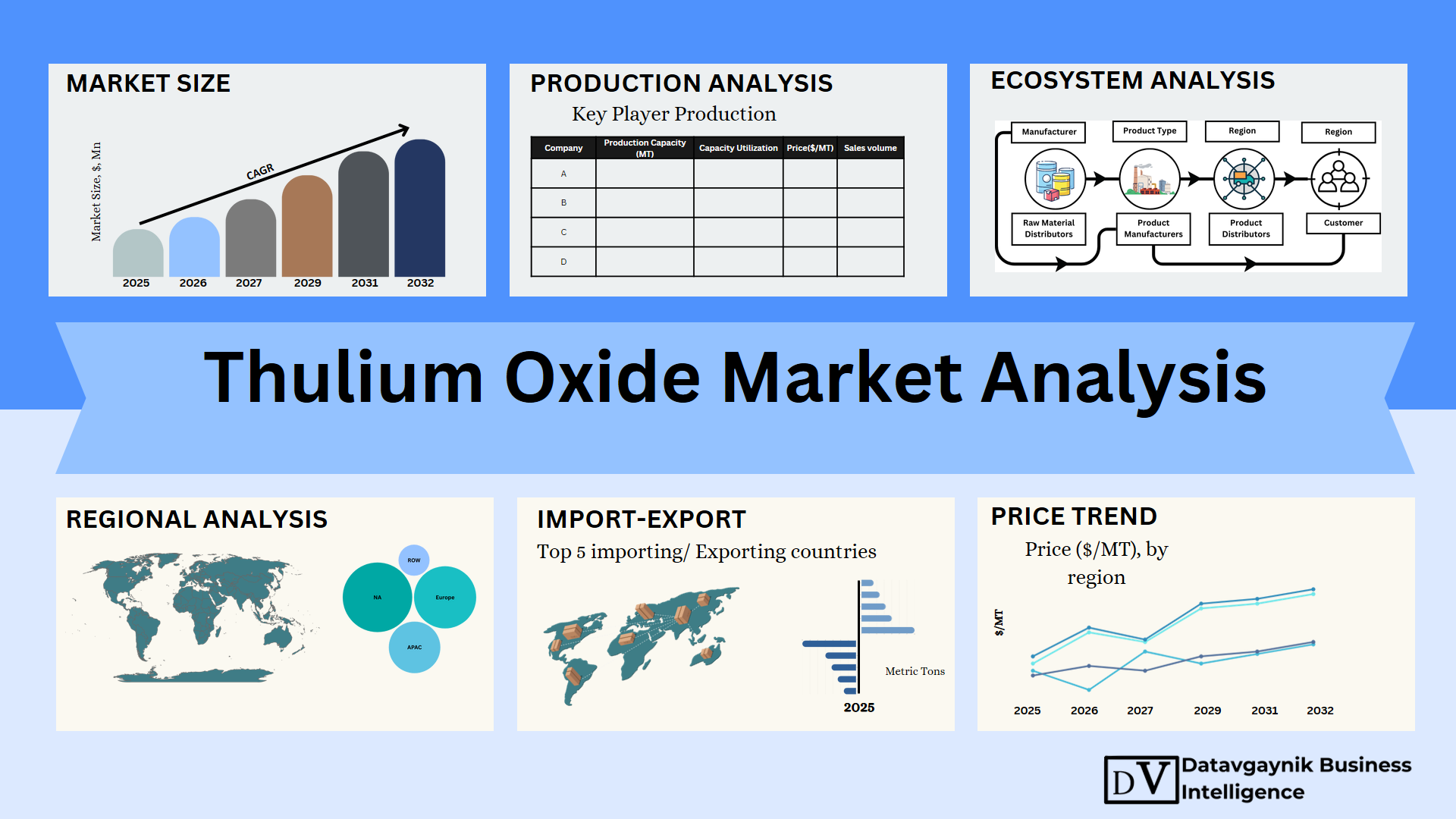
Laser, optical fiber, specialty ceramic, medical imaging, and research-grade phosphor applications define the demand base for the Global Thulium Oxide Market. The Global Thulium Oxide Market is estimated at USD 84 million in 2026 and is projected to reach USD 128 million by 2032, advancing at a 7.3% CAGR, as high-purity thulium oxide gains demand in 1.9–2.0 µm laser systems, rare-earth-doped fibers, radiation dosimetry, and specialty glass additives.
Thulium oxide is not a bulk rare-earth oxide like cerium, lanthanum, or neodymium oxide. Its market scenario is controlled by small-volume, high-purity demand, where oxide purity of 99.9% to 99.999% determines suitability for optical, laser, ceramic, and research applications. This keeps sales volume limited but raises average selling value, particularly for electronic, optical, and medical-grade material.
The strongest application pull comes from thulium-doped laser systems. Thulium-based lasers operate near the 2 µm wavelength range, making them relevant for medical laser procedures, sensing, defense-related optics, and industrial materials processing where controlled absorption and eye-safer wavelengths matter. In May 2025, researchers reported a 105 W diode-pumped thulium-doped all-silica fiber laser, with 77.5% continuous-wave slope efficiency, showing how higher-power thulium laser development can increase demand for consistent rare-earth oxide feedstock used in dopant preparation.
Supply logic remains tied to heavy rare-earth separation rather than direct thulium mining. USGS classifies thulium with heavy rare-earth elements such as terbium, dysprosium, holmium, erbium, ytterbium, and lutetium, and global rare-earth mine output was estimated at about 390,000 tonnes REO in 2025. Only a very small fraction of this stream is recoverable as thulium-bearing oxide, making Global Thulium Oxide production dependent on separation economics, not standalone ore development.
China’s rare-earth refining concentration strongly affects the Global Thulium Oxide market scenario. IEA data shows China accounted for about 91% of global refined rare-earth output in 2024, while China’s October 2025 rare-earth export controls expanded license requirements for rare-earth-related products and technologies. For buyers of Global Thulium Oxide, this shifts procurement focus toward inventory planning, qualified non-Chinese processors, and secure supply of high-purity separated oxide.
Demand is also supported by specialty glass and ceramic uses, where Global Thulium Oxide is valued for optical behavior, thermal stability, and controlled dopant performance rather than bulk consumption. Research laboratories, optical component manufacturers, and laser-material producers often buy in kilogram-scale or smaller qualified lots, while industrial users require reproducible impurity profiles and stable batch chemistry.
Regional Separation Capacity Defines Supply Security in the Global Thulium Oxide Market
Global Thulium Oxide production begins with rare-earth-bearing minerals such as monazite, xenotime, and ion-adsorption clay concentrates, but thulium is recovered only after multi-stage separation of heavy rare earths. The production route is therefore not based on dedicated thulium mining. It depends on whether a processor can economically separate low-abundance heavy rare earth fractions from mixed rare-earth streams.
The supply chain normally follows four steps:
- Mining and concentration: rare-earth ores or mineral-sands by-products are upgraded into mixed concentrates.
- Cracking and leaching: acids or alkalis break down mineral structures to release rare-earth elements.
- Solvent extraction: individual rare-earth oxides are separated through hundreds of extraction stages.
- Calcination and finishing: thulium compounds are converted into oxide powder, usually supplied in 99.9% to 99.999% purity grades.
This makes Global Thulium Oxide supply highly sensitive to separation capacity rather than ore availability alone. A mine can contain thulium-bearing minerals, but without heavy rare-earth solvent extraction, quality control, impurity removal, and customer qualification, it cannot create saleable thulium oxide for laser, optical, ceramic, or research applications.
China remains the main production and refining center because it has long-established heavy rare-earth separation circuits, reagent systems, trained operators, waste-treatment infrastructure, and downstream buyers. Global rare-earth mine output was estimated at about 390,000 tonnes of rare-earth oxide equivalent in 2025, but only a narrow fraction reaches separated heavy rare-earth oxide streams. Thulium oxide sits within this small fraction, which keeps Global Thulium Oxide production structurally constrained even when total rare-earth mining expands.
The bottleneck is more visible in high-purity grades. Laser and optical users require controlled impurity profiles, especially for transition metals and neighboring rare-earth contamination, because small impurity variations can alter optical absorption, dopant behavior, and batch reproducibility. For this reason, Global Thulium Oxide suppliers must manage purity, particle size, moisture, loss on ignition, and certificate-of-analysis consistency rather than simply offering oxide powder.
Non-Chinese supply is developing, but slowly. In May 2025, Lynas produced separated dysprosium oxide at its Malaysian facility, followed by terbium oxide production in June 2025, after commissioning a heavy rare-earth separation circuit. The company later announced expanded heavy rare-earth separation capacity of up to 5,000 tonnes per year of heavy rare-earth feedstock in Malaysia. While this expansion is not thulium-specific, it matters for the Global Thulium Oxide Market because commercial heavy rare-earth separation outside China increases the probability of broader separated oxide availability.
Australia is another strategic supply node. Iluka’s Eneabba refinery in Western Australia is being developed as an integrated rare-earth oxide separation facility, with commissioning targeted for 2027. Its feedstock strategy includes monazite-rich mineral sands streams, which can carry heavy rare-earth content. This type of project may not immediately reshape Global Thulium Oxide sales, but it can reduce long-term reliance on a single refining geography.
Storage and logistics also affect supply reliability. Thulium oxide is shipped in small drums or sealed containers, but buyers often require batch traceability, moisture protection, and export documentation. October 2025 rare-earth export control measures from China increased buyer attention on licenses, end-use screening, and inventory buffers, especially for defense, semiconductor, and advanced optics supply chains.
Application Segments Keep Global Thulium Oxide Demand Concentrated in High-Purity Use Cases
The Global Thulium Oxide Market is segmented less by bulk industrial tonnage and more by application purity, oxide form, dopant behavior, and buyer qualification. Demand is narrow, but individual use cases carry high value because thulium oxide is normally purchased for controlled optical, laser, ceramic, and research performance rather than commodity rare-earth consumption.
Key segments include:
- By purity: 99.9%, 99.99%, and 99.999% thulium oxide
- By form: powder, sub-micron powder, and customized oxide batches
- By application: lasers, optical fiber, specialty glass, ceramics, phosphors, catalysts, research chemicals, and radiation-related uses
- By end-user: medical device manufacturers, photonics companies, defense optics suppliers, research laboratories, specialty glass producers, and rare-earth material processors
- By sales route: direct qualified supply, specialty chemical distributors, research-grade catalogs, and custom rare-earth oxide contracts
Laser and optical applications represent the most value-dense segment of the Global Thulium Oxide Market. Thulium ions are used in laser materials operating near the 1.9–2.0 µm wavelength band, where absorption behavior supports medical laser systems, fiber lasers, sensing devices, and defense-related optical platforms. Even when consumption volume is small, the value per kilogram is higher because buyers require high purity, low metallic contamination, and stable batch-to-batch chemistry.
Medical and surgical laser systems create a recurring demand layer. Thulium-doped lasers are used in urology, soft-tissue surgery, lithotripsy, and precision medical procedures where controlled penetration depth and thermal behavior matter. A single equipment manufacturer may not consume large oxide volumes, but qualified dopant supply becomes critical once a laser platform enters production, servicing, and component replacement cycles.
Optical fiber and specialty glass applications form the second major value cluster. In this segment, Global Thulium Oxide is used as a dopant or additive where controlled optical absorption, emission, and refractive behavior are required. Specialty glass producers usually buy higher-purity grades because impurities can affect transmission, color stability, fluorescence response, and long-term optical performance.
Ceramic and electronic-material uses remain smaller but technically relevant. Thulium oxide can be used in advanced ceramics, dielectric research, and rare-earth-modified materials where thermal stability and rare-earth ion behavior are needed. These uses are usually project-driven, linked to pilot-scale development, laboratory qualification, or specialized component manufacturing rather than continuous mass production.
Research and laboratory demand is fragmented but steady. Universities, national laboratories, photonics research centers, and materials science groups purchase small lots of Global Thulium Oxide for experimental lasers, luminescent compounds, crystal growth, and rare-earth material synthesis. This segment supports a high number of transactions but lower aggregate volume, with 10 g, 100 g, 500 g, and 1 kg pack sizes common in research-grade supply.
Purity segmentation strongly influences pricing and supplier selection. Standard 99.9% grades are suitable for general ceramics, synthesis, and lower-sensitivity research uses, while 99.99% and 99.999% grades are preferred for optical, laser, and electronic-material applications. The higher-purity segment can command a significant premium because purification losses, analytical testing, moisture control, and documentation costs rise sharply at trace-impurity levels.
Asia Pacific leads consumption by processing and component manufacturing linkage, especially through China’s rare-earth refining base, Japan’s optical materials industry, South Korea’s electronics supply chain, and India’s growing medical-device and research procurement. North America and Europe remain important for photonics, defense optics, medical lasers, and university research, where purchases are smaller but specification intensity is higher.
Processing Cost and Purity Premium Shape Global Thulium Oxide Price Behavior
Global Thulium Oxide pricing is driven less by mining cost and more by separation complexity, purification yield, batch size, and documentation requirements. Unlike higher-volume rare-earth oxides, thulium oxide is recovered in small fractions from heavy rare-earth streams, so the cost structure reflects low natural abundance, multi-stage solvent extraction, and limited processing redundancy.
The main cost layers include:
- Feedstock cost: rare-earth concentrates, monazite, xenotime, or ion-adsorption clay-derived mixed rare-earth streams
- Separation cost: multi-stage solvent extraction required to isolate thulium from chemically similar rare earths
- Purification cost: higher reagent use, analytical testing, and yield loss for 99.99% and 99.999% grades
- Finishing cost: calcination, milling, particle-size control, drying, and moisture protection
- Documentation cost: certificate of analysis, trace impurity data, export controls, and end-use compliance
- Logistics cost: small-lot packaging, air freight for urgent orders, and inventory holding for qualified users
Standard 99.9% Global Thulium Oxide is typically priced as a specialty rare-earth oxide, while 99.99% and 99.999% grades carry wider premiums because impurity control becomes more difficult at each additional purity step. The difference is not only analytical. Optical, laser, and electronic-material users may reject a lower-cost batch if neighboring rare-earth impurities, transition metals, moisture, or loss-on-ignition values exceed internal limits.
Small order size also pushes pricing higher. Research users often buy 10 g to 1 kg lots, where packaging, testing, handling, and documentation can represent a large share of the final selling price. Industrial buyers may procure larger kilogram-scale batches, but they usually demand lot consistency, retained samples, and repeatable impurity profiles, which keeps supplier qualification costs embedded in the price.
China’s role in refining and separation creates regional price sensitivity. When Chinese processors control most separated heavy rare-earth supply, buyers in North America, Europe, Japan, South Korea, and India face import-dependent pricing for high-purity Global Thulium Oxide. Freight is not the largest cost because shipment volumes are small, but export licensing, compliance checks, and lead-time risk can add procurement premiums.
The October 2025 rare-earth export control expansion in China intensified this risk. By adding licensing requirements around rare-earth-related products and technologies, the policy increased buyer focus on end-use declarations, supplier documentation, and inventory buffers. For Global Thulium Oxide users in photonics, defense optics, and advanced research, the effective cost now includes supply assurance, not only the invoice price per kilogram.
Energy cost matters indirectly through cracking, separation, solvent recovery, drying, and calcination. Heavy rare-earth separation requires chemical handling, acid-base processing, wastewater treatment, and multiple extraction cycles. Producers with integrated rare-earth separation, waste treatment, and downstream oxide finishing have lower unit cost than traders who rely on external processors and resell qualified lots.
Grade premiums are strongest where performance failure is expensive. A thulium-doped fiber laser, optical glass batch, or medical laser component may use only a small amount of oxide-derived dopant, but poor purity can affect emission efficiency, absorption behavior, or device reproducibility. This makes buyers less price-sensitive after a supplier is qualified.
Contract versus spot pricing depends on buyer profile. Research laboratories purchase through catalog or distributor channels at high per-gram prices. Photonics and specialty material producers prefer repeat orders or annual supply arrangements to secure batch continuity. Spot availability can tighten quickly because Global Thulium Oxide is not produced in large speculative volumes.
Pricing Power Sits with Qualified Heavy Rare-Earth Oxide Producers
Competition in the Global Thulium Oxide Market is concentrated around rare-earth separation capability, high-purity finishing, and export-compliant supply rather than broad chemical distribution. The market does not have dozens of large thulium-specific producers. It is controlled by companies that can separate heavy rare-earth oxides, certify purity, manage impurity profiles, and supply kilogram-scale batches to optical, laser, ceramic, and research users.
China Northern Rare Earth, China Minmetals Rare Earth, Chinalco Rare Earth, and Shenghe Resources form part of China’s broader rare-earth production and processing base. Their advantage comes from integrated feedstock access, established solvent-extraction infrastructure, downstream rare-earth processing, and proximity to Chinese optical, phosphor, magnet, and specialty-material customers. China’s dominance in processed rare earths gives these suppliers strong pricing power when export licenses, end-use declarations, or heavy rare-earth availability become tighter.
Outside China, Lynas Rare Earths is the most strategically important non-Chinese separated rare-earth oxide producer. The company describes itself as the only significant producer of separated light and heavy rare earths outside China, and its Malaysian heavy rare-earth separation expansion announced in October 2025 strengthened non-Chinese supply options for dysprosium and terbium oxide. This does not make Lynas a large thulium oxide supplier immediately, but it improves the competitive base for broader heavy rare-earth separation outside China.
Iluka Resources is another relevant future competitor through its Eneabba rare-earth refinery in Western Australia. Its position is tied to mineral sands feedstock and planned separated rare-earth oxide capacity rather than current large-scale thulium oxide sales. If heavy rare-earth separation streams are expanded successfully after commissioning, Iluka could improve long-term non-Chinese availability for smaller heavy rare-earth oxides, including thulium-bearing fractions.
Specialty material suppliers such as American Elements, Stanford Advanced Materials, ESPI Metals, Alfa Aesar/Thermo Fisher Scientific, and Materion serve the Global Thulium Oxide Market through high-purity catalogs, research-grade packs, and custom oxide supply. Their role is different from integrated processors. They compete on availability, purity documentation, packaging size, customer service, and rapid delivery, but many rely on upstream separated oxide sources.
Competitive positioning can be summarized as follows:
| Supplier category | Competitive strength | Limitation |
| Integrated Chinese rare-earth groups | Scale, separation depth, cost control, export capability | Geopolitical and licensing exposure |
| Lynas Rare Earths | Non-Chinese separation credibility, Malaysia processing base | Heavy rare-earth range still expanding |
| Iluka Resources | Future integrated refinery route, Australian feedstock linkage | Commercial ramp-up still pending |
| Specialty chemical distributors | Small-pack supply, documentation, research customer access | Limited upstream production control |
| Custom high-purity processors | Purity tailoring, batch certification, technical support | Smaller scale and higher cost base |
Market share is difficult to assign precisely because thulium oxide is a small by-product stream inside broader rare-earth oxide operations. China-based processors likely account for the leading share of global separated thulium oxide availability, while non-Chinese suppliers hold a smaller but strategically important position in high-security, defense-linked, and supply-diversification procurement.
Entry barriers are high. A new supplier needs rare-earth feedstock access, solvent-extraction know-how, environmental permits, waste-treatment capability, analytical laboratories, and repeatable purification performance. For optical and laser buyers, supplier approval can take multiple batches because impurity variation directly affects dopant behavior, laser efficiency, and glass performance.


