

Xenotime (Yttrium Phosphate) Market Growth Drivers and Market Trends
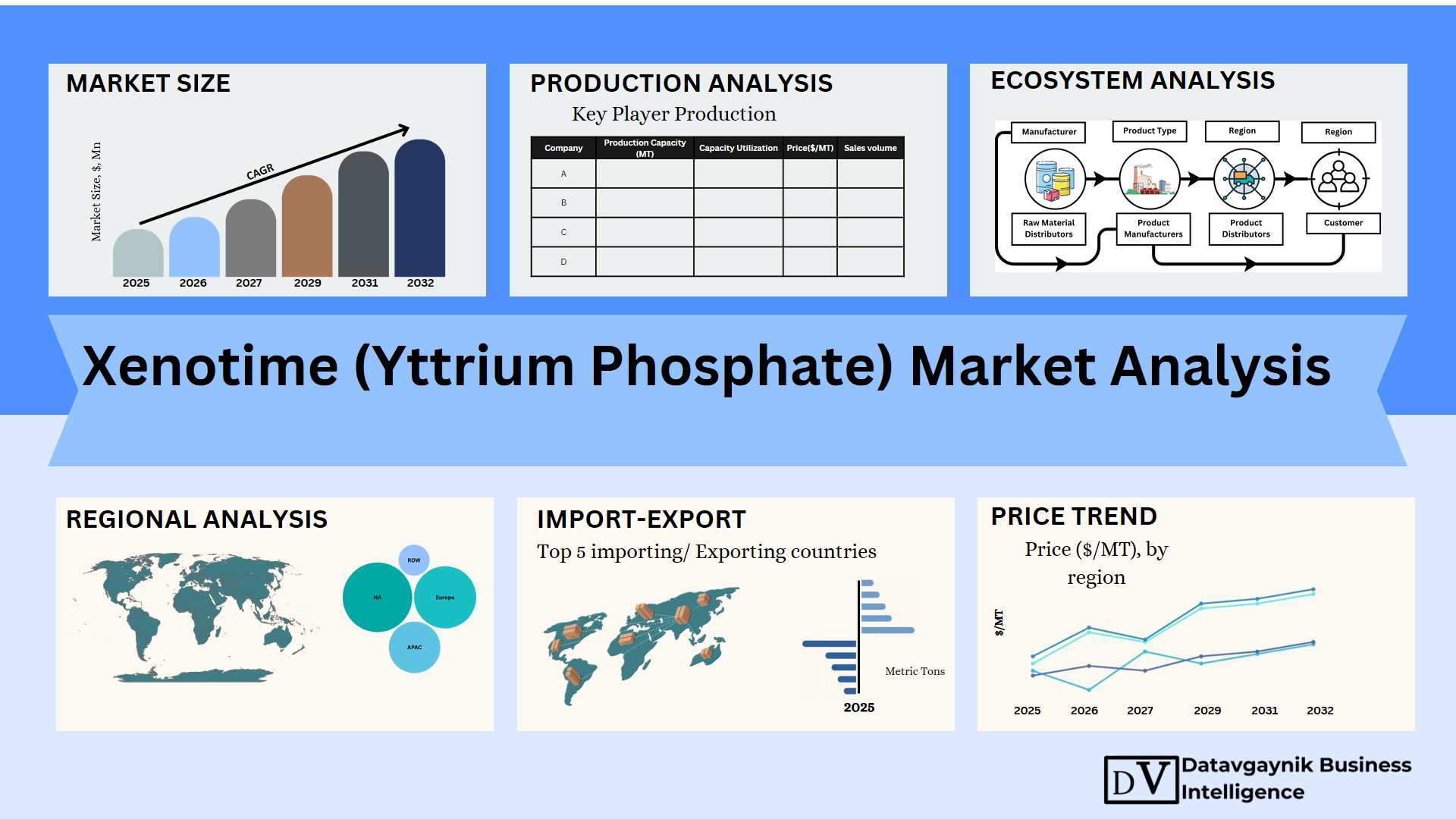
The Xenotime (Yttrium Phosphate) Market is witnessing a strong growth trajectory, driven by increasing global demand for rare earth elements (REEs), which are crucial for numerous high-tech applications. The rising demand for materials like yttrium, extracted from Xenotime, has resulted in accelerated production and exploration activities across the globe.
This is especially true in the electronics, energy, defense, and healthcare sectors, where Xenotime plays a pivotal role in supplying yttrium for high-performance applications. For instance, global demand for rare earth elements, especially yttrium, is expected to expand significantly, with analysts predicting a compound annual growth rate (CAGR) of 7-8% in the coming years. This growth trajectory highlights the critical role of Xenotime in meeting the escalating demand for yttrium-based materials.
Growing Demand for Rare Earth Elements in Electronics
The electronics industry is one of the largest and fastest-growing sectors driving demand for Xenotime (Yttrium Phosphate) Market. Xenotime-derived yttrium is integral in producing phosphors for LED displays, lighting, and high-resolution screens. The global push for energy-efficient lighting solutions and advanced digital displays has created a substantial need for yttrium-based phosphors, making Xenotime a key resource.
For instance, in the past decade, the demand for energy-efficient LED lighting has surged by nearly 15% annually, which in turn has contributed to the increased consumption of Xenotime. With continued advancements in electronics, such as the development of 8K TVs and OLED technology, the Xenotime (Yttrium Phosphate) Market size is expected to expand further, aligning with the growth of the broader electronics industry.
Datavagyanik also covers related markets such as the Yttrium Oxide Market, the Yttrium Chloride Market, and the Yttrium Carbonate Market. These materials are considered in high-temperature and specialty chemical environments, where glass production, catalysis, and safety regulations influence adoption patterns.
Demand in Clean Energy Technologies and Energy Storage Systems
Xenotime (Yttrium Phosphate) Market is also experiencing significant growth due to the rising adoption of clean energy technologies. Yttrium, derived from Xenotime, is critical in the development of solid oxide fuel cells (SOFCs), which are among the most efficient energy storage systems in the market.
These fuel cells, which are used for both stationary and portable applications, are gaining prominence in renewable energy solutions. For instance, the SOFC market is projected to grow at a CAGR of 15% through 2030, indicating a sharp rise in demand for yttrium-based materials. This trend is reinforced by the global push toward decarbonization and the widespread adoption of renewable energy sources. As governments and corporations invest in cleaner energy alternatives, the demand for Xenotime, as a key source of yttrium, is expected to grow significantly.
Electric Vehicle (EV) Market and Yttrium’s Role in Battery Technologies
The electric vehicle (EV) market is another major driver for the Xenotime (Yttrium Phosphate) Market. Yttrium is used in the development of advanced battery technologies, especially in high-performance electric vehicle batteries and energy storage systems. The automotive industry’s rapid shift towards electric vehicles, bolstered by government incentives, is fueling this demand. According to Datavagyanik, the global EV market is projected to grow at an astounding CAGR of 20% from 2024 to 2032, further propelling the need for yttrium and, consequently, Xenotime. As the demand for energy-efficient and long-lasting EV batteries rises, the consumption of Xenotime is expected to increase in parallel, ensuring a steady supply of yttrium for this sector.
Xenotime in Medical Applications: Growth in Cancer Treatment
Another major growth driver for the Xenotime (Yttrium Phosphate) Market is its use in medical applications, particularly in cancer treatment. Yttrium-90, derived from Xenotime, is a radioactive isotope that plays a critical role in targeted radiotherapy for liver cancer and other forms of cancer. The increasing prevalence of cancer, coupled with advancements in precision medicine, has led to a surge in demand for yttrium-90. For instance, the market for radioactive cancer treatments is expected to grow by over 10% annually through 2032, contributing to the increasing consumption of Xenotime. This growth in the healthcare sector is not only helping save lives but also elevating the importance of Xenotime as a valuable resource for the production of yttrium-90.
Advancements in High-Temperature Superconductors
High-temperature superconductors, which are used in applications such as magnetic resonance imaging (MRI) and other advanced scientific instruments, rely heavily on yttrium. As research and development in superconducting materials advance, the demand for Xenotime is growing. The increasing adoption of MRI machines, as well as other medical and industrial equipment, has resulted in a corresponding increase in the demand for yttrium, which is extracted from Xenotime. This application is expected to see steady growth, contributing to the rising demand for Xenotime in both medical and industrial sectors.
Xenotime Demand in Defense and Aerospace Industries
The defense and aerospace industries are another major driver for the Xenotime (Yttrium Phosphate) Market. Yttrium is an essential component in the production of advanced materials used in missile guidance systems, jet engines, and other defense technologies. As global defense spending continues to rise, particularly in emerging markets, the need for high-performance yttrium-based alloys and materials is also increasing. For example, defense budgets in Asia-Pacific countries have increased by an average of 5% annually, with a focus on advanced aerospace and military technologies. This has directly fueled the demand for Xenotime as a crucial resource for yttrium.
Rising Applications in High-Performance Alloys
Yttrium, derived from Xenotime, is extensively used in the production of high-performance alloys, particularly for aerospace, automotive, and electronics industries. The aerospace industry, in particular, requires lightweight, durable materials for jet engines and other high-performance applications. Xenotime is an essential source of yttrium for these advanced materials, which are designed to withstand extreme temperatures and pressures. The global aerospace market is projected to grow at a CAGR of 6% from 2024 to 2032, driving an increasing need for high-performance alloys and, by extension, Xenotime.
Geopolitical Factors and the Shift in Xenotime Production
Geopolitical factors are also influencing the dynamics of the Xenotime (Yttrium Phosphate) Market. With rare earth elements like yttrium becoming increasingly critical in high-tech industries, countries are recognizing the need to secure a stable supply of these materials. The U.S., for example, has intensified efforts to reduce its dependence on China for rare earth minerals. As a result, countries like Australia, South Africa, and the U.S. are increasing production capacity for Xenotime, ensuring more diversification in the global supply chain. This trend of diversifying sources of Xenotime will play a crucial role in stabilizing the supply chain and ensuring the sustainable growth of the Xenotime market.
The Future Outlook for the Xenotime (Yttrium Phosphate) Market
Looking ahead, the Xenotime (Yttrium Phosphate) Market is poised for continued growth. With increasing demand from sectors such as electronics, clean energy, medical applications, and defense, Xenotime is becoming a key material in high-tech industries. As global trends such as renewable energy adoption, the rise of electric vehicles, and advancements in healthcare continue, the demand for yttrium—and by extension, Xenotime—will remain robust. According to Datavagyanik, the Xenotime (Yttrium Phosphate) Market size is expected to grow substantially in the next decade, driven by these technological advancements and increasing applications.
In conclusion, the Xenotime (Yttrium Phosphate) Market is experiencing significant growth due to the expanding demand for yttrium in a wide range of high-tech applications. From electronics and clean energy to medical treatments and defense, Xenotime is becoming a crucial material in various industries. With the continued rise in global demand for rare earth elements, particularly yttrium, Xenotime’s role in supplying this critical resource will only continue to increase, ensuring a promising future for the market.
“Track Country-wise Xenotime (Yttrium Phosphate) Production and Demand through our Xenotime (Yttrium Phosphate) Production Database”
-
-
- Xenotime (Yttrium Phosphate) production database for 24+ countries worldwide
- Xenotime (Yttrium Phosphate) sales volume for 29+ countries
- Country-wise Xenotime (Yttrium Phosphate) production capacity, production plant mapping, production capacity utilization for 24+ manufacturers
- Xenotime (Yttrium Phosphate) production plants and production plant capacity analysis by top manufacturers
-
“Track real-time Xenotime (Yttrium Phosphate) Prices, Xenotime (Yttrium Phosphate) price charts for 24+ countries, Xenotime (Yttrium Phosphate) weekly price tracker and Xenotime (Yttrium Phosphate) monthly price tracker”
-
-
- Track real-time Xenotime (Yttrium Phosphate) prices and Xenotime (Yttrium Phosphate) price trend in 24+ countries though our excel-based Xenotime (Yttrium Phosphate) price charts
- Real-time Xenotime (Yttrium Phosphate) price tracker dashboard with 24+ countries
- Complete transparency on Xenotime (Yttrium Phosphate) price trend through our Xenotime (Yttrium Phosphate) monthly price tracker, Xenotime (Yttrium Phosphate) weekly price tracker
-
Geographical Demand for Xenotime (Yttrium Phosphate) Market
The geographical demand for the Xenotime (Yttrium Phosphate) Market is largely driven by the rising need for yttrium in industries such as electronics, clean energy, defense, and medical technologies. Each region around the globe is witnessing a surge in demand for yttrium-based materials, which directly impacts the consumption of Xenotime, the key source of yttrium. For example, North America, Europe, and the Asia-Pacific regions are all reporting substantial growth in their respective demand for Xenotime, each driven by sector-specific applications.
In Asia-Pacific, China remains the largest consumer of Xenotime (Yttrium Phosphate), contributing to a significant portion of the global demand for yttrium. China’s dominance in the electronics sector, particularly in LED displays and lighting technologies, fuels the continuous demand for Xenotime. The country’s rapidly growing electric vehicle market, which is projected to grow at a CAGR of 20% through 2032, further supports the rising need for Xenotime, given its critical role in advanced battery technologies. As a result, China is expected to maintain its position as a global leader in the Xenotime (Yttrium Phosphate) Market.
Production Dynamics in the Xenotime (Yttrium Phosphate) Market
The production of Xenotime (Yttrium Phosphate) is concentrated in a few key regions, with Asia-Pacific, Africa, and Australia taking the lead. China, being the dominant player in the global rare earths market, also has the largest share in the production of Xenotime. This is largely due to the country’s rich reserves of rare earth elements, including Xenotime, and its advanced processing capabilities. However, there is a growing shift in production as other countries explore their own resources of Xenotime. For instance, Australia, which is rich in rare earth elements, has made strides in increasing its mining capacity, positioning itself as a key player in the global Xenotime market.
Africa, particularly in countries like South Africa and Mozambique, has also emerged as a significant contributor to the global Xenotime supply. The increased focus on rare earth exploration in these regions, coupled with new investments in mining technologies, has enhanced the production of Xenotime and other rare earth elements. These countries are expected to play a crucial role in diversifying the global supply chain, ensuring a more stable and sustainable production of Xenotime (Yttrium Phosphate) in the future.
Market Segmentation of the Xenotime (Yttrium Phosphate) Market
The Xenotime (Yttrium Phosphate) Market can be segmented based on its applications and end-use industries. The primary segments include electronics, clean energy, defense, aerospace, medical applications, and high-performance alloys. Among these, the electronics sector holds the largest share, as the growing demand for energy-efficient lighting and high-resolution displays continues to escalate. In fact, the global demand for energy-efficient lighting solutions is expected to grow at a CAGR of 8% from 2024 to 2032, which directly contributes to the rising demand for Xenotime-derived yttrium.
In clean energy applications, Xenotime is gaining significant traction due to the increasing use of yttrium-based materials in energy storage systems, particularly solid oxide fuel cells (SOFCs). As governments around the world continue to prioritize decarbonization efforts, the demand for clean energy technologies is expected to soar. The growing adoption of electric vehicles (EVs) also plays a key role in driving demand for Xenotime in energy storage applications. This segment, expected to grow by 15% annually, is a significant contributor to the overall market expansion.
The defense and aerospace sectors are also witnessing a rise in demand for Xenotime, primarily due to the increasing need for advanced materials in missile systems, jet engines, and other high-performance technologies. With global defense spending on the rise, particularly in emerging markets, the demand for Xenotime in these applications is projected to grow steadily over the next decade.
Price Trends in the Xenotime (Yttrium Phosphate) Market
The price of Xenotime (Yttrium Phosphate) has witnessed fluctuations due to a variety of factors, including supply chain disruptions, geopolitical tensions, and changes in global demand for rare earth elements. For instance, in recent years, the Xenotime (Yttrium Phosphate) price has been subject to significant volatility, with periods of high demand in sectors such as electronics and clean energy leading to price spikes. However, with increased production capacity in regions outside of China, such as Australia and Africa, the Xenotime market has experienced more stabilization in pricing.
According to Datavagyanik, the Xenotime (Yttrium Phosphate) price is expected to experience moderate growth in the coming years, as demand for yttrium continues to rise across industries like electronics, clean energy, and defense. With the increasing adoption of electric vehicles and renewable energy technologies, the demand for yttrium-based materials is expected to keep prices relatively high. However, the growing availability of Xenotime from alternative sources, particularly in Australia and Africa, will help balance price fluctuations and ensure a stable supply chain.
Xenotime (Yttrium Phosphate) Price Trend Analysis
Looking at the price trend of Xenotime (Yttrium Phosphate), it is evident that fluctuations in its price are closely tied to the global demand for yttrium and other rare earth elements. Over the past decade, there have been periods of sharp price increases, particularly when the demand for high-tech applications surged. The emergence of new uses in clean energy and the electric vehicle market has contributed significantly to these price increases. However, the expansion of Xenotime production outside of China has led to some price stabilization.
The global trend toward circular economy practices, including recycling initiatives for rare earth materials, also plays a significant role in moderating Xenotime (Yttrium Phosphate) prices. Countries such as Japan and South Korea are heavily investing in rare earth recycling technologies to reduce their reliance on imported materials. This trend is expected to influence the price dynamics of Xenotime, as recycled Xenotime becomes a viable alternative source of yttrium.
Impact of Geopolitical Factors on Xenotime (Yttrium Phosphate) Price Trend
Geopolitical factors continue to have a significant impact on the Xenotime (Yttrium Phosphate) price trend. Tensions surrounding the control of rare earth resources, particularly between the U.S. and China, have resulted in fluctuations in Xenotime prices. For instance, the imposition of tariffs on rare earth materials has caused price hikes in the global market. However, with the increasing diversification of Xenotime production, the reliance on any single country is decreasing, which is likely to contribute to a more stable price environment.
As countries like Australia, South Africa, and the U.S. ramp up their rare earth mining efforts, the global Xenotime market is becoming less reliant on China. This diversification not only ensures a more stable supply chain but also contributes to stabilizing the price trends. Given the geopolitical shifts, the Xenotime price trend is expected to remain stable over the long term, with moderate increases driven by growing demand in electronics, clean energy, and defense.
Regional Production and Price Trend Insights
In regions outside of China, the production of Xenotime (Yttrium Phosphate) is seeing significant advancements. Australia, for instance, is focusing on developing its rare earth mining infrastructure, and its efforts are likely to lead to a steady increase in Xenotime production. With a diversified supply chain and a growing emphasis on sustainability, Australia’s contribution to the global Xenotime market is poised to expand, which could moderate price increases in the future.
Similarly, countries in Africa, particularly South Africa and Mozambique, are becoming important players in the production of Xenotime. These countries have significant untapped reserves of rare earth minerals and are investing in mining technologies that will enable them to capture a larger share of the global Xenotime market. As these regions ramp up production, the overall supply of Xenotime will increase, which could lead to more competitive pricing and stabilize price fluctuations.
Conclusion: The Future Outlook for the Xenotime (Yttrium Phosphate) Market
The Xenotime (Yttrium Phosphate) Market is set for continued growth, with increasing demand across key industries such as electronics, clean energy, defense, and medical applications. As the market expands, the geographical demand for Xenotime will continue to diversify, with key players emerging in regions outside of China, such as Australia, Africa, and the U.S. The steady increase in production, coupled with innovations in recycling technologies, will also help stabilize Xenotime prices. The demand for Xenotime in the clean energy and electric vehicle sectors is expected to remain strong, supporting long-term growth in the market.
In conclusion, the Xenotime (Yttrium Phosphate) Market will experience steady growth driven by increasing demand in high-tech applications and the expanding availability of production capacity. The overall price trend will be influenced by global supply chain dynamics, with regional production advances and recycling initiatives contributing to price stabilization. As the market matures, the Xenotime industry is positioned for sustained growth and stability, driven by technological innovations and the growing global reliance on rare earth elements like yttrium.
“Xenotime (Yttrium Phosphate) Manufacturing Database, Xenotime (Yttrium Phosphate) Manufacturing Capacity”
-
-
- Xenotime (Yttrium Phosphate) top manufacturers market share for 24+ manufacturers
- Top 7 manufacturers and top 14 manufacturers of Xenotime (Yttrium Phosphate) in North America, Europe, Asia Pacific
- Xenotime (Yttrium Phosphate) production plant capacity by manufacturers and Xenotime (Yttrium Phosphate) production data for 24+ market players
- Xenotime (Yttrium Phosphate) production dashboard, Xenotime (Yttrium Phosphate) production data in excel format
-
“Xenotime (Yttrium Phosphate) price charts, Xenotime (Yttrium Phosphate) weekly price tracker and Xenotime (Yttrium Phosphate) monthly price tracker”
-
-
- Factors impacting real-time Xenotime (Yttrium Phosphate) prices in 19+ countries worldwide
- Xenotime (Yttrium Phosphate) monthly price tracker, Xenotime (Yttrium Phosphate) weekly price tracker
- Real-time Xenotime (Yttrium Phosphate) price trend, Xenotime (Yttrium Phosphate) price charts, news and updates
- Tracking Xenotime (Yttrium Phosphate) price fluctuations
-
Xenotime (Yttrium Phosphate) Market: Analysis of Top Manufacturers and Market Dynamics
The Xenotime (Yttrium Phosphate) Market is experiencing significant growth, driven by its essential role in various high-tech applications. This analysis delves into the leading manufacturers in the Xenotime market, their product offerings, market shares, and recent industry developments.
Leading Manufacturers in the Xenotime (Yttrium Phosphate) Market
- RZ Resources
RZ Resources is a prominent player in the Xenotime market, primarily focusing on the extraction and processing of rare earth elements (REEs) from minerals such as monazite and Xenotime. Their Copi Project is notable for its rich deposits of Xenotime, which is a crucial source of yttrium and heavy lanthanide elements. The company’s operations are strategically positioned to meet the growing demand for REEs in various applications, including electronics and clean energy technologies.
- Red Mountain Mining
Red Mountain Mining has made significant strides in the exploration of Xenotime deposits, particularly at their Mt Mansbridge project in Western Australia. Recent petrological studies have confirmed the presence of Xenotime, indicating a substantial opportunity for the company to expand its REE portfolio. The Mt Mansbridge project is poised to contribute notably to the global supply of heavy REEs, including yttrium, dysprosium, and terbium.
- FUNCMATER
FUNCMATER specializes in the production of high-purity yttrium compounds, including yttrium phosphate (YPO₄). Their Yttrium(III) phosphate powder is utilized in various applications, such as phosphors for LEDs and displays. The company’s commitment to quality and innovation positions it as a key supplier in the Xenotime market, catering to the increasing demand for advanced materials in electronics.
Xenotime (Yttrium Phosphate) Market Share by Manufacturers
The market share distribution among Xenotime manufacturers is influenced by factors such as production capacity, technological advancements, and strategic partnerships. While specific market share percentages are proprietary, the following observations can be made:
- RZ Resources: Leveraging their extensive reserves and processing capabilities, RZ Resources is a significant contributor to the global Xenotime supply. Their focus on high-quality extraction positions them favorably in the market.
- Red Mountain Mining: With recent confirmations of Xenotime deposits at Mt Mansbridge, Red Mountain Mining is emerging as a key player. The potential scale of their operations could substantially impact their market share in the coming years.
- FUNCMATER: As a specialized manufacturer of yttrium compounds, FUNCMATER holds a notable share in the segment of processed Xenotime products. Their dedication to producing high-purity materials caters to the stringent requirements of electronic applications.
Recent Industry Developments
- Red Mountain Mining’s Xenotime Discovery (January 2022)
In January 2022, Red Mountain Mining announced the discovery of Xenotime-bearing mineralization at their Mt Mansbridge project. Petrological studies confirmed the presence of heavy REEs, including yttrium, dysprosium, and terbium. This discovery positions Red Mountain Mining to become a significant supplier of heavy REEs, aligning with the global shift towards sustainable and clean energy technologies that demand such materials.
- FUNCMATER’s Product Enhancement Initiative (March 2022)
In March 2022, FUNCMATER introduced an enhanced yttrium phosphate powder with improved purity levels. This product development caters to the growing demand for high-quality materials in LED manufacturing and other electronic applications, reinforcing FUNCMATER’s position in the specialized segment of the Xenotime market.
- RZ Resources’ Expansion Plans (July 2022)
In July 2022, RZ Resources announced plans to expand their processing facilities at the Copi Project site. This expansion aims to increase their production capacity of Xenotime-derived yttrium compounds, addressing the rising global demand for REEs in various high-tech applications.
“Xenotime (Yttrium Phosphate) Production Data and Xenotime (Yttrium Phosphate) Production Trend, Xenotime (Yttrium Phosphate) Production Database and forecast”
-
-
- Xenotime (Yttrium Phosphate) production database for historical years, 10 years historical data
- Xenotime (Yttrium Phosphate) production data and forecast for next 7 years
- Xenotime (Yttrium Phosphate) sales volume by manufacturers
-
“Track Real-time Xenotime (Yttrium Phosphate) Prices for purchase and sales contracts, Xenotime (Yttrium Phosphate) price charts, Xenotime (Yttrium Phosphate) weekly price tracker and Xenotime (Yttrium Phosphate) monthly price tracker”
-
-
- Gain control on your purchase and sales contracts through our real-time Xenotime (Yttrium Phosphate) price tracker and Xenotime (Yttrium Phosphate) price trend analysis
- Xenotime (Yttrium Phosphate) weekly price tracker and forecast for next four weeks
- Xenotime (Yttrium Phosphate) monthly price tracker and forecast for next two months
-
Market Scenario, Demand vs Supply, Average Product Price, Import vs Export, till 2032
- Global Xenotime (Yttrium Phosphate) Market revenue and demand by region
- Global Xenotime (Yttrium Phosphate) Market production and sales volume
- United States Xenotime (Yttrium Phosphate) Market revenue size and demand by country
- Europe Xenotime (Yttrium Phosphate) Market revenue size and demand by country
- Asia Pacific Xenotime (Yttrium Phosphate) Market revenue size and demand by country
- Middle East & Africa Xenotime (Yttrium Phosphate) Market revenue size and demand by country
- Latin America Xenotime (Yttrium Phosphate) Market revenue size and demand by
- Import-export scenario – United States, Europe, APAC, Latin America, Middle East & Africa
- Average product price – United States, Europe, APAC, Latin America, Middle East & Africa
- Market player analysis, competitive scenario, market share analysis
- Business opportunity analysis
Key questions answered in the Global Xenotime (Yttrium Phosphate) Market Analysis Report:
- What is the market size for Xenotime (Yttrium Phosphate) in United States, Europe, APAC, Middle East & Africa, Latin America?
- What is the yearly sales volume of Xenotime (Yttrium Phosphate) and how is the demand rising?
- Who are the top market players by market share, in each product segment?
- Which is the fastest growing business/ product segment?
- What should be the business strategies and Go to Market strategies?
The report covers Xenotime (Yttrium Phosphate) Market revenue, Production, Sales volume, by regions, (further split into countries):
- Asia Pacific (China, Japan, South Korea, India, Indonesia, Vietnam, Rest of APAC)
- Europe (UK, Germany, France, Italy, Spain, Benelux, Poland, Rest of Europe)
- North America (United States, Canada, Mexico)
- Latin America (Brazil, Argentina, Rest of Latin America)
- Middle East & Africa
Table of Contents:
Xenotime (Yttrium Phosphate) Market: Trends, Insights, and Forecast
- Introduction to Xenotime (Yttrium Phosphate)
-
- Overview of Xenotime and Its Chemical Properties
- Historical Significance and Uses in Various Industries
- Purpose and Scope of the Market Study
- Market Segmentation
-
- By Type (Natural Xenotime, Synthetic Xenotime)
- By Application (Rare Earth Elements, Catalysts, Electronics, Ceramics)
- By End-Use Industry (Electronics, Aerospace, Energy, Ceramics)
- Global Xenotime Market Overview (2015-2035)
-
- Market Development and Historical Insights
- Key Market Drivers and Influencing Factors
- Challenges and Emerging Opportunities in the Xenotime Market
- Demand and Supply Dynamics
-
- Major Demand Drivers in Electronics, Energy, and Aerospace
- Raw Material Sourcing and Production Insights
- Key Manufacturers and Market Share Distribution
- Regional Market Insights
-
- North America
- Demand in Electronics and Aerospace Sectors
- Market Trends and Regulatory Landscape
- Europe
- Applications in Ceramics and Catalysts
- Market Growth and Regulatory Influence
- Asia Pacific
- Growing Demand for Xenotime in Electronics and Energy
- Key Market Opportunities in China and India
- Latin America
- Emerging Applications in Energy and Manufacturing
- Regional Market Dynamics and Growth Trends
- Middle East & Africa
- Demand in Electronics and Energy Sectors
- Market Expansion Opportunities in Aerospace and Ceramics
- North America
- Production and Manufacturing Insights
-
- Methods of Xenotime Extraction and Production
- Leading Manufacturers and Market Share Analysis
- Innovations in Synthesis and Production Techniques
- Competitive Landscape
-
- Key Players in the Xenotime Market
- Competitive Positioning and Market Share Distribution
- R&D Investments and Strategic Initiatives
- Pricing Trends and Economic Insights
-
- Historical Pricing Trends and Influencing Factors
- Price Forecasts and Economic Outlook (2025-2035)
- Price Variability and Key Market Drivers
- Applications of Xenotime
-
- Rare Earth Elements: Role in Electronics and Green Technologies
- Catalysts: Contribution to Chemical Reactions and Industrial Processes
- Electronics: Use in Semiconductors and Other Advanced Materials
- Ceramics: Application in High-Performance Ceramics and Refractories
- Sustainability and Environmental Considerations
-
- Environmental Impact of Xenotime Mining and Processing
- Innovations in Eco-Friendly Manufacturing Practices
- Regulatory Compliance and Environmental Standards
- Global Trade and Distribution Networks
-
- Key Exporting and Importing Regions for Xenotime
- Barriers to Market Entry and Access Insights
- Distribution Channels and Logistics in Global Markets
- Consumer Insights and Market Behavior
-
- Shifting Demand in Electronics, Aerospace, and Ceramics
- Regional Consumption Patterns and Consumer Preferences
- Growing Demand for Sustainable and Eco-Friendly Products
- Technological Developments in Xenotime
-
- Advances in Extraction, Synthesis, and Processing Technologies
- Role of Nanotechnology and Advanced Materials in Xenotime Applications
- Innovations in Electronics, Ceramics, and Catalytic Uses
- Market Risks and Challenges
-
- Fluctuations in Raw Material Prices and Supply Chain Issues
- Regulatory Barriers and Market Access Challenges
- Environmental and Health Risks in Xenotime Production
- Opportunities for Growth in the Xenotime Market
-
- Expanding Use in Clean Energy and Green Technologies
- Applications in Advanced Electronics and Aerospace
- Growth in Emerging Economies and New Markets
- Market Forecast and Projections (2025-2035)
-
- Revenue and Demand Projections by Region
- Application-Specific Market Growth Forecasts
- Long-Term Trends and Industry Growth Potential
- Sustainability and Circular Economy
-
- Role of Xenotime in Supporting Sustainable Manufacturing
- Innovations in Recycling and Resource Efficiency
- Contribution to Circular Economy Models in Electronics, Ceramics, and Energy
- Value Chain and Stakeholder Analysis
-
- Key Stakeholders in the Xenotime Value Chain
- Opportunities for Collaboration and Strategic Partnerships
- Role of Research Institutions, Government Agencies, and Regulators
- Emerging Applications and Innovations
-
- New Uses in Clean Energy Solutions and Advanced Materials
- Expanding Role in Catalysis and Semiconductor Industries
- Innovations in Xenotime for Green Technologies and Environmental Applications
- Appendix and Supporting Resources
-
- Glossary of Key Terms
- Research Methodology and Data Sources
- References and Further Reading

