

Market Summary and Growth Forecast
The global Graphene-based Composites Market will witness a robust CAGR of 18.6%, valued at USD 0.78 billion in 2026, expected to appreciate and reach USD 3.62 billion by 2035.
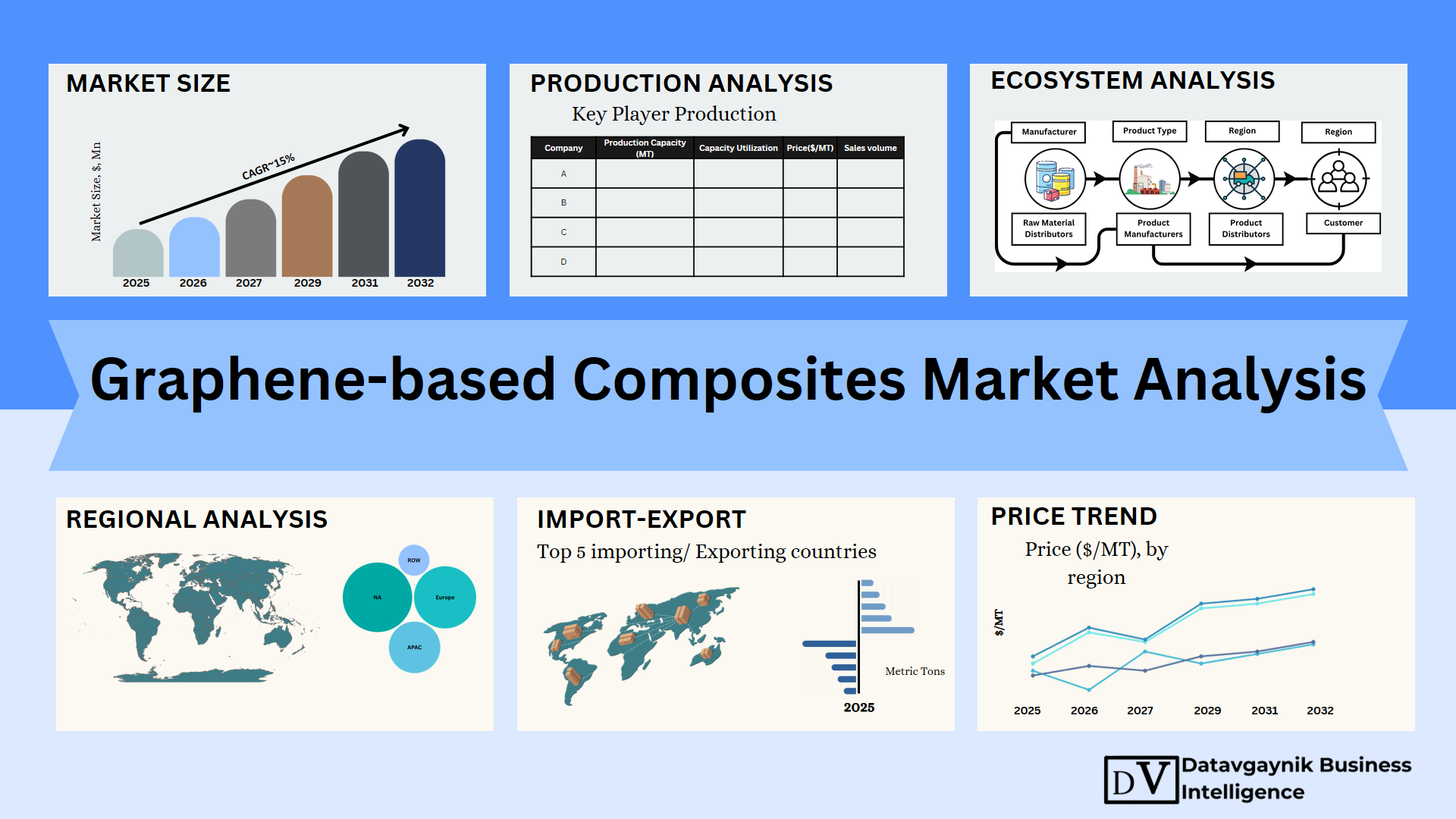
Graphene-based composites refer to engineered materials where graphene, graphene nanoplatelets, graphene oxide, reduced graphene oxide, or other graphene-related materials are added to polymers, metals, ceramics, cementitious materials, coatings, elastomers, or fiber-reinforced structures. The purpose is simple: improve mechanical strength, thermal conductivity, electrical conductivity, barrier performance, corrosion resistance, or weight-to-strength ratio without fully changing the base material system.
In 2026, the market is still not a fully commoditized materials market. It is more of a performance-additive and advanced-composite ecosystem. Volumes are small compared with conventional carbon black, glass fiber, carbon fiber, or mineral fillers. But the value per kilogram is much higher. That is why revenue growth is outpacing volume growth. Buyers are not paying for bulk reinforcement. They are paying for measurable performance gains.
The strategic relevance of the Graphene-based Composites Market between 2026 and 2035 comes from three forces working together.
First, lightweighting is becoming more serious. Automotive, aerospace, defense, sports equipment, wind energy, and electronics companies want stronger materials without adding mass. Graphene-enhanced polymers and fiber composites can help here, especially where a small filler loading can change stiffness, thermal behavior, or electrical performance.
Second, electrification is changing material requirements. EV battery packs, charging systems, power electronics, EMI shielding, thermal interface structures, conductive coatings, and lightweight housings need materials that manage heat and current better. Traditional polymers often need support. Graphene gives formulators another route.
Third, industrial users are becoming more selective. They don’t want “graphene” as a label. They want proof: better fatigue life, lower coating failure, improved conductivity, reduced part weight, or longer service life. This is pushing the market toward application-specific formulations rather than generic graphene powder sales.
The next phase won’t be won by companies selling graphene as a miracle material. It’ll be won by suppliers that can disperse it consistently, prove repeatable performance, and fit into existing molding, coating, compounding, or curing lines.
Global Graphene-based Composites Market Forecast, 2026–2035
| Metric | Estimate |
| Global Market Size, 2026 | USD 0.78 billion |
| Projected Market Size, 2035 | USD 3.62 billion |
| CAGR, 2026–2035 | 18.6% |
| Estimated Volume, 2026 | 22.5 kilotons of graphene-enhanced composite formulations |
| Estimated Volume, 2035 | 86.0 kilotons of graphene-enhanced composite formulations |
| Highest-Value Application Areas | Aerospace, defense, electronics, EV thermal systems, specialty coatings |
| Highest-Volume Application Areas | Polymers, coatings, construction additives, elastomers |
The market’s growth path will not be linear. Adoption will move faster in applications where graphene is used at low loading levels and where the customer can directly quantify the benefit. Anti-corrosion coatings, conductive polymers, EMI shielding compounds, tire and rubber additives, composite sporting goods, and aerospace prepregs are good examples. Construction and cement-based composites can create larger volume potential, but pricing pressure and validation cycles will be tougher.
Regionally, Asia Pacific is expected to hold the largest share in 2026, supported by strong electronics manufacturing, battery supply chains, polymer processing, and industrial coating demand. North America will remain strong in aerospace, defense, advanced polymers, and energy storage applications. Europe will continue to play a critical role in R&D, sustainability-led materials development, and early industrial validation through research-industry collaboration.
From a stakeholder perspective, the market sits at the intersection of material science and industrial manufacturing. Key stakeholders include graphene producers, masterbatch compounders, specialty chemical companies, composite part manufacturers, coating formulators, automotive OEMs, aerospace suppliers, electronics brands, EV battery system integrators, defense agencies, construction material companies, universities, investors, and industry associations.
Governments also matter. Not because graphene-based composites need broad subsidies to exist, but because national programs around advanced materials, semiconductor resilience, EV supply chains, defense readiness, and lightweight transportation indirectly support adoption. Investors are watching the space carefully, but funding is becoming more disciplined. Companies with pilot-scale dispersion technology, strong customer trials, and repeatable quality data will attract more attention than firms with only lab-level claims.
The Graphene-based Composites Market is therefore moving from technical curiosity to selective commercial adoption. The market will expand, but only where graphene solves a real formulation problem. That distinction is important. In 2026–2035, the opportunity is not in replacing every conventional composite. It is in upgrading high-value materials where strength, conductivity, thermal control, corrosion protection, or weight reduction directly affect product performance.
Competitive Intelligence and Benchmarking
The competitive structure of the Graphene-based Composites Market is still fragmented. There are few scaled suppliers. Many companies remain application-led, not volume-led. This means competition is less about who can produce graphene powder and more about who can turn it into usable composite additives, dispersions, masterbatches, coatings, and customer-ready formulations.
Key Company Benchmarking
| Company | Portfolio Position | Market Position |
| NanoXplore | Graphene-enhanced plastics, polymer compounds, composite materials, battery-linked materials, and industrial graphene additives | One of the more commercially scaled players with a stronger plastics and composites orientation |
| First Graphene | Graphene additives for polymers, rubbers, elastomers, cement, coatings, inks, and masterbatch systems | Strong in industrial-grade graphene additives and formulation-ready composite enhancement |
| Directa Plus | Graphene nanoplatelet-based materials used across textiles, elastomers, composites, paints, batteries, and environmental applications | Europe-based supplier with a broad commercial application base and sustainability positioning |
| Black Swan Graphene | Graphene-enhanced polymer masterbatches for PP, HDPE, TPU, and related polymer systems | Emerging masterbatch-focused player targeting easier adoption by plastics processors |
| Haydale Graphene Industries | Functionalized graphene and nano-material systems for polymers, resins, coatings, composites, inks, and technical applications | Differentiated by surface functionalization know-how and application development support |
| Universal Matter | Graphene-based additives and dispersions for industrial materials, coatings, polymers, and sustainability-led formulations | Strengthened its coatings and dispersions position after acquiring Applied Graphene Materials’ operating assets |
| Graphenea | Graphene oxide, CVD graphene, graphene films, foundry services, and custom dispersions | More research, electronics, and advanced-materials oriented, but relevant for high-purity graphene oxide and specialty composite development |
NanoXplore has one of the most industrially aligned positions in the market. Its portfolio is not limited to lab-grade graphene. The company works around graphene-enhanced plastics and composite products, which gives it better proximity to automotive, transportation, packaging, energy, and industrial customers. Its advantage is scale and downstream integration. That matters because composite buyers often want consistency, not just nanomaterial novelty.
First Graphene is positioned around additive-grade graphene that can be introduced into existing material systems. Its portfolio touches plastics, elastomers, cementitious materials, coatings, rubbers, and inks. This makes the company relevant across both high-volume and high-performance use cases. Its value proposition is practical: improve strength, conductivity, fire behavior, flexural performance, or durability without forcing customers to redesign the full production line.
Directa Plus has a wider application spread than many pure-play graphene suppliers. Its graphene nanoplatelet-based materials are used across textiles, paints, elastomers, composites, and environmental systems. In composites, its strongest advantage is sustainability-led positioning and European manufacturing credibility. That said, its challenge is similar to others: converting promising material performance into repeatable large-volume contracts.
Black Swan Graphene is becoming important in polymer masterbatches. This is a smart route because many plastics processors already understand masterbatch dosing. Instead of asking converters to handle loose graphene powder, the company is pushing graphene into a format that fits existing extrusion and molding workflows. This lowers the adoption barrier.
Haydale Graphene Industries is more technology-enabling than volume-dominant. Its strength lies in functionalization and helping customers integrate graphene into polymers, resins, and coatings. For aerospace, advanced composites, conductive inks, and technical materials, surface compatibility is often the real problem. Haydale’s position fits that pain point.
Universal Matter has become more relevant after absorbing Applied Graphene Materials’ operating platform. The company’s positioning is tied to graphene-based additives, dispersions, coatings, and industrial performance materials. Its opportunity sits in anti-corrosion coatings, industrial paints, polymer reinforcement, and sustainability-linked formulations.
Graphenea plays a different role. It is less of a mainstream bulk composite supplier and more of a specialty graphene materials provider. Its graphene oxide and high-quality graphene materials support R&D, specialty coatings, polymer composites, membranes, sensors, and advanced electronics development. It is important for innovation pipelines even if it is not the highest-volume composite supplier.
The competitive story is not about one company dominating every end market. The likely winners will be application specialists. One supplier may lead polymer masterbatch. Another may lead coatings. Another may support high-purity graphene oxide for advanced composites. That makes benchmarking more nuanced than a simple revenue ranking.
Regional Landscape and Adoption Outlook
Adoption in the Graphene-based Composites Market is uneven. The technology is global, but commercialization depends on manufacturing depth, R&D funding, customer validation culture, and the presence of industries that can pay for performance materials.
Regional Adoption Outlook
| Region / Country | Adoption Status | Growth Outlook | Key Demand Areas |
| North America | Commercial pilots moving into selective industrial use | High | Aerospace, defense, plastics, coatings, EV systems, construction additives |
| Europe | Strong R&D base and growing industrial validation | High | Sustainable construction, coatings, automotive lightweighting, technical textiles, specialty composites |
| China | Largest industrial scale-up potential | Very High | Electronics, EVs, batteries, polymer composites, coatings, construction |
| India | Early-stage but high white-space opportunity | High | Construction additives, coatings, automotive plastics, infrastructure materials |
| Japan | Quality-led adoption in electronics and advanced materials | Moderate to High | Electronics, thermal management, specialty polymers, precision components |
| South Korea | Strong fit with electronics, batteries, and mobility supply chains | High | Battery systems, thermal materials, conductive polymers, displays, EV components |
| Rest of the World | Selective adoption | Moderate | Construction, coatings, mining equipment, marine coatings, industrial plastics |
North America
North America is one of the most attractive regions for high-value graphene composites. The region has strong demand from aerospace, defense, mobility, specialty chemicals, coatings, and advanced plastics. The U.S. leads in customer validation and defense-linked advanced materials. Canada is relevant because of graphene production, battery materials, and polymer composite activity.
Adoption is strongest where graphene can deliver measurable technical gains. Examples include conductive plastics, EMI shielding, anti-corrosion coatings, thermal management parts, and lightweight composite structures. Funding is also available for advanced materials tied to electrification, domestic manufacturing, and defense resilience.
That said, North America is not the easiest region for suppliers. Buyers ask for data. They want durability testing, safety documentation, process compatibility, and cost-per-performance proof.
Europe
Europe has one of the strongest graphene innovation ecosystems. Public research support, university-industry platforms, sustainability policy, and advanced manufacturing clusters all support adoption. The region is particularly active in sustainable construction materials, automotive lightweighting, coatings, technical textiles, elastomers, and industrial composites.
The UK, Germany, Italy, Spain, France, and the Netherlands are the most visible markets. The UK has a strong graphene research-commercialization base. Germany offers automotive and industrial composite demand. Italy has activity in graphene nanoplatelet production and downstream applications. Spain is relevant for specialty graphene materials and graphene oxide capability.
Europe’s biggest advantage is structured R&D. Its biggest limitation is speed. Industrial validation is careful and can be slow.
China
China has the strongest scale-up potential. Its large electronics, EV, battery, plastics, coatings, and construction sectors create a broad adoption base. Chinese manufacturers are also more willing to test new material additives when they align with cost reduction, conductivity, thermal performance, or product differentiation.
China’s strength is manufacturing depth. If graphene-enhanced polymers or coatings meet process and cost targets, local adoption can scale faster than in most regions. The country also has a strong graphite supply chain, which gives it upstream relevance.
The key risk is quality variation. Not all graphene products are equal. In composites, platelet size, layer count, oxygen content, surface chemistry, dispersion quality, and batch consistency can strongly affect performance.
India
India is still early in graphene-based composites, but the white space is meaningful. The strongest future demand may come from construction materials, anti-corrosion coatings, infrastructure repair, automotive plastics, EV components, rubber products, and industrial coatings.
India has a large price-sensitive market. So adoption will not be led by expensive aerospace-grade composites. It will be led by practical use cases where graphene can reduce lifecycle cost. For example, coatings that last longer in humid or coastal environments. Or concrete additives that reduce cement content while maintaining strength. Or polymer parts that improve durability without shifting to premium engineering plastics.
India is not a near-term volume leader, but it could become a strong mid-cost application market if suppliers localize compounding, testing, and customer support.
Japan
Japan is more selective. Adoption is likely to focus on electronics, advanced polymers, precision components, thermal management, energy devices, and specialty industrial materials. Japanese buyers usually require high consistency and long validation cycles. That makes rapid commercialization difficult, but once qualified, suppliers can access premium applications.
Japan’s opportunity is less about bulk volume and more about high-value use cases where material precision matters.
South Korea
South Korea has a strong fit with graphene composites because of its electronics, batteries, displays, semiconductors, EVs, and advanced manufacturing base. Adoption will likely be strongest in conductive polymers, thermal spreader-related materials, battery pack components, lightweight housings, coatings, and EMI shielding structures.
Korean companies are also used to integrating advanced materials into compact devices. That helps graphene adoption, especially where thermal and electrical performance must improve without increasing component size.
Rest of the World
The Rest of the World includes Latin America, the Middle East, Africa, Southeast Asia, and Oceania. Adoption is selective but not irrelevant. Australia has graphene production and mining-linked materials interest. The Middle East may support graphene-enhanced construction and infrastructure materials. Southeast Asia could become relevant through electronics assembly, footwear, plastics, and consumer goods manufacturing.
Underserved regions include Latin America, Africa, and parts of Southeast Asia. These markets may not lead in advanced composites, but they can adopt graphene-enhanced coatings, cement additives, industrial plastics, marine materials, and infrastructure repair solutions if costs fall.
End-User Dynamics and Use Case
End-user adoption is shaped by one question: does graphene solve a problem that existing additives cannot solve at the same cost-performance level?
Automotive and EV companies use graphene-based composites mainly for lightweight plastics, conductive parts, thermal management, anti-static components, and structural reinforcement. Aerospace and defense buyers focus on weight reduction, stiffness, fatigue resistance, EMI shielding, and multifunctional composites. Electronics manufacturers look for thermal conductivity, electrical conductivity, shielding, miniaturization support, and improved polymer performance.
Construction companies are interested in graphene-enhanced concrete, cement additives, and coatings, but they need proof at job-site scale. Sports and leisure brands use graphene composites in premium equipment where strength, stiffness, and weight are visible to the customer. Industrial coating users focus on corrosion protection, abrasion resistance, and service-life extension.
Realistic Use Case Scenario
A mid-sized EV component supplier in South Korea is developing a lightweight battery-pack cover for compact electric vehicles. The original polymer composite meets weight targets but struggles with heat dissipation and dimensional stability during repeated charge-discharge cycles. Instead of shifting to a heavier metal structure, the supplier tests a graphene-enhanced polymer compound at low additive loading. The formulation improves thermal conductivity and stiffness while keeping the molding process largely unchanged. After six months of cycling, vibration, and thermal exposure tests, the supplier qualifies the material for a limited production run in premium EV trims.
This type of use case is realistic because it reflects how adoption usually happens. It starts with a specific technical bottleneck. It moves through pilot compounding, part validation, and cost review. Only then does it enter commercial production.
In the Graphene-based Composites Market, end users are not adopting the material because it sounds advanced. They are adopting it when it avoids a heavier material, improves lifecycle performance, reduces coating failure, improves conductivity, or helps meet sustainability targets.
Recent Developments + Opportunities & Restraints
Recent Developments
| Year / Month | Event | Market Impact |
| July 2024 | Black Swan Graphene launched an HDPE-focused graphene-enhanced masterbatch for packaging and molded/extruded polymer applications. | Strengthened the masterbatch route for easier graphene adoption in plastics processing. |
| July 2025 | Black Swan Graphene reported progress in commercial initiatives after launching multiple graphene-enhanced masterbatch products in 2024, with more than 40 customers or joint projects under discussion. | Shows that polymer masterbatch is becoming one of the more practical routes to commercialization. |
| July 2025 | A consortium involving The University of Manchester’s Graphene Engineering Innovation Centre, Cemex UK, Galliford Try, Sika, and Northumbrian Water deployed graphene-enhanced low-carbon concrete at a live UK site. | Supports construction-sector validation for graphene-based cementitious composites. |
| October 2025 | Graphene Flagship highlighted its continued Horizon Europe-backed role, bringing together 126 academic and industrial partners across graphene and 2D material innovation projects. | Reinforces Europe’s structured R&D and industrial translation pipeline for graphene-enabled materials. |
| November 2025 | First Graphene shipped graphene-enhanced TPU masterbatch for a commercial footwear application in Indonesia. | Demonstrates movement from trial-stage polymer additives toward real industrial product use. |
Opportunities
- Polymer masterbatch route can unlock faster adoption
Graphene powder is difficult for many processors to handle directly. Masterbatch formats solve part of this issue. They allow controlled dosing, better dispersion, and easier use in extrusion, molding, and compounding lines.
- Construction and coatings offer large-volume potential
Graphene-enhanced concrete, anti-corrosion coatings, marine coatings, and industrial paints could create higher volume demand than aerospace or electronics. The challenge is price. The opportunity is lifecycle cost saving.
- EVs and electronics need multifunctional materials
EVs, battery packs, charging systems, power electronics, and compact consumer devices need materials that manage heat, weight, conductivity, and shielding. Graphene-based composites can address several of these needs in one formulation.
Restraints
- Cost-performance proof is still inconsistent
Graphene can improve performance, but not every formulation works. Customers need application-level evidence. Lab data alone is not enough.
- Dispersion remains a technical bottleneck
Poor dispersion can reduce performance or create batch inconsistency. This is one of the biggest barriers in polymer and coating applications.
- Market hype has made buyers cautious
Many buyers have seen exaggerated graphene claims. So commercial teams now face a credibility gap. Clear testing, repeatable quality, and realistic claims are essential.


