

Market Summary and Growth Forecast
The global Hafnium-based Alloys for Aerospace Applications Market is estimated at $124 million in 2026 and is expected to reach $238 million by 2035, growing at a CAGR of 7.5%.
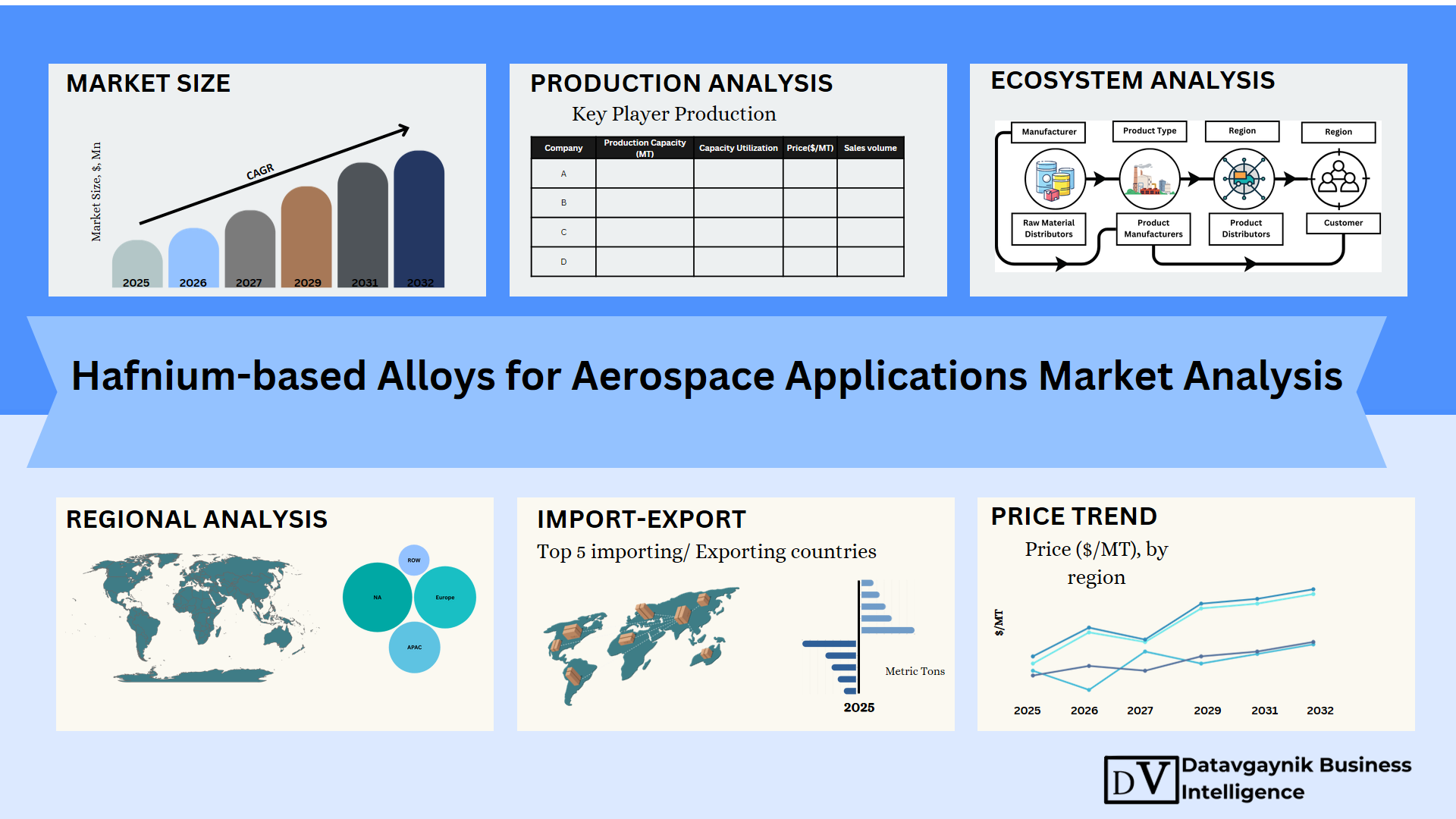
This estimate covers aerospace-grade hafnium alloy materials, master alloys, hafnium-bearing superalloys, refractory alloy formulations, coating materials and semi-fabricated products supplied for aircraft and space systems. It excludes hafnium used in nuclear control rods, semiconductor components, optical coatings and other non-aerospace applications. It also excludes the full value of finished engines or aircraft. Only the value attributable to the hafnium-based material or alloy product is counted.
Datavagyanik also covers related markets such as the Hafnium Oxide Market, the Hafnium Sulfate Market, and the Hafnium Carbonate Market. These compounds are commonly used in oxidation systems and industrial chemical processing, supporting shifts in formulation standards and regulatory compliance.
Because this is a highly specialized material category, companies rarely disclose hafnium-alloy revenue separately. The market figures are therefore modeled from aerospace material consumption, available hafnium supply, alloy-processing premiums, component demand and expected production volumes. This avoids overstating the market by assigning the total value of a turbine blade, rocket nozzle or propulsion system to a relatively small material input.
| Market indicator | Estimate |
| Global market size in 2026 | $124 million |
| Projected market size in 2035 | $238 million |
| Forecast period | 2026–2035 |
| Expected CAGR | 7.5% |
| Primary demand base | Aircraft engines, space propulsion, thermal protection and defense aerospace |
| Main material advantage | High-temperature stability, oxidation resistance and grain-boundary strengthening |
Why hafnium matters in aerospace
Hafnium is not used as a bulk structural metal in conventional aircraft. Its value comes from what a small addition can do inside a demanding alloy system.
Controlled hafnium additions can improve grain-boundary strength, oxidation resistance, creep performance and coating adhesion. These properties become important in components exposed to extreme heat, pressure and repeated thermal cycling. Typical areas include turbine hot-section components, rocket propulsion hardware, thermal-barrier coating systems, combustion equipment and selected refractory-metal assemblies.
For example, a small quantity of hafnium introduced into a nickel-based superalloy may improve the durability of a high-temperature component without materially increasing its weight. This performance-to-volume relationship is the commercial foundation of the market.
The Hafnium-based Alloys for Aerospace Applications Market will remain small compared with the broader aerospace superalloys industry. Yet it is strategically important. Hafnium is used where material failure can lead to engine shutdown, mission loss or major maintenance costs. Buyers therefore focus more on purity, consistency and qualification history than on the lowest available price.
Technology and performance forces
Aircraft engine manufacturers continue to pursue higher operating temperatures because hotter engines can support better fuel efficiency and thrust performance. This places more stress on turbine blades, vanes, combustors and protective coatings. Hafnium-bearing alloy systems can support selected applications where conventional nickel, cobalt or refractory alloys require additional high-temperature stability.
Space propulsion is another important demand area. Reusable launch vehicles face repeated ignition, heating and cooling cycles. Upper-stage engines and advanced propulsion systems also require materials that remain stable under severe thermal and chemical exposure. Hafnium additions are being assessed alongside rhenium, tantalum, niobium, zirconium and advanced ceramic systems.
The material will not replace mainstream aerospace alloys. Its role is narrower. It will be introduced where the performance improvement justifies the cost and supply risk.
Production and supply conditions
Hafnium is mainly recovered during the separation of hafnium from zirconium. Its production is therefore linked to zirconium-processing economics rather than aerospace demand alone. New hafnium supply cannot be expanded as quickly as demand for a conventional industrial metal.
Production also requires complex separation and purification. Aerospace-grade material must meet tighter requirements for chemistry, trace elements and batch consistency. The number of suppliers capable of producing qualified material is consequently limited.
This creates three commercial effects:
- Long-term supply agreements become more important.
- Aerospace-grade material commands a premium over standard industrial grades.
- Recycling and recovery from production scrap become economically attractive.
Supply concentration may also increase inventory requirements. Engine manufacturers and alloy producers cannot assume that spot-market material will always meet aerospace specifications. So, procurement teams may hold larger safety stocks or qualify more than one processing route.
Regulatory and qualification environment
There is no single regulation that directly determines hafnium-alloy demand. The main barrier is aerospace qualification.
Materials used in engines, launch vehicles and defense systems must pass extensive testing for mechanical performance, fatigue, oxidation, thermal cycling and manufacturing consistency. A new alloy composition may take several years to move from laboratory testing to commercial production.
Export controls and national-security rules can also affect cross-border trade in advanced aerospace materials. This is particularly relevant when hafnium-bearing products are developed for military propulsion, missiles, hypersonic systems or strategic spacecraft.
Environmental rules covering chemical processing, emissions and industrial waste may raise the cost of hafnium separation and alloy production. They are unlikely to stop demand, but they may reinforce the advantage held by established suppliers with compliant refining and quality-control infrastructure.
Key consumers and client groups
The main customers are not commercial airlines. Demand originates further upstream among engine manufacturers, space propulsion companies, defense contractors, specialty alloy producers and aerospace component suppliers.
Representative downstream organizations relevant to this market include:
| Consumer group | Representative organizations | Likely requirement |
| Aircraft engine manufacturers | GE Aerospace, Pratt & Whitney, Rolls-Royce, Safran Aircraft Engines | High-temperature superalloys, coatings and hot-section components |
| Space launch and propulsion companies | SpaceX, Blue Origin, L3Harris Technologies, Northrop Grumman | Rocket engines, nozzles, combustion systems and thermal protection |
| Aerospace and defense primes | Boeing, Airbus, Lockheed Martin, RTX, BAE Systems | Qualified materials for aircraft, missiles and space platforms |
| Specialty alloy and component manufacturers | Producers of master alloys, turbine components and refractory-metal products | Controlled alloy additions and aerospace-grade semi-finished products |
| Government and research organizations | Space agencies, defense laboratories and aerospace research institutes | Experimental propulsion and high-temperature material programs |
These organizations should be viewed as representative demand participants. Public disclosures rarely confirm the exact hafnium content used in individual platforms or procurement contracts.
Commercial outlook through 2035
Growth during 2026–2035 will be led by higher aircraft engine production, replacement demand for hot-section components, reusable launch systems and increased spending on defense propulsion. Hypersonic research may create additional opportunities, although commercial volumes will remain uncertain until more programs move into serial production.
The strongest revenue growth is likely to come from higher-value processed products rather than primary hafnium metal alone. Master alloys, customized compositions, coating feedstocks and qualification-ready material forms carry greater margins. They also create closer relationships between suppliers and aerospace customers.
That said, cost will limit broad adoption. Hafnium will continue to compete with alternative alloying elements, ceramic coatings and redesigned cooling systems. It will be selected only where testing demonstrates a measurable improvement in service life, heat resistance or reliability.
The long-term opportunity is not based on using large quantities of hafnium. It is based on using carefully controlled quantities in components where material performance carries an unusually high economic value.
By 2035, the Hafnium-based Alloys for Aerospace Applications Market should be more integrated with advanced propulsion and reusable aerospace platforms. Supply security, material traceability and qualification capability will matter almost as much as alloy performance. Companies that combine reliable hafnium access with aerospace-grade processing and application engineering will be best placed to capture this demand.
Competitive Intelligence and Benchmarking
Competition in the Hafnium-based Alloys for Aerospace Applications Market is spread across three layers: hafnium separation, alloy and powder production, and finished-component manufacturing. No single company controls the full chain. That matters because aerospace buyers need more than metal availability. They need controlled chemistry, repeatable processing, traceability and qualification support.
Framatome
Framatome holds a strong upstream position through its Jarrie facility in France. The site separates hafnium as part of its nuclear-grade zirconium production chain. It supplies hafnium metals, oxides and alloy-related materials for aerospace, space, defense and other high-temperature applications.
Its main advantage is direct access to separated hafnium. This is difficult to replicate because hafnium production depends on complex zirconium-hafnium separation infrastructure. The company also benefits from established quality systems and European supply-chain proximity.
Market position: A strategically important upstream supplier rather than a dedicated producer of finished aerospace components. Its position becomes more valuable when buyers prioritize non-Chinese material sources and long-term supply security.
ATI Inc.
ATI Inc. is one of the more established commercial suppliers of niobium-hafnium C103 material. Its portfolio includes plate and spherical powder containing approximately 9%–11% hafnium, alongside niobium and titanium.
The company serves propulsion systems requiring sustained strength at high operating temperatures. It has an advantage in conventional mill products as well as powder formats for additive manufacturing. This allows ATI to support both legacy component production and newer near-net-shape manufacturing routes.
Market position: A leading qualified alloy supplier with strong credibility in U.S. aerospace and defense programs. Its broad specialty-metals infrastructure gives it an advantage in metallurgy, certification and scaled production.
Elmet Technologies
Elmet Technologies supplies refractory-metal powders, mill products and fabricated components. Its hafnium-related portfolio includes C103 niobium-hafnium-titanium alloy and molybdenum-hafnium-carbide materials.
The company supports bar, rod, sheet, plate, powder and specialized processing requirements. It also has capabilities across powder metallurgy, vacuum processing, extrusion, rolling and additive manufacturing. This breadth is useful for customers that need development support before entering serial production.
Recent work on laser powder bed fusion has examined how hot isostatic pressing, coatings and heat treatment affect C103 mechanical properties. That research improves Elmet’s position in qualification-driven space propulsion applications.
Market position: A vertically integrated U.S. refractory-material specialist with a strong position in low-volume and technically demanding aerospace programs.
6K Additive
6K Additive is positioned around spherical C103 powder and circular material production. Its processing technology can convert revert material, machining scrap and end-of-life components into aerospace-grade powder.
The company is participating in federally supported programs designed to expand the usable particle-size range of C103 feedstock. The objective is straightforward: use a larger portion of every powder batch, improve deposition productivity and reduce material cost.
Its competitive advantage is not conventional ingot metallurgy. It is the ability to turn expensive refractory-metal scrap into controlled additive-manufacturing powder.
Market position: An emerging powder supplier with strong exposure to U.S. defense, hypersonic and space-manufacturing programs. It could become an important cost-reduction player as additive manufacturing moves from prototypes to qualified production.
ADDMAN–Castheon
ADDMAN, through its Castheon operation, competes at the component and process-engineering level. It produces complex C103 parts using laser powder bed fusion for thrusters, rocket nozzles, thermal protection systems and hypersonic applications.
The company has developed proprietary approaches intended to improve C103 strength, creep performance and high-temperature stability. Its position is supported by participation in U.S. manufacturing programs and by production-transition partnerships involving aerospace and defense contractors.
Unlike an upstream metal supplier, ADDMAN sells engineering capability and finished-component performance. This places it closer to engine developers and spacecraft manufacturers.
Market position: A specialist in additive manufacturing of niobium-hafnium components. It is particularly well placed in applications where conventional machining creates excessive material waste or cannot produce internal channels and thin-wall structures.
Competitive Benchmark
| Company | Primary market role | Key strength | Main limitation |
| Framatome | Hafnium separation and upstream supply | Direct access to separated hafnium | Limited presence in finished aerospace components |
| ATI Inc. | C103 plate and powder | Established aerospace metallurgy and qualification | Exposure to low-volume specialty demand |
| Elmet Technologies | Powders, mill products and fabricated refractory materials | Broad processing and manufacturing capabilities | Complex qualification requirements by application |
| 6K Additive | Recycled and spherical AM powders | Material recovery and improved powder economics | Dependent on broader AM production adoption |
| ADDMAN–Castheon | Additively manufactured C103 components | Complex geometries and application engineering | Smaller scale than traditional metal producers |
Expert view: The leading supplier won’t necessarily be the company with the largest hafnium output. The stronger position will belong to companies that connect secure raw-material access with qualified powder, coating and component-processing capabilities.
Regional Landscape and Adoption Outlook
The Hafnium-based Alloys for Aerospace Applications Market is led by regions with established propulsion programs, refractory-metal processing and long-duration material qualification infrastructure. Space-launch frequency alone does not determine demand. Local material availability, engine manufacturing and defense procurement also matter.
| Region | Adoption level | Main demand source | Funding and infrastructure position | Outlook through 2035 |
| United States | High | Space propulsion, defense and hypersonics | Strongest integrated ecosystem | Market leader |
| Europe | High | Aircraft engines, launch vehicles and defense | Strong aerospace base and domestic French hafnium supply | Stable strategic growth |
| China | Medium to high | Space launch, missiles and aircraft engines | Large state-backed industrial system | High-growth but less transparent |
| India | Emerging | Launch vehicles and propulsion research | Expanding public-space and materials R&D | High percentage growth from a small base |
| Japan | Medium | Launch vehicles and advanced aircraft systems | Strong engineering base but import-dependent materials chain | Moderate growth |
| South Korea | Emerging | Launch systems, missiles and aerospace localization | Rapidly increasing government funding | High-growth opportunity |
| Middle East | Early stage | Space missions and defense procurement | Strong project funding but limited metallurgy infrastructure | Import-led demand |
United States
The United States represents the largest commercial and development market. It combines upstream hafnium availability, C103 alloy production, additive powder manufacturing, component printing, engine development and government qualification laboratories.
NASA continues to evaluate C103 and alternative niobium alloys for high-temperature propulsion. The Air Force Research Laboratory, America Makes and defense contractors are also supporting powder qualification and cost-reduction programs.
Hafnium’s inclusion in the U.S. 2025 critical-minerals list reinforces its strategic status. This may improve access to supply-chain grants, domestic processing support and defense procurement preference.
The United States should maintain its lead through 2035. Growth will come from reusable propulsion, hypersonic thermal systems and additively manufactured thrusters. Export controls may limit the movement of certain alloy powders, technical data and finished defense components.
Europe
Europe has one of the strongest aerospace manufacturing bases and an important upstream advantage: France is a recognized producer of hafnium separated from zirconium processing.
Framatome, Airbus, Safran, Rolls-Royce, ArianeGroup and their supplier networks create a credible demand ecosystem. France is the regional leader because it combines material production, aircraft-engine manufacturing, launch systems and defense applications.
The EU Critical Raw Materials framework recognizes the economic importance and supply vulnerability of materials such as hafnium. The policy direction supports domestic processing, recycling and diversified sourcing.
Europe’s growth is likely to be measured rather than aggressive. Qualification cycles are lengthy. Still, local hafnium access gives the region a strategic position that most other markets lack.
China
China is a significant zirconium and hafnium-producing country. It also has a rapidly expanding space and defense ecosystem. The country completed 92 space launches in 2025, including 50 commercial launches, indicating rising demand for propulsion hardware and high-temperature materials.
Demand should be led by launch vehicles, missile propulsion, reusable spacecraft research and advanced aircraft-engine programs. Local material production reduces some import dependence.
That said, public information on aerospace-grade hafnium output, qualified alloy volumes and platform-level consumption remains limited. China may become one of the largest volume markets by 2035, but precise supplier shares will remain difficult to verify.
India
India remains an emerging market. ISRO has identified C103 as a structural refractory alloy for high-temperature aerospace propulsion. Its research programs also cover additive manufacturing, engine-component optimization and advanced alloy development.
The country has strong public-sector capabilities in space propulsion and nuclear materials. However, commercial production of qualified hafnium-bearing aerospace alloys remains limited.
Growth will be linked to launch-frequency expansion, reusable launch research, semi-cryogenic propulsion and domestic defense programs. India could record one of the highest percentage growth rates through 2035, although its absolute market size will remain below the United States, Europe and China.
Japan
Japan has advanced materials engineering, precision manufacturing and a mature aerospace supplier base. The H3 launch vehicle is now Japan’s main launch platform. Government policy is also using the Space Strategy Fund to expand private-sector participation.
Mitsubishi Heavy Industries, IHI, JAXA and specialist materials companies form the main demand ecosystem. Adoption opportunities exist in propulsion components, high-temperature coatings and space-transport systems.
Japan’s weakness is limited domestic hafnium separation. The country is more likely to import primary material and add value through precision processing, coatings and component manufacturing.
South Korea
South Korea is moving from an aerospace buyer toward a domestic developer. The Korea AeroSpace Administration proposed a 2025 budget of KRW 964.9 billion, up 27% from the previous year. Its finalized 2026 budget reached KRW 1.1201 trillion.
Funding is being directed toward launch vehicles, satellites, aeronautics and private-sector participation. The country also plans investment in specialized space clusters, including launch-vehicle infrastructure in Jeonnam.
Near-term hafnium-alloy demand will remain small. South Korea lacks a large upstream hafnium industry. Still, its strong metal-processing, defense and manufacturing capabilities could support localized component production over the forecast period.
Middle East
The Middle East is relevant mainly as a downstream and investment market. The UAE and Saudi Arabia are developing space programs, defense-manufacturing capabilities and aerospace partnerships.
The UAE’s National Space Fund is valued at AED 3 billion and supports space engineering, research and private-sector projects. However, the region has little commercial infrastructure for hafnium separation or C103 production.
Demand will therefore be import-led. Opportunities are more likely to arise in component procurement, maintenance, joint ventures and research partnerships than in primary alloy manufacturing.
Expert view: Asia will produce the fastest demand growth. Yet North America and Europe should retain the highest value capture because qualification knowledge, material traceability and established propulsion relationships are difficult to reproduce quickly.
Recent Developments, Opportunities and Restraints
Recent Developments
- August 2024: 6K Additive was selected for an America Makes project funded through the Air Force Research Laboratory. The program focuses on improving C103 powder affordability and productivity by qualifying a wider particle-size range for laser powder bed fusion and directed-energy deposition.
- October 2024: Amaero completed qualification work involving ADDMAN’s C103 powder for aerospace applications. The development supports wider use of additively manufactured niobium-hafnium components in rocket and propulsion systems.
- December 2024: Elmet Technologies published research on laser powder bed fusion of coated C103. The study found that printed material could meet conventional strength requirements before some post-processing stages. It also showed that hot isostatic pressing and coating treatments can cause grain growth and lower strength.
- March 2025: NASA Glenn Research Center presented a technical comparison of C103 and Nb521 for high-temperature rocket propulsion. The work confirms C103’s benchmark position while also showing that alternative niobium systems are being evaluated.
- November 2025: The U.S. Department of the Interior released the final 2025 critical-minerals list, which includes hafnium and specifically identifies its aerospace relevance. This raises the probability of further domestic supply-chain and recycling support.
Opportunities and Business Insights
Additive manufacturing: C103 is expensive and difficult to machine. Near-net-shape production can reduce scrap, simplify thin-wall structures and enable internal cooling passages. This may improve the economics of thrusters and propulsion components.
Recycling and revert recovery: Hafnium-bearing machining waste has meaningful residual value. Closed-loop powder production can lower raw-material exposure and support domestic sourcing requirements.
Emerging Asian aerospace programs: India, South Korea and China are expanding launch and defense capabilities. Local qualification partnerships may create new opportunities for powder suppliers, coating specialists and testing laboratories.
Principal Restraints
Concentrated supply: Hafnium is produced mainly as a consequence of zirconium purification. Supply cannot be increased independently or rapidly.
Oxidation and coating complexity: C103 requires protective coatings in many oxygen-rich high-temperature environments. Coating, heat treatment and hot isostatic pressing can change its microstructure and mechanical performance.
Long qualification periods: Aerospace customers cannot substitute alloy sources quickly. Every new powder, process route or coating may require extensive testing.
Alternative materials: C103 competes with other refractory alloys, ceramic composites, cooled nickel superalloys and newer niobium compositions. NASA’s work on Nb521 shows that substitution remains a genuine technical risk.


