

Market Summary and Growth Forecast
The global Heat-Integrated Crude Oil Distillation Units Market is estimated at $1,420 million in 2026 and is expected to reach $2,380 million by 2035, growing at a CAGR of 5.9%.
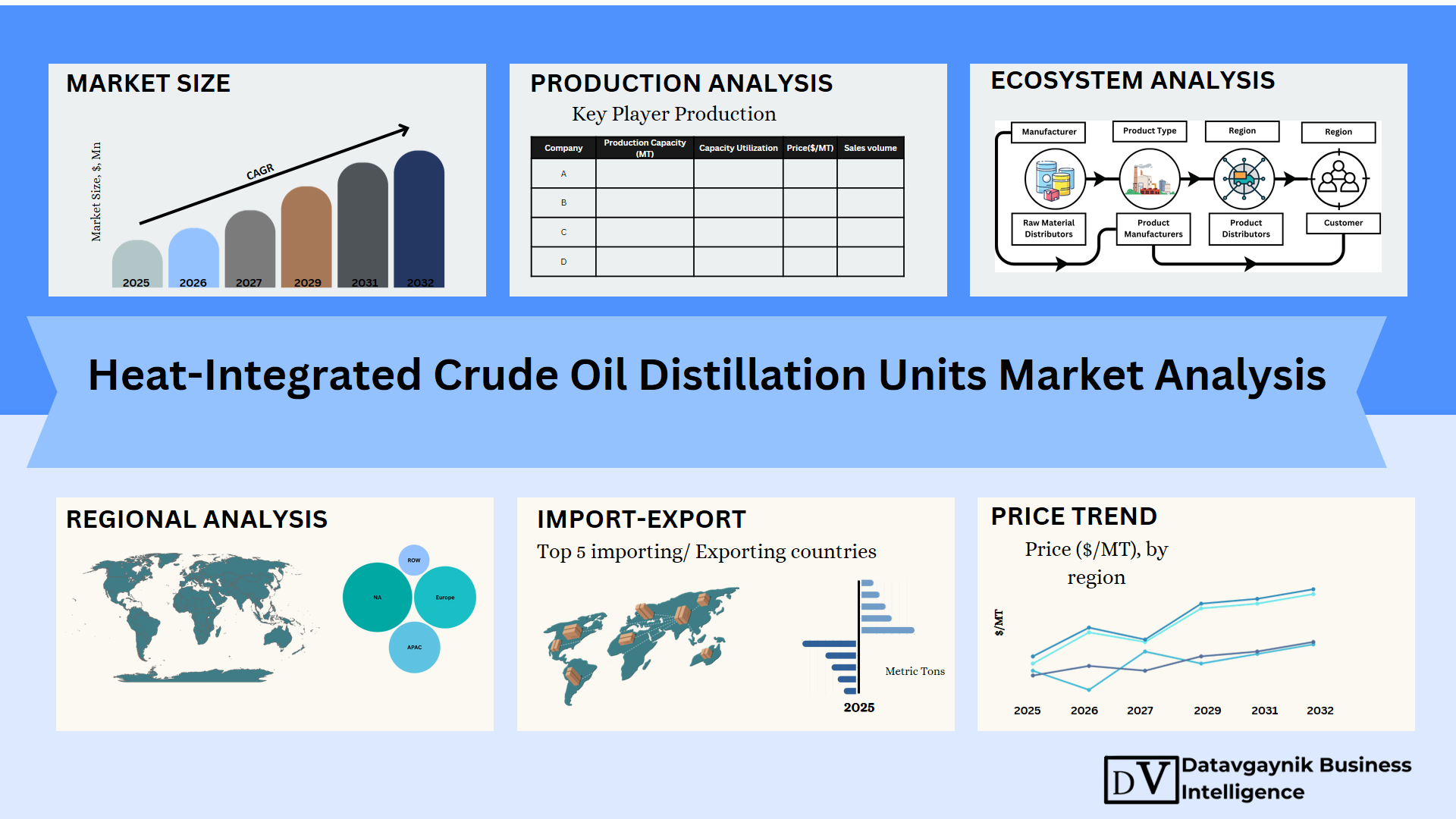
The Heat-Integrated Crude Oil Distillation Units Market covers engineering, equipment, control systems, and retrofit packages used to reduce energy loss across crude distillation operations. In practical terms, this includes crude preheat trains, heat exchanger networks, pumparound heat recovery, furnace-duty reduction systems, vapor-liquid heat recovery schemes, advanced process control, and energy-integration studies linked to atmospheric and vacuum distillation units.
Datavagyanik also covers related markets such as the Desulfurization Units for Crude Oil Market. These markets reflect the interconnectedness of industrial forces that define the growth and direction of the primary topic.
This is not a broad refinery construction market. It is a focused market tied to one of the most energy-intensive sections of a refinery: the crude unit. Every refinery runs crude through distillation before deeper conversion, so even a small gain in heat recovery can affect fuel gas consumption, carbon intensity, throughput, and operating margin. That is why heat-integrated CDU investment is moving from “nice-to-have efficiency work” to a more strategic capex and opex lever during 2026–2035.
| Metric | Estimate |
| Global market size, 2026 | $1,420 million |
| Projected market size, 2035 | $2,380 million |
| CAGR, 2026–2035 | 5.9% |
| Primary revenue boundary | Heat exchanger networks, process integration engineering, fired-heater optimization, APC/digital optimization, CDU revamp packages |
| Main buying trigger | Lower refinery energy cost and reduced emissions per barrel processed |
The strongest business case sits in older refineries. Many of these assets were designed around earlier crude slates, different energy costs, and less aggressive emissions expectations. Now refiners are running heavier, sourer, and more variable crude blends while also trying to reduce fuel consumption. That makes the preheat train and furnace system a serious margin point. A fouled or poorly integrated heat network can push more duty to the fired heater. That means higher fuel use, higher CO₂ emissions, and tighter capacity limits.
Three macro forces are shaping the market.
First, refinery energy efficiency is becoming a board-level topic. Fired heaters in crude units consume large volumes of fuel gas. Heat integration helps shift recoverable heat back into the process, cutting the need for external firing. This is especially important in regions where carbon pricing, fuel cost, or energy-security pressure is rising.
Second, refinery operators are prioritizing brownfield upgrades over large greenfield additions. New refinery builds still matter in Asia and the Middle East, but the bigger near-term volume sits in revamps. A refinery can often improve crude-unit efficiency without replacing the entire CDU. That makes retrofit heat exchanger trains, pinch-based integration studies, and APC packages attractive.
Third, digital refinery tools are improving the economics of heat integration. Traditional heat recovery design was mostly static. Now operators can track fouling, crude switching impact, exchanger duty, furnace constraints, and temperature approach in near real time. This allows the Heat-Integrated Crude Oil Distillation Units Market to capture not only one-time equipment spending but also recurring optimization and monitoring work.
Key consumers and clients include national oil companies, integrated oil majors, independent refiners, refinery EPC contractors, and process licensors. Typical buyers include refinery groups such as Saudi Aramco, ADNOC, Sinopec, PetroChina, Indian Oil Corporation, Reliance Industries, ExxonMobil, Shell, BP, Valero, Marathon Petroleum, and Petrobras. EPC and technology-facing clients include Technip Energies, Honeywell UOP, KBR, Wood, Fluor, Worley, Larsen & Toubro, Alfa Laval, Kelvion, SPX Flow, Emerson, Yokogawa, and AspenTech.
Expert view: The market will not grow because refiners are building more crude units everywhere. It will grow because existing units need to run cleaner, cheaper, and more flexibly. That is a more durable demand base than pure greenfield capex.
Market Segmentation and Forecast Scope
The Heat-Integrated Crude Oil Distillation Units Market is best segmented by project type, solution area, application, end user, and region. This structure reflects how buying decisions are made in real refinery projects. A refinery rarely says, “we need a heat-integrated CDU product.” It usually starts with a problem: high furnace duty, exchanger fouling, crude flexibility constraints, energy loss, or emissions pressure. The solution then becomes a mix of engineering, hardware, process control, and operating changes.
By Project Type
The market includes new-build heat-integrated CDU systems, brownfield retrofit and revamp packages, heat exchanger network upgrades, and digital/process optimization projects.
Brownfield retrofit and revamp packages accounted for an estimated 58% of global revenue in 2026. This is the largest visible segment because many refineries already have atmospheric and vacuum distillation units in place. They do not need a full new CDU. They need better heat recovery, lower fired-heater duty, exchanger replacement, fouling control, and sometimes a revised crude preheat arrangement.
New-build systems are more selective. They are linked to new refining capacity, refinery-petrochemical integration, or major crude-unit replacement. These projects are bigger in ticket size but fewer in number. Digital and APC-led optimization is smaller today but strategically important because it can be layered onto both existing and new assets.
By Solution Area
The main solution areas include crude preheat train optimization, heat exchanger network design, fired-heater duty reduction, pumparound and side-stream heat recovery, fouling management, advanced process control, and process integration engineering.
Heat exchanger network design remains the technical core of the market. It decides how effectively process heat is recovered before crude enters the furnace. Fired-heater optimization is also important because fuel reduction is usually the most visible financial benefit. APC and digital tools are gaining attention because they help maintain benefits after the revamp is complete. That matters because heat-integration benefits can fade if fouling, crude variability, or poor operating discipline is not controlled.
By Application
Key applications include energy-efficiency improvement, CO₂-intensity reduction, throughput debottlenecking, crude slate flexibility, fouling and reliability management, and refinery margin optimization.
Energy-efficiency improvement is the most common business case. It is easier to approve because refinery teams can calculate fuel savings and payback. CO₂-intensity reduction is becoming more important in Europe, North America, and parts of Asia. Throughput debottlenecking is more selective but high value. In some units, better heat recovery can reduce furnace load and free up capacity without a major CDU expansion.
Example: A refinery processing heavier crude may face higher furnace duty and exchanger fouling. A heat-integration revamp can reduce energy loss while also improving operating stability. That gives both energy and reliability benefits, not just a lower fuel bill.
By End User
End users include national oil company refineries, integrated oil-major refineries, independent refining companies, refinery-petrochemical complexes, and EPC/process-licensor-led projects.
National oil companies are important because they operate large refinery systems and often pursue energy-efficiency programs across multiple sites. Independent refiners are more selective. They tend to invest when payback is clear and downtime can be tightly managed. Refinery-petrochemical complexes are among the most strategic buyers because heat integration can be linked across fuel and petrochemical streams.
By Region
The regional scope includes North America, Europe, Asia Pacific, and LAMEA.
Asia Pacific represented an estimated 41% of global spending in 2026. The region has the strongest mix of refining capacity additions, large existing refinery bases, and crude slate diversification. China, India, South Korea, and Southeast Asia are important demand centers.
North America is mostly a retrofit and optimization market. Europe is driven by emissions, energy cost, and asset rationalization. LAMEA has two different demand pools: high-capacity Middle Eastern refinery projects and energy-efficiency upgrades in Latin American assets.
| Segmentation Dimension | Key Sub-Segments | Visible 2026 Share View | Strategic Growth Signal |
| Project Type | New-build, retrofit/revamp, exchanger network upgrades, digital optimization | Retrofit/revamp: 58% | Retrofit remains the largest spend pool |
| Solution Area | Preheat trains, exchanger networks, fired-heater optimization, APC, fouling control | Share retained for client report | APC and fouling analytics grow faster |
| Application | Energy saving, emissions reduction, debottlenecking, crude flexibility | Share retained for client report | CO₂-intensity reduction gains priority |
| End User | NOCs, oil majors, independent refiners, refinery-petrochemical complexes | Share retained for client report | Integrated complexes are most strategic |
| Region | North America, Europe, Asia Pacific, LAMEA | Asia Pacific: 41% | Asia Pacific and Middle East lead expansion |
The fastest-growing sub-segment is expected to be digital optimization and APC-enabled heat integration. The reason is simple. Hardware revamps improve the asset. Digital systems protect the gain. Refiners increasingly want both.
Market Trends and Innovation Landscape
The Heat-Integrated Crude Oil Distillation Units Market is moving toward smarter, cleaner, and more flexible distillation operations. The market is not being reshaped by one breakthrough technology. It is being shaped by many smaller improvements that work together: better exchanger design, tighter process simulation, advanced fouling prediction, improved fired-heater control, and more practical energy-integration engineering.
R&D Evolution
Earlier R&D in this area focused heavily on pinch analysis and static heat exchanger network design. That remains important. But refiners now want models that reflect real operating behavior. Crude quality changes. Exchangers foul. Desalter performance shifts. Furnace efficiency moves with operating conditions. So, R&D is shifting toward dynamic heat-integration models that can adjust to real refinery constraints.
The focus is also moving from one-time revamp studies to lifecycle energy management. That is a meaningful shift. A refinery may complete a heat-integration project and get strong savings in the first year. But without monitoring, fouling and operating drift can erode benefits. Newer project scopes increasingly include performance tracking, exchanger cleaning optimization, and operational dashboards.
Expert view: The next phase of value will come from sustaining heat recovery, not just designing it. Many refiners already know where energy is lost. The harder question is how to keep the savings alive after crude slates and operating conditions change.
Technology Evolution
The main technology changes are happening in four areas.
First, exchanger network design is becoming more selective. Refiners are not simply adding more heat-transfer surface. They are looking at pressure drop, fouling risk, plot space, shutdown windows, and crude compatibility. This favors high-efficiency exchangers where suitable, but conventional shell-and-tube systems still dominate in severe crude service.
Second, fired-heater optimization is becoming more integrated with CDU heat recovery. A well-designed preheat train can lower furnace duty, but the furnace still needs tight control. Operators are linking burner efficiency, excess oxygen control, coil outlet temperature, and feed preheat temperature into a more coordinated operating strategy.
Third, fouling management is becoming a core buying criterion. Crude preheat exchangers are exposed to asphaltenes, salts, corrosion products, and unstable blends. Better fouling prediction can improve cleaning schedules and reduce unplanned energy loss. This is especially valuable for refineries processing opportunity crudes.
Fourth, refinery digital twins and APC platforms are becoming part of the package. Vendors such as Honeywell, Emerson, Yokogawa, AspenTech, AVEVA, and Siemens support process control, simulation, asset performance, and optimization layers that can be applied to crude units. These tools help operators compare actual heat recovery against expected duty and identify where performance is slipping.
Material Science and Equipment Design
Material science is relevant, but it is not the central growth engine of the Heat-Integrated Crude Oil Distillation Units Market. The more important issue is applying the right metallurgy and exchanger design to the crude service.
Refineries handling sour, acidic, or unstable crudes may require corrosion-resistant alloys, upgraded tube materials, improved gaskets, better weld integrity, and anti-fouling design features. Enhanced surface exchangers and compact heat-transfer systems can help in selected areas, but refiners remain cautious. Reliability usually beats theoretical efficiency in CDU service.
That said, materials and coatings will still matter. They can extend exchanger life, reduce cleaning frequency, and support higher heat-recovery performance under difficult crude conditions. The commercial value is highest when material upgrades reduce downtime or protect the energy savings achieved by the revamp.
AI Integration and Digital Optimization
AI is relevant in this market where it supports specific refinery decisions. It is not a standalone replacement for process engineering. The most practical AI use cases include exchanger fouling prediction, crude slate impact modeling, cleaning schedule optimization, anomaly detection, and furnace-performance monitoring.
In the coming years, AI-assisted heat-integration tools will likely sit on top of process historians, APC systems, and simulation software. They will help refinery engineers see when heat recovery is below target, which exchanger is causing the loss, and whether cleaning or operating adjustment is the better option.
Expert view: AI will not design the crude unit by itself. The real value is in narrowing the operating gap between design intent and day-to-day refinery reality.
Mergers, Partnerships, and Market Activity
Recent market activity around this space has been less about CDU-specific mergers and more about partnerships across refinery engineering, automation, and digital optimization. EPC firms are working more closely with simulation software providers. Process licensors are adding energy-efficiency modules into broader refinery revamp studies. Automation vendors are positioning APC and asset-performance platforms as tools for emissions and energy management.
Equipment companies such as Alfa Laval, Kelvion, Danfoss, SPX Flow, and API Heat Transfer continue to benefit from exchanger replacement and upgrade demand. Engineering and integration-led players such as Technip Energies, KBR, Wood, Worley, Fluor, and Larsen & Toubro remain important because most heat-integration projects require site-specific engineering rather than off-the-shelf supply.
The Heat-Integrated Crude Oil Distillation Units Market will likely see more commercial partnerships between heat-transfer equipment suppliers, process licensors, and digital refinery software companies. The reason is practical. Refiners want accountable savings. They do not want disconnected studies, separate equipment packages, and isolated software tools. They want integrated outcomes.
So, the innovation path is clear. The market is shifting from hardware-led heat recovery to performance-led crude-unit optimization. That makes the Heat-Integrated Crude Oil Distillation Units Market more relevant to energy transition planning, even though it remains deeply tied to conventional refining operations.
Competitive Intelligence and Benchmarking
Competition in the Heat-Integrated Crude Oil Distillation Units Market is not organized like a standard equipment market. No single company owns the full value chain. A refinery heat-integration project usually combines process licensor expertise, EPC design, exchanger supply, control systems, simulation software, and site execution. So, the competitive landscape is best viewed as an ecosystem of engineering-led and technology-led players.
| Company | Core Portfolio in This Market | Market Position | Benchmark View |
| Technip Energies | Refinery process design, energy-efficiency studies, plant performance improvement, revamp engineering, digital performance support | Strong in front-end engineering, complex refinery revamps, and energy-efficiency-led studies | Premium integration player for large refinery owners and NOCs |
| Honeywell UOP | Refinery process technology, automation-linked optimization, process licensing, performance services, unit-level optimization | Strong refinery technology brand with deep relationships across large refiners | Best positioned when CDU work is tied to wider refinery modernization |
| KBR | Refining process technologies, distillation revamps, separation efficiency improvement, column redesign, engineering services | Strong in process-intensification and refinery revamp concepts | Relevant where heat-integration is combined with separation-efficiency upgrades |
| Wood | Refinery decarbonization consulting, optimization studies, brownfield engineering, emissions roadmaps, project execution | Strong advisory-to-execution player for mature refining assets | Well placed in Europe, North America, and energy-transition-driven refinery studies |
| Alfa Laval | Compact and welded heat exchangers, crude preheat service, heat recovery systems, exchanger replacement, refinery energy-efficiency packages | Strong specialist in high-efficiency heat-transfer equipment | Strong hardware position in CDU preheat train and space-constrained revamps |
| Emerson | Distributed control, instrumentation, advanced process control, analytics, remote monitoring, asset performance software | Strong automation layer for sustaining CDU performance | Important where heat recovery depends on better control and live performance tracking |
| AspenTech | Process simulation, refinery planning, optimization models, digital twins, AI-enabled hybrid modeling | Strong software layer for engineering, planning, and operating optimization | Critical in design validation, model-based energy optimization, and crude slate planning |
Technip Energies competes as a high-end engineering and technology integrator. Its strength is not only equipment selection. It brings refinery process know-how, energy studies, revamp planning, and digital services into one project frame. That matters in the Heat-Integrated Crude Oil Distillation Units Market because most projects are site-specific. Refinery operators need the heat exchanger network to fit the existing layout, shutdown window, crude slate, and operating philosophy. Technip Energies has positioned its refining services around plant performance, energy efficiency, hydrogen and flare networks, troubleshooting, and digital services for improved margins and lower emissions.
Honeywell UOP sits close to refinery owners because of its process technology and automation ecosystem. The company is relevant where heat-integrated CDU work is part of a broader refinery improvement program. In many cases, CDU energy optimization is connected with downstream hydrotreating, reforming, fuel-quality changes, and crude-blend management. Honeywell’s advantage is its refinery domain depth and installed relationships with large operators. Its position is strongest when clients want technology assurance along with optimization.
KBR is more relevant in advanced distillation and revamp-led efficiency work. Its strength comes from process engineering and separation technologies rather than pure exchanger supply. For crude units, this matters when a refinery wants to reduce energy use by improving how separation is configured, not only by adding heat-transfer surface. KBR’s recent technical focus on distillation column revamp using dividing-wall concepts reflects the broader industry move toward lower-energy separation and lower carbon intensity.
Wood is positioned around decarbonization, optimization, and practical brownfield execution. For mature refinery markets, that combination is useful. Many refinery owners do not start with a clear equipment purchase. They start with a carbon baseline, energy gap, refinery margin issue, or asset-risk concern. Wood’s strength is in building a technically and commercially realistic pathway before the client commits to capex. Its decarbonization and optimization work is framed around balancing technical, commercial, and practical drivers.
Alfa Laval is one of the clearest equipment specialists in this market. Its crude distillation heat exchanger portfolio is directly linked to preheat train performance, heat recovery, energy efficiency, and debottlenecking. The company cites CDU preheat train references across refineries where exchanger upgrades improved capacity, uptime, or energy performance. Its competitive edge is strongest where plot space is tight, exchanger replacement is needed, and refinery owners want higher heat recovery without a full CDU rebuild.
Emerson competes through control systems, instrumentation, APC, and operational analytics. Its role is important after the heat-integration project is installed. The equipment may be well designed, but savings can fade if exchanger fouling, furnace control, and crude switching are not monitored. Emerson’s automation and software portfolio is relevant to connected operations and performance improvement across industrial assets.
AspenTech is central to the simulation and optimization layer. Heat integration depends heavily on reliable models: crude assay behavior, tower constraints, exchanger duty, pressure drop, furnace limits, and downstream product impacts. AspenTech’s process simulation platform supports refining and crude-oil-to-chemicals workflows, energy management, safety analysis, and AI-enabled modeling. This makes the company highly relevant for design screening, digital twins, and sustained CDU optimization.
Expert view: The winning suppliers will not be the ones selling isolated equipment. The stronger position will belong to companies that can prove the refinery saves fuel, protects throughput, and keeps those savings stable after start-up.
Regional Landscape and Adoption Outlook
Regional demand for heat-integrated CDU projects follows refinery age, energy cost, emissions pressure, crude slate complexity, and capacity investment. The Heat-Integrated Crude Oil Distillation Units Market is therefore split between two different buying patterns. Mature markets invest to extend asset life and cut energy intensity. Growth markets invest to build large integrated refining and petrochemical platforms with better heat recovery from day one.
United States
The United States is a brownfield-heavy market. Refiners are not adding large volumes of new atmospheric distillation capacity. Instead, they are pushing existing assets harder through reliability upgrades, turnaround projects, control improvements, and selective debottlenecking. The U.S. Energy Information Administration reported U.S. operable atmospheric crude distillation capacity of 18.2 million barrels per calendar day as of January 1, 2026, down by more than 250,000 barrels per calendar day from the prior year.
This creates a clear logic for heat integration. If capacity growth is limited, refiners need more margin from existing units. CDU preheat train cleaning, exchanger replacement, furnace optimization, and APC become practical tools. Leading demand comes from Gulf Coast and Midwest refineries, especially large sites operated by Valero, Marathon Petroleum, ExxonMobil, Phillips 66, and Chevron.
Regulation also matters. Refiners face air-emission compliance, carbon-intensity pressure from customers, and tighter internal sustainability targets. Funding is mainly private capex. Public support is more indirect through industrial decarbonization and energy-efficiency programs rather than CDU-specific grants.
Europe
Europe is a high-pressure but selective market. Fuel demand is structurally weaker than in Asia, and refinery rationalization continues. At the same time, surviving refineries need to be cleaner, more flexible, and more energy efficient. FuelsEurope reported 74 mainstream refineries operating in 2024 across the EU-27, UK, Norway, and Switzerland, with primary refining capacity of 638.2 million tonnes.
European adoption is driven by energy cost, carbon pricing, and asset survival. Refiners cannot rely on volume growth alone. They need lower fuel consumption, better yield flexibility, and stronger integration with biofuel, SAF, hydrogen, and petrochemical streams. That makes heat-integrated CDU revamps relevant in countries such as Germany, France, the Netherlands, Spain, Italy, Belgium, and the UK.
Country-level leaders include Shell, TotalEnergies, BP, Eni, Repsol, Neste, and OMV. Growth is not uniform. Some sites will close or convert. Others will receive efficiency capex because they remain strategically located, integrated, or export-capable.
China
China remains one of the most important demand pools. The market is large, but it is no longer only about adding capacity. The government has pushed consolidation, larger refinery scale, and tighter control over inefficient capacity. China’s policy direction has included refinery capacity limits, minimum scale expectations for new refineries, and audits around crude sources, capacity, and efficiency.
This supports a different kind of opportunity. Large integrated refinery-petrochemical complexes need advanced heat integration because energy cost and carbon management are becoming more visible. Older independent refineries face pressure to modernize or exit. So, China offers both new-build and retrofit demand.
Key adopters include Sinopec, PetroChina, CNOOC, Zhejiang Petroleum & Chemical, Hengli Petrochemical, and major provincial refining groups. The fastest adoption is expected at large integrated coastal complexes and upgraded inland refining hubs where crude flexibility and petrochemical yield matter.
India
India is one of the highest-growth markets for this segment. It has rising fuel demand, expanding petrochemical consumption, and a refining sector that still needs capacity and efficiency investment. India’s petroleum ministry stated that the country had 23 refineries and 258.2 MMTPA of refining capacity in its recent petroleum industry update.
For the Heat-Integrated Crude Oil Distillation Units Market, India is attractive for three reasons. First, refinery throughput demand is still growing. Second, new and expanded refining capacity increasingly comes with petrochemical integration. Third, public-sector refiners are under pressure to improve energy efficiency while also meeting cleaner fuel norms.
High-growth buyers include Indian Oil Corporation, Bharat Petroleum, Hindustan Petroleum, Reliance Industries, Nayara Energy, MRPL, and Chennai Petroleum. Large projects in Rajasthan, Gujarat, Maharashtra, Odisha, and Andhra Pradesh can generate CDU heat-integration demand through both greenfield and expansion activity.
Japan
Japan is a mature and capacity-rationalizing market. Domestic fuel demand is declining, but refinery security and efficiency remain important. Japan’s refinery operators are exposed to crude import risk and energy-security concerns. So, the adoption outlook is not about broad expansion. It is about making selected assets more resilient.
Main adopters include ENEOS, Idemitsu Kosan, Cosmo Energy, and Taiyo Oil. Heat-integrated CDU work will be selective and mostly tied to energy saving, crude flexibility, and reliability. Japan’s transition finance roadmap for the oil sector includes energy-efficiency strengthening and fuel conversion as part of refinery CO₂ reduction efforts.
Japan will not be the fastest-growing region by volume. But it can be a technically demanding market. Projects need strong payback, compact execution, and limited disruption because refinery utilization and demand conditions are sensitive.
South Korea
South Korea has one of the world’s most export-oriented refining systems. Its refineries are large, complex, and closely linked with petrochemicals. The EIA’s country brief listed South Korea’s operating crude refining capacity at about 3.3 million barrels per day based on refinery-level capacity data.
Key players include SK Energy, GS Caltex, S-Oil, HD Hyundai Oilbank, and Hanwha TotalEnergies. The opportunity is not basic CDU construction. It is high-efficiency operation, crude slate management, naphtha-linked optimization, and refinery-petrochemical integration.
That said, South Korea faces petrochemical margin pressure. This may slow discretionary capex. But it can also push refiners to invest in energy saving and operational efficiency. The best opportunities are likely to be digital optimization, exchanger performance monitoring, and targeted revamps that show fast payback.
Middle East
The Middle East is highly relevant. It combines large crude-processing assets, integrated refining-petrochemical strategy, and national energy-sector investment. Saudi Arabia, the UAE, Kuwait, Oman, and Qatar are the main demand centers.
Kuwait’s Al-Zour refinery is one of the largest recent additions. Sinopec stated in June 2024 that the Al-Zour refinery, constructed with Sinopec participation, had a refining capacity of 31.5 million tonnes per year. ADNOC also highlights crude flexibility and waste heat recovery within its refining and Ruwais project portfolio.
The Middle East adoption case is straightforward. Large-scale assets can justify higher-quality heat integration because savings multiply across very high throughput. The region also has strong state-backed funding capacity. The main restraint is project timing. These are large, complex projects and procurement decisions can be centralized and lengthy.
| Region | Adoption Outlook | Main Growth Logic |
| United States | Moderate, brownfield-led | Energy savings, reliability, capacity protection |
| Europe | Selective but technically strong | Carbon cost, refinery survival, energy price pressure |
| China | High | Large integrated complexes and refinery consolidation |
| India | High | Capacity expansion, cleaner fuels, public-sector refinery modernization |
| Japan | Selective | Asset resilience, energy security, compact upgrades |
| South Korea | Moderate to high | Export refinery efficiency and petrochemical integration |
| Middle East | High | Large-scale integrated refining and state-backed capex |
Expert view: Asia and the Middle East will drive new project value. The United States and Europe will drive smarter retrofit value. Both pools matter, but the sales cycle and decision logic are very different.
Recent Developments + Opportunities & Restraints
Recent Developments
| Year / Month | Event | Relevance to the Heat-Integrated Crude Oil Distillation Units Market |
| April 2026 | India’s Cabinet approved the revised cost and equity investment for the HPCL Rajasthan Refinery Limited project. The project is a 9 MMTPA greenfield refinery-cum-petrochemical complex with 2.4 MMTPA petrochemical production capacity. | Supports new CDU-linked heat-integration demand in India. Large integrated refineries usually require advanced preheat trains, energy-efficient fired-heater design, and heat recovery from the start. |
| June 2026 | The U.S. EIA reported that U.S. operable atmospheric distillation capacity stood at 18.2 million barrels per calendar day as of January 1, 2026, down by over 250,000 barrels per calendar day from January 1, 2025. | Reinforces the brownfield opportunity. When capacity declines or remains flat, refiners focus more on extracting efficiency from existing crude units. |
| March 2026 | KBR published technical work on distillation column revamp using dividing-wall column concepts for energy efficiency and lower carbon footprint in refining and petrochemicals. | Shows that refinery energy optimization is moving beyond exchanger-only upgrades. Separation efficiency and heat integration are becoming more connected. |
| June 2024 | Sinopec announced that Kuwait’s Al-Zour Refinery, constructed with Sinopec participation, was put into operation with 31.5 million tonnes per year refining capacity. | Adds a large Middle East refining asset where high-throughput CDU systems, heat recovery, and energy-efficient operation are commercially important. |
| April 2025 | Technip Energies released its refining solutions portfolio emphasizing energy efficiency, feedstock and product flexibility, emissions reduction, and full project delivery. | Confirms that major engineering firms are positioning refinery efficiency and flexibility as core commercial themes, not peripheral services. |
Opportunities and Business Insights
Opportunity 1: Brownfield refinery efficiency upgrades
The largest near-term opportunity is in existing refineries. Many crude units are old, but still strategically important. Operators can justify capex when the project reduces furnace fuel, improves exchanger duty, lowers CO₂ intensity, or unlocks throughput. Payback-led projects will be easier to approve than broad transformation programs.
Opportunity 2: Digital monitoring and fouling analytics
Heat integration fails commercially when performance degrades after start-up. Fouling, crude switching, and exchanger imbalance can quietly remove savings. This creates a strong opportunity for digital monitoring, exchanger-performance analytics, APC tuning, and remote advisory services. It also creates recurring revenue potential for automation and software vendors.
Opportunity 3: Asia and Middle East integrated refinery-petrochemical complexes
India, China, South Korea, Saudi Arabia, the UAE, and Kuwait will remain central to adoption. These regions have either high refining scale, petrochemical integration, or active modernization programs. Heat-integrated CDU systems are especially valuable where crude units feed naphtha, aromatics, olefins, and high-value downstream chains.
Restraints
Restraint 1: Shutdown dependency
Many heat-integration projects require access to exchangers, piping, furnaces, and control systems during turnarounds. Refiners are cautious because downtime is expensive. Even a technically strong project can be delayed if it does not fit the turnaround window.
Restraint 2: Site-specific engineering complexity
There is no universal heat-integrated CDU package. Crude assays, exchanger layout, plot space, metallurgy, fouling behavior, pressure drop, and column constraints differ by site. This increases engineering time and limits standardization.
Restraint 3: Uncertain refinery investment outlook in mature markets
Europe, Japan, and parts of North America face long-term fuel demand uncertainty. Some refiners may prefer minimal maintenance capex instead of major efficiency upgrades unless payback is clear. This creates a split market: strategic assets receive investment, weaker assets do not.


